Key Statistics
Key Takeaways
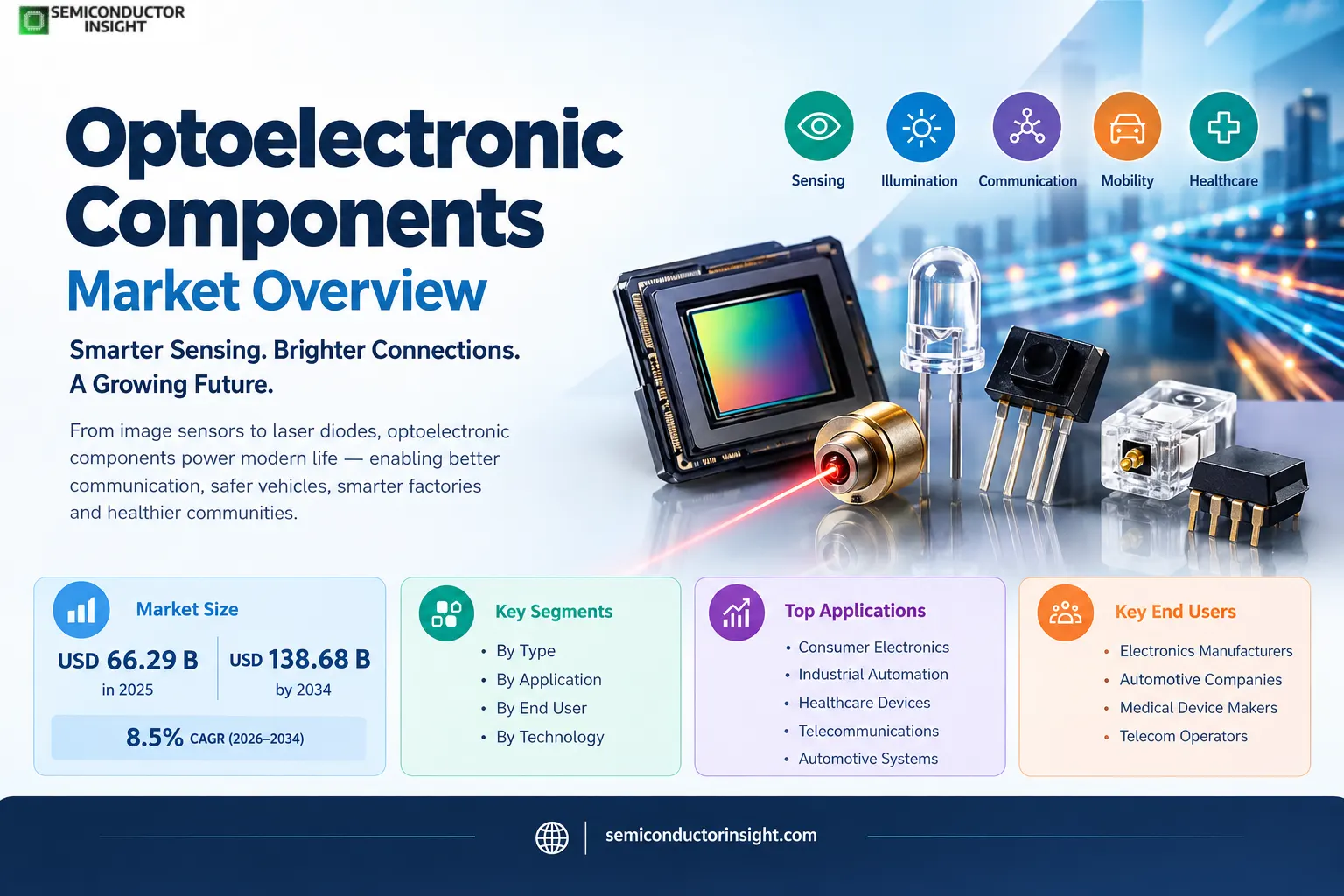
- The market is valued at USD 66.29 billion in 2025 and is projected to reach USD 138.68 billion by 2034, representing a 8.5% CAGR over 2026–2034.
- Image Sensors is a major product segment, while adjacent variants are expanding as performance, integration and cost requirements evolve.
- Consumer Electronics is a leading application area, supported by demand across Industrial Automation, Healthcare Devices.
- Asia Pacific is the largest market in 2025 based on current demand, technology concentration and ecosystem maturity.
Optoelectronic Components Market Overview
Optoelectronic Components convert electrical energy into light, detect optical signals or control light inside electronic systems. The category spans image sensors, LEDs, laser diodes, photodetectors, optocouplers and related optical sensors used across smartphones, vehicles, data centers, factories, medical equipment and communications infrastructure. Commercial adoption of Optoelectronic Components products therefore depends on system-level productivity, integration requirements, reliability expectations and the economics of replacing established alternatives in real operating environments.
The market is expanding because electronic systems increasingly rely on optical interfaces for sensing, communication, illumination and human-machine interaction. Growth is distributed across several technology families rather than one product, making manufacturing scale, wavelength performance, packaging and application-specific reliability central competitive factors. Suppliers that translate technical improvements into measurable gains in efficiency, uptime, cost, throughput or workflow simplicity are better positioned to win long-duration programs and repeat purchases.
Segment Analysis: By Type
Image sensors represent the largest high-value segment because mobile, automotive and industrial systems need increasingly capable optical capture, while LEDs remain the broadest volume component. Laser diodes are growing strongly in communications, sensing, medical and industrial applications. Within this segment, customers increasingly compare lifecycle support, qualification requirements, integration effort and total ownership cost rather than relying on a single specification or upfront price.
| Segment | Market Relevance |
|---|---|
| Image Sensors | Largest high-value sensing category. |
| Laser Diodes | High-growth communication and precision-light source. |
| Optical Sensors | Broad industrial and consumer sensing. |
| LED Components | Largest lighting and indication volume. |
Segment Analysis: By Application
Consumer electronics lead through smartphones, displays and wearables, while industrial automation and automotive systems are among the fastest-growth applications. Telecommunications adds sustained demand for lasers, photodetectors and optical modules as network bandwidth rises. Within this segment, customers increasingly compare lifecycle support, qualification requirements, integration effort and total ownership cost rather than relying on a single specification or upfront price.
| Segment | Market Relevance |
|---|---|
| Consumer Electronics | Smartphones, displays, wearables and appliances. |
| Industrial Automation | Machine vision, sensing and automation. |
| Healthcare Devices | Imaging, therapy and diagnostics. |
| Telecommunications | Fiber networks and data centers. |
| Automotive Systems | ADAS, LiDAR and intelligent lighting. |
Segment Analysis: By End User
Electronics manufacturers account for the largest component volumes, automotive companies are increasing optoelectronic content per vehicle, medical-device makers use precision emitters and detectors, and telecom operators indirectly drive demand through optical-network equipment. Within this segment, customers increasingly compare lifecycle support, qualification requirements, integration effort and total ownership cost rather than relying on a single specification or upfront price.
| Segment | Market Relevance |
|---|---|
| Electronics Manufacturers | Largest volume integrators. |
| Automotive Companies | Fast-growing optoelectronic content per vehicle. |
| Medical Device Makers | High-value regulated use. |
| Telecom Operators | Network infrastructure and optical transport. |
Segment Analysis: By Technology
CMOS image sensors dominate imaging because of low power and high integration. Laser-diode technology is expanding through optical communication, LiDAR and precision processing, while optical sensors provide proximity, ambient-light, spectral and industrial detection functions. Within this segment, customers increasingly compare lifecycle support, qualification requirements, integration effort and total ownership cost rather than relying on a single specification or upfront price.
| Segment | Market Relevance |
|---|---|
| CMOS Image Sensors | Dominant integrated imaging platform. |
| CCD Image Sensors | Specialized scientific and legacy imaging. |
| Laser Diode Technology | Telecom, LiDAR, industrial and medical use. |
| Optical Sensors | Ambient, proximity, spectral and industrial sensing. |
Regional Analysis
Asia Pacific dominates because China, South Korea and Japan combine massive electronics manufacturing with major image-sensor, LED and display supply chains. North America and Europe retain strong positions in advanced sensing, industrial photonics, automotive and communications. Regional share also reflects supplier depth, engineering support, manufacturing concentration and the speed at which new Optoelectronic Components designs can move from evaluation into repeat deployment.
| Region | Position | Growth | Profile |
|---|---|---|---|
| Asia Pacific | Largest | Very strong | Consumer electronics and manufacturing led |
| North America | High-value innovation market | Strong | Data center, defense, medical and industrial led |
| Europe | Automotive and industrial hub | Strong | Photonics, automotive and precision industry led |
| South America | Emerging | Moderate | Consumer, telecom and automotive led |
| Middle East & Africa | Developing | Moderate-strong | Lighting, telecom and smart-city led |
Detailed Regional Blocks
Why does Asia Pacific matter in this market?
Asia Pacific leads because the region manufactures most smartphones, displays and many automotive electronics systems. Japan adds world-class image-sensor and LED technology, South Korea contributes displays and semiconductors, and China provides enormous production scale. In Asia Pacific, procurement decisions also depend on service coverage, qualification resources, logistics and long-term availability, so ecosystem maturity can materially influence adoption even when core technology performance is similar.
| Country / Market | Role | Context |
|---|---|---|
| China | Largest manufacturing base | Consumer electronics, telecom and automotive drive demand. |
| Japan | Image sensor and LED hub | Sony and Nichia support high-value components. |
| South Korea | Display and electronics hub | Samsung and LG ecosystems create large volumes. |
| Taiwan | Semiconductor supply chain | Foundry and packaging support optical ICs. |
- The report page states Asia Pacific holds more than 60% of global market share.
- Sony Semiconductor Solutions states it has the world’s largest image-sensor market share across consumer, industrial and automotive use.
- Nichia continues a broad LED and laser-diode portfolio spanning UV, visible and industrial photonics.
Why does North America matter in this market?
North America is a major high-value market for optical communication, medical devices, industrial lasers and advanced sensing. Large cloud and data-center investment also increases demand for laser and photodetector components. In North America, procurement decisions also depend on service coverage, qualification resources, logistics and long-term availability, so ecosystem maturity can materially influence adoption even when core technology performance is similar.
| Country / Market | Role | Context |
|---|---|---|
| United States | Largest regional market | Cloud, medical, defense and industrial applications drive premium demand. |
| Canada | Photonics and research niche | Optical communications and sensing create specialized use. |
| Mexico | Electronics manufacturing | Automotive and consumer assembly create downstream demand. |
- High-speed data-center links increase laser and detector requirements per rack.
- Medical and defense systems value reliability and wavelength precision over raw component price.
- Industrial machine vision uses LEDs, lasers and image sensors in the same equipment ecosystem.
Why does Europe matter in this market?
Europe is strong in automotive lighting, industrial photonics and scientific instrumentation. Germany and France support vehicle and factory demand, while European photonics companies supply lasers, sensors and specialty optical modules. In Europe, procurement decisions also depend on service coverage, qualification resources, logistics and long-term availability, so ecosystem maturity can materially influence adoption even when core technology performance is similar.
| Country / Market | Role | Context |
|---|---|---|
| Germany | Automotive and industrial hub | Machine vision and vehicle optoelectronics support demand. |
| France | Photonics and aerospace | Sensors and lasers create high-value use. |
| Netherlands | Semiconductor equipment ecosystem | Optical systems support advanced manufacturing. |
- Automotive LiDAR and in-cabin sensing increase optical component content.
- Industrial users require long-lifetime emitters and detectors with stable calibration.
- European energy-efficiency policy also supports continued LED deployment.
Why does South America matter in this market?
South America is an emerging downstream market led by Brazil and Mexico-linked supply chains. Consumer electronics imports and telecom modernization create the largest optoelectronic demand pools. In South America, procurement decisions also depend on service coverage, qualification resources, logistics and long-term availability, so ecosystem maturity can materially influence adoption even when core technology performance is similar.
| Country / Market | Role | Context |
|---|---|---|
| Brazil | Largest regional market | Consumer and automotive electronics support demand. |
| Argentina | Selective industrial market | Direct component production is limited. |
- Most components arrive embedded in finished devices or modules.
- Telecom fiber build-out creates indirect laser and detector demand.
- Local manufacturing is concentrated in assembly rather than component fabrication.
Why does Middle East & Africa matter in this market?
Middle East and Africa demand is developing through LED lighting, telecom infrastructure, smart-city sensing and premium electronics. Gulf investment supports higher-value applications, while large-scale component manufacturing remains limited. In Middle East & Africa, procurement decisions also depend on service coverage, qualification resources, logistics and long-term availability, so ecosystem maturity can materially influence adoption even when core technology performance is similar.
| Country / Market | Role | Context |
|---|---|---|
| Saudi Arabia | Infrastructure and smart-city demand | Lighting and sensing support growth. |
| United Arab Emirates | Premium electronics and smart buildings | Optical sensing and LEDs expand. |
| South Africa | Telecom and industrial market | Fiber and automation create demand. |
- LED conversion remains a major volume driver in buildings and infrastructure.
- Fiber networks increase laser and photodetector consumption upstream.
- Most optoelectronic components are imported through module suppliers.
Competitive Landscape
Nichia, ams OSRAM, Sony, Samsung, Lumileds, Seoul Semiconductor, Everlight, Lite-On, Broadcom, Vishay, Coherent, IPG Photonics and Renesas compete across different optoelectronic categories. Competitive factors vary by product but generally include efficiency, wavelength, sensitivity, package size, reliability and manufacturing scale.
| Company | Competitive Context |
|---|---|
| Nichia | Major LED and laser-diode supplier with broad wavelength and industrial photonics portfolio. |
| ams OSRAM | Broad emitter, sensor and optical semiconductor portfolio across automotive, consumer and industrial markets. |
| Sony Semiconductor Solutions | Global leader in CMOS image sensors and imaging/sensing semiconductor solutions. |
| Samsung Electronics | Relevant participant with products, IP or system-level presence in this market. |
| Lumileds | Relevant participant with products, IP or system-level presence in this market. |
| Seoul Semiconductor | Relevant participant with products, IP or system-level presence in this market. |
| Everlight Electronics | Relevant participant with products, IP or system-level presence in this market. |
| Lite-On Technology | Relevant participant with products, IP or system-level presence in this market. |
| Broadcom | Relevant participant with products, IP or system-level presence in this market. |
| Vishay Intertechnology | Relevant participant with products, IP or system-level presence in this market. |
| Coherent | Relevant participant with products, IP or system-level presence in this market. |
| IPG Photonics | Relevant participant with products, IP or system-level presence in this market. |
Production Capacity Analysis
Capacity is highly technology specific. LEDs and laser diodes require compound-semiconductor epitaxy and wafer processing, image sensors use CMOS fabs plus specialized pixel processes, and optical sensors combine silicon or compound semiconductors with optical packaging. Scaling output without degrading consistency requires stable upstream materials, disciplined process control and final testing that catches performance drift before products reach high-value customer systems.
Asia dominates high-volume manufacturing, but specialist laser and sensor capacity is distributed across North America, Europe and Japan. Packaging and optical test are critical bottlenecks because final performance depends on alignment, wavelength, filters and thermal design. Second-source planning and regional technical support therefore become increasingly important as deployments expand and buyers seek supply continuity without repeating lengthy qualification work.
Market Dynamics
The market is becoming more integrated as sensors, emitters and processors are packaged into modules rather than sold as isolated components. Camera modules, LiDAR units and optical transceivers increasingly combine multiple optoelectronic functions with electronics and software. This is changing competitive behavior because vendors increasingly sell system-level value, workflow integration and lifecycle economics rather than an isolated component specification.
Application growth also shifts value toward higher-performance devices. A standard indicator LED is highly commoditized, while automotive LiDAR lasers, advanced image sensors and data-center optical devices command much higher technical and qualification requirements. Buyers consequently evaluate total ownership cost, qualification effort and roadmap stability across the life of a program instead of focusing only on initial purchase price.
Market Drivers
Consumer electronics
Automotive sensing
Data-center optics
Industrial automation
Market Restraints
Manufacturing complexity
Price erosion
Supply concentration
Qualification cycles
Market Opportunities
LiDAR and 3D sensing
800G/1.6T optics
Medical photonics
UV LEDs and lasers
Supply Chain Analysis
The value chain spans semiconductor materials, epitaxy, wafer fabrication, optical filters, packaging, module assembly and system integration. Different product families share common dependence on precise optical test and thermal management. Traceability and coordination between component suppliers, integrators and end users are important because failures found late in the chain can be far more expensive than the underlying part itself.
| Stage | Role |
|---|---|
| Semiconductor materials and epitaxy | GaN, GaAs, InP and silicon form emitter and detector platforms. |
| Wafer fabrication | LEDs, lasers, sensors and image sensors are processed. |
| Optical packaging and test | Lenses, filters and packages align light and protect devices. |
| Module and system integration | Components enter cameras, transceivers, vehicles and industrial equipment. |
Recent Developments
Report Scope & Segmentation
| Base Year | 2025 |
| Estimated Year | 2026 |
| Forecast Year | 2034 |
| Forecast Period | 2026–2034 |
| Market Size, 2025 | USD 66.29 billion |
| Projected Market Size, 2034 | USD 138.68 billion |
| CAGR, 2026–2034 | 8.5% |
| Largest Market in 2025 | Asia Pacific |
| Segmentation Coverage | By Type, By Application, By End User, By Technology |
Frequently Asked Questions
What is the Optoelectronic Components market size in 2025?
The market is valued at USD 66.29 billion in 2025.
What is the projected Optoelectronic Components market size by 2034?
The market is projected to reach USD 138.68 billion by 2034.
What is the CAGR for the Optoelectronic Components market from 2026 to 2034?
The market is projected to expand at a 8.5% CAGR from 2026 to 2034.
Which region leads the Optoelectronic Components market?
Asia Pacific is the largest market in 2025.
What are the main types in the Optoelectronic Components market?
Key types include Image Sensors, Laser Diodes, Optical Sensors, LED Components.
What are the main applications for Optoelectronic Components?
Major applications include Consumer Electronics, Industrial Automation, Healthcare Devices, Telecommunications, Automotive Systems.
What is driving growth in the Optoelectronic Components market?
Phones, displays and wearables consume large optical component volumes.
What is a key restraint for the Optoelectronic Components market?
Compound-semiconductor epitaxy and optical packaging require specialized equipment.
Which companies are important in the Optoelectronic Components market?
Important participants include Nichia, ams OSRAM, Sony Semiconductor Solutions, Samsung Electronics, Lumileds, Seoul Semiconductor.
What opportunity is emerging in the Optoelectronic Components market?
Laser and detector arrays expand in vehicles and robotics.
Research Sources & Evidence Base
View research sources used for this overview.
- Nichia — LED / Laser Diode Products: Current optoelectronic emitter portfolio across LEDs and laser diodes.
- Sony Semiconductor Solutions — Products & Solutions: Current image-sensor, laser-diode and sensing portfolio.
- Sony Semiconductor Solutions — Laser Diodes: Current VCSEL and optical-communication laser-diode products.

Get Sample Report PDF for Exclusive Insights
Report Sample Includes
- Table of Contents
- List of Tables & Figures
- Charts, Research Methodology, and more...
 Download Sample Report PDF