Market Insights
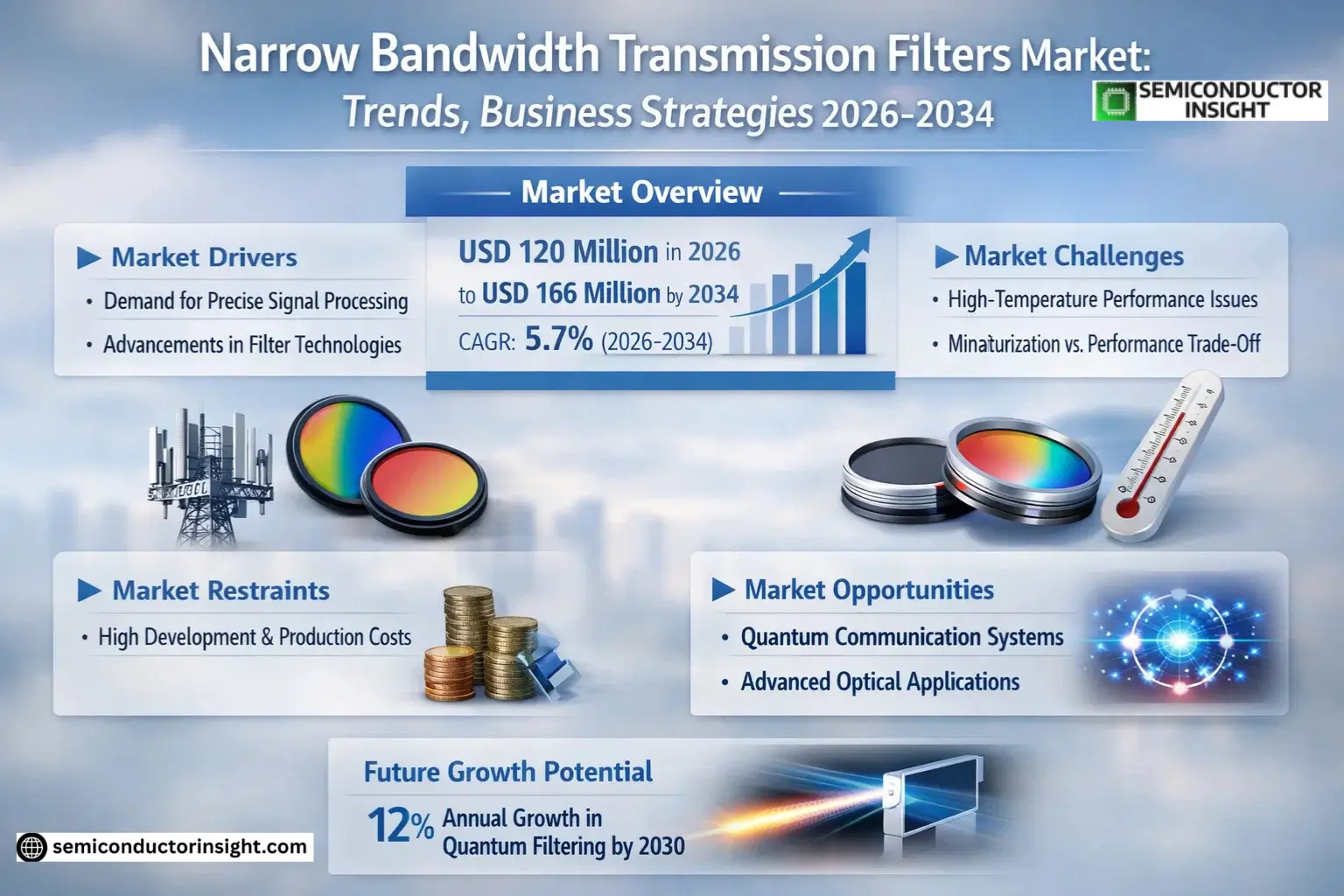
Global Narrow Bandwidth Transmission Filters Market size was valued at USD 114 million in 2025. The market is projected to grow from USD 120 million in 2026 to USD 166 million by 2034, exhibiting a CAGR of 5.7% during the forecast period.
Narrow Bandwidth Transmission Filters are specialized optical components designed to transmit light within a precise wavelength range while blocking all other wavelengths. These filters play a critical role in applications requiring high spectral selectivity, such as telecommunications, laser systems, and spectroscopy. Their ability to isolate specific spectral lines enhances signal clarity and reduces interference in optical systems.
The market growth is driven by increasing demand for high-precision optical components in telecom infrastructure and advancements in laser-based technologies. Furthermore, rising investments in photonics research and the expansion of 5G networks are expected to fuel adoption. Key players like Advanced Optics Solutions and Edmund Optics continue to innovate, offering filters with improved performance metrics such as narrower bandwidths and higher transmission efficiency.
MARKET DRIVERS
Growing Demand for Precise Signal Processing
Narrow Bandwidth Transmission Filters Market is experiencing growth due to increasing demand for precise signal filtering in telecommunications and defense applications. These filters play a critical role in eliminating interference and enhancing signal clarity, particularly in 5G networks and radar systems. Market analysts project a 7.2% CAGR from 2023 to 2028, driven by infrastructure modernization needs.
Advancements in Filter Design Technologies
Recent breakthroughs in SAW (Surface Acoustic Wave) and BAW (Bulk Acoustic Wave) filter technologies have significantly improved the performance of narrow bandwidth transmission filters. Manufacturers are achieving bandwidths as narrow as 0.01% of center frequency with improved insertion loss characteristics, making these components essential for next-generation wireless systems.
Military communications upgrades continue to drive adoption, with defense sector investments accounting for approximately 35% of the total narrow bandwidth transmission filters market revenue in 2023.
MARKET CHALLENGES
Technical Limitations in Extreme Conditions
Narrow Bandwidth Transmission Filters face performance degradation challenges in high-temperature environments, limiting their deployment in certain industrial and aerospace applications. Temperature stability remains a critical issue, with current solutions only maintaining ±2 ppm/°C frequency stability at best.
Other Challenges
Miniaturization vs Performance Trade-off
Shrinking filter sizes while maintaining narrow bandwidth characteristics presents significant engineering challenges, particularly for frequencies below 500 MHz where physical dimensions become problematic.
MARKET RESTRAINTS
High Development and Production Costs
The specialized materials and precision manufacturing requirements for Narrow Bandwidth Transmission Filters result in production costs 3-5 times higher than standard RF filters. This price premium limits adoption in cost-sensitive commercial applications, with the average unit price ranging from USD 15-USD 250 depending on specifications.
MARKET OPPORTUNITIES
Emerging Quantum Communication Systems
The development of quantum communication networks creates new opportunities for ultra-narrowband filtering solutions. These systems require bandwidths under 1 kHz for effective single-photon detection, opening a specialized niche projected to grow at 12% annually through 2030.
Narrow Bandwidth Transmission Filters Market Trends
Growing Demand for Precision Optical Systems
Narrow Bandwidth Transmission Filters Market is experiencing significant growth due to increasing demand for high-precision optical systems across industries. These filters are critical in applications requiring exact wavelength control, with telecommunications and spectroscopy driving adoption. Manufacturers are focusing on improving filter selectivity to meet the stringent requirements of advanced optical instruments.
Other Trends
Advancements in FWHM Below 1nm Technology
The segment for filters with Full Width at Half Maximum (FWHM) below 1nm is gaining traction as industries require finer wavelength discrimination. This trend is particularly noticeable in scientific research applications where ultra-narrow bandpass characteristics are essential for accurate measurements and analysis.
Regional Market Developments
Significant investments in optical technologies are reshaping regional Narrow Bandwidth Transmission Filters Markets. The United States remains a key player due to its strong research infrastructure, while China’s manufacturing capabilities are enabling rapid adoption in industrial applications. Europe continues to lead in scientific instrumentation applications requiring these specialized filters.
Competitive Landscape Shifts
The market features established players like Advanced Optics Solutions and Edmund Optics alongside specialized manufacturers such as Alluxa and Alnair Labs. Recent years have seen increased competition in developing more cost-effective solutions without compromising the critical performance characteristics of narrow bandwidth filters.
Emerging Applications Driving Innovation
Beyond traditional sectors, new applications in quantum computing and advanced sensing technologies are creating opportunities for Narrow Bandwidth Transmission Filters. Manufacturers are responding with filters tailored to specific wavelength requirements of these emerging technologies, indicating potential for market expansion.
COMPETITIVE LANDSCAPE
Key Industry Players
Technological Innovation Drives Competition in Narrow Band Filter Market
Global Narrow Bandwidth Transmission Filters Market is highly competitive, with Advanced Optics Solutions and iXblue Photonics leading as the top revenue generators, collectively holding a significant market share. These companies dominate through advanced R&D capabilities and established distribution networks, particularly in telecom and sensing applications. The market exhibits moderate consolidation, with the top five players accounting for approximately 35-40% of global revenue, while specialized manufacturers compete in niche segments like spectroscopy and laser systems.
Emerging players like Alnair Labs and Alluxa are gaining traction through patented thin-film coating technologies, challenging established vendors in high-precision applications. Regional competition intensified with Chinese manufacturers entering the sub-1nm FWHM segment, offering cost-competitive solutions. The market sees frequent collaborations between filter manufacturers and optical system integrators to develop application-specific solutions, particularly in quantum computing and LIDAR technologies.
List of Key Narrow Bandwidth Transmission Filters Companies Profiled
- Advanced Optics Solutions
- iXblue Photonics
- Materion Corporation
- Alluxa
- Edmund Optics
- Chroma Technology Corp
- Alnair Laboratories
- Semrock (IDEX Health & Science)
- Laser Components
- Thorlabs
- Omega Optical
- Delta Optical Thin Film
- Layertec GmbH
- NDK Optacom
- Viavi Solutions
Segment Analysis:
| Segment Category | Sub-Segments | Key Insights |
| By Type |
|
FWHM Below 1nm dominates due to its superior wavelength precision critical for high-end applications.
|
| By Application |
|
Telecom applications lead demand with critical wavelength management needs.
|
| By End User |
|
Telecom Service Providers represent the most significant consumption segment.
|
| By Technology |
|
Thin-Film Filters remain the most widely adopted technology.
|
| By Performance |
|
High Precision filters show strongest market traction.
|
Regional Analysis: Narrow Bandwidth Transmission Filters Market
North America
The US market leads in deploying narrow bandwidth filters for 5G mmWave spectrum applications, with telecom operators investing heavily in network densification. Filter manufacturers are developing compact solutions for small cell deployments in high-frequency bands.
Canada’s focus on next-gen satellite communications and defense systems drives demand for ultra-stable narrow bandwidth filters. Academic-industrial partnerships in Ontario and Quebec are pioneering new filter materials for extreme environmental conditions.
Manufacturing hubs across the Great Lakes region are incorporating narrow bandwidth filters in industrial IoT networks. These filters ensure interference-free communication in factory automation systems operating in crowded radio frequency environments.
Military communications upgrades in North America increasingly utilize ruggedized narrow bandwidth filters for secure tactical networks. Specialized filters enable clear signal transmission even in electronic warfare scenarios with heavy jamming.
Europe
European nations are prioritizing narrow bandwidth filter deployment for 5G rollout and industrial digitalization. Germany leads in automotive radar applications, while the UK focuses on terrestrial TV broadcast upgrades. Strict EU electromagnetic compatibility regulations drive demand for high-selectivity filters in consumer electronics. Nordic countries are pioneering energy-efficient filter designs for sustainable telecom infrastructure. The region’s mature aerospace sector requires precision filters for satellite ground stations and avionics systems.
Asia-Pacific
The APAC region shows the fastest growth for narrow bandwidth transmission filters, fueled by massive 5G infrastructure projects across China and India. South Korea and Japan lead in miniaturized filter technologies for smartphone RF front-ends. Southeast Asian nations are upgrading cellular backhaul networks with advanced filtering solutions. Australia’s mining sector deploys rugged filters for remote area communications, while Taiwan’s semiconductor industry develops innovative filter integration techniques.
South America
Brazil emerges as the key market for narrow bandwidth filters in Latin America, driven by urban telecom network modernization. Andean nations invest in filters for mountainous terrain communications. Argentina’s renewable energy monitoring systems incorporate specialized filters for reliable data transmission. Regional oil/gas operations require filters resilient to electromagnetic interference from industrial equipment.
Middle East & Africa
Gulf Cooperation Council countries deploy advanced narrow bandwidth filters for smart city initiatives and oil field communications. Israel’s defense electronics sector develops cutting-edge filtering technologies. South Africa leads African adoption in telecom infrastructure, while North African nations modernize broadcasting networks with selective filtering solutions for clearer signal transmission.
Report Scope
This market research report provides a comprehensive analysis of the Narrow Bandwidth Transmission Filters Market , covering the forecast period 2026–2034. It offers detailed insights into market dynamics, technological advancements, competitive landscape, and key trends shaping the industry.
Key focus areas of the report include:
- Market Overview: The report begins with an overview outlining its current market scenario, key growth indicators, and industry transformation drivers. It discusses macroeconomic factors, demand–supply balance, regulatory landscape, and the strategic role of semiconductors in powering advancements across industries such as automotive, telecommunications, consumer electronics, and industrial automation.
- Market Size & Forecast: Historical data and future projections for revenue, unit shipments, and market value across major regions and segments.
- Segmentation Analysis: Detailed breakdown by product type, technology, application, and end-user industry to identify high-growth segments and investment opportunities.
- Regional Insights: Insights into market performance across North America, Europe, Asia-Pacific, Latin America, and the Middle East & Africa, including country-level analysis where relevant.
- Competitive Landscape: Profiles of leading market participants, including their product offerings, R&D focus, manufacturing capacity, pricing strategies, and recent developments such as mergers, acquisitions, and partnerships.
- Technology Trends & Innovation: Assessment of emerging technologies, integration of AI/IoT, semiconductor design trends, fabrication techniques, and evolving industry standards.
- Market Drivers & Restraints: Evaluation of factors driving market growth along with challenges, supply chain constraints, regulatory issues, and market-entry barriers.
- Stakeholder Insights: Insights for component suppliers, OEMs, system integrators, investors, and policymakers regarding the evolving ecosystem and strategic opportunities.
Primary and secondary research methods are employed, including interviews with industry experts, data from verified sources, and real-time market intelligence to ensure the accuracy and reliability of the insights presented.
FREQUENTLY ASKED QUESTIONS:
What is the current market size of Narrow Bandwidth Transmission Filters Market?
-> Narrow Bandwidth Transmission Filters Market size was valued at USD 114 million in 2025. The market is projected to grow from USD 120 million in 2026 to USD 166 million by 2034, exhibiting a CAGR of 5.7% during the forecast period.
Which key companies operate in Narrow Bandwidth Transmission Filters Market?
-> Key players include Advanced Optics Solutions, iXblue Photonics, Materion, Alluxa, Edmund Optics, Chroma, and Alnair Labs, among others. Global top five players held approximately % market share in terms of revenue in 2025.
What are the key growth drivers?
-> Key growth drivers include increasing demand in spectroscopy, laser systems, and telecommunications applications, along with advancements in optical technologies requiring precise wavelength control.
Which region dominates the market?
-> North America (particularly the U.S.) and Asia-Pacific (especially China) are significant markets for Narrow Bandwidth Transmission Filters.
What are the emerging trends?
-> Emerging trends include development of ultra-narrow bandwidth filters (FWHM below 1nm) and increasing adoption in sensing and telecom applications.

Get Sample Report PDF for Exclusive Insights
Report Sample Includes
- Table of Contents
- List of Tables & Figures
- Charts, Research Methodology, and more...
 Download Sample Report PDF