MEMS Timing Device Market Overview
Microelectromechanical Systems (MEMS)-based oscillators have received wide market adoption in recent years due to the reliability, short lead times and small package sizes. The rise in portable and wearable electronics is driving the need to reduce both the energy consumption and footprint of all types of electronic components, including oscillators. Oscillators based on Micro-Electro-Mechanical Systems (MEMS) technology combine accurate frequency generation with low power consumption and are becoming increasingly popular in clock circuits.
This report provides a deep insight into the global MEMS Timing Device market covering all its essential aspects. This ranges from a macro overview of the market to micro details of the market size, competitive landscape, development trend, niche market, key market drivers and challenges, SWOT analysis, value chain analysis, etc.
The analysis helps the reader to shape the competition within the industries and strategies for the competitive environment to enhance the potential profit. Furthermore, it provides a simple framework for evaluating and accessing the position of the business organization. The report structure also focuses on the competitive landscape of the Global MEMS Timing Device Market, this report introduces in detail the market share, market performance, product situation, operation situation, etc. of the main players, which helps the readers in the industry to identify the main competitors and deeply understand the competition pattern of the market.
In a word, this report is a must-read for industry players, investors, researchers, consultants, business strategists, and all those who have any kind of stake or are planning to foray into the MEMS Timing Device market in any manner.
MEMS Timing Device Market Analysis:
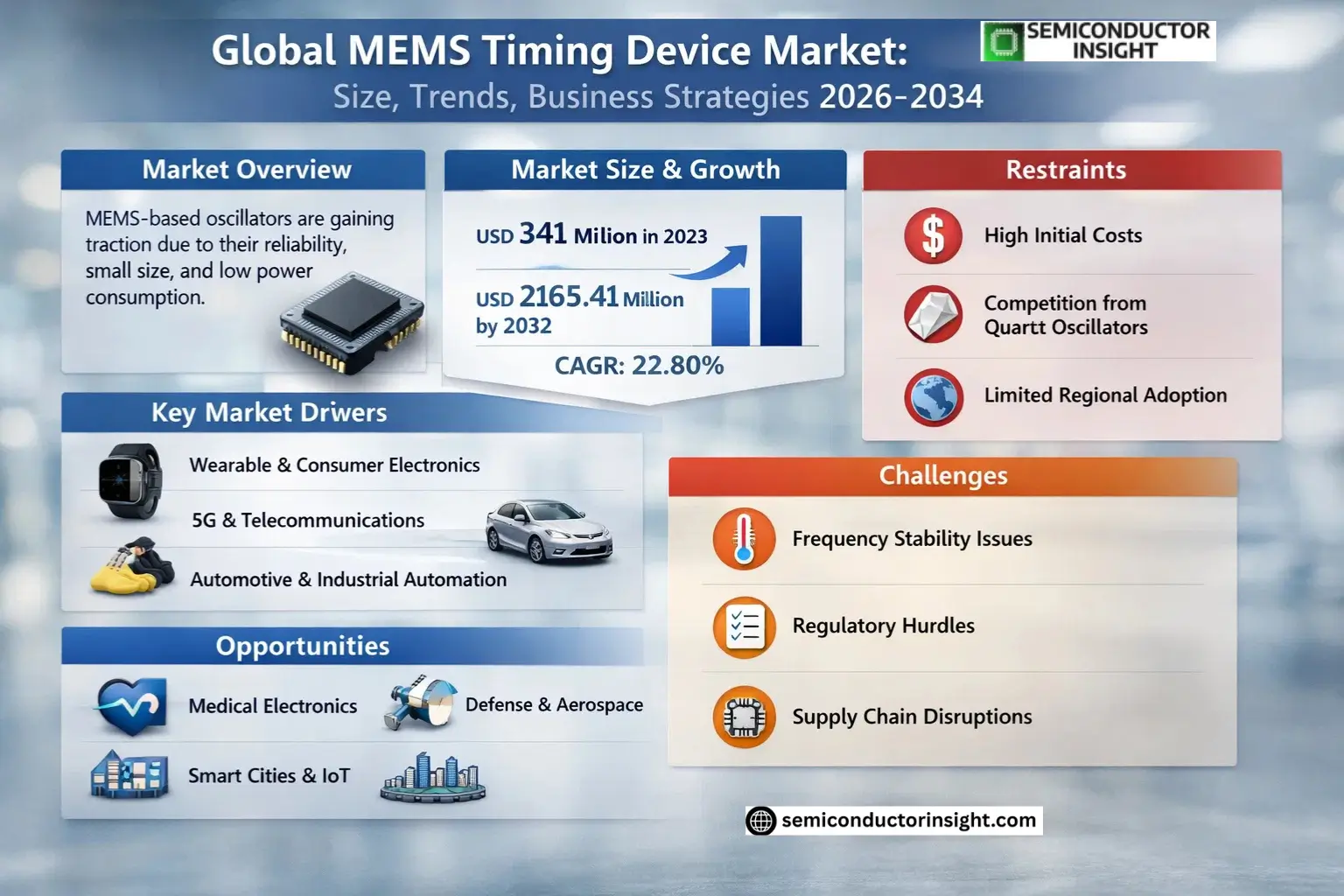
Global MEMS Timing Device Market size was estimated at USD 341 million in 2023 and is projected to reach USD 2165.41 million by 2032, exhibiting a CAGR of 22.80% during the forecast period.
North America MEMS Timing Device market size was estimated at USD 126.98 million in 2023, at a CAGR of 19.54% during the forecast period of 2025 through 2032.
MEMS Timing Device Key Market Trends :
-
Growing Demand for Compact and Power-Efficient Devices
MEMS timing devices are gaining popularity due to their small size, low power consumption, and high reliability, making them ideal for portable and wearable electronics. -
Rising Adoption in Automotive and Aerospace Applications
Advanced driver-assistance systems (ADAS) and aerospace navigation systems are increasingly relying on MEMS oscillators for precise timing and robust performance. -
Shift Toward 5G and IoT Expansion
The rise of 5G networks and IoT-driven applications is fueling the demand for MEMS-based timing solutions to ensure accurate synchronization and low latency. -
Technological Advancements in MEMS Fabrication
Ongoing R&D in MEMS technology is improving oscillator performance, enhancing frequency stability, and reducing manufacturing costs, driving widespread adoption. -
Increase in Strategic Partnerships and Mergers
Leading MEMS timing device manufacturers are forming alliances and acquisitions to expand market presence, enhance production capabilities, and meet growing demand.
MEMS Timing Device Market Regional Analysis :
-
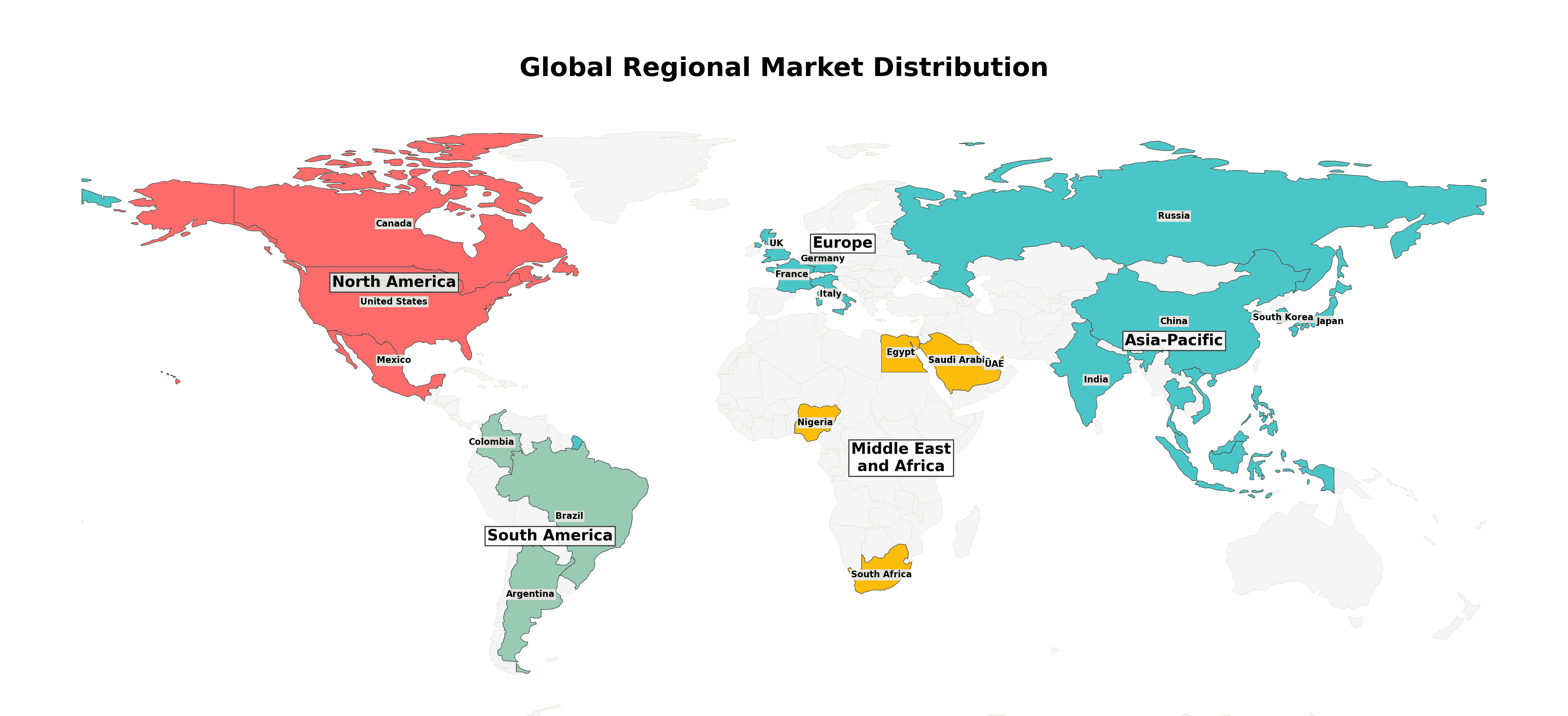
North America:
Strong demand driven by EVs, 5G infrastructure, and renewable energy, with the U.S. leading the market.
-
Europe:
Growth fueled by automotive electrification, renewable energy, and strong regulatory support, with Germany as a key player.
-
Asia-Pacific:
Dominates the market due to large-scale manufacturing in China and Japan, with growing demand from EVs, 5G, and semiconductors.
-
South America:
Emerging market, driven by renewable energy and EV adoption, with Brazil leading growth.
-
Middle East & Africa:
Gradual growth, mainly due to investments in renewable energy and EV infrastructure, with Saudi Arabia and UAE as key contributors.
MEMS Timing Device Market Segmentation :
The research report includes specific segments by region (country), manufacturers, Type, and Application. Market segmentation creates subsets of a market based on product type, end-user or application, Geographic, and other factors. By understanding the market segments, the decision-maker can leverage this targeting in the product, sales, and marketing strategies. Market segments can power your product development cycles by informing how you create product offerings for different segments.
Key Company
- SiTime
- Microchip Technology
- Abracon
- Daishinku (KDS)
- Murata
- Kyocera Corporation
- Analog Devices
- TXC Corporation
- ShenZhen Yangxing Technology (YXC)
- Skyworks
Market Segmentation (by Type)
- kHz Device
- MHz Device
Market Segmentation (by Application)
- Aerospace & Defense
- Automotive
- Consumer Electronics
- Medical
- IT & Telecommunication
- Industrial
- Others
Drivers
-
Increasing Demand for Wearable and Consumer Electronics
The growing use of smartwatches, fitness trackers, and portable gadgets is driving the need for compact and power-efficient MEMS timing devices. -
Advancements in Telecommunications and 5G Networks
MEMS-based oscillators are playing a crucial role in improving signal processing and timing accuracy, essential for seamless 5G deployment. -
Expansion of Automotive and Industrial Automation
The rise of autonomous vehicles and industrial automation solutions is increasing the need for precise timing solutions, boosting market growth.
Restraints
-
High Initial Costs and Manufacturing Complexities
The production of MEMS timing devices involves intricate processes, leading to higher initial investments and limiting adoption in cost-sensitive sectors. -
Competition from Quartz-Based Oscillators
Traditional quartz oscillators still dominate the market, creating challenges for MEMS-based alternatives despite their advantages. -
Limited Awareness and Adoption in Certain Regions
Developing regions have lower adoption rates due to limited awareness of MEMS technology, restricting overall market penetration.
Opportunities
-
Increasing Demand in Medical Electronics
MEMS timing devices are being widely integrated into medical devices, including portable diagnostic tools and remote patient monitoring systems. -
Growing Investments in Defense and Aerospace
Government initiatives to enhance defense technology and satellite communication systems are opening new avenues for MEMS oscillator applications. -
Surge in Smart City and IoT Deployments
The proliferation of smart city projects and IoT-enabled devices is creating a strong demand for highly reliable and precise MEMS timing devices.
Challenges
-
Maintaining Frequency Stability in Harsh Environments
MEMS oscillators need further advancements to ensure stability and accuracy under extreme temperature and pressure conditions. -
Regulatory and Standardization Hurdles
Stringent industry regulations and certification requirements can slow down product development and market expansion. -
Supply Chain Disruptions and Component Shortages
Shortages of semiconductor materials and global supply chain disruptions can impact production and availability of MEMS timing devices.
Key Benefits of This Market Research:
- Industry drivers, restraints, and opportunities covered in the study
- Neutral perspective on the market performance
- Recent industry trends and developments
- Competitive landscape & strategies of key players
- Potential & niche segments and regions exhibiting promising growth covered
- Historical, current, and projected market size, in terms of value
- In-depth analysis of the MEMS Timing Device Market
- Overview of the regional outlook of the MEMS Timing Device Market:
Key Reasons to Buy this Report:
- Access to date statistics compiled by our researchers. These provide you with historical and forecast data, which is analyzed to tell you why your market is set to change
- This enables you to anticipate market changes to remain ahead of your competitors
- You will be able to copy data from the Excel spreadsheet straight into your marketing plans, business presentations, or other strategic documents
- The concise analysis, clear graph, and table format will enable you to pinpoint the information you require quickly
- Provision of market value data for each segment and sub-segment
- Indicates the region and segment that is expected to witness the fastest growth as well as to dominate the market
- Provides insight into the market through Value Chain
- Market dynamics scenario, along with growth opportunities of the market in the years to come
- 6-month post-sales analyst support
Customization of the Report
In case of any queries or customization requirements, please connect with our sales team, who will ensure that your requirements are met.
FAQs
Q: What are the key driving factors and opportunities in the MEMS Timing Device market?
A: The major drivers include the growing demand for compact, power-efficient devices, advancements in 5G and IoT technologies, and increased adoption in automotive and aerospace sectors. Opportunities lie in medical electronics, defense applications, and smart city developments.
Q: Which region is projected to have the largest market share?
A: North America is expected to lead the MEMS Timing Device market due to strong demand in telecommunications, aerospace, and industrial automation, followed closely by Asia-Pacific due to its expanding electronics manufacturing sector.
Q: Who are the top players in the global MEMS Timing Device market?
A: Leading companies include SiTime, Microchip Technology, Abracon, Daishinku (KDS), Murata, Kyocera Corporation, Analog Devices, TXC Corporation, ShenZhen Yangxing Technology (YXC), and Skyworks.
Q: What are the latest technological advancements in the industry?
A: Innovations include improved frequency stability, enhanced energy efficiency, miniaturization, and the integration of MEMS oscillators into high-speed 5G networks and industrial IoT applications.
Q: What is the current size of the global MEMS Timing Device market?
A: MEMS Timing Device Market size was estimated at USD 341 million in 2023 and is projected to reach USD 2165.41 million by 2032, exhibiting a CAGR of 22.80% during the forecast period.
Get Sample Report PDF for Exclusive Insights
Report Sample Includes
- Table of Contents
- List of Tables & Figures
- Charts, Research Methodology, and more...
 Download Sample Report PDF