Market Insights
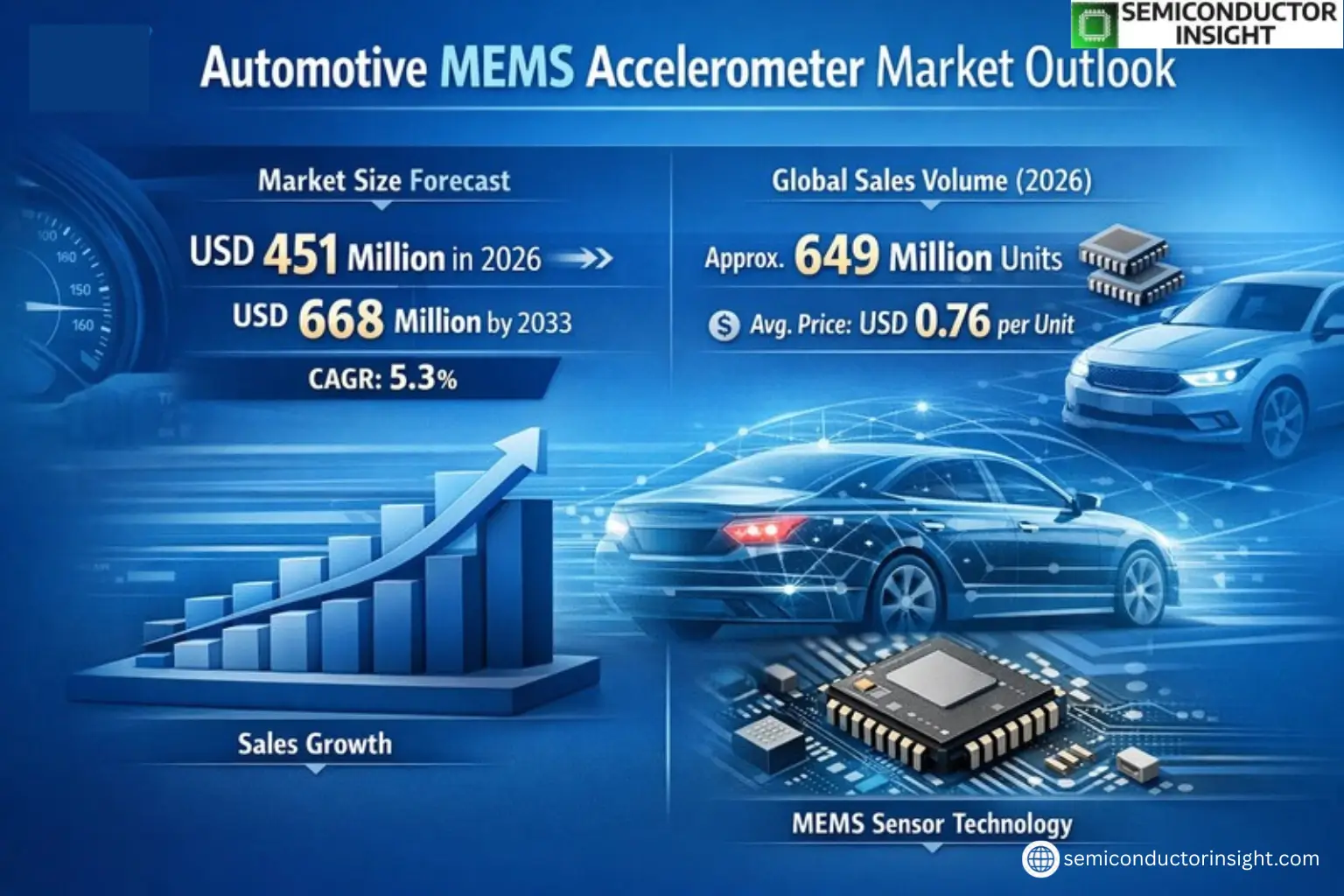
Global Automotive MEMS Accelerometer Market was valued at USD 451 million in 2026 and is projected to reach USD 668 million by 2033, exhibiting a CAGR of 5.3% during the forecast period.
In 2026, global sales volume reached approximately 649 million units, with an average price of USD 0.76 per unit.
Automotive MEMS Accelerometer Market is a vehicle-grade motion sensor built using Micro-Electro-Mechanical Systems (MEMS) technology that measures linear acceleration, deceleration, vibration, shock, and tilt. These sensors convert physical forces into electrical signals used by electronic control units (ECUs) to enable safety systems like airbag deployment, electronic stability control (ESC), and rollover detection. Unlike consumer-grade devices, automotive MEMS accelerometers are engineered for harsh operating conditions and must meet stringent quality standards like AEC-Q100.
The market growth is primarily driven by increasing electronic content in modern vehicles, particularly through advanced driver-assistance systems (ADAS) and electric vehicle architectures. Regulatory mandates for enhanced safety features across major automotive markets are accelerating adoption rates. Furthermore, the shift toward integrated inertial measurement units (IMUs) combining accelerometers with gyroscopes and magnetometers is creating higher-value opportunities. Key players like Bosch, NXP Semiconductors, and STMicroelectronics dominate the market through continuous innovation in sensor fusion technologies.
MARKET DRIVERS
Rising Demand for Advanced Driver-Assistance Systems (ADAS)
Automotive MEMS Accelerometer Market is experiencing significant growth due to increasing adoption of ADAS technologies in modern vehicles. These systems rely heavily on MEMS accelerometers for functions like electronic stability control and rollover detection. With over 60% of new vehicles now equipped with basic ADAS features, sensor demand continues to rise.
Vehicle Safety Regulations Driving Adoption
Stringent government safety mandates worldwide are compelling automakers to integrate more MEMS accelerometers. Regulations requiring electronic stability control in all passenger vehicles have created a USD2.5 billion annual market for automotive safety sensors, with MEMS accelerometers capturing a growing share.
The transition toward autonomous vehicles is creating additional demand for high-accuracy MEMS accelerometers that can support precise positioning and navigation systems.
MARKET CHALLENGES
Technical Limitations in Extreme Conditions
Automotive MEMS accelerometers face performance challenges in harsh environments, particularly in temperature extremes exceeding 125°C. Sensor drift and reduced accuracy under these conditions remain significant technical hurdles for manufacturers.
Other Challenges
Cost Pressure from Traditional Sensor Alternatives
While MEMS technology offers advantages, some automakers continue to use cheaper conventional sensors for basic applications, creating price competition in the Automotive MEMS Accelerometer Market.
MARKET RESTRAINTS
Supply Chain Disruptions Affecting Production
Automotive MEMS Accelerometer Market faces constraints from semiconductor supply chain issues, with lead times for specialized MEMS components extending beyond 30 weeks in some cases. This has delayed new vehicle production and retrofitting programs worldwide.
MARKET OPPORTUNITIES
Emerging Applications in Electric Vehicles
The rapid growth of electric vehicles presents new opportunities for MEMS accelerometer suppliers, as EV platforms typically incorporate more sophisticated sensor arrays than conventional vehicles. The integration of MEMS accelerometers with battery management and vehicle dynamics systems is becoming increasingly common.
Automotive MEMS Accelerometer Market TrendsGrowing Electronic Content and Safety System Integration in Vehicles
Automotive MEMS Accelerometer Market is experiencing strong growth due to increasing electronic content in vehicles, particularly in safety systems. These sensors are critical for airbag deployment, electronic stability control, traction control, and crash sensing. With stricter global safety regulations requiring multi-airbag systems and enhanced crash detection, automakers are integrating more accelerometers per vehicle. Electric vehicles and ADAS systems further drive demand as they rely on accelerometers for motion estimation and vehicle control functions. The market reached 649 million units in 2026 with an average price of USD0.76 per unit.
Other Trends
Shift Toward Multi-Sensor Integration and Advanced Inertial Systems
The industry is moving from standalone sensors to integrated multi-sensor modules and inertial measurement units (IMUs). As autonomous driving technology advances, there’s growing demand for accelerometers combined with gyroscopes and magnetometers on single platforms. These integrated solutions offer improved accuracy for vehicle localization, chassis control, and vibration diagnostics. This trend is shifting the market toward higher-margin, complex products as OEMs invest in sensor fusion technologies.
Rising Demand for Predictive Maintenance in Connected Vehicles
Automotive MEMS accelerometers are increasingly used for condition monitoring in connected vehicle ecosystems. They help detect vibration patterns, suspension performance, and mechanical wear in real-time, enabling predictive maintenance. This trend is particularly strong in commercial fleets where minimizing downtime is critical. Telematics platforms leverage accelerometer data for over-the-air diagnostics and maintenance scheduling, creating new revenue streams in the Automotive MEMS Accelerometer Market.
COMPETITIVE LANDSCAPE
Key Industry Players
Global Automotive MEMS Accelerometer Market Dominated by Established Sensor Manufacturers
Automotive MEMS Accelerometer Market is characterized by the dominance of established semiconductor and sensor manufacturers with strong automotive-grade MEMS expertise. Bosch leads the market with comprehensive automotive sensor solutions integrated across multiple vehicle systems. STMicroelectronics and NXP Semiconductors follow closely, leveraging their semiconductor manufacturing capabilities to deliver high-volume, cost-optimized MEMS accelerometers. These top players account for over 60% of the global automotive MEMS accelerometer revenue, benefiting from long-term relationships with automotive OEMs and Tier-1 suppliers.
Several specialized players maintain strong positions in niche segments. Murata Manufacturing and TDK focus on high-reliability solutions for advanced driver assistance systems, while Analog Devices and TE Connectivity target precision measurement applications. Emerging Chinese manufacturers like MiraMEMS Sensing Technology and XDLK Microsystem are gaining traction through localized production and competitive pricing strategies, particularly in the Asia-Pacific region.
List of Key Automotive MEMS Accelerometer Companies Profiled
- Bosch
- NXP Semiconductors
- STMicroelectronics
- Murata Manufacturing
- PCB Piezotronics
- Analog Devices
- TDK
- ROHM Semiconductor
- Honeywell
- TE Connectivity
- Kistler
- Meggitt Sensing Systems
- Memsic
- MiraMEMS Sensing Technology
- Safran
Segment Analysis:
| Segment Category | Sub-Segments | Key Insights |
| By Type |
|
Capacitive Type dominates due to superior performance characteristics:
|
| By Application |
|
Passenger Vehicle leads adoption with critical safety integration:
|
| By End User |
|
OEMs represent the primary adoption channel:
|
| By Function |
|
Safety Systems drive core demand with technological evolution:
|
| By Integration Level |
|
IMU Modules show strongest growth trajectory:
|
Regional Analysis: Global Automotive MEMS Accelerometer Market
Asia-Pacific
China’s automotive MEMS accelerometer demand surges with strict safety regulations and expanding EV production. Local sensor manufacturers rapidly develop indigenous alternatives to international brands, offering competitive pricing without compromising on crash detection performance.
Japanese suppliers lead in developing ultra-miniature accelerometers with enhanced vibration resistance, crucial for electric vehicle battery monitoring systems. Tight integration between Tier-1 suppliers and automakers enables rapid technology adoption across vehicle platforms.
India’s automotive accelerometer market grows alongside domestic safety standard upgrades, though adoption remains concentrated in premium segments. Local manufacturing incentives aim to develop MEMS production capabilities to reduce import dependence in coming years.
South Korea stands out for advanced MEMS packaging techniques that improve accelerometer durability in harsh conditions. Collaborations between display manufacturers and sensor companies enable innovative HUD applications using motion sensing data.
North America
The North American Automotive MEMS Accelerometer Market benefits from stringent safety regulations and high consumer demand for advanced vehicle technologies. U.S. manufacturers focus on developing high-reliability sensors for autonomous driving systems, with particular emphasis on failsafe operation. Canada emerges as a testing ground for arctic-condition accelerometer performance validation. Regional suppliers implement AI-driven quality control processes to ensure sensor consistency across production batches.
Europe
Europe’s Automotive MEMS Accelerometer Market emphasizes precision engineering for premium vehicle applications. German automakers integrate accelerometers with other chassis sensors for comprehensive vehicle dynamics control. The region leads in developing low-power MEMS solutions for electric vehicles, with French companies pioneering novel energy harvesting techniques. EU safety regulations drive standardized testing protocols for crash detection sensors across member states.
South America
South America’s Automotive MEMS Accelerometer Market growth trails other regions but shows potential in Brazil’s thriving aftermarket segment. Economic fluctuations impact OEM adoption rates, leading to selective implementation in safety-critical applications only. Regional suppliers develop cost-optimized accelerometer variants suitable for popular compact vehicle platforms while meeting basic safety certification requirements.
Middle East & Africa
The Middle East & Africa Automotive MEMS Accelerometer Market remains niche, focused mainly on luxury vehicle imports and fleet safety systems. Harsh environmental conditions drive demand for ruggedized sensor solutions with extended temperature tolerances. Gulf nations show growing interest in MEMS-based stolen vehicle tracking systems, creating alternative market opportunities beyond traditional safety applications.
Report Scope
This market research report provides a comprehensive analysis of the Automotive MEMS Accelerometer Market, covering the forecast period 2026–2033. It offers detailed insights into market dynamics, technological advancements, competitive landscape, and key trends shaping the industry.
Key focus areas of the report include:
- Market Overview: The report begins with an overview outlining its current market scenario, key growth indicators, and industry transformation drivers. It discusses macroeconomic factors, demand–supply balance, regulatory landscape, and the strategic role of MEMS accelerometers in powering advancements across automotive safety systems, vehicle dynamics, and motion sensing applications.
- Market Size & Forecast: Historical data and future projections for revenue, unit shipments, and market value across major regions and segments.
- Segmentation Analysis: Detailed breakdown by product type, axis configuration, structure, application, and end-user industry to identify high-growth segments and investment opportunities.
- Regional Insights: Insights into market performance across North America, Europe, Asia-Pacific, Latin America, and the Middle East & Africa, including country-level analysis where relevant.
- Competitive Landscape: Profiles of leading market participants, including their product offerings, R&D focus, manufacturing capacity, pricing strategies, and recent developments such as mergers, acquisitions, and partnerships.
- Technology Trends & Innovation: Assessment of emerging technologies, multi-sensor integration, inertial measurement units (IMUs), and predictive maintenance applications in connected vehicles.
- Market Drivers & Restraints: Evaluation of factors driving market growth along with challenges, supply chain constraints, regulatory issues, and market-entry barriers.
- Stakeholder Insights: Insights for component suppliers, OEMs, system integrators, investors, and policymakers regarding the evolving ecosystem and strategic opportunities.
Primary and secondary research methods are employed, including interviews with industry experts, data from verified sources, and real-time market intelligence to ensure the accuracy and reliability of the insights presented.
FREQUENTLY ASKED QUESTIONS:
What is the current market size of Automotive MEMS Accelerometer Market?
-> Automotive MEMS Accelerometer Market was valued at USD 451 million in 2026 and is projected to reach USD 668 million by 2033, exhibiting a CAGR of 5.3% during the forecast period.
Which key companies operate in Automotive MEMS Accelerometer Market?
-> Key players include Bosch, NXP Semiconductors, STMicroelectronics, Murata Manufacturing, Analog Devices, TDK, and Honeywell, among others.
What are the key growth drivers?
-> Key growth drivers include increasing electronic content in vehicles, safety system integration, shift toward multi-sensor fusion, and demand for predictive maintenance in connected vehicles.
Which region dominates the market?
-> Asia is the largest market, with China, Japan, and South Korea being major contributors, while Europe remains a key region for automotive MEMS technology innovation.
What are the emerging trends?
-> Emerging trends include multi-axis accelerometer adoption, integration with inertial measurement units (IMUs), and vibration monitoring for predictive maintenance.

Get Sample Report PDF for Exclusive Insights
Report Sample Includes
- Table of Contents
- List of Tables & Figures
- Charts, Research Methodology, and more...
 Download Sample Report PDF