
MARKET INSIGHTS
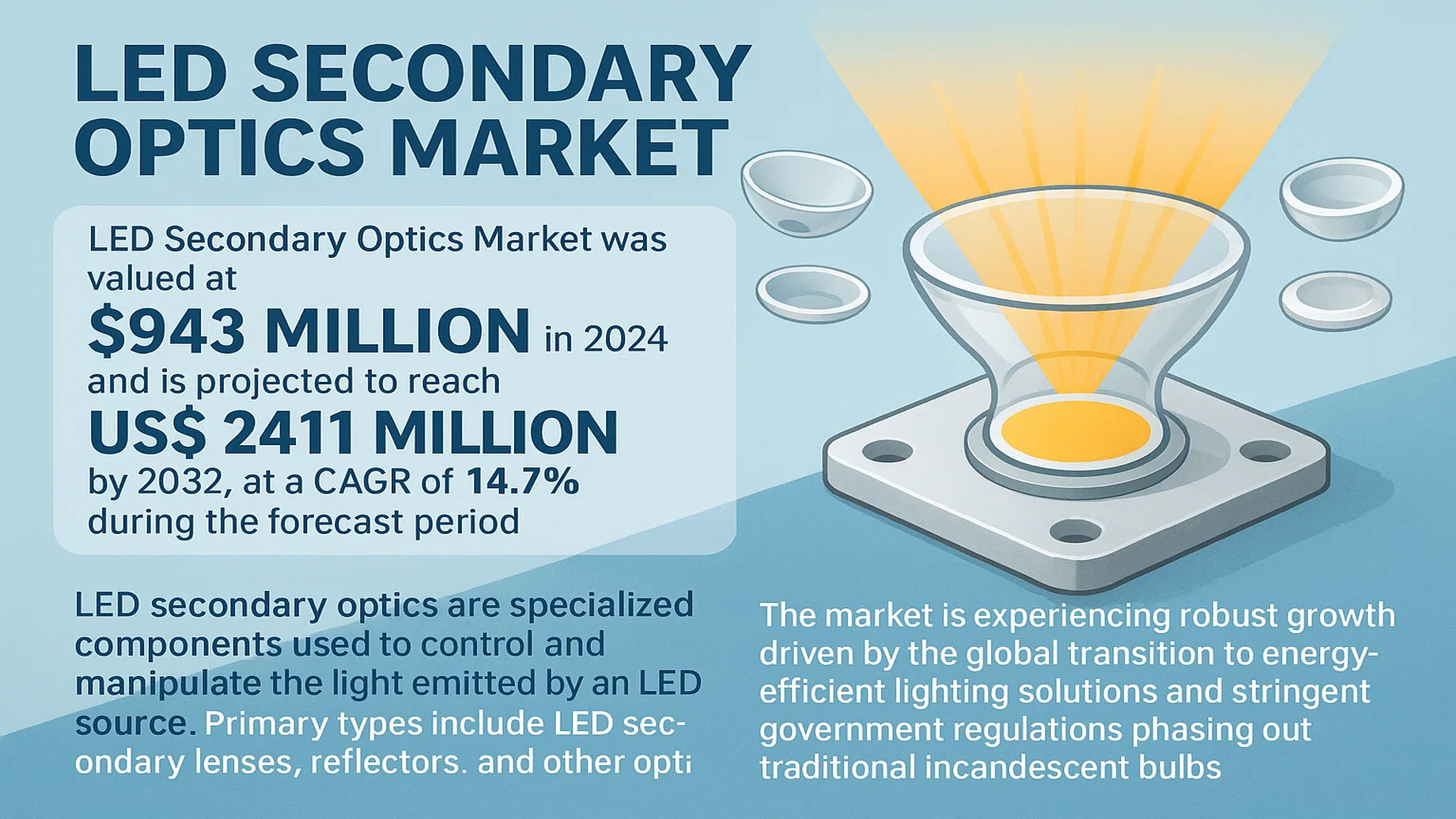
The global LED Secondary Optics Market was valued at 943 million in 2024 and is projected to reach US$ 2411 million by 2032, at a CAGR of 14.7% during the forecast period.
LED secondary optics are specialized components used to control and manipulate the light emitted by an LED source. While LEDs inherently produce directional light, these secondary optics are crucial for shaping and directing the light output to achieve specific lighting effects, optimize distribution patterns, and enhance overall luminaire efficiency. The primary types include LED secondary lenses, reflectors, and other optical elements.
The market is experiencing robust growth driven by the global transition to energy-efficient lighting solutions and stringent government regulations phasing out traditional incandescent bulbs. The rapid expansion of smart city infrastructure projects, particularly in Asia-Pacific, is a significant contributor, with street lighting and commercial lighting applications leading the demand. Furthermore, technological advancements in materials, such as the use of high-performance polycarbonates and PMMA (polymethyl methacrylate), are enabling more complex and efficient optical designs. The top five manufacturers collectively hold approximately 20% of the market share, indicating a competitive and fragmented landscape. China dominates the market, accounting for about 35% of global consumption, largely because it is a major hub for LED manufacturing and assembly.
MARKET DYNAMICS
MARKET DRIVERS
Global Energy Efficiency Initiatives and LED Adoption to Drive Market Expansion
The global push for energy-efficient lighting solutions is significantly accelerating the adoption of LED technology, thereby driving demand for secondary optics. Governments worldwide are implementing stringent regulations phasing out inefficient lighting technologies, with over 40 countries having banned or scheduled bans on incandescent bulbs. The European Union’s Energy Efficiency Directive mandates a 32.5% improvement in energy efficiency by 2030, while the United States Department of Energy reports that LED lighting uses at least 75% less energy than traditional lighting. Secondary optics play a crucial role in maximizing LED efficiency by precisely controlling light distribution, reducing energy waste, and ensuring compliance with these regulations. The ongoing global transition toward sustainable lighting solutions continues to create substantial market opportunities for advanced optical components.
Rising Demand for Smart Lighting and Architectural Applications to Boost Growth
The increasing integration of smart lighting systems and sophisticated architectural lighting designs is driving substantial growth in the secondary optics market. Smart city initiatives worldwide are incorporating intelligent lighting systems that require precise optical control for optimal performance. The global smart lighting market is projected to exceed $30 billion by 2027, with secondary optics being essential components in these systems. Architectural lighting applications, particularly in commercial and public spaces, demand customized optical solutions to achieve specific lighting effects, enhance visual comfort, and reduce light pollution. The growing emphasis on human-centric lighting designs, which require precise spectral control and distribution patterns, further amplifies the need for advanced secondary optics in both indoor and outdoor applications.
Automotive Lighting Evolution and Technological Advancements to Fuel Market Development
The automotive industry’s rapid adoption of advanced LED lighting systems is creating significant opportunities for secondary optics manufacturers. Modern vehicles increasingly incorporate sophisticated lighting technologies, including adaptive driving beams, matrix LED systems, and signature lighting designs that require precise optical control. The global automotive lighting market is expected to reach approximately $45 billion by 2028, with LED technology capturing over 70% of the market share. Secondary optics enable automakers to achieve distinctive lighting signatures, improve road safety through better illumination patterns, and meet stringent regulatory requirements. Recent technological advancements in materials science, including the development of high-temperature-resistant polymers and advanced optical coatings, are further enhancing the performance and durability of automotive lighting optics.
MARKET CHALLENGES
High Development Costs and Complex Manufacturing Processes to Challenge Market Penetration
The LED secondary optics market faces significant challenges related to the high costs associated with research, development, and manufacturing processes. Developing custom optical solutions requires substantial investment in specialized design software, prototyping equipment, and testing facilities. The precision manufacturing of optical components demands advanced injection molding machines capable of maintaining tight tolerances, with equipment costs often exceeding $500,000 per unit. Additionally, the need for optical-grade materials with specific refractive indices and thermal stability properties increases material costs by approximately 30-40% compared to standard polymers. These financial barriers particularly affect smaller manufacturers and may limit innovation in price-sensitive market segments.
Other Challenges
Technical Complexity in Optical Design
Designing effective secondary optics requires sophisticated understanding of light behavior, material properties, and thermal management. The complexity increases with applications requiring specific beam patterns, high efficiency, and minimal optical losses. Achieving optimal performance often involves balancing multiple competing requirements, such as efficiency versus cost, or precision versus manufacturability.
Rapid Technological Obsolescence
The fast-paced evolution of LED technology creates challenges in keeping optical designs current. As LED manufacturers develop new chip architectures with higher lumen output and different emission characteristics, optical designs must be continuously updated to maintain compatibility and performance, leading to increased R&D expenditure and shorter product life cycles.
MARKET RESTRAINTS
Price Sensitivity and Intense Competition to Limit Profit Margins
The LED secondary optics market experiences significant price pressure due to intense global competition and the increasing cost sensitivity of end-users. With over 30 major manufacturers operating worldwide and numerous smaller regional players, price competition has intensified considerably. The market has witnessed average price reductions of 5-7% annually over the past three years, primarily driven by manufacturing efficiencies and economies of scale achieved by larger players. This price erosion affects profitability across the value chain, particularly for companies specializing in custom optical solutions that require higher R&D investment. The situation is exacerbated by the trend toward standardized optical solutions in mass-market applications, where price becomes the primary purchasing criterion.
Supply Chain Vulnerabilities and Material Availability Issues to Constrain Growth
Global supply chain disruptions and material availability present significant restraints for the LED secondary optics market. The industry relies on specialized optical-grade polymers, particularly polycarbonate and PMMA, which have experienced supply constraints and price volatility. Recent global events have caused polymer prices to increase by 25-35%, while lead times have extended from 4-6 weeks to 12-16 weeks. Additionally, the precision tooling required for optical component manufacturing faces bottlenecks, with experienced mold makers becoming increasingly scarce. These supply chain challenges not only increase costs but also affect the ability of manufacturers to meet delivery commitments and maintain product quality consistency.
Regulatory Compliance and Standardization Challenges to Hinder Market Expansion
The fragmented regulatory landscape and evolving standards for LED lighting present substantial challenges for secondary optics manufacturers. Different regions maintain varying requirements for photometric performance, safety standards, and environmental compliance. The European Union’s RoHS and REACH regulations, North America’s UL standards, and Asia-Pacific’s diverse certification requirements create complex compliance scenarios. Manufacturers must invest significant resources in testing and certification, with each new optical design requiring comprehensive photometric testing that can cost between $15,000-$25,000 per application. The ongoing evolution of lighting standards, particularly for automotive and street lighting applications, requires continuous adaptation of optical designs and additional compliance investments.
MARKET OPPORTUNITIES
Emerging Applications in Horticulture and UV-C Disinfection to Create New Growth Avenues
The expanding applications of LED technology in specialized fields such as horticultural lighting and UV-C disinfection present significant growth opportunities for secondary optics manufacturers. The global horticulture lighting market is projected to grow at a compound annual growth rate of over 20%, reaching approximately $8 billion by 2028. Secondary optics play a critical role in optimizing light distribution for plant growth, ensuring uniform photosynthetic photon flux density across cultivation areas. Similarly, the UV-C disinfection market has experienced remarkable growth, particularly in healthcare and public space applications, where precise optical control is essential for effective pathogen inactivation and user safety. These emerging applications require specialized optical designs that can command premium pricing and higher profit margins.
Advancements in Micro-Optics and Freeform Optics to Enable Premium Market Segments
Technological innovations in micro-optics and freeform optical design are creating opportunities in high-value market segments. The development of micro-structured optical surfaces enables unprecedented control over light distribution, particularly valuable in applications requiring precise beam shaping and high efficiency. Freeform optics allow designers to create complex optical surfaces that were previously impossible to manufacture, opening new possibilities in architectural, automotive, and specialty lighting. The adoption of these advanced technologies is particularly strong in premium automotive lighting systems, where manufacturers seek distinctive lighting signatures and superior performance. The market for advanced optical solutions in automotive applications alone is expected to grow by approximately 15% annually through 2030.
Integration with IoT and Connected Lighting Systems to Drive Future Innovation
The convergence of LED lighting with Internet of Things technologies and connected lighting systems presents substantial opportunities for optical innovation. Smart lighting systems require optics that can accommodate integrated sensors, communication modules, and adaptive lighting capabilities while maintaining aesthetic appeal and optical performance. The global market for connected lighting systems is anticipated to exceed $25 billion by 2027, creating demand for optical solutions that support bidirectional communication, presence detection, and environmental monitoring. This integration requires optical designs that balance traditional lighting functions with new technological requirements, particularly in commercial and industrial applications where smart lighting adoption is growing most rapidly.
LED SECONDARY OPTICS MARKET TRENDS
Rising Demand for Energy-Efficient Lighting Solutions Drives Market Expansion
The global push toward energy efficiency and sustainability continues to propel the LED secondary optics market forward. With governments worldwide implementing stringent regulations to phase out inefficient lighting technologies, the adoption of LED lighting systems has accelerated significantly. Secondary optics play a critical role in maximizing the efficiency of LED systems by precisely controlling light distribution, reducing wasted light, and enhancing overall luminous efficacy. The market has witnessed substantial growth due to these factors, with the global LED secondary optics market valued at approximately 943 million USD in 2024 and projected to reach 2411 million USD by 2032, representing a compound annual growth rate of 14.7%. This growth is particularly pronounced in commercial and street lighting applications, where precise light control is essential for both performance and regulatory compliance.
Other Trends
Technological Advancements in Optical Design
Recent innovations in optical design software and manufacturing techniques have revolutionized the capabilities of LED secondary optics. Advanced freeform optics design allows for unprecedented control over light distribution patterns, enabling manufacturers to create custom solutions for specific applications. The integration of computer-aided design and precision injection molding technologies has reduced production costs while improving optical performance. These advancements have led to optics that achieve higher efficiency rates, with some modern secondary lenses achieving optical efficiency exceeding 92%. The development of hybrid optics that combine refractive and reflective elements has further expanded design possibilities, allowing for more compact form factors and improved thermal management in high-power LED applications.
Expansion in Automotive and Smart Lighting Applications
The automotive sector represents one of the fastest-growing segments for LED secondary optics, driven by the transition from traditional lighting to advanced LED systems. Modern vehicles increasingly incorporate sophisticated lighting systems that require precise optical control for functions including adaptive headlights, daytime running lights, and interior ambient lighting. The automotive LED secondary optics market has grown approximately 18% annually as manufacturers seek to meet both aesthetic and regulatory requirements. Simultaneously, the emergence of smart city initiatives and connected lighting systems has created new opportunities for advanced optical solutions. These systems often incorporate sensors and communication capabilities that require specialized optics to maintain performance while integrating additional functionality. The convergence of IoT technology with lighting infrastructure has particularly driven demand for optics that can accommodate multiple technological requirements within single lighting fixtures.
COMPETITIVE LANDSCAPE
Key Industry Players
Companies Focus on Innovation and Geographic Expansion to Secure Market Position
The global LED secondary optics market exhibits a fragmented yet dynamic competitive structure, characterized by a mix of established international players and a multitude of specialized, often regionally-focused manufacturers. While the top five companies collectively hold approximately 20% of the global market share, the remainder is distributed among numerous competitors, underscoring the high level of competition and diverse application needs. This landscape is driven by continuous technological innovation, as companies strive to develop optics that offer higher efficiency, better light control, and compatibility with the latest LED chip technologies.
Ledlink Optics and LEDiL Oy are recognized as significant leaders, leveraging their extensive product portfolios and strong patent positions in key optical designs. Their growth is heavily supported by robust relationships with major LED module and luminaire manufacturers worldwide. Furthermore, Carclo Optics and Auer Lighting have cemented their status through expertise in precision injection molding and high-performance materials, catering to demanding applications in automotive and professional lighting sectors.
Meanwhile, the competitive intensity is notably high in the Asia-Pacific region, which dominates global production. Chinese manufacturers like ShenZhen Likeda Optical and HENGLI Optical compete aggressively on cost-efficiency and scale, serving the vast domestic market and export channels. Their strategy often involves rapid adoption of new manufacturing techniques and scaling production to meet high-volume orders. Conversely, European and North American players frequently compete on value, emphasizing superior optical performance, reliability, and custom design services for specialized applications.
Growth strategies are multifaceted. Key players are investing significantly in research and development to create optics for emerging applications such as UV-C disinfection, horticultural lighting, and advanced automotive adaptive driving beams. Strategic partnerships with LED chipset producers are also common, ensuring early integration and optimized system performance. Additionally, mergers and acquisitions remain a tool for geographic expansion and portfolio diversification, as seen with larger conglomerates acquiring niche optic specialists to enhance their technological offerings.
List of Key LED Secondary Optics Companies Profiled
- Ledlink Optics (Taiwan)
- Carclo Optics (UK)
- Auer Lighting (Germany)
- LEDiL (Finland)
- Fraen Corporation (USA)
- Gaggione (Lednlight) (France)
- Bicom Optics (China)
- Darkoo Optics (China)
- Aether systems Inc (USA)
- B&M Optics Co., Ltd (China)
- ShenZhen Likeda Optical (China)
- HENGLI Optical (China)
- Brightlx Optics (China)
- Kunrui Optical (China)
- FORTECH (Taiwan)
Segment Analysis:
By Type
LED Secondary Lens Segment Dominates the Market Due to Its Critical Role in Precise Light Control and High Adoption Across Applications
The market is segmented based on type into:
- LED Secondary Lens
- Subtypes: TIR (Total Internal Reflection) Lenses, Reflector Lenses, and others
- Reflector
- Others
- Subtypes: Diffusers, Light Guides, and Collimators
By Application
Commercial Lighting Segment Leads Due to High Demand for Energy-Efficient and Aesthetically Pleasing Lighting Solutions
The market is segmented based on application into:
- Street Lighting
- Commercial Lighting
- Landscape Lighting
- Residential Lighting
- Automotive Lighting
- Others
By Material
Polycarbonate (PC) Segment Leads Due to Its Superior Optical Clarity, Impact Resistance, and Cost-Effectiveness
The market is segmented based on material into:
- Polycarbonate (PC)
- Polymethyl Methacrylate (PMMA)
- Glass
- Others
By Distribution Channel
Direct Sales Segment Leads Due to Strong Manufacturer-Customer Relationships and Customization Requirements
The market is segmented based on distribution channel into:
- Direct Sales
- Distributors
- Online Retail
- Others
Regional Analysis: LED Secondary Optics Market
Asia-Pacific
The Asia-Pacific region is the undisputed global leader in the LED secondary optics market, accounting for approximately 55% of the total market share by volume. This dominance is primarily driven by China, which alone holds a 35% share, making it the world’s largest manufacturing hub and consumer. The region’s massive and expanding electronics manufacturing base, coupled with aggressive government-led infrastructure projects, fuels immense demand. Major urban centers in China, India, and Southeast Asia are undergoing rapid modernization of street lighting and commercial spaces, requiring high volumes of cost-effective secondary optics. While the market is characterized by intense price competition and a high concentration of manufacturers, there is a clear and accelerating trend toward more sophisticated optical designs to improve energy efficiency and meet stricter performance standards for applications like automotive lighting and smart cities.
North America
The North American market is characterized by a strong demand for high-performance, precision-engineered optics, particularly for specialized applications in automotive lighting, architectural projects, and high-end commercial fixtures. Stringent energy efficiency standards, such as those set by the U.S. Department of Energy and DesignLights Consortium (DLC), are key market drivers, pushing manufacturers toward optics that maximize lumens per watt. The region shows a pronounced preference for advanced materials like PMMA and polycarbonate for their superior optical clarity and durability. Innovation is a central theme, with significant R&D investment focused on micro-optics and tailored light distribution solutions for emerging sectors such as horticultural lighting and medical devices. While the market volume is smaller than Asia-Pacific, the average value per unit is significantly higher.
Europe
Similar to North America, the European market is driven by strict regulatory frameworks and a high-value manufacturing ecosystem. EU directives on energy efficiency and Ecodesign requirements compel the adoption of advanced secondary optics that minimize light pollution and ensure precise beam control. The region is a hub for optical innovation, with leading companies focusing on sustainable production processes and materials with high recyclability. Demand is particularly robust in the automotive sector, where European OEMs require complex optics for adaptive driving beams and signature lighting, and in the architectural sector, which prioritizes aesthetics and precise light shaping. The market is mature and highly competitive, with a strong emphasis on quality, certification, and technical customer support.
South America
The South American market for LED secondary optics is in a growth phase, largely propelled by gradual infrastructure development and the ongoing transition from traditional lighting to LED technology in major urban areas of countries like Brazil and Argentina. The market is currently highly cost-sensitive, with a significant portion of demand met by imported, standard optics from Asian manufacturers. This price focus often delays the widespread adoption of more advanced, higher-performance optical solutions. However, as energy costs rise and awareness of long-term savings grows, there is a slowly emerging interest in quality optics that enhance system efficiency. The market potential is substantial but is closely tied to regional economic stability and government investment in public lighting upgrades.
Middle East & Africa
This region represents an emerging market with potential driven by large-scale infrastructure and urban development projects, particularly in the Gulf Cooperation Council (GCC) nations like the UAE, Saudi Arabia, and Qatar. Demand is primarily for durable optics capable of withstanding harsh environmental conditions, including extreme heat and dust, for applications in street lighting, landscape illumination of mega-projects, and commercial complexes. While there is a growing appreciation for quality, the market remains challenged by budget constraints and a lack of stringent local performance standards, which can lead to a preference for lower-cost alternatives. Nonetheless, the focus on smart city initiatives and sustainable development in key economies presents a long-term opportunity for suppliers of more advanced optical components.
Report Scope
This market research report provides a comprehensive analysis of the global and regional LED Secondary Optics markets, covering the forecast period 2025–2032. It offers detailed insights into market dynamics, technological advancements, competitive landscape, and key trends shaping the industry.
Key focus areas of the report include:
- Market Size & Forecast: Historical data and future projections for revenue, unit shipments, and market value across major regions and segments.
- Segmentation Analysis: Detailed breakdown by product type, technology, application, and end-user industry to identify high-growth segments and investment opportunities.
- Regional Outlook: Insights into market performance across North America, Europe, Asia-Pacific, Latin America, and the Middle East & Africa, including country-level analysis where relevant.
- Competitive Landscape: Profiles of leading market participants, including their product offerings, R&D focus, manufacturing capacity, pricing strategies, and recent developments such as mergers, acquisitions, and partnerships.
- Technology Trends & Innovation: Assessment of emerging technologies, integration of AI/IoT, semiconductor design trends, fabrication techniques, and evolving industry standards.
- Market Drivers & Restraints: Evaluation of factors driving market growth along with challenges, supply chain constraints, regulatory issues, and market-entry barriers.
- Stakeholder Analysis: Insights for component suppliers, OEMs, system integrators, investors, and policymakers regarding the evolving ecosystem and strategic opportunities.
Primary and secondary research methods are employed, including interviews with industry experts, data from verified sources, and real-time market intelligence to ensure the accuracy and reliability of the insights presented.
FREQUENTLY ASKED QUESTIONS:
What is the current market size of Global LED Secondary Optics Market?
-> LED Secondary Optics Market was valued at 943 million in 2024 and is projected to reach US$ 2411 million by 2032, at a CAGR of 14.7% during the forecast period.
Which key companies operate in Global LED Secondary Optics Market?
-> Key players include Ledlink Optics, Carclo Optics, Auer Lighting, LEDiL, Fraen Corporation, Gaggione (Lednlight), and Bicom Optics, among others.
What are the key growth drivers?
-> Key growth drivers include global energy efficiency initiatives, urbanization, infrastructure development, and the transition from traditional lighting to LED technology.
Which region dominates the market?
-> Asia-Pacific dominates the market with China holding approximately 35% market share, followed by Taiwan with about 20%.
What are the emerging trends?
-> Emerging trends include miniaturization of optics, advanced materials for higher efficiency, smart lighting integration, and customized optical solutions for specialized applications.

Get Sample Report PDF for Exclusive Insights
Report Sample Includes
- Table of Contents
- List of Tables & Figures
- Charts, Research Methodology, and more...
 Download Sample Report PDF

