Key Statistics
Key Takeaways
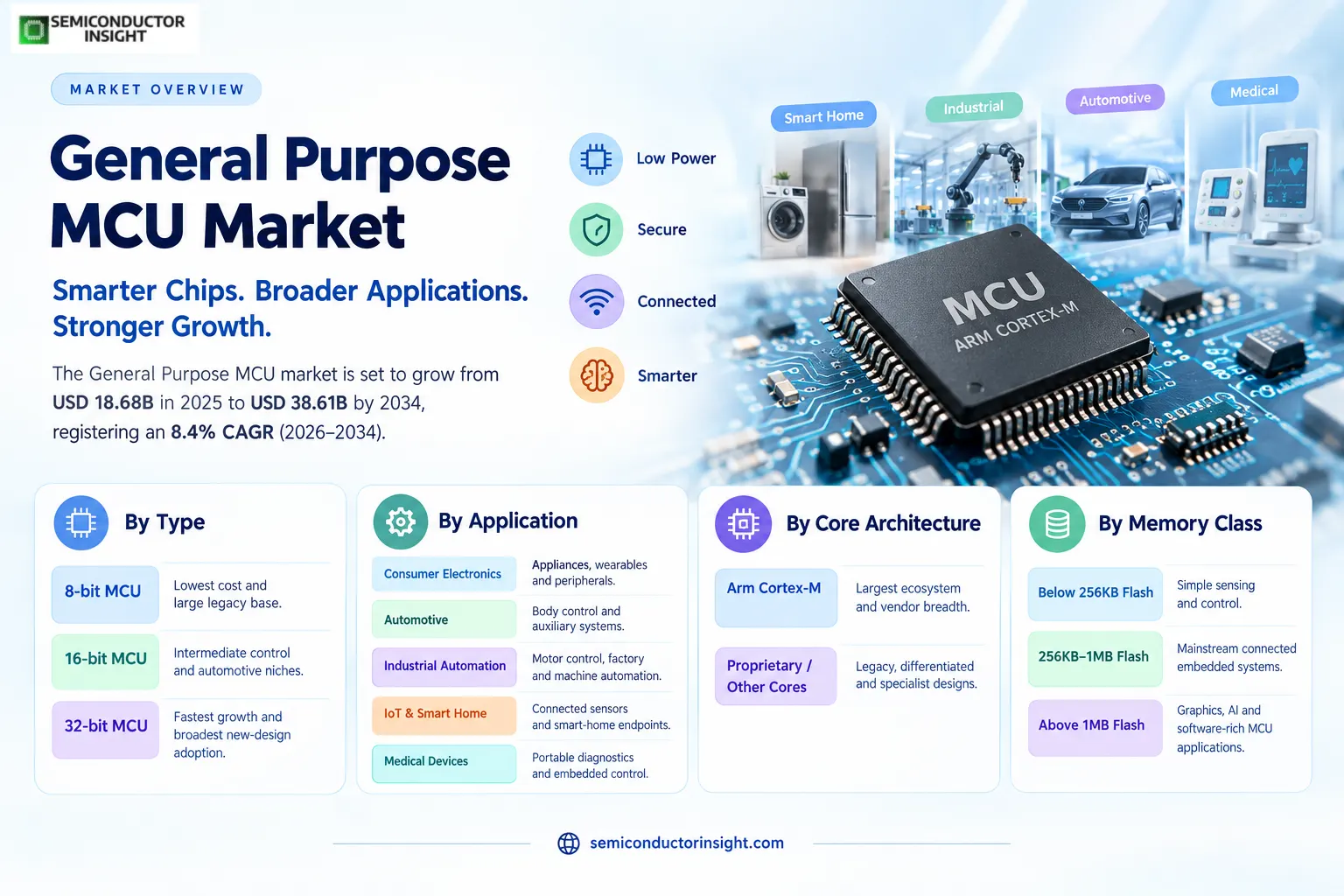
- The market is valued at USD 18.68 billion in 2025 and is projected to reach USD 38.61 billion by 2034, representing a 8.4% CAGR over 2026–2034.
- 8-bit MCU is a major product segment, while adjacent variants are expanding as performance, integration and cost requirements evolve.
- Consumer Electronics is a leading application area, supported by demand across Automotive, Industrial Automation.
- Asia Pacific is the largest market in 2025 based on current demand, manufacturing concentration and ecosystem maturity.
General Purpose MCU Market Overview
General Purpose MCU devices integrate a processor core, embedded flash and SRAM, timers, analog peripherals and communications interfaces into a single programmable chip. They provide deterministic low-power control for products ranging from appliances and smart-home devices to factory equipment, medical instruments and vehicle subsystems. Commercial adoption of General Purpose MCU products therefore depends on system-level productivity, integration requirements, reliability expectations and the economics of replacing established alternatives in real operating environments.
The market is shifting steadily toward 32-bit Arm Cortex-M devices with stronger security, connectivity and embedded intelligence. Suppliers are adding NPUs, high-resolution ADCs, motor-control peripherals and post-quantum-ready security while preserving long product lifecycles and pin compatibility, allowing MCUs to absorb functions once handled by separate controllers. Suppliers that translate technical improvements into measurable gains in efficiency, uptime, cost, throughput or workflow simplicity are better positioned to win long-duration programs and repeat purchases.
Segment Analysis: By Type
32-bit MCUs are the strongest growth segment because Arm Cortex-M and similar architectures deliver more performance, security and connectivity while remaining highly energy efficient. 8-bit and 16-bit devices retain large installed bases in simple control, appliances and cost-sensitive applications. Within this segment, customers increasingly compare lifecycle support, qualification requirements, integration effort and total ownership cost rather than relying on a single specification or upfront price.
| Segment | Market Relevance |
|---|---|
| 8-bit MCU | Lowest cost and large legacy base. |
| 16-bit MCU | Intermediate control and automotive niches. |
| 32-bit MCU | Fastest growth and broadest new-design adoption. |
Segment Analysis: By Application
Industrial automation, IoT and automotive are major growth applications because edge devices need real-time control, security and richer connectivity. Consumer electronics remains a large volume base, while medical products value long lifecycle support and deterministic behavior. Within this segment, customers increasingly compare lifecycle support, qualification requirements, integration effort and total ownership cost rather than relying on a single specification or upfront price.
| Segment | Market Relevance |
|---|---|
| Consumer Electronics | Appliances, wearables and peripherals. |
| Automotive | Body control and auxiliary vehicle systems. |
| Industrial Automation | Motor control, factory and machine automation. |
| IoT & Smart Home | Connected sensors and smart-home endpoints. |
| Medical Devices | Portable diagnostics and embedded control. |
Segment Analysis: By Core Architecture
Arm Cortex-M dominates new general-purpose designs because it offers a large software ecosystem and broad supplier choice. Proprietary cores remain important in legacy families and differentiated low-cost products where customers value pin compatibility and long design lifetimes. Within this segment, customers increasingly compare lifecycle support, qualification requirements, integration effort and total ownership cost rather than relying on a single specification or upfront price.
| Segment | Market Relevance |
|---|---|
| Arm Cortex-M | Largest ecosystem and vendor breadth. |
| Proprietary / Other Cores | Legacy, differentiated and specialist designs. |
Segment Analysis: By Memory Class
256KB–1MB flash is the mainstream range for connected embedded control, while above-1MB devices are expanding as MCUs add graphics, connectivity stacks, AI models and security software. Lower-memory products remain cost-effective for basic sensing and control. Within this segment, customers increasingly compare lifecycle support, qualification requirements, integration effort and total ownership cost rather than relying on a single specification or upfront price.
| Segment | Market Relevance |
|---|---|
| Below 256KB Flash | Simple sensing and control. |
| 256KB–1MB Flash | Mainstream connected embedded systems. |
| Above 1MB Flash | Graphics, AI and software-rich MCU applications. |
Regional Analysis
Asia Pacific leads through electronics, automotive and industrial manufacturing in China, Japan, South Korea and Taiwan. Europe and North America remain important design and application markets, especially for automotive, industrial, medical and IoT systems. Regional share also reflects supplier depth, engineering support, manufacturing concentration and the speed at which new General Purpose MCU designs can move from evaluation into repeat deployment.
| Region | Position | Growth | Profile |
|---|---|---|---|
| Asia Pacific | Largest | Very strong | Electronics manufacturing and IoT led |
| North America | High-value design market | Strong | Industrial, IoT and medical led |
| Europe | Automotive and industrial hub | Strong | Automotive, motor control and industrial led |
| South America | Emerging | Moderate | Industrial and consumer led |
| Middle East & Africa | Developing | Moderate-strong | IoT, energy and smart infrastructure led |
Detailed Regional Blocks
Why does Asia Pacific matter in this market?
Asia Pacific leads because most consumer electronics and a large share of embedded-control products are manufactured in the region. China adds a growing domestic MCU supplier base, while Japan has strong automotive and industrial demand. In Asia Pacific, procurement decisions also depend on service coverage, qualification resources, logistics and long-term availability, so ecosystem maturity can materially influence adoption even when core technology performance is similar.
| Country / Market | Role | Context |
|---|---|---|
| China | Largest volume market | Appliances, IoT and industrial electronics consume large MCU volumes. |
| Japan | Automotive and industrial hub | Renesas and other suppliers support long-lifecycle applications. |
| South Korea | Consumer and electronics market | Connected devices drive 32-bit MCU adoption. |
| Taiwan | Electronics manufacturing ecosystem | ODM and embedded-device production sustain demand. |
- NXP’s MCX A series uses Arm Cortex-M33 and targets scalable low-power general-purpose control.
- The MCX A26 integrates up to 1 MB flash, 256 KB RAM, CAN FD, I3C and advanced motor-control peripherals.
- Regional smart-home and factory automation growth increasingly favors secure 32-bit MCUs.
Why does North America matter in this market?
North America is a major design market through Microchip, Texas Instruments, Silicon Labs and large IoT, medical and industrial OEM bases. Customers emphasize long-term software support, security and low-power operation. In North America, procurement decisions also depend on service coverage, qualification resources, logistics and long-term availability, so ecosystem maturity can materially influence adoption even when core technology performance is similar.
| Country / Market | Role | Context |
|---|---|---|
| United States | Largest regional market | Industrial, medical and connected products drive diverse MCU demand. |
| Canada | IoT and industrial niche | Embedded control supports specialized products. |
| Mexico | Electronics manufacturing | Appliance and automotive assembly create downstream volume. |
- General-purpose MCU vendors increasingly integrate hardware security and machine-learning acceleration.
- Low-power operation remains critical for battery-powered IoT products.
- Software ecosystem quality can influence vendor choice as much as MCU specifications.
Why does Europe matter in this market?
Europe has strong MCU demand in automotive, power conversion and industrial automation. Infineon, STMicroelectronics and NXP maintain broad portfolios aligned with these markets. In Europe, procurement decisions also depend on service coverage, qualification resources, logistics and long-term availability, so ecosystem maturity can materially influence adoption even when core technology performance is similar.
| Country / Market | Role | Context |
|---|---|---|
| Germany | Automotive and automation hub | Motor control and vehicle electronics sustain premium MCUs. |
| France | Industrial and embedded market | Automation and smart-energy products create demand. |
| Netherlands | MCU supplier hub | NXP serves broad general-purpose and automotive markets. |
- Infineon launched the PSOC Control C3 Performance Line in September 2026 for real-time power and motor control.
- The family uses Arm Cortex-M33 multicore architecture and includes post-quantum-cryptography-oriented security support.
- European industrial users value long supply life and deterministic real-time control.
Why does South America matter in this market?
South America is an emerging MCU market led by Brazil, with demand from appliances, automotive electronics, energy and industrial automation. Most silicon is imported but local design and assembly create steady consumption. In South America, procurement decisions also depend on service coverage, qualification resources, logistics and long-term availability, so ecosystem maturity can materially influence adoption even when core technology performance is similar.
| Country / Market | Role | Context |
|---|---|---|
| Brazil | Largest regional market | Industrial and consumer electronics support MCUs. |
| Argentina | Embedded-design niche | Industrial and IoT projects create smaller demand. |
- 8-bit and low-cost 32-bit MCUs remain important in price-sensitive products.
- Distributor availability and software support influence design choices.
- Industrial automation is the strongest long-term opportunity.
Why does Middle East & Africa matter in this market?
Middle East and Africa demand is developing through smart buildings, metering, industrial monitoring and connected infrastructure. Volume is smaller than Asia, but IoT programs create steady embedded-control demand. In Middle East & Africa, procurement decisions also depend on service coverage, qualification resources, logistics and long-term availability, so ecosystem maturity can materially influence adoption even when core technology performance is similar.
| Country / Market | Role | Context |
|---|---|---|
| United Arab Emirates | Smart infrastructure market | Connected systems support MCU use. |
| Saudi Arabia | Industrial and smart-city investment | Embedded control expands with new projects. |
| South Africa | Regional electronics hub | Industrial and utility systems sustain demand. |
- Low-power MCUs are attractive for remote metering and sensor nodes.
- Secure boot and crypto become more important in connected infrastructure.
- Most devices are imported through global distributors and module suppliers.
Competitive Landscape
Infineon, STMicroelectronics, NXP, Microchip, Renesas, Texas Instruments, Analog Devices, Silicon Labs, GigaDevice and Chinese MCU vendors compete through core performance, analog integration, security, software tools, power consumption and long-term availability.
| Company | Competitive Context |
|---|---|
| Infineon Technologies | PSOC, XMC and related MCU families cover industrial, consumer and real-time control applications. |
| STMicroelectronics | STM32 is one of the broadest general-purpose 32-bit MCU ecosystems globally. |
| NXP Semiconductors | MCX general-purpose MCU portfolio spans scalable Cortex-M33 devices with rich peripherals and embedded intelligence. |
| Microchip Technology | Relevant participant with products, IP or system-level presence in this market. |
| Renesas Electronics | Relevant participant with products, IP or system-level presence in this market. |
| Texas Instruments | Relevant participant with products, IP or system-level presence in this market. |
| Analog Devices | Relevant participant with products, IP or system-level presence in this market. |
| Silicon Labs | Relevant participant with products, IP or system-level presence in this market. |
| GigaDevice | Relevant participant with products, IP or system-level presence in this market. |
| Nations Technologies | Relevant participant with products, IP or system-level presence in this market. |
Production Capacity Analysis
MCU capacity relies heavily on mature and midrange CMOS process nodes, embedded flash, analog integration, package assembly and extensive final test. Unlike leading-edge processors, wafer supply can often be expanded across several fabs, but automotive and long-lifecycle products require qualified capacity. Scaling output without degrading consistency requires stable upstream materials, disciplined process control and final testing that catches performance drift before products reach high-value customer systems.
Software tools and ecosystem support are a major part of effective capacity. Development kits, compilers, middleware and long-term firmware maintenance determine how quickly customers can adopt new families and migrate from older devices. Second-source planning and regional technical support therefore become increasingly important as deployments expand and buyers seek supply continuity without repeating lengthy qualification work.
Market Dynamics
The market is moving upward in capability while preserving MCU-class power and determinism. More devices now include DSP extensions, NPUs, secure enclaves and richer communications without becoming full application processors. This is changing competitive behavior because vendors increasingly sell system-level value, workflow integration and lifecycle economics rather than an isolated component specification.
At the same time, 8-bit and 16-bit products remain resilient because many embedded functions do not need 32-bit performance. Suppliers therefore maintain broad portfolios rather than forcing every application onto the newest architecture. Buyers consequently evaluate total ownership cost, qualification effort and roadmap stability across the life of a program instead of focusing only on initial purchase price.
Market Drivers
IoT growth
Industrial automation
Automotive electronics
Edge intelligence
Market Restraints
Strong price competition
Long design cycles
Embedded-flash complexity
Software fragmentation
Market Opportunities
AI-enabled MCUs
Secure connected control
Motor-control MCUs
RISC-V alternatives
Supply Chain Analysis
The value chain combines MCU architecture, embedded-flash and mixed-signal wafer fabrication, package assembly, software tools and distribution. Success depends on both silicon breadth and developer ecosystem. Traceability and coordination between component suppliers, integrators and end users are important because failures found late in the chain can be far more expensive than the underlying part itself.
| Stage | Role |
|---|---|
| MCU architecture and IP | CPU, memory, analog and peripheral subsystems are integrated. |
| Wafer fabrication | Mature CMOS and embedded-flash processes manufacture the devices. |
| Packaging and final test | MCUs are assembled into QFN, LQFP, BGA and other packages. |
| Developer ecosystem and distribution | Software, boards and channel support enable broad design adoption. |
Recent Developments
Report Scope & Segmentation
| Base Year | 2025 |
| Estimated Year | 2026 |
| Forecast Year | 2034 |
| Forecast Period | 2026–2034 |
| Market Size, 2025 | USD 18.68 billion |
| Projected Market Size, 2034 | USD 38.61 billion |
| CAGR, 2026–2034 | 8.4% |
| Largest Market in 2025 | Asia Pacific |
| Segmentation Coverage | By Type, By Application, By Core Architecture, By Memory Class |
Frequently Asked Questions
What is the General Purpose MCU market size in 2025?
The market is valued at USD 18.68 billion in 2025.
What is the projected General Purpose MCU market size by 2034?
The market is projected to reach USD 38.61 billion by 2034.
What is the CAGR for the General Purpose MCU market from 2026 to 2034?
The market is projected to expand at a 8.4% CAGR from 2026 to 2034.
Which region leads the General Purpose MCU market?
Asia Pacific is the largest market in 2025.
What are the main types in the General Purpose MCU market?
Key types include 8-bit MCU, 16-bit MCU, 32-bit MCU.
What are the main applications for General Purpose MCU?
Major applications include Consumer Electronics, Automotive, Industrial Automation, IoT & Smart Home, Medical Devices.
What is driving growth in the General Purpose MCU market?
Connected endpoints require low-power control, security and communications.
What is a key restraint for the General Purpose MCU market?
MCU ASPs are pressured by many global suppliers.
Which companies are important in the General Purpose MCU market?
Important participants include Infineon Technologies, STMicroelectronics, NXP Semiconductors, Microchip Technology, Renesas Electronics, Texas Instruments.
What opportunity is emerging in the General Purpose MCU market?
NPUs can run local classification at very low power.
Research Sources & Evidence Base
View research sources used for this overview.
- NXP — General Purpose MCUs: Current Arm Cortex-M general-purpose MCU portfolio and use cases.
- NXP — MCX A26: Current Cortex-M33 MCU performance, memory and peripheral specifications.
- Infineon Technologies — Microcontrollers: Current PSOC, XMC and related general-purpose MCU families.

Get Sample Report PDF for Exclusive Insights
Report Sample Includes
- Table of Contents
- List of Tables & Figures
- Charts, Research Methodology, and more...
 Download Sample Report PDF