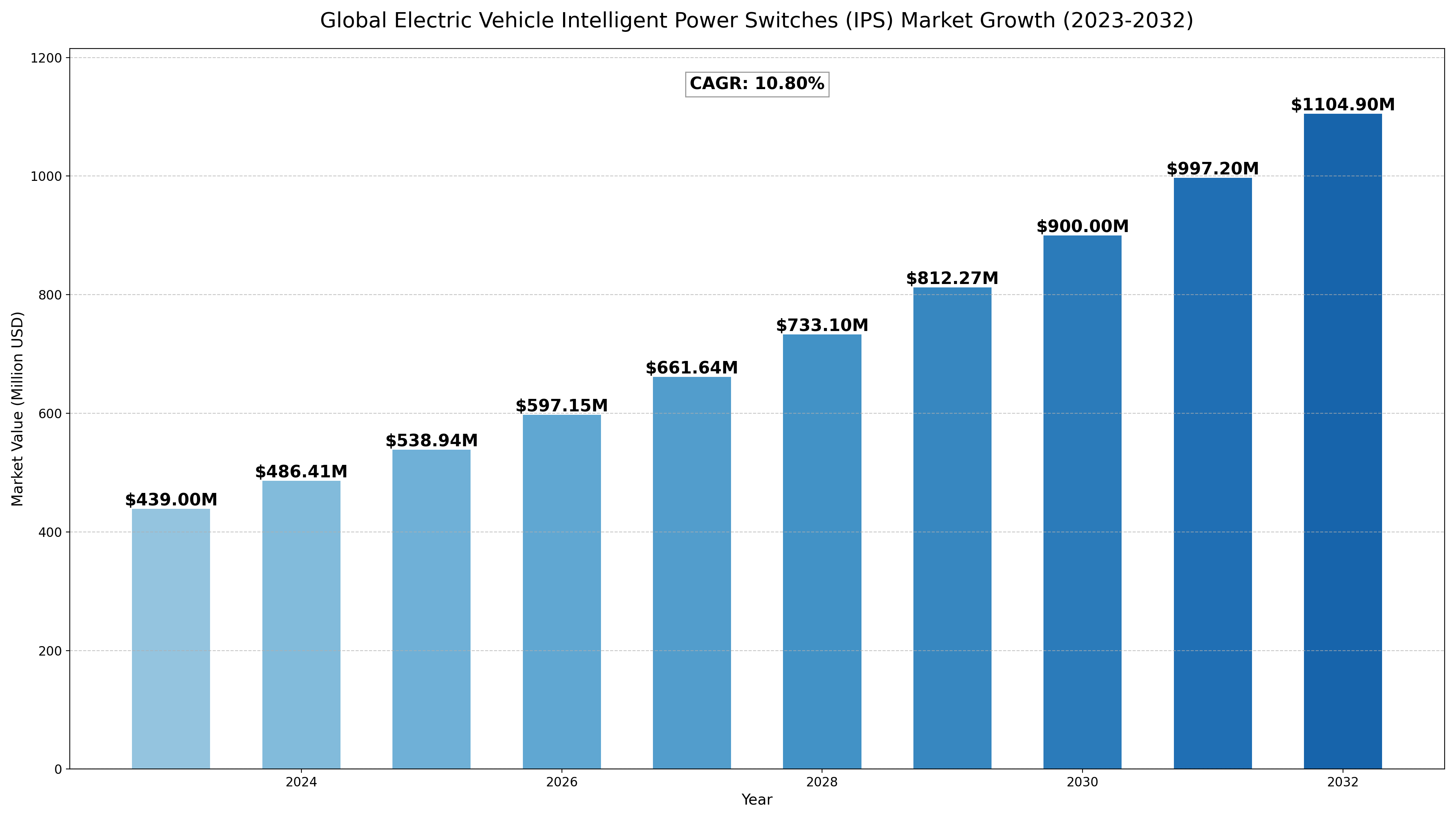
The Global Electric Vehicle Intelligent Power Switches(IPS) Market size was estimated at USD 439 million in 2023 and is projected to reach USD 1104.90 million by 2032, exhibiting a CAGR of 10.80% during the forecast period.
North America Electric Vehicle Intelligent Power Switches(IPS) market size was estimated at USD 136.55 million in 2023, at a CAGR of 9.26% during the forecast period of 2025 through 2032.
Electric Vehicle Intelligent Power Switches (IPS): Advanced semiconductor devices used in electric vehicles (EVs) to manage and control the flow of electrical power within the vehicle’s powertrain and battery systems. IPS ensures efficient power distribution, protects against overcurrent and short circuits, and enhances overall energy efficiency, safety, and system reliability.
Report Overview
Intelligent Power Switches (IPSs) are particularly appreciated in the automotive environment, where they have to deal with some of the worst electrical conditions – including ground loss or offset, voltage peaks, reverse or disconnected battery, and load dump. IPSs protect against all these conditions, while driving loads ranging from power relays and electrovalves to motors and lamps.
This report provides a deep insight into the global Electric Vehicle Intelligent Power Switches(IPS) market covering all its essential aspects. This ranges from a macro overview of the market to micro details of the market size, competitive landscape, development trend, niche market, key market drivers and challenges, SWOT analysis, value chain analysis, etc.
The analysis helps the reader to shape the competition within the industries and strategies for the competitive environment to enhance the potential profit. Furthermore, it provides a simple framework for evaluating and accessing the position of the business organization. The report structure also focuses on the competitive landscape of the Global Electric Vehicle Intelligent Power Switches(IPS) Market, this report introduces in detail the market share, market performance, product situation, operation situation, etc. of the main players, which helps the readers in the industry to identify the main competitors and deeply understand the competition pattern of the market.
In a word, this report is a must-read for industry players, investors, researchers, consultants, business strategists, and all those who have any kind of stake or are planning to foray into the Electric Vehicle Intelligent Power Switches(IPS) market in any manner.
Global Electric Vehicle Intelligent Power Switches(IPS) Market: Market Segmentation Analysis
The research report includes specific segments by region (country), manufacturers, Type, and Application. Market segmentation creates subsets of a market based on product type, end-user or application, Geographic, and other factors. By understanding the market segments, the decision-maker can leverage this targeting in the product, sales, and marketing strategies. Market segments can power your product development cycles by informing how you create product offerings for different segments.
Key Company
- STMicroelectronics
- Infineon
- Diodes lncorporated
- ROHM
- Renesas
- Fuji Electric
- Texas Instruments
- Microchip
- onsemi
- Toshiba
- 12V
- 24V
- Others
- Commercial Vehicle
- Passenger Vehicle
- North America (USA, Canada, Mexico)
- Europe (Germany, UK, France, Russia, Italy, Rest of Europe)
- Asia-Pacific (China, Japan, South Korea, India, Southeast Asia, Rest of Asia-Pacific)
- South America (Brazil, Argentina, Columbia, Rest of South America)
- The Middle East and Africa (Saudi Arabia, UAE, Egypt, Nigeria, South Africa, Rest of MEA)
- Industry drivers, restraints, and opportunities covered in the study
- Neutral perspective on the market performance
- Recent industry trends and developments
- Competitive landscape & strategies of key players
- Potential & niche segments and regions exhibiting promising growth covered
- Historical, current, and projected market size, in terms of value
- In-depth analysis of the Electric Vehicle Intelligent Power Switches(IPS) Market
- Overview of the regional outlook of the Electric Vehicle Intelligent Power Switches(IPS) Market:
- Access to date statistics compiled by our researchers. These provide you with historical and forecast data, which is analyzed to tell you why your market is set to change
- This enables you to anticipate market changes to remain ahead of your competitors
- You will be able to copy data from the Excel spreadsheet straight into your marketing plans, business presentations, or other strategic documents
- The concise analysis, clear graph, and table format will enable you to pinpoint the information you require quickly
- Provision of market value data for each segment and sub-segment
- Indicates the region and segment that is expected to witness the fastest growth as well as to dominate the market
- Analysis by geography highlighting the consumption of the product/service in the region as well as indicating the factors that are affecting the market within each region
- Competitive landscape which incorporates the market ranking of the major players, along with new service/product launches, partnerships, business expansions, and acquisitions in the past five years of companies profiled
- Extensive company profiles comprising of company overview, company insights, product benchmarking, and SWOT analysis for the major market players
- The current as well as the future market outlook of the industry concerning recent developments which involve growth opportunities and drivers as well as challenges and restraints of both emerging as well as developed regions
- Includes in-depth analysis of the market from various perspectives through Porters five forces analysis
- Provides insight into the market through Value Chain
- Market dynamics scenario, along with growth opportunities of the market in the years to come
- 6-month post-sales analyst support
Customization of the Report
In case of any queries or customization requirements, please connect with our sales team, who will ensure that your requirements are met.
1. Drivers
1.1. Rising Demand for Electric Vehicles (EVs) The growing shift towards electric mobility, driven by government incentives, environmental regulations, and consumer demand for sustainable transport, is a primary driver for the Electric Vehicle Intelligent Power Switches (IPS) market. As EV adoption increases, the demand for efficient power management systems also rises. IPS solutions play a vital role in optimizing power distribution, reducing energy losses, and enhancing overall vehicle efficiency.
1.2. Technological Advancements in Power Electronics Advancements in power electronics, including the development of wide-bandgap semiconductors like silicon carbide (SiC) and gallium nitride (GaN), are driving the growth of the IPS market. These materials enable higher efficiency, faster switching speeds, and smaller form factors, making them ideal for EV power systems. The evolution of semiconductor technology allows IPS devices to handle higher voltages and temperatures, thereby supporting next-generation EV architectures.
1.3. Emphasis on Vehicle Safety and Battery Protection Intelligent Power Switches play a critical role in ensuring EV safety by managing overcurrent, short circuits, and thermal runaway conditions. As automakers prioritize safety features to differentiate their products, the demand for advanced IPS solutions with integrated fault detection and protection mechanisms is growing. This trend is further amplified by regulatory standards mandating stringent safety protocols for electric vehicles.
1.4. Growth in EV Charging Infrastructure The rapid development of EV charging infrastructure, particularly high-speed charging stations, necessitates the use of IPS for efficient power flow control. IPS solutions help manage voltage fluctuations and load balancing, ensuring smooth power transfer from the grid to the vehicle’s battery. This dynamic control capability is essential for supporting ultra-fast charging, which is a key differentiator in the competitive EV market.
2. Restraints
2.1. High Initial Cost of Intelligent Power Switches The high cost of developing and producing intelligent power switches, particularly those made with wide-bandgap semiconductors, poses a significant restraint. Compared to traditional silicon-based components, SiC and GaN devices have higher manufacturing costs. This cost disparity can affect the profitability of EV manufacturers and limit the widespread adoption of IPS solutions in budget and mid-range EV models.
2.2. Design Complexity and Integration Challenges Integrating IPS solutions into existing EV powertrains and battery management systems (BMS) requires significant design and engineering efforts. The complexity of ensuring compatibility with various EV architectures increases development time and costs for automakers and Tier 1 suppliers. This integration challenge can delay the commercialization of new EV models and impact market growth.
2.3. Supply Chain Disruptions and Semiconductor Shortages Global semiconductor shortages and supply chain disruptions have adversely impacted the availability of critical components used in IPS devices. Raw material constraints and geopolitical factors have created bottlenecks in the production of power semiconductors. Such supply chain vulnerabilities affect production timelines, leading to delayed EV rollouts and reduced market growth for IPS solutions.
2.4. Thermal Management Issues IPS devices operate in high-voltage, high-temperature environments, which poses significant thermal management challenges. Excessive heat generation can affect the reliability and lifespan of IPS components, leading to higher maintenance costs. The need for advanced thermal management solutions adds to the overall system cost and complexity.
3. Opportunities
3.1. Expansion of the EV Market in Emerging Economies The expansion of EV adoption in emerging economies, particularly in Asia-Pacific and Latin America, presents significant growth opportunities for the IPS market. Governments in these regions are promoting EV adoption through subsidies, tax incentives, and infrastructure investments. As a result, demand for cost-effective and efficient IPS solutions is expected to rise in these price-sensitive markets.
3.2. Integration of Advanced Control Features The development of IPS devices with advanced features such as predictive analytics, self-diagnosis, and adaptive control is creating new revenue streams. Next-generation IPS devices with AI-based control algorithms can optimize power usage, predict system failures, and reduce downtime. These smart features are becoming essential for automakers striving to improve the reliability and intelligence of EVs.
3.3. Rise of Wireless Charging for EVs The rise of wireless EV charging systems presents a new growth avenue for the IPS market. Wireless charging requires precise power management to ensure energy transfer efficiency. Intelligent Power Switches enable the seamless control of power flow, minimizing energy loss during inductive charging. As wireless charging infrastructure expands, demand for IPS solutions is expected to grow.
3.4. Development of Vehicle-to-Grid (V2G) Technology The growing interest in Vehicle-to-Grid (V2G) technology, where EVs can send excess power back to the grid, creates a need for sophisticated power management systems. IPS devices play a key role in facilitating bi-directional energy flow. As V2G becomes a core element of future energy grids, the adoption of IPS solutions will increase, offering lucrative opportunities for market players.
4. Challenges
4.1. Intense Competition and Pricing Pressure The IPS market is highly competitive, with numerous players vying for market share. Companies are under pressure to offer cost-competitive solutions while maintaining product quality and performance. The entry of new market participants and the growing preference for open-source designs could further intensify price competition, affecting profit margins.
4.2. Evolving Regulatory Landscape The IPS market is subject to evolving regulations governing EV power systems and electronic components. Regional variations in safety and performance standards add complexity for manufacturers attempting to create globally compliant products. Navigating these regulatory hurdles increases development costs and time-to-market.
4.3. Reliability and Durability Issues Ensuring the long-term reliability and durability of IPS devices in harsh automotive environments is a persistent challenge. Vibration, shock, temperature extremes, and exposure to contaminants can affect component performance. Addressing these reliability issues requires rigorous testing, which increases production costs and slows down product development.
4.4. Limited Technical Expertise and Workforce Shortage The IPS market requires specialized technical expertise in semiconductor design, power electronics, and automotive engineering. The shortage of skilled labor, particularly in the field of wide-bandgap semiconductor design, poses a challenge for market players. Companies must invest in workforce training and talent acquisition to bridge the skills gap and drive innovation in IPS technology.

Get Sample Report PDF for Exclusive Insights
Report Sample Includes
- Table of Contents
- List of Tables & Figures
- Charts, Research Methodology, and more...