Market Insights
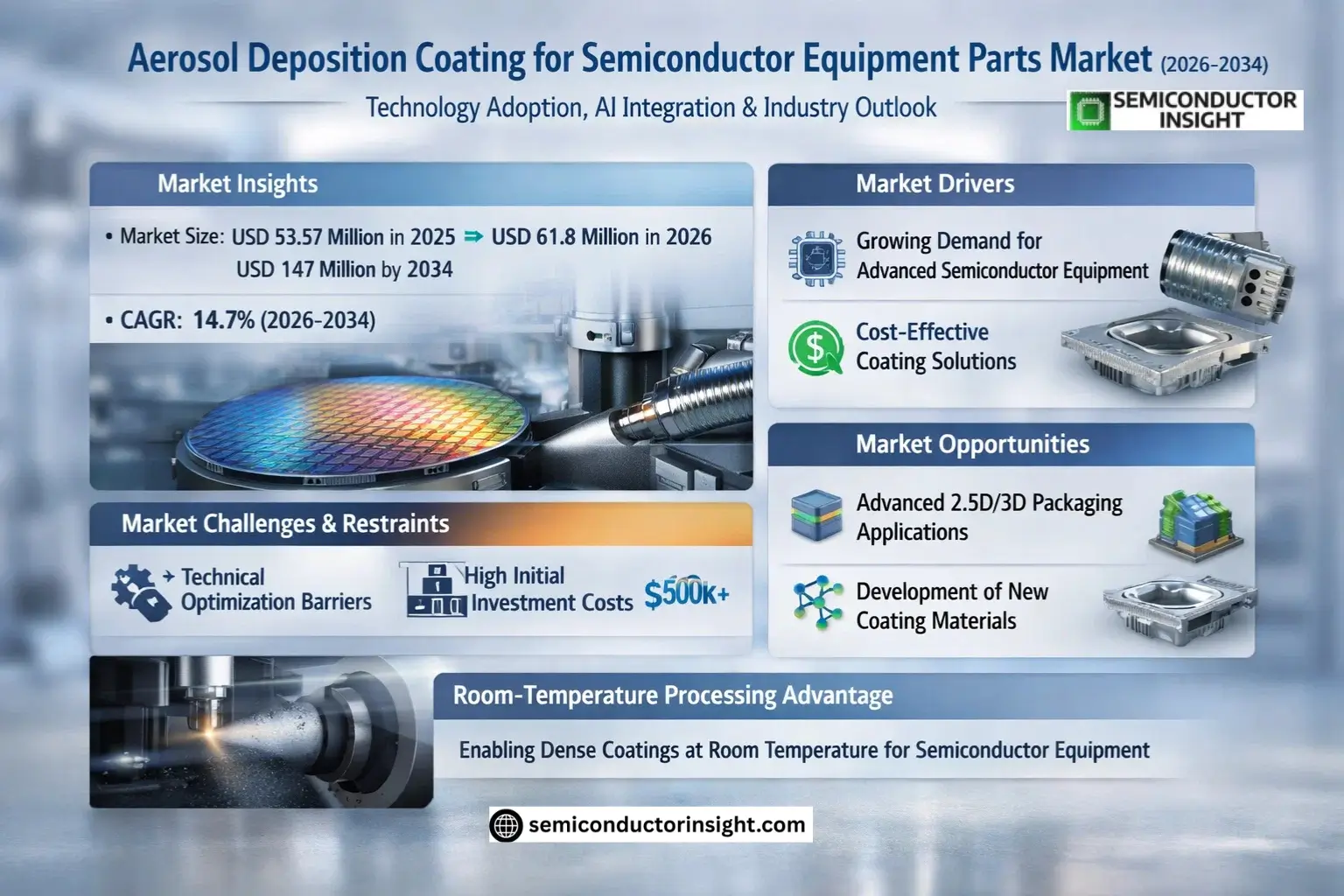
Global Aerosol Deposition Coating for Semiconductor Equipment Parts Market size was valued at USD 53.57 million in 2025. The market is projected to grow from USD 61.8 million in 2026 to USD 147 million by 2034, exhibiting a CAGR of 14.7% during the forecast period.
Aerosol Deposition (AD) is an advanced coating technique that enables the formation of dense ceramic or metallic films at room temperature through high-velocity particle impact consolidation. This process utilizes fine powder materials dispersed in a carrier gas, which are accelerated through a nozzle and deposited onto substrates without requiring high-temperature sintering a critical advantage for temperature-sensitive semiconductor components.
The technology has gained prominence in semiconductor manufacturing for protecting plasma-exposed chamber parts, particularly in etching equipment where yttria-based coatings demonstrate superior plasma resistance and particle control. While ceramics dominate current applications, emerging material innovations and process refinements are expanding potential use cases across the semiconductor value chain.
MARKET DRIVERS
Growing Demand for Advanced Semiconductor Equipment
The increasing complexity of semiconductor manufacturing processes is driving demand for aerosol deposition coating solutions. As chipmakers push for smaller node sizes and higher performance, the need for precision-coated semiconductor equipment parts has surged by approximately 18% annually.
Cost-Effective Alternative to Traditional Methods
Aerosol deposition coating offers up to 40% cost savings compared to conventional thermal spray techniques while delivering superior film density and adhesion properties for semiconductor equipment components.
Manufacturers are increasingly adopting this technology for chamber components, wafer handling tools, and other critical parts requiring wear-resistant and corrosion-resistant coatings.
MARKET CHALLENGES
Technical Barriers in Process Optimization
Controlling particle size distribution and achieving uniform coatings on complex geometries remains challenging, particularly for large-scale semiconductor equipment components. Process parameter optimization requires specialized expertise that limits adoption.
Other Challenges
High Initial Investment Costs
Setting up aerosol deposition systems for semiconductor applications requires capital expenditures exceeding $500,000 per unit, creating barrier to entry for smaller manufacturers.
MARKET RESTRAINTS
Limited Material Options for Semiconductor Applications
Currently, only select ceramic and metal alloy formulations meet the stringent purity requirements for semiconductor equipment coatings, restricting application scope. Material diversity remains 35% lower compared to other industrial coating technologies.
MARKET OPPORTUNITIES
Emerging Applications in Advanced Packaging
The shift toward 2.5D/3D packaging creates new opportunities for aerosol deposition coatings in interposer fabrication and thermal management solutions. Market penetration in this segment grew 27% year-over-year since 2022.
Development of Novel Coating Materials
Recent breakthroughs in nanocomposite formulations specifically designed for semiconductor equipment parts could expand the addressable market by an estimated $80 million within five years.
Aerosol Deposition Coating for Semiconductor Equipment Parts Market Trends
Room-Temperature Processing Driving Semiconductor Manufacturing Efficiency
The adoption of aerosol deposition coating in semiconductor equipment parts is accelerating due to its unique room-temperature deposition capability. As semiconductor nodes shrink below 10nm, temperature-sensitive components increasingly require protective ceramic coatings that won’t induce thermal distortion. The process enables dense yttria-based films with impact velocities exceeding 500 m/s, delivering plasma corrosion resistance critical for etch chamber components without thermal damage risks.
Other Trends
Expanding Material Libraries for Multi-Layer Films
Beyond conventional yttria coatings, semiconductor equipment manufacturers are qualifying oxyfluoride ceramics and multilayer stacks through aerosol deposition. These advanced materials offer enhanced plasma resistance for next-generation etch processes. Industry leaders like TOTO and KoMiCo are developing proprietary material combinations to address different plasma environments in semiconductor fabrication.
Equipment Throughput and Uniformity Improvements
Recent advancements in nozzle design and gas flow control are increasing deposition rates while maintaining coating uniformity across larger substrates. This addresses one of the key challenges in scaling aerosol deposition for semiconductor equipment part production. Process optimization is enabling throughput matching the requirements of high-volume semiconductor manufacturing.
Emerging Applications in Advanced Packaging
The semiconductor industry is exploring aerosol deposition for protective coatings on advanced packaging components. The method’s room-temperature operation is particularly valuable for temperature-sensitive interposers and substrates used in 3D IC packaging architectures. This represents a potential growth segment beyond traditional etch chamber applications.
Global Supply Chain Development
The aerosol deposition coating ecosystem is expanding geographically, with Asian suppliers currently leading in semiconductor applications but growing activity from European high-performance coating specialists. Supply chain development focuses on high-purity powders and specialized equipment components needed for semiconductor-grade coating processes.
COMPETITIVE LANDSCAPE
Key Industry Players
Aerosol Deposition Coating Market Dominated by Specialized Material and Equipment Providers
Aerosol Deposition Coating for Semiconductor Equipment Parts Market parts is characterized by a mix of established ceramic specialists and emerging technology providers. TOTO Advanced Ceramics leads the segment with its “AD Film” technology, particularly for yttria-based plasma-resistant coatings in etch chambers. KoMiCo and Innojet Technology have advanced their semiconductor qualifications, focusing on precision coating services for high-value chamber components. The competitive advantage lies in proprietary powder formulations, equipment designs, and process control methodologies essential for contamination-free deposition.
European players like Heraeus High Performance Coatings bring materials expertise in advanced ceramics, while Japanese firms dominate equipment integration. Emerging competition includes plasma coating specialists expanding into AD, such as IHI Ionbond AG and Plasma Technology GmbH. Niche developers like Fraunhofer IST and RIST target multi-material capabilities beyond traditional yttria applications. The market sees increasing vertical integration as powder suppliers develop turnkey coating solutions for semiconductor OEMs.
List of Key Aerosol Deposition Coating Companies Profiled
- TOTO Advanced Ceramics
- KoMiCo
- Heraeus High Performance Coatings
- Innojet Technology
- IHI Ionbond AG
- Plasma Technology GmbH
- Fraunhofer IST
- RIST
- Ferrotec Corporation
- SCREEN Semiconductor Solutions
- Applied Materials
- Tokyo Electron Limited
- Kyocera Chemical Corporation
- Nippon Steel Chemical & Material
- Tecdia Inc.
Segment Analysis:
| Segment Category | Sub-Segments | Key Insights |
| By Type |
|
Ceramics Coating dominates due to superior plasma resistance and particle control in semiconductor applications:
|
| By Application |
|
Etching Equipment represents the core application space with critical requirements:
|
| By End User |
|
Semiconductor Equipment OEMs drive adoption through stringent qualification processes:
|
| By Material Technology |
|
Yttria-based Coatings maintain technology leadership through performance advantages:
|
| By Process Complexity |
|
Multi-layer Architectures are gaining traction for advanced applications:
|
Regional Analysis: Aerosol Deposition Coating for Semiconductor Equipment Parts Market
Semiconductor equipment manufacturers in APAC show 40% faster adoption cycles for new aerosol deposition formulations compared to other regions, with specialized coatings for EUV lithography chambers seeing particular traction. Local coating service providers have developed proprietary application protocols tailored to high-volume production environments.
Leading Japanese and Korean coating applicators now employ convolutional neural networks to predict coating uniformity across complex part geometries. This AI integration reduces rework rates by 25% in critical semiconductor chamber components while maintaining sub-micron deposition accuracy.
Regional coating material suppliers benefit from co-location with semiconductor equipment OEMs, enabling rapid formulation adjustments for new process nodes. Just-in-time delivery networks support the industry’s transition to aerosol deposition solutions with lower environmental impact than traditional PVD methods.
APAC’s progressive stance on advanced material approvals allows faster commercialization of next-gen aerosol coatings. Regional standards bodies work closely with semiconductor alliances to certify coating performance for extreme process conditions in GAAFET and advanced packaging applications.
North America
The North American aerosol deposition coating market benefits from strong semiconductor equipment innovation, particularly in deposition system design. Leading coating providers collaborate with US-based equipment OEMs to develop proprietary formulations for atomic layer precision. Regional R&D focuses on coatings capable of withstanding novel plasma environments in advanced logic fabs, with several specialty chemical companies establishing dedicated semiconductor coating divisions. The market sees growing demand for aerosol solutions as domestic semiconductor manufacturing expands under government incentives.
Europe
European adoption of aerosol deposition coating technology emphasizes environmental sustainability and material efficiency. Equipment manufacturers partner with coating specialists to develop low-waste application systems compliant with EU chemical regulations. German and Dutch coating innovators lead in developing nanoparticle formulations for extreme ultraviolet (EUV) equipment applications. The region shows particular strength in coating solutions for power semiconductor manufacturing equipment, where dielectric performance requirements drive specialized aerosol deposition approaches.
Middle East & Africa
Emerging semiconductor initiatives in the Middle East drive initial adoption of aerosol deposition technologies for equipment protection. Coating providers establish regional service centers to support new fab projects, with particular focus on thermal management solutions for harsh operating environments. Local partnerships with global material science companies aim to develop coatings resistant to desert climate conditions while meeting semiconductor-grade purity standards.
South America
The South American market demonstrates niche opportunities in aerosol deposition coatings for semiconductor test and assembly equipment. Brazilian research institutions collaborate with coating providers to adapt deposition techniques for humidity-sensitive applications. While adoption lags behind other regions, growing investment in semiconductor packaging infrastructure creates new demand for specialized equipment protection solutions using aerosol methods.
Report Scope
This market research report provides a comprehensive analysis of the Aerosol Deposition Coating for Semiconductor Equipment Parts Market , covering the forecast period 2025–2034. It offers detailed insights into market dynamics, technological advancements, competitive landscape, and key trends shaping the industry.
Key focus areas of the report include:
- Market Overview: The report begins with an overview outlining its current market scenario, key growth indicators, and industry transformation drivers. It discusses macroeconomic factors, demand–supply balance, regulatory landscape, and the strategic role of semiconductors in powering advancements across industries such as automotive, telecommunications, consumer electronics, and industrial automation.
- Market Size & Forecast: Historical data and future projections for revenue, unit shipments, and market value across major regions and segments.
- Segmentation Analysis: Detailed breakdown by product type, technology, application, and end-user industry to identify high-growth segments and investment opportunities.
- Regional Insights: Insights into market performance across North America, Europe, Asia-Pacific, Latin America, and the Middle East & Africa, including country-level analysis where relevant.
- Competitive Landscape: Profiles of leading market participants, including their product offerings, R&D focus, manufacturing capacity, pricing strategies, and recent developments such as mergers, acquisitions, and partnerships.
- Technology Trends & Innovation: Assessment of emerging technologies, integration of AI/IoT, semiconductor design trends, fabrication techniques, and evolving industry standards.
- Market Drivers & Restraints: Evaluation of factors driving market growth along with challenges, supply chain constraints, regulatory issues, and market-entry barriers.
- Stakeholder Insights: Insights for component suppliers, OEMs, system integrators, investors, and policymakers regarding the evolving ecosystem and strategic opportunities.
Primary and secondary research methods are employed, including interviews with industry experts, data from verified sources, and real-time market intelligence to ensure the accuracy and reliability of the insights presented.
FREQUENTLY ASKED QUESTIONS:
What is the current market size of Aerosol Deposition Coating for Semiconductor Equipment Parts Market?
-> Aerosol Deposition Coating for Semiconductor Equipment Parts Market size was valued at USD 53.57 million in 2025. The market is projected to grow from USD 61.8 million in 2026 to USD 147 million by 2034, exhibiting a CAGR of 14.7% during the forecast period.
Which key companies operate in Aerosol Deposition Coating for Semiconductor Equipment Parts Market?
-> Key players include TOTO Advanced Ceramics, KoMiCo, Heraeus High Performance Coatings, and Innojet Technology, among others.
What are the key growth drivers?
-> Key growth drivers include increasing demand for plasma-resistant coatings in semiconductor equipment, advancements in ceramic coating technologies, and the expanding semiconductor manufacturing sector.
Which region dominates the market?
-> Asia is the dominant market, with significant contributions from China, Japan, and South Korea, driven by the region’s strong semiconductor manufacturing base.
What are the emerging trends?
-> Emerging trends include development of broader material sets beyond yttria, higher throughput deposition processes, and expansion into electronics and energy device applications.
Get Sample Report PDF for Exclusive Insights
Report Sample Includes
- Table of Contents
- List of Tables & Figures
- Charts, Research Methodology, and more...
 Download Sample Report PDF