Glass Substrate for AR/MR Wearables Market Insights
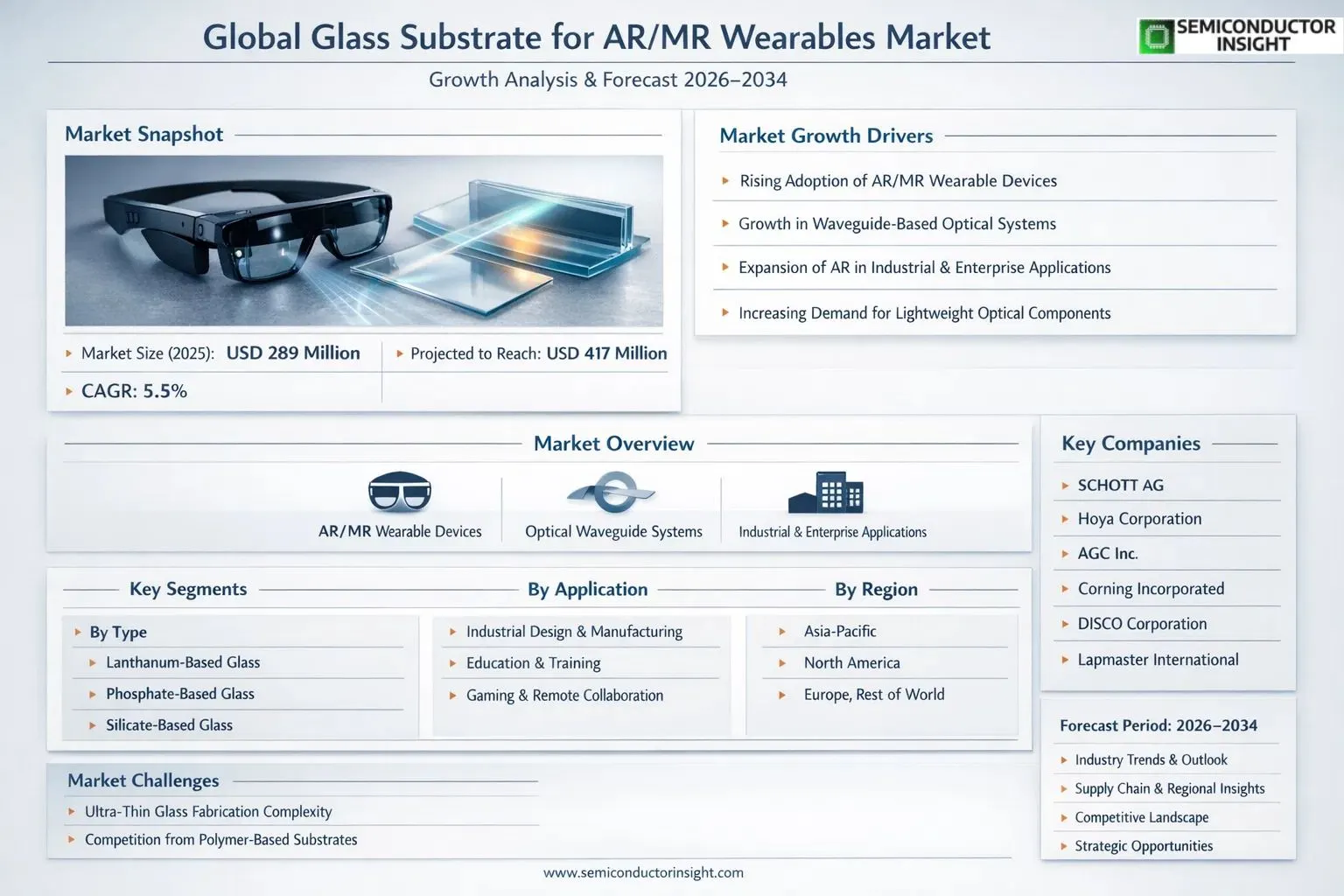
Global Glass Substrate for AR/MR Wearables market size was valued at USD 289 million in 2025. The market is projected to grow from USD 305 million in 2026 to USD 417 million by 2034, exhibiting a CAGR of 5.5% during the forecast period.
Glass Substrate for AR/MR Wearables is a high-precision optical material specifically engineered for augmented reality and mixed reality wearable devices, characterized by high transmittance, elevated refractive index, and excellent thermal stability. Functioning as the core carrier for light propagation and image projection, these substrates utilize micro- and nano-structured surface processing to efficiently guide and control light, minimizing optical loss and distortion while preserving image clarity and delivering an immersive user experience. The product range encompasses Lanthanum-Based Glass, Phosphate-Based Glass, Silicate-Based Glass, and other specialty optical substrate types, differentiated further by refractive index classifications and varying thickness specifications.
The market is witnessing consistent growth driven by the rapid adoption of AR/MR wearable devices across gaming, education and training, remote collaboration, and industrial design applications. Furthermore, innovations in nanofabrication precision and optical integration continue to raise performance benchmarks across the industry. Key players operating across the industrial chain include upstream optical glass material manufacturers such as SCHOTT, Hoya, DISCO, and Lapmaster, while downstream demand is increasingly shaped by leading device makers including Apple, Microsoft, and Magic Leap, whose expanding AR/MR device portfolios are directly fueling substrate procurement volumes.
MARKET DRIVERS
Rising Demand for Lightweight, High-Precision Optical Components in Next-Generation AR/MR Headsets
The Glass Substrate for AR/MR Wearables Market is experiencing robust momentum as device manufacturers increasingly prioritize optical clarity, dimensional stability, and thermal resistance in their next-generation platforms. Glass substrates serve as the foundational layer for waveguide optics, combiner lenses, and display panels embedded within augmented and mixed reality headsets. Their superior refractive index control and surface flatness make them indispensable for achieving high-resolution, low-distortion imagery that modern AR/MR applications demand. As enterprise deployments in sectors such as manufacturing, healthcare, and logistics accelerate, the performance benchmarks for optical components continue to rise, directly stimulating demand for precision-engineered glass substrates.
Expansion of Waveguide-Based Display Architectures Fueling Substrate Innovation
Waveguide-based display technologies, including diffractive and reflective waveguides, rely critically on ultra-thin, chemically strengthened glass substrates to propagate light efficiently from the projector to the user’s eye. The shift toward slimmer, consumer-friendly AR/MR form factors is compelling substrate manufacturers to develop glass compositions with tighter thickness tolerances,often below 0.5 mm,while maintaining exceptional mechanical durability. This technical evolution is a key driver for the Glass Substrate for AR/MR Wearables Market, as each new waveguide architecture iteration necessitates customized glass formulations that balance refractive index, Abbe number, and scratch resistance in ways that conventional display glass cannot fulfill.
➤ The convergence of consumer AR adoption and enterprise mixed reality solutions is creating sustained, multi-year procurement cycles for specialty glass substrates, positioning advanced material suppliers at the center of the broader spatial computing supply chain.
Growing investment from major technology conglomerates into spatial computing platforms is translating into long-term supply agreements with specialty glass manufacturers, providing visibility and stability across the Glass Substrate for AR/MR Wearables Market. Additionally, government-backed digital transformation initiatives in North America, Europe, and the Asia-Pacific region are catalyzing AR/MR procurement in defense, education, and public safety domains, further broadening the addressable market for high-performance glass substrate solutions.
MARKET CHALLENGES
Technical Complexity of Achieving Sub-Millimeter Thickness with Concurrent Optical and Mechanical Performance Standards
One of the foremost challenges confronting the Glass Substrate for AR/MR Wearables Market is the extreme difficulty of manufacturing ultra-thin glass substrates that simultaneously satisfy optical homogeneity, surface roughness, and structural integrity requirements. As waveguide designs push glass thickness toward 0.2–0.4 mm, manufacturing yields are adversely affected by increased susceptibility to edge chipping, micro-fractures, and warpage during downstream processing steps such as coating deposition and laser cutting. These defect mechanisms inflate production costs and limit the scalability of high-volume supply chains, posing a significant barrier for emerging AR/MR device brands seeking cost-competitive glass substrate partnerships.
Other Challenges
High Capital Expenditure Requirements for Specialty Glass Fabs
Establishing manufacturing infrastructure capable of producing AR/MR-grade glass substrates demands substantial capital investment in precision float lines, ion-exchange strengthening systems, and advanced metrology equipment. This high capital intensity restricts market entry to a limited number of established glass technology companies, constraining supply diversification and creating concentration risks for AR/MR device original equipment manufacturers dependent on a narrow supplier base.
Integration Complexity with Emerging Photonic and Semiconductor Processes
Glass substrates used in AR/MR wearables must be compatible with photolithography, nanoimprint lithography, and atomic layer deposition processes employed in waveguide grating fabrication. Achieving the requisite surface energy, thermal expansion compatibility, and chemical inertness across all these process steps represents an ongoing engineering challenge that requires close collaboration between glass suppliers and device integrators, extending development cycles and elevating time-to-market risks for the Glass Substrate for AR/MR Wearables Market.
MARKET RESTRAINTS
Limited Commercial-Scale AR/MR Wearable Adoption Constraining Near-Term Volume Demand for Specialty Glass
Despite significant technological progress, the mass-market adoption of AR/MR wearable devices remains in its early stages, as concerns around device ergonomics, battery life, and price accessibility continue to temper consumer uptake. This restrained end-market penetration directly limits the volume throughput required to justify large-scale capacity expansions within the Glass Substrate for AR/MR Wearables Market. Specialty glass manufacturers face the challenge of maintaining niche production lines at sub-optimal utilization rates, which elevates per-unit costs and reduces the economic incentive to accelerate next-generation substrate development without clearer demand signals from device OEMs.
Competitive Pressure from Alternative Optical Polymer and Plastic Waveguide Substrates
The Glass Substrate for AR/MR Wearables Market faces a structural restraint from the advancing performance envelope of polymer-based waveguide substrates, including polycarbonate and cyclic olefin copolymer variants. Although glass substrates retain advantages in optical precision and thermal stability, ongoing improvements in polymer refractive index engineering and anti-reflective coating compatibility are narrowing the performance gap in select low-to-mid tier AR/MR applications. Cost-sensitive device manufacturers may increasingly opt for polymer alternatives, particularly for consumer-grade products where absolute optical fidelity is secondary to form factor and affordability, thereby limiting the addressable volume for glass substrate suppliers in certain market segments.
MARKET OPPORTUNITIES
Emergence of Pancake Lens and Birdbath Optical Architectures Creating New Glass Substrate Design Requirements
The adoption of pancake lens and birdbath combiner configurations in next-generation mixed reality headsets is generating differentiated demand for glass substrates with highly controlled birefringence characteristics and precisely engineered partial-reflectance coatings. These optical architectures require substrate materials that go beyond conventional waveguide glass specifications, opening a new product development frontier for specialty glass manufacturers serving the Glass Substrate for AR/MR Wearables Market. Companies investing early in glass compositions tailored for these emerging optical systems are well-positioned to capture design wins with leading spatial computing platform developers planning product launches within the next several years.
Strategic Expansion into Asia-Pacific Manufacturing Ecosystems to Support Regional AR/MR OEM Supply Chains
The rapid scaling of AR/MR device manufacturing ecosystems across South Korea, Japan, Taiwan, and China presents a compelling geographic expansion opportunity for glass substrate suppliers. Regional AR/MR OEMs and contract manufacturers are actively seeking localized substrate partners to reduce logistics lead times, minimize foreign exchange exposure, and comply with emerging supply chain localization policies. Establishing or expanding production and technical support presence within Asia-Pacific markets represents a high-priority opportunity for participants in the Glass Substrate for AR/MR Wearables Market, enabling closer co-development partnerships with device manufacturers and faster iteration cycles on next-generation substrate specifications.
Integration of Smart Glass Functionalities and Photonic Structures Directly onto AR/MR Substrates
Advances in nano-structuring and direct-write photonic fabrication techniques are enabling the embedding of diffractive optical elements, electrochromic layers, and sensor integration features directly into glass substrates, eliminating the need for separate component assembly steps. This functional integration trend represents a transformative opportunity for the Glass Substrate for AR/MR Wearables Market, as it elevates the value contribution of the substrate from a passive optical carrier to an active, multifunctional platform component. Manufacturers capable of delivering these integrated glass substrate solutions can command meaningfully higher average selling prices and establish deeper, longer-term design partnerships with AR/MR device developers navigating the push toward thinner, lighter, and more capable wearable platforms.
MAIN TITLE HERE () Trends
Rising Demand for High-Performance Optical Materials in AR/MR Wearable Devices
The Glass Substrate for AR/MR Wearables Market is experiencing sustained momentum driven by the accelerating adoption of augmented reality and mixed reality wearable devices across multiple end-use sectors. As AR/MR headsets and smart glasses become increasingly integrated into gaming, industrial design, remote collaboration, and education and training environments, the demand for precision-engineered optical glass substrates continues to intensify. These substrates serve as the core carrier for light propagation and image projection, making their optical performance critical to the overall quality of the user experience. The emphasis on high transmittance, elevated refractive index, and superior thermal stability has become a defining characteristic of next-generation substrate specifications, pushing manufacturers to pursue tighter fabrication tolerances and enhanced material purity standards.
Other Trends
Advancements in Nanofabrication and Surface Structuring Technologies
A prominent trend shaping the Glass Substrate for AR/MR Wearables Market is the rapid advancement in micro- and nano-structured surface processing techniques. Precision cutting, polishing, and optical coating processes play a decisive role in determining substrate yield and optical efficiency. Manufacturers are increasingly investing in nanofabrication capabilities to minimize optical loss and distortion, while achieving the image clarity essential for immersive AR/MR experiences. These developments are also enabling thinner and lighter substrate configurations, a critical requirement as device makers prioritize ergonomics and wearability in next-generation headset designs.
Diversification Across Glass Composition Types
The market is witnessing notable diversification in glass substrate composition, with lanthanum-based, phosphate-based, and silicate-based glass types each serving distinct optical performance requirements. Lanthanum-based glass substrates are gaining traction due to their high refractive index characteristics, which are particularly suited for compact waveguide optics used in AR/MR headsets. Meanwhile, phosphate-based and silicate-based variants continue to find application in configurations where thermal and chemical stability take precedence. This compositional diversification reflects the broader effort within the Glass Substrate for AR/MR Wearables Market to offer tailored optical solutions aligned with varying device architectures and performance benchmarks.
Strategic Upstream Integration and Supply Chain Consolidation
Upstream participants in the Glass Substrate for AR/MR Wearables Market, including high-purity optical glass material producers and precision substrate manufacturers, are increasingly pursuing strategic collaboration and capacity expansion to address growing downstream demand from AR/MR device developers. The industrial chain connects specialized glass material suppliers through midstream processing operations to downstream device integrators, with each stage contributing to the substrate’s final optical and mechanical performance. As leading AR/MR hardware developers continue advancing their product roadmaps, the pressure on supply chain participants to deliver consistent quality, scalability, and competitive pricing is expected to remain a defining trend throughout the forecast period.
COMPETITIVE LANDSCAPE
Key Industry Players
Glass Substrate for AR/MR Wearables Market: Competitive Dynamics, Strategic Positioning, and Leading Manufacturer Profiles
Global Glass Substrate for AR/MR Wearables market is characterized by a moderately consolidated competitive structure, with a handful of established optical glass specialists commanding significant revenue shares amid a growing field of specialized entrants. SCHOTT AG stands out as a dominant force, leveraging decades of expertise in precision optical glass manufacturing to supply high-refractive-index and thermally stable glass substrates tailored for augmented and mixed reality applications. The company’s advanced material engineering capabilities,including lanthanum-based and phosphate-based glass formulations,position it at the forefront of the upstream supply chain. Similarly, Hoya Corporation commands a substantial market presence, drawing on its vertically integrated optical glass operations and proprietary coating technologies to deliver substrates with superior transmittance and minimal optical distortion. As the market was valued at approximately USD 289 million in 2025 and is projected to reach USD 417 million by 2034 at a CAGR of 5.5%, these incumbents are actively scaling capacity and investing in nano-structured surface processing to maintain competitive differentiation and capture growing demand from downstream AR/MR device manufacturers such as Apple, Microsoft, and Magic Leap.
Beyond the market leaders, a number of specialized and regionally significant players are intensifying competition by targeting niche segments and application-specific substrate requirements. Companies such as AGC Inc. and Corning Incorporated are applying their extensive flat glass and specialty glass portfolios to address the precision optical demands of AR/MR wearables, particularly in silicate-based glass formulations and ultra-thin substrate categories. Japanese precision manufacturer DISCO Corporation contributes critical upstream capabilities in wafer dicing and substrate processing, supporting yield optimization across production lines with an average annual capacity of approximately 20,000 pieces per line. Meanwhile, Lapmaster International and several Asia-Pacific-based optical glass producers are gaining traction by offering competitive pricing and rapid customization, particularly for mid-tier AR/MR device segments. Technological differentiation,spanning refractive index engineering, anti-reflective coating integration, and nanofabrication precision,remains the primary battleground, as manufacturers race to meet the increasingly stringent optical performance, durability, and form-factor requirements imposed by next-generation wearable platforms.
List of Key Glass Substrate for AR/MR Wearables Companies Profiled
- SCHOTT AG
- Hoya Corporation
- AGC Inc.
- Corning Incorporated
- DISCO Corporation
- Lapmaster International
- Nippon Electric Glass Co., Ltd.
- Ohara Corporation
- Sumita Optical Glass, Inc.
- LightPath Technologies
- Nikon Corporation
- Canon Optron Inc.
- Sydor Optics
- Photon Dynamics (a subsidiary of Orbotech)
- Shenzhen Lens Technology Co., Ltd.
Segment Analysis:
| Segment Category | Sub-Segments | Key Insights |
| By Type |
|
Lanthanum-Based Glass Type stands as the leading segment within this category, driven by its superior optical properties that make it particularly well-suited for the demanding performance requirements of AR/MR wearable devices.
|
| By Application |
|
Industrial Design and Manufacturing emerges as the dominant application segment, reflecting the critical role that precision AR/MR tools play in modern production environments and professional workflows.
|
| By End User |
|
Enterprise and B2B Users represent the leading end-user segment, as organizations across diverse industries have been early and consistent adopters of AR/MR wearable technologies powered by high-performance glass substrates.
|
| By Refractive Index |
|
High Refractive Index (Above n1.9) is the leading segment within refractive index classification, as the evolving design philosophy of AR/MR wearables increasingly favors thinner, lighter waveguide architectures that rely on high-index materials to efficiently manage light propagation.
|
| By Thickness |
|
Ultra-Thin (Below 0.5 mm) substrates lead this segment as the wearable industry’s relentless push toward sleeker, more comfortable device profiles places a premium on minimizing the physical footprint of optical components.
|
Regional Analysis: Glass Substrate for AR/MR Wearables Market
Asia-Pacific
Asia-Pacific’s glass substrate for AR/MR wearables market is underpinned by world-class precision manufacturing infrastructure. Specialized float glass and fusion-draw processes refined over decades enable the production of ultra-thin, optically homogeneous substrates critical for waveguide performance. The region’s dense cluster of photonics and display fabrication facilities provides unmatched production scalability and quality assurance capabilities.
Continuous R&D investment across Japan, South Korea, and China is advancing glass substrate technologies including nano-imprint lithography and high-refractive-index glass formulations suited for compact AR/MR optical systems. Government-sponsored innovation clusters and close university-industry partnerships are accelerating commercialization pathways for next-generation waveguide glass materials serving the AR/MR wearables sector.
Rising middle-class affluence, high smartphone penetration, and growing enterprise adoption of AR/MR solutions across Asia-Pacific are fueling demand for sophisticated wearable devices. This consumer pull directly incentivizes regional glass substrate producers to invest in higher optical performance materials, driving quality improvements and supply chain depth that benefit the broader global AR/MR wearables ecosystem.
The vertically integrated nature of Asia-Pacific’s electronics and photonics supply chains gives regional glass substrate producers significant advantages in cost efficiency, lead time reduction, and collaborative product development with AR/MR device OEMs. Proximity to rare earth material sources and specialty chemical suppliers further reinforces the region’s structural competitiveness in producing advanced optical glass substrates.
North America
North America represents a strategically significant market for glass substrate used in AR/MR wearables, anchored by the presence of leading AR/MR device developers, pioneering optical technology companies, and a thriving venture capital ecosystem that accelerates hardware innovation. The United States, in particular, hosts several of the world’s most prominent AR/MR headset developers whose demand for high-performance waveguide glass substrates shapes global supply chain priorities. The region’s strength lies not merely in device manufacturing but in systems integration, software-hardware co-development, and the definition of performance benchmarks for optical clarity, field of view, and form factor that filter back to glass substrate specifications. Enterprise adoption of AR/MR solutions across defense, healthcare, and industrial sectors is creating durable demand for reliable, high-precision glass substrates. North American research universities and national laboratories also contribute meaningfully to the fundamental science of photonic glass materials, ensuring the region remains at the forefront of optical innovation relevant to the AR/MR wearables market.
Europe
Europe occupies a distinguished position in the glass substrate for AR/MR wearables market, drawing on centuries of optical craftsmanship and a modern industrial base renowned for precision engineering and specialty materials science. Germany, the United Kingdom, and France are home to established optical glass producers and photonics research centers that actively develop advanced substrate materials tailored for waveguide applications in AR and mixed reality wearables. The European Union’s commitment to digital industrial strategy and its investment in photonics as a key enabling technology create a supportive policy environment for glass substrate innovation. Enterprise and industrial AR applications , particularly in automotive, aerospace, and advanced manufacturing , are generating sustained demand for reliable, high-performance optical glass. Europe’s emphasis on material sustainability and circular economy principles is also influencing substrate development, with regional producers exploring environmentally responsible glass compositions without compromising the optical properties demanded by AR/MR wearable applications.
South America
South America represents an emerging and gradually evolving market within Global glass substrate for AR/MR wearables landscape. While the region does not yet host significant domestic production of specialty optical glass substrates, growing technology adoption across Brazil, Argentina, and Chile is laying the groundwork for increased demand. Brazil’s expanding technology sector, supported by initiatives to modernize healthcare, education, and industrial operations through digital tools, is fostering early-stage interest in AR/MR wearable deployments that will incrementally drive substrate demand. The region primarily relies on imports of advanced glass substrates from Asia-Pacific and European suppliers, creating an opportunity for international producers to establish distribution and partnership networks. As regional awareness of AR/MR applications matures and infrastructure for advanced manufacturing develops, South America is expected to transition from a peripheral to a more engaged participant in Global glass substrate for AR/MR wearables supply chain.
Middle East & Africa
The Middle East and Africa region presents a long-term growth frontier for the glass substrate for AR/MR wearables market, characterized by nascent but strategically motivated adoption of advanced technologies. Gulf Cooperation Council nations, particularly the United Arab Emirates and Saudi Arabia, are investing heavily in smart city infrastructure, defense modernization, and digital transformation agendas that are beginning to incorporate AR/MR wearable solutions in enterprise and public sector contexts. These deployments, while still in early phases, signal future demand trajectories for precision glass substrates that support high-performance optical systems. Africa’s market remains largely in an exploratory stage, though pockets of technology-forward activity in South Africa and select East African nations point to gradual integration of AR/MR tools in healthcare and education. As the broader Middle East and Africa region deepens its technology adoption, the glass substrate for AR/MR wearables market is expected to find growing relevance through import-led supply supported by global industry leaders.
Report Scope
This market research report provides a comprehensive analysis of the Glass Substrate for AR/MR Wearables Market, covering the forecast period 2026–2034. It offers detailed insights into market dynamics, technological advancements, competitive landscape, and key trends shaping the industry.
Key focus areas of the report include:
- Market Overview: The report begins with an overview outlining its current market scenario, key growth indicators, and industry transformation drivers. It discusses macroeconomic factors, demand–supply balance, regulatory landscape, and the strategic role of glass substrates in powering advancements across industries such as gaming, telecommunications, consumer electronics, and industrial automation.
- Market Size & Forecast: Historical data and future projections for revenue, unit shipments, and market value across major regions and segments.
- Segmentation Analysis: Detailed breakdown by product type, technology, application, and end-user industry to identify high-growth segments and investment opportunities.
- Regional Insights: Insights into market performance across North America, Europe, Asia-Pacific, Latin America, and the Middle East & Africa, including country-level analysis where relevant.
- Competitive Landscape: Profiles of leading market participants, including their product offerings, R&D focus, manufacturing capacity, pricing strategies, and recent developments such as mergers, acquisitions, and partnerships.
- Technology Trends & Innovation: Assessment of emerging technologies, integration of AI/IoT, nanofabrication design trends, fabrication techniques, and evolving industry standards.
- Market Drivers & Restraints: Evaluation of factors driving market growth along with challenges, supply chain constraints, regulatory issues, and market-entry barriers.
- Stakeholder Insights: Insights for component suppliers, OEMs, system integrators, investors, and policymakers regarding the evolving ecosystem and strategic opportunities.
Primary and secondary research methods are employed, including interviews with industry experts, data from verified sources, and real-time market intelligence to ensure the accuracy and reliability of the insights presented.
FREQUENTLY ASKED QUESTIONS:
What is the current market size of Glass Substrate for AR/MR Wearables Market?
-> Global Glass Substrate for AR/MR Wearables Market was valued at USD 289 million in 2025 and is expected to reach USD 417 million by 2034, growing at a CAGR of 5.5% during the forecast period.
Which key companies operate in Glass Substrate for AR/MR Wearables Market?
-> Key players include upstream manufacturers such as DISCO, Lapmaster, SCHOTT, and Hoya, along with downstream AR/MR wearable device companies including Apple, Microsoft, and Magic Leap, among others.
What are the key growth drivers?
-> Key growth drivers include rapid adoption of AR/MR wearable devices, increasing demand in gaming, education and training, remote collaboration, and industrial design applications, as well as continuous innovations in material quality, nanofabrication precision, and optical integration.
Which region dominates the market?
-> Asia-Pacific is the fastest-growing region, driven by strong manufacturing capabilities and technology adoption, while North America remains a dominant market owing to leading AR/MR device companies and significant R&D investments.
What are the emerging trends?
-> Emerging trends include micro- and nano-structured surface processing, high refractive index glass substrates, precision optical coatings, and advancements in lanthanum-based, phosphate-based, and silicate-based glass types catering to next-generation AR/MR wearable devices.

Get Sample Report PDF for Exclusive Insights
Report Sample Includes
- Table of Contents
- List of Tables & Figures
- Charts, Research Methodology, and more...
 Download Sample Report PDF