Glass-Resin Hybrid Lenses Market, Trends, Business Strategies 2026-2034

Glass-Resin Hybrid Lenses Market size was valued at USD 44.61 million in 2025. The market is projected to grow from USD 48.92 million in 2026 to USD 136 million by 2034, exhibiting a CAGR of 17.7% during the forecast period.

PDF Icon Download Sample Report PDF
  • Quick Dispatch

    All Orders

  • Secure Payment

    100% Secure Payment

Price range: $1,500.00 through $4,250.00

Clear

Market Insights

Global Glass-Resin Hybrid Lenses Market size was valued at USD 44.61 million in 2025. The market is projected to grow from USD 48.92 million in 2026 to USD 136 million by 2034, exhibiting a CAGR of 17.7% during the forecast period.

Glass-resin hybrid lenses combine the optical clarity of glass with the lightweight durability of resin, offering superior performance for advanced applications. These lenses are engineered to reduce system weight and complexity while maintaining high precision, making them ideal for augmented reality (AR) devices, digital cameras, and automotive imaging systems. The integration of both materials enables thinner designs without compromising optical quality.

Rising demand for compact, high-performance optics in consumer electronics and automotive sectors is driving market growth. Innovations in AR glasses and next-generation camera lenses further accelerate adoption. Key players like Konica Minolta and Edmund Optics are expanding production capabilities to meet increasing demand for hybrid solutions.
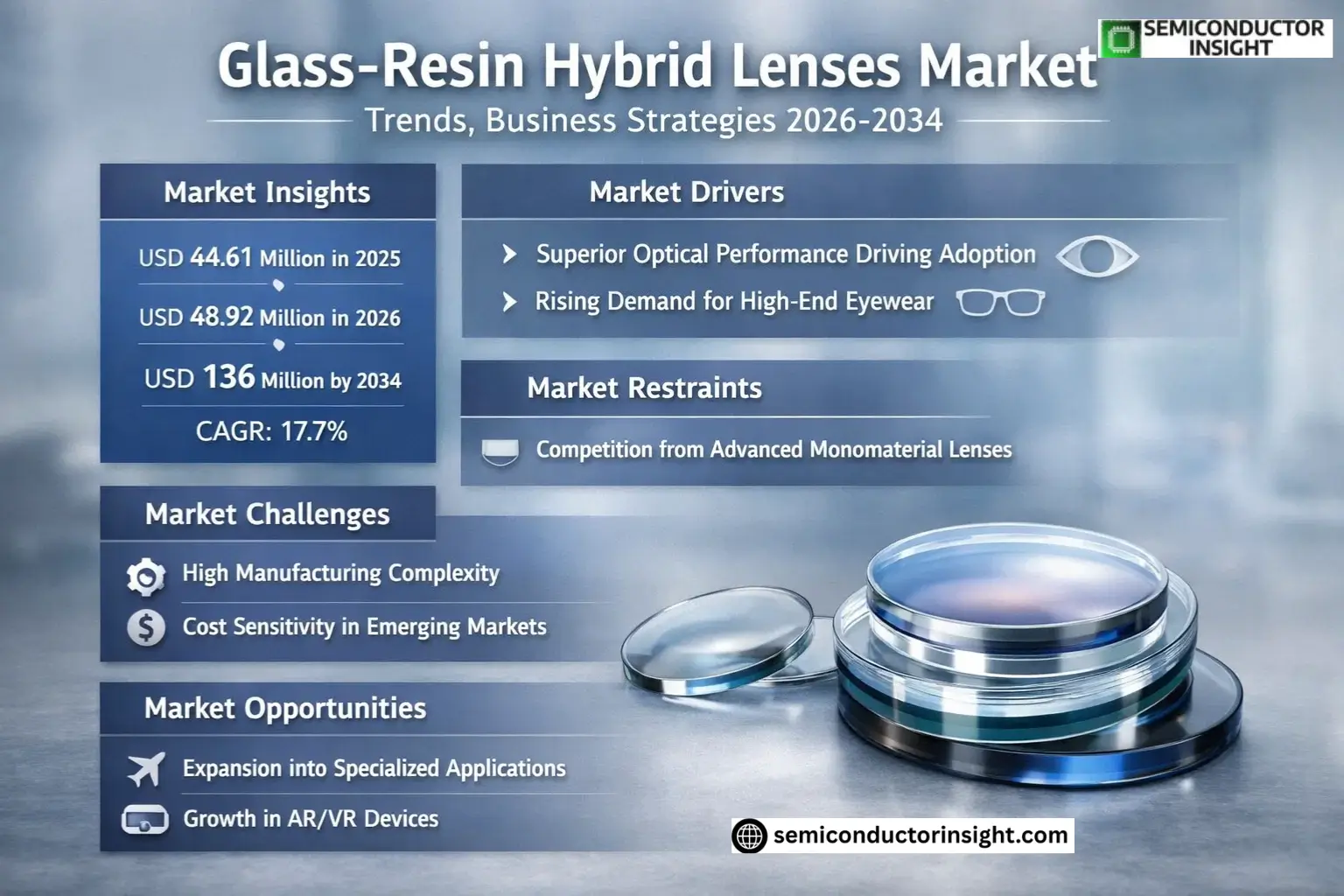
Glass-Resin Hybrid Lenses Market Trends

MARKET DRIVERS

Superior Optical Performance Driving Adoption

Glass-Resin Hybrid Lenses Market is experiencing significant growth due to their ability to combine the benefits of glass (high refractive index, scratch resistance) with resin (lightweight, impact resistance). These lenses deliver superior optical clarity and durability, making them ideal for premium eyewear applications in both prescription and sunglasses segments.

Rising Demand for High-End Eyewear

Consumers are increasingly willing to invest in premium eyewear solutions, with the global luxury eyewear market projected to grow at 5.8% CAGR through 2027. Glass-resin hybrid lenses meet this demand by offering higher-end performance characteristics than standard plastic lenses while remaining more practical than pure glass options.

Technological advancements in bonding techniques have significantly improved the reliability of hybrid lens construction, reducing production costs by nearly 20% since 2019 while maintaining high quality standards.

MARKET CHALLENGES

High Manufacturing Complexity

The production process for glass-resin hybrid lenses requires specialized equipment and skilled technicians, creating barriers to widespread adoption. The complex lamination process between glass and resin components leads to higher defect rates compared to single-material lenses.

Other Challenges

Cost Sensitivity in Emerging Markets
While popular in developed markets, the premium pricing of hybrid lenses remains a significant obstacle in price-sensitive regions where they can cost 3-5 times more than standard plastic lenses.

Limited Frame Compatibility
The unique material properties and thickness of hybrid lenses restrict their use with certain frame styles, particularly ultra-slim and rimless designs that dominate current fashion trends.

MARKET RESTRAINTS

Competition from Advanced Monomaterial Lenses

Recent breakthroughs in high-index plastic materials and trivex lenses are eroding some of the performance advantages traditionally held by glass-resin hybrid lenses. These alternatives offer comparable optical properties with easier manufacturing processes and lower retail prices.

MARKET OPPORTUNITIES

Expansion into Specialized Applications

The unique properties of glass-resin hybrid lenses create opportunities in niche sectors such as aviation, where pilots require lenses that combine optical precision with impact resistance. The military and sports performance eyewear segments also present significant growth potential for these advanced lenses.

Glass-Resin Hybrid Lenses Market Trends
Expanding Applications in AR/VR Devices

Glass-Resin Hybrid Lenses Market is experiencing significant growth due to rising demand in augmented and virtual reality applications. These lenses combine optical clarity with lightweight properties, making them ideal for near-eye displays in AR glasses. Leading manufacturers are focusing on waveguide-based AR solutions that leverage hybrid lens technology for improved image quality.

Other Trends

Advancements in Optical System Miniaturization

Glass-resin hybrid technology enables reduction of optical system footprints by 30-40% compared to traditional glass-only solutions. The automotive industry is adopting these lenses for compact camera modules in ADAS applications. Consumer electronics brands are integrating them into smartphones with periscope zoom systems.

Geographical Market Shifts

Asia-Pacific currently dominates Glass-Resin Hybrid Lenses production, with key manufacturers expanding capacity in China and Japan. However, North American and European markets are showing accelerated adoption rates, particularly for industrial and medical imaging applications. The technology is gaining traction in aerospace sectors for lightweight optical systems.

Material Science Innovations

Recent developments in resin formulations have improved thermal stability and refractive index matching with glass components. Manufacturers are achieving <1% haze levels while maintaining high optical transmission characteristics across visible and NIR spectra.

Supply Chain Optimization

The market is seeing vertical integration among Glass-Resin Hybrid Lenses producers, with several manufacturers bringing resin compounding in-house. This trend aims to reduce lead times and improve quality control for specialized optical applications. Automated alignment systems are being implemented to enhance production yields of aspherical hybrid lenses.

COMPETITIVE LANDSCAPE

Key Industry Players

Innovation Leaders Driving Hybrid Lens Technology Adoption

Konica Minolta leads the Glass-Resin Hybrid Lenses Market with advanced optical solutions for AR/VR applications. The company holds significant market share through proprietary manufacturing techniques and strong partnerships with consumer electronics manufacturers. The competitive landscape shows consolidation among optical component suppliers, with top five players accounting for over 35% of global revenue.

Japanese and Chinese manufacturers dominate production capabilities, with Seikoh Giken specializing in precision optical components while Sunny Optical focuses on mass production for smartphone cameras. Smaller innovators like Edmund Optics cater to niche industrial applications, creating a diversified competitive environment across different end-use segments.

List of Key Glass-Resin Hybrid Lenses Companies Profiled

Segment Analysis:

Segment Category Sub-Segments Key Insights
By Type
  • Aspherical
  • Spherical
  • Flat
Aspherical lenses dominate as they provide superior optical performance with reduced aberrations. Key advantages include:

  • Enables compact optical designs critical for AR/VR devices
  • Superior image quality compared to spherical counterparts
  • Growing demand from premium camera lens manufacturers
By Application
  • Consumer Electronics
  • Automotive Industry
  • Medical Devices
  • Industrial Equipment
Consumer Electronics leads with substantial adoption due to:

  • Booming demand for AR/VR headsets requiring lightweight optics
  • Smartphone camera innovations pushing multi-lens systems
  • Growing market for XR (cross reality) glasses and smart eyewear
By End User
  • OEM Manufacturers
  • Aftermarket Suppliers
  • Research Institutions
OEM Manufacturers are driving market growth through:

  • Direct integration in next-gen consumer electronics
  • Strategic partnerships with optical component suppliers
  • Ongoing R&D investments for performance enhancements
By Technology
  • Waveguide Technology
  • Freeform Optics
  • Hybrid Refractive/Diffractive
Waveguide Technology is gaining prominence due to:

  • Critical role in AR glasses for near-eye displays
  • Superior light efficiency compared to alternatives
  • Thin profile enabling consumer-grade AR devices
By Material Combination
  • Glass-Resin Combinations
  • Advanced Polymer Composites
  • Photo-Resistant Coatings
Glass-Resin Combinations show the most innovative potential with:

  • Superior thermal stability for demanding applications
  • Flexibility in optical design parameters
  • Reduced system complexity compared to traditional optics

Regional Analysis: Glass-Resin Hybrid Lenses Market

Asia-Pacific

The Asia-Pacific region dominates the Glass-Resin Hybrid Lenses Market, driven by expanding consumer electronics manufacturing and growing demand for high-performance optical components. Countries like China, Japan, and South Korea account for nearly 60% of regional demand, with Chinese companies leading in cost-competitive production. The region benefits from strong supply chain integration between glass suppliers and lens manufacturers. Increasing adoption of augmented reality devices and smartphone camera innovations are accelerating market growth. Japanese firms maintain technological leadership in precision molding techniques, while South Korea excels in hybrid lens integration with display technologies. The region’s thriving automotive sector also contributes significantly to demand for advanced driver assistance systems (ADAS) applications.

Manufacturing Concentration
Southern China and Japan’s Kyushu island host the highest concentration of glass-resin hybrid lens production facilities. Special economic zones in Guangdong province provide infrastructure advantages, while Kyushu benefits from proximity to high-purity glass suppliers. Cluster development has created efficient supplier networks for specialized coating services and precision molding equipment.
Technology Innovation Hubs
Tokyo and Seoul have emerged as primary R&D centers for advanced glass-resin hybrid lens formulations. Japanese companies lead in developing ultra-low dispersion hybrid materials, while South Korean labs focus on minimizing chromatic aberration in compact lens designs. Research collaborations between universities and manufacturers are driving material science breakthroughs.
Supply Chain Dynamics
Regional supply chains for glass-resin hybrid lenses benefit from vertical integration among Japanese material suppliers and Chinese assembly plants. Taiwan plays a crucial intermediary role in semiconductor-grade lens components. Recent trade agreements have improved resin material flows between Southeast Asian polymer producers and North Asian lens manufacturers.
End-Use Market Growth
Smartphone manufacturers drive over 45% of regional demand for glass-resin hybrid lenses, particularly for high-resolution multi-camera arrays. Medical imaging applications show the fastest growth trajectory, with Japanese firms developing specialized endoscopes. Automotive adoption remains concentrated in premium vehicle segments, though mass-market penetration is increasing.

North America
North America maintains strong demand for high-performance glass-resin hybrid lenses, particularly in defense and medical applications. The U.S. hosts several specialized manufacturers focusing on aerospace-grade optical systems and military night vision components. California’s Silicon Valley drives innovation in AR/VR applications, with tech giants investing heavily in hybrid lens solutions for next-generation displays. The region benefits from close collaboration between material science researchers and optical engineers at national laboratories and tech campuses. Canada’s emerging photonics cluster in Waterloo is gaining attention for automotive lidar applications.

Europe
European demand for glass-resin hybrid lenses centers on industrial and automotive applications. Germany leads in precision engineering applications, with optical manufacturers supplying machine vision systems for Industry 4.0 implementations. French and Italian luxury automotive brands specify hybrid lenses for premium driver assistance systems. The region shows growing adoption in biomedical devices, supported by strong medtech manufacturing in Switzerland and Scandinavia. EU-funded photonics initiatives are accelerating technology transfer from research institutes to commercial applications.

South America
The South American market for glass-resin hybrid lenses remains emerging but shows promising growth in surveillance and security applications. Brazil accounts for over 60% of regional demand, driven by urban security investments and expanding industrial automation. Argentina’s developing optics industry is focusing on agricultural monitoring applications. Infrastructure limitations in material supply chains currently constrain local manufacturing capabilities, making the region largely import-dependent for advanced optical components.

Middle East & Africa
This region presents niche opportunities for glass-resin hybrid lenses in oil and gas inspection systems and telecommunications infrastructure. UAE and Saudi Arabia lead adoption in surveillance and urban smart city projects. South Africa shows growing medical imaging demand, though market penetration remains limited by healthcare infrastructure. The region’s harsh climate conditions drive specialized requirements for durable optical coatings and temperature-resistant formulations.

Report Scope

This market research report provides a comprehensive analysis of the Glass-Resin Hybrid Lenses Market , covering the forecast period 2021–2034. It offers detailed insights into market dynamics, technological advancements, competitive landscape, and key trends shaping the industry.

Key focus areas of the report include:

  • Market Overview: The report begins with an overview outlining its current market scenario, key growth indicators, and industry transformation drivers. It discusses macroeconomic factors, demand–supply balance, regulatory landscape, and the strategic role of hybrid lenses in powering advancements across industries such as consumer electronics, automotive, and augmented reality applications.
  • Market Size & Forecast: Historical data and future projections for revenue, unit shipments, and market value across major regions and segments.
  • Segmentation Analysis: Detailed breakdown by product type (aspherical, spherical, flat), application (consumer electronics, automotive, others), and end-user industry to identify high-growth segments.
  • Regional Insights: Insights into market performance across North America, Europe, Asia, South America, and Middle East & Africa, including country-level analysis.
  • Competitive Landscape: Profiles of leading market participants, including their product offerings, R&D focus, manufacturing capacity, and recent developments.
  • Technology Trends & Innovation: Assessment of hybrid lens technologies, XR glasses integration, and optical system miniaturization trends.
  • Market Drivers & Restraints: Evaluation of factors driving market growth along with challenges, supply chain constraints, and technological barriers.
  • Stakeholder Insights: Strategic insights for component suppliers, OEMs, and investors regarding market opportunities.

Primary and secondary research methods are employed, including interviews with industry experts and data from verified sources to ensure accuracy.

FREQUENTLY ASKED QUESTIONS:

What is the current market size of Glass-Resin Hybrid Lenses Market?

-> Glass-Resin Hybrid Lenses Market size was valued at USD 44.61 million in 2025. The market is projected to grow from USD 48.92 million in 2026 to USD 136 million by 2034, exhibiting a CAGR of 17.7% during the forecast period.

What is the growth rate of Glass-Resin Hybrid Lenses Market?

-> The market is projected to grow at a CAGR of 17.7% during 2025-2034.

Which key companies operate in Glass-Resin Hybrid Lenses Market?

-> Key players include Konica Minolta, Seikoh Giken, Edmund Optics, Sunny Optical, Largan Precision, AAC Optics, and Toyotec.

What are the key growth drivers?

-> Key growth drivers include demand for XR glasses, miniaturization of optical systems, and growth in AR wearable devices.

Which region dominates the market?

-> Asia holds the largest market share, driven by consumer electronics and automotive applications.

What are the key product segments?

-> Key segments include aspherical, spherical, and flat hybrid lenses.

Glass-Resin Hybrid Lenses Market, Trends, Business Strategies 2026-2034

Get Sample Report PDF for Exclusive Insights

Report Sample Includes

  • Table of Contents
  • List of Tables & Figures
  • Charts, Research Methodology, and more...

PDF Icon Download Sample Report PDF
SKU: 82887c50012c
Category:
License Type

Corporate License, Excel License, PDF and Excel Databook License

Download Sample Report

Table of Content

1 Introduction to Research & Analysis Reports
1.1 Glass-Resin Hybrid Lenses Market Definition
1.2 Market Segments
1.2.1 Segment by Type
1.2.2 Segment by Application
1.3 Global Glass-Resin Hybrid Lenses Market Overview
1.4 Features & Benefits of This Report
1.5 Methodology & Sources of Information
1.5.1 Research Methodology
1.5.2 Research Process
1.5.3 Base Year
1.5.4 Report Assumptions & Caveats
2 Global Glass-Resin Hybrid Lenses Overall Market Size
2.1 Global Glass-Resin Hybrid Lenses Market Size: 2025 VS 2034
2.2 Global Glass-Resin Hybrid Lenses Market Size, Prospects & Forecasts: 2021-2034
2.3 Global Glass-Resin Hybrid Lenses Sales: 2021-2034
3 Company Landscape
3.1 Top Glass-Resin Hybrid Lenses Players in Global Market
3.2 Top Global Glass-Resin Hybrid Lenses Companies Ranked by Revenue
3.3 Global Glass-Resin Hybrid Lenses Revenue by Companies
3.4 Global Glass-Resin Hybrid Lenses Sales by Companies
3.5 Global Glass-Resin Hybrid Lenses Price by Manufacturer (2021-2026)
3.6 Top 3 and Top 5 Glass-Resin Hybrid Lenses Companies in Global Market, by Revenue in 2025
3.7 Global Manufacturers Glass-Resin Hybrid Lenses Product Type
3.8 Tier 1, Tier 2, and Tier 3 Glass-Resin Hybrid Lenses Players in Global Market
3.8.1 List of Global Tier 1 Glass-Resin Hybrid Lenses Companies
3.8.2 List of Global Tier 2 and Tier 3 Glass-Resin Hybrid Lenses Companies
4 Sights by Type
4.1 Overview
4.1.1 Segment by Type – Global Glass-Resin Hybrid Lenses Market Size Markets, 2025 & 2034
4.1.2 Aspherical
4.1.3 Spherical
4.1.4 Flat
4.2 Segment by Type – Global Glass-Resin Hybrid Lenses Revenue & Forecasts
4.2.1 Segment by Type – Global Glass-Resin Hybrid Lenses Revenue, 2021-2026
4.2.2 Segment by Type – Global Glass-Resin Hybrid Lenses Revenue, 2027-2034
4.2.3 Segment by Type – Global Glass-Resin Hybrid Lenses Revenue Market Share, 2021-2034
4.3 Segment by Type – Global Glass-Resin Hybrid Lenses Sales & Forecasts
4.3.1 Segment by Type – Global Glass-Resin Hybrid Lenses Sales, 2021-2026
4.3.2 Segment by Type – Global Glass-Resin Hybrid Lenses Sales, 2027-2034
4.3.3 Segment by Type – Global Glass-Resin Hybrid Lenses Sales Market Share, 2021-2034
4.4 Segment by Type – Global Glass-Resin Hybrid Lenses Price (Manufacturers Selling Prices), 2021-2034
5 Sights by Application
5.1 Overview
5.1.1 Segment by Application – Global Glass-Resin Hybrid Lenses Market Size, 2025 & 2034
5.1.2 Consumer Electronics
5.1.3 Automotive Industry
5.1.4 Others
5.2 Segment by Application – Global Glass-Resin Hybrid Lenses Revenue & Forecasts
5.2.1 Segment by Application – Global Glass-Resin Hybrid Lenses Revenue, 2021-2026
5.2.2 Segment by Application – Global Glass-Resin Hybrid Lenses Revenue, 2027-2034
5.2.3 Segment by Application – Global Glass-Resin Hybrid Lenses Revenue Market Share, 2021-2034
5.3 Segment by Application – Global Glass-Resin Hybrid Lenses Sales & Forecasts
5.3.1 Segment by Application – Global Glass-Resin Hybrid Lenses Sales, 2021-2026
5.3.2 Segment by Application – Global Glass-Resin Hybrid Lenses Sales, 2027-2034
5.3.3 Segment by Application – Global Glass-Resin Hybrid Lenses Sales Market Share, 2021-2034
5.4 Segment by Application – Global Glass-Resin Hybrid Lenses Price (Manufacturers Selling Prices), 2021-2034
6 Sights Region
6.1 By Region – Global Glass-Resin Hybrid Lenses Market Size, 2025 & 2034
6.2 By Region – Global Glass-Resin Hybrid Lenses Revenue & Forecasts
6.2.1 By Region – Global Glass-Resin Hybrid Lenses Revenue, 2021-2026
6.2.2 By Region – Global Glass-Resin Hybrid Lenses Revenue, 2027-2034
6.2.3 By Region – Global Glass-Resin Hybrid Lenses Revenue Market Share, 2021-2034
6.3 By Region – Global Glass-Resin Hybrid Lenses Sales & Forecasts
6.3.1 By Region – Global Glass-Resin Hybrid Lenses Sales, 2021-2026
6.3.2 By Region – Global Glass-Resin Hybrid Lenses Sales, 2027-2034
6.3.3 By Region – Global Glass-Resin Hybrid Lenses Sales Market Share, 2021-2034
6.4 North America
6.4.1 By Country – North America Glass-Resin Hybrid Lenses Revenue, 2021-2034
6.4.2 By Country – North America Glass-Resin Hybrid Lenses Sales, 2021-2034
6.4.3 United States Glass-Resin Hybrid Lenses Market Size, 2021-2034
6.4.4 Canada Glass-Resin Hybrid Lenses Market Size, 2021-2034
6.4.5 Mexico Glass-Resin Hybrid Lenses Market Size, 2021-2034
6.5 Europe
6.5.1 By Country – Europe Glass-Resin Hybrid Lenses Revenue, 2021-2034
6.5.2 By Country – Europe Glass-Resin Hybrid Lenses Sales, 2021-2034
6.5.3 Germany Glass-Resin Hybrid Lenses Market Size, 2021-2034
6.5.4 France Glass-Resin Hybrid Lenses Market Size, 2021-2034
6.5.5 U.K. Glass-Resin Hybrid Lenses Market Size, 2021-2034
6.5.6 Italy Glass-Resin Hybrid Lenses Market Size, 2021-2034
6.5.7 Russia Glass-Resin Hybrid Lenses Market Size, 2021-2034
6.5.8 Nordic Countries Glass-Resin Hybrid Lenses Market Size, 2021-2034
6.5.9 Benelux Glass-Resin Hybrid Lenses Market Size, 2021-2034
6.6 Asia
6.6.1 By Region – Asia Glass-Resin Hybrid Lenses Revenue, 2021-2034
6.6.2 By Region – Asia Glass-Resin Hybrid Lenses Sales, 2021-2034
6.6.3 China Glass-Resin Hybrid Lenses Market Size, 2021-2034
6.6.4 Japan Glass-Resin Hybrid Lenses Market Size, 2021-2034
6.6.5 South Korea Glass-Resin Hybrid Lenses Market Size, 2021-2034
6.6.6 Southeast Asia Glass-Resin Hybrid Lenses Market Size, 2021-2034
6.6.7 India Glass-Resin Hybrid Lenses Market Size, 2021-2034
6.7 South America
6.7.1 By Country – South America Glass-Resin Hybrid Lenses Revenue, 2021-2034
6.7.2 By Country – South America Glass-Resin Hybrid Lenses Sales, 2021-2034
6.7.3 Brazil Glass-Resin Hybrid Lenses Market Size, 2021-2034
6.7.4 Argentina Glass-Resin Hybrid Lenses Market Size, 2021-2034
6.8 Middle East & Africa
6.8.1 By Country – Middle East & Africa Glass-Resin Hybrid Lenses Revenue, 2021-2034
6.8.2 By Country – Middle East & Africa Glass-Resin Hybrid Lenses Sales, 2021-2034
6.8.3 Turkey Glass-Resin Hybrid Lenses Market Size, 2021-2034
6.8.4 Israel Glass-Resin Hybrid Lenses Market Size, 2021-2034
6.8.5 Saudi Arabia Glass-Resin Hybrid Lenses Market Size, 2021-2034
6.8.6 UAE Glass-Resin Hybrid Lenses Market Size, 2021-2034
7 Manufacturers & Brands Profiles
7.1 Konica Minolta
7.1.1 Konica Minolta Company Summary
7.1.2 Konica Minolta Business Overview
7.1.3 Konica Minolta Glass-Resin Hybrid Lenses Major Product Offerings
7.1.4 Konica Minolta Glass-Resin Hybrid Lenses Sales and Revenue in Global (2021-2026)
7.1.5 Konica Minolta Key News & Latest Developments
7.2 Seikoh Giken
7.2.1 Seikoh Giken Company Summary
7.2.2 Seikoh Giken Business Overview
7.2.3 Seikoh Giken Glass-Resin Hybrid Lenses Major Product Offerings
7.2.4 Seikoh Giken Glass-Resin Hybrid Lenses Sales and Revenue in Global (2021-2026)
7.2.5 Seikoh Giken Key News & Latest Developments
7.3 Edmund Optics
7.3.1 Edmund Optics Company Summary
7.3.2 Edmund Optics Business Overview
7.3.3 Edmund Optics Glass-Resin Hybrid Lenses Major Product Offerings
7.3.4 Edmund Optics Glass-Resin Hybrid Lenses Sales and Revenue in Global (2021-2026)
7.3.5 Edmund Optics Key News & Latest Developments
7.4 Sunny Optical
7.4.1 Sunny Optical Company Summary
7.4.2 Sunny Optical Business Overview
7.4.3 Sunny Optical Glass-Resin Hybrid Lenses Major Product Offerings
7.4.4 Sunny Optical Glass-Resin Hybrid Lenses Sales and Revenue in Global (2021-2026)
7.4.5 Sunny Optical Key News & Latest Developments
7.5 Largan Precision
7.5.1 Largan Precision Company Summary
7.5.2 Largan Precision Business Overview
7.5.3 Largan Precision Glass-Resin Hybrid Lenses Major Product Offerings
7.5.4 Largan Precision Glass-Resin Hybrid Lenses Sales and Revenue in Global (2021-2026)
7.5.5 Largan Precision Key News & Latest Developments
7.6 AAC Optics
7.6.1 AAC Optics Company Summary
7.6.2 AAC Optics Business Overview
7.6.3 AAC Optics Glass-Resin Hybrid Lenses Major Product Offerings
7.6.4 AAC Optics Glass-Resin Hybrid Lenses Sales and Revenue in Global (2021-2026)
7.6.5 AAC Optics Key News & Latest Developments
7.7 Toyotec
7.7.1 Toyotec Company Summary
7.7.2 Toyotec Business Overview
7.7.3 Toyotec Glass-Resin Hybrid Lenses Major Product Offerings
7.7.4 Toyotec Glass-Resin Hybrid Lenses Sales and Revenue in Global (2021-2026)
7.7.5 Toyotec Key News & Latest Developments
8 Global Glass-Resin Hybrid Lenses Production Capacity, Analysis
8.1 Global Glass-Resin Hybrid Lenses Production Capacity, 2021-2034
8.2 Glass-Resin Hybrid Lenses Production Capacity of Key Manufacturers in Global Market
8.3 Global Glass-Resin Hybrid Lenses Production by Region
9 Key Market Trends, Opportunity, Drivers and Restraints
9.1 Market Opportunities & Trends
9.2 Market Drivers
9.3 Market Restraints
10 Glass-Resin Hybrid Lenses Supply Chain Analysis
10.1 Glass-Resin Hybrid Lenses Industry Value Chain
10.2 Glass-Resin Hybrid Lenses Upstream Market
10.3 Glass-Resin Hybrid Lenses Downstream and Clients
10.4 Marketing Channels Analysis
10.4.1 Marketing Channels
10.4.2 Glass-Resin Hybrid Lenses Distributors and Sales Agents in Global
11 Conclusion
12 Appendix
12.1 Note
12.2 Examples of Clients
12.3 DisclaimerList of Tables
Table 1. Key Players of Glass-Resin Hybrid Lenses in Global Market
Table 2. Top Glass-Resin Hybrid Lenses Players in Global Market, Ranking by Revenue (2025)
Table 3. Global Glass-Resin Hybrid Lenses Revenue by Companies, (US$, Mn), 2021-2026
Table 4. Global Glass-Resin Hybrid Lenses Revenue Share by Companies, 2021-2026
Table 5. Global Glass-Resin Hybrid Lenses Sales by Companies, (K Units), 2021-2026
Table 6. Global Glass-Resin Hybrid Lenses Sales Share by Companies, 2021-2026
Table 7. Key Manufacturers Glass-Resin Hybrid Lenses Price (2021-2026) & (US$/Unit)
Table 8. Global Manufacturers Glass-Resin Hybrid Lenses Product Type
Table 9. List of Global Tier 1 Glass-Resin Hybrid Lenses Companies, Revenue (US$, Mn) in 2025 and Market Share
Table 10. List of Global Tier 2 and Tier 3 Glass-Resin Hybrid Lenses Companies, Revenue (US$, Mn) in 2025 and Market Share
Table 11. Segment by Type – Global Glass-Resin Hybrid Lenses Revenue, (US$, Mn), 2025 & 2034
Table 12. Segment by Type – Global Glass-Resin Hybrid Lenses Revenue (US$, Mn), 2021-2026
Table 13. Segment by Type – Global Glass-Resin Hybrid Lenses Revenue (US$, Mn), 2027-2034
Table 14. Segment by Type – Global Glass-Resin Hybrid Lenses Sales (K Units), 2021-2026
Table 15. Segment by Type – Global Glass-Resin Hybrid Lenses Sales (K Units), 2027-2034
Table 16. Segment by Application – Global Glass-Resin Hybrid Lenses Revenue, (US$, Mn), 2025 & 2034
Table 17. Segment by Application – Global Glass-Resin Hybrid Lenses Revenue, (US$, Mn), 2021-2026
Table 18. Segment by Application – Global Glass-Resin Hybrid Lenses Revenue, (US$, Mn), 2027-2034
Table 19. Segment by Application – Global Glass-Resin Hybrid Lenses Sales, (K Units), 2021-2026
Table 20. Segment by Application – Global Glass-Resin Hybrid Lenses Sales, (K Units), 2027-2034
Table 21. By Region – Global Glass-Resin Hybrid Lenses Revenue, (US$, Mn), 2025 & 2034
Table 22. By Region – Global Glass-Resin Hybrid Lenses Revenue, (US$, Mn), 2021-2026
Table 23. By Region – Global Glass-Resin Hybrid Lenses Revenue, (US$, Mn), 2027-2034
Table 24. By Region – Global Glass-Resin Hybrid Lenses Sales, (K Units), 2021-2026
Table 25. By Region – Global Glass-Resin Hybrid Lenses Sales, (K Units), 2027-2034
Table 26. By Country – North America Glass-Resin Hybrid Lenses Revenue, (US$, Mn), 2021-2026
Table 27. By Country – North America Glass-Resin Hybrid Lenses Revenue, (US$, Mn), 2027-2034
Table 28. By Country – North America Glass-Resin Hybrid Lenses Sales, (K Units), 2021-2026
Table 29. By Country – North America Glass-Resin Hybrid Lenses Sales, (K Units), 2027-2034
Table 30. By Country – Europe Glass-Resin Hybrid Lenses Revenue, (US$, Mn), 2021-2026
Table 31. By Country – Europe Glass-Resin Hybrid Lenses Revenue, (US$, Mn), 2027-2034
Table 32. By Country – Europe Glass-Resin Hybrid Lenses Sales, (K Units), 2021-2026
Table 33. By Country – Europe Glass-Resin Hybrid Lenses Sales, (K Units), 2027-2034
Table 34. By Region – Asia Glass-Resin Hybrid Lenses Revenue, (US$, Mn), 2021-2026
Table 35. By Region – Asia Glass-Resin Hybrid Lenses Revenue, (US$, Mn), 2027-2034
Table 36. By Region – Asia Glass-Resin Hybrid Lenses Sales, (K Units), 2021-2026
Table 37. By Region – Asia Glass-Resin Hybrid Lenses Sales, (K Units), 2027-2034
Table 38. By Country – South America Glass-Resin Hybrid Lenses Revenue, (US$, Mn), 2021-2026
Table 39. By Country – South America Glass-Resin Hybrid Lenses Revenue, (US$, Mn), 2027-2034
Table 40. By Country – South America Glass-Resin Hybrid Lenses Sales, (K Units), 2021-2026
Table 41. By Country – South America Glass-Resin Hybrid Lenses Sales, (K Units), 2027-2034
Table 42. By Country – Middle East & Africa Glass-Resin Hybrid Lenses Revenue, (US$, Mn), 2021-2026
Table 43. By Country – Middle East & Africa Glass-Resin Hybrid Lenses Revenue, (US$, Mn), 2027-2034
Table 44. By Country – Middle East & Africa Glass-Resin Hybrid Lenses Sales, (K Units), 2021-2026
Table 45. By Country – Middle East & Africa Glass-Resin Hybrid Lenses Sales, (K Units), 2027-2034
Table 46. Konica Minolta Company Summary
Table 47. Konica Minolta Glass-Resin Hybrid Lenses Product Offerings
Table 48. Konica Minolta Glass-Resin Hybrid Lenses Sales (K Units), Revenue (US$, Mn) and Average Price (US$/Unit) & (2021-2026)
Table 49. Konica Minolta Key News & Latest Developments
Table 50. Seikoh Giken Company Summary
Table 51. Seikoh Giken Glass-Resin Hybrid Lenses Product Offerings
Table 52. Seikoh Giken Glass-Resin Hybrid Lenses Sales (K Units), Revenue (US$, Mn) and Average Price (US$/Unit) & (2021-2026)
Table 53. Seikoh Giken Key News & Latest Developments
Table 54. Edmund Optics Company Summary
Table 55. Edmund Optics Glass-Resin Hybrid Lenses Product Offerings
Table 56. Edmund Optics Glass-Resin Hybrid Lenses Sales (K Units), Revenue (US$, Mn) and Average Price (US$/Unit) & (2021-2026)
Table 57. Edmund Optics Key News & Latest Developments
Table 58. Sunny Optical Company Summary
Table 59. Sunny Optical Glass-Resin Hybrid Lenses Product Offerings
Table 60. Sunny Optical Glass-Resin Hybrid Lenses Sales (K Units), Revenue (US$, Mn) and Average Price (US$/Unit) & (2021-2026)
Table 61. Sunny Optical Key News & Latest Developments
Table 62. Largan Precision Company Summary
Table 63. Largan Precision Glass-Resin Hybrid Lenses Product Offerings
Table 64. Largan Precision Glass-Resin Hybrid Lenses Sales (K Units), Revenue (US$, Mn) and Average Price (US$/Unit) & (2021-2026)
Table 65. Largan Precision Key News & Latest Developments
Table 66. AAC Optics Company Summary
Table 67. AAC Optics Glass-Resin Hybrid Lenses Product Offerings
Table 68. AAC Optics Glass-Resin Hybrid Lenses Sales (K Units), Revenue (US$, Mn) and Average Price (US$/Unit) & (2021-2026)
Table 69. AAC Optics Key News & Latest Developments
Table 70. Toyotec Company Summary
Table 71. Toyotec Glass-Resin Hybrid Lenses Product Offerings
Table 72. Toyotec Glass-Resin Hybrid Lenses Sales (K Units), Revenue (US$, Mn) and Average Price (US$/Unit) & (2021-2026)
Table 73. Toyotec Key News & Latest Developments
Table 74. Glass-Resin Hybrid Lenses Capacity of Key Manufacturers in Global Market, 2024-2026 (K Units)
Table 75. Global Glass-Resin Hybrid Lenses Capacity Market Share of Key Manufacturers, 2024-2026
Table 76. Global Glass-Resin Hybrid Lenses Production by Region, 2021-2026 (K Units)
Table 77. Global Glass-Resin Hybrid Lenses Production by Region, 2027-2034 (K Units)
Table 78. Glass-Resin Hybrid Lenses Market Opportunities & Trends in Global Market
Table 79. Glass-Resin Hybrid Lenses Market Drivers in Global Market
Table 80. Glass-Resin Hybrid Lenses Market Restraints in Global Market
Table 81. Glass-Resin Hybrid Lenses Raw Materials
Table 82. Glass-Resin Hybrid Lenses Raw Materials Suppliers in Global Market
Table 83. Typical Glass-Resin Hybrid Lenses Downstream
Table 84. Glass-Resin Hybrid Lenses Downstream Clients in Global Market
Table 85. Glass-Resin Hybrid Lenses Distributors and Sales Agents in Global Market

List of Figures
Figure 1. Glass-Resin Hybrid Lenses Product Picture
Figure 2. Glass-Resin Hybrid Lenses Segment by Type in 2025
Figure 3. Glass-Resin Hybrid Lenses Segment by Application in 2025
Figure 4. Global Glass-Resin Hybrid Lenses Market Overview: 2025
Figure 5. Key Caveats
Figure 6. Global Glass-Resin Hybrid Lenses Market Size: 2025 VS 2034 (US$, Mn)
Figure 7. Global Glass-Resin Hybrid Lenses Revenue: 2021-2034 (US$, Mn)
Figure 8. Glass-Resin Hybrid Lenses Sales in Global Market: 2021-2034 (K Units)
Figure 9. The Top 3 and 5 Players Market Share by Glass-Resin Hybrid Lenses Revenue in 2025
Figure 10. Segment by Type – Global Glass-Resin Hybrid Lenses Revenue, (US$, Mn), 2025 & 2034
Figure 11. Segment by Type – Global Glass-Resin Hybrid Lenses Revenue Market Share, 2021-2034
Figure 12. Segment by Type – Global Glass-Resin Hybrid Lenses Sales Market Share, 2021-2034
Figure 13. Segment by Type – Global Glass-Resin Hybrid Lenses Price (US$/Unit), 2021-2034
Figure 14. Segment by Application – Global Glass-Resin Hybrid Lenses Revenue, (US$, Mn), 2025 & 2034
Figure 15. Segment by Application – Global Glass-Resin Hybrid Lenses Revenue Market Share, 2021-2034
Figure 16. Segment by Application – Global Glass-Resin Hybrid Lenses Sales Market Share, 2021-2034
Figure 17. Segment by Application -Global Glass-Resin Hybrid Lenses Price (US$/Unit), 2021-2034
Figure 18. By Region – Global Glass-Resin Hybrid Lenses Revenue, (US$, Mn), 2025 & 2034
Figure 19. By Region – Global Glass-Resin Hybrid Lenses Revenue Market Share, 2021 VS 2025 VS 2034
Figure 20. By Region – Global Glass-Resin Hybrid Lenses Revenue Market Share, 2021-2034
Figure 21. By Region – Global Glass-Resin Hybrid Lenses Sales Market Share, 2021-2034
Figure 22. By Country – North America Glass-Resin Hybrid Lenses Revenue Market Share, 2021-2034
Figure 23. By Country – North America Glass-Resin Hybrid Lenses Sales Market Share, 2021-2034
Figure 24. United States Glass-Resin Hybrid Lenses Revenue, (US$, Mn), 2021-2034
Figure 25. Canada Glass-Resin Hybrid Lenses Revenue, (US$, Mn), 2021-2034
Figure 26. Mexico Glass-Resin Hybrid Lenses Revenue, (US$, Mn), 2021-2034
Figure 27. By Country – Europe Glass-Resin Hybrid Lenses Revenue Market Share, 2021-2034
Figure 28. By Country – Europe Glass-Resin Hybrid Lenses Sales Market Share, 2021-2034
Figure 29. Germany Glass-Resin Hybrid Lenses Revenue, (US$, Mn), 2021-2034
Figure 30. France Glass-Resin Hybrid Lenses Revenue, (US$, Mn), 2021-2034
Figure 31. U.K. Glass-Resin Hybrid Lenses Revenue, (US$, Mn), 2021-2034
Figure 32. Italy Glass-Resin Hybrid Lenses Revenue, (US$, Mn), 2021-2034
Figure 33. Russia Glass-Resin Hybrid Lenses Revenue, (US$, Mn), 2021-2034
Figure 34. Nordic Countries Glass-Resin Hybrid Lenses Revenue, (US$, Mn), 2021-2034
Figure 35. Benelux Glass-Resin Hybrid Lenses Revenue, (US$, Mn), 2021-2034
Figure 36. By Region – Asia Glass-Resin Hybrid Lenses Revenue Market Share, 2021-2034
Figure 37. By Region – Asia Glass-Resin Hybrid Lenses Sales Market Share, 2021-2034
Figure 38. China Glass-Resin Hybrid Lenses Revenue, (US$, Mn), 2021-2034
Figure 39. Japan Glass-Resin Hybrid Lenses Revenue, (US$, Mn), 2021-2034
Figure 40. South Korea Glass-Resin Hybrid Lenses Revenue, (US$, Mn), 2021-2034
Figure 41. Southeast Asia Glass-Resin Hybrid Lenses Revenue, (US$, Mn), 2021-2034
Figure 42. India Glass-Resin Hybrid Lenses Revenue, (US$, Mn), 2021-2034
Figure 43. By Country – South America Glass-Resin Hybrid Lenses Revenue Market Share, 2021-2034
Figure 44. By Country – South America Glass-Resin Hybrid Lenses Sales, Market Share, 2021-2034
Figure 45. Brazil Glass-Resin Hybrid Lenses Revenue, (US$, Mn), 2021-2034
Figure 46. Argentina Glass-Resin Hybrid Lenses Revenue, (US$, Mn), 2021-2034
Figure 47. By Country – Middle East & Africa Glass-Resin Hybrid Lenses Revenue, Market Share, 2021-2034
Figure 48. By Country – Middle East & Africa Glass-Resin Hybrid Lenses Sales, Market Share, 2021-2034
Figure 49. Turkey Glass-Resin Hybrid Lenses Revenue, (US$, Mn), 2021-2034
Figure 50. Israel Glass-Resin Hybrid Lenses Revenue, (US$, Mn), 2021-2034
Figure 51. Saudi Arabia Glass-Resin Hybrid Lenses Revenue, (US$, Mn), 2021-2034
Figure 52. UAE Glass-Resin Hybrid Lenses Revenue, (US$, Mn), 2021-2034
Figure 53. Global Glass-Resin Hybrid Lenses Production Capacity (K Units), 2021-2034
Figure 54. The Percentage of Production Glass-Resin Hybrid Lenses by Region, 2025 VS 2034
Figure 55. Glass-Resin Hybrid Lenses Industry Value Chain
Figure 56. Marketing Channels

