
Glan Laser Prism Market Insights
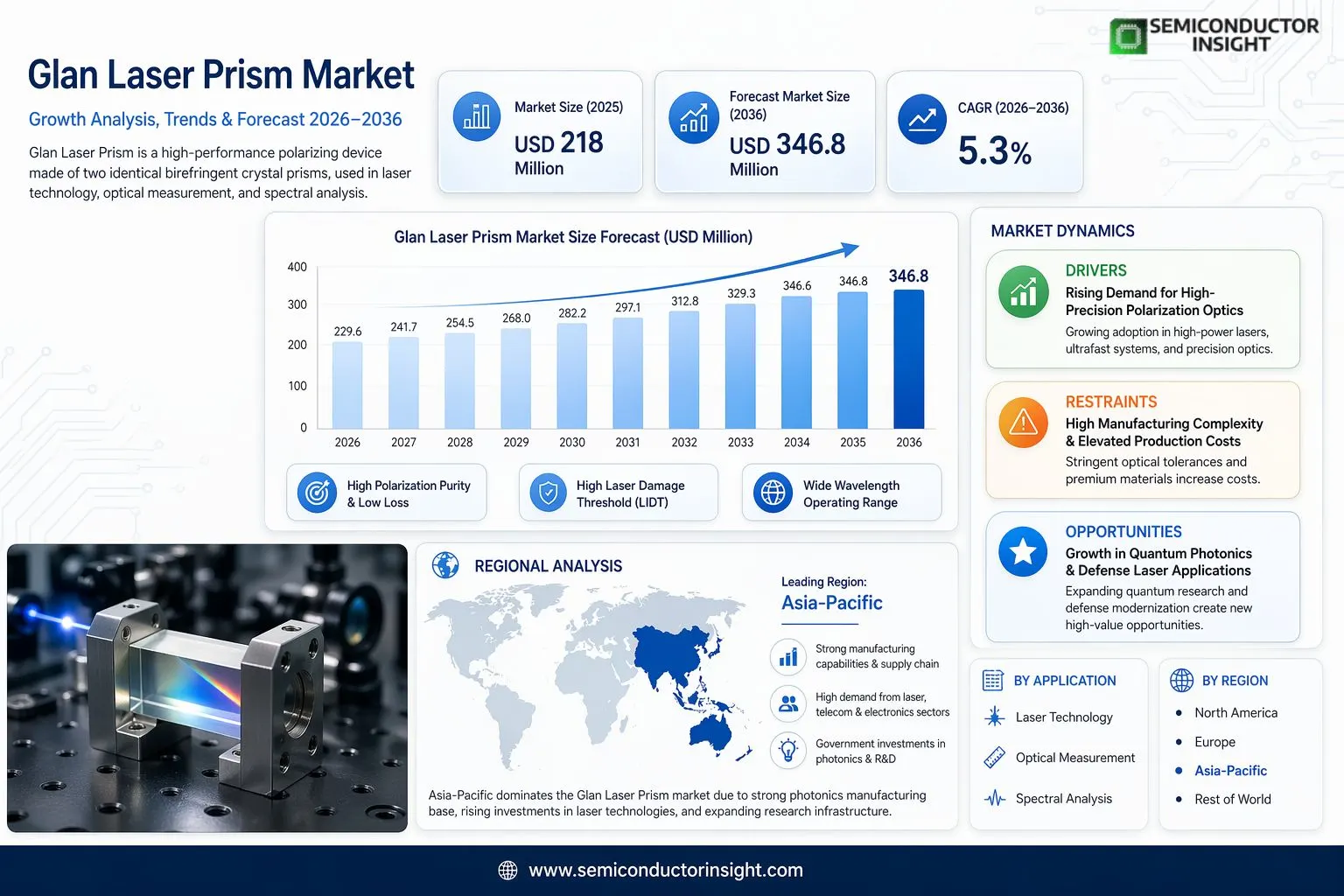
Global Glan Laser Prism market size was valued at USD 218 million in 2025. The market is projected to grow from USD 229.6 million in 2026 to USD 346.8 million by 2034, exhibiting a CAGR of 5.3% during the forecast period.
Glan Laser Prism is a high-performance polarizing device made of two identical birefringent crystal material prisms. The air gap between the prisms is filled by edge-clamped gaskets, a design that effectively reduces reflection loss while improving overall transmittance. Characterized by high transmittance and high polarization purity, Glan Laser Prisms are widely utilized across laser technology, optical measurement, spectral analysis, and other precision optical fields. The primary crystal materials used in manufacturing include Calcite Crystal, a-BBO Crystal, and YVO4 Crystal, each offering distinct optical properties suited to specific application requirements.
The market is driven by expanding adoption of laser-based technologies across industrial, scientific, and medical sectors, alongside growing investments in photonics research and optical instrumentation. The increasing deployment of high-power laser systems in manufacturing and defense applications has further reinforced demand for reliable polarizing components such as Glan Laser Prisms. Key manufacturers operating in this market include Edmund Optics, Thorlabs, MKS Instruments, EKSMA Optics, OptoSigma, Karl Lambrecht, Optogama, FOCtek Photonics, DayOptics, and Crystock, among others, collectively representing a significant share of global revenues.
MARKET DRIVERS
Rising Demand for High-Precision Polarization Optics in Laser Systems
Glan Laser Prism Market is experiencing steady growth driven by the expanding adoption of high-power laser systems across scientific research, industrial, and defense applications. Glan laser prisms, renowned for their superior polarization purity and high laser-induced damage threshold (LIDT), are increasingly preferred over conventional polarizing optics in demanding photonics environments. The surge in ultrafast laser research, including femtosecond and picosecond laser platforms, has directly amplified the need for polarizing components capable of withstanding intense optical flux without compromising beam quality.
Expansion of Laser-Based Manufacturing and Microfabrication Technologies
Advanced manufacturing sectors, particularly in semiconductor fabrication, precision micromachining, and laser lithography, are increasingly integrating polarization-sensitive optical assemblies. The Glan laser prism, characterized by its wide field of view, low wavefront distortion, and broad spectral transmission range, has become an essential component in laser beam conditioning modules used in these high-throughput production environments. As laser-based microfabrication scales globally, the consistent demand for reliable polarizing prisms continues to reinforce market expansion.
➤ The growth of ultrafast laser technologies and high-power industrial laser systems remains one of the most significant structural drivers sustaining long-term demand for Glan laser prisms across global photonics markets.
Furthermore, the proliferation of quantum optics research, optical coherence tomography (OCT), and LiDAR-based sensing platforms has broadened the application base for Glan Laser Prism Market. Research institutions and photonics companies worldwide are investing in optical polarization management components to enhance signal-to-noise ratios and measurement precision, reinforcing sustained market momentum across both commercial and academic segments.
MARKET CHALLENGES
High Manufacturing Complexity and Stringent Optical Tolerances
One of the primary challenges facing Glan Laser Prism Market is the intrinsic complexity involved in manufacturing these components to the exacting standards required by modern laser systems. Glan laser prisms require high-purity birefringent crystal materials, typically calcite or alpha-barium borate (α-BBO), that must be precisely cut, polished, and cemented or air-spaced to achieve extinction ratios exceeding 100,000:1. Maintaining such tolerances consistently across production batches demands significant investment in metrology infrastructure, skilled optical fabrication expertise, and rigorous quality control protocols, which pose barriers to market entry and scalability for smaller manufacturers.
Other Challenges
Raw Material Supply Constraints
The availability of optical-grade calcite and α-BBO crystals of sufficient size and homogeneity is geographically concentrated, creating supply chain vulnerabilities. Natural calcite deposits of the optical quality required for Glan laser prism fabrication are limited to select global sources, and synthetic alternatives involve cost-intensive growth processes. These material constraints can result in extended lead times and price volatility, which present ongoing challenges to market participants seeking to scale production in response to growing demand.
Competition from Alternative Polarizing Technologies
Glan Laser Prism Market also faces competitive pressure from alternative polarization management technologies, including thin-film polarizing beamsplitter cubes, wire-grid polarizers, and Wollaston prisms. While these alternatives may not match the extinction ratio or damage threshold performance of Glan laser prisms in high-power applications, they offer cost and integration advantages in lower-power or compact optical systems. As photonics system designers seek to optimize cost-performance trade-offs, this competitive landscape presents a persistent challenge to broader market penetration of Glan laser prism solutions.
MARKET RESTRAINTS
Elevated Production Costs Limiting Adoption in Price-Sensitive Applications
The high cost of producing precision Glan laser prisms represents a significant restraint on broader market adoption. The combination of expensive raw crystal materials, labor-intensive fabrication processes, and the need for specialized optical coating technologies contributes to premium unit pricing. This cost structure restricts the incorporation of Glan laser prisms in cost-sensitive commercial photonics products, medical instrumentation, and consumer-grade laser systems, where lower-cost polarizing alternatives are frequently selected despite performance trade-offs. The resultant market segmentation limits overall volume growth potential for Glan Laser Prism Market.
Limited Scalability of Crystal Growth and Optical Fabrication Processes
Scaling production of high-quality Glan laser prisms to meet increasing market demand is constrained by the inherent limitations of crystal growth and precision optical fabrication. Natural crystal sourcing is inherently unpredictable in yield and quality, while synthetic crystal growth processes such as Czochralski or hydrothermal methods require extended cycle times and controlled environments that limit throughput. These scalability constraints mean that supply can struggle to keep pace with demand spikes, particularly during periods of rapid expansion in laser technology adoption, potentially impeding the ability of Glan laser prism market participants to capitalize fully on emerging opportunities.Additionally, regulatory compliance requirements for optical components used in defense, aerospace, and medical laser applications impose further constraints. Export control regulations governing advanced optical and photonic technologies, particularly in jurisdictions with strict dual-use technology frameworks, can restrict the cross-border trade of precision polarizing components including Glan laser prisms, creating market access barriers and increasing compliance costs for internationally operating manufacturers and distributors.
MARKET OPPORTUNITIES
Growing Integration of Glan Laser Prisms in Quantum Technology and Photonic Research Platforms
Emerging quantum computing, quantum communication, and quantum sensing research programs represent a significant and growing opportunity for Glan Laser Prism Market. These applications demand polarization optics with exceptional extinction ratios, minimal wavefront aberration, and high photon transmission efficiency — performance characteristics in which Glan laser prisms excel. As national and institutional investments in quantum photonics infrastructure increase globally, the demand for high-specification polarization components is expected to expand meaningfully, offering Glan laser prism manufacturers access to a technically demanding but high-value market segment.
Expansion of Defense and Aerospace Laser Applications
The defense and aerospace sectors present a robust opportunity landscape for Glan Laser Prism Market, driven by increasing deployment of directed energy weapons, laser rangefinders, target designation systems, and LIDAR-based situational awareness platforms. These mission-critical applications impose stringent requirements on optical component reliability and performance under extreme environmental conditions, favoring precision polarizing prisms such as the Glan laser prism. Increasing defense budgets in North America, Europe, and the Asia-Pacific region, combined with accelerating modernization of military photonics systems, are expected to generate sustained procurement demand for high-performance polarizing optics components.
Technological Advancements in Anti-Reflection Coatings and Crystal Purification
Ongoing advancements in broadband anti-reflection (AR) coating technologies and improvements in synthetic crystal purification methods present opportunities to enhance the performance and cost-competitiveness of Glan laser prisms. Next-generation ion-beam sputtering and atomic layer deposition (ALD) coating techniques are enabling lower reflection losses across wider spectral ranges, expanding the usable wavelength coverage of Glan laser prism assemblies. Simultaneously, improvements in synthetic α-BBO and calcite crystal growth are progressively reducing dependence on natural crystal sources, offering pathways to greater supply chain stability and manufacturing scalability that could unlock new commercial applications for Glan Laser Prism Market.
Trends
Rising Demand Across Laser Technology and Optical Applications Drives Glan Laser Prism Market Growth
Glan Laser Prism Market is witnessing consistent growth driven by expanding applications across laser technology, optical measurement, and spectral analysis. A Glan Laser Prism is a high-performance polarizing device constructed from two identical birefringent crystal material prisms, with an air gap maintained by edge-clamped gaskets. This structural design significantly reduces reflection loss and enhances transmittance, making it a preferred choice in precision optical systems. The growing integration of advanced optics in scientific instrumentation and industrial laser systems continues to reinforce demand for Glan Laser Prisms globally.
Other Trends
Diversification of Crystal Material Types
Glan Laser Prism Market is segmented by crystal type, including Calcite Crystal, a-BBO Crystal, and YVO4 Crystal. Each material offers distinct optical properties suited to specific wavelength ranges and power thresholds. Calcite Crystal remains widely used due to its broad spectral transmission range and established manufacturing base. Meanwhile, a-BBO Crystal is gaining traction in ultrafast laser applications owing to its superior damage threshold and transparency in the ultraviolet range. YVO4 Crystal is increasingly selected for near-infrared applications. This diversification in material preference reflects the broadening scope of end-use environments within Glan Laser Prism Market.
Expanding Application Scope in Optical Measurement and Spectral Analysis
Beyond laser technology, Glan Laser Prisms are finding increasing adoption in optical measurement and spectral analysis. Precision polarization control is critical in interferometry, ellipsometry, and other measurement techniques where optical accuracy is non-negotiable. In spectral analysis, these prisms enable clean polarization states essential for minimizing noise and improving signal integrity. As research institutions and industrial labs scale up their analytical capabilities, the demand for high-purity polarizing optics such as Glan Laser Prisms is expected to remain strong across these application segments.
Competitive Landscape and Regional Dynamics
Glan Laser Prism Market features a competitive global landscape with key manufacturers including Edmund Optics, Thorlabs, MKS Instruments, EKSMA Optics, OptoSigma, Karl Lambrecht, Optogama, FOCtek Photonics, DayOptics, and Crystock, among others. North America and Europe maintain significant market presence due to well-established photonics industries and strong R&D investment. Asia, particularly China, is emerging as both a major production hub and a growing consumption market. The presence of manufacturers such as CASTECH, FOCtek Photonics, and Fuzhou Hundreds Optics highlights Asia’s expanding role in Global Glan Laser Prism supply chain.
Technological Advancements Supporting Long-Term Market Trajectory
Continuous improvements in crystal growth techniques and optical coating technologies are enhancing the performance consistency of Glan Laser Prisms. Manufacturers are investing in tighter polarization extinction ratios and improved damage thresholds to meet the demands of high-power laser systems used in industrial and scientific settings. These technological advancements, combined with growing investment in photonics research worldwide, are expected to support sustained development of Glan Laser Prism Market over the coming years.
COMPETITIVE LANDSCAPE
Key Industry Players
Global Glan Laser Prism Market – Competitive Dynamics and Leading Manufacturer Profiles
Global Glan Laser Prism market, valued at approximately USD 218 million in 2025 and projected to reach USD 311 million by 2032 at a CAGR of 5.3%, is characterized by moderate consolidation with a mix of established optical component giants and specialized niche manufacturers. Edmund Optics and Thorlabs collectively represent a significant portion of the market’s top-tier revenue share, leveraging their expansive global distribution networks, broad product portfolios, and strong relationships with research institutions, defense contractors, and industrial laser system integrators. MKS Instruments further strengthens the upper competitive tier through its photonics division, offering precision polarizing optics including Glan Laser Prisms across diverse applications such as laser technology, optical measurement, and spectral analysis. These leading players continue to invest in material innovation — particularly in Calcite Crystal, α-BBO Crystal, and YVO4 Crystal substrates — to enhance transmittance, polarization purity, and laser damage thresholds, which remain critical performance differentiators in high-power laser environments.
Beyond the market leaders, the competitive landscape includes a robust set of technically specialized players that command meaningful regional and application-specific market positions. EKSMA Optics, based in Lithuania, has established a strong foothold in the European photonics market with competitively priced, high-precision polarizing prisms tailored for scientific and industrial laser systems. OptoSigma and Karl Lambrecht serve precision optics markets across North America and Asia with customized solutions for demanding optical measurement and spectral analysis applications. China-based manufacturers including FOCtek Photonics, DayOptics, CASTECH, Fuzhou Hundreds Optics, and MT-Optics are increasingly expanding their global market presence by offering cost-effective Glan Laser Prisms without significant compromise on optical quality, intensifying competitive pressure on Western incumbents. Emerging players such as Optogama, JCOPTIX, Ultra Photonics, A-STAR PHOTONICS, and Crystock further diversify the competitive field, targeting both OEM supply chains and direct research customers across Asia-Pacific and beyond.
List of Key Glan Laser Prism Companies Profiled
- Edmund Optics
- Thorlabs
- MKS Instruments
- EKSMA Optics
- OptoSigma
- Karl Lambrecht
- Optogama
- FOCtek Photonics
- DayOptics
- Crystock
- MT-Optics
- CASTECH
- JCOPTIX
- Ultra Photonics
- Fuzhou Hundreds Optics
- A-STAR PHOTONICS
Segment Analysis:
| Segment Category | Sub-Segments | Key Insights |
| By Type |
|
Calcite Crystal remains the leading segment within Glan Laser Prism Market by type, owing to its well-established birefringent properties and long-standing use in high-performance polarization optics.
|
| By Application |
|
Laser Technology stands as the dominant application segment for Glan Laser Prisms, driven by the fundamental role these optical components play in controlling and directing laser beam polarization states.
|
| By End User |
|
Research & Academic Institutions constitute a foundational end-user segment for Glan Laser Prisms, as advanced optical research inherently requires reliable, high-purity polarization components for experimental setups.
|
| By Wavelength Range |
|
Visible Range is the leading wavelength segment in Glan Laser Prism Market, supported by the widespread use of visible-wavelength lasers across scientific, industrial, and consumer-facing photonics applications.
|
| By Sales Channel |
|
Direct Sales through OEM and System Integrator channels represents the dominant go-to-market route for Glan Laser Prism manufacturers, reflecting the technical complexity and customization requirements typical of high-performance optical component procurement.
|
Regional Analysis: Glan Laser Prism Market
North America
The North American Glan Laser Prism market receives considerable momentum from defense and aerospace applications. High-energy laser systems deployed in target designation, directed-energy weapons, and surveillance platforms require exceptionally pure polarization components. Government procurement programs continue to prioritize optical precision, making Glan Laser Prisms an indispensable element of next-generation defense optics supply chains across the region.
World-class research universities and national laboratories in North America are among the most active consumers of Glan Laser Prism components. Applications spanning spectroscopy, quantum optics, and ultrafast laser research demand polarizers with exceptional extinction ratios and damage thresholds. This institutionally driven demand creates a stable, recurring procurement base that supports specialized manufacturers catering to Glan Laser Prism Market in the region.
The biomedical sector in North America represents an increasingly significant end-user segment for Glan Laser Prism Market. Laser-based diagnostic systems, ophthalmic surgical equipment, and advanced fluorescence microscopy platforms rely on high-quality polarizing prisms for reliable performance. As healthcare institutions continue adopting laser-assisted procedures, demand for precision optical components like Glan Laser Prisms is expected to grow consistently throughout the forecast period.
North America hosts a sophisticated optical manufacturing ecosystem with capabilities spanning crystal growth, precision polishing, optical coating, and final assembly of Glan Laser Prisms. The presence of vertically integrated manufacturers alongside specialized component suppliers creates competitive pricing dynamics while maintaining quality benchmarks. Investments in automation and metrology further strengthen the region’s ability to scale production in response to growing global and domestic demand.
Europe
Europe occupies a prominent position in Global Glan Laser Prism market, underpinned by a legacy of excellence in precision optics manufacturing and a highly active scientific research community. Germany stands out as the region’s foremost contributor, home to internationally recognized optical technology firms and research institutes that drive continuous refinement of polarization optics. The United Kingdom, France, and the Netherlands also play integral roles, particularly in photonics-driven industrial applications and academic laser research. Europe’s Glan Laser Prism market benefits from coordinated investment through programs such as Horizon Europe, which channels funding into photonics, quantum technologies, and laser-based sensing systems. Stringent quality standards enforced across the European Union ensure that optical components, including Glan Laser Prisms, meet exacting performance specifications demanded by industrial and scientific users alike. The region’s emphasis on sustainability and energy-efficient manufacturing aligns with the development of advanced laser systems where precision optical components are central, offering long-term growth opportunities for manufacturers operating in this market through 2034.
Asia-Pacific
The Asia-Pacific region is emerging as one of the most dynamic and rapidly evolving markets for Glan Laser Prisms, propelled by aggressive industrial expansion, rising investments in semiconductor manufacturing, and growing photonics research capabilities. China is at the forefront of this growth, with substantial state-backed investments in laser technology, optical fiber communications, and quantum research driving demand for high-performance polarizing prisms. Japan and South Korea contribute significantly through their precision electronics industries and advanced materials science expertise, providing both demand and manufacturing capabilities within Glan Laser Prism Market. India is gaining recognition as an emerging hub, with expanding defense optics programs and a growing base of research institutions increasingly adopting laser-based instrumentation. The competitive cost structures available across several Asia-Pacific economies attract global optical component manufacturers seeking production efficiencies, while domestic demand continues to accelerate as regional industries modernize their laser and optical infrastructure heading into the 2026–2036 forecast window.
South America
South America represents a developing but progressively relevant segment of Global Glan Laser Prism market. Brazil leads regional activity, supported by its growing scientific research infrastructure, university-affiliated photonics programs, and expanding industrial laser applications in manufacturing and materials processing. While the region currently accounts for a comparatively modest share of the overall Glan Laser Prism market, increasing awareness of advanced optical technologies among industrial users and academic institutions is creating a foundation for gradual growth. Argentina and Chile also contribute through niche scientific and telecommunications applications that require quality polarization components. Infrastructure investment constraints and import dependency on precision optical components remain challenges for South American participants, though regional trade agreements and targeted government initiatives in science and technology funding are steadily improving access to high-performance Glan Laser Prisms. The region’s potential is expected to be more fully realized in the latter years of the 2026–2036 forecast period as industrial modernization accelerates.
Middle East & Africa
The Middle East and Africa region occupies an early-stage but strategically noteworthy position in Glan Laser Prism Market. Within the Middle East, nations such as Israel and the United Arab Emirates are notable contributors, leveraging sophisticated defense programs, advanced research institutions, and growing photonics-driven industrial sectors that create demand for precision optical components including Glan Laser Prisms. Israel’s globally recognized defense optics industry in particular drives specialized procurement of high-performance polarizers for military and intelligence applications. In Africa, South Africa leads through its scientific research community and emerging industrial laser adoption, though the continent as a whole remains in the nascent stages of engagement with Glan Laser Prism Market. Long-term opportunities across both subregions are closely tied to broader investments in science and technology infrastructure, defense modernization, and international partnerships with established optical technology suppliers, positioning the Middle East and Africa as a region to monitor for incremental growth across the forecast horizon through 2034.
Report Scope
This market research report provides a comprehensive analysis of Glan Laser Prism Market, covering the forecast period 2026–2036. It offers detailed insights into market dynamics, technological advancements, competitive landscape, and key trends shaping the industry.
Key focus areas of the report include:
- Market Overview: The report begins with an overview outlining its current market scenario, key growth indicators, and industry transformation drivers. It discusses macroeconomic factors, demand–supply balance, regulatory landscape, and the strategic role of Glan Laser Prisms in powering advancements across industries such as laser technology, optical measurement, spectral analysis, and scientific instrumentation.
- Market Size & Forecast: Historical data and future projections for revenue, unit shipments, and market value across major regions and segments.
- Segmentation Analysis: Detailed breakdown by product type (Calcite Crystal, a-BBO Crystal, YVO4 Crystal), application, and end-user industry to identify high-growth segments and investment opportunities.
- Regional Insights: Insights into market performance across North America, Europe, Asia-Pacific, Latin America, and the Middle East & Africa, including country-level analysis where relevant.
- Competitive Landscape: Profiles of leading market participants, including their product offerings, R&D focus, manufacturing capacity, pricing strategies, and recent developments such as mergers, acquisitions, and partnerships.
- Technology Trends & Innovation: Assessment of emerging technologies, integration of AI/IoT, optical design trends, crystal fabrication techniques, and evolving industry standards.
- Market Drivers & Restraints: Evaluation of factors driving market growth along with challenges, supply chain constraints, regulatory issues, and market-entry barriers.
- Stakeholder Insights: Insights for component suppliers, OEMs, system integrators, investors, and policymakers regarding the evolving ecosystem and strategic opportunities.
Primary and secondary research methods are employed, including interviews with industry experts, data from verified sources, and real-time market intelligence to ensure the accuracy and reliability of the insights presented.
FREQUENTLY ASKED QUESTIONS:
What is the current market size of Glan Laser Prism Market?
-> Global Glan Laser Prism Market was valued at USD 218 million in 2025 and is expected to reach USD 311 million by 2032, growing at a CAGR of 5.3% during the forecast period.
Which key companies operate in Glan Laser Prism Market?
-> Key players include Edmund Optics, Thorlabs, MKS Instruments, EKSMA Optics, OptoSigma, Karl Lambrecht, Optogama, FOCtek Photonics, DayOptics, Crystock, MT-Optics, CASTECH, JCOPTIX, Ultra Photonics, Fuzhou Hundreds Optics, and A-STAR PHOTONICS, among others.
What are the key growth drivers?
-> Key growth drivers include rising demand in laser technology applications, expanding use in optical measurement and spectral analysis, growing investments in photonics research, and increasing adoption of high-performance polarizing optics across scientific and industrial sectors.
Which region dominates the market?
-> Asia is among the fastest-growing regions driven by strong demand from China, Japan, and South Korea, while North America remains a significant market led by the United States, supported by advanced laser technology infrastructure and leading optical manufacturers.
What are the emerging trends?
-> Emerging trends include advancements in birefringent crystal materials (Calcite, a-BBO, and YVO4), increasing use of Glan Laser Prisms in precision spectral analysis, growing integration with laser measurement systems, and expanding applications in telecommunications and industrial automation.

Get Sample Report PDF for Exclusive Insights
Report Sample Includes
- Table of Contents
- List of Tables & Figures
- Charts, Research Methodology, and more...
 Download Sample Report PDF



