Market Insights
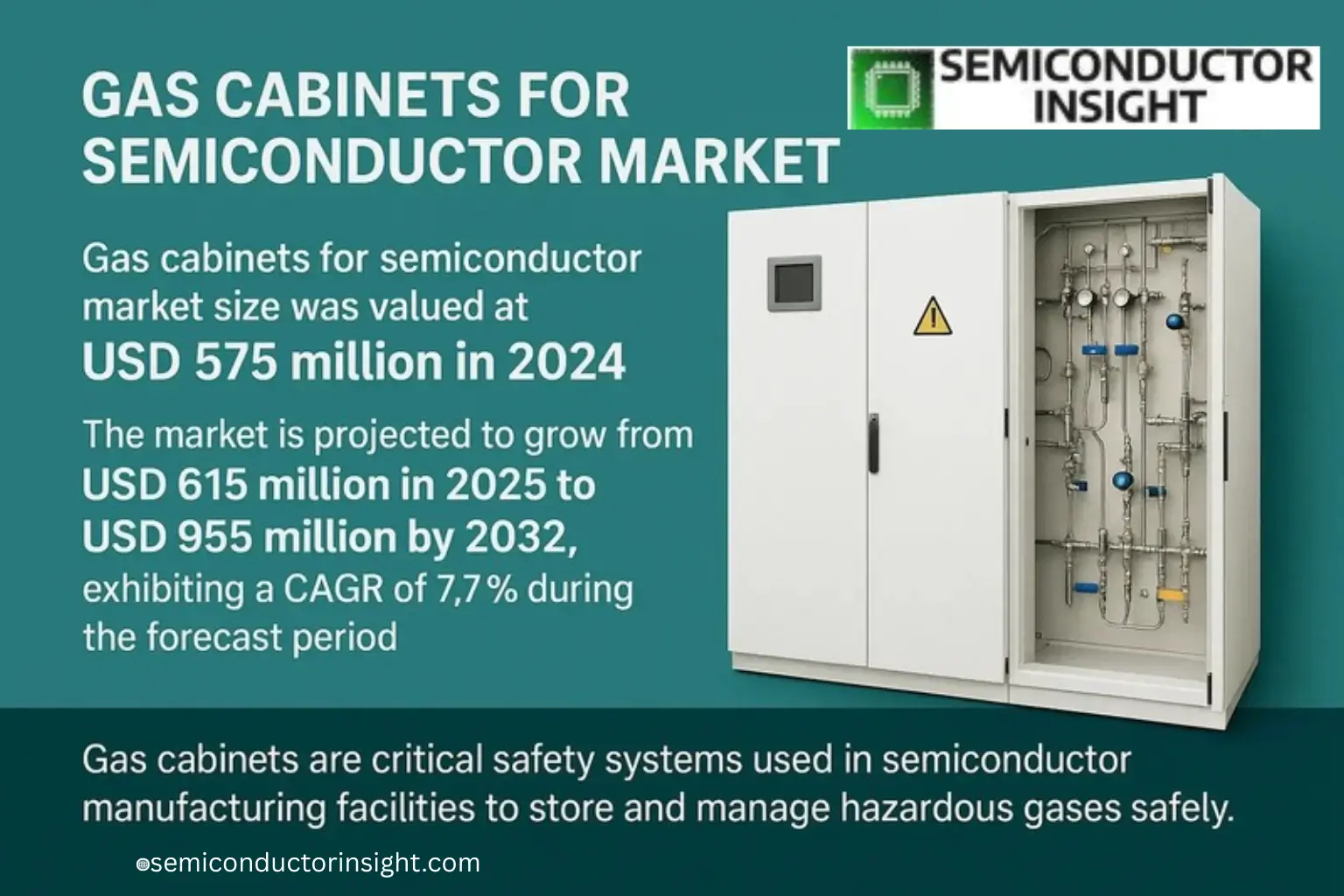
Global Gas Cabinets for Semiconductor Market size was valued at USD 575 million in 2024. The market is projected to grow from USD 615 million in 2025 to USD 955 million by 2032, exhibiting a CAGR of 7.7% during the forecast period.
Gas cabinets are critical safety systems used in semiconductor manufacturing facilities to store and manage hazardous gases safely. These cabinets ensure controlled environments for processes such as chemical vapor deposition (CVD), etching, doping, and photolithography. They are designed to prevent leaks, minimize contamination risks, and comply with stringent industry safety standards.
The market growth is driven by the rapid expansion of the semiconductor industry, particularly with advancements in process technologies like 5nm, 3nm, and emerging 2nm nodes. These innovations demand higher precision in gas handling and storage conditions. Additionally, rising investments in wafer fabrication plants across key regions such as China, South Korea, and Taiwan further propel demand. Leading players like Entegris, Exyte Group, and Applied Energy Systems continue to innovate with automated solutions to meet evolving industry requirements.
MARKET DRIVERS
Expansion of Semiconductor Manufacturing Capacity
Global boom in semiconductor fabrication plant construction, driven by government incentives and soaring demand for chips, is a primary driver for the Gas Cabinets for Semiconductor Market. These facilities require extensive gas delivery systems for processes like etching and deposition, creating sustained demand for high-purity gas cabinets. Investments exceeding USD 500 billion are planned for new fabs globally over the next five years, directly fueling market growth.
Advancements in Process Technology Nodes
The transition to advanced process nodes below 7nm and the rise of 3D NAND and logic chips necessitate ultra-high-purity gas handling. Even minute contaminants can cause yield loss, making sophisticated gas cabinets with advanced purification and monitoring systems essential. The increasing complexity of semiconductor manufacturing processes directly increases the specifications and adoption of these critical safety and delivery systems.
Furthermore, the push towards smaller, more powerful chips requires the use of more specialized and often more hazardous precursor gases. This technological evolution underscores the critical role of gas cabinets in the modern semiconductor ecosystem, ensuring both safety and process purity.
MARKET CHALLENGES
High Initial Investment and Complex Integration
The significant capital expenditure required for advanced gas cabinets, which can include gas detection systems, purifiers, and automated controls, presents a major challenge. Integrating these systems into existing fab infrastructure is complex and requires specialized engineering, potentially delaying new production lines and increasing total cost of ownership for semiconductor manufacturers.
Other Challenges
Stringent and Evolving Regulatory Compliance
Manufacturers must navigate a complex web of international, national, and local safety standards (e.g., SEMI, NFPA). Compliance requires continuous investment in design updates and certification, adding to development timelines and costs for gas cabinet suppliers.
Supply Chain Vulnerabilities for Specialized Components
Critical components like high-purity valves, sensors, and corrosion-resistant materials face supply chain constraints. Disruptions can lead to extended lead times and increased costs, impacting the ability to meet the accelerating demand from new semiconductor fabs.
MARKET RESTRAINTS
Economic Volatility and Capital Expenditure Cycles
The semiconductor industry is cyclical, with periods of high investment followed by downturns. During economic slowdowns or periods of oversupply, manufacturers delay or cancel new fab projects and capex, directly restraining demand for new gas cabinets. This cyclicality creates uncertainty for suppliers in the Gas Cabinets for Semiconductor Market.
Maturity in Certain Geographic Markets
While regions like Asia-Pacific are experiencing rapid growth, established semiconductor manufacturing hubs in other parts of the world have slower growth rates. The replacement market for gas cabinets in these mature fabs is less dynamic than the demand from greenfield projects, acting as a moderating factor on overall market expansion.
MARKET OPPORTUNITIES
Adoption of Smart and IIoT-Enabled Gas Cabinets
The integration of Industrial Internet of Things (IIoT) technology presents a significant opportunity. Smart gas cabinets with real-time monitoring, predictive maintenance capabilities, and data analytics can optimize gas usage, enhance safety, and reduce downtime. This value-added functionality is increasingly becoming a key differentiator for suppliers.
Growth in Compound Semiconductor and MEMS Fabrication
Beyond traditional silicon chips, the fabrication of compound semiconductors (GaN, SiC) for power electronics and 5G, along with MEMS devices, requires specialized gas handling. These emerging application areas represent new, high-growth segments for the Gas Cabinets for Semiconductor Market, demanding tailored solutions for different gas chemistries.
Focus on Miniaturization and Footprint Optimization
As fab space becomes increasingly expensive, there is a growing demand for compact, modular gas cabinet designs that offer the same functionality in a smaller footprint. Suppliers that innovate in space-saving and modular system architecture are well-positioned to capture value in dense manufacturing environments.
Gas Cabinets for Semiconductor Market Trends
Strong Growth Driven by Advanced Node Manufacturing
Global Gas Cabinets for Semiconductor Market is on a robust growth trajectory, projected to expand from a valuation of USD 575 million in 2024 to approximately USD 955 million by 2032, representing a compound annual growth rate of 7.7%. This significant growth is fundamentally linked to the ongoing advancement in semiconductor manufacturing technologies. As the industry pushes towards more complex process nodes like 5nm, 3nm, and 2nm, the requirements for ultra-high-purity gases and their safe, contained storage have become more stringent than ever. These advanced fabrication processes demand gas cabinets that can maintain pristine conditions to prevent contamination, which is a critical factor driving demand for more sophisticated and reliable equipment.
Other Trends
Regional Expansion of Fab Capacity
A major trend fueling the Gas Cabinets for Semiconductor Market is the significant investment in new and expanded wafer fabrication facilities, particularly across Asia. Regions such as China, South Korea, and Taiwan are witnessing a surge in fab construction to meet the escalating global demand for chips. Each new facility represents a substantial requirement for integrated gas delivery systems, including multiple gas cabinets for processes like deposition, etching, and doping. This regional capacity build-out is a primary driver for market expansion, creating a sustained demand pipeline for gas cabinet manufacturers.
Diversification by Application and Automation
The market is also characterized by diversification across different semiconductor manufacturing applications. Key segments include deposition, etching, photolithography, and ion implantation, each with specific gas handling needs. Concurrently, the trend towards automation for enhanced safety and operational efficiency is gaining momentum. The market segment for fully-automatic gas cabinets is growing as fabs seek to minimize human intervention with hazardous gases, reduce the potential for error, and improve overall process control and monitoring capabilities.
Competitive Landscape and Supply Chain Considerations
The competitive landscape for the Gas Cabinets for Semiconductor Market includes a mix of established global players and regional specialists. Key companies such as Entegris, Exyte Group, and Applied Energy Systems compete on technology innovation, reliability, and global service support. Market dynamics are also influenced by broader geopolitical and trade policies, which can affect supply chains and regional market structures. Companies are focusing on building resilient supply chains and adapting to regional tariff landscapes to maintain competitiveness and ensure the steady availability of these critical components for the semiconductor industry.
COMPETITIVE LANDSCAPE
Key Industry Players
A consolidated market characterized by technological expertise and stringent safety standards
Global Gas Cabinets for Semiconductor Market is led by a core group of established international players who have secured their positions through extensive experience, robust R&D capabilities, and a deep understanding of the stringent safety protocols required in semiconductor fabrication plants (fabs). Entegris stands as a prominent leader, leveraging its comprehensive portfolio of advanced materials handling solutions to serve major global foundries and IDMs. The competitive dynamics are heavily influenced by the need for cabinets that ensure ultra-high purity (UHP) gas delivery, particularly for advanced process nodes (5nm, 3nm, and beyond), where even minute contaminants can critically impact chip yield. The market concentration is relatively high, with the top five companies accounting for a significant revenue share in 2024. Competition intensifies around reliability, automation features (fully-automatic vs. semi-automatic types), and adherence to international safety certifications.
Beyond the market leaders, a tier of significant players operates with strong regional presence or specialized niche expertise. Companies like Exyte Group and Applied Energy Systems have established strong footholds by providing integrated gas delivery systems and cabinet solutions. Meanwhile, a number of specialized and regional manufacturers, particularly in Asia, cater to the burgeoning demand from new fab constructions in China, South Korea, and Taiwan. These companies, including KC Co.,Ltd, Shanghai GenTech, and Shanghai Brother Microelectronics, compete effectively on cost-efficiency and localized service support for specific applications such as etching, deposition, and doping. The competitive landscape is further shaped by ongoing technological advancements aimed at enhancing cabinet intelligence, remote monitoring capabilities, and modular designs for flexible fab layouts.
List of Key Gas Cabinets for Semiconductor Companies Profiled
- Entegris
- Exyte Group
- Applied Energy Systems
- Sempa Systems (Meptagon)
- KC Co.,Ltd
- PNC Process Systems
- Shanghai GenTech
- Shanghai Hankoom
- Fath Group
- Shanghai Brother Microelectronics
- SVCS Process Innovation
- Shanghai Sunto Semiconductor Technology
- CVD Equipment Corporation
- Shenzhen Wofly Technology
Segment Analysis:
| Segment Category | Sub-Segments | Key Insights |
| By Type |
|
Fully-automatic Type represents the leading segment, driven by the critical need for operational safety and precision in advanced semiconductor fabs.
|
| By Application |
|
Deposition is the dominant application segment, as it is a fundamental and high-consumption step in chip fabrication.
|
| By End User |
|
Foundries constitute the leading end-user segment due to their massive capital expenditure and central role in global chip supply.
|
| By Hazard Level |
|
High-Hazard Gases segment drives the most stringent and sophisticated gas cabinet requirements.
|
| By Control System Integration |
|
Facility-Integrated Systems are becoming the leading approach for new and upgraded fabs, reflecting the trend towards holistic fab management.
|
Regional Analysis: Global
The region’s status as the world’s primary semiconductor manufacturing hub creates an unparalleled, sustained demand for Gas Cabinets for Semiconductor systems. The high volume of new fabrication facility construction and the upgrading of existing plants to produce more advanced nodes necessitate sophisticated gas delivery and abatement solutions, making it the largest and most dynamic market.
A deeply integrated local supply chain for both semiconductor equipment and specialty gases provides a significant competitive advantage. This proximity reduces lead times, lowers costs, and facilitates closer technical collaboration between gas cabinet suppliers and fab operators, ensuring systems are optimized for specific manufacturing processes and local safety standards.
Increasingly stringent regional regulations concerning workplace safety and environmental emissions are pushing fabs to adopt the most advanced Gas Cabinets for Semiconductor available. This regulatory pressure, combined with a heightened focus on operational excellence, is accelerating the replacement of older systems with newer, safer, and more efficient models featuring enhanced monitoring and control capabilities.
The region is a first-mover in adopting advanced semiconductor processes like EUV lithography and 3D NAND, which require exceptionally pure and stable gas delivery. This drives innovation in Gas Cabinets for Semiconductor Market products, with a focus on ultra-high purity components, advanced leak detection, and integration with fab-wide monitoring systems to maintain yield and ensure process integrity.
North America
North America remains a critical and technologically advanced market for Gas Cabinets for Semiconductor, characterized by a strong focus on R&D and the production of high-value, leading-edge chips. The presence of major semiconductor equipment companies and integrated device manufacturers (IDMs) fuels demand for highly specialized and reliable gas cabinet solutions. The market is driven by the need to support complex research initiatives and low-volume, high-mix production of advanced logic and memory chips. Strategic government initiatives aimed at reshoring semiconductor manufacturing are expected to stimulate new investments in fab capacity, subsequently boosting the demand for state-of-the-art gas handling systems that meet rigorous safety and performance standards.
Europe
The European market for Gas Cabinets for Semiconductor is defined by a strong emphasis on quality, safety, and environmental sustainability. The region hosts several key research institutions and fabs specializing in power semiconductors, sensors, and automotive chips. This focus creates demand for robust and highly reliable gas cabinet systems that can ensure process stability for these specialized applications. Strict EU regulations governing the use of hazardous materials and emissions drive the adoption of gas cabinets with advanced abatement and monitoring technologies. Collaborative projects within the European semiconductor ecosystem are fostering innovation in gas cabinet design to enhance safety protocols and reduce the environmental footprint of semiconductor manufacturing processes.
South America
The Gas Cabinets for Semiconductor Market in South America is a developing segment, currently characterized by a smaller manufacturing base compared to other regions. Demand is primarily driven by maintenance, retrofitting, and capacity upgrades within existing industrial and electronics manufacturing facilities. The market shows potential for growth as regional governments begin to explore strategies for developing a more robust technology sector. The adoption of gas cabinets is focused on ensuring operational safety and compliance with evolving industrial regulations, with suppliers often providing modular and cost-effective solutions tailored to the specific needs and scale of local operations.
Middle East & Africa
The Middle East & Africa region represents an emerging opportunity within the Gas Cabinets for Semiconductor Market. Growth is largely fueled by strategic national investments aimed at diversifying economies away from traditional sectors like oil and gas into high-technology industries. Several countries are establishing technology hubs and investing in basic semiconductor assembly and packaging facilities. This nascent market creates a demand for foundational gas cabinet systems that provide essential safety for handling specialty gases. The focus is on establishing reliable infrastructure, with an emphasis on training and knowledge transfer to build local expertise in the operation and maintenance of these critical semiconductor manufacturing support systems.
Report Scope
This market research report provides a comprehensive analysis of the Gas Cabinets for Semiconductor Market, covering the forecast period 2025–2032. It offers detailed insights into market dynamics, technological advancements, competitive landscape, and key trends shaping the industry.
Key focus areas of the report include:
- Market Overview: The report begins with an overview outlining its current market scenario, key growth indicators, and industry transformation drivers. It discusses macroeconomic factors, demand–supply balance, regulatory landscape, and the strategic role of gas cabinets in semiconductor manufacturing processes such as chemical vapor deposition (CVD), etching, and doping.
- Market Size & Forecast: Historical data and future projections for revenue, unit shipments, and market value across major regions and segments.
- Segmentation Analysis: Detailed breakdown by product type (Fully-automatic, Semi-automatic, Manual), application (Deposition, Etching, Photolithography, etc.), and end-user industry.
- Regional Insights: Insights into market performance across North America, Europe, Asia, South America, and Middle East & Africa, including country-level analysis.
- Competitive Landscape: Profiles of leading market participants, including their product offerings, market share, and recent developments.
- Technology Trends & Innovation: Assessment of emerging technologies and evolving industry standards for gas handling in semiconductor fabrication.
- Market Drivers & Restraints: Evaluation of factors driving market growth along with challenges, regulatory issues, and market-entry barriers.
- Stakeholder Insights: Strategic insights for equipment suppliers, semiconductor manufacturers, investors, and policymakers.
Primary and secondary research methods are employed, including interviews with industry experts and data from verified sources to ensure the accuracy and reliability of the insights presented.
FREQUENTLY ASKED QUESTIONS:
What is the current market size of Gas Cabinets for Semiconductor Market?
-> Gas Cabinets for Semiconductor Market size was valued at USD 575 million in 2024. The market is projected to grow from USD 615 million in 2025 to USD 955 million by 2032, exhibiting a CAGR of 7.7% during the forecast period.
What is the growth rate of Gas Cabinets for Semiconductor Market?
-> The market is projected to grow at a CAGR of 7.7% during the forecast period 2024-2032.
Which key companies operate in Gas Cabinets for Semiconductor Market?
-> Key players include Entegris, Exyte Group, Applied Energy Systems, Sempa Systems (Meptagon), KC Co.,Ltd, PNC Process Systems, and Shanghai GenTech, among others.
What are the key growth drivers?
-> Key growth drivers include advancements in semiconductor manufacturing processes (5nm, 3nm, 2nm nodes), expansion of wafer fabs in Asia, and increasing demand from 5G, IoT, AI, and autonomous driving applications.
Which region dominates the market?
-> Asia is the fastest-growing and dominant market, with significant demand from China, South Korea, and Taiwan due to new wafer fab projects.
What are the emerging trends?
-> Emerging trends include higher precision gas handling requirements for advanced nodes, increased automation in gas cabinets, and stricter safety standards.

Get Sample Report PDF for Exclusive Insights
Report Sample Includes
- Table of Contents
- List of Tables & Figures
- Charts, Research Methodology, and more...
 Download Sample Report PDF