Key Statistics
Key Takeaways
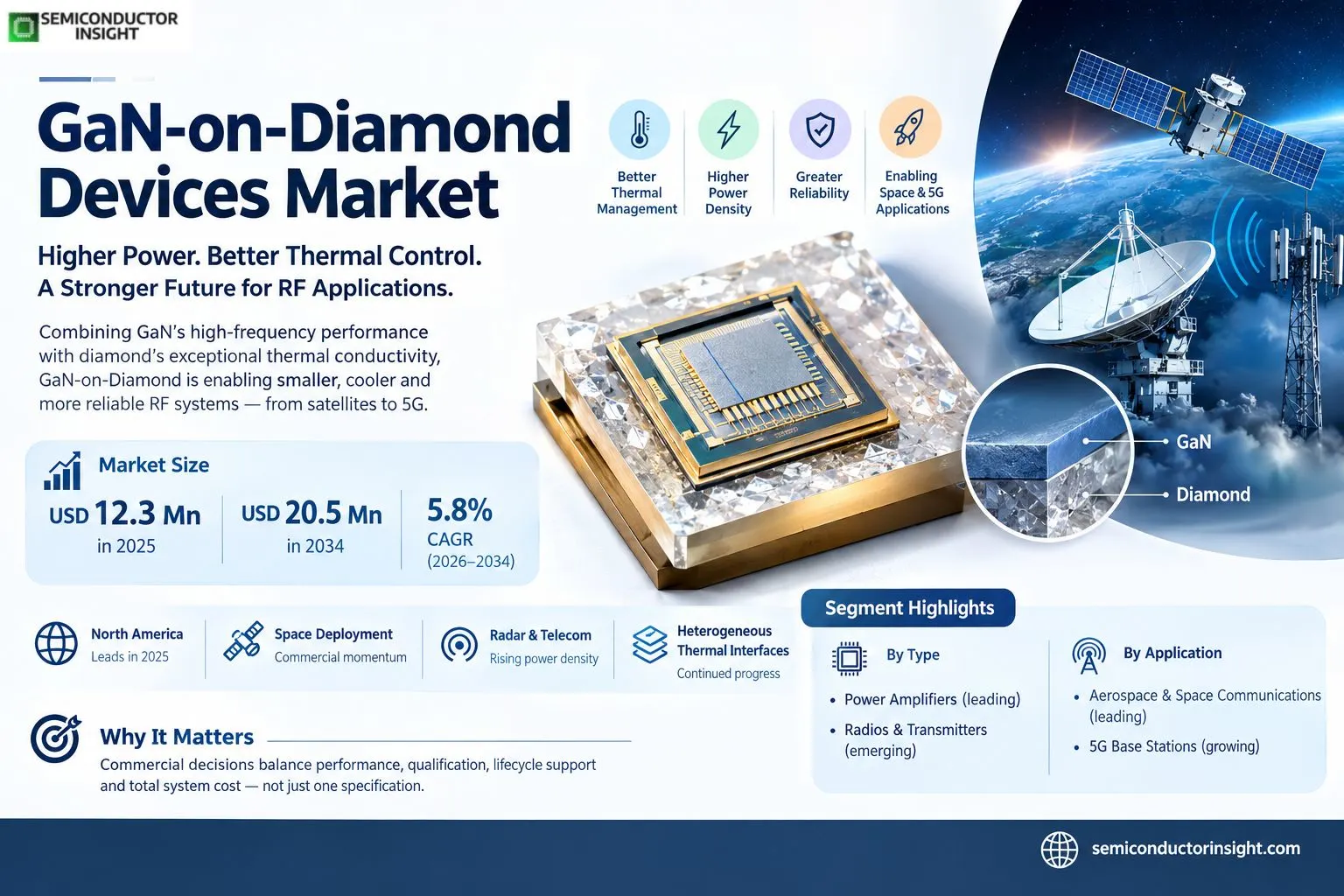
- Market size and growth: the market is valued at USD 12.3 million in 2025 and is projected to reach USD 20.5 million by 2034, representing a 5.8% CAGR over 2026–2034.
- Power Amplifiers leads by type because diamond-assisted heat spreading increases thermal headroom for high-power GaN RF stages and can reduce system-level cooling constraints.
- Aerospace & Space Communications leads application demand because satellite, radar and defense radios place unusually high value on RF power density, low mass, sustained duty cycle and thermal reliability.
- North America is the largest regional market, while Asia Pacific has the strongest incremental growth profile.
- Primary driver: high-power RF systems increasingly need more thermal headroom than conventional GaN packaging can economically provide
- Principal restraint: diamond integration remains expensive, difficult to scale and highly sensitive to interface quality and wafer-level yield
Market Overview
The GaN-on-Diamond devices market was valued at USD 12.3 million in 2025 and is projected to reach USD 20.5 million by 2034, expanding at a 5.8% CAGR over 2026–2034. North America leads in 2025, while the market is being reshaped by commercial space deployment, direct GaN-to-diamond integration, radar power density and continued progress in heterogeneous thermal interfaces.. Commercial decisions therefore balance performance, qualification, lifecycle support and total system cost rather than relying on one headline specification.
GaN-on-Diamond devices combine gallium nitride’s high-frequency and high-power performance with diamond’s exceptional thermal conductivity to remove heat close to the transistor channel. Akash Systems describes a process that transfers GaN thin films onto synthetic diamond, while its current technology material cites diamond thermal conductivity above 1,500 W/mK. The commercial value is strongest where heat, rather than transistor capability alone, limits sustained RF output, equipment size, cooling mass or lifetime in satellite communications, radar and high-duty-cycle transmitters.
Device-level research supports the thermal proposition. An IEEE Electron Device Letters study on 3-inch GaN-on-Diamond HEMTs reported a reduction in measured peak junction temperature from 241°C to 191°C after diamond transfer at 10 W/mm power density while preserving RF operation. Later work demonstrated GaN-on-Diamond behavior at still higher power density. These results matter commercially because they show that diamond can reduce channel temperature when the GaN-to-diamond interface is engineered correctly, rather than acting only as a distant package heat spreader.
Commercialization is beginning to move beyond laboratory samples. Akash Systems reported in January 2025 that its Diamond Cooled satellite radio achieved space heritage in low Earth orbit, while its current radio platform is positioned around high data rate, small size and reduced energy use. Space is a logical early market because every watt and gram has economic value. Broader telecom adoption will require the same thermal advantage to be delivered with repeatable wafer-scale yield, lower cost, long reliability data and secure manufacturing capacity.
Segment Analysis: By Type
By type, the market is segmented into Power Amplifiers, Radios and Transmitters. Power Amplifiers holds the leading position because diamond-assisted heat spreading increases thermal headroom for high-power GaN RF stages and can reduce system-level cooling constraints. Commercial decisions therefore balance performance, qualification, lifecycle support and total system cost rather than relying on one headline specification. As deployment scales, repeatable manufacturing, application engineering and supplier support become increasingly important to customer confidence and ownership economics. This combination is shaping product roadmaps, procurement priorities and investment decisions across both established customers and newer application segments.
| Type | Function / role | Market position |
|---|---|---|
| Power Amplifiers | GaN RF power stages integrated with diamond to lower channel-to-case thermal resistance. | Leading value segment because power density and sustained transmit performance directly benefit from stronger heat spreading. |
| Radios and Transmitters | Complete RF transmitter assemblies that use diamond-cooled GaN devices to reduce cooling burden. | Emerging system-level segment in satellite, radar and specialized communications. |
Commercial implications by type
Power amplifiers present the clearest device-level use case because conventional GaN-on-SiC can reach thermal limits before the desired electrical output is achieved. Diamond can improve the usable power envelope, but the benefit depends on interface resistance, die attach, package design and system cooling. Integrated radios capture more value per unit because lower junction temperature can enable smaller heat sinks, reduced mass and longer transmit duty cycles. This makes system co-design and qualification as important as the semiconductor material itself.
Segment Analysis: By Application
By application, demand is segmented into Aerospace & Space Communications, 5G Base Stations. Aerospace & Space Communications leads because satellite, radar and defense radios place unusually high value on RF power density, low mass, sustained duty cycle and thermal reliability. Commercial decisions therefore balance performance, qualification, lifecycle support and total system cost rather than relying on one headline specification. As deployment scales, repeatable manufacturing, application engineering and supplier support become increasingly important to customer confidence and ownership economics.
| Application | Demand characteristics |
|---|---|
| Aerospace & Space Communications | Satellite radios, radar and secure links benefit from high RF power density, lower cooling mass and strong thermal margin. |
| 5G Base Stations | High-power radio units could benefit where GaN amplifier temperature constrains efficiency, enclosure density or duty cycle. |
By Integration Method
| Integration Method | Commercial relevance |
|---|---|
| Direct / Transferred GaN-on-Diamond | GaN device layers are bonded or transferred close to synthetic diamond for minimum thermal path. |
| Diamond Heat-Spreader Integration | Diamond is used beneath or adjacent to a GaN die where full substrate transfer is not required. |
| System-Level Diamond Cooling | Diamond thermal structures are integrated into modules and complete radio assemblies. |
By Frequency Range
| Frequency Range | Commercial relevance |
|---|---|
| Sub-6 GHz | Macro-cell and lower-frequency radar prioritize rugged high-power operation. |
| Microwave / X-Band | Defense radar and satellite links require sustained RF power and thermal stability. |
| Ka-Band and Above | Compact high-frequency devices face severe local heat flux and packaging constraints. |
By End User
| End User | Commercial relevance |
|---|---|
| Defense & Aerospace | Mission value and thermal constraints support premium early adoption. |
| Telecom Equipment OEMs | Potential high-volume market if manufacturing economics become competitive. |
| Satellite Operators & Space OEMs | Compact radios can reduce payload mass, power and thermal-management burden. |
Regional Analysis
North America leads the market because the United States combines the strongest commercial developer base, defense and satellite demand, compound-semiconductor research and an early space-deployment reference. Asia Pacific has the strongest growth profile as demand expands through telecom, satellite and advanced semiconductor programs across China, Japan and South Korea could provide the strongest future scale-up route. Commercial decisions therefore balance performance, qualification, lifecycle support and total system cost rather than relying on one headline specification.
How does regional demand differ across this market?
North America leads current commercialization because demand is concentrated in high-value space and defense RF rather than mass electronics. Europe contributes advanced materials, semiconductor research and aerospace applications, while Asia Pacific offers the strongest volume potential through telecom equipment, satellite programs and established GaN manufacturing. South America and the Middle East & Africa remain downstream markets where content is more likely to enter through imported radar, satellite or telecom systems. Across regions, qualification evidence and thermal performance consistency matter more than simple device availability.
| Region | Position | Growth outlook | Demand profile | Supplier selection |
|---|---|---|---|---|
| North America | Largest | Strong | Defense, space and RF innovation | Thermal performance, qualification, domestic supply |
| Europe | Second | Moderate | RF research and aerospace | Reliability, interface quality, standards |
| Asia Pacific | Third | Fastest | Telecom and semiconductor scale | Cost reduction, manufacturability, supply chain |
| South America | Smaller | Selective | Imported telecom and aerospace | Cost, availability, service |
| Middle East & Africa | Emerging | Project-led | Defense and satellite communications | Mission value, ruggedness, supply support |
Competitive Landscape
Competition is narrow and technology-intensive because successful suppliers must combine GaN device engineering, diamond materials, bonding and RF packaging rather than relying on a standard foundry flow. Commercial decisions therefore balance performance, qualification, lifecycle support and total system cost rather than relying on one headline specification. As deployment scales, repeatable manufacturing, application engineering and supplier support become increasingly important to customer confidence and ownership economics. This combination is shaping product roadmaps, procurement priorities and investment decisions across both established customers and newer application segments.
Akash Systems is the clearest commercial specialist, combining proprietary Diamond Cooling with satellite-radio products and broader thermal-management offerings. Its public technology material emphasizes direct GaN-to-diamond integration, while the 2025 space deployment provides a real system milestone. Qorvo, RFHIC, Mitsubishi Electric and Sumitomo Electric remain important adjacent competitors because established GaN-on-SiC products set the performance, cost and reliability benchmark that GaN-on-Diamond must beat. The competitive test is therefore system-level value rather than thermal conductivity alone. Commercial decisions therefore balance performance, qualification, lifecycle support and total system cost rather than relying on one headline specification.
Academic and commercial evidence shows that the GaN-diamond interface is a critical competitive moat. IEEE work demonstrated lower junction temperature after diamond transfer while preserving device behavior, but production must reproduce that outcome across wafers and packaged modules. Suppliers that achieve low-defect diamond, thin and uniform bonding interfaces, controlled stress and high-yield RF assembly can create more durable differentiation than companies that own only a transistor layout. Process metrology and thermal characterization are consequently central to commercialization.
Alternative thermal technologies remain a strong competitive pressure. GaN-on-SiC continues improving through better epitaxy, packages and heat spreaders, while package-level diamond can capture part of the thermal benefit without full substrate transfer. GaN-on-Diamond becomes compelling only when thermal constraints impose a clear penalty on cooling mass, RF duty cycle, output power or lifetime. Expansion beyond defense and space therefore depends on proving a total-system benefit large enough to offset higher wafer, bonding and qualification costs.
| Competitive group | Representative participants | Competitive focus |
|---|---|---|
| GaN-on-Diamond specialist | Akash Systems | Direct commercialization and system deployment |
| Established GaN RF suppliers | Qorvo, RFHIC, Mitsubishi Electric, Sumitomo Electric | Conventional GaN benchmark and potential thermal integration |
| Materials / research ecosystem | Diamond suppliers, universities and research institutes | Synthetic diamond, bonding and thermal characterization |
Companies Profiled
The companies profiled include Akash Systems, Qorvo, RFHIC Corporation, Mitsubishi Electric, Diamond Microwave Limited, Sumitomo Electric. They span materials, semiconductor design, component manufacturing, packaging or system integration depending on the market. Competitive positions differ by technology depth, manufacturing scale, customer qualification and geographic reach, so the strongest suppliers combine differentiated engineering with repeatable volume production, application support and long-term product availability. Commercial decisions therefore balance performance, qualification, lifecycle support and total system cost rather than relying on one headline specification.
Production Capacity Analysis
Manufacturing capacity is constrained by diamond material quality, GaN transfer or bonding yield, interface engineering, RF processing and specialized thermal metrology rather than conventional wafer starts alone. Commercial decisions therefore balance performance, qualification, lifecycle support and total system cost rather than relying on one headline specification. As deployment scales, repeatable manufacturing, application engineering and supplier support become increasingly important to customer confidence and ownership economics. This combination is shaping product roadmaps, procurement priorities and investment decisions across both established customers and newer application segments.
A GaN-on-Diamond production line must control processes that are not standard in conventional GaN-on-SiC manufacturing. Diamond surface preparation, bonding or transfer, residual stress, GaN thickness and thermal-boundary resistance all influence final performance, while transfer defects can erase the thermal advantage. The small current market means suppliers cannot yet rely on mature high-volume learning curves. Each improvement in wafer size, bonding uniformity, metrology and automated RF test therefore has a disproportionate effect on unit cost and commercially available capacity.
System qualification further limits effective capacity because defense and space customers require extensive reliability evidence before adopting a new thermal architecture. Akash’s progression from wafer technology to shipping radios and space heritage illustrates how commercial capacity follows qualification rather than simple fab installation. Future 5G or commercial satellite demand would require repeatable multi-wafer production, automated RF test and a supply chain capable of delivering diamond-integrated devices at costs and lead times much closer to established GaN module production.
Market Dynamics
The market is shifting from a materials-science proposition toward a system-level RF value proposition centered on size, power density, energy use, cooling simplification and reliability. Commercial decisions therefore balance performance, qualification, lifecycle support and total system cost rather than relying on one headline specification. As deployment scales, repeatable manufacturing, application engineering and supplier support become increasingly important to customer confidence and ownership economics. This combination is shaping product roadmaps, procurement priorities and investment decisions across both established customers and newer application segments.
The critical market question is no longer whether diamond can remove heat efficiently, because published device studies establish that it can. The commercial issue is whether manufacturers can integrate diamond close enough to the GaN channel, at sufficient yield and cost, to create repeatable system savings in radios, radar arrays or base stations. Space deployment provides an important validation path because every gram and watt matters, while telecom will demand much lower cost, second-source assurance and far larger production volume before it can become the dominant application.
Market Drivers
Drivers Impact Analysis
| Driver | Impact | Commercial mechanism |
|---|---|---|
| Thermal limits in high-power RF | High | RF power density is increasing faster than conventional package thermal resistance can comfortably absorb in compact systems. GaN already supports high electric field and high-frequency operation, so the next practical bottleneck often becomes junction temperature and heat spreading. Diamond integration directly targets that limit, enabling higher sustained output, smaller heat sinks or reduced derating. The benefit is strongest in phased-array radar, satellite radios and high-duty-cycle transmitters where thermal headroom can translate directly into mission capability or reduced platform mass. |
| Satellite and defense demand | High | Aerospace and defense platforms value performance per unit mass and can justify premium materials when they reduce size, cooling hardware or mission risk. Akash’s 2025 space heritage is relevant because it demonstrates operation in an environment where conventional thermal solutions consume valuable volume and power. Defense radar also operates at high duty cycle and power density, creating a natural premium market for GaN devices that can tolerate greater thermal loads without compromising reliability, transmitter availability or the density of active array elements. |
| 5G and high-frequency communications | Medium | 5G and future wireless networks continue to push power amplifiers toward higher efficiency, bandwidth and compact radio units. GaN-on-Diamond is attractive where thermal constraints limit the number of power amplifiers that can be placed in an enclosure or force heavier cooling hardware. Commercial adoption will depend on whether device cost falls enough to justify replacing well-established GaN-on-SiC in applications where current thermal solutions still meet operator needs. The telecom opportunity is consequently large but requires much stronger manufacturing economics than space or defense. |
| Diamond materials progress | Medium | CVD diamond quality, wafer handling and direct-bonding research continue to improve the practical route from laboratory devices to manufacturable structures. Published studies show that the thermal advantage survives real device transfer when the interface is engineered correctly. As substrate quality and bonding control improve, suppliers can reduce temperature variation across a wafer, increase RF yield and make product specifications more repeatable. These improvements are essential before high-volume telecom customers will accept the technology in long-lived radio platforms with strict quality and supply requirements. |
Thermal limits in high-power RF
RF power density is increasing faster than conventional package thermal resistance can comfortably absorb in compact systems. GaN already supports high electric field and high-frequency operation, so the next practical bottleneck often becomes junction temperature and heat spreading. Diamond integration directly targets that limit, enabling higher sustained output, smaller heat sinks or reduced derating. The benefit is strongest in phased-array radar, satellite radios and high-duty-cycle transmitters where thermal headroom can translate directly into mission capability or reduced platform mass.
Satellite and defense demand
Aerospace and defense platforms value performance per unit mass and can justify premium materials when they reduce size, cooling hardware or mission risk. Akash’s 2025 space heritage is relevant because it demonstrates operation in an environment where conventional thermal solutions consume valuable volume and power. Defense radar also operates at high duty cycle and power density, creating a natural premium market for GaN devices that can tolerate greater thermal loads without compromising reliability, transmitter availability or the density of active array elements.
5G and high-frequency communications
5G and future wireless networks continue to push power amplifiers toward higher efficiency, bandwidth and compact radio units. GaN-on-Diamond is attractive where thermal constraints limit the number of power amplifiers that can be placed in an enclosure or force heavier cooling hardware. Commercial adoption will depend on whether device cost falls enough to justify replacing well-established GaN-on-SiC in applications where current thermal solutions still meet operator needs. The telecom opportunity is consequently large but requires much stronger manufacturing economics than space or defense.
Diamond materials progress
CVD diamond quality, wafer handling and direct-bonding research continue to improve the practical route from laboratory devices to manufacturable structures. Published studies show that the thermal advantage survives real device transfer when the interface is engineered correctly. As substrate quality and bonding control improve, suppliers can reduce temperature variation across a wafer, increase RF yield and make product specifications more repeatable. These improvements are essential before high-volume telecom customers will accept the technology in long-lived radio platforms with strict quality and supply requirements.
Market Restraints
Restraints Impact Analysis
| Restraint | Impact | Commercial mechanism |
|---|---|---|
| High manufacturing cost | High | Synthetic diamond and specialized integration add process steps beyond conventional GaN-on-SiC production, increasing wafer and package cost. The current market is too small to spread those costs across very large production runs, so commercial pricing remains oriented toward premium missions. Until suppliers achieve larger wafers, higher bonding yield and more automated assembly, cost will restrict adoption to applications where cooling, weight or RF performance has unusually high economic value and where the system-level savings are large enough to offset the semiconductor premium. |
| Interface thermal resistance | High | Diamond’s bulk thermal conductivity does not automatically guarantee a cool transistor because the GaN-diamond interface can dominate the thermal path. Bonding layers, surface roughness, contamination and residual dielectric material increase boundary resistance, while mechanical stress can affect device reliability. This makes interface metrology and repeatability central manufacturing challenges and explains why technical studies focus on placing diamond extremely close to the active channel rather than simply adding a thick diamond spreader farther from the heat-generating region. |
| Limited mass-production ecosystem | Medium | Conventional GaN-on-SiC benefits from established epitaxy, foundry, packaging and reliability infrastructure, whereas direct GaN-on-Diamond production remains specialized. A telecom customer needs secure multi-year capacity, second-source planning and predictable yields, not only a high-performing engineering sample. The lack of a broad foundry ecosystem therefore slows qualification and creates supply-chain risk, particularly for customers that need millions of RF devices rather than hundreds or thousands of premium units. Scale will depend on standardized processes, equipment and material specifications. |
| Strong GaN-on-SiC alternatives | Medium | GaN-on-SiC continues to improve through better epitaxy, packaging and thermal interfaces, raising the benchmark that GaN-on-Diamond must exceed. For many base-station, industrial and defense applications, existing GaN solutions already deliver acceptable power density at much lower cost and with established reliability data. Diamond becomes compelling only when thermal constraints impose a clear system penalty, so market expansion depends on applications where incremental cooling performance converts directly into revenue, mission capability, smaller hardware or lower lifetime operating cost. |
High manufacturing cost
Synthetic diamond and specialized integration add process steps beyond conventional GaN-on-SiC production, increasing wafer and package cost. The current market is too small to spread those costs across very large production runs, so commercial pricing remains oriented toward premium missions. Until suppliers achieve larger wafers, higher bonding yield and more automated assembly, cost will restrict adoption to applications where cooling, weight or RF performance has unusually high economic value and where the system-level savings are large enough to offset the semiconductor premium.
Interface thermal resistance
Diamond’s bulk thermal conductivity does not automatically guarantee a cool transistor because the GaN-diamond interface can dominate the thermal path. Bonding layers, surface roughness, contamination and residual dielectric material increase boundary resistance, while mechanical stress can affect device reliability. This makes interface metrology and repeatability central manufacturing challenges and explains why technical studies focus on placing diamond extremely close to the active channel rather than simply adding a thick diamond spreader farther from the heat-generating region.
Limited mass-production ecosystem
Conventional GaN-on-SiC benefits from established epitaxy, foundry, packaging and reliability infrastructure, whereas direct GaN-on-Diamond production remains specialized. A telecom customer needs secure multi-year capacity, second-source planning and predictable yields, not only a high-performing engineering sample. The lack of a broad foundry ecosystem therefore slows qualification and creates supply-chain risk, particularly for customers that need millions of RF devices rather than hundreds or thousands of premium units. Scale will depend on standardized processes, equipment and material specifications.
Strong GaN-on-SiC alternatives
GaN-on-SiC continues to improve through better epitaxy, packaging and thermal interfaces, raising the benchmark that GaN-on-Diamond must exceed. For many base-station, industrial and defense applications, existing GaN solutions already deliver acceptable power density at much lower cost and with established reliability data. Diamond becomes compelling only when thermal constraints impose a clear system penalty, so market expansion depends on applications where incremental cooling performance converts directly into revenue, mission capability, smaller hardware or lower lifetime operating cost.
Market Opportunities
Space-qualified transmitters
Satellite communications are an attractive early market because radio mass, power and heat rejection directly affect mission economics. Akash’s current platform demonstrates how diamond cooling can be packaged into a complete product rather than sold as a standalone wafer technology. Higher data rates, smaller thermal hardware and lower electrical consumption can create system-level savings that are easier to monetize than a modest transistor-level improvement, especially in small satellites where available volume, radiator area and power budgets are tightly constrained.
High-duty-cycle radar
Phased-array radar places many RF amplifiers close together, creating concentrated heat that can limit duty cycle or require heavy cooling. GaN-on-Diamond could allow more sustained transmit power or smaller thermal hardware while maintaining junction temperatures within reliability limits. Defense programs also tolerate longer qualification cycles and premium component pricing when improved thermal headroom increases detection range, reduces platform mass or enables denser arrays, making radar one of the strongest value-based opportunities for the technology during the forecast period.
Ka-band and millimeter-wave links
Higher-frequency satellite and point-to-point links require compact amplifiers with tight package parasitics and significant heat flux. Diamond’s thermal conductivity can be valuable because cooling area shrinks as devices become smaller, while electromagnetic design leaves limited freedom for bulky heat spreaders. If suppliers combine low thermal-boundary resistance with high-frequency package integrity, GaN-on-Diamond can address applications where conventional thermal paths become a hard limit on output power, efficiency or sustained transmit duty cycle. Commercial decisions therefore balance performance, qualification, lifecycle support and total system cost rather than relying on one headline specification.
Telecom scale-up
5G base stations represent the largest potential volume opportunity but also the most demanding cost target. Success would require wafer-scale manufacturing, reliable second-source options and clear total-system savings from smaller heat sinks, higher efficiency or reduced radio size. A telecom breakthrough would therefore indicate that GaN-on-Diamond had moved from a premium aerospace material to a scalable semiconductor platform. That transition could expand the market far beyond its current niche base but requires stronger yield, cost, reliability and supply-chain maturity.
Supply Chain Analysis
Synthetic CVD diamond and surface preparation
Transfer, bonding, interface control and HEMT fabrication
Die attach, matching networks and thermal interfaces
Radar, satellite radios and high-power telecom equipment
Diamond materials
CVD diamond quality, thickness, surface flatness and thermal conductivity determine the ceiling for heat spreading, but consistency across wafers is equally important for volume production. Material suppliers must deliver surfaces compatible with direct or intermediate bonding without contamination or stress that raises thermal-boundary resistance. Because current volumes are small, supply relationships are strategic and qualification can be lengthy, particularly when defense or space programs require detailed provenance, lot traceability and long-term reliability documentation. Commercial decisions therefore balance performance, qualification, lifecycle support and total system cost rather than relying on one headline specification.
GaN integration
The critical manufacturing step is bringing diamond close to the active GaN channel while preserving transistor characteristics. Device-first transfer, direct bonding and other heterogeneous methods attempt to minimize the thermally resistive interface without cracking the GaN layer or disturbing metallization. This stage combines semiconductor processing with advanced materials engineering and remains the main barrier to repeatable high-volume production because small variations in bonding thickness, roughness or residual stress can produce substantial changes in thermal performance.
RF packaging
Even an excellent GaN-on-Diamond die can lose much of its advantage if the package adds thermal bottlenecks or excessive electrical parasitics. RF modules therefore require co-design of heat spreading, impedance matching, bias networks and mechanical mounting so that the thermal path and high-frequency signal path support each other. Satellite and radar modules also require environmental qualification, making package engineering a substantial share of delivered product value and an important differentiator between laboratory devices and field-ready commercial systems.
System OEM integration
System manufacturers ultimately determine whether the technology creates economic value by redesigning radios, radar arrays or base stations around the improved thermal envelope. If the device simply replaces a GaN-on-SiC part without reducing heat sinks, fan power, mass or derating, the premium is difficult to justify. The strongest commercial programs therefore treat GaN-on-Diamond as a system architecture change rather than a drop-in semiconductor substitution, linking device performance directly to measurable benefits in the final RF platform.
Recent Developments
January 2025 — Akash Systems achieves space heritage with Diamond Cooled satellite radio
The company reported deployment of a GaN-on-Diamond-based satellite radio in low Earth orbit, providing a commercial reference for system-level thermal integration. Source
Current — Akash Systems markets Diamond Cooling for GaN
The current technology platform describes GaN thin-film transfer to synthetic diamond and positions thermal conductivity as the central performance advantage. Source
Research milestone — IEEE documents lower GaN junction temperature after diamond transfer
A device-first transfer study reported a substantial reduction in peak junction temperature while maintaining RF device performance. Source
Report Scope & Segmentation
| Attribute | Coverage |
|---|---|
| Market | GaN-on-Diamond Devices |
| Base Year | 2025 |
| Estimated Year | 2026 |
| Forecast Period | 2026–2034 |
| 2025 Market Size | USD 12.3 million |
| 2026 Estimated Size | USD 13.0 million |
| 2034 Forecast Size | USD 20.5 million |
| CAGR | 5.8% (2026–2034) |
| By Type | Power Amplifiers, Radios and Transmitters |
| By Application | Aerospace & Space Communications, 5G Base Stations |
| By Integration Method | Direct / Transferred GaN-on-Diamond, Diamond Heat-Spreader Integration, System-Level Diamond Cooling |
| By Frequency Range | Sub-6 GHz, Microwave / X-Band, Ka-Band and Above |
| By End User | Defense & Aerospace, Telecom Equipment OEMs, Satellite Operators & Space OEMs |
| Regions | North America, Europe, Asia Pacific, South America, Middle East & Africa |
| Companies Profiled | Akash Systems, Qorvo, RFHIC Corporation, Mitsubishi Electric, Diamond Microwave Limited, Sumitomo Electric |
Frequently Asked Questions
What is the GaN-on-Diamond devices market size in 2025?
The market is valued at USD 12.3 million in 2025.
What is the projected market size by 2034?
The market is projected to reach USD 20.5 million by 2034.
What is the CAGR from 2026 to 2034?
The market is expected to expand at a 5.8% CAGR.
Which region leads the market?
North America is the largest regional market in 2025.
Which type leads the market?
Power Amplifiers is the leading type.
Which application leads demand?
Aerospace & Space Communications is the leading application.
What is the primary growth driver?
high-power RF systems increasingly need more thermal headroom than conventional GaN packaging can economically provide.
What is the principal restraint?
diamond integration remains expensive, difficult to scale and highly sensitive to interface quality and wafer-level yield.
Where are the strongest opportunities?
satellite radios, high-duty-cycle radar, Ka-band links and thermally constrained telecom transmitters.
Which companies are active in the market?
Akash Systems, Qorvo, RFHIC Corporation, Mitsubishi Electric, Diamond Microwave Limited, Sumitomo Electric.
Research Sources & Evidence Base
View primary and authoritative evidence used in this overview
- Akash Systems: GaN-on-Diamond Technology — Commercial description of GaN-to-diamond integration and thermal performance.
- Akash Systems: Satellite Radio — System-level radio performance, size and power positioning.
- Akash Systems: Space Heritage Announcement — 2025 commercial deployment milestone.
- IEEE Electron Device Letters: 3-inch GaN-on-Diamond HEMTs With Device-First Transfer Technology — Measured thermal and RF performance before and after transfer.
- IEEE Electron Device Letters: GaN-on-Diamond HEMT Technology at High Power Density — Thermoreflectance evidence under high power density.
- Nature Reviews Electrical Engineering: Wide-bandgap membrane and heterogeneous integration review — Context on GaN-to-diamond heterogeneous integration and bonding.
Get Sample Report PDF for Exclusive Insights
Report Sample Includes
- Table of Contents
- List of Tables & Figures
- Charts, Research Methodology, and more...
 Download Sample Report PDF