SEMICONDUCTOR INSIGHT
MARKET RESEARCH REPORT

FZ NTD Silicon Wafer Market

2026 to 2034
MARKET INTELLIGENCE
ACROSS KEY REGIONS
2026 EDITION
ELECTRONIC COMPONENTS Semiconductor Market Research

FZ NTD Silicon Wafer Market

Size, Share & Industry Analysis, By Type (Less Than 6 Inch, 8 Inch), By Application (MEMS, Transistor, IGBT, RF Device, Optical Communication, Others), By Material Purity (Standard Purity, High Purity, Ultra-High Purity), By End-Use Industry (Automotive, Consumer Electronics, Industrial, Telecommunications, Others), and Regional Forecast, 2026-2034

◷
UPDATED 15 October 2026
▤
REPORT LENGTH Detailed Report
▣
REPORT CODE 49d0b27d5857
▯
FORMATS PDF

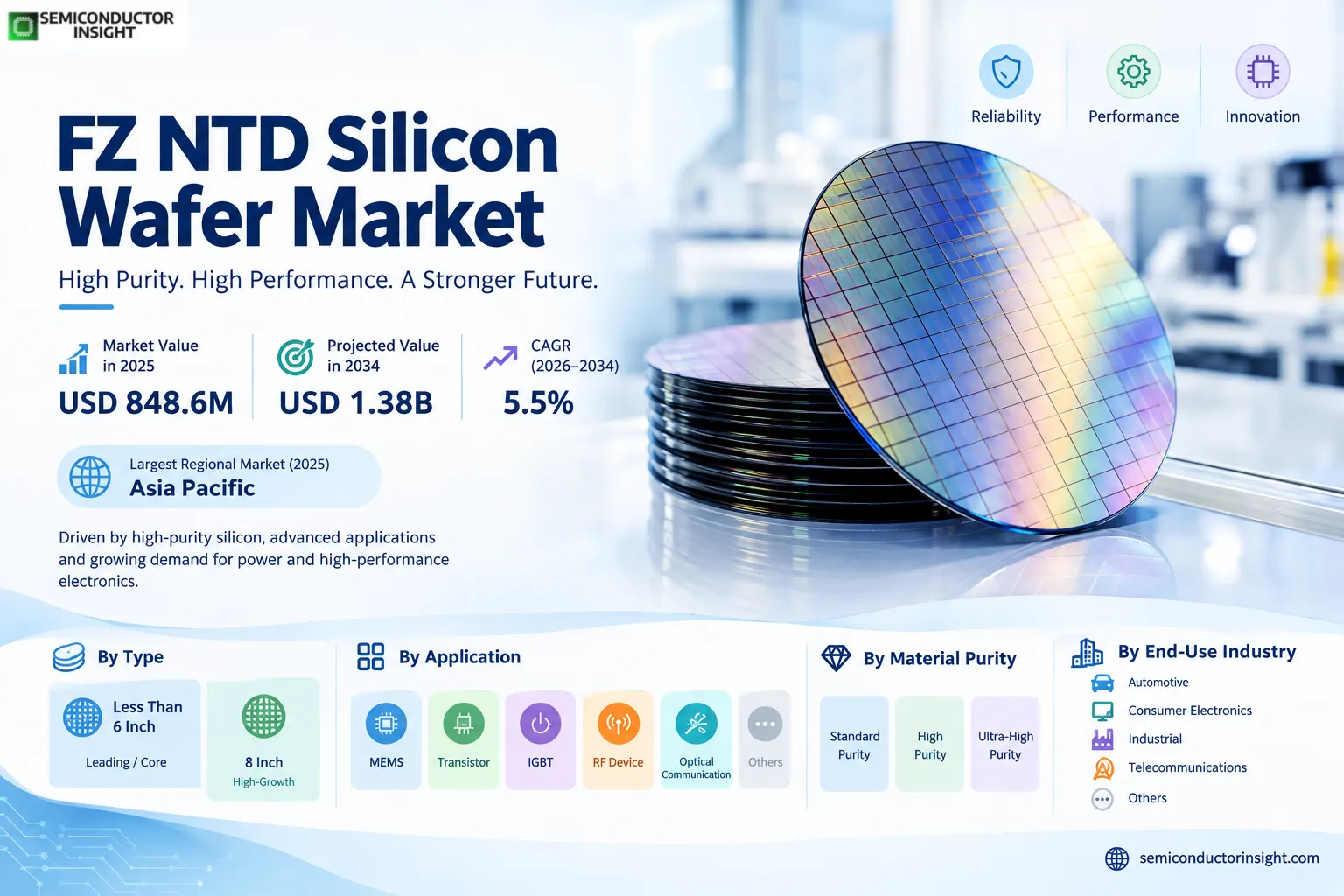
FZ NTD silicon wafer market was valued at USD 848.6 million in 2025 and is projected to reach USD 1.38 billion by 2034, expanding at a CAGR of 5.5% during 2026–2034. Asia Pacific is the largest regional market in 2025.

Get the sample PDF with study scope, segmentation and methodology details.

Key Statistics

2025 Market Size
USD 848.6 million
2034 Projected Market Size
USD 1.38 billion
CAGR (2026–2034)
5.5%
Largest Market in 2025
Asia Pacific

Key Takeaways

  • Market size and growth: USD 848.6 million in 2025, rising to USD 1.38 billion by 2034 at a 5.5% CAGR over 2026–2034.
  • Asia Pacific is the largest market in 2025 because the region combines major end-use demand with a dense electronics and semiconductor supply base.
  • Less Than 6 Inch is a core product category, while technology migration is increasing the value of higher-performance and application-specific variants.
  • Primary demand driver: Power semiconductors, high-voltage industrial systems and selected RF applications require high-purity silicon with strong resistivity uniformity and low oxygen content.
  • Structural restraint: Float-zone crystal growth is yield-sensitive, while neutron transmutation doping depends on specialized irradiation capacity, regulatory controls and long qualification cycles.
  • Growth opportunity: Higher-voltage power modules, specialty detectors, advanced RF devices and selected quantum and photonic applications support demand for ultra-high-purity material.

FZ NTD Silicon Wafer Market Overview

FZ NTD silicon wafer market was valued at USD 848.6 million in 2025 and is projected to reach USD 1.38 billion by 2034, expanding at a CAGR of 5.5% during 2026–2034. Asia Pacific is the largest regional market in 2025.

Base year: 2025 · Estimated year: 2026 · Forecast period: 2026–2034 · Values in USD million unless stated otherwise

FZ NTD Silicon Wafer is a specialized electronics market in which performance, reliability and system integration determine purchasing decisions. Buyers typically qualify products against electrical, thermal, mechanical and lifecycle requirements before a supplier can enter a production program. This creates meaningful switching costs once a design is approved, while also raising the technical threshold for new suppliers seeking high-volume business.

Power semiconductors, high-voltage industrial systems and selected RF applications require high-purity silicon with strong resistivity uniformity and low oxygen content. The commercial effect is a shift from commodity selection toward application-specific products that deliver measurable system benefits. Suppliers that can document reliability, maintain stable lead times and support customer engineering teams are positioned to capture a larger share of recurring design-win revenue.

Production is concentrated among specialist wafer manufacturers in Japan, Germany, Taiwan and China, with neutron irradiation capacity acting as an additional supply-chain gate. This geographic concentration matters because supply security now influences sourcing alongside price and performance. OEMs increasingly seek dual sourcing, regional inventory and long-term capacity visibility, especially for components used in high-value systems where a shortage can delay an entire platform launch.

Segment Analysis: By Type

By type, the market includes Less Than 6 Inch, 8 Inch. Product selection depends on the balance between performance, integration complexity, thermal behavior, qualification requirements and cost. The largest revenue pool is concentrated in established architectures, while newer variants generally grow faster when they solve a clear system bottleneck.

Type Commercial role Market position
Less Than 6 Inch Defines the main product architecture and purchasing specification. Leading / core segment. Demand depends on performance, qualification, supply continuity and total system economics rather than a single component specification.
8 Inch Defines the main product architecture and purchasing specification. High-growth segment. Demand depends on performance, qualification, supply continuity and total system economics rather than a single component specification.

Segment Analysis: By Application

By application, demand spans MEMS, Transistor, IGBT, RF Device, Optical Communication, Others. Purchasing behavior differs materially across these applications because system reliability, operating environment, qualification duration and replacement cost vary. High-value applications favor suppliers with deeper engineering support, while consumer and high-volume applications place greater weight on unit economics and manufacturing scale.

Application Purchasing trigger Demand characteristics
MEMS Links demand to system-level performance and qualification requirements. Leading / core segment. Demand depends on performance, qualification, supply continuity and total system economics rather than a single component specification.
Transistor Links demand to system-level performance and qualification requirements. High-growth segment. Demand depends on performance, qualification, supply continuity and total system economics rather than a single component specification.
IGBT Links demand to system-level performance and qualification requirements. Established segment. Demand depends on performance, qualification, supply continuity and total system economics rather than a single component specification.
RF Device Links demand to system-level performance and qualification requirements. Established segment. Demand depends on performance, qualification, supply continuity and total system economics rather than a single component specification.
Optical Communication Links demand to system-level performance and qualification requirements. Established segment. Demand depends on performance, qualification, supply continuity and total system economics rather than a single component specification.
Others Links demand to system-level performance and qualification requirements. Established segment. Demand depends on performance, qualification, supply continuity and total system economics rather than a single component specification.

By Material Purity

Material Purity Market relevance
Standard Purity Relevant to product selection, qualification and supplier differentiation.
High Purity Relevant to product selection, qualification and supplier differentiation.
Ultra-High Purity Relevant to product selection, qualification and supplier differentiation.

By End-Use Industry

End-Use Industry Market relevance
Automotive Creates a distinct design, performance or procurement requirement within the market.
Consumer Electronics Creates a distinct design, performance or procurement requirement within the market.
Industrial Creates a distinct design, performance or procurement requirement within the market.
Telecommunications Creates a distinct design, performance or procurement requirement within the market.
Others Creates a distinct design, performance or procurement requirement within the market.

FZ NTD Silicon Wafer Market Size & Growth

Regional Analysis

Asia Pacific leads the FZ NTD silicon wafer market in 2025. Regional demand differs by manufacturing concentration, end-use investment, qualification requirements and access to local supply chains. The strongest opportunities are therefore not identical across regions, even where the same product family is used.

How does regional demand differ across the market?

Regional competition is shaped by where products are designed, where they are manufactured and where the final systems are deployed. Asia Pacific benefits from electronics and semiconductor manufacturing density, North America concentrates advanced system design and cloud or defense demand, while Europe remains important in automotive, industrial and regulation-led applications. South America and the Middle East & Africa are smaller but can generate attractive project-led demand.

Region Position Growth outlook Demand profile
Asia Pacific Largest High Largest demand and production base, supported by Japanese wafer leaders, Chinese capacity expansion and regional power-semiconductor manufacturing.
North America Established High Demand is concentrated in aerospace, defense, power electronics, research and specialty semiconductor applications.
Europe Established Moderate Germany and other European markets are important for power electronics, industrial drives and specialty wafer production.
South America Established Moderate Demand is limited and largely imported for industrial electronics and research applications.
Middle East & Africa Established Moderate Selective demand comes from energy, telecom and research projects, with very limited local wafer production.
Asia Pacific LARGEST

What defines demand in Asia Pacific?

Largest demand and production base, supported by Japanese wafer leaders, Chinese capacity expansion and regional power-semiconductor manufacturing.

Market positionLargest
Demand profileApplication-led
Supplier priorityQualification & supply
Commercial gateDesign-in access
Country Demand characteristics
China China participates through a mix of local electronics demand, imported components, system integration and sector-specific investment. Supplier success depends on application qualification, access to major OEM programs and reliable regional distribution rather than headline market size alone.
Japan Japan participates through a mix of local electronics demand, imported components, system integration and sector-specific investment. Supplier success depends on application qualification, access to major OEM programs and reliable regional distribution rather than headline market size alone.
South Korea South Korea participates through a mix of local electronics demand, imported components, system integration and sector-specific investment. Supplier success depends on application qualification, access to major OEM programs and reliable regional distribution rather than headline market size alone.

The full report expands this regional view with country-level demand, supplier presence, application mix, qualification requirements and market-entry considerations. The regional opportunity is therefore assessed through actual production ecosystems and end-use programs rather than by repeating a single global statistic across countries.

North America ESTABLISHED

What defines demand in North America?

Demand is concentrated in aerospace, defense, power electronics, research and specialty semiconductor applications.

Market positionEstablished
Demand profileApplication-led
Supplier priorityQualification & supply
Commercial gateDesign-in access
Country Demand characteristics
United States United States participates through a mix of local electronics demand, imported components, system integration and sector-specific investment. Supplier success depends on application qualification, access to major OEM programs and reliable regional distribution rather than headline market size alone.
Canada Canada participates through a mix of local electronics demand, imported components, system integration and sector-specific investment. Supplier success depends on application qualification, access to major OEM programs and reliable regional distribution rather than headline market size alone.
Mexico Mexico participates through a mix of local electronics demand, imported components, system integration and sector-specific investment. Supplier success depends on application qualification, access to major OEM programs and reliable regional distribution rather than headline market size alone.

The full report expands this regional view with country-level demand, supplier presence, application mix, qualification requirements and market-entry considerations. The regional opportunity is therefore assessed through actual production ecosystems and end-use programs rather than by repeating a single global statistic across countries.

Europe ESTABLISHED

What defines demand in Europe?

Germany and other European markets are important for power electronics, industrial drives and specialty wafer production.

Market positionEstablished
Demand profileApplication-led
Supplier priorityQualification & supply
Commercial gateDesign-in access
Country Demand characteristics
Germany Germany participates through a mix of local electronics demand, imported components, system integration and sector-specific investment. Supplier success depends on application qualification, access to major OEM programs and reliable regional distribution rather than headline market size alone.
United Kingdom United Kingdom participates through a mix of local electronics demand, imported components, system integration and sector-specific investment. Supplier success depends on application qualification, access to major OEM programs and reliable regional distribution rather than headline market size alone.
France France participates through a mix of local electronics demand, imported components, system integration and sector-specific investment. Supplier success depends on application qualification, access to major OEM programs and reliable regional distribution rather than headline market size alone.

The full report expands this regional view with country-level demand, supplier presence, application mix, qualification requirements and market-entry considerations. The regional opportunity is therefore assessed through actual production ecosystems and end-use programs rather than by repeating a single global statistic across countries.

South America ESTABLISHED

What defines demand in South America?

Demand is limited and largely imported for industrial electronics and research applications.

Market positionEstablished
Demand profileApplication-led
Supplier priorityQualification & supply
Commercial gateDesign-in access
Country Demand characteristics
Brazil Brazil participates through a mix of local electronics demand, imported components, system integration and sector-specific investment. Supplier success depends on application qualification, access to major OEM programs and reliable regional distribution rather than headline market size alone.
Argentina Argentina participates through a mix of local electronics demand, imported components, system integration and sector-specific investment. Supplier success depends on application qualification, access to major OEM programs and reliable regional distribution rather than headline market size alone.
Chile Chile participates through a mix of local electronics demand, imported components, system integration and sector-specific investment. Supplier success depends on application qualification, access to major OEM programs and reliable regional distribution rather than headline market size alone.

The full report expands this regional view with country-level demand, supplier presence, application mix, qualification requirements and market-entry considerations. The regional opportunity is therefore assessed through actual production ecosystems and end-use programs rather than by repeating a single global statistic across countries.

Middle East & Africa ESTABLISHED

What defines demand in Middle East & Africa?

Selective demand comes from energy, telecom and research projects, with very limited local wafer production.

Market positionEstablished
Demand profileApplication-led
Supplier priorityQualification & supply
Commercial gateDesign-in access
Country Demand characteristics
Saudi Arabia Saudi Arabia participates through a mix of local electronics demand, imported components, system integration and sector-specific investment. Supplier success depends on application qualification, access to major OEM programs and reliable regional distribution rather than headline market size alone.
United Arab Emirates United Arab Emirates participates through a mix of local electronics demand, imported components, system integration and sector-specific investment. Supplier success depends on application qualification, access to major OEM programs and reliable regional distribution rather than headline market size alone.
South Africa South Africa participates through a mix of local electronics demand, imported components, system integration and sector-specific investment. Supplier success depends on application qualification, access to major OEM programs and reliable regional distribution rather than headline market size alone.

The full report expands this regional view with country-level demand, supplier presence, application mix, qualification requirements and market-entry considerations. The regional opportunity is therefore assessed through actual production ecosystems and end-use programs rather than by repeating a single global statistic across countries.

Competitive Landscape

Competition is driven by technical qualification, customer access, manufacturing consistency and the ability to support product transitions. Market leaders generally combine proprietary process knowledge with broad application engineering, while specialist suppliers compete through narrower performance advantages, customization or regional service.

The competitive structure rewards suppliers that can convert R&D into qualified production rather than simply demonstrating laboratory performance. Long customer qualification cycles protect incumbents once designed in, but they also create opportunities during architecture changes when OEMs reconsider vendors, package formats and performance targets.

Supply reliability has become a central differentiator. Customers increasingly evaluate capacity commitments, geographic resilience, quality systems and lifecycle support in parallel with electrical specifications. This favors companies able to coordinate manufacturing, test, logistics and engineering support across multiple regions.

Company Position Competitive focus
Shin-Etsu Chemical Established participant Competes through technology, qualification, portfolio breadth and customer relationships.
SUMCO Established participant Competes through technology, qualification, portfolio breadth and customer relationships.
Siltronic Established participant Competes through technology, qualification, portfolio breadth and customer relationships.
GlobalWafers Established participant Competes through technology, qualification, portfolio breadth and customer relationships.
Zhonghuan Advanced Semiconductor Materials Established participant Competes through technology, qualification, portfolio breadth and customer relationships.
GRINM Semiconductor Materials Established participant Competes through technology, qualification, portfolio breadth and customer relationships.

Production Capacity Analysis

Production is concentrated among specialist wafer manufacturers in Japan, Germany, Taiwan and China, with neutron irradiation capacity acting as an additional supply-chain gate.

Capacity expansion is not determined by floor space alone. Yield learning, specialty equipment, trained personnel, material quality and customer qualification can all delay effective output after new equipment is installed. For this reason, announced capacity and immediately usable market supply can diverge, especially in advanced products with tight process windows.

Market Dynamics

The market is shaped by a combination of end-system performance requirements, technology migration, supply-chain resilience and cost pressure. Growth is strongest where the component removes a system bottleneck or enables a new architecture, while adoption slows when qualification complexity or alternative technologies reduce the economic advantage.

Power semiconductors, high-voltage industrial systems and selected RF applications require high-purity silicon with strong resistivity uniformity and low oxygen content. At the same time, float-zone crystal growth is yield-sensitive, while neutron transmutation doping depends on specialized irradiation capacity, regulatory controls and long qualification cycles. Suppliers therefore need to balance innovation with manufacturability, reliability and commercial discipline.

Market Drivers

Drivers Impact Analysis

Driver Impact Commercial implication
System performance High Directly increases component content or value per system.
Technology migration High Creates replacement and redesign opportunities.
Supply resilience Medium Favors qualified vendors with stable capacity.

System-level performance requirements

Power semiconductors, high-voltage industrial systems and selected RF applications require high-purity silicon with strong resistivity uniformity and low oxygen content. This directly affects vendor selection because component-level specifications increasingly translate into measurable platform performance, energy efficiency, thermal headroom or reliability. Products that create a clear system benefit can sustain better pricing and deeper customer engagement.

Design complexity and integration

As electronic systems become more integrated, component suppliers are expected to provide reference designs, simulation support, qualification data and predictable lifecycle management. This broadens competition beyond unit price and favors vendors that can reduce engineering time for OEMs while maintaining stable production quality.

Electrification and digitalization

The continued shift toward connected, electrified and software-defined systems increases the number and value of electronics used in vehicles, industrial equipment, data centers and consumer devices. This expands the addressable opportunity for suppliers whose products improve power efficiency, signal integrity, memory bandwidth, durability or user experience.

Regional supply-chain investment

Governments and manufacturers are investing in more resilient electronics and semiconductor supply chains. Even where these programs do not directly subsidize the market, they influence localization, inventory strategy and supplier qualification, creating opportunities for vendors with manufacturing or engineering support close to major customers.

Market Restraints

Restraints Impact Analysis

Restraint Impact Commercial implication
Qualification burden High Lengthens time to revenue and raises engineering cost.
Input cost volatility Medium Compresses margins when contracts limit price changes.
Alternative technologies Medium Can reduce content per system in selected applications.

Qualification and integration cost

Float-zone crystal growth is yield-sensitive, while neutron transmutation doping depends on specialized irradiation capacity, regulatory controls and long qualification cycles. These barriers slow supplier switching and can delay commercialization, particularly when products enter safety-critical, high-reliability or high-volume platforms. Smaller suppliers may have strong technology but still face long sales cycles before meaningful production revenue begins.

Cost pressure and substitution

OEMs continue to reduce bill-of-material cost and consolidate functions into more integrated devices. Suppliers must therefore show that the component provides a measurable system advantage. Where that advantage is weak, buyers may substitute lower-cost alternatives or redesign the function into another subsystem.

Market Opportunities

Next-generation architectures

Higher-voltage power modules, specialty detectors, advanced RF devices and selected quantum and photonic applications support demand for ultra-high-purity material. Vendors that engage early with platform designers can shape specifications, improve design-win probability and secure longer revenue lifecycles once the architecture moves into production.

Application-specific products

Specialized products for automotive, industrial, AI, medical or aerospace systems can command stronger margins because qualification requirements are tighter and failure costs are higher. The commercial opportunity is strongest where suppliers combine product performance with documentation, traceability and long-term availability.

Regional localization

Customers are diversifying sourcing and building more regional resilience into electronics supply chains. Local technical support, shorter logistics routes and qualified second-source options can therefore become competitive advantages even when manufacturing economics still favor a concentrated global production base.

Lifecycle services

Engineering support, failure analysis, reliability data and product-change management create service-based differentiation around the physical component. These capabilities strengthen customer retention and can reduce the risk of substitution when a market moves through technology transitions or periods of constrained supply.

Supply Chain Analysis

Stage Value creation and bottlenecks
Raw materials / upstream Purity, consistency, specialty materials and process inputs determine yield and performance.
Component manufacturing Value is created through process control, device architecture, testing and product-specific qualification.
Packaging / integration System integration determines thermal performance, reliability, footprint and manufacturability.
OEM / end user Design wins, lifecycle support and supply assurance determine recurring revenue and replacement demand.

The upstream stage determines material consistency and the starting cost structure. Manufacturing then converts process control into yield and product performance, while packaging or integration determines whether the component can meet system-level thermal, mechanical and electrical requirements. The OEM stage captures value through design ownership, platform integration and end-market access. Bottlenecks at any stage can affect the whole chain because qualification limits rapid supplier substitution.

Recent Developments

2025-01-01 — Major silicon-wafer suppliers continued investment in higher-value specialty wafers as power-electronics and advanced-device requirements increased. Source
2024-01-01 — European semiconductor policy continued to support capacity and supply-chain resilience through the European Chips Act framework. Source

Report Scope & Segmentation

Attribute Coverage
Market definition FZ NTD Silicon Wafer products and systems covered by the stated segmentation.
Base year 2025
Estimated year 2026
Forecast period 2026–2034
By Type Less Than 6 Inch, 8 Inch
By Application MEMS, Transistor, IGBT, RF Device, Optical Communication, Others
By Material Purity Standard Purity, High Purity, Ultra-High Purity
By End-Use Industry Automotive, Consumer Electronics, Industrial, Telecommunications, Others
Regions North America, Europe, Asia Pacific, South America, Middle East & Africa
Companies Shin-Etsu Chemical, SUMCO, Siltronic, GlobalWafers, Zhonghuan Advanced Semiconductor Materials, GRINM Semiconductor Materials

Frequently Asked Questions

What is the FZ NTD Silicon Wafer market size in 2025?

The market is valued at USD 848.6 million in 2025.

What is the projected FZ NTD Silicon Wafer market size by 2034?

The market is projected to reach USD 1.38 billion by 2034.

What is the CAGR of the FZ NTD Silicon Wafer market from 2026 to 2034?

The market is expected to expand at a CAGR of 5.5% over 2026–2034.

Which region leads the FZ NTD Silicon Wafer market?

Asia Pacific is the largest market in 2025.

What are the main product types?

The main types are Less Than 6 Inch, 8 Inch.

What are the key applications?

Key applications include MEMS, Transistor, IGBT, RF Device, Optical Communication, Others.

What is the main growth driver?

Power semiconductors, high-voltage industrial systems and selected RF applications require high-purity silicon with strong resistivity uniformity and low oxygen content.

What is the main restraint?

Float-zone crystal growth is yield-sensitive, while neutron transmutation doping depends on specialized irradiation capacity, regulatory controls and long qualification cycles.

Where are the strongest opportunities?

Higher-voltage power modules, specialty detectors, advanced RF devices and selected quantum and photonic applications support demand for ultra-high-purity material.

Which companies are active in the market?

Key participants include Shin-Etsu Chemical, SUMCO, Siltronic, GlobalWafers, Zhonghuan Advanced Semiconductor Materials, GRINM Semiconductor Materials.

Research Sources & Evidence Base

View primary and official sources used in this overview
  1. SUMCO: Silicon wafer product and corporate information.
  2. Siltronic: Silicon wafer technology and products.
  3. European Commission: European Chips Act.
FZ NTD Silicon Wafer Market Size, Share & Industry Analysis, By Type (Less Than 6 Inch, 8 Inch), By Application (MEMS, Transistor, IGBT, RF Device, Optical Communication, Others), By Material Purity (Standard Purity, High Purity, Ultra-High Purity), By End-Use Industry (Automotive, Consumer Electronics, Industrial, Telecommunications, Others), and Regional Forecast, 2026-2034

Get Sample Report PDF for Exclusive Insights

Report Sample Includes

  • Table of Contents
  • List of Tables & Figures
  • Charts, Research Methodology, and more...

PDF Icon Download Sample Report PDF

Download Sample Report

Table of Content

1 Introduction to Research & Analysis Reports
1.1 FZ NTD Silicon Wafer Market Definition
1.2 Market Segments
1.2.1 Segment by Type
1.2.2 Segment by Application
1.3 Global FZ NTD Silicon Wafer Market Overview
1.4 Features & Benefits of This Report
1.5 Methodology & Sources of Information
1.5.1 Research Methodology
1.5.2 Research Process
1.5.3 Base Year
1.5.4 Report Assumptions & Caveats
2 Global FZ NTD Silicon Wafer Overall Market Size
2.1 Global FZ NTD Silicon Wafer Market Size: 2024 VS 2032
2.2 Global FZ NTD Silicon Wafer Market Size, Prospects & Forecasts: 2026-2034
2.3 Global FZ NTD Silicon Wafer Sales: 2026-2034
3 Company Landscape
3.1 Top FZ NTD Silicon Wafer Players in Global Market
3.2 Top Global FZ NTD Silicon Wafer Companies Ranked by Revenue
3.3 Global FZ NTD Silicon Wafer Revenue by Companies
3.4 Global FZ NTD Silicon Wafer Sales by Companies
3.5 Global FZ NTD Silicon Wafer Price by Manufacturer (2020-2025)
3.6 Top 3 and Top 5 FZ NTD Silicon Wafer Companies in Global Market, by Revenue in 2024
3.7 Global Manufacturers FZ NTD Silicon Wafer Product Type
3.8 Tier 1, Tier 2, and Tier 3 FZ NTD Silicon Wafer Players in Global Market
3.8.1 List of Global Tier 1 FZ NTD Silicon Wafer Companies
3.8.2 List of Global Tier 2 and Tier 3 FZ NTD Silicon Wafer Companies
4 Sights by Product
4.1 Overview
4.1.1 Segment by Type – Global FZ NTD Silicon Wafer Market Size Markets, 2024 & 2032
4.1.2 Less than 6 inch
4.1.3 8 inch
4.2 Segment by Type – Global FZ NTD Silicon Wafer Revenue & Forecasts
4.2.1 Segment by Type – Global FZ NTD Silicon Wafer Revenue, 2020-2025
4.2.2 Segment by Type – Global FZ NTD Silicon Wafer Revenue, 2026-2032
4.2.3 Segment by Type – Global FZ NTD Silicon Wafer Revenue Market Share, 2026-2034
4.3 Segment by Type – Global FZ NTD Silicon Wafer Sales & Forecasts
4.3.1 Segment by Type – Global FZ NTD Silicon Wafer Sales, 2020-2025
4.3.2 Segment by Type – Global FZ NTD Silicon Wafer Sales, 2026-2032
4.3.3 Segment by Type – Global FZ NTD Silicon Wafer Sales Market Share, 2026-2034
4.4 Segment by Type – Global FZ NTD Silicon Wafer Price (Manufacturers Selling Prices), 2026-2034
5 Sights by Application
5.1 Overview
5.1.1 Segment by Application – Global FZ NTD Silicon Wafer Market Size, 2024 & 2032
5.1.2 MEMS
5.1.3 Transistor
5.1.4 IGBT
5.1.5 RF Device
5.1.6 Optical Communication
5.1.7 Other
5.2 Segment by Application – Global FZ NTD Silicon Wafer Revenue & Forecasts
5.2.1 Segment by Application – Global FZ NTD Silicon Wafer Revenue, 2020-2025
5.2.2 Segment by Application – Global FZ NTD Silicon Wafer Revenue, 2026-2032
5.2.3 Segment by Application – Global FZ NTD Silicon Wafer Revenue Market Share, 2026-2034
5.3 Segment by Application – Global FZ NTD Silicon Wafer Sales & Forecasts
5.3.1 Segment by Application – Global FZ NTD Silicon Wafer Sales, 2020-2025
5.3.2 Segment by Application – Global FZ NTD Silicon Wafer Sales, 2026-2032
5.3.3 Segment by Application – Global FZ NTD Silicon Wafer Sales Market Share, 2026-2034
5.4 Segment by Application – Global FZ NTD Silicon Wafer Price (Manufacturers Selling Prices), 2026-2034
6 Sights by Region
6.1 By Region – Global FZ NTD Silicon Wafer Market Size, 2024 & 2032
6.2 By Region – Global FZ NTD Silicon Wafer Revenue & Forecasts
6.2.1 By Region – Global FZ NTD Silicon Wafer Revenue, 2020-2025
6.2.2 By Region – Global FZ NTD Silicon Wafer Revenue, 2026-2032
6.2.3 By Region – Global FZ NTD Silicon Wafer Revenue Market Share, 2026-2034
6.3 By Region – Global FZ NTD Silicon Wafer Sales & Forecasts
6.3.1 By Region – Global FZ NTD Silicon Wafer Sales, 2020-2025
6.3.2 By Region – Global FZ NTD Silicon Wafer Sales, 2026-2032
6.3.3 By Region – Global FZ NTD Silicon Wafer Sales Market Share, 2026-2034
6.4 North America
6.4.1 By Country – North America FZ NTD Silicon Wafer Revenue, 2026-2034
6.4.2 By Country – North America FZ NTD Silicon Wafer Sales, 2026-2034
6.4.3 United States FZ NTD Silicon Wafer Market Size, 2026-2034
6.4.4 Canada FZ NTD Silicon Wafer Market Size, 2026-2034
6.4.5 Mexico FZ NTD Silicon Wafer Market Size, 2026-2034
6.5 Europe
6.5.1 By Country – Europe FZ NTD Silicon Wafer Revenue, 2026-2034
6.5.2 By Country – Europe FZ NTD Silicon Wafer Sales, 2026-2034
6.5.3 Germany FZ NTD Silicon Wafer Market Size, 2026-2034
6.5.4 France FZ NTD Silicon Wafer Market Size, 2026-2034
6.5.5 U.K. FZ NTD Silicon Wafer Market Size, 2026-2034
6.5.6 Italy FZ NTD Silicon Wafer Market Size, 2026-2034
6.5.7 Russia FZ NTD Silicon Wafer Market Size, 2026-2034
6.5.8 Nordic Countries FZ NTD Silicon Wafer Market Size, 2026-2034
6.5.9 Benelux FZ NTD Silicon Wafer Market Size, 2026-2034
6.6 Asia
6.6.1 By Region – Asia FZ NTD Silicon Wafer Revenue, 2026-2034
6.6.2 By Region – Asia FZ NTD Silicon Wafer Sales, 2026-2034
6.6.3 China FZ NTD Silicon Wafer Market Size, 2026-2034
6.6.4 Japan FZ NTD Silicon Wafer Market Size, 2026-2034
6.6.5 South Korea FZ NTD Silicon Wafer Market Size, 2026-2034
6.6.6 Southeast Asia FZ NTD Silicon Wafer Market Size, 2026-2034
6.6.7 India FZ NTD Silicon Wafer Market Size, 2026-2034
6.7 South America
6.7.1 By Country – South America FZ NTD Silicon Wafer Revenue, 2026-2034
6.7.2 By Country – South America FZ NTD Silicon Wafer Sales, 2026-2034
6.7.3 Brazil FZ NTD Silicon Wafer Market Size, 2026-2034
6.7.4 Argentina FZ NTD Silicon Wafer Market Size, 2026-2034
6.8 Middle East & Africa
6.8.1 By Country – Middle East & Africa FZ NTD Silicon Wafer Revenue, 2026-2034
6.8.2 By Country – Middle East & Africa FZ NTD Silicon Wafer Sales, 2026-2034
6.8.3 Turkey FZ NTD Silicon Wafer Market Size, 2026-2034
6.8.4 Israel FZ NTD Silicon Wafer Market Size, 2026-2034
6.8.5 Saudi Arabia FZ NTD Silicon Wafer Market Size, 2026-2034
6.8.6 UAE FZ NTD Silicon Wafer Market Size, 2026-2034
7 Manufacturers & Brands Profiles
7.1 Zhonghuan Advanced
7.1.1 Zhonghuan Advanced Company Summary
7.1.2 Zhonghuan Advanced Business Overview
7.1.3 Zhonghuan Advanced FZ NTD Silicon Wafer Major Product Offerings
7.1.4 Zhonghuan Advanced FZ NTD Silicon Wafer Sales and Revenue in Global (2020-2025)
7.1.5 Zhonghuan Advanced Key News & Latest Developments
7.2 GlobalWafers
7.2.1 GlobalWafers Company Summary
7.2.2 GlobalWafers Business Overview
7.2.3 GlobalWafers FZ NTD Silicon Wafer Major Product Offerings
7.2.4 GlobalWafers FZ NTD Silicon Wafer Sales and Revenue in Global (2020-2025)
7.2.5 GlobalWafers Key News & Latest Developments
7.3 Shin-Etsu Chemical
7.3.1 Shin-Etsu Chemical Company Summary
7.3.2 Shin-Etsu Chemical Business Overview
7.3.3 Shin-Etsu Chemical FZ NTD Silicon Wafer Major Product Offerings
7.3.4 Shin-Etsu Chemical FZ NTD Silicon Wafer Sales and Revenue in Global (2020-2025)
7.3.5 Shin-Etsu Chemical Key News & Latest Developments
7.4 Siltronic
7.4.1 Siltronic Company Summary
7.4.2 Siltronic Business Overview
7.4.3 Siltronic FZ NTD Silicon Wafer Major Product Offerings
7.4.4 Siltronic FZ NTD Silicon Wafer Sales and Revenue in Global (2020-2025)
7.4.5 Siltronic Key News & Latest Developments
7.5 SUMCO
7.5.1 SUMCO Company Summary
7.5.2 SUMCO Business Overview
7.5.3 SUMCO FZ NTD Silicon Wafer Major Product Offerings
7.5.4 SUMCO FZ NTD Silicon Wafer Sales and Revenue in Global (2020-2025)
7.5.5 SUMCO Key News & Latest Developments
7.6 Beijing Jingyuntong Technology
7.6.1 Beijing Jingyuntong Technology Company Summary
7.6.2 Beijing Jingyuntong Technology Business Overview
7.6.3 Beijing Jingyuntong Technology FZ NTD Silicon Wafer Major Product Offerings
7.6.4 Beijing Jingyuntong Technology FZ NTD Silicon Wafer Sales and Revenue in Global (2020-2025)
7.6.5 Beijing Jingyuntong Technology Key News & Latest Developments
7.7 Luoyang Hongtai Semiconductor
7.7.1 Luoyang Hongtai Semiconductor Company Summary
7.7.2 Luoyang Hongtai Semiconductor Business Overview
7.7.3 Luoyang Hongtai Semiconductor FZ NTD Silicon Wafer Major Product Offerings
7.7.4 Luoyang Hongtai Semiconductor FZ NTD Silicon Wafer Sales and Revenue in Global (2020-2025)
7.7.5 Luoyang Hongtai Semiconductor Key News & Latest Developments
7.8 Chengdu Qingyang Electronic
7.8.1 Chengdu Qingyang Electronic Company Summary
7.8.2 Chengdu Qingyang Electronic Business Overview
7.8.3 Chengdu Qingyang Electronic FZ NTD Silicon Wafer Major Product Offerings
7.8.4 Chengdu Qingyang Electronic FZ NTD Silicon Wafer Sales and Revenue in Global (2020-2025)
7.8.5 Chengdu Qingyang Electronic Key News & Latest Developments
7.9 GRINM Semiconductor Materials
7.9.1 GRINM Semiconductor Materials Company Summary
7.9.2 GRINM Semiconductor Materials Business Overview
7.9.3 GRINM Semiconductor Materials FZ NTD Silicon Wafer Major Product Offerings
7.9.4 GRINM Semiconductor Materials FZ NTD Silicon Wafer Sales and Revenue in Global (2020-2025)
7.9.5 GRINM Semiconductor Materials Key News & Latest Developments
7.10 WaferPro
7.10.1 WaferPro Company Summary
7.10.2 WaferPro Business Overview
7.10.3 WaferPro FZ NTD Silicon Wafer Major Product Offerings
7.10.4 WaferPro FZ NTD Silicon Wafer Sales and Revenue in Global (2020-2025)
7.10.5 WaferPro Key News & Latest Developments
7.11 PlutoSemi
7.11.1 PlutoSemi Company Summary
7.11.2 PlutoSemi Business Overview
7.11.3 PlutoSemi FZ NTD Silicon Wafer Major Product Offerings
7.11.4 PlutoSemi FZ NTD Silicon Wafer Sales and Revenue in Global (2020-2025)
7.11.5 PlutoSemi Key News & Latest Developments
8 Global FZ NTD Silicon Wafer Production Capacity, Analysis
8.1 Global FZ NTD Silicon Wafer Production Capacity, 2026-2034
8.2 FZ NTD Silicon Wafer Production Capacity of Key Manufacturers in Global Market
8.3 Global FZ NTD Silicon Wafer Production by Region
9 Key Market Trends, Opportunity, Drivers and Restraints
9.1 Market Opportunities & Trends
9.2 Market Drivers
9.3 Market Restraints
10 FZ NTD Silicon Wafer Supply Chain Analysis
10.1 FZ NTD Silicon Wafer Industry Value Chain
10.2 FZ NTD Silicon Wafer Upstream Market
10.3 FZ NTD Silicon Wafer Downstream and Clients
10.4 Marketing Channels Analysis
10.4.1 Marketing Channels
10.4.2 FZ NTD Silicon Wafer Distributors and Sales Agents in Global
11 Conclusion
12 Appendix
12.1 Note
12.2 Examples of Clients
12.3 DisclaimerList of Tables
Table 1. Key Players of FZ NTD Silicon Wafer in Global Market
Table 2. Top FZ NTD Silicon Wafer Players in Global Market, Ranking by Revenue (2024)
Table 3. Global FZ NTD Silicon Wafer Revenue by Companies, (US$, Mn), 2020-2025
Table 4. Global FZ NTD Silicon Wafer Revenue Share by Companies, 2020-2025
Table 5. Global FZ NTD Silicon Wafer Sales by Companies, (K Units), 2020-2025
Table 6. Global FZ NTD Silicon Wafer Sales Share by Companies, 2020-2025
Table 7. Key Manufacturers FZ NTD Silicon Wafer Price (2020-2025) & (US$/Unit)
Table 8. Global Manufacturers FZ NTD Silicon Wafer Product Type
Table 9. List of Global Tier 1 FZ NTD Silicon Wafer Companies, Revenue (US$, Mn) in 2024 and Market Share
Table 10. List of Global Tier 2 and Tier 3 FZ NTD Silicon Wafer Companies, Revenue (US$, Mn) in 2024 and Market Share
Table 11. Segment by Type – Global FZ NTD Silicon Wafer Revenue, (US$, Mn), 2024 & 2032
Table 12. Segment by Type – Global FZ NTD Silicon Wafer Revenue (US$, Mn), 2020-2025
Table 13. Segment by Type – Global FZ NTD Silicon Wafer Revenue (US$, Mn), 2026-2032
Table 14. Segment by Type – Global FZ NTD Silicon Wafer Sales (K Units), 2020-2025
Table 15. Segment by Type – Global FZ NTD Silicon Wafer Sales (K Units), 2026-2032
Table 16. Segment by Application – Global FZ NTD Silicon Wafer Revenue, (US$, Mn), 2024 & 2032
Table 17. Segment by Application – Global FZ NTD Silicon Wafer Revenue, (US$, Mn), 2020-2025
Table 18. Segment by Application – Global FZ NTD Silicon Wafer Revenue, (US$, Mn), 2026-2032
Table 19. Segment by Application – Global FZ NTD Silicon Wafer Sales, (K Units), 2020-2025
Table 20. Segment by Application – Global FZ NTD Silicon Wafer Sales, (K Units), 2026-2032
Table 21. By Region – Global FZ NTD Silicon Wafer Revenue, (US$, Mn), 2025-2032
Table 22. By Region – Global FZ NTD Silicon Wafer Revenue, (US$, Mn), 2020-2025
Table 23. By Region – Global FZ NTD Silicon Wafer Revenue, (US$, Mn), 2026-2032
Table 24. By Region – Global FZ NTD Silicon Wafer Sales, (K Units), 2020-2025
Table 25. By Region – Global FZ NTD Silicon Wafer Sales, (K Units), 2026-2032
Table 26. By Country – North America FZ NTD Silicon Wafer Revenue, (US$, Mn), 2020-2025
Table 27. By Country – North America FZ NTD Silicon Wafer Revenue, (US$, Mn), 2026-2032
Table 28. By Country – North America FZ NTD Silicon Wafer Sales, (K Units), 2020-2025
Table 29. By Country – North America FZ NTD Silicon Wafer Sales, (K Units), 2026-2032
Table 30. By Country – Europe FZ NTD Silicon Wafer Revenue, (US$, Mn), 2020-2025
Table 31. By Country – Europe FZ NTD Silicon Wafer Revenue, (US$, Mn), 2026-2032
Table 32. By Country – Europe FZ NTD Silicon Wafer Sales, (K Units), 2020-2025
Table 33. By Country – Europe FZ NTD Silicon Wafer Sales, (K Units), 2026-2032
Table 34. By Region – Asia FZ NTD Silicon Wafer Revenue, (US$, Mn), 2020-2025
Table 35. By Region – Asia FZ NTD Silicon Wafer Revenue, (US$, Mn), 2026-2032
Table 36. By Region – Asia FZ NTD Silicon Wafer Sales, (K Units), 2020-2025
Table 37. By Region – Asia FZ NTD Silicon Wafer Sales, (K Units), 2026-2032
Table 38. By Country – South America FZ NTD Silicon Wafer Revenue, (US$, Mn), 2020-2025
Table 39. By Country – South America FZ NTD Silicon Wafer Revenue, (US$, Mn), 2026-2032
Table 40. By Country – South America FZ NTD Silicon Wafer Sales, (K Units), 2020-2025
Table 41. By Country – South America FZ NTD Silicon Wafer Sales, (K Units), 2026-2032
Table 42. By Country – Middle East & Africa FZ NTD Silicon Wafer Revenue, (US$, Mn), 2020-2025
Table 43. By Country – Middle East & Africa FZ NTD Silicon Wafer Revenue, (US$, Mn), 2026-2032
Table 44. By Country – Middle East & Africa FZ NTD Silicon Wafer Sales, (K Units), 2020-2025
Table 45. By Country – Middle East & Africa FZ NTD Silicon Wafer Sales, (K Units), 2026-2032
Table 46. Zhonghuan Advanced Company Summary
Table 47. Zhonghuan Advanced FZ NTD Silicon Wafer Product Offerings
Table 48. Zhonghuan Advanced FZ NTD Silicon Wafer Sales (K Units), Revenue (US$, Mn) and Average Price (US$/Unit) & (2020-2025)
Table 49. Zhonghuan Advanced Key News & Latest Developments
Table 50. GlobalWafers Company Summary
Table 51. GlobalWafers FZ NTD Silicon Wafer Product Offerings
Table 52. GlobalWafers FZ NTD Silicon Wafer Sales (K Units), Revenue (US$, Mn) and Average Price (US$/Unit) & (2020-2025)
Table 53. GlobalWafers Key News & Latest Developments
Table 54. Shin-Etsu Chemical Company Summary
Table 55. Shin-Etsu Chemical FZ NTD Silicon Wafer Product Offerings
Table 56. Shin-Etsu Chemical FZ NTD Silicon Wafer Sales (K Units), Revenue (US$, Mn) and Average Price (US$/Unit) & (2020-2025)
Table 57. Shin-Etsu Chemical Key News & Latest Developments
Table 58. Siltronic Company Summary
Table 59. Siltronic FZ NTD Silicon Wafer Product Offerings
Table 60. Siltronic FZ NTD Silicon Wafer Sales (K Units), Revenue (US$, Mn) and Average Price (US$/Unit) & (2020-2025)
Table 61. Siltronic Key News & Latest Developments
Table 62. SUMCO Company Summary
Table 63. SUMCO FZ NTD Silicon Wafer Product Offerings
Table 64. SUMCO FZ NTD Silicon Wafer Sales (K Units), Revenue (US$, Mn) and Average Price (US$/Unit) & (2020-2025)
Table 65. SUMCO Key News & Latest Developments
Table 66. Beijing Jingyuntong Technology Company Summary
Table 67. Beijing Jingyuntong Technology FZ NTD Silicon Wafer Product Offerings
Table 68. Beijing Jingyuntong Technology FZ NTD Silicon Wafer Sales (K Units), Revenue (US$, Mn) and Average Price (US$/Unit) & (2020-2025)
Table 69. Beijing Jingyuntong Technology Key News & Latest Developments
Table 70. Luoyang Hongtai Semiconductor Company Summary
Table 71. Luoyang Hongtai Semiconductor FZ NTD Silicon Wafer Product Offerings
Table 72. Luoyang Hongtai Semiconductor FZ NTD Silicon Wafer Sales (K Units), Revenue (US$, Mn) and Average Price (US$/Unit) & (2020-2025)
Table 73. Luoyang Hongtai Semiconductor Key News & Latest Developments
Table 74. Chengdu Qingyang Electronic Company Summary
Table 75. Chengdu Qingyang Electronic FZ NTD Silicon Wafer Product Offerings
Table 76. Chengdu Qingyang Electronic FZ NTD Silicon Wafer Sales (K Units), Revenue (US$, Mn) and Average Price (US$/Unit) & (2020-2025)
Table 77. Chengdu Qingyang Electronic Key News & Latest Developments
Table 78. GRINM Semiconductor Materials Company Summary
Table 79. GRINM Semiconductor Materials FZ NTD Silicon Wafer Product Offerings
Table 80. GRINM Semiconductor Materials FZ NTD Silicon Wafer Sales (K Units), Revenue (US$, Mn) and Average Price (US$/Unit) & (2020-2025)
Table 81. GRINM Semiconductor Materials Key News & Latest Developments
Table 82. WaferPro Company Summary
Table 83. WaferPro FZ NTD Silicon Wafer Product Offerings
Table 84. WaferPro FZ NTD Silicon Wafer Sales (K Units), Revenue (US$, Mn) and Average Price (US$/Unit) & (2020-2025)
Table 85. WaferPro Key News & Latest Developments
Table 86. PlutoSemi Company Summary
Table 87. PlutoSemi FZ NTD Silicon Wafer Product Offerings
Table 88. PlutoSemi FZ NTD Silicon Wafer Sales (K Units), Revenue (US$, Mn) and Average Price (US$/Unit) & (2020-2025)
Table 89. PlutoSemi Key News & Latest Developments
Table 90. FZ NTD Silicon Wafer Capacity of Key Manufacturers in Global Market, 2023-2025 (K Units)
Table 91. Global FZ NTD Silicon Wafer Capacity Market Share of Key Manufacturers, 2023-2025
Table 92. Global FZ NTD Silicon Wafer Production by Region, 2020-2025 (K Units)
Table 93. Global FZ NTD Silicon Wafer Production by Region, 2026-2032 (K Units)
Table 94. FZ NTD Silicon Wafer Market Opportunities & Trends in Global Market
Table 95. FZ NTD Silicon Wafer Market Drivers in Global Market
Table 96. FZ NTD Silicon Wafer Market Restraints in Global Market
Table 97. FZ NTD Silicon Wafer Raw Materials
Table 98. FZ NTD Silicon Wafer Raw Materials Suppliers in Global Market
Table 99. Typical FZ NTD Silicon Wafer Downstream
Table 100. FZ NTD Silicon Wafer Downstream Clients in Global Market
Table 101. FZ NTD Silicon Wafer Distributors and Sales Agents in Global Market

List of Figures
Figure 1. FZ NTD Silicon Wafer Product Picture
Figure 2. FZ NTD Silicon Wafer Segment by Type in 2024
Figure 3. FZ NTD Silicon Wafer Segment by Application in 2024
Figure 4. Global FZ NTD Silicon Wafer Market Overview: 2024
Figure 5. Key Caveats
Figure 6. Global FZ NTD Silicon Wafer Market Size: 2024 VS 2032 (US$, Mn)
Figure 7. Global FZ NTD Silicon Wafer Revenue: 2026-2034 (US$, Mn)
Figure 8. FZ NTD Silicon Wafer Sales in Global Market: 2026-2034 (K Units)
Figure 9. The Top 3 and 5 Players Market Share by FZ NTD Silicon Wafer Revenue in 2024
Figure 10. Segment by Type – Global FZ NTD Silicon Wafer Revenue, (US$, Mn), 2024 & 2032
Figure 11. Segment by Type – Global FZ NTD Silicon Wafer Revenue Market Share, 2026-2034
Figure 12. Segment by Type – Global FZ NTD Silicon Wafer Sales Market Share, 2026-2034
Figure 13. Segment by Type – Global FZ NTD Silicon Wafer Price (US$/Unit), 2026-2034
Figure 14. Segment by Application – Global FZ NTD Silicon Wafer Revenue, (US$, Mn), 2024 & 2032
Figure 15. Segment by Application – Global FZ NTD Silicon Wafer Revenue Market Share, 2026-2034
Figure 16. Segment by Application – Global FZ NTD Silicon Wafer Sales Market Share, 2026-2034
Figure 17. Segment by Application -Global FZ NTD Silicon Wafer Price (US$/Unit), 2026-2034
Figure 18. By Region – Global FZ NTD Silicon Wafer Revenue, (US$, Mn), 2025 & 2032
Figure 19. By Region – Global FZ NTD Silicon Wafer Revenue Market Share, 2020 VS 2024 VS 2032
Figure 20. By Region – Global FZ NTD Silicon Wafer Revenue Market Share, 2026-2034
Figure 21. By Region – Global FZ NTD Silicon Wafer Sales Market Share, 2026-2034
Figure 22. By Country – North America FZ NTD Silicon Wafer Revenue Market Share, 2026-2034
Figure 23. By Country – North America FZ NTD Silicon Wafer Sales Market Share, 2026-2034
Figure 24. United States FZ NTD Silicon Wafer Revenue, (US$, Mn), 2026-2034
Figure 25. Canada FZ NTD Silicon Wafer Revenue, (US$, Mn), 2026-2034
Figure 26. Mexico FZ NTD Silicon Wafer Revenue, (US$, Mn), 2026-2034
Figure 27. By Country – Europe FZ NTD Silicon Wafer Revenue Market Share, 2026-2034
Figure 28. By Country – Europe FZ NTD Silicon Wafer Sales Market Share, 2026-2034
Figure 29. Germany FZ NTD Silicon Wafer Revenue, (US$, Mn), 2026-2034
Figure 30. France FZ NTD Silicon Wafer Revenue, (US$, Mn), 2026-2034
Figure 31. U.K. FZ NTD Silicon Wafer Revenue, (US$, Mn), 2026-2034
Figure 32. Italy FZ NTD Silicon Wafer Revenue, (US$, Mn), 2026-2034
Figure 33. Russia FZ NTD Silicon Wafer Revenue, (US$, Mn), 2026-2034
Figure 34. Nordic Countries FZ NTD Silicon Wafer Revenue, (US$, Mn), 2026-2034
Figure 35. Benelux FZ NTD Silicon Wafer Revenue, (US$, Mn), 2026-2034
Figure 36. By Region – Asia FZ NTD Silicon Wafer Revenue Market Share, 2026-2034
Figure 37. By Region – Asia FZ NTD Silicon Wafer Sales Market Share, 2026-2034
Figure 38. China FZ NTD Silicon Wafer Revenue, (US$, Mn), 2026-2034
Figure 39. Japan FZ NTD Silicon Wafer Revenue, (US$, Mn), 2026-2034
Figure 40. South Korea FZ NTD Silicon Wafer Revenue, (US$, Mn), 2026-2034
Figure 41. Southeast Asia FZ NTD Silicon Wafer Revenue, (US$, Mn), 2026-2034
Figure 42. India FZ NTD Silicon Wafer Revenue, (US$, Mn), 2026-2034
Figure 43. By Country – South America FZ NTD Silicon Wafer Revenue Market Share, 2026-2034
Figure 44. By Country – South America FZ NTD Silicon Wafer Sales, Market Share, 2026-2034
Figure 45. Brazil FZ NTD Silicon Wafer Revenue, (US$, Mn), 2026-2034
Figure 46. Argentina FZ NTD Silicon Wafer Revenue, (US$, Mn), 2026-2034
Figure 47. By Country – Middle East & Africa FZ NTD Silicon Wafer Revenue, Market Share, 2026-2034
Figure 48. By Country – Middle East & Africa FZ NTD Silicon Wafer Sales, Market Share, 2026-2034
Figure 49. Turkey FZ NTD Silicon Wafer Revenue, (US$, Mn), 2026-2034
Figure 50. Israel FZ NTD Silicon Wafer Revenue, (US$, Mn), 2026-2034
Figure 51. Saudi Arabia FZ NTD Silicon Wafer Revenue, (US$, Mn), 2026-2034
Figure 52. UAE FZ NTD Silicon Wafer Revenue, (US$, Mn), 2026-2034
Figure 53. Global FZ NTD Silicon Wafer Production Capacity (K Units), 2026-2034
Figure 54. The Percentage of Production FZ NTD Silicon Wafer by Region, 2024 VS 2032
Figure 55. FZ NTD Silicon Wafer Industry Value Chain
Figure 56. Marketing Channels