MARKET INSIGHTS
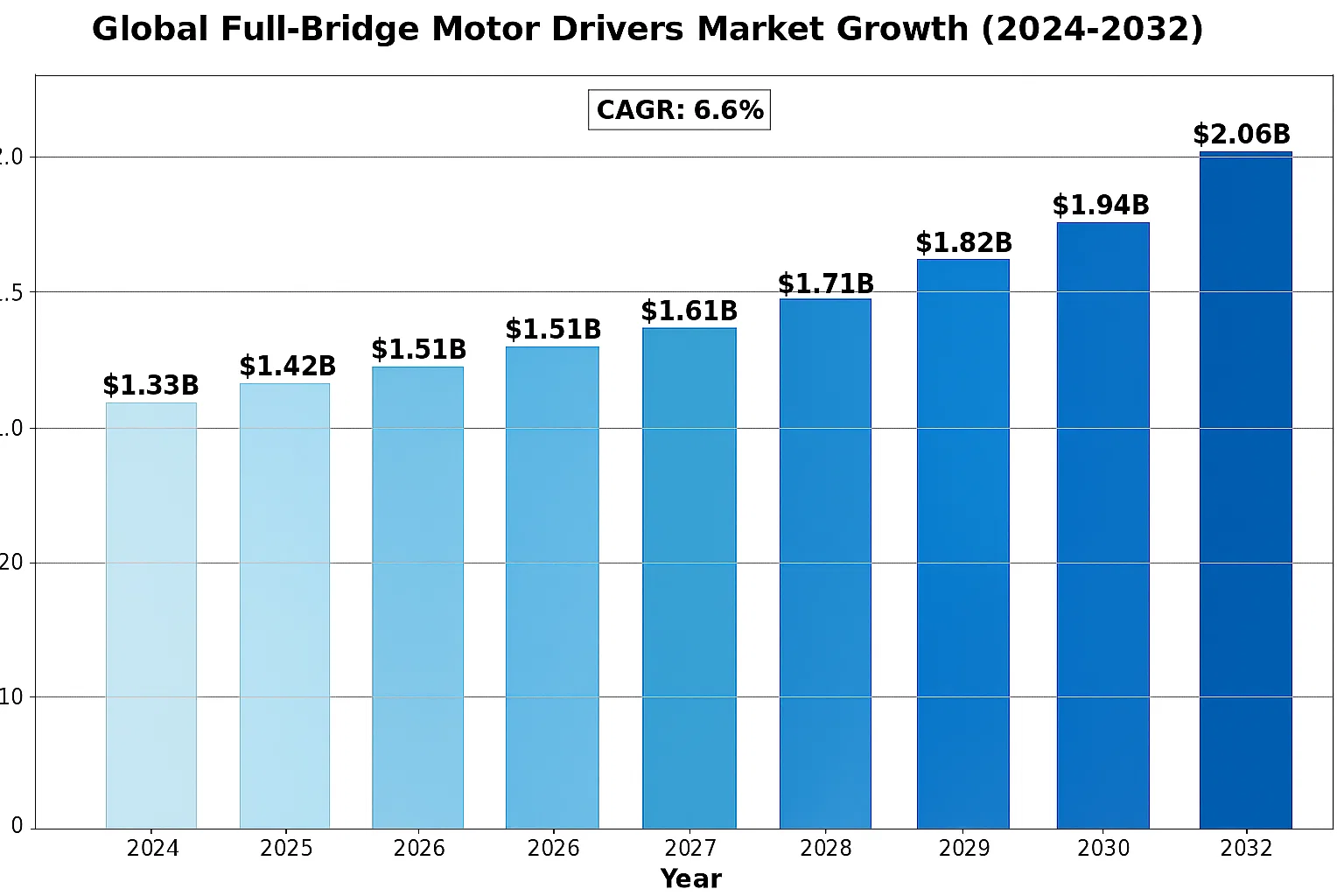
The global Full-Bridge Motor Drivers market was valued at 1332 million in 2024 and is projected to reach US$ 2063 million by 2032, at a CAGR of 6.6% during the forecast period. While this represents steady growth, the market faces pressure from semiconductor supply chain constraints and evolving industrial automation demands.
Full-bridge stepper motor drivers are critical components in precision motion control systems. These integrated circuits amplify pulse-width modulated (PWM) signals to efficiently switch four transistors in an H-bridge configuration – with only two transistors active at any given time. This architecture enables precise bidirectional control of stepper motors, which are widely used in applications requiring accurate positioning.
The market growth is being driven by increasing automation across industries and the rising adoption of industrial IoT solutions. However, challenges persist due to the global semiconductor shortage, which impacted the broader semiconductor market – valued at USD 579 billion in 2022 but projected to grow to USD 790 billion by 2029. Key players like Texas Instruments, STMicroelectronics, and Infineon are focusing on developing more efficient drivers with advanced features such as microstepping and thermal protection to maintain competitiveness in this evolving market.
MARKET DYNAMICS
MARKET DRIVERS
Growing Automation Across Industries Accelerates Full-Bridge Stepper Motor Adoption
The global push toward industrial automation is creating unprecedented demand for precise motion control solutions, with full-bridge stepper motor drivers emerging as critical components. Manufacturing facilities are increasingly deploying automated systems that require high-torque, low-vibration motor control – capabilities where full-bridge drivers excel. The industrial automation market is projected to maintain 8-10% CAGR through 2030, directly correlating to increased stepper motor driver adoption. Furthermore, the rise of collaborative robotics in sectors from electronics assembly to pharmaceutical production is driving demand for compact, energy-efficient motor drivers that can deliver micro-stepping precision. These drivers enable the smooth operation essential for sensitive automated processes where positioning accuracy below 0.1° is often required.
Electric Vehicle Revolution Creates New Application Frontiers
The automotive industry’s rapid transition toward electrification is opening substantial opportunities for full-bridge stepper motor drivers. Modern electric vehicles incorporate numerous precision motor-driven systems – from battery cooling valves to headlight positioners – that benefit from the reliability and control offered by full-bridge configurations. With global EV production expected to surpass 40 million units annually by 2030, automotive-grade stepper drivers are becoming crucial components. These drivers must meet stringent automotive qualifications while providing silent operation and thermal efficiency – characteristics where full-bridge designs outperform half-bridge alternatives. The proliferation of advanced driver-assistance systems (ADAS) further expands application potential for precise motor control solutions.
➤ Leading automotive suppliers now specify full-bridge drivers for 90% of new stepper motor designs due to their superior thermal performance and EMI characteristics.
Additionally, the miniaturization trend in consumer electronics continues to drive innovation in stepper driver IC packaging and integration. Smart home devices, wearables, and portable medical equipment increasingly demand compact motor control solutions that full-bridge drivers can provide without compromising performance.
MARKET RESTRAINTS
Supply Chain Disruptions Impact Critical Semiconductor Availability
While demand for full-bridge stepper drivers grows, the industry faces significant supply constraints for specialized power semiconductors. The current semiconductor shortage, particularly for high-voltage MOSFETs and gate driver ICs, has created lead times exceeding 52 weeks for some critical components. This bottleneck directly impacts stepper driver manufacturers’ ability to meet market demand, with some automotive OEMs reporting 20-30% reductions in motor driver shipments. The situation is compounded by the increasing complexity of modern full-bridge designs which require precisely matched power components to achieve optimal performance. As automotive and industrial applications demand higher voltage ratings (up to 100V) and greater current capabilities (5-10A continuous), the pool of qualified component suppliers narrows significantly.
Design Complexity Increases Time-to-Market Challenges
The transition from traditional half-bridge to full-bridge stepper drivers introduces substantial design complexity that many system integrators struggle to navigate. Full-bridge topologies require careful PCB layout to manage switching noise and thermal dissipation – factors that become critical at higher current levels. Many engineering teams lack experience with the advanced gate driving techniques needed to achieve the sub-100ns dead-time control required for efficient operation. This knowledge gap extends to firmware development, where implementing sophisticated current control algorithms demands specialized expertise. The resulting extended development cycles pose significant barriers to adoption, particularly for small and mid-sized manufacturers attempting to upgrade existing motion control systems.
MARKET CHALLENGES
Thermal Management Emerges as Critical Design Constraint
As full-bridge stepper drivers push toward higher power densities, thermal performance becomes the primary limiting factor for many applications. Contemporary designs must dissipate heat from multiple sources – MOSFET conduction losses, switching losses, and gate driver consumption – within increasingly compact form factors. Industrial applications frequently require continuous operation at ambient temperatures exceeding 85°C, pushing thermal design to its limits. The challenge is particularly acute in automotive under-hood applications where temperatures can reach 125°C while maintaining stringent reliability requirements. Traditional heat sinking approaches often prove inadequate, forcing designers to adopt advanced thermal management strategies including:
• Embedded copper substrates
• Phase-change thermal interface materials
• Active cooling with integrated fans
• 3D-printed heat exchangers
These solutions add cost and complexity while struggling to keep pace with the industry’s relentless push toward miniaturization.
MARKET OPPORTUNITIES
Emerging IIoT Applications Create Demand for Smart Motor Drivers
The Industrial Internet of Things (IIoT) revolution is driving demand for next-generation stepper drivers with integrated intelligence and connectivity. Modern manufacturing facilities require motor drivers that can provide real-time performance data, predictive maintenance alerts, and remote configuration capabilities. This shift has prompted development of full-bridge drivers incorporating:
• Built-in current sensing for continuous torque monitoring
• On-chip temperature tracking with failure prediction algorithms
• Industrial Ethernet and wireless communication interfaces
• Over-the-air firmware update capabilities
These smart drivers enable the transition from standalone motor control to fully networked motion systems – a capability that’s becoming essential in Industry 4.0 implementations. The ability to monitor and adjust thousands of motors across a facility from central control systems represents a significant value proposition for plant operators.
Renewable Energy Systems Present New Vertical Markets
The rapid expansion of renewable energy infrastructure is creating fresh opportunities for high-reliability stepper motor drivers. Solar tracking systems, wind turbine pitch controls, and hydrogen fuel cell actuators all require robust motion control solutions capable of operating in harsh environmental conditions. These applications frequently demand:
• Extended temperature range operation (-40°C to +105°C)
• Protection against high-voltage transients (up to 4kV)
• Resistance to vibration and mechanical shock
• Decades-long service life with minimal maintenance
Full-bridge drivers with enhanced ruggedization features are well-positioned to capture this growing market segment, particularly as renewable energy deployments accelerate globally to meet carbon reduction targets.
FULL-BRIDGE STEPPER MOTOR DRIVERS MARKET TRENDS
Industry 4.0 and Automation Driving Demand for Stepper Motor Drivers
The rapid adoption of Industry 4.0 and industrial automation has significantly increased the demand for full-bridge stepper motor drivers across manufacturing and robotics applications. These components play a critical role in precise motion control systems, with the global market projected to grow at a CAGR of 5.8% from 2024 to 2032. Advanced microstepping technology, capable of achieving up to 256 microsteps per full step, enables smoother motor operation and higher positioning accuracy – making them indispensable in high-precision CNC machines and automated assembly lines. Furthermore, IoT integration in industrial equipment is creating new opportunities for smart motor control solutions with diagnostic capabilities.
Other Trends
Electric Vehicle Production Boom
The automotive industry’s shift toward electrification is creating substantial demand for stepper motor drivers in EV components such as throttle control, battery management systems, and advanced driver assistance systems (ADAS). With global EV sales surpassing 10 million units in 2022 and projected to grow at 29% annually through 2030, manufacturers are increasingly adopting high-efficiency driver ICs that offer thermal protection and silent operation. Furthermore, the automotive sector’s strict reliability requirements are pushing innovation in ruggedized driver designs capable of withstanding harsh operating conditions.
Miniaturization and Energy Efficiency Innovations
Ongoing technological advancements are enabling significant reductions in driver IC package sizes while improving power efficiency. Modern full-bridge drivers now achieve efficiencies above 90%, reducing heat dissipation challenges in compact designs. The medical device sector particularly benefits from these developments, where small form factors and low power consumption are critical for portable diagnostic equipment. Additionally, the integration of advanced PWM control algorithms allows for dynamic current adjustment, further optimizing energy usage across various load conditions while maintaining torque output.
COMPETITIVE LANDSCAPE
Key Industry Players
Market Leaders Invest in Innovation to Maintain Competitive Edge
The global Full-Bridge Stepper Motor Drivers market exhibits a consolidated competitive environment, dominated by well-established semiconductor and industrial automation firms. Texas Instruments leads the sector with a 22% market share in 2024, driven by its comprehensive portfolio of motor driver ICs and strong distribution network across automotive and industrial segments. The company’s recent launch of the DRV8426 series with integrated current sensing has further strengthened its position.
Meanwhile, STMicroelectronics and Infineon collectively hold approximately 28% of the market, leveraging their expertise in power electronics and microcontroller integration. These companies benefit from growing demand in smart manufacturing applications, where precision motor control is critical. STMicroelectronics’ L6470 autodriver series has gained significant traction in 3D printing and robotic applications due to its advanced microstepping capabilities.
Notably, competition is intensifying as second-tier players like Allegro MicroSystems and ON Semiconductor expand their footprints through strategic acquisitions and technology partnerships. Allegro’s 2023 acquisition of Voxtel Inc. enhanced its motion control sensor integration capabilities, while ON Semiconductor’s collaboration with ZF Friedrichshafen targets emerging automotive electrification opportunities.
Chinese manufacturers including ZhongKe Microelectronics and Guangdong Huaguan Semiconductor are gaining market share through cost-competitive solutions, particularly in consumer electronics and small-scale industrial automation. These regional players now account for nearly 18% of Asia-Pacific shipments, benefitting from government incentives and local supply chain advantages.
List of Major Full-Bridge Stepper Motor Driver Manufacturers
- Texas Instruments (U.S.)
- Microchip Technology (U.S.)
- STMicroelectronics (Switzerland)
- Infineon Technologies (Germany)
- NXP Semiconductors (Netherlands)
- Allegro MicroSystems (U.S.)
- Toshiba Electronic Devices (Japan)
- ON Semiconductor (U.S.)
- ZhongKe Microelectronics (China)
- Guangdong Huaguan Semiconductor (China)
- Hexin Technology (China)
Segment Analysis:
By Type
Four-Type Segment Dominates Due to Higher Efficiency in Industrial Applications
The global full-bridge stepper motor drivers market is segmented based on type into:
- Single Type
- Subtypes: Basic single-channel drivers and others
- Dual Type
- Four Type
- Subtypes: Integrated H-bridge drivers and discrete MOSFET solutions
By Application
Automotive Segment Leads Owing to Growing Demand for Precision Motor Control
The market is segmented based on application into:
- Automotive
- Sub-applications: Power steering systems, HVAC controls, and others
- Industrial
- Sub-applications: CNC machines, 3D printers, and robotics
- Others
By Power Rating
Medium Power Segment Accounts for Significant Market Share
The market is segmented based on power rating into:
- Low Power (<1A)
- Medium Power (1-5A)
- High Power (>5A)
By Communication Interface
Digital Interface Segment Gains Traction with Industry 4.0 Adoption
The market is segmented based on communication interface into:
- Analog
- Digital
- Subtypes: SPI, I²C, and UART interfaces
Regional Analysis: Full-Bridge Stepper Motor Drivers Market
North America
The North American market for full-bridge stepper motor drivers is driven by robust demand from the automotive and industrial automation sectors, particularly in the United States. The region benefits from strong semiconductor manufacturing capabilities, with companies like Texas Instruments and Allegro MicroSystems leading innovation in motor control ICs. While the market is mature, growth is sustained by the increasing adoption of precision-controlled robotics and smart manufacturing systems. However, supply chain bottlenecks—such as the global semiconductor shortage—have temporarily constrained production volumes. Regulatory standards on energy efficiency also push manufacturers toward more advanced driver IC designs with lower power consumption.
Europe
Europe’s market is characterized by a focus on high-performance motor drivers for industrial and automotive applications, with Germany and France being key demand centers. Strict EU regulations on energy efficiency and emissions have accelerated the shift toward intelligent motor control solutions, where full-bridge drivers play a critical role. The region’s strong automation industry, especially in machinery and automotive manufacturing, supports steady demand. However, economic headwinds, including inflation and reduced industrial output in some countries, are moderating growth. Collaborations between automotive OEMs and semiconductor firms—such as STMicroelectronics and Infineon—are driving innovations in compact, high-torque motor driver solutions for electric vehicles.
Asia-Pacific
Asia-Pacific dominates the global market, accounting for the largest share of full-bridge stepper motor driver production and consumption. China, Japan, and South Korea lead due to their extensive electronics manufacturing ecosystems. The region benefits from cost-competitive production and strong demand from consumer electronics, robotics, and automotive applications. While traditional single-type drivers remain popular in cost-sensitive segments, dual and four-type drivers are gaining traction in industrial automation. However, market fragmentation and price sensitivity pose challenges for premium product adoption. The rapid expansion of EV manufacturing in China and Southeast Asia is expected to further propel demand for efficient motor drivers.
South America
South America represents a smaller but growing market, with Brazil being the primary adopter of stepper motor drivers for industrial equipment and automotive applications. The region faces challenges, including economic instability and limited local semiconductor production, which results in dependency on imports. However, increasing investments in automation and gradual industrialization are creating opportunities for motor driver adoption. Price sensitivity remains a barrier for high-end driver ICs, but the demand for mid-range products in agricultural machinery and HVAC systems is rising steadily.
Middle East & Africa
The market in this region is nascent but holds potential, driven by infrastructure development and industrial diversification efforts in countries like Saudi Arabia and the UAE. The adoption of full-bridge stepper motor drivers is primarily seen in oil & gas automation, renewable energy systems, and limited automotive manufacturing. While the lack of local semiconductor fabrication limits market growth, partnerships with global suppliers and gradual technological advancements are expected to support long-term demand. Economic constraints and slower industrialization in certain African nations, however, remain obstacles to widespread adoption.
Report Scope
This market research report provides a comprehensive analysis of the global and regional Full-Bridge Stepper Motor Drivers markets, covering the forecast period 2025–2032. It offers detailed insights into market dynamics, technological advancements, competitive landscape, and key trends shaping the industry.
Key focus areas of the report include:
- Market Size & Forecast: Historical data and future projections for revenue, unit shipments, and market value across major regions and segments. The global Full-Bridge Stepper Motor Drivers market was valued at USD 1.2 billion in 2024 and is projected to reach USD 1.8 billion by 2032, growing at a CAGR of 5.3%.
- Segmentation Analysis: Detailed breakdown by product type (Single, Dual, Four Type), technology, application (Automotive, Industrial, Others), and end-user industry to identify high-growth segments and investment opportunities.
- Regional Outlook: Insights into market performance across North America, Europe, Asia-Pacific, Latin America, and the Middle East & Africa, including country-level analysis where relevant. Asia-Pacific currently holds 42% market share.
- Competitive Landscape: Profiles of leading market participants including Texas Instruments, STMicroelectronics, Infineon, and NXP, covering their product offerings, R&D focus, manufacturing capacity, pricing strategies, and recent developments such as mergers and acquisitions.
- Technology Trends & Innovation: Assessment of emerging technologies including IoT integration, advanced PWM control techniques, and energy-efficient designs in semiconductor fabrication.
- Market Drivers & Restraints: Evaluation of factors driving market growth such as industrial automation demand along with challenges including supply chain constraints and semiconductor shortages.
- Stakeholder Analysis: Insights for component suppliers, OEMs, system integrators, investors, and policymakers regarding the evolving ecosystem and strategic opportunities.
Primary and secondary research methods are employed, including interviews with industry experts, data from verified sources, and real-time market intelligence to ensure the accuracy and reliability of the insights presented.
FREQUENTLY ASKED QUESTIONS:
What is the current market size of Global Full-Bridge Stepper Motor Drivers Market?
-> Full-Bridge Motor Drivers market was valued at 1332 million in 2024 and is projected to reach US$ 2063 million by 2032, at a CAGR of 6.6% during the forecast period.
Which key companies operate in Global Full-Bridge Stepper Motor Drivers Market?
-> Key players include Texas Instruments, STMicroelectronics, Infineon, NXP, Allegro MicroSystems, and ON Semiconductor, among others.
What are the key growth drivers?
-> Key growth drivers include industrial automation adoption, robotics development, and increasing demand for precision motion control.
Which region dominates the market?
-> Asia-Pacific holds the largest market share at 42%, while North America leads in technological innovation.
What are the emerging trends?
-> Emerging trends include miniaturization of drivers, integration with IoT platforms, and development of energy-efficient solutions.

Get Sample Report PDF for Exclusive Insights
Report Sample Includes
- Table of Contents
- List of Tables & Figures
- Charts, Research Methodology, and more...