Market Insights
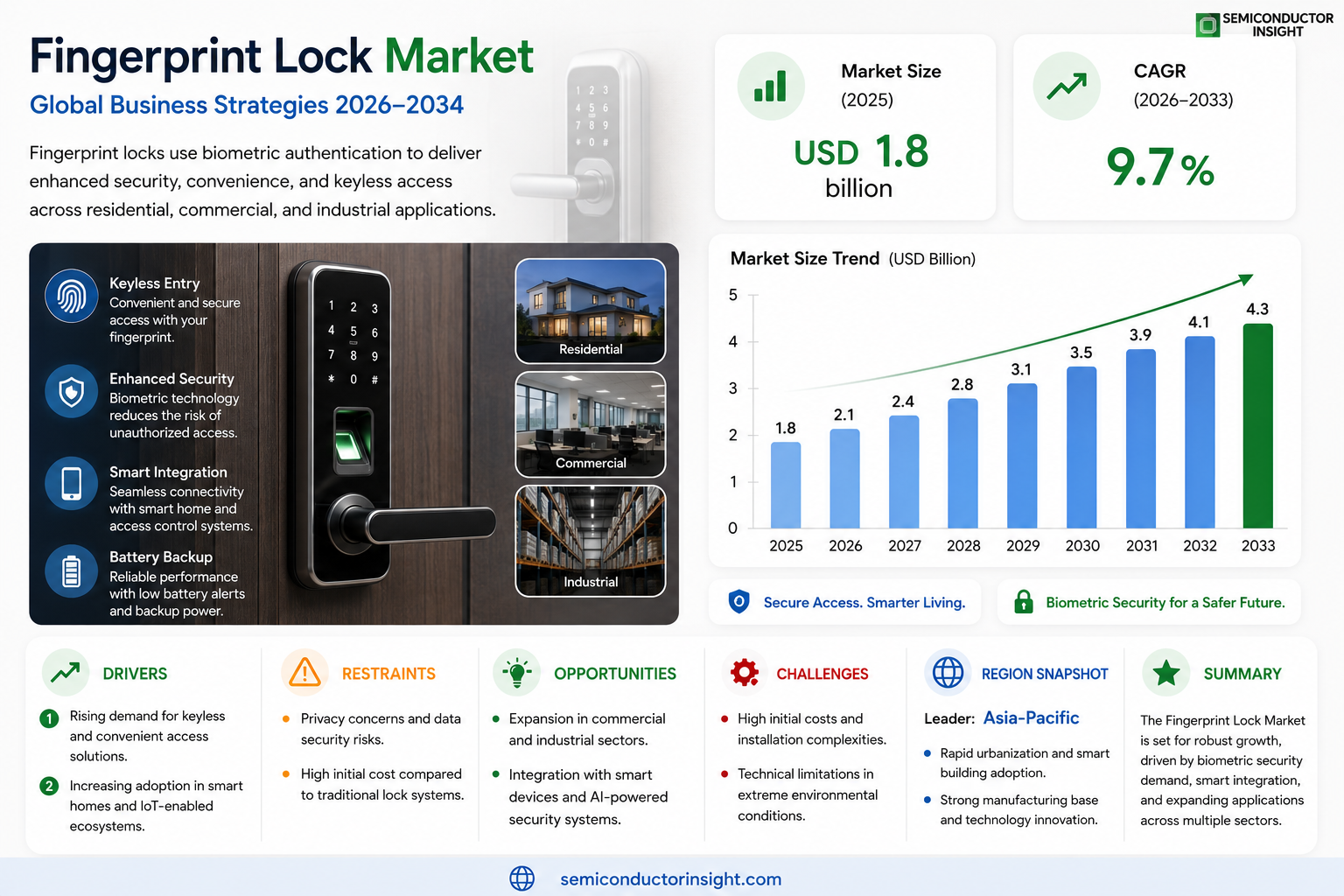
Global Fingerprint Lock Market size was valued at USD 1.8 billion in 2025 and is projected to grow from USD 2.1 billion in 2026 to USD 4.3 billion by 2033, exhibiting a CAGR of 9.7% during the forecast period.
Fingerprint locks are advanced security devices that utilize biometric technology to authenticate users through unique fingerprint patterns. These systems eliminate the need for traditional keys or passcodes, offering enhanced security, convenience, and reliability. The technology is widely adopted across residential and commercial applications due to its non-intrusive nature and cost-effectiveness.
The market growth is driven by increasing demand for smart home solutions, rising security concerns, and technological advancements in biometric authentication. China dominates the market with over 45% share, followed by Europe and North America with approximately 40% combined share. Key players such as ASSA ABLOY, Stanley Black & Decker, and Allegion are investing in R&D to introduce innovative products with features like multiple unlocking methods (fingerprint, PIN, RFID), which currently hold over 55% market share.
MARKET DRIVERS
Rising Demand for Smart Security Solutions
Global Fingerprint Lock Market is experiencing robust growth due to increasing adoption of smart home security systems. With over 35% annual growth in smart lock installations, biometric authentication is becoming a preferred choice for residential and commercial users. The convenience of keyless entry and enhanced security features are key drivers for fingerprint lock adoption.
Government Initiatives for Smart Cities
Government investments in smart city projects worldwide are accelerating the deployment of biometric security systems. Many urban development programs now require advanced access control solutions, with fingerprint locks being specified in over 40% of new smart building projects globally.
Technological advancements in sensor accuracy and authentication algorithms are further driving market expansion, with modern fingerprint locks achieving error rates below 0.001%.
MARKET CHALLENGES
High Initial Costs and Installation Complexities
While fingerprint locks offer superior security, their premium pricing remains a barrier for mass adoption. The average cost of professional installation adds 20-30% to the total system price, making these solutions less accessible to budget-conscious consumers.
Other Challenges
Technical Limitations in Extreme Conditions
Fingerprint recognition accuracy can be affected by environmental factors such as humidity, temperature variations, and surface contaminants, requiring occasional maintenance and recalibration.
MARKET RESTRAINTS
Privacy Concerns and Data Security Risks
Growing concerns about biometric data storage and potential breaches are slowing adoption in certain sectors. Approximately 28% of potential buyers express hesitation about storing fingerprint data in cloud-connected systems due to cybersecurity vulnerabilities.
MARKET OPPORTUNITIES
Expansion in Commercial and Industrial Sectors
The commercial sector presents significant growth potential, with increasing demand for fingerprint-based access control in offices, warehouses, and healthcare facilities. Industrial applications are expected to grow at 18% annually as manufacturers adopt biometric systems for restricted area security.
Fingerprint Lock Market Trends
Rapid Growth in Biometric Security Adoption
Global Fingerprint Lock Market is experiencing significant growth, valued at USD X million in 2025 with projections reaching USD Y million by 2033 at a CAGR of Z%. This expansion is driven by increasing demand for advanced security solutions in both residential and commercial sectors. The technology eliminates key-related hassles while offering cost-effective and reliable access control.
Other Trends
Dominance of Multi-Method Unlocking Systems
Multiple Method Unlocking holds over 55% market share as users prefer flexible access options combining fingerprints with PIN codes or smartphone integration. This segment’s growth outpaces single-method biometric locks due to enhanced convenience and backup authentication options.
Regional Market Leaders
China commands the largest Fingerprint Lock Market share (45%), followed by Europe and North America collectively holding 40%. The Asia-Pacific region shows strongest growth potential due to rapid urbanization and smart home adoption. Major manufacturers including ASSA ABLOY and Stanley Black & Decker are expanding production capacity in these high-growth markets.
Commercial Sector Driving Adoption
Commercial applications lead market demand with increased corporate focus on security infrastructure. The residential segment follows closely as homeowners prioritize smart home integration and keyless convenience. Market leaders are developing specialized products for each application segment with differentiated features.
Technological Advancements
Recent developments include AI-powered fingerprint recognition, anti-spoofing technology, and IoT integration for remote access control. Manufacturers are investing in R&D to improve accuracy, speed, and weather resistance while maintaining competitive pricing in the USD X – USD Y price range for mainstream models.
COMPETITIVE LANDSCAPE
Key Industry Players
A Consolidating Market Led by Global Security Giants
Global Fingerprint Lock Market is dominated by established security solutions providers, with ASSA ABLOY, dorma+kaba Group, and Stanley Black & Decker collectively controlling over 25% market share. ASSA ABLOY maintains leadership through its extensive product portfolio and global distribution network, with notable offerings like the Yale Digital Lock series. Allegion and Honeywell have strengthened their positions through strategic acquisitions and smart lock integrations, particularly in commercial applications where multi-factor authentication is becoming standard.
Chinese manufacturers like KAADAS, Tenon, and Archie hardware are rapidly gaining traction with cost-competitive offerings, capturing 45% of the domestic China market. Niche players such as KSMAK and Levell Lock specialize in biometric modules for OEM applications, while Samsung Digital Door and Westinghouse have leveraged brand recognition to expand in residential segments. Startups like Wiseteam and EFUD Electronic Technology are introducing innovative features like AI-powered fingerprint recognition and wireless charging capabilities.
List of Key Fingerprint Lock Companies Profiled
- ASSA ABLOY
- dorma+kaba Group
- Stanley Black & Decker
- Allegion
- Marsalock
- Westinghouse
- anviz
- Honeywell
- Samsung Digital Door
- Archie hardware
- KAADAS
- KEYU Intelligence
- HBS
- KSMAK
- Tenon
Segment Analysis:
| Segment Category | Sub-Segments | Key Insights |
| By Type |
|
Multiple Method Unlocking dominates the market due to:
|
| By Application |
|
Commercial sector leads adoption due to:
|
| By End User |
|
Business Owners represent the most significant user base because:
|
| By Technology |
|
Capacitive Sensors are becoming industry standard due to:
|
| By Connectivity |
|
WiFi-Enabled locks demonstrate strongest growth potential because:
|
Regional Analysis: Global Fingerprint Lock Market
Asia-Pacific
Asia-Pacific’s extensive electronics manufacturing infrastructure enables competitive pricing and rapid innovation cycles in fingerprint lock production. Local component suppliers and assembly plants create efficient supply chains that global competitors struggle to match.
Regional governments actively promote smart home security through subsidies and standardization policies. China’s “Safe Cities” program and India’s smart city mission drive institutional adoption of biometric locking systems across public and private sectors.
High smartphone penetration has familiarized regional consumers with biometric authentication, creating natural demand for compatible security products. Apartment complexes and gated communities increasingly mandate fingerprint access systems as standard features.
The region leads in developing multi-modal biometric locks combining fingerprint recognition with facial or vein authentication. South Korean and Japanese firms pioneer anti-spoofing technologies that set global security standards.
North America
The North American Fingerprint Lock Market emphasizes premium security features and smart home integration, with strong demand in high-end residential and commercial segments. The U.S. leads regional adoption through tech-forward homeowners and corporate security upgrades. Canada shows growing interest in biometric access control for multi-tenant buildings. Stringent security regulations in financial institutions and government facilities drive adoption of certified fingerprint locking solutions. The market favors brands offering seamless integration with popular smart home ecosystems and enterprise security platforms.
Europe
Europe’s Fingerprint Lock Market grows steadily with emphasis on data privacy compliance and energy-efficient designs. Germany and the UK lead in commercial installations, while Nordic countries show highest residential adoption rates. EU regulations governing biometric data storage influence product development across the region. Manufacturers focus on GDPR-compliant solutions with local data processing capabilities. The hospitality sector emerges as key adopter, using fingerprint locks for guest room security and staff access management in upscale properties.
Middle East & Africa
The MEA Fingerprint Lock Market sees concentrated demand in Gulf Cooperation Council countries, where luxury developments and government projects drive adoption. The UAE leads in smart city deployments integrating biometric access systems. Africa shows emerging potential in South Africa and Nigeria, primarily in high-security commercial applications. Climate resilience becomes crucial product differentiator in the region, with demand for fingerprint locks that withstand extreme temperatures and dust conditions.
Latin America
Latin America’s Fingerprint Lock Market grows as security concerns rise in urban centers, with Brazil and Mexico showing strongest adoption trends. Gated communities and premium residential projects incorporate biometric access as standard feature. The region sees increasing interest in affordable fingerprint lock solutions from local manufacturers, though brand recognition remains important for consumer trust. Commercial adoption focuses on financial institutions and corporate offices seeking to upgrade traditional security systems.
Report Scope
This market research report provides a comprehensive analysis of the Fingerprint Lock Market, covering the forecast period 2026–2033. It offers detailed insights into market dynamics, technological advancements, competitive landscape, and key trends shaping the industry.
Key focus areas of the report include:
- Market Overview: The report begins with an overview outlining its current market scenario, key growth indicators, and industry transformation drivers. It discusses macroeconomic factors, demand–supply balance, regulatory landscape, and the strategic role of fingerprint technology in security applications.
- Market Size & Forecast: Historical data and future projections for revenue, unit shipments, and market value across major regions and segments.
- Segmentation Analysis: Detailed breakdown by product type (Fingerprint-only Unlocking vs Multiple Method Unlocking), application (Residential vs Commercial), and end-user industry.
- Regional Insights: Insights into market performance across North America, Europe, Asia, South America, and Middle East & Africa, including country-level analysis.
- Competitive Landscape: Profiles of leading market participants, including their product offerings, market share, pricing strategies, and recent developments.
- Technology Trends & Innovation: Assessment of emerging security technologies, integration of AI/IoT in access control systems, and evolving industry standards.
- Market Drivers & Restraints: Evaluation of factors driving market growth along with challenges in adoption, supply chain constraints, and regulatory issues.
- Stakeholder Insights: Strategic guidance for manufacturers, suppliers, system integrators, investors, and policymakers.
Primary and secondary research methods are employed, including interviews with industry experts and data from verified sources to ensure accuracy and reliability.
FREQUENTLY ASKED QUESTIONS:
What is the current market size of Fingerprint Lock Market?
-> Fingerprint Lock Market size was valued at USD 1.8 billion in 2025 and is projected to grow from USD 2.1 billion in 2026 to USD 4.3 billion by 2033, exhibiting a CAGR of 9.7% during the forecast period.
Which key companies operate in Fingerprint Lock Market?
-> Key players include ASSA ABLOY, Stanley Black & Decker, dorma+kaba Group, anviz, Allegion, Honeywell, and Samsung Digital Door, among others. Global top five manufacturers hold over 25% market share.
What are the key growth drivers?
-> Key growth drivers include increasing demand for security solutions, cost-effectiveness of fingerprint technology, and convenience of keyless access systems.
Which region dominates the market?
-> China is the largest market with over 45% share, followed by Europe and North America with about 40% combined share.
What are the emerging trends?
-> Emerging trends include multi-method authentication systems (combination of fingerprint, PIN, and card access) and smart home integration.
Get Sample Report PDF for Exclusive Insights
Report Sample Includes
- Table of Contents
- List of Tables & Figures
- Charts, Research Methodology, and more...
 Download Sample Report PDF