Market Insights
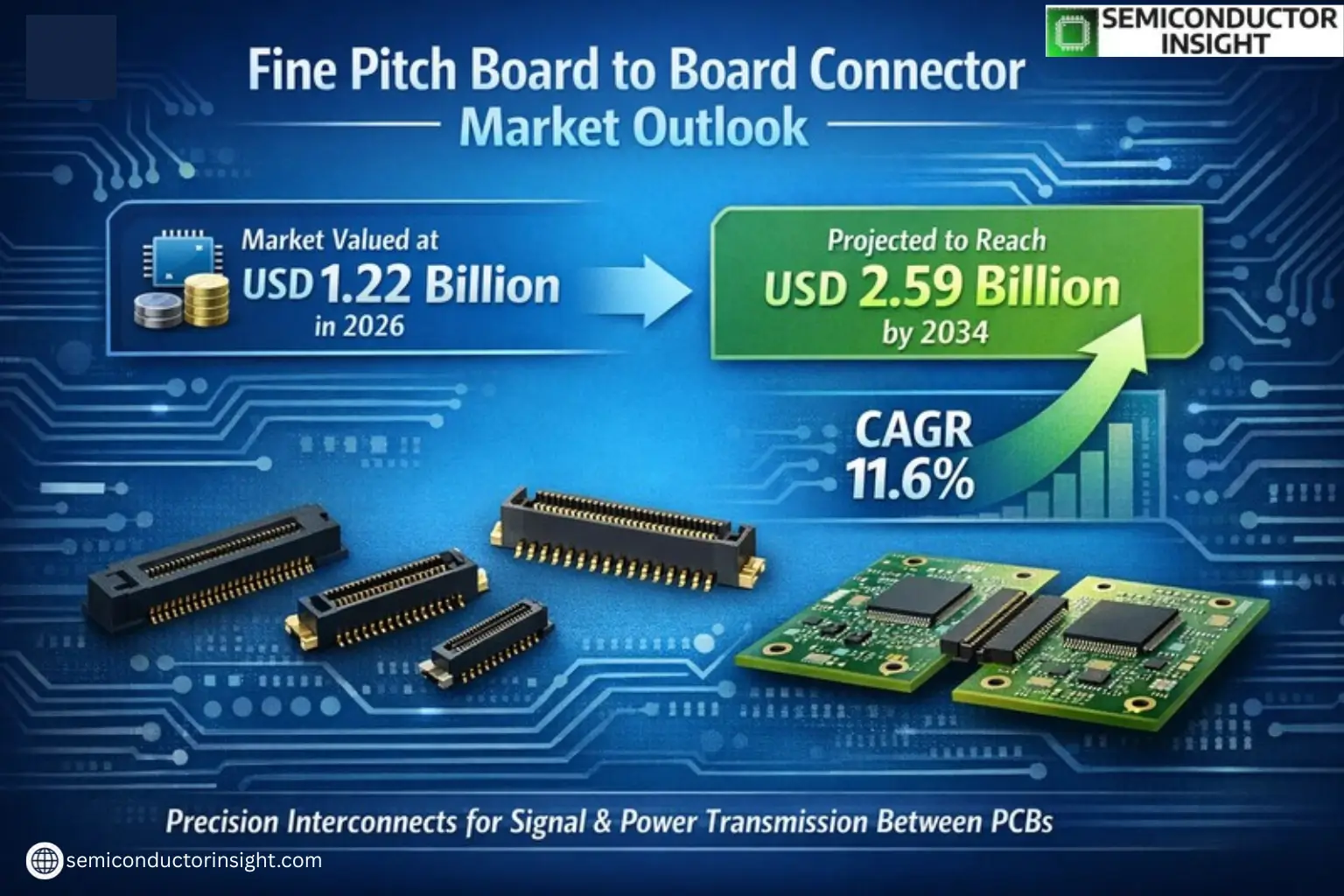
Global Fine Pitch Board to Board Connector Market was valued at USD 1.22 billion in 2026 and is projected to reach USD 2.59 billion by 2034, exhibiting a CAGR of 11.6% during the forecast period.
Fine pitch board-to-board (BTB) connectors are precision interconnect components designed for signal and power transmission between printed circuit boards (PCBs). These connectors typically feature a contact pitch ranging from 0.5mm to 1.0mm, with ultra-fine pitch variants defined as those below 0.5mm. Their compact design enables high-density pin arrangements, making them ideal for applications requiring miniaturization and space optimization in electronic devices such as smartphones, wearables, and automotive systems.
The market growth is driven by increasing demand for compact electronic devices and advancements in high-speed data transmission technologies. While consumer electronics remain the dominant application sector, emerging opportunities in automotive electronics and industrial automation are creating new growth avenues. However, manufacturers face challenges related to precision manufacturing tolerances and material costs that impact production scalability.
MARKET DRIVERS
Miniaturization Trend in Electronics
The growing demand for compact electronic devices is driving the fine pitch board to board connector market. With consumer electronics shrinking in size while increasing in functionality, these connectors enable high-density interconnections in constrained spaces.
5G and IoT Adoption Acceleration
Rapid deployment of 5G networks and IoT devices requires reliable high-speed data transmission, which fine pitch connectors can efficiently provide. The market is projected to grow at 8.2% CAGR through 2028 as these technologies mature.
Increasing complexity in automotive electronics, particularly in ADAS and infotainment systems, is creating new demand for robust fine pitch interconnect solutions.
MARKET CHALLENGES
Manufacturing Precision Requirements
The production of fine pitch board to board connectors demands extremely tight tolerances, requiring advanced manufacturing equipment and skilled labor. This raises production costs and creates barriers for new market entrants.
Other Challenges
Signal Integrity at Higher Frequencies
As data rates exceed 56Gbps, maintaining signal integrity becomes increasingly difficult with conventional fine pitch connector designs, requiring advanced shielding and impedance control.
Thermal Management Issues
High-density connector configurations generate significant heat, necessitating innovative thermal dissipation solutions that don’t compromise the connector’s compact form factor.
MARKET RESTRAINTS
Raw Material Price Volatility
Fluctuations in the prices of copper alloys and specialized plastics used in fine pitch board to board connectors create pricing pressures. Recent market analysis shows material costs contribute up to 45% of total production expenses.
MARKET OPPORTUNITIES
Next-Generation Data Centers
The shift towards hyperscale data centers creates opportunities for high-speed fine pitch board to board connectors that can handle 112G PAM4 signaling with minimal crosstalk. This segment is expected to account for 22% of market revenue by 2026.
Automotive Electrification
Electric vehicles require up to 3x more electronic components than traditional vehicles, driving demand for rugged fine pitch connectors that can withstand automotive environmental conditions while maintaining signal integrity.
Fine Pitch Board to Board Connector Market Trends
Growth Driven by Miniaturization in Electronics
Global Fine Pitch Board to Board Connector Market is projected to grow from USD 1.22 billion in 2026 to USD 2.59 billion by 2034, at an 11.6% CAGR. This growth is fueled by increasing demand for compact, high-density connectors in smartphones, wearables, and automotive electronics. Connectors with pitches below 0.4mm are seeing particularly strong adoption as device manufacturers push for thinner form factors.
Other Trends
Pricing Segmentation Across Product Types
The market shows clear price stratification – standard 0.5-0.8mm pitch connectors range USD 0.25-USD 0.50 per pair, while ultra-fine pitch (<0.3mm) international brand connectors command USD 3.50-USD 5.00. Domestic manufacturers are gaining share in the USD 1.80-USD 2.80 range for comparable specs.
Industry Facing Key Technological Challenges
Manufacturers grapple with maintaining signal integrity at reduced pitches, with crosstalk and EMI mitigation being critical. Yield rates remain 7-10% lower for domestic producers versus international leaders in ultra-fine pitch production. The industry is making progress in laser micromachining and nano-electroplating to close this gap.
Automotive Electronics Emerging as Growth Segment
While consumer electronics still dominate (60%+ market share), automotive applications are growing fastest. Requirements for vibration-resistant, high-temperature connectors in smart cockpits and ADAS systems are driving specialized product development.
Supply Chain and Localization Dynamics
Geopolitical factors continue impacting material availability, particularly for high-performance copper alloys and precision equipment. Domestic substitution is accelerating in China, supported by government policies targeting self-sufficiency in critical electronic components.
COMPETITIVE LANDSCAPE
Key Industry Players
Global Fine Pitch Board to Board Connector Market Dominated by International Giants with Rapid Local Player Growth
Fine Pitch Board to Board Connector Market is characterized by a mix of established international players and emerging local manufacturers. Leading the market are global giants like TE Connectivity, Amphenol, and Molex, which dominate the high-end segment with superior technology for ultra-fine pitch (below 0.3mm) and high-speed transmission connectors. These companies possess strong R&D capabilities and hold key patents for advanced connector technologies, maintaining their positions through continuous innovation in high-density interconnect solutions for smartphones, automotive electronics, and other advanced applications.
Meanwhile, Asian manufacturers such as Japan’s JAE and Korea’s LCN have carved out strong niches in specific connector types and regional markets. Chinese players like Sunway Communication and YXT are rapidly gaining market share through competitive pricing and improving product quality, particularly in mid-range fine pitch connectors for consumer electronics. The competitive landscape is also seeing increased specialization, with some players focusing on specific applications like floating connectors for foldable devices or high-reliability connectors for automotive use.
List of Key Fine Pitch Board to Board Connector Companies Profiled
- Molex
- TE Connectivity
- Amphenol
- HRS (Hirose Electric)
- JAE Electronics
- Panasonic
- LCN
- ECT
- OCN
- Sunway Communication
- YXT
- Acon
- Kyocera
- CSCONN
Segment Analysis:
| Segment Category | Sub-Segments | Key Insights |
| By Type |
|
Floating BTB Connectors are gaining traction due to increasing demand from foldable devices:
|
| By Application |
|
Smartphones remain the dominant application area with evolving requirements:
|
| By End User |
|
Consumer Electronics OEMs drive innovation with demanding specifications:
|
| By Pitch Size |
|
0.4mm-0.5mm Pitch represents the sweet spot for most applications:
|
| By Transmission Performance |
|
High-Speed Transmission connectors are becoming essential for advanced applications:
|
Regional Analysis: Fine Pitch Board to Board Connector Market
Asia-Pacific hosts the world’s most concentrated electronics manufacturing base, with connector production facilities clustered in China’s Pearl River Delta and Japan’s Nagoya region. Local component availability reduces lead times for board to board connector integration.
Japanese firms pioneer ultra-fine pitch solutions below 0.3mm pitch for wearables and medical devices. South Korean manufacturers specialize in high-speed connectors for smartphone display modules and camera interconnects.
Proximity to semiconductor foundries and PCB manufacturers enables just-in-time delivery of fine pitch board to board connectors. Regional trade agreements facilitate component movement across production networks.
Expanding automotive electronics production in Thailand and Vietnam creates new demand for vibration-resistant fine pitch connectors. India’s growing electronics manufacturing initiative boosts local connector consumption.
North America
North America maintains strong demand for high-reliability fine pitch board to board connectors, particularly in aerospace, defense, and medical equipment applications. The region benefits from stringent quality standards driving connector innovation, with U.S. manufacturers focusing on ruggedized designs for extreme environments. Growing investments in autonomous vehicle technologies and advanced robotics are creating specialized connector requirements. The presence of leading OEMs in Silicon Valley and Boston’s biomedical hub sustains premium connector demand, though higher costs limit mass-market penetration compared to Asian alternatives.
Europe
Europe’s fine pitch board to board connector market thrives in automotive electronics and industrial automation segments. German manufacturers excel in precision connectors for automotive ECUs and sensor modules, while the Nordic region drives demand for miniature connectors in IoT devices. Strict RoHS and REACH regulations shape connector material development, with European firms leading in halogen-free and environmentally sustainable connector solutions. The region’s focus on Industry 4.0 implementations continues to boost demand for reliable high-density interconnects in smart factory applications.
South America
South America’s connector market shows gradual growth, primarily serving consumer electronics assembly and automotive manufacturing in Brazil. While the region imports most fine pitch board to board connectors, local assembly of smartphones and automotive electronics creates steady demand. Infrastructure challenges and economic volatility sometimes disrupt supply chains, prompting manufacturers to maintain higher connector inventory levels compared to other regions.
Middle East & Africa
The MEA region represents an emerging market for fine pitch board to board connectors, with growth centered around telecommunications infrastructure and oil/gas automation systems. Dubai’s electronics trading hubs serve as regional distribution centers, while South Africa shows increasing connector demand for automotive component manufacturing. The lack of local production means most connectors are imported from Asia and Europe, with price sensitivity being a key market characteristic.
Report Scope
This market research report provides a comprehensive analysis of the Fine Pitch Board to Board Connector Market, covering the forecast period 2026–2034. It offers detailed insights into market dynamics, technological advancements, competitive landscape, and key trends shaping the industry.
Key focus areas of the report include:
- Market Overview: The report begins with an overview outlining its current market scenario, key growth indicators, and industry transformation drivers. It discusses macroeconomic factors, demand–supply balance, regulatory landscape, and the strategic role of semiconductors in powering advancements across industries such as automotive, telecommunications, consumer electronics, and industrial automation.
- Market Size & Forecast: Historical data and future projections for revenue, unit shipments, and market value across major regions and segments.
- Segmentation Analysis: Detailed breakdown by product type, technology, application, and end-user industry to identify high-growth segments and investment opportunities.
- Regional Insights: Insights into market performance across North America, Europe, Asia-Pacific, Latin America, and the Middle East & Africa, including country-level analysis where relevant.
- Competitive Landscape: Profiles of leading market participants, including their product offerings, R&D focus, manufacturing capacity, pricing strategies, and recent developments such as mergers, acquisitions, and partnerships.
- Technology Trends & Innovation: Assessment of emerging technologies, integration of AI/IoT, semiconductor design trends, fabrication techniques, and evolving industry standards.
- Market Drivers & Restraints: Evaluation of factors driving market growth along with challenges, supply chain constraints, regulatory issues, and market-entry barriers.
- Stakeholder Insights: Insights for component suppliers, OEMs, system integrators, investors, and policymakers regarding the evolving ecosystem and strategic opportunities.
Primary and secondary research methods are employed, including interviews with industry experts, data from verified sources, and real-time market intelligence to ensure the accuracy and reliability of the insights presented.
FREQUENTLY ASKED QUESTIONS:
What is the current market size of Fine Pitch Board to Board Connector Market?
-> Fine Pitch Board to Board Connector Market was valued at USD 1.22 billion in 2026 and is projected to reach USD 2.59 billion by 2034, exhibiting a CAGR of 11.6% during the forecast period.
What is the projected CAGR for the Fine Pitch Board to Board Connector Market?
-> The market is projected to grow at a compound annual growth rate (CAGR) of 11.6% during the forecast period from 2026 to 2034.
Which key companies operate in Fine Pitch Board to Board Connector Market?
-> Key players include Molex, HRS, LCN, JAE, ECT, OCN, Sunway Communication, YXT, Acon, Kyosera, Panasonic, TE Connectivity, Amphenol, and CSCONN, among others.
What are the key growth drivers?
-> Key growth drivers include miniaturization trend of electronic devices, demand for high-speed signal transmission, high-density integration requirements, and the rise of emerging terminal markets such as foldable smartphones and automotive smart cockpits.
Which region dominates the Fine Pitch Board to Board Connector Market?
-> The Asia-Pacific region, particularly China, Japan, and South Korea, dominates the market due to the strong presence of consumer electronics and automotive manufacturers.

Get Sample Report PDF for Exclusive Insights
Report Sample Includes
- Table of Contents
- List of Tables & Figures
- Charts, Research Methodology, and more...
 Download Sample Report PDF