
MARKET INSIGHTS
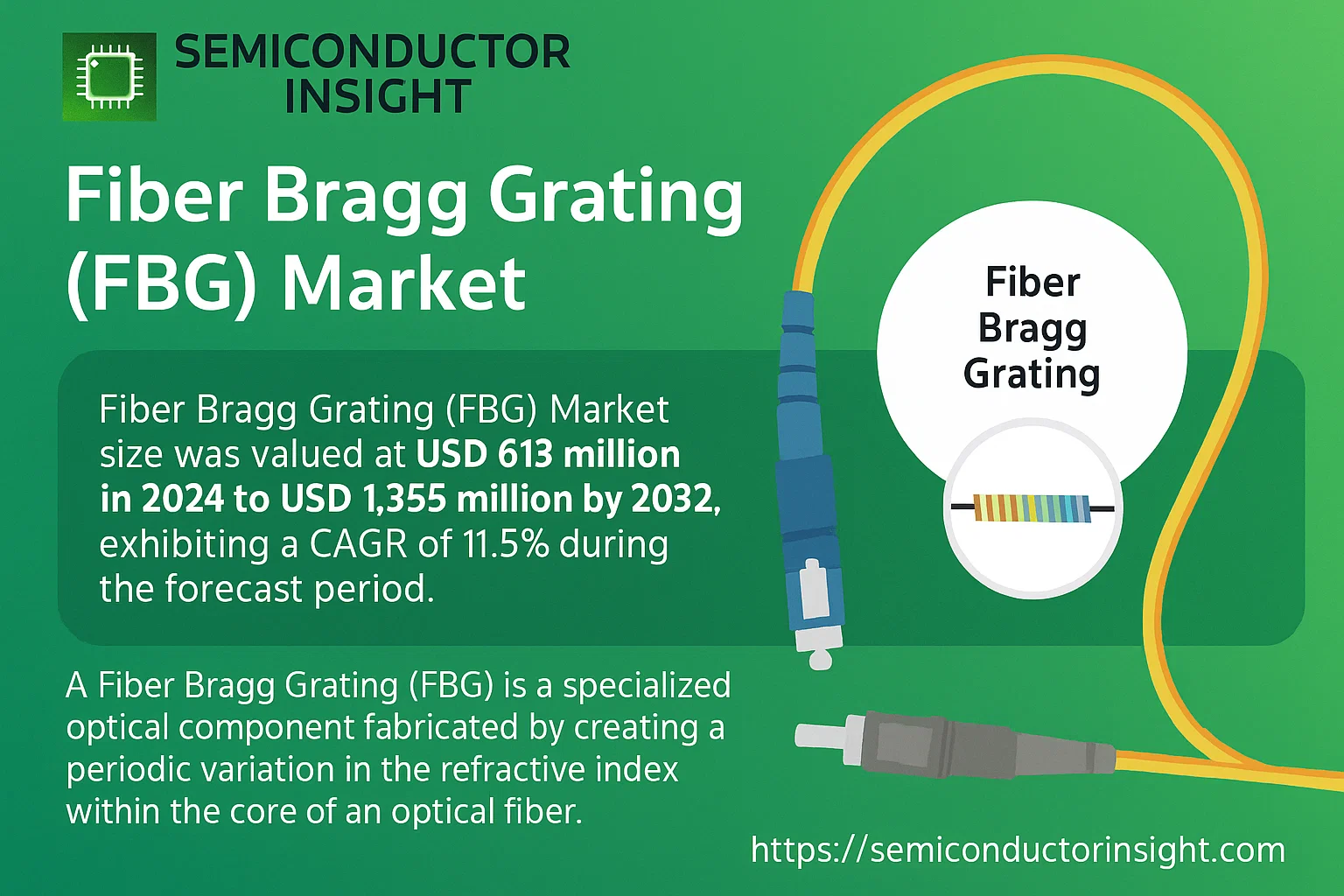
Global Fiber Bragg Grating (FBG) Market size was valued at USD 613 million in 2024 to USD 1,355 million by 2032, exhibiting a CAGR of 11.5% during the forecast period.
A Fiber Bragg Grating (FBG) is a specialized optical component fabricated by creating a periodic variation in the refractive index within the core of an optical fiber. This structure acts as a wavelength-specific reflector, allowing it to filter or sense changes in its environment with high precision. The fundamental operating principle is based on the Bragg condition, where a specific wavelength of light, known as the Bragg wavelength, is reflected while all others are transmitted. This unique property makes FBGs exceptionally sensitive to strain and temperature variations, as any physical change causes a measurable shift in the reflected wavelength.
The market growth is primarily driven by increasing adoption across aerospace for structural health monitoring and in civil engineering for real-time integrity assessment of bridges, dams, and tunnels. Furthermore, advancements in sensing technologies and rising demand from the energy sector for pipeline monitoring are significant contributors. Key industry players are actively expanding their portfolios through strategic initiatives; for instance, Luna Innovations has consistently launched new high-performance FBG sensor arrays tailored for harsh environments. Luna Innovations, Proximion AB, HBK FiberSensing, and ITF Technologies are some of the key players that operate in the market with a wide range of portfolios.
MARKET DRIVERS
Growing Demand for Structural Health Monitoring
Global push for infrastructure safety and longevity is a primary driver for the FBG market. FBG sensors are extensively used for real-time monitoring of bridges, tunnels, and buildings, providing critical data on strain, temperature, and vibration. The ability to detect structural degradation early helps prevent catastrophic failures and reduces maintenance costs, making them indispensable in civil engineering.
Expansion in the Oil and Gas Industry
In the oil and gas sector, FBG sensors are crucial for downhole monitoring in harsh environments. They provide accurate measurements of pressure and temperature in wells, enabling optimized extraction processes and enhanced reservoir management. The technology’s immunity to electromagnetic interference makes it superior to traditional electronic sensors in explosive atmospheres.
➤ Advancements in aerospace and defense applications further propel adoption, with FBGs used for monitoring aircraft wings and composite materials.
The increasing integration of FBGs in smart manufacturing and Industry 4.0 initiatives for process control and predictive maintenance is also contributing significantly to market growth. The demand for high-precision, reliable sensing solutions in automated production lines is expected to continue driving the market forward.
MARKET CHALLENGES
High Initial System Cost
The significant upfront investment required for FBG interrogation systems and specialized optical equipment remains a major barrier to entry for many small and medium-sized enterprises. This includes the cost of sensors, demodulators, and installation expertise, which can be prohibitive compared to conventional sensing technologies.
Other Challenges
Technical Complexity and Skill Gap
The deployment and interpretation of FBG data require specialized knowledge in photonics and data analysis. The current shortage of skilled professionals who can effectively install, calibrate, and maintain these sophisticated systems poses a significant challenge to widespread adoption across various industries.
MARKET RESTRAINTS
Competition from Alternative Sensing Technologies
Established competing technologies, such as electrical strain gauges and piezoelectric sensors, continue to hold significant market share due to their lower cost and well-understood implementation. In applications where extreme precision or immunity to EMI is not critical, these alternatives often present a more economical choice, restraining the FBG market’s growth in certain segments.
Sensitivity to Physical Handling and Installation
FBG sensors are delicate and can be damaged during installation if not handled by trained personnel. Improper bonding or excessive bending of the fiber can lead to signal attenuation or sensor failure, which increases the total cost of ownership and can deter potential users from adopting the technology.
MARKET OPPORTUNITIES
Rise of Distributed Sensing and Multiplexing
A key opportunity lies in the advancement of multiplexing techniques that allow hundreds of FBG sensors to operate on a single optical fiber. This capability drastically reduces the cost per sensing point and simplifies system architecture, opening up new applications in large-scale environmental monitoring and smart city infrastructure.
Emerging Applications in Renewable Energy
The renewable energy sector, particularly wind power, presents substantial growth potential. FBG sensors are increasingly deployed for condition monitoring of wind turbine blades, measuring bend-twist coupling and detecting structural defects. This application is critical for maximizing turbine lifespan and efficiency, creating a promising new market segment.
Fiber Bragg Grating (FBG) Market Trends
Robust Growth Driven by Diverse Industry Applications
Global Fiber Bragg Grating (FBG) Market is demonstrating strong growth, with its valuation projected to increase from USD 613 million in 2024 to USD 1,355 million by 2032, representing a compound annual growth rate (CAGR) of 11.5%. This expansion is primarily fueled by the technology’s critical role across multiple high-value industries. FBGs offer high precision in measuring strain and temperature by reflecting specific wavelengths of light, making them indispensable for structural health monitoring and sensing applications. Their inherent advantages, such as immunity to electromagnetic interference, multiplexing capability, and long-term stability, are key factors driving adoption beyond traditional optical communication into sectors like aerospace, energy, and civil engineering.
Other Trends
Market Consolidation and Competitive Landscape
While the FBG market is characterized by the presence of numerous players, a notable trend is the concentration of market share among leading manufacturers. The top four companies, including Luna Innovations, Proximion AB, HBK FiberSensing, and ITF Technologies, collectively hold approximately 31% of the global market. This indicates a moderately consolidated landscape where established players with advanced technological capabilities and strong customer relationships dominate. Competition is intensifying as companies focus on innovation, particularly in enhancing the sensitivity, durability, and cost-effectiveness of FBG-based solutions to capture a larger share of high-growth segments.
Dominance of Sensor Products and Key Applications
A clear trend in product segmentation is the overwhelming dominance of Fiber Bragg Grating Sensors, which account for 75% of the market. These sensors are the primary revenue generator due to their extensive use in monitoring and measurement. In terms of application, the Geo-Technical & Civil Engineering segment is the largest, holding a 23% market share. The use of FBG sensor arrays for monitoring the structural integrity of bridges, tunnels, dams, and buildings is a major growth driver. This is complemented by significant demand from the aerospace sector for component testing and health monitoring, and the energy industry for pipeline and power grid monitoring, showcasing the technology’s versatility and reliability.
COMPETITIVE LANDSCAPE
Key Industry Players
A Market Shaped by Specialization and Technological Innovation
Global Fiber Bragg Grating (FBG) Market is characterized by a mix of established leaders and specialized niche players, with Luna Innovations, Proximion AB, HBK FiberSensing, and ITF Technologies collectively holding approximately 31% of the market share. The market is driven by the critical need for highly precise sensing solutions in demanding applications such as aerospace, energy infrastructure, and geotechnical engineering. These leading companies dominate through extensive R&D investments, strong patent portfolios, and global distribution networks. They provide comprehensive solutions, from the fiber grating components themselves to complete sensing systems and analysis software, catering primarily to large-scale industrial and infrastructure projects. Competition is intensifying as these key players focus on enhancing the performance, multiplexing capabilities, and durability of their FBG products to meet evolving industry standards.
Beyond the major players, numerous specialized companies have carved out significant niches by focusing on specific applications or technologies. Companies like FBGS Technologies GmbH are prominent in producing high-volume draw tower gratings, while Technica and INFIBRA TECHNOLOGIES specialize in components for the telecommunications sector. Players like Smart Fibres Ltd (part of Halliburton) and Smartec (Roctest) focus intensely on the oil & gas and civil engineering markets, offering ruggedized sensing systems. Other notable manufacturers, such as TeraXion and Alnair Labs Corporation, compete in high-performance filter and laser markets. This diverse landscape includes regional specialists like FBG Korea in Asia and WUHAN LIGONG GUANGKE in China, which serve their domestic markets with tailored solutions. The ongoing trend of consolidation, alongside continuous innovation from smaller, agile companies, makes the FBG market highly dynamic.
List of Key Fiber Bragg Grating (FBG) Companies Profiled
- Luna Innovations
- Proximion AB
- HBK FiberSensing
- ITF Technologies
- FBGS Technologies GmbH
- Technica
- INFIBRA TECHNOLOGIES
- Smart Fibres Ltd (Halliburton)
- PolyTech
- Advanced Optics Solutions GmbH
- WUHAN LIGONG GUANGKE
- TeraXion
- FBG Korea
- Smartec (Roctest)
- Alnair Labs Corporation
Segment Analysis:
| Segment Category | Sub-Segments | Key Insights |
| By Type |
|
Fiber Bragg Grating Sensors dominate the market by type, driven by their exceptional ability to precisely measure strain and temperature changes across a multitude of demanding environments. This segment’s leadership is anchored in the versatility and reliability of these sensors, which can be embedded in composite materials, attached to structural components, or deployed in harsh industrial settings where traditional electronic sensors might fail. The demand is propelled by their intrinsic safety in volatile atmospheres, immunity to electromagnetic interference, and capacity for multipoint sensing along a single optical fiber, making them indispensable for structural health monitoring and predictive maintenance applications that require precise, real-time data acquisition. |
| By Application |
|
Geotechnical and Civil Engineering represents a leading application area, characterized by extensive utilization for structural health monitoring of critical infrastructure such as bridges, tunnels, dams, and buildings. The adoption in this segment is fueled by the need for long-term, remote monitoring solutions that can detect minute structural deformations, settlement, and stress over time. FBG sensors provide unparalleled advantages in these large-scale projects due to their durability, resistance to corrosion, and ability to be multiplexed into dense sensor networks, offering engineers vital data for ensuring public safety and extending the operational lifespan of vital infrastructure assets through proactive maintenance and damage assessment. |
| By End User |
|
Infrastructure Developers & Agencies are the predominant end-users, consistently driving demand as they integrate advanced monitoring systems into new construction projects and existing public works. This segment’s leadership is underpinned by stringent regulatory requirements for safety and the increasing focus on smart city initiatives worldwide. These users rely on FBG technology for its proven performance in large-scale, permanent installations that deliver critical data on structural integrity, enabling informed decision-making for maintenance schedules and ensuring compliance with safety standards, which ultimately minimizes risks and operational costs associated with infrastructure management over decades of service. |
| By Sensing Parameter |
|
Strain Sensing is the most critical and widely adopted parameter measurement category, forming the backbone of the FBG market’s value proposition. The fundamental principle of FBG technology, where the Bragg wavelength shifts in response to mechanical strain, makes it exceptionally accurate for detecting deformation, stress, and vibration in materials. This capability is paramount across diverse sectors, from monitoring load-bearing capacity in aerospace components to assessing structural fatigue in wind turbine blades. The high sensitivity and resolution of strain sensing applications provide essential data for predictive maintenance strategies, preventing catastrophic failures and optimizing the performance and safety of engineered systems in real-world operating conditions. |
| By Fabrication Method |
|
Phase Mask Technique stands out as the leading fabrication methodology due to its superior advantages in mass production, reproducibility, and operational stability. This technique utilizes a phase mask to create the periodic pattern of ultraviolet light that induces the refractive index change in the fiber core, allowing for the rapid and highly consistent inscription of gratings. Its dominance is attributed to the ability to produce high-quality FBGs with precise control over grating parameters, which is essential for meeting the stringent specifications required by telecommunications and high-precision sensing applications. The robustness and scalability of the phase mask method make it the preferred choice for manufacturers aiming for high-volume output while maintaining critical performance characteristics and cost-effectiveness. |
Regional Analysis: Fiber Bragg Grating (FBG) Market
The unparalleled scale of infrastructure development, particularly in China and Southeast Asia, is the primary driver. Governments are heavily investing in transport and utility projects that require sophisticated, real-time structural health monitoring, creating a vast and consistent market for FBG sensors that is unmatched in other regions.
A mature and highly competitive electronics and photonics manufacturing ecosystem allows for the high-volume production of FBG components at lower costs. This cost efficiency makes advanced sensing solutions more viable for a broader range of applications, from civil engineering to industrial process monitoring, fueling widespread adoption.
Strong collaboration between leading universities, research institutions, and corporations in countries like Japan and South Korea drives rapid innovation. This ecosystem is focused on enhancing FBG performance, developing new applications in aerospace and biomedical fields, and integrating FBGs with IoT platforms for smarter monitoring systems.
National policies promoting industrial automation, energy efficiency, and the development of smart cities are creating a favorable regulatory environment. These initiatives directly encourage the adoption of advanced sensor technologies like FBGs, ensuring long-term, policy-supported market growth across multiple key industries.
North America
North America represents a highly mature and technologically advanced market for Fiber Bragg Gratings, characterized by early adoption and sophisticated application development. The region’s strength lies in its well-established aerospace and defense sectors, where FBGs are critical for strain and temperature monitoring in aircraft and military assets. The energy sector, particularly oil and gas, utilizes FBGs for downhole sensing and pipeline monitoring in challenging environments. A strong presence of leading FBG manufacturers and research entities fosters a continuous cycle of innovation. While growth rates may be more moderate compared to Asia-Pacific, the demand is driven by the need for upgrades, replacement of legacy systems, and the penetration of FBGs into new, high-value sectors such as medical devices and advanced scientific research.
Europe
The European FBG market is distinguished by its strong emphasis on quality, precision engineering, and stringent regulatory standards. The region is a leader in applying FBG technology for renewable energy, especially in monitoring the structural integrity of offshore wind farms and geothermal installations. The automotive industry, particularly in Germany, is increasingly adopting FBGs for testing and monitoring composite materials in vehicle design. Collaborative multinational research projects funded by the European Union promote the development of next-generation sensing solutions. The market growth is steady, supported by a robust industrial base and a focus on safety and sustainability, though it faces competition from lower-cost manufacturing regions.
South America
The Fiber Bragg Grating market in South America is in a developing stage, with growth potential tied to the region’s natural resource and infrastructure sectors. The primary applications are found in monitoring large-scale mining operations, dams, and oil and gas pipelines. Brazil is the largest market, driven by investments in energy infrastructure and a growing awareness of the benefits of structural health monitoring. However, market expansion is often constrained by economic volatility and limited local manufacturing capabilities, leading to a reliance on imports. The adoption rate is gradual, with growth focused on specific, high-value projects rather than widespread industrial use.
Middle East & Africa
This region presents a market with significant potential, particularly in the Middle East, where vast investments in infrastructure, such as megacities and transportation networks, are creating opportunities for FBG sensors. The oil and gas industry remains a key consumer, using FBGs for reservoir and pipeline monitoring. In Africa, the market is nascent, with adoption primarily in monitoring critical infrastructure like dams and bridges, often supported by international development projects. The overall market growth is uneven, heavily dependent on regional economic stability and large-scale government-led projects, with the Middle East showing more dynamic activity compared to the slower-paced African market.
Report Scope
This market research report provides a comprehensive analysis of the Fiber Bragg Grating (FBG) Market, covering the forecast period 2025–2032. It offers detailed insights into market dynamics, technological advancements, competitive landscape, and key trends shaping the industry.
Key focus areas of the report include:
- Market Overview: The report begins with an overview outlining its current market scenario, key growth indicators, and industry transformation drivers. It discusses macroeconomic factors, demand–supply balance, regulatory landscape, and the strategic role of semiconductors in powering advancements across industries such as automotive, telecommunications, consumer electronics, and industrial automation.
- Market Size & Forecast: Historical data and future projections for revenue, unit shipments, and market value across major regions and segments.
- Segmentation Analysis: Detailed breakdown by product type, technology, application, and end-user industry to identify high-growth segments and investment opportunities.
- Regional Insights: Insights into market performance across North America, Europe, Asia-Pacific, Latin America, and the Middle East & Africa, including country-level analysis where relevant.
- Competitive Landscape: Profiles of leading market participants, including their product offerings, R&D focus, manufacturing capacity, pricing strategies, and recent developments such as mergers, acquisitions, and partnerships.
- Technology Trends & Innovation: Assessment of emerging technologies, integration of AI/IoT, semiconductor design trends, fabrication techniques, and evolving industry standards.
- Market Drivers & Restraints: Evaluation of factors driving market growth along with challenges, supply chain constraints, regulatory issues, and market-entry barriers.
- Stakeholder Insights: Insights for component suppliers, OEMs, system integrators, investors, and policymakers regarding the evolving ecosystem and strategic opportunities.
Primary and secondary research methods are employed, including interviews with industry experts, data from verified sources, and real-time market intelligence to ensure the accuracy and reliability of the insights presented.
FREQUENTLY ASKED QUESTIONS:
What is the current market size of Fiber Bragg Grating (FBG) Market?
-> Fiber Bragg Grating (FBG) Market size was valued at USD 613 million in 2024 to USD 1,355 million by 2032, exhibiting a CAGR of 11.5% during the forecast period.
Which key companies operate in Fiber Bragg Grating (FBG) Market?
-> Key players include Luna Innovations, Proximion AB, HBK FiberSensing, and ITF Technologies, among others. The top four manufacturers hold approximately 31% of the global market share.
What are the key growth drivers?
-> Key growth drivers include increasing demand for structural health monitoring in infrastructure, adoption in aerospace and energy sectors, and advancements in optical communication technologies.
Which region dominates the market?
-> The market is segmented globally, with significant growth potential across all regions. A detailed regional breakdown is provided in the report.
What are the emerging trends?
-> Emerging trends include the rising adoption of Fiber Bragg Grating Sensors, which hold a 75% market share by product type, and their increasing application in Geo-Technical & Civil Engineering, which accounts for about 23% of the market.

Get Sample Report PDF for Exclusive Insights
Report Sample Includes
- Table of Contents
- List of Tables & Figures
- Charts, Research Methodology, and more...
 Download Sample Report PDF




