MARKET INSIGHTS
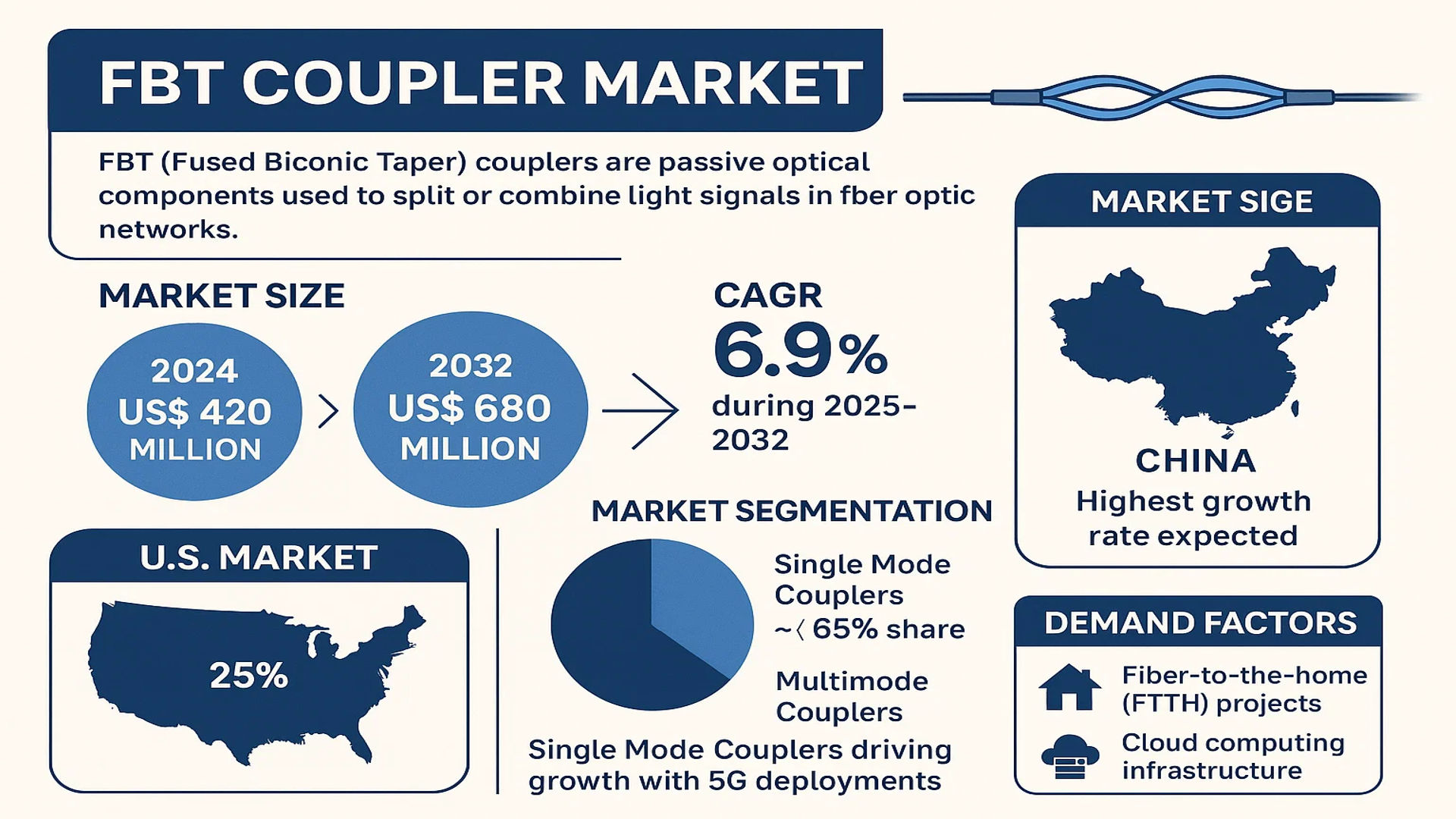
The global FBT Coupler Market size was valued at US$ 420 million in 2024 and is projected to reach US$ 680 million by 2032, at a CAGR of 6.9% during the forecast period 2025-2032. The U.S. market accounted for 25% of the global revenue in 2024, while China is expected to witness the highest growth rate due to rapid telecom infrastructure expansion.
FBT (Fused Biconic Taper) couplers are passive optical components used to split or combine light signals in fiber optic networks. These devices are integral to wavelength division multiplexing (WDM) systems, enabling efficient signal distribution in applications like broadband communication and data centers. The market is segmented into Single Mode Couplers (dominant with ~65% share) and Multimode Couplers, with the former driving growth due to 5G network deployments.
Demand is surging due to escalating investments in fiber-to-the-home (FTTH) projects and cloud computing infrastructure. However, competition from planar lightwave circuit (PLC) splitters poses a challenge. Key players like T&S Communications and Optico Communication are expanding production capacities, with Asia-Pacific emerging as the fastest-growing region, projected to capture 42% of the market by 2032.
MARKET DYNAMICS
MARKET DRIVERS
5G Network Expansion Fueling Demand for High-Performance Optical Components
The global rollout of 5G infrastructure is significantly driving the FBT coupler market, as these components play a critical role in optical network distribution. With telecom operators worldwide investing over $60 billion annually in 5G infrastructure, the demand for reliable passive optical components has surged. FBT couplers, with their proven reliability in signal splitting applications, are increasingly adopted for cell site backhaul and fronthaul networks. The stability and cost-effectiveness of FBT technology make it particularly attractive for 5G deployment scenarios requiring multiple splitting ratios across dense urban environments.
Data Center Boom Creating New Application Scenarios
Massive growth in hyperscale data centers, projected to exceed 1,200 facilities globally by 2025, is creating substantial demand for optical connectivity solutions. FBT couplers are finding increased application in data center monitoring systems, where they enable efficient signal tapping for performance measurement and troubleshooting. The technology’s compatibility with multiple wavelength operations and environmental stability makes it particularly suitable for the rigorous demands of data center environments. Furthermore, cloud service providers are adopting FBT-based solutions for their cost advantages in large-scale deployments where thousands of splitting points are required.
FTTH Deployments Accelerating in Emerging Economies
Fiber-to-the-Home deployments in Asia-Pacific and Latin American markets are driving volume demand for FBT couplers. Countries like China and India are adding millions of new FTTH connections annually, with China alone accounting for over 60% of global FBT coupler production. The technology’s maturity and lower production costs compared to PLC alternatives make it the preferred choice for cost-sensitive mass deployments in these regions. Government broadband initiatives and private sector investments are creating sustained growth momentum that benefits established FBT manufacturers.
MARKET RESTRAINTS
Competition from PLC Technology in High-Performance Applications
Planar Lightwave Circuit (PLC) splitters are increasingly challenging FBT couplers in applications requiring precise splitting ratios and wavelength independence. PLC technology offers advantages in terms of compact footprint and temperature stability, capturing market share in environments where these factors are critical. While FBT maintains cost advantages in standard applications, the narrowing price gap with PLC solutions is creating competitive pressures, particularly in North American and European markets where performance often outweighs cost considerations.
Supply Chain Disruptions Affecting Raw Material Availability
The FBT coupler manufacturing process requires specialized optical fibers and fusing equipment, with supply chain vulnerabilities becoming apparent in recent years. Geopolitical tensions and trade restrictions have affected the availability of high-quality silica fibers, a key raw material. Manufacturers face challenges in maintaining consistent production volumes while managing input cost volatility. The industry’s heavy concentration in specific geographic regions creates additional logistical challenges for global distribution networks.
MARKET CHALLENGES
Quality Consistency Issues in Mass Production
The fused biconical tapering process requires precise control of multiple parameters including temperature, tension, and timing. Maintaining product consistency across high-volume production runs presents significant technical challenges, with even minor variations potentially affecting performance characteristics. Manufacturers must invest heavily in process automation and quality control systems to meet the increasingly stringent specifications demanded by network operators, particularly for 5G and data center applications where reliability is paramount.
Skilled Labor Shortage in Precision Manufacturing
The specialized nature of FBT manufacturing requires technicians with extensive experience in fiber optics processing. As the technology matures, attracting new talent to this niche field has become challenging, particularly in regions with aging workforces. The knowledge-intensive production process makes automation difficult for certain critical stages, creating bottlenecks in scaling up production capacity to meet growing market demand. Training programs and knowledge transfer initiatives are becoming increasingly important for maintaining production quality.
MARKET OPPORTUNITIES
Emerging Applications in Quantum Computing Infrastructure
Quantum computing research is opening new possibilities for optical components in quantum networking applications. FBT couplers with specialized performance characteristics are being evaluated for quantum key distribution systems and photonic quantum computers. The technology’s ability to maintain photon state integrity during splitting operations makes it a promising candidate for these cutting-edge applications. Early-stage collaborations between traditional optical component manufacturers and quantum technology startups are exploring these new use cases.
Smart City Deployments Creating New Demand Channels
Urban digital transformation initiatives worldwide are incorporating extensive fiber optic networks for smart city infrastructure. FBT couplers are finding applications in distributed sensor networks, intelligent traffic systems, and municipal surveillance networks. The technology’s reliability in harsh outdoor environments and capability to support multiple service connections from single fiber lines make it well-suited for these deployments. Municipal broadband projects in particular are driving demand for cost-effective optical distribution solutions.
FBT COUPLER MARKET TRENDS
5G Network Expansion Drives Demand for FBT Couplers in Optical Communication
The global rollout of 5G networks is significantly accelerating the adoption of FBT couplers in optical communication systems. As telecommunication providers upgrade their infrastructure to support higher bandwidth and lower latency, the need for reliable signal splitting solutions has grown exponentially. Fused Biconic Taper (FBT) technology remains a preferred choice due to its cost-effectiveness and proven reliability in splitting optical signals with minimal insertion loss. Recent industry reports indicate that the Asia-Pacific region, particularly China, accounts for over 40% of global FBT coupler demand, driven by aggressive 5G deployment strategies.
Other Trends
Fiber-to-the-Home (FTTH) Network Expansion
The rapid growth of fiber-to-the-home installations worldwide is creating sustained demand for FBT splitters in passive optical networks (PON). Telecommunications providers are investing heavily in last-mile connectivity solutions, with multimode FBT couplers seeing particular adoption in metropolitan area networks. Market data suggests that FTTH deployments grew by approximately 12% year-over-year in 2023, with projections showing continued expansion through 2030. This trend is particularly pronounced in North America and Europe, where government initiatives are subsidizing broadband infrastructure development.
Increasing Focus on Wavelength Division Multiplexing (WDM) Systems
The rising implementation of WDM technology in datacenter interconnects and enterprise networks is generating new opportunities for specialized FBT couplers. These components play a critical role in combining and separating multiple optical signals over single fiber strands, enabling more efficient bandwidth utilization. Industry leaders are developing high-performance FBT couplers with improved thermal stability to meet the demanding requirements of next-generation optical networks. Technological advancements have resulted in products with insertion losses below 0.3dB, making them increasingly suitable for high-density network environments.
COMPETITIVE LANDSCAPE
Key Industry Players
Competition Intensifies as Telecom and Fiber Optic Giants Invest in FBT Coupler Innovation
The global FBT Coupler market exhibits a fragmented competitive structure with a mix of established fiber optic component manufacturers and specialized optical communication firms. T&S Communications maintains a leading position due to its extensive product portfolio across both single-mode and multimode couplers, capturing significant market share in North America and Asia-Pacific regions.
Optico Communication Co., Ltd and Guangzhou Sintai Communication Co., Ltd have emerged as strong competitors, particularly in cost-sensitive markets. These companies leverage advanced manufacturing capabilities to produce high-performance FBT splitters at competitive price points, making them preferred suppliers for telecom infrastructure projects in developing economies.
Market leaders are actively pursuing vertical integration strategies, with several players expanding into upstream fiber production to secure raw material supplies. Recent industry movements include partnerships between coupler manufacturers and optical fiber producers to develop customized solutions for 5G backhaul networks.
Mid-sized companies like WolonFiber and ZG Technology are gaining traction through niche specialization, particularly in industrial and defense applications where ruggedized FBT couplers are required. These firms differentiate themselves through superior quality control and customized wavelength-specific solutions.
The competitive environment continues to evolve as Chinese manufacturers increase their global footprint through aggressive pricing strategies while Western firms emphasize technological superiority and reliability certifications. This dynamic is particularly evident in the single-mode coupler segment, which commands premium pricing in high-performance applications.
List of Key FBT Coupler Manufacturers Profiled
- T&S Communications (Global)
- Optico Communication Co., Ltd (China)
- Baymro Technology (China)
- Guangzhou Sintai Communication Co., Ltd (China)
- Nova Cable Company (U.S.)
- Raiwav Opto-electronic Technology Co., Ltd (China)
- WolonFiber (China)
- ZG Technology (U.S.)
- Shenzhen Opelink Technology Co., Ltd (China)
- Flyin Optronics Co.,Ltd (China)
- Sopto (China)
Segment Analysis:
By Type
Single Mode Coupler Segment Leads Due to High Demand in Long-Distance Communication Networks
The market is segmented based on type into:
- Single Mode Coupler
- Subtypes: 1×2, 1×4, 1×8, 1×16, and others
- Multimode Coupler
- Subtypes: 50/125μm, 62.5/125μm, and others
By Application
Optical Communication System Segment Dominates for Fiber Optic Network Expansion
The market is segmented based on application into:
- Optical Communication System
- System and Signal Monitoring
- Others
By Technology
Standard FBT Couplers Maintain Market Share Due to Cost-Effectiveness
The market is segmented based on technology into:
- Standard FBT Couplers
- Premium FBT Couplers
- Subtypes: Wavelength-flattened, Polarization-independent, and others
- Customized FBT Couplers
By End User
Telecommunication Providers Drive Demand for Network Infrastructure Expansion
The market is segmented based on end user into:
- Telecommunication Providers
- Cable TV Operators
- Data Center Operators
- Others
Regional Analysis: FBT Coupler Market
Asia-Pacific
The Asia-Pacific region dominates the FBT Coupler market, accounting for the largest revenue share in 2024, driven by China’s robust telecommunications infrastructure expansion and India’s growing demand for high-speed broadband. China’s “Broadband China” strategy has accelerated fiber optic deployments, directly increasing the need for cost-effective FBT couplers. Single-mode couplers are particularly prominent due to their compatibility with long-distance communication systems. However, local manufacturers face increasing competition from global players as quality standards rise alongside infrastructure investments. Japan and South Korea continue to lead in technological advancements, contributing to the region’s position as both a production hub and consumer market.
North America
North America’s market is propelled by the rapid adoption of 5G networks and investments in data centers. The U.S., with its extensive fiber optic backbone, prioritizes high-performance FBT couplers for signal distribution in optical communication systems. Unlike Asia’s cost-driven market, North American buyers emphasize reliability and compliance with ISO standards. Canada shows steady growth due to rural broadband initiatives, while Mexico benefits from cross-border telecom collaborations. The region’s focus on research and development has spurred innovations in multimode couplers for shorter-range applications like local area networks.
Europe
Europe’s mature telecommunications sector relies on FBT couplers for system upgrades and smart city projects. Germany and the U.K. lead in deploying fiber-to-the-home (FTTH) solutions, with stringent EU regulations ensuring high product quality. The region sees a shift toward environmentally sustainable manufacturing processes, influencing supplier strategies. While growth is slower than in Asia, Eastern European countries like Poland and Hungary present untapped opportunities due to increasing internet penetration rates. European manufacturers often focus on niche applications such as aerospace and defense, differentiating themselves through precision engineering.
South America
Market growth in South America is hindered by economic instability but supported by gradual digitalization efforts. Brazil, the largest market, invests in fiber optic networks to bridge urban-rural connectivity gaps, though budget constraints favor lower-cost FBT couplers. Argentina and Chile show potential with rising demand for high-speed internet, but currency fluctuations impact import-dependent supply chains. Local production remains limited, with most couplers sourced from Asian manufacturers. The region’s preference for multimode couplers aligns with its focus on short-distance communication infrastructure.
Middle East & Africa
The MEA market is emerging, driven by smart city initiatives in the UAE and Saudi Arabia. Fiber optic deployments for oil & gas infrastructure also contribute to demand, particularly for ruggedized couplers. However, Africa’s growth is inconsistent, with South Africa and Nigeria leading adoption while other nations lag due to inadequate funding. The region imports most FBT couplers, though local assembly units are increasing. Challenges include harsh environmental conditions requiring specialized products and limited technical expertise for maintenance.
Report Scope
This market research report provides a comprehensive analysis of the global FBT Coupler market, covering the forecast period 2024–2032. It offers detailed insights into market dynamics, technological advancements, competitive landscape, and key trends shaping the industry.
Key focus areas of the report include:
- Market Size & Forecast: Historical data and future projections for revenue, unit shipments, and market value across major regions and segments. The Global FBT Coupler market was valued at US$ 420 million in 2024 and is projected to reach US$ 680 million by 2032.
- Segmentation Analysis: Detailed breakdown by product type (Single Mode Coupler, Multimode Coupler), application (Optical Communication System, System and Signal Monitoring, Others), and end-user industry to identify high-growth segments and investment opportunities.
- Regional Outlook: Insights into market performance across North America, Europe, Asia-Pacific, Latin America, and the Middle East & Africa, including country-level analysis. The U.S. market is estimated at USD million in 2024, while China is projected to reach USD million.
- Competitive Landscape: Profiles of leading market participants, including T&S Communications, Optico Communication Co., Ltd, Baymro Technology, Guangzhou Sintai Communication Co., Ltd, and Nova Cable Company, among others. The global top five players held approximately % market share in 2024.
- Technology Trends & Innovation: Assessment of emerging technologies in FBT (Fused Biconic Taper) techniques, integration with advanced optical systems, and evolving industry standards.
- Market Drivers & Restraints: Evaluation of factors driving market growth along with challenges, supply chain constraints, regulatory issues, and market-entry barriers.
- Stakeholder Analysis: Insights for component suppliers, OEMs, system integrators, investors, and policymakers regarding the evolving ecosystem and strategic opportunities in optical communication technologies.
Primary and secondary research methods are employed, including interviews with industry experts, data from verified sources, and real-time market intelligence to ensure the accuracy and reliability of the insights presented.
FREQUENTLY ASKED QUESTIONS:
What is the current market size of Global FBT Coupler Market?
-> FBT Coupler Market size was valued at US$ 420 million in 2024 and is projected to reach US$ 680 million by 2032, at a CAGR of 6.9% during the forecast period 2025-2032.
Which key companies operate in Global FBT Coupler Market?
-> Key players include T&S Communications, Optico Communication Co., Ltd, Baymro Technology, Guangzhou Sintai Communication Co., Ltd, and Nova Cable Company, among others.
What are the key growth drivers?
-> Key growth drivers include increasing demand for optical communication systems, expansion of 5G networks, and growing investments in fiber optic infrastructure.
Which region dominates the market?
-> Asia-Pacific is the fastest-growing region, led by China, while North America remains a significant market.
What are the emerging trends?
-> Emerging trends include advancements in FBT technology, miniaturization of components, and integration with next-generation optical networks.

Get Sample Report PDF for Exclusive Insights
Report Sample Includes
- Table of Contents
- List of Tables & Figures
- Charts, Research Methodology, and more...
 Download Sample Report PDF