Fan Filter Unit (FFU) for Semiconductor Equipment Market Insights
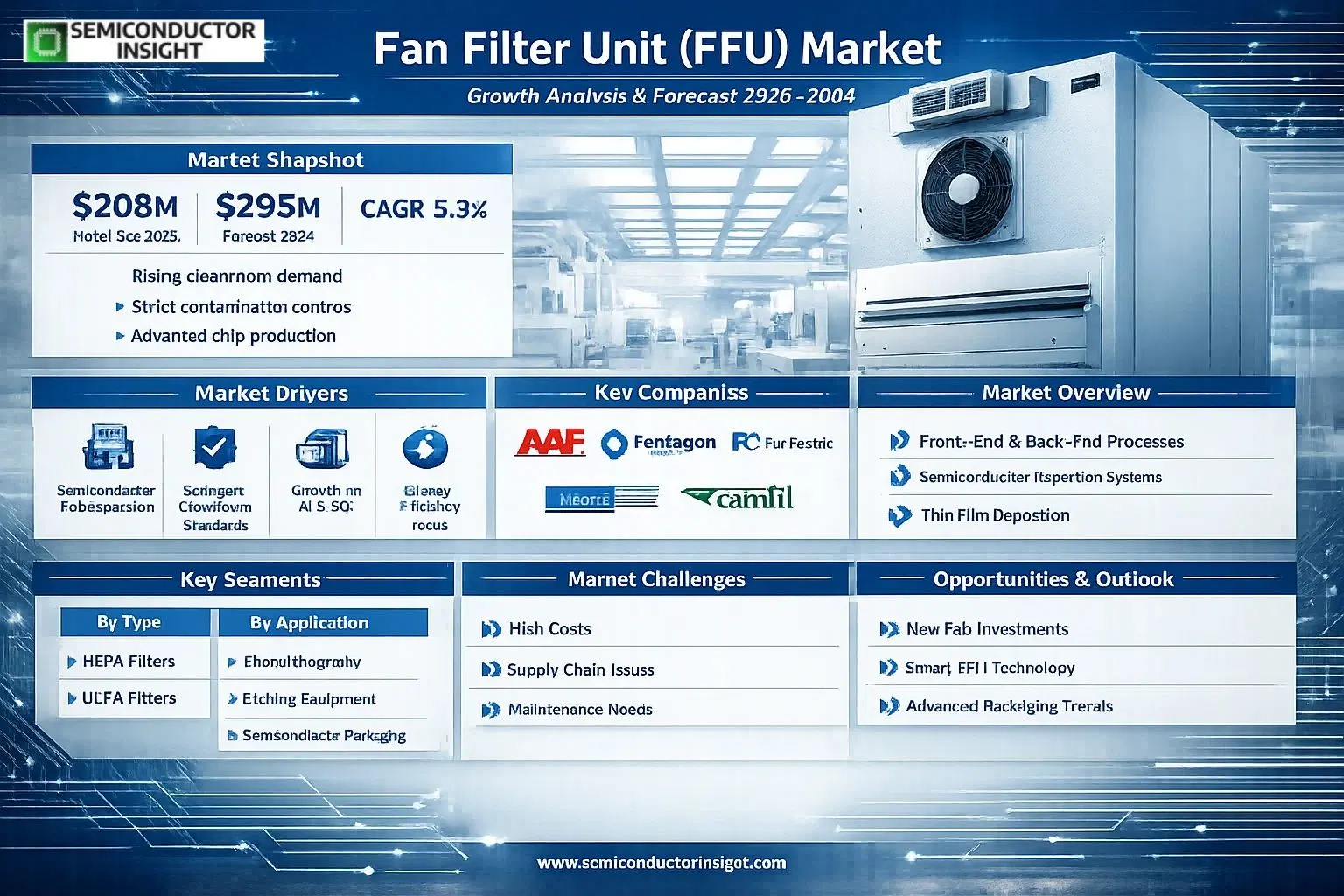
Global Fan Filter Unit (FFU) for Semiconductor Equipment market size was valued at USD 208 million in 2025. The market is projected to grow from USD 219 million in 2026 to USD 295 million by 2034, exhibiting a CAGR of 5.3% during the forecast period.
Fan Filter Units (FFUs) are self-contained air filtration and circulation systems that integrate a motor-driven fan with a high-efficiency filter , typically a HEPA (High-Efficiency Particulate Air) or ULPA (Ultra-Low Penetration Air) filter , housed within a single unit. In semiconductor equipment, FFUs serve as a critical component for maintaining the ultra-clean environments required in cleanroom facilities. They are deployed across both front-end processes such as photolithography, etching, and thin film deposition, and back-end processes including semiconductor inspection and packaging, where even sub-micron particulate contamination can compromise chip yield and performance.
The market is witnessing steady growth driven by the rapid global expansion of semiconductor fabrication capacity, increasingly stringent cleanroom standards, and rising demand for advanced chips across applications such as artificial intelligence, 5G, and electric vehicles. Furthermore, growing investments in semiconductor manufacturing infrastructure , particularly across Asia-Pacific, North America, and Europe , are directly amplifying demand for high-performance FFU systems. Key manufacturers operating in this space include American Air Filter Company, Pentagon Technologies, Nicotra Gebhardt, Fuji Electric, Camfil, Huntair, Price Industries, Airkey Envirotch Co., Ltd., Nippon Muki, and Bacclean, among others, each offering a broad range of FFU solutions tailored to the evolving needs of semiconductor equipment environments.
MARKET DRIVERS
Rising Demand for Advanced Semiconductor Fabrication Facilities
Global expansion of semiconductor fabrication plants, commonly referred to as fabs, has emerged as one of the most significant forces propelling Fan Filter Unit for Semiconductor Equipment. As chipmakers accelerate investments in leading-edge process nodes ranging from 5nm to sub-2nm geometries, the need for ultra-clean manufacturing environments has intensified considerably. Fan Filter Units are integral to cleanroom infrastructure, providing highly controlled airflow and particulate filtration that directly supports yield optimization in wafer production. The ongoing construction of new fab facilities across the United States, Europe, Japan, South Korea, and Taiwan,driven by both geopolitical supply chain strategies and commercial demand,is generating sustained procurement activity for advanced FFU systems.
Stringent Cleanroom Standards Amplifying FFU Adoption
Semiconductor manufacturing environments are governed by ISO cleanroom classifications, with leading-edge fabs typically requiring ISO Class 1 to ISO Class 4 conditions. Achieving and maintaining these classifications demands high-performance Fan Filter Units for Semiconductor Equipment capable of delivering uniform laminar airflow across the entire cleanroom ceiling area. Modern FFU systems are designed to meet HEPA and ULPA filtration standards, capturing particles as small as 0.1 microns with efficiencies exceeding 99.9995%. As device geometries continue to shrink, even sub-micron particulate contamination can result in critical defects, making high-efficiency FFUs an indispensable component of the semiconductor manufacturing ecosystem. Regulatory compliance with international cleanroom standards is further reinforcing capital expenditure allocations toward advanced filtration infrastructure.
➤ The transition toward gate-all-around (GAA) transistor architectures and extreme ultraviolet (EUV) lithography processes has raised contamination control requirements to unprecedented levels, positioning Fan Filter Unit for Semiconductor Equipment as a critical enabler of next-generation chip production.
Energy efficiency has also emerged as a compelling driver within Fan Filter Unit for Semiconductor Equipment landscape. Contemporary FFU systems incorporate EC (electronically commutated) motor technology, which delivers variable speed control and significantly reduced power consumption compared to legacy AC motor-driven units. Given that cleanroom HVAC systems can account for a substantial portion of a fab’s total energy consumption, the adoption of energy-optimized FFUs aligns with both operational cost reduction objectives and broader corporate sustainability commitments. Semiconductor manufacturers are increasingly evaluating the total cost of ownership of FFU installations, making energy performance a decisive procurement criterion alongside filtration efficiency and airflow uniformity.
MARKET CHALLENGES
High Capital Expenditure and Integration Complexity in Semiconductor Cleanroom Environments
One of the foremost challenges confronting Fan Filter Unit for Semiconductor Equipment is the considerable capital investment required for large-scale cleanroom FFU deployments. A fully equipped leading-edge fab may require thousands of Fan Filter Units to achieve the requisite ceiling coverage and airflow velocity necessary for ISO Class 1 or Class 2 conditions. The procurement, installation, commissioning, and ongoing maintenance of these systems represent a meaningful component of overall facility capital expenditure. For smaller or emerging semiconductor manufacturers, the financial burden associated with high-density FFU arrays can constrain facility expansion plans or delay technology upgrades. Furthermore, the integration of FFU systems with building automation platforms, cleanroom monitoring infrastructure, and energy management systems introduces engineering complexity that demands specialized expertise and careful project coordination.
Other Challenges
Supply Chain Vulnerabilities and Lead Time Constraints
Fan Filter Unit for Semiconductor Equipment supply chain is exposed to disruptions arising from the availability of key components including ULPA filter media, EC motor assemblies, and precision-engineered housings. Global logistics constraints and concentrated manufacturing bases for critical sub-components have, at various points, extended lead times for FFU deliveries. Semiconductor fab construction timelines are highly sensitive to equipment procurement schedules, and FFU delivery delays can cascade into broader facility commissioning setbacks, imposing significant financial and operational consequences on chip manufacturers.
Maintenance and Filter Replacement Lifecycle Management
Ongoing maintenance requirements present a persistent operational challenge within Fan Filter Unit for Semiconductor Equipment. HEPA and ULPA filter elements have defined service lifespans and must be replaced under controlled conditions to prevent cleanroom contamination events. Coordinating planned maintenance activities within active fab environments,where production continuity is paramount,demands rigorous scheduling, trained personnel, and stringent change-control protocols. The cumulative cost of filter consumables and maintenance labor over the operational life of a cleanroom installation constitutes a notable component of total ownership cost that procurement teams must account for in long-term facility planning.
MARKET RESTRAINTS
Cyclicality of Semiconductor Capital Expenditure Impacting FFU Demand
Fan Filter Unit for Semiconductor Equipment is inherently linked to the cyclical investment patterns characteristic of the broader semiconductor industry. Capital expenditure on new fab construction and cleanroom expansion tends to contract during periods of semiconductor demand softness or inventory correction cycles, directly suppressing procurement activity for FFU systems. During downturns, chipmakers frequently defer facility expansion projects, extend the operational life of existing cleanroom infrastructure, and reduce discretionary spending on equipment upgrades. This cyclical sensitivity introduces revenue volatility for FFU manufacturers and system integrators, complicating long-term capacity planning and research and development investment decisions.
Technological Transition Risks and Obsolescence Pressures
Rapid technological evolution in semiconductor manufacturing processes creates obsolescence risk for installed Fan Filter Unit for Semiconductor Equipment infrastructure. As cleanroom requirements evolve in response to advances in lithography, materials, and device architecture, FFU systems designed for earlier-generation contamination control specifications may require wholesale replacement rather than incremental upgrade. The pace of innovation within the semiconductor equipment sector means that FFU manufacturers must sustain continuous product development investment to remain competitive, placing pressure on research and development budgets and engineering resources. Smaller FFU suppliers lacking the financial capacity to maintain pace with evolving technical requirements face the risk of market share erosion to larger, more technologically agile competitors.
MARKET OPPORTUNITIES
Government-Backed Semiconductor Sovereignty Initiatives Driving Greenfield Fab Construction
Global strategic prioritization of domestic semiconductor manufacturing capacity has created an expansive opportunity landscape for Fan Filter Unit for Semiconductor Equipment. Legislative frameworks such as the CHIPS and Science Act in the United States, the European Chips Act, and analogous government incentive programs across Japan, South Korea, India, and other nations are channeling substantial public and private investment into new semiconductor fabrication facility construction. Each new greenfield fab project represents a significant demand event for FFU systems, given that cleanroom ceiling coverage requirements for advanced fabs can span tens of thousands of square meters. This policy-driven investment wave is expected to sustain above-trend demand for Fan Filter Units for Semiconductor Equipment through the latter half of the current decade, providing manufacturers with a relatively predictable long-term pipeline of project opportunities.
Smart FFU Systems and IoT-Enabled Cleanroom Monitoring as an Emerging Growth Vector
The integration of digital intelligence into cleanroom infrastructure represents a compelling growth opportunity for Fan Filter Unit for Semiconductor Equipment. Smart FFU platforms incorporating embedded sensors, real-time airflow monitoring, predictive filter life analytics, and wireless connectivity to building management systems are gaining traction among semiconductor manufacturers seeking to optimize cleanroom operational efficiency. IoT-enabled FFU ecosystems allow facility engineers to implement dynamic airflow control strategies that respond to real-time contamination monitoring data, reducing energy consumption during low-occupancy periods while ensuring continuous compliance with cleanroom classification requirements. The convergence of Industry 4.0 principles with cleanroom management practices is creating differentiated value propositions for FFU suppliers capable of delivering integrated digital solutions, opening premium market segments beyond conventional hardware procurement.
Expansion of Advanced Packaging and Compound Semiconductor Applications
Beyond traditional silicon-based logic and memory fabrication, Fan Filter Unit for Semiconductor Equipment market is positioned to benefit from the accelerating growth of advanced packaging technologies and compound semiconductor manufacturing. Applications including silicon photonics, gallium nitride (GaN) power devices, silicon carbide (SiC) substrates, and heterogeneous integration packaging platforms require controlled cleanroom environments that necessitate high-performance FFU systems. As the semiconductor value chain diversifies beyond conventional CMOS logic manufacturing, the addressable market for Fan Filter Units in Semiconductor Equipment environments expands correspondingly. Investment in these adjacent and emerging semiconductor segments is expected to contribute incrementally to FFU demand, providing market participants with growth opportunities that are partially decoupled from the traditional memory and logic fab investment cycles.
MAIN TITLE HERE () Trends
Rising Demand for Cleanroom Environments Driving Fan Filter Unit for Semiconductor Equipment
Fan Filter Unit for Semiconductor Equipment is witnessing sustained growth, driven by the semiconductor industry’s increasing emphasis on contamination control across manufacturing environments. As chip fabrication processes become more intricate,particularly with the transition toward sub-5nm node architectures,the tolerance for airborne particulates has reached near-zero levels. Fan filter units, functioning as active air purification systems, are essential in maintaining the stringent cleanliness standards required in both front-end wafer processing and back-end packaging operations. Cleanroom classifications such as ISO Class 1 through ISO Class 5 are increasingly mandated across leading fabrication facilities, intensifying the demand for high-performance FFU systems globally.
Other Trends
Expansion of Semiconductor Fabrication Capacity Across Asia-Pacific
Asia-Pacific continues to lead global semiconductor manufacturing activity, with countries such as China, South Korea, Japan, and Taiwan aggressively expanding their fabrication capacity. This regional buildup directly fuels demand for Fan Filter Unit (FFU) for Semiconductor Equipment solutions, as each new cleanroom facility requires a comprehensive air filtration infrastructure. China’s ongoing investment in domestic semiconductor self-sufficiency has been a particularly significant demand driver, pushing local and international FFU suppliers to scale production capabilities to meet project timelines across multiple gigafab developments.
Shift Toward ULPA Filtration Technology for Advanced Node Manufacturing
While HEPA filters have historically dominated Fan Filter Unit for Semiconductor Equipment, there is a growing transition toward Ultra-Low Penetration Air (ULPA) filtration in advanced semiconductor equipment environments. ULPA filters, capable of trapping particles as small as 0.12 microns with efficiency exceeding 99.999%, are increasingly preferred in photolithography and etching equipment applications where even sub-micron contamination can render wafers unusable. This trend is pushing manufacturers such as Camfil, Nippon Muki, and American Air Filter Company to innovate their ULPA-based FFU product lines.
Integration of Energy-Efficient and Smart FFU Systems
Energy efficiency has emerged as a prominent trend shaping Fan Filter Unit for Semiconductor Equipment. Modern FFU systems are increasingly equipped with electronically commutated (EC) motors and variable speed drives that reduce power consumption significantly compared to conventional AC motor-based units. Additionally, the integration of IoT-enabled monitoring capabilities allows facility managers to track filter loading, airflow velocity, and energy usage in real time. These smart FFU systems align with semiconductor manufacturers’ broader sustainability goals while also improving operational uptime and predictive maintenance outcomes.
Growing Application in Semiconductor Inspection and Thin Film Deposition Equipment
Beyond traditional photolithography and etching applications, Fan Filter Unit for Semiconductor Equipment is experiencing expanding adoption within semiconductor inspection and thin film deposition equipment segments. These processes demand highly controlled micro-environments to ensure measurement accuracy and film uniformity. As manufacturers such as Fuji Electric, Huntair, and Pentagon Technologies develop application-specific FFU configurations, the market is gradually diversifying its end-use base, creating additional revenue opportunities across a broader range of semiconductor equipment categories.
COMPETITIVE LANDSCAPE
Key Industry Players
Fan Filter Unit (FFU) for Semiconductor Equipment Market – Competitive Dynamics and Leading Manufacturer Profiles
Global Fan Filter Unit (FFU) for Semiconductor Equipment market is moderately consolidated, with a handful of established multinational corporations commanding significant revenue shares alongside a growing number of specialized regional players. As of 2025, the market is valued at approximately USD 208 million and is forecast to reach USD 295 million by 2034, expanding at a CAGR of 5.3%. American Air Filter Company (AAF International) stands out as one of the dominant forces in this space, leveraging its extensive product portfolio spanning HEPA and ULPA filtration systems, deep integration with cleanroom infrastructure providers, and a well-established global distribution network. Camfil, another tier-one competitor, has reinforced its position through sustained R&D investment in energy-efficient FFU solutions tailored to the stringent contamination control requirements of semiconductor front-end and back-end processing environments, including photolithography, etching, thin film deposition, and inspection equipment applications.
Beyond the market leaders, several niche and regionally significant players are intensifying competition across Asia-Pacific and North America , the two most critical demand hubs for semiconductor manufacturing equipment. Fuji Electric and Nippon Muki have leveraged their strong footholds in Japan and South Korea to supply FFUs aligned with the ultra-clean standards demanded by leading semiconductor fabs in those regions. Pentagon Technologies and Huntair continue to differentiate through application-specific engineering capabilities and rapid customization services for OEM semiconductor equipment integrators. Meanwhile, China-based manufacturers such as Airkey Envirotch Co., Ltd. and Bacclean are gaining traction as domestic semiconductor capacity expansions accelerate, benefiting from localization policies and cost-competitive manufacturing. Price Industries and Nicotra Gebhardt round out the competitive field with broad cleanroom air management solutions that address diverse FFU deployment scenarios across global semiconductor facilities.
List of Key Fan Filter Unit (FFU) for Semiconductor Equipment Companies Profiled
- American Air Filter Company (AAF International)
- Pentagon Technologies
- Nicotra Gebhardt
- Fuji Electric
- Camfil
- Huntair
- Price Industries
- Airkey Envirotch Co., Ltd.
- Nippon Muki
- Bacclean
Segment Analysis:
| Segment Category | Sub-Segments | Key Insights |
| By Type |
|
ULPA Filter
|
| By Application |
|
Photolithography Equipment
|
| By End User |
|
Wafer Fabrication Facilities
|
| By Size |
|
2×4 feet
|
| By Motor Technology |
|
EC Motor
|
Regional Analysis: Fan Filter Unit (FFU) for Semiconductor Equipment Market
Asia-Pacific
Taiwan and South Korea anchor the region’s semiconductor prowess, with expansive cleanrooms relying on FFUs for precise airflow control. China’s burgeoning fabs prioritize scalable FFU deployments to support rapid capacity ramps, fostering a competitive supplier ecosystem that delivers reliable, high-uptime units essential for yield optimization in advanced processes.
Regional players pioneer smart FFUs integrating sensors for predictive maintenance, reducing downtime in 24/7 operations. Energy-efficient designs with variable speed motors address power-intensive fab needs, while modular configurations enable flexible cleanroom layouts, driving adoption across diverse semiconductor applications from logic to memory chips.
Proximity to component fabricators in Japan and Southeast Asia streamlines FFU assembly, minimizing lead times amid volatile global logistics. Strategic partnerships between equipment makers and filter specialists enhance quality consistency, bolstering resilience against disruptions and supporting just-in-time inventory models prevalent in high-tech manufacturing hubs.
Escalating investments in next-gen fabs promise sustained FFU demand, with emphasis on eco-friendly models complying with regional sustainability mandates. Emerging trends like AI-optimized airflow promise further efficiencies, positioning Asia-Pacific suppliers to capture value in the evolving Fan Filter Unit (FFU) for Semiconductor Equipment Market.
North America
North America plays a strategic role in Fan Filter Unit for Semiconductor Equipment, buoyed by revitalized domestic fabrication initiatives and robust R&D ecosystems. Leading chip designers transition select advanced processes to U.S.-based facilities, heightening needs for premium FFUs capable of sub-fab integration and stringent cleanroom standards. Collaborations between government and industry spur cleanroom upgrades, favoring domestically produced FFUs with enhanced cybersecurity features for smart manufacturing. Canada’s contributions through specialized equipment firms add diversity, focusing on ruggedized units for harsh environments. Market growth hinges on supply chain diversification away from Asia, prompting investments in local FFU production to mitigate risks. Innovations in low-noise FFUs cater to urban fab sites, while regulatory emphasis on energy efficiency aligns with corporate sustainability goals. Challenges persist in scaling production volumes compared to Asian counterparts, yet North America’s technological edge and policy support cultivate a premium segment ripe for expansion.
Europe
Europe’s Fan Filter Unit (FFU) for Semiconductor Equipment Market thrives on its blend of established players and precision engineering heritage. Germany and the Netherlands host key equipment suppliers and specialty fabs, demanding FFUs with superior filtration for power and automotive semiconductors. The EU’s green deal accelerates adoption of low-energy FFUs in retrofitted cleanrooms, promoting circular economy principles through recyclable materials. France and Italy contribute via niche innovations in vibration-dampening designs for sensitive lithography tools. Regional integration facilitates cross-border collaborations, enhancing FFU standardization across diverse regulatory landscapes. Focus on Industry 4.0 drives demand for connected FFUs enabling predictive analytics in cleanroom operations. Supply constraints from global events underscore the push for European manufacturing resurgence, supported by subsidies. While volume lags behind Asia-Pacific, Europe’s strength in high-value, customized solutions positions it well for specialized semiconductor niches.
South America
South America represents an emerging frontier in Fan Filter Unit for Semiconductor Equipment, with nascent semiconductor assembly and testing facilities spurring initial FFU deployments. Brazil leads regional efforts through electronics hubs, integrating FFUs into cleanrooms for backend processes amid growing device localization mandates. Partnerships with international suppliers introduce cost-effective, adaptable FFU models suited to variable grid power. Chile’s tech corridors explore fab-lite models, prioritizing durable units resilient to climatic fluctuations. Infrastructure investments in data centers indirectly boost FFU familiarity, paving the way for advanced semiconductor pursuits. Challenges include import dependencies and skill gaps, yet favorable trade policies and workforce training programs foster gradual market maturation. Sustainability focus aligns with eco-conscious FFU selections, setting foundations for scalable adoption as regional tech ambitions intensify.
Middle East & Africa
The Middle East & Africa region is carving a niche in Fan Filter Unit for Semiconductor Equipment, propelled by diversification strategies beyond oil. UAE and Israel’s innovation clusters develop semiconductor packaging facilities, requiring compact, high-reliability FFUs for controlled environments. Saudi Arabia’s megaprojects include cleanroom setups for electronics, emphasizing dust-resistant designs adapted to arid conditions. South Africa’s established manufacturing base supports backend operations, favoring modular FFUs for flexible expansions. Geopolitical investments in tech sovereignty drive FFU imports and local adaptations, with emphasis on energy-efficient models amid rising utility costs. Collaborations with Asian and European vendors transfer knowledge, building regional capabilities. Hurdles like infrastructure variability persist, but visionary policies and private equity signal promising growth trajectories for FFU integration in nascent semiconductor ecosystems.
Report Scope
This market research report provides a comprehensive analysis of the Fan Filter Unit (FFU) for Semiconductor Equipment Market , covering the forecast period 2026–2034. It offers detailed insights into market dynamics, technological advancements, competitive landscape, and key trends shaping the industry.
Key focus areas of the report include:
- Market Overview: The report begins with an overview outlining its current market scenario, key growth indicators, and industry transformation drivers. It discusses macroeconomic factors, demand–supply balance, regulatory landscape, and the strategic role of semiconductors in powering advancements across industries such as automotive, telecommunications, consumer electronics, and industrial automation.
- Market Size & Forecast: Historical data and future projections for revenue, unit shipments, and market value across major regions and segments.
- Segmentation Analysis: Detailed breakdown by product type, technology, application, and end-user industry to identify high-growth segments and investment opportunities.
- Regional Insights: Insights into market performance across North America, Europe, Asia-Pacific, Latin America, and the Middle East & Africa, including country-level analysis where relevant.
- Competitive Landscape: Profiles of leading market participants, including their product offerings, R&D focus, manufacturing capacity, pricing strategies, and recent developments such as mergers, acquisitions, and partnerships.
- Technology Trends & Innovation: Assessment of emerging technologies, integration of AI/IoT, semiconductor design trends, fabrication techniques, and evolving industry standards.
- Market Drivers & Restraints: Evaluation of factors driving market growth along with challenges, supply chain constraints, regulatory issues, and market-entry barriers.
- Stakeholder Insights: Insights for component suppliers, OEMs, system integrators, investors, and policymakers regarding the evolving ecosystem and strategic opportunities.
Primary and secondary research methods are employed, including interviews with industry experts, data from verified sources, and real-time market intelligence to ensure the accuracy and reliability of the insights presented.
FREQUENTLY ASKED QUESTIONS:
What is the current market size of Fan Filter Unit (FFU) for Semiconductor Equipment Market?
-> Global Fan Filter Unit (FFU) for Semiconductor Equipment market was valued at USD 208 million in 2025 and is projected to reach USD 295 million by 2034, at a CAGR of 5.3% during the forecast period.
Which key companies operate in Fan Filter Unit (FFU) for Semiconductor Equipment Market?
-> Key players include American Air Filter Company, Pentagon Technologies, Nicotra Gebhardt, Fuji Electric, Camfil, Huntair, Price Industries, Airkey Envirotch Co., Ltd., Nippon Muki, Bacclean, among others.
What are the key growth drivers?
-> Key growth drivers include the critical role of FFU as a key air purification device in semiconductor front-end and back-end processes to prevent dust, particles, and microorganisms from contaminating chips.
Which region dominates the market?
-> Asia, particularly China, Japan, and South Korea, dominates the market due to major semiconductor manufacturing hubs.
What are the emerging trends?
-> Emerging trends include advancements in HEPA and ULPA filters, applications in photolithography, etching, thin film deposition, and semiconductor inspection equipment.

Get Sample Report PDF for Exclusive Insights
Report Sample Includes
- Table of Contents
- List of Tables & Figures
- Charts, Research Methodology, and more...
 Download Sample Report PDF