Key Statistics
Key Takeaways
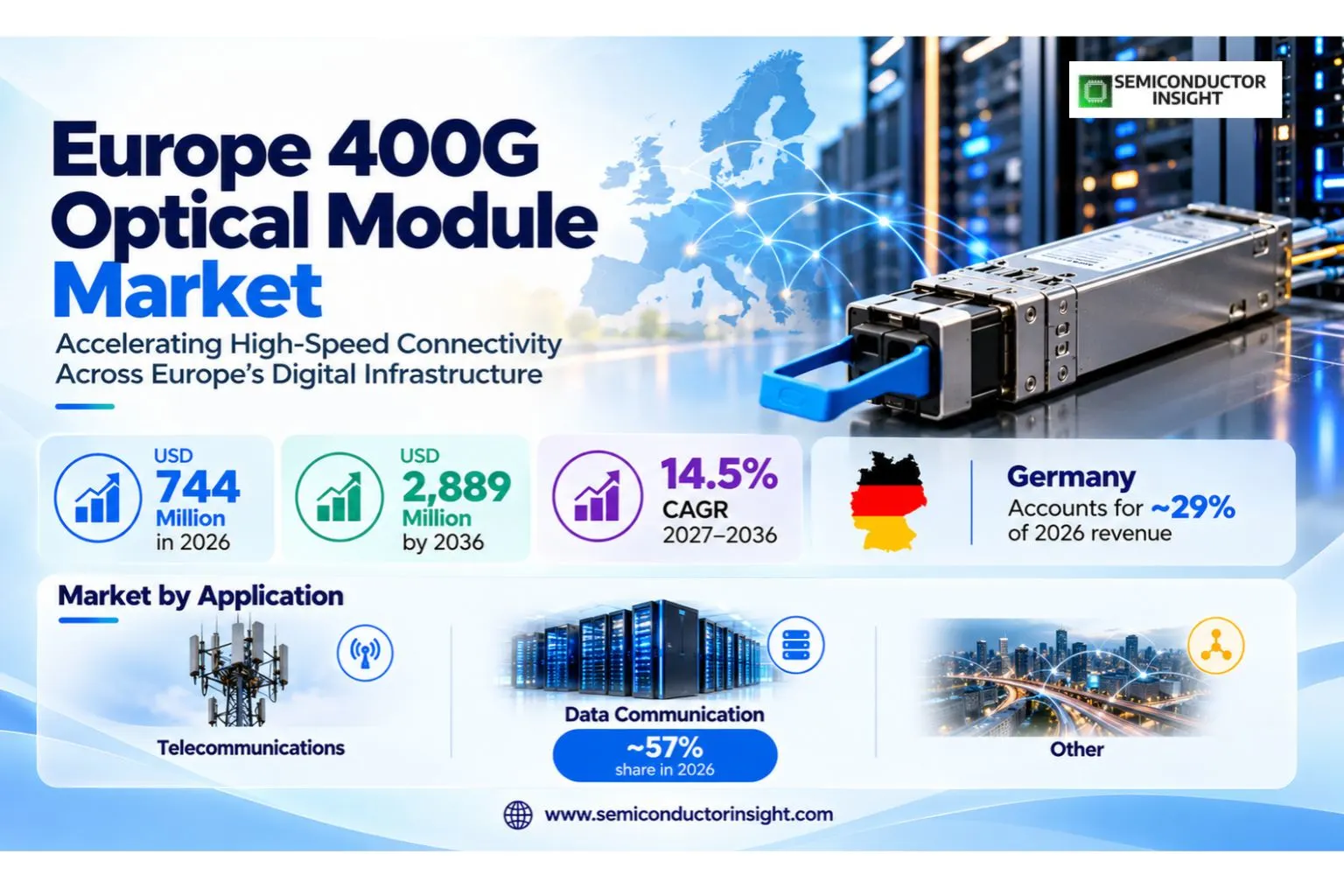
- Market valuation: the europe 400g optical module market is valued at USD 744 million in 2026, with a projection of USD 2,889 million in 2036 at 14.5% CAGR during 2027–2036. The product boundary concentrates on 400 gigabit-per-second optical modules used within Europe and excludes revenue belonging to unrelated end equipment.
- Largest product class: Package Form: QSFP-DD holds an estimated ~56% of 2026 sales, while Package Form: OSFP is positioned for changing design requirements; rack density and the cost of moving traffic across distributed AI clusters favour 400G interfaces where 100G capacity is exhausted. In europe 400g optical module largest product class, continued qualification and sourcing decisions determine the pace at which that opportunity becomes recognized commercial revenue.
- Application demand: Data Communication contributes an estimated ~57% of 2026 revenue because 400G port deployments in data centers, internet exchanges and metro transport networks. In europe 400g optical module application demand, suppliers must translate end-user needs into components tested for the host system, rather than count entire equipment budgets as optical-product sales.
- Geographic concentration: Germany represents an estimated ~29% of 2026 market turnover. Demand is influenced by Frankfurt-London-Amsterdam internet exchange and hyperscale campus build-out; the other geographic blocks are distinct purchasing environments and are not assumed to share the same product mix or buying cycle.
- Principal constraint: Switch-port compatibility, optical power consumption, reach budgets and 800g substitution remain the major limitations on conversion from technical interest to deployments. In europe 400g optical module principal constraint, price pressure and the ability to maintain a replacement supply can outweigh first-mover product specifications in long-life infrastructure programmes.
Europe 400G Optical Module Market Overview
Europe 400g optical module market reached USD 744 million in 2026 and is projected at USD 2,889 million by 2036, representing a CAGR of 14.5% over the 2027–2036 forecast period. Germany accounts for an estimated ~29% of 2026 revenue, with the outlook shaped by 400G port deployments in data centers, internet exchanges and metro transport networks.
Europe 400G Optical Module brings together 400 Gb/s QSFP-DD and OSFP pluggables, PAM4 direct-detect lanes and coherent optical transceivers. The saleable boundary covers 400 gigabit-per-second optical modules used within Europe, which are bought through a specialized supply chain and tested to the requirements of their downstream electronic or optical equipment. Within europe 400g optical module, the market definition decision is affected by switch-port compatibility, optical power consumption, reach budgets and 800g substitution. In the europe 400g optical module market overview, this scope avoids allocating the whole of a network system or finished vehicle to its optical chip or medium.
Product inclusions follow the published type classes: Package Form: QSFP-DD, Package Form: OSFP, Package Form: CFP8, Package Form: CDFP, Other. Application demand is separated into Telecommunications, Data Communication, Other. In the europe 400g optical module market overview, closely related services, installed end devices and adjacent technologies may influence sales but are not added automatically to the semiconductor, module or media product line. Within europe 400g optical module, the revenue boundary decision is affected by switch-port compatibility, optical power consumption, reach budgets and 800g substitution. The distinction also preserves comparability between replacement purchasing and first-time deployment.
The technical architecture depends on 400 Gb/s QSFP-DD and OSFP pluggables, PAM4 direct-detect lanes and coherent optical transceivers. In the europe 400g optical module market overview, packaging, active electrical interfaces, product lifetime and service documentation each affect the final cost more than raw functional capability. In the europe 400g optical module market overview, the risk increases when a promising development cannot be characterized consistently across temperatures, factories and customer qualification fixtures. Within europe 400g optical module, the technology architecture decision is affected by switch-port compatibility, optical power consumption, reach budgets and 800g substitution. In the europe 400g optical module market overview, suppliers with test capacity and known process windows are better positioned than prototype-only entrants.
Buying decisions originate in 400G port deployments in data centers, internet exchanges and metro transport networks. In the europe 400g optical module market overview, customer procurement therefore tends to be shaped by system design windows, engineering sign-off, approved part lists and the underlying business case for replacing existing equipment. A relevant source for the technology ecosystem is Nokia and its documented programme, hetzner network upgrade with 400g and 800g. Within europe 400g optical module, the procurement mechanism decision is affected by switch-port compatibility, optical power consumption, reach budgets and 800g substitution. In the europe 400g optical module market overview, customer projects and supplier shipments are different stages and should not be mistaken for the same volume.
The major transition for europe 400g optical module is that rack density and the cost of moving traffic across distributed AI clusters favour 400G interfaces where 100G capacity is exhausted. This does not mean all legacy architectures disappear immediately. Procurement must still absorb switch-port compatibility, optical power consumption, reach budgets and 800G substitution, and design qualification typically creates an offset between a technical announcement and a recurring shipment cycle. Within europe 400g optical module, the current market change decision is affected by switch-port compatibility, optical power consumption, reach budgets and 800g substitution. The highest-value opportunities belong to repeatable designs and multi-year production programmes.
Segment Analysis: By Type
The type structure follows Package Form: QSFP-DD, Package Form: OSFP, Package Form: CFP8, Package Form: CDFP, Other. Package Form: QSFP-DD leads in 2026 at an estimated ~56% share, while Package Form: OSFP represents ~22% with an indicative ~18.5% growth profile. In europe 400g optical module by-type composition, product functionality alone is insufficient to establish a sale; compatible interfaces and qualified manufacturing decide the design slot. Within europe 400g optical module, the product segmentation decision is affected by switch-port compatibility, optical power consumption, reach budgets and 800g substitution.
| Type | Function | Market position |
|---|---|---|
| Package Form: QSFP-DD | Package Form: QSFP-DD is a defined product class within europe 400g optical module, addressing an identifiable technical or deployment requirement. In Package Form: QSFP-DD products, its usefulness depends on host interfaces, environmental tolerance, acceptable integration cost and the ability to maintain supply beyond a single prototype. Package Form: QSFP-DD must be specified by the buyer before a product can be tested against alternatives. Within europe 400g optical module, the type package form: qsfp-dd decision is affected by switch-port compatibility, optical power consumption, reach budgets and 800g substitution. switch OEM qualification, carrier transport programs and approved pluggable module distribution conditions the opportunity. | Estimated ~56% of 2026 product revenue; ~13.1% CAGR. For Package Form: QSFP-DD, commercial ranking reflects not only volume but also price and component complexity. This class faces a distinct adoption balance between current customer programmes and competing formats; the revenue opportunity is bounded by 400 gigabit-per-second optical modules used within Europe. Within europe 400g optical module, the market position package form: qsfp-dd decision is affected by switch-port compatibility, optical power consumption, reach budgets and 800g substitution. In Package Form: QSFP-DD procurement, customers will not necessarily replace existing qualified hardware when a newer design becomes available. |
| Package Form: OSFP | Package Form: OSFP is a defined product class within europe 400g optical module, addressing an identifiable technical or deployment requirement. In Package Form: OSFP products, its usefulness depends on host interfaces, environmental tolerance, acceptable integration cost and the ability to maintain supply beyond a single prototype. Package Form: OSFP must be specified by the buyer before a product can be tested against alternatives. Within europe 400g optical module, the type package form: osfp decision is affected by switch-port compatibility, optical power consumption, reach budgets and 800g substitution. switch OEM qualification, carrier transport programs and approved pluggable module distribution conditions the opportunity. | Estimated ~22% of 2026 product revenue; ~18.5% CAGR. For Package Form: OSFP, commercial ranking reflects not only volume but also price and component complexity. In Package Form: OSFP procurement, this class faces a distinct adoption balance between current customer programmes and competing formats; the revenue opportunity is bounded by 400 gigabit-per-second optical modules used within Europe. Within europe 400g optical module, the market position package form: osfp decision is affected by switch-port compatibility, optical power consumption, reach budgets and 800g substitution. In Package Form: OSFP procurement, customers will not necessarily replace existing qualified hardware when a newer design becomes available. |
| Package Form: CFP8 | Package Form: CFP8 is a defined product class within europe 400g optical module, addressing an identifiable technical or deployment requirement. In Package Form: CFP8 products, its usefulness depends on host interfaces, environmental tolerance, acceptable integration cost and the ability to maintain supply beyond a single prototype. Package Form: CFP8 must be specified by the buyer before a product can be tested against alternatives. Within europe 400g optical module, the type package form: cfp8 decision is affected by switch-port compatibility, optical power consumption, reach budgets and 800g substitution. switch OEM qualification, carrier transport programs and approved pluggable module distribution conditions the opportunity. | Estimated ~10% of 2026 product revenue; ~13.1% CAGR. For Package Form: CFP8, commercial ranking reflects not only volume but also price and component complexity. In Package Form: CFP8 procurement, this class faces a distinct adoption balance between current customer programmes and competing formats; the revenue opportunity is bounded by 400 gigabit-per-second optical modules used within Europe. Within europe 400g optical module, the market position package form: cfp8 decision is affected by switch-port compatibility, optical power consumption, reach budgets and 800g substitution. In Package Form: CFP8 procurement, customers will not necessarily replace existing qualified hardware when a newer design becomes available. |
| Package Form: CDFP | Package Form: CDFP is a defined product class within europe 400g optical module, addressing an identifiable technical or deployment requirement. In Package Form: CDFP products, its usefulness depends on host interfaces, environmental tolerance, acceptable integration cost and the ability to maintain supply beyond a single prototype. Package Form: CDFP must be specified by the buyer before a product can be tested against alternatives. Within europe 400g optical module, the type package form: cdfp decision is affected by switch-port compatibility, optical power consumption, reach budgets and 800g substitution. switch OEM qualification, carrier transport programs and approved pluggable module distribution conditions the opportunity. | Estimated ~7% of 2026 product revenue; ~13.1% CAGR. For Package Form: CDFP, commercial ranking reflects not only volume but also price and component complexity. In Package Form: CDFP procurement, this class faces a distinct adoption balance between current customer programmes and competing formats; the revenue opportunity is bounded by 400 gigabit-per-second optical modules used within Europe. Within europe 400g optical module, the market position package form: cdfp decision is affected by switch-port compatibility, optical power consumption, reach budgets and 800g substitution. In Package Form: CDFP procurement, customers will not necessarily replace existing qualified hardware when a newer design becomes available. |
| Other | Other is a defined product class within europe 400g optical module, addressing an identifiable technical or deployment requirement. In Other products, its usefulness depends on host interfaces, environmental tolerance, acceptable integration cost and the ability to maintain supply beyond a single prototype. Other must be specified by the buyer before a product can be tested against alternatives. Within europe 400g optical module, the type other decision is affected by switch-port compatibility, optical power consumption, reach budgets and 800g substitution. switch OEM qualification, carrier transport programs and approved pluggable module distribution conditions the opportunity. | Estimated ~5% of 2026 product revenue; ~13.1% CAGR. For Other, commercial ranking reflects not only volume but also price and component complexity. In Other procurement, this class faces a distinct adoption balance between current customer programmes and competing formats; the revenue opportunity is bounded by 400 gigabit-per-second optical modules used within Europe. Within europe 400g optical module, the market position other decision is affected by switch-port compatibility, optical power consumption, reach budgets and 800g substitution. In Other procurement, customers will not necessarily replace existing qualified hardware when a newer design becomes available. |
Secondary segmentation: commercial and integration axes
In Secondary segmentation: commercial and integration axes, a commercial segmentation can be useful alongside the source-defined type breakdown, particularly when determining the distinction between a packaged module, a technology platform and an integrated final system. These illustrative purchasing stages do not alter the published product classes. Within europe 400g optical module, the commercial structure decision is affected by switch-port compatibility, optical power consumption, reach budgets and 800g substitution.
| Axis | Members | Commercial role |
|---|---|---|
| By Integration | Chip integration · Packaged module · System qualification | By Integration in europe 400g optical module separates the design responsibility among Chip integration, Packaged module, System qualification. For By Integration in europe 400g optical module, these commercial routes influence who owns final reliability testing, firmware validation, component interchangeability and qualification documentation. Buyers in the europe 400g optical module market selecting Chip integration often have different engineering resources from integrators sourcing pre-tested modules. Within europe 400g optical module, the By Integration commercial segmentation decision is affected by switch-port compatibility, optical power consumption, reach budgets and 800g substitution. |
| By Channel | Direct supply agreement · OEM-integrated component · Distributor-qualified part | By Channel in europe 400g optical module separates the design responsibility among Direct supply agreement, OEM-integrated component, Distributor-qualified part. For By Channel in europe 400g optical module, these commercial routes influence who owns final reliability testing, firmware validation, component interchangeability and qualification documentation. Buyers in the europe 400g optical module market selecting Direct supply agreement often have different engineering resources from integrators sourcing pre-tested modules. Within europe 400g optical module, the By Channel commercial segmentation decision is affected by switch-port compatibility, optical power consumption, reach budgets and 800g substitution. |
Segment Analysis: By Application
Applications in the market comprise Telecommunications, Data Communication, Other. Data Communication leads at an estimated ~57% of 2026 value. In europe 400g optical module application composition, each application has different performance thresholds, testing obligations, replacement cycles and commercial access, which means total installations cannot be treated as direct sales of the narrower product. Within europe 400g optical module, the applications decision is affected by switch-port compatibility, optical power consumption, reach budgets and 800g substitution.
| Application | Demand characteristics |
|---|---|
| Telecommunications | An estimated ~38% share of 2026 revenue; ~16.0% CAGR. Telecommunications buyers prioritize the function of 400 Gb/s QSFP-DD and OSFP pluggables, PAM4 direct-detect lanes and coherent optical transceivers under their own reliability, access and procurement conditions. In Telecommunications applications, engineering approval must precede larger purchase orders, and the purchasing process can operate through specialized suppliers rather than direct orders from end customers. Within europe 400g optical module, the application telecommunications decision is affected by switch-port compatibility, optical power consumption, reach budgets and 800g substitution. In Telecommunications applications, compared with adjacent deployments, the practical value is defined by accepted test results and product supply terms. |
| Data Communication | An estimated ~57% share of 2026 revenue; ~13.6% CAGR. Data Communication buyers prioritize the function of 400 Gb/s QSFP-DD and OSFP pluggables, PAM4 direct-detect lanes and coherent optical transceivers under their own reliability, access and procurement conditions. In Data Communication applications, engineering approval must precede larger purchase orders, and the purchasing process can operate through specialized suppliers rather than direct orders from end customers. Within europe 400g optical module, the application data communication decision is affected by switch-port compatibility, optical power consumption, reach budgets and 800g substitution. In Data Communication applications, compared with adjacent deployments, the practical value is defined by accepted test results and product supply terms. |
| Other | An estimated ~5% share of 2026 revenue; ~13.3% CAGR. Other buyers prioritize the function of 400 Gb/s QSFP-DD and OSFP pluggables, PAM4 direct-detect lanes and coherent optical transceivers under their own reliability, access and procurement conditions. In Other applications, engineering approval must precede larger purchase orders, and the purchasing process can operate through specialized suppliers rather than direct orders from end customers. Within europe 400g optical module, the application other decision is affected by switch-port compatibility, optical power consumption, reach budgets and 800g substitution. In Other applications, compared with adjacent deployments, the practical value is defined by accepted test results and product supply terms. |
The sales channel for the application segmentation is switch OEM qualification, carrier transport programs and approved pluggable module distribution. In the application sales channel, an application opportunity can involve several equipment makers, but only the applicable component, module or disc shipment belongs within the product market. Service contracts and unrelated hardware should not be double-counted. Within europe 400g optical module, the application channel decision is affected by switch-port compatibility, optical power consumption, reach budgets and 800g substitution. In the application sales channel, demand also depends on buyer budgets and how rapidly existing equipment reaches replacement age.
Regional Analysis
Regional demand is led by Germany (~29%), United Kingdom (~25%), France (~19%) on an estimated 2026 revenue basis. Germany shows the strongest modeled expansion at ~15.9% CAGR. The geographic demand pattern is shaped by Frankfurt-London-Amsterdam internet exchange and hyperscale campus build-out, with customer qualification requirements and import exposure differing significantly across locations. Within europe 400g optical module, the regional analysis decision is affected by switch-port compatibility, optical power consumption, reach budgets and 800g substitution.
Why do markets for europe 400g optical module develop at different rates?
Each region buys 400 gigabit-per-second optical modules used within Europe through distinct industrial structures. In the market regional comparison, high-value deployments may be concentrated near major engineering centers while routine purchases can be arranged through distributors and integrated equipment vendors. Switch-port compatibility, optical power consumption, reach budgets and 800g substitution are not equally burdensome across all customer groups. Within europe 400g optical module, the regional comparisons decision is affected by switch-port compatibility, optical power consumption, reach budgets and 800g substitution. In the market regional comparison, supplier coverage depends on available technical support and a credible service plan.
| Region | Position | Growth outlook | Demand profile | What decides supplier selection |
|---|---|---|---|---|
| Germany | Largest (~29%) | ~15.9% CAGR | hyperscale networks | Qualification, 2026–2036 |
| United Kingdom | Established (~25%) | ~13.5% CAGR | internet networks | Qualification, 2026–2036 |
| France | Specialized (~19%) | ~13.3% CAGR | metro networks | Qualification, 2026–2036 |
| Netherlands & Belgium | Emerging (~19%) | ~15.4% CAGR | high-density networks | Qualification, 2026–2036 |
| Southern Europe | Developing (~8%) | ~12.6% CAGR | operator networks | Qualification, 2026–2036 |
Competitive Landscape
Competition in the europe 400g optical module market takes place across product manufacturers, component designers, integrators and research infrastructure rather than a single undifferentiated list. The published profile set covers Nokia Corporation, Ericsson, ADVA Optical Networking, Ciena Corporation, Huawei Technologies Co., Ltd. and others. The commercial distinction matters because company-wide revenue does not identify revenue from 400 gigabit-per-second optical modules used within Europe. Within europe 400g optical module, the competitive landscape decision is affected by switch-port compatibility, optical power consumption, reach budgets and 800g substitution.
Commercial differentiation begins with 400 Gb/s QSFP-DD and OSFP pluggables, PAM4 direct-detect lanes and coherent optical transceivers; qualification quality and production yield usually decide recurring orders. Within europe 400g optical module, the competition 0 decision is affected by switch-port compatibility, optical power consumption, reach budgets and 800g substitution. In competition factor 1, product acceptance in this competition 0 context hinges on traceable specifications, qualification responsibility, approved sourcing and the operating lifetime expected by buyers.
Supplier strategies reflect switch OEM qualification, carrier transport programs and approved pluggable module distribution, including the differences between catalog components and custom customer-designed products. Within europe 400g optical module, the competition 1 decision is affected by switch-port compatibility, optical power consumption, reach budgets and 800g substitution. In competition factor 2, product acceptance in this competition 1 context hinges on traceable specifications, qualification responsibility, approved sourcing and the operating lifetime expected by buyers.
In competition factor 3, competition intensifies when customers can substitute equivalent components without changing the host design. Switch-port compatibility, optical power consumption, reach budgets and 800g substitution can preserve an incumbent advantage when approved designs are expensive to requalify. Within europe 400g optical module, the competition 2 decision is affected by switch-port compatibility, optical power consumption, reach budgets and 800g substitution.
The full player landscape includes Cisco Systems, Inc., Fujitsu Optical Components Ltd., NEC Corporation, ZTE Corporation. In competition factor 4, some names represent legacy subsidiaries, institutional partners or finished-system companies rather than direct shipments of the defined optical product. Within europe 400g optical module, the competition 3 decision is affected by switch-port compatibility, optical power consumption, reach budgets and 800g substitution.
Tier structure
| Tier | Companies | Basis of competition |
|---|---|---|
| Tier 1 | Nokia; Fujitsu Optical Components | This tier groups participants by their direct exposure to 400 gigabit-per-second optical modules used within Europe and by whether they manufacture, integrate or enable the technology. In Tier 1 suppliers, supplier qualification, delivery continuity, customer support and ownership of proprietary design form the important differentiators. The companies shown in this tier may operate different business models. Within europe 400g optical module, the tier 0 decision is affected by switch-port compatibility, optical power consumption, reach budgets and 800g substitution. In Tier 1 suppliers, system and platform partners are separated where a sale of the final machine does not imply chip or module manufacturing. |
| Tier 2 | Cisco; Ciena; Huawei; Infinera; ADVA Optical Networking | In Tier 2 suppliers, this tier groups participants by their direct exposure to 400 gigabit-per-second optical modules used within Europe and by whether they manufacture, integrate or enable the technology. For europe 400g optical module applications in Tier 2 suppliers, supplier qualification, delivery continuity, customer support and ownership of proprietary design form the important differentiators. The companies shown in this tier may operate different business models. Within europe 400g optical module, the tier 1 decision is affected by switch-port compatibility, optical power consumption, reach budgets and 800g substitution. For europe 400g optical module applications in Tier 2 suppliers, system and platform partners are separated where a sale of the final machine does not imply chip or module manufacturing. |
| Tier 3 | Ericsson; NEC; ZTE; other integrated system vendors | In Tier 3 suppliers, this tier groups participants by their direct exposure to 400 gigabit-per-second optical modules used within Europe and by whether they manufacture, integrate or enable the technology. For europe 400g optical module applications in Tier 3 suppliers, supplier qualification, delivery continuity, customer support and ownership of proprietary design form the important differentiators. The companies shown in this tier may operate different business models. Within europe 400g optical module, the tier 2 decision is affected by switch-port compatibility, optical power consumption, reach budgets and 800g substitution. For europe 400g optical module applications in Tier 3 suppliers, system and platform partners are separated where a sale of the final machine does not imply chip or module manufacturing. |
Key companies profiled
- Nokia Corporation
- Ericsson
- ADVA Optical Networking
- Ciena Corporation
- Huawei Technologies Co., Ltd.
- Infinera Corporation
- Cisco Systems, Inc.
- Fujitsu Optical Components Ltd.
- NEC Corporation
- ZTE Corporation
Production Capacity Analysis
Production capability for europe 400g optical module depends on 400 Gb/s QSFP-DD and OSFP pluggables, PAM4 direct-detect lanes and coherent optical transceivers and on specialized testing, packaging and reliable material supply. In production capacities, technical capacity must be distinguished from publicly announced facility investment and from customer shipments. In production capacities, access to product-specific process controls is a leading determinant of scalable output. Within europe 400g optical module, the production decision is affected by switch-port compatibility, optical power consumption, reach budgets and 800g substitution.
Upstream manufacturing capacity is constrained by switch-port compatibility, optical power consumption, reach budgets and 800G substitution. In production stage 1, even where wafer fabrication, media coating or optical-module lines are available, the practical yield of acceptable finished products depends on optical testing, error screening and customer-specific reliability sign-off. Within europe 400g optical module, the production economics decision is affected by switch-port compatibility, optical power consumption, reach budgets and 800g substitution.
Alternative sourcing and regional capacity matter when switch OEM qualification, carrier transport programs and approved pluggable module distribution. In production stage 2, cross-border suppliers need compatible technical documentation and reliable logistics, whereas customers with long-life products may pay more for second-source approval and stable manufacturing change control. Within europe 400g optical module, the production geography decision is affected by switch-port compatibility, optical power consumption, reach budgets and 800g substitution.
Upstream inputs include specialist materials, optoelectronic assemblies, precision equipment and software for verification of 400 gigabit-per-second optical modules used within Europe. In production stage 3, a supplier can have nominal capacity without enough verified test throughput, making test fixtures, skilled process engineering and reliable device packaging important practical bottlenecks. Within europe 400g optical module, the production constraints decision is affected by switch-port compatibility, optical power consumption, reach budgets and 800g substitution.
Market Dynamics
Growth and adoption reflect several interacting drivers: 400G port deployments in data centers, internet exchanges and metro transport networks, shifts in integration efficiency and procurement decisions. Countervailing factors include switch-port compatibility, optical power consumption, reach budgets and 800G substitution. In the market outlook, consequently, market growth does not translate mechanically into identical growth for every product, customer application or country. Within europe 400g optical module, the market dynamics decision is affected by switch-port compatibility, optical power consumption, reach budgets and 800g substitution.
MARKET DRIVERS
Drivers Impact Analysis*
| Driver | (~) % impact on CAGR forecast | Geographic relevance | Impact timeline |
|---|---|---|---|
| Growth in end-user technical requirements | +2.3% | Europe | 2026–2036 |
| New integration and manufacturing platforms | +1.7% | Europe | 2027–2036 |
| Customer qualification and design wins | +1.2% | Europe | 2028–2036 |
| Changes in data, mobility and infrastructure | +0.8% | Europe | 2029–2036 |
| Regional industrial investment | +0.6% | Europe | 2030–2036 |
Growth in end-user technical requirements
Growth in end-user technical requirements matters because rack density and the cost of moving traffic across distributed AI clusters favour 400G interfaces where 100G capacity is exhausted. The uptake depends on tangible demand for 400G port deployments in data centers, internet exchanges and metro transport networks, followed by the successful integration of components within a complete customer system. Within europe 400g optical module, the driver growth in end-user technical requirements decision is affected by switch-port compatibility, optical power consumption, reach budgets and 800g substitution. Near-term engineering awards must be separated from repeat production revenue.
New integration and manufacturing platforms
New integration and manufacturing platforms matters because rack density and the cost of moving traffic across distributed AI clusters favour 400G interfaces where 100G capacity is exhausted. In new integration and manufacturing platforms factor, the uptake depends on tangible demand for 400G port deployments in data centers, internet exchanges and metro transport networks, followed by the successful integration of components within a complete customer system. Within europe 400g optical module, the driver new integration and manufacturing platforms decision is affected by switch-port compatibility, optical power consumption, reach budgets and 800g substitution. Near-term engineering awards must be separated from repeat production revenue.
Customer qualification and design wins
Customer qualification and design wins matters because rack density and the cost of moving traffic across distributed AI clusters favour 400G interfaces where 100G capacity is exhausted. In customer qualification and design wins factor, the uptake depends on tangible demand for 400G port deployments in data centers, internet exchanges and metro transport networks, followed by the successful integration of components within a complete customer system. Within europe 400g optical module, the driver customer qualification and design wins decision is affected by switch-port compatibility, optical power consumption, reach budgets and 800g substitution. Near-term engineering awards must be separated from repeat production revenue.
Changes in data, mobility and infrastructure
Changes in data, mobility and infrastructure matters because rack density and the cost of moving traffic across distributed AI clusters favour 400G interfaces where 100G capacity is exhausted. In changes in data, mobility and infrastructure factor, the uptake depends on tangible demand for 400G port deployments in data centers, internet exchanges and metro transport networks, followed by the successful integration of components within a complete customer system. Within europe 400g optical module, the driver changes in data, mobility and infrastructure decision is affected by switch-port compatibility, optical power consumption, reach budgets and 800g substitution. Near-term engineering awards must be separated from repeat production revenue.
MARKET RESTRAINTS
Restraints Impact Analysis*
| Restraint | (~) % impact on CAGR forecast | Geographic relevance | Impact timeline |
|---|---|---|---|
| Upfront engineering and validation cost | −1.1% | Europe | 2026–2035 |
| Fragmented compatibility and interfaces | −0.9% | Europe | 2027–2035 |
| Price competition from adjacent technology | −0.7% | Europe | 2028–2035 |
| Concentration of critical manufacturing capacity | −0.5% | Europe | 2029–2035 |
Upfront engineering and validation cost
Upfront engineering and validation cost is a binding issue wherever switch-port compatibility, optical power consumption, reach budgets and 800G substitution. In upfront engineering and validation cost factor, suppliers face pressure to validate the functional specification at scale and provide stable lifecycle support. In upfront engineering and validation cost factor, when alternatives are already qualified and supported, buyer migration can be slower than raw market demand indicators suggest. Within europe 400g optical module, the restraint upfront engineering and validation cost decision is affected by switch-port compatibility, optical power consumption, reach budgets and 800g substitution. Complex qualification is especially material for long-lived infrastructure and compliance-sensitive purchases.
Fragmented compatibility and interfaces
Fragmented compatibility and interfaces is a binding issue wherever switch-port compatibility, optical power consumption, reach budgets and 800G substitution. For europe 400g optical module applications in fragmented compatibility and interfaces factor, suppliers face pressure to validate the functional specification at scale and provide stable lifecycle support. For europe 400g optical module applications in fragmented compatibility and interfaces factor, when alternatives are already qualified and supported, buyer migration can be slower than raw market demand indicators suggest. Within europe 400g optical module, the restraint fragmented compatibility and interfaces decision is affected by switch-port compatibility, optical power consumption, reach budgets and 800g substitution. Complex qualification is especially material for long-lived infrastructure and compliance-sensitive purchases.
Price competition from adjacent technology
Price competition from adjacent technology is a binding issue wherever switch-port compatibility, optical power consumption, reach budgets and 800G substitution. For europe 400g optical module applications in price competition from adjacent technology factor, suppliers face pressure to validate the functional specification at scale and provide stable lifecycle support. For europe 400g optical module applications in price competition from adjacent technology factor, when alternatives are already qualified and supported, buyer migration can be slower than raw market demand indicators suggest. Within europe 400g optical module, the restraint price competition from adjacent technology decision is affected by switch-port compatibility, optical power consumption, reach budgets and 800g substitution. Complex qualification is especially material for long-lived infrastructure and compliance-sensitive purchases.
Concentration of critical manufacturing capacity
Concentration of critical manufacturing capacity is a binding issue wherever switch-port compatibility, optical power consumption, reach budgets and 800G substitution. For europe 400g optical module applications in concentration of critical manufacturing capacity factor, suppliers face pressure to validate the functional specification at scale and provide stable lifecycle support. For europe 400g optical module applications in concentration of critical manufacturing capacity factor, when alternatives are already qualified and supported, buyer migration can be slower than raw market demand indicators suggest. Within europe 400g optical module, the restraint concentration of critical manufacturing capacity decision is affected by switch-port compatibility, optical power consumption, reach budgets and 800g substitution. Complex qualification is especially material for long-lived infrastructure and compliance-sensitive purchases.
MARKET OPPORTUNITIES
Customer upgrades and installation renewal
Customer upgrades and installation renewal creates space for suppliers able to deliver 400 gigabit-per-second optical modules used within Europe against verified acceptance criteria. In customer upgrades and installation renewal factor, the advantage may come from better integration, predictable production, or more dependable support rather than nominal top-line performance. Within europe 400g optical module, the opportunity customer upgrades and installation renewal decision is affected by switch-port compatibility, optical power consumption, reach budgets and 800g substitution. Switch oem qualification, carrier transport programs and approved pluggable module distribution must translate interest into purchase orders.
More integrated product architectures
More integrated product architectures creates space for suppliers able to deliver 400 gigabit-per-second optical modules used within Europe against verified acceptance criteria. For europe 400g optical module applications in more integrated product architectures factor, the advantage may come from better integration, predictable production, or more dependable support rather than nominal top-line performance. Within europe 400g optical module, the opportunity more integrated product architectures decision is affected by switch-port compatibility, optical power consumption, reach budgets and 800g substitution. In more integrated product architectures factor, switch oem qualification, carrier transport programs and approved pluggable module distribution must translate interest into purchase orders.
Expansion through industrial partnerships
Expansion through industrial partnerships creates space for suppliers able to deliver 400 gigabit-per-second optical modules used within Europe against verified acceptance criteria. For europe 400g optical module applications in expansion through industrial partnerships factor, the advantage may come from better integration, predictable production, or more dependable support rather than nominal top-line performance. Within europe 400g optical module, the opportunity expansion through industrial partnerships decision is affected by switch-port compatibility, optical power consumption, reach budgets and 800g substitution. In expansion through industrial partnerships factor, switch oem qualification, carrier transport programs and approved pluggable module distribution must translate interest into purchase orders.
Reliability-focused specialized deployments
Reliability-focused specialized deployments creates space for suppliers able to deliver 400 gigabit-per-second optical modules used within Europe against verified acceptance criteria. For europe 400g optical module applications in reliability-focused specialized deployments factor, the advantage may come from better integration, predictable production, or more dependable support rather than nominal top-line performance. Within europe 400g optical module, the opportunity reliability-focused specialized deployments decision is affected by switch-port compatibility, optical power consumption, reach budgets and 800g substitution. In reliability-focused specialized deployments factor, switch oem qualification, carrier transport programs and approved pluggable module distribution must translate interest into purchase orders.
Supply Chain Analysis
The europe 400g optical module supply chain links specialized upstream materials and design intellectual property to process engineering, product testing, qualified integration and end-use customers. The importance of each link depends on 400 Gb/s QSFP-DD and OSFP pluggables, PAM4 direct-detect lanes and coherent optical transceivers. In the supply chain, contractual control of the production and qualification process matters as much as control of the initial design. Within europe 400g optical module, the supply chain decision is affected by switch-port compatibility, optical power consumption, reach budgets and 800g substitution.
Upstream. Upstream activities determine the product cost, acceptance criteria and delivery commitments associated with 400 gigabit-per-second optical modules used within Europe. In upstream participants, in practice, specifications evolve through supplier-customer collaboration, and a failure at one stage may delay adoption even when the core optical technology is technically strong. Within europe 400g optical module, the supply upstream decision is affected by switch-port compatibility, optical power consumption, reach budgets and 800g substitution. Switch-port compatibility, optical power consumption, reach budgets and 800g substitution can shape contract terms and warranty responsibilities.
Manufacturing. Manufacturing activities determine the product cost, acceptance criteria and delivery commitments associated with 400 gigabit-per-second optical modules used within Europe. For europe 400g optical module applications in manufacturing participants, in practice, specifications evolve through supplier-customer collaboration, and a failure at one stage may delay adoption even when the core optical technology is technically strong. Within europe 400g optical module, the supply manufacturing decision is affected by switch-port compatibility, optical power consumption, reach budgets and 800g substitution. In manufacturing participants, switch-port compatibility, optical power consumption, reach budgets and 800g substitution can shape contract terms and warranty responsibilities.
Channel. Channel activities determine the product cost, acceptance criteria and delivery commitments associated with 400 gigabit-per-second optical modules used within Europe. For europe 400g optical module applications in channel participants, in practice, specifications evolve through supplier-customer collaboration, and a failure at one stage may delay adoption even when the core optical technology is technically strong. Within europe 400g optical module, the supply channel decision is affected by switch-port compatibility, optical power consumption, reach budgets and 800g substitution. In channel participants, switch-port compatibility, optical power consumption, reach budgets and 800g substitution can shape contract terms and warranty responsibilities.
Downstream. Downstream activities determine the product cost, acceptance criteria and delivery commitments associated with 400 gigabit-per-second optical modules used within Europe. For europe 400g optical module applications in downstream participants, in practice, specifications evolve through supplier-customer collaboration, and a failure at one stage may delay adoption even when the core optical technology is technically strong. Within europe 400g optical module, the supply downstream decision is affected by switch-port compatibility, optical power consumption, reach budgets and 800g substitution. In downstream participants, switch-port compatibility, optical power consumption, reach budgets and 800g substitution can shape contract terms and warranty responsibilities.
Recent Developments
- 15 Sep 2026 Published
Telxius 800G coherent pluggable rollout. Nokia and Telxius detailed a higher-speed coherent pluggable rollout on network corridors including Europe. The documented action affects europe 400g optical module because rack density and the cost of moving traffic across distributed AI clusters favour 400G interfaces where 100G capacity is exhausted. The implementation path still requires supplier-specific qualification and a clear distinction between development activity, related system deployment and recurring sales of 400 gigabit-per-second optical modules used within Europe. In 15 Sep 2026 ius 800G coherent pluggable rollout, buyers will assess the effect on performance, supply assurance and maintenance rather than treating a single corporate announcement as immediate market revenue. Source - 16 Mar 2026 Published
AI-era coherent optics solutions. Nokia introduced application-specific optical transport innovations for AI-focused network scaling. In 16 Mar 2026 ng>AI-era coherent optics solutions, the documented action affects europe 400g optical module because rack density and the cost of moving traffic across distributed AI clusters favour 400G interfaces where 100G capacity is exhausted. In 16 Mar 2026 ng>AI-era coherent optics solutions, the implementation path still requires supplier-specific qualification and a clear distinction between development activity, related system deployment and recurring sales of 400 gigabit-per-second optical modules used within Europe. In 16 Mar 2026 ng>AI-era coherent optics solutions, buyers will assess the effect on performance, supply assurance and maintenance rather than treating a single corporate announcement as immediate market revenue. Source - 22 Sep 2025 Published
400G and 800G driver chip family. Coherent introduced driver and receiver circuits for 400G coherent and higher-speed optical pluggables. In 22 Sep 2025 ng>400G and 800G driver chip family, the documented action affects europe 400g optical module because rack density and the cost of moving traffic across distributed AI clusters favour 400G interfaces where 100G capacity is exhausted. In 22 Sep 2025 ng>400G and 800G driver chip family, the implementation path still requires supplier-specific qualification and a clear distinction between development activity, related system deployment and recurring sales of 400 gigabit-per-second optical modules used within Europe. In 22 Sep 2025 ng>400G and 800G driver chip family, buyers will assess the effect on performance, supply assurance and maintenance rather than treating a single corporate announcement as immediate market revenue. Source - 10 Sep 2025 Published
400G Netherlands DCI network. i4Networks deployed Nokia 1830 platforms supporting 100G and 400G data-center links in the Netherlands. In 10 Sep 2025 strong>400G Netherlands DCI network, the documented action affects europe 400g optical module because rack density and the cost of moving traffic across distributed AI clusters favour 400G interfaces where 100G capacity is exhausted. In 10 Sep 2025 strong>400G Netherlands DCI network, the implementation path still requires supplier-specific qualification and a clear distinction between development activity, related system deployment and recurring sales of 400 gigabit-per-second optical modules used within Europe. In 10 Sep 2025 strong>400G Netherlands DCI network, buyers will assess the effect on performance, supply assurance and maintenance rather than treating a single corporate announcement as immediate market revenue. Source - 24 Jul 2025 Published
Receiver ICs for 400G and 800G. Coherent announced a 100G transimpedance amplifier family intended for 400G and 800G pluggables. In 24 Jul 2025 rong>Receiver ICs for 400G and 800G, the documented action affects europe 400g optical module because rack density and the cost of moving traffic across distributed AI clusters favour 400G interfaces where 100G capacity is exhausted. In 24 Jul 2025 rong>Receiver ICs for 400G and 800G, the implementation path still requires supplier-specific qualification and a clear distinction between development activity, related system deployment and recurring sales of 400 gigabit-per-second optical modules used within Europe. In 24 Jul 2025 rong>Receiver ICs for 400G and 800G, buyers will assess the effect on performance, supply assurance and maintenance rather than treating a single corporate announcement as immediate market revenue. Source - 27 Mar 2025 Published
OCS-optimized 400G optical modules. Coherent introduced 400G FR4 optics adapted to the insertion loss of optical circuit switches. In 27 Mar 2025 >OCS-optimized 400G optical modules, the documented action affects europe 400g optical module because rack density and the cost of moving traffic across distributed AI clusters favour 400G interfaces where 100G capacity is exhausted. In 27 Mar 2025 >OCS-optimized 400G optical modules, the implementation path still requires supplier-specific qualification and a clear distinction between development activity, related system deployment and recurring sales of 400 gigabit-per-second optical modules used within Europe. In 27 Mar 2025 >OCS-optimized 400G optical modules, buyers will assess the effect on performance, supply assurance and maintenance rather than treating a single corporate announcement as immediate market revenue. Source - 17 Mar 2025 Published
Hetzner network upgrade with 400G and 800G. Hetzner selected Nokia network technology for 400G and 800G connections across its European hosting footprint. In 17 Mar 2025 network upgrade with 400G and 800G, the documented action affects europe 400g optical module because rack density and the cost of moving traffic across distributed AI clusters favour 400G interfaces where 100G capacity is exhausted. In 17 Mar 2025 network upgrade with 400G and 800G, the implementation path still requires supplier-specific qualification and a clear distinction between development activity, related system deployment and recurring sales of 400 gigabit-per-second optical modules used within Europe. In 17 Mar 2025 network upgrade with 400G and 800G, buyers will assess the effect on performance, supply assurance and maintenance rather than treating a single corporate announcement as immediate market revenue. Source
REPORT SCOPE & SEGMENTATION
| Attribute | Details |
|---|---|
| Study Period | 2021–2036 |
| Base Year | 2026 |
| Estimated Year | 2027 |
| Forecast Period | 2027–2036 |
| 2026 Market Size | USD 744 million |
| 2027 Market Estimate | USD 852 million |
| 2036 Projected Market Size | USD 2,889 million |
| Growth Rate | 14.5% CAGR (2027–2036) |
| Reporting Unit | USD million |
| Product Boundary | 400 gigabit-per-second optical modules used within Europe |
| By Type | Package Form: QSFP-DD · Package Form: OSFP · Package Form: CFP8 · Package Form: CDFP · Other |
| By Application | Telecommunications · Data Communication · Other |
| By Region | Europe-only study; each comparison block represents a national or subregional market. GermanyFrankfurt; Berlin; Munich; Hamburg United KingdomLondon; Manchester; Birmingham; Slough FranceParis; Marseille; Lyon; Bordeaux Netherlands & BelgiumAmsterdam; Rotterdam; Brussels; Antwerp Southern EuropeMadrid; Barcelona; Milan; Rome |
| Key Companies Profiled | Nokia Corporation; Ericsson; ADVA Optical Networking; Ciena Corporation; Huawei Technologies Co., Ltd.; Infinera Corporation; Cisco Systems, Inc.; Fujitsu Optical Components Ltd.; NEC Corporation; ZTE Corporation |
| Customization Scope | Company and country detail, product qualification and supplier economics, volumes, pricing, cost structure, technical architectures and demand by year for 400 gigabit-per-second optical modules used within Europe. |
Frequently Asked Questions
What is the Europe 400G Optical Module market size and outlook?
The europe 400g optical module market is estimated at USD 744 million in 2026 and projected to reach USD 2,889 million in 2036, equivalent to a 14.5% CAGR over 2027–2036. The defined revenue boundary covers 400 gigabit-per-second optical modules used within Europe. The estimate reflects growth in 400G port deployments in data centers, internet exchanges and metro transport networks rather than the total value of finished equipment or associated services. Within europe 400g optical module, the faq 0 decision is affected by switch-port compatibility, optical power consumption, reach budgets and 800g substitution.
Which product type leads the europe 400g optical module market?
Package Form: QSFP-DD leads with an estimated ~56% share of 2026 product sales. It has a meaningful position because rack density and the cost of moving traffic across distributed AI clusters favour 400G interfaces where 100G capacity is exhausted. In which product type leads the europe 400g optical module market, that share is an estimate of product value, not a factory-capacity figure, and purchasers still apply their own reliability tests and approved-part controls before committing to recurring orders. Within europe 400g optical module, the faq 1 decision is affected by switch-port compatibility, optical power consumption, reach budgets and 800g substitution.
Which type may gain adoption most rapidly?
Package Form: OSFP is positioned for changing requirements and holds an estimated ~22% of 2026 market value. Its modeled growth of ~18.5% reflects an opportunity within the same product boundary. In which type may gain adoption most rapidly, technical readiness does not automatically guarantee purchasing adoption; product qualification, effective selling price and the installed base of alternatives remain important conditions. Within europe 400g optical module, the faq 2 decision is affected by switch-port compatibility, optical power consumption, reach budgets and 800g substitution.
What is the leading application in this market?
Data Communication generates an estimated ~57% of 2026 market revenue. This application depends on 400G port deployments in data centers, internet exchanges and metro transport networks, but it pays for the compatible optical product rather than the entire downstream machine, service or network. In what is the leading application in this market, its buying behaviour is shaped by engineering approval, total lifetime costs, supply continuity and replacement cycles. Within europe 400g optical module, the faq 3 decision is affected by switch-port compatibility, optical power consumption, reach budgets and 800g substitution.
Which geography represents the largest revenue pool?
Germany is the largest geographic market, at an estimated ~29% of 2026 product revenue. The chief commercial context is Frankfurt-London-Amsterdam internet exchange and hyperscale campus build-out. The region is measured through sales attributable to 400 gigabit-per-second optical modules used within Europe, so research funding, installed infrastructure and the market value of completed systems are not substituted for direct product revenue. Within europe 400g optical module, the faq 4 decision is affected by switch-port compatibility, optical power consumption, reach budgets and 800g substitution.
Which market region is modeled to grow fastest?
Germany has the highest modeled regional revenue growth, at ~15.9% CAGR. In which market region is modeled to grow fastest, the rate applies to an estimated share of the defined optical product and should not be taken as a published government statistic. In which market region is modeled to grow fastest, actual uptake will depend on project timing, technical approval and availability of qualified supply. Within europe 400g optical module, the faq 5 decision is affected by switch-port compatibility, optical power consumption, reach budgets and 800g substitution.
What drives investment in europe 400g optical module?
The central demand drivers are 400G port deployments in data centers, internet exchanges and metro transport networks and the change in hardware design economics. Rack density and the cost of moving traffic across distributed ai clusters favour 400g interfaces where 100g capacity is exhausted. In what drives investment in europe 400g optical module, customers seek a combination of acceptable performance, known operational lifetime and credible replacement support, which makes supplier relationships, field reliability and product integration important determinants of realized sales. Within europe 400g optical module, the faq 6 decision is affected by switch-port compatibility, optical power consumption, reach budgets and 800g substitution.
What technical barriers constrain commercial scaling?
Commercial scaling remains limited by switch-port compatibility, optical power consumption, reach budgets and 800G substitution. In what technical barriers constrain commercial scaling, the impact is greatest in customer programmes where qualification tests are time-consuming or product replacement is difficult. In what technical barriers constrain commercial scaling, suppliers must demonstrate repeatable performance in manufacturing, not merely laboratory capability, and account for transport, environmental conditions, field maintenance and warranty responsibilities. Within europe 400g optical module, the faq 7 decision is affected by switch-port compatibility, optical power consumption, reach budgets and 800g substitution.
How is the product typically purchased and supplied?
Purchasing operates through switch OEM qualification, carrier transport programs and approved pluggable module distribution. In how is the product typically purchased and supplied, direct supplier involvement is more common for new designs, while replacement orders can move through approved channels after a part is qualified. In how is the product typically purchased and supplied, this structure separates prototype revenue from established production and creates ongoing commercial value for manufacturers capable of stable lot-to-lot quality. Within europe 400g optical module, the faq 8 decision is affected by switch-port compatibility, optical power consumption, reach budgets and 800g substitution.
What is covered by this europe 400g optical module report?
In what is covered by this europe 400g optical module report, the study addresses the defined product market, its 2026–2036 outlook, type and application segmentation, supplier landscape, regional revenue mix, supply-chain constraints and commercialization trends. It preserves the published categories of Package Form: QSFP-DD, Package Form: OSFP, Package Form: CFP8, Package Form: CDFP, Other and the applications Telecommunications, Data Communication, Other. In what is covered by this europe 400g optical module report, figures relate to the product boundary rather than the entire surrounding equipment market. Within europe 400g optical module, the faq 9 decision is affected by switch-port compatibility, optical power consumption, reach budgets and 800g substitution.
Research Sources & Evidence Base

Get Sample Report PDF for Exclusive Insights
Report Sample Includes
- Table of Contents
- List of Tables & Figures
- Charts, Research Methodology, and more...
 Download Sample Report PDF