MARKET INSIGHTS
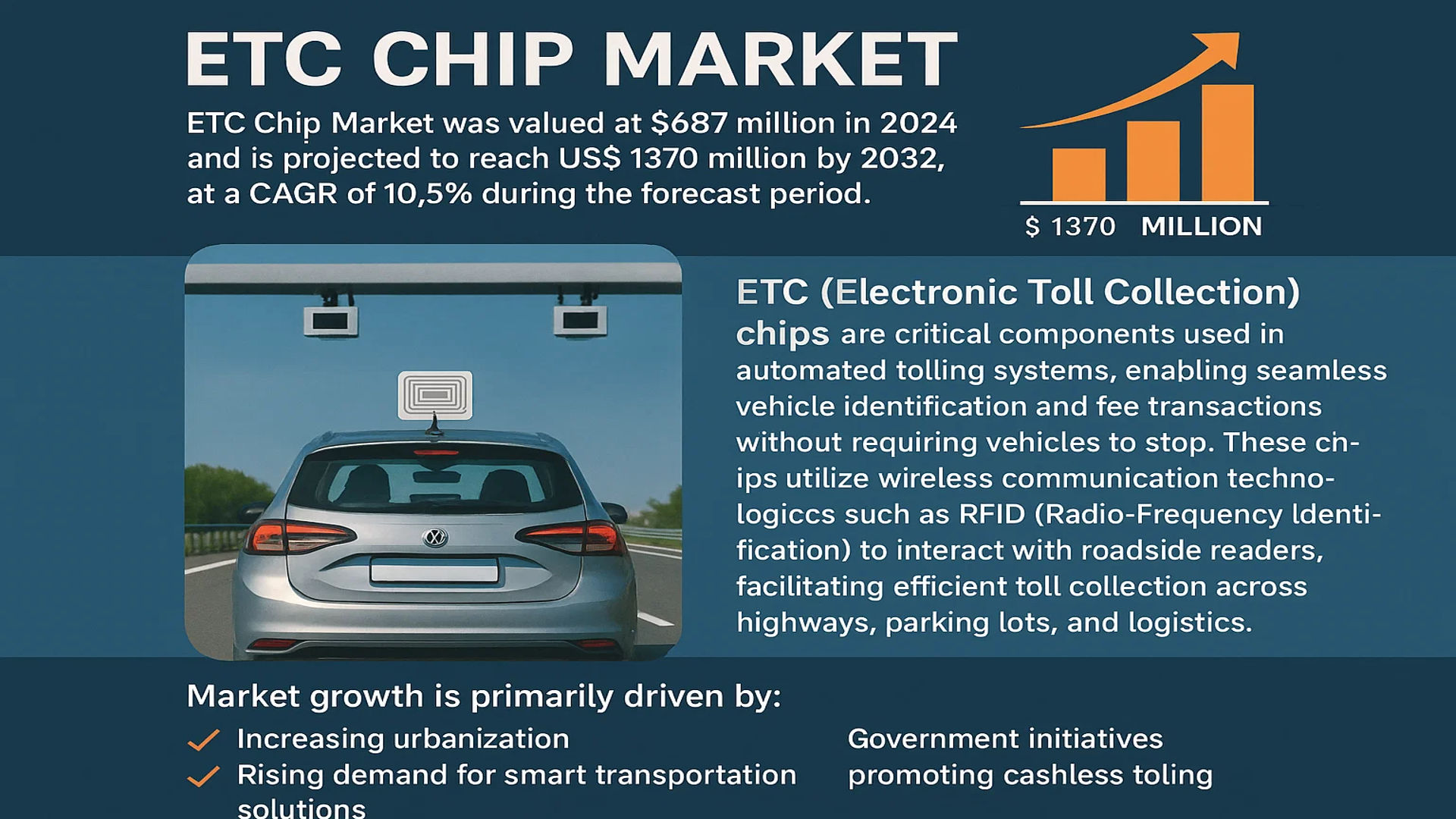
The global ETC Chip Market was valued at 687 million in 2024 and is projected to reach US$ 1370 million by 2032, at a CAGR of 10.5% during the forecast period.
ETC (Electronic Toll Collection) chips are critical components used in automated tolling systems, enabling seamless vehicle identification and fee transactions without requiring vehicles to stop. These chips utilize wireless communication technologies such as RFID (Radio-Frequency Identification) to interact with roadside readers, facilitating efficient toll collection across highways, parking lots, and logistics applications.
Market growth is primarily driven by increasing urbanization, rising demand for smart transportation solutions, and government initiatives promoting cashless tolling. However, challenges such as high initial infrastructure costs and interoperability issues between regional systems persist. Key players like NXP Semiconductors, Broadcom, and Texas Instruments dominate the market, leveraging their expertise in semiconductor technologies to enhance ETC chip performance and reliability.
MARKET DYNAMICS
MARKET DRIVERS
Government-Led Smart Transportation Initiatives Accelerate ETC Chip Adoption
National infrastructure modernization programs across major economies are significantly driving the adoption of Electronic Toll Collection (ETC) systems. The global push for intelligent transportation solutions to reduce congestion and emissions has led to substantial investments in ETC infrastructure. With over 45 countries implementing nationwide ETC programs, the demand for high-performance ETC chips continues to grow. These chips enable seamless toll transactions while supporting advanced capabilities such as vehicle classification and real-time traffic monitoring. In 2024 alone, transportation authorities allocated more than $8 billion globally for smart highway projects, with ETC systems forming the backbone of these initiatives.
Rising Vehicle Electrification and Connectivity Fuels Demand
The automotive industry’s rapid shift toward connected and electric vehicles presents significant growth opportunities for ETC chips. Modern vehicles increasingly incorporate integrated telematics systems that require advanced RFID solutions for automated payments. With EV adoption projected to grow at 29% CAGR through 2030, manufacturers are equipping vehicles with embedded ETC capabilities during production. This trend is particularly strong in China and Europe, where over 60% of new vehicles now ship with factory-installed ETC modules. The convergence of vehicle-to-infrastructure (V2I) communication technologies with ETC systems is creating a robust ecosystem for next-generation toll collection solutions.
Operational Efficiency Benefits Drive Commercial Fleet Adoption
Commercial logistics operators are increasingly adopting ETC systems to optimize route planning and reduce operational costs. Major shipping companies report 12-18% reductions in toll-related delays and administration costs after implementing fleet-wide ETC solutions. The ability to integrate toll data with fleet management systems provides unprecedented visibility into transportation expenses. This has led to over 85% of Fortune 500 transportation companies mandating ETC tags across their vehicle fleets. As supply chains become more digitized, the demand for ETC chips with advanced data capabilities continues to surge.
MARKET CHALLENGES
Interoperability Issues Between Regional Systems Create Implementation Hurdles
Despite the growing adoption of ETC systems, the lack of standardization across regions presents significant challenges. Different countries and even states within federal systems often implement incompatible ETC protocols, requiring multi-standard chips that increase complexity and cost. This fragmentation forces manufacturers to produce region-specific variants, driving up R&D expenses while limiting economies of scale. Transportation analysts estimate that interoperability issues add 15-20% to total system implementation costs, creating resistance among some potential adopters.
Security Vulnerabilities in Older ETC Infrastructure
The rapid evolution of ETC technology has exposed vulnerabilities in legacy systems still using first-generation chips. Cybersecurity incidents involving toll collection systems increased by 230% between 2020-2024, with most attacks targeting outdated RFID implementations. Modernization efforts often require complete hardware replacements, creating temporary market disruptions during transition periods.
MARKET RESTRAINTS
High Initial Infrastructure Costs Limit Emerging Market Adoption
The capital-intensive nature of ETC system deployment remains a significant barrier in developing economies. A complete national ETC implementation requires $50-100 million in upfront infrastructure investment, creating budgetary challenges for many transportation authorities. While the long-term benefits are well-documented, the high initial costs lead to extended evaluation and procurement cycles. This has resulted in slower adoption rates across Southeast Asia and Africa, where only 30% of countries have implemented comprehensive ETC programs compared to 80% in developed markets.
Consumer Resistance in Cash-Preferring Markets
Cultural preferences for cash transactions continue to hinder ETC adoption in certain regions. Despite demonstrated convenience benefits, consumer surveys indicate that 35% of drivers in Southern Europe and 45% in South America express reluctance to transition from manual toll payments. This resistance slows the return on investment for infrastructure projects, creating disincentives for private sector participation in some markets.
MARKET OPPORTUNITIES
Integration with Smart City Ecosystems Creates New Revenue Streams
The expansion of smart city initiatives worldwide presents transformative opportunities for ETC chip manufacturers. Modern ETC systems are evolving into multi-functional platforms capable of supporting parking payment, congestion charging, and even electric vehicle charging transactions. This convergence creates demand for chips with enhanced processing power and memory capacity. Pilot programs in Shanghai and Singapore have demonstrated the potential for a single device to handle 8-10 different urban mobility services, significantly improving user convenience while reducing administrative overhead.
Advancements in Battery-Free RFID Technology
The development of energy-harvesting ETC chips eliminates maintenance requirements while extending operational lifespans. These innovations are particularly valuable for commercial fleets that operate across extreme climate conditions. Early adopters report 60% reductions in tag replacement costs and 40% improvements in read reliability compared to traditional battery-powered solutions.
ETC CHIP MARKET TRENDS
Expansion of Smart Tolling Infrastructure Driving Global ETC Chip Demand
The rapid adoption of electronic toll collection (ETC) systems across highways and urban road networks is accelerating the demand for ETC chips. Governments worldwide are investing heavily in smart transportation infrastructure to reduce congestion and enhance efficiency. In 2024, the global ETC chip market was valued at $687 million, with projections indicating growth to $1.37 billion by 2032, reflecting a CAGR of 10.5%. The trend is particularly strong in North America and Asia-Pacific, where regulatory mandates and increasing vehicle density are prompting toll operators to shift from manual to automated systems.
Other Trends
Automotive Sector Adopting RFID-Based Solutions
The automotive industry’s integration of Radio Frequency Identification (RFID) technology is a major catalyst for ETC chip market growth. Passive RFID chips, projected to reach multi-million dollar valuation by 2032, are increasingly embedded in vehicle tags due to their cost-effectiveness and reliability. Emerging markets like India and China are witnessing double-digit adoption rates as toll authorities modernize infrastructure to handle rising traffic volumes. Fleet management companies are also leveraging active RFID solutions for real-time tracking, further expanding application potential beyond traditional toll collection.
Technological Advancements in Chip Design
Leading semiconductor manufacturers are investing heavily in next-generation ETC chip development to enhance performance metrics. Innovations include low-power consumption designs and extended communication range capabilities, with some chips now operating effectively at speeds exceeding 200 km/h. Market leaders like NXP Semiconductors and Infineon have recently launched chipsets supporting 5.9 GHz DSRC and C-V2X protocols, enabling seamless integration with smart city ecosystems. These advancements address critical pain points such as signal interference and data security, which previously limited adoption rates in complex urban environments.
COMPETITIVE LANDSCAPE
Key Industry Players
Semiconductor Giants and Emerging Players Compete in the Rapidly Growing ETC Chip Market
The global ETC chip market features a dynamic competitive landscape where established semiconductor leaders compete with specialized regional players. NXP Semiconductors and Texas Instruments dominate the market through their extensive portfolios of RFID and wireless communication solutions. These companies leverage their expertise in automotive electronics and IoT technologies to develop advanced ETC chips that enable seamless toll collection.
Broadcom and Qorvo have emerged as significant players, capitalizing on their RF and mixed-signal semiconductor capabilities. Their involvement in the ETC market stems from the growing demand for reliable communication chips in intelligent transportation systems. Both companies continue to invest in research and development to enhance chip performance and security features.
The Asia-Pacific region has seen rapid growth with local manufacturers like Fudan Microelectronics Group and Beken Corporation capturing substantial market share. These companies benefit from government initiatives promoting electronic toll collection across China’s extensive highway network. Their cost-competitive solutions have enabled widespread ETC adoption in emerging markets.
While the market remains concentrated among a few key players, competition is intensifying as companies expand their geographic presence and product offerings. Strategic partnerships with toll system integrators and ongoing technological innovations will likely shape the competitive dynamics in coming years.
List of Key ETC Chip Manufacturers
- Broadcom Inc. (U.S.)
- Qorvo, Inc. (U.S.)
- NXP Semiconductors (Netherlands)
- TDK Corporation (Japan)
- Infineon Technologies (Germany)
- Texas Instruments (U.S.)
- STMicroelectronics (Switzerland)
- Beken Corporation (China)
- Skyrelay (China)
- Fudan Microelectronics Group (China)
- China Electronics Huada Technology (China)
- Smartlink Microchip (China)
Segment Analysis:
By Type
Passive RFID Chip Segment Leads Due to Cost-Effectiveness and Widespread Adoption in Toll Collection
The market is segmented based on type into:
- Passive RFID chip
- Active RFID chip
By Application
Automotive Segment Dominates Due to Increased Vehicle Penetration and Government Mandates
The market is segmented based on application into:
- Automotive
- Road
- Parking Lot
- Logistics
- Others
By Communication Technology
DSRC Technology Holds Major Share Due to Infrastructure Compatibility
The market is segmented based on communication technology into:
- DSRC (Dedicated Short Range Communication)
- RFID (Radio Frequency Identification)
- NFC (Near Field Communication)
By Region
Asia Pacific Emerges as Fastest Growing Market Due to Rapid Infrastructure Development
The market is segmented based on region into:
- North America
- Europe
- Asia Pacific
- Latin America
- Middle East & Africa
Regional Analysis: ETC Chip Market
Asia-Pacific
The Asia-Pacific region dominates the global ETC Chip market, accounting for the largest revenue share. This leadership position is primarily driven by China’s expansive highway network and nationwide ETC adoption policies. Major economies like Japan, South Korea, and India are also contributing significantly through smart city initiatives and intelligent transportation system deployments. China’s Ministry of Transport reported over 250 million ETC users by 2023, creating massive demand for chips. Local manufacturers such as Fudan Microelectronics Group and Smartlink Microchip benefit from government support and domestic procurement policies. However, price competition remains intense due to the proliferation of local players.
North America
North America represents a technologically advanced market where ETC chip innovation thrives, led by U.S.-based semiconductor giants like Broadcom and Texas Instruments. The region’s mature toll infrastructure and high vehicle penetration create steady demand, though growth is more moderate compared to Asia. Recent infrastructure bills have allocated funds for smart transportation upgrades, spurring interest in next-generation ETC solutions with enhanced security and interoperability features. The U.S. Department of Transportation’s focus on reducing highway congestion through technologies like dedicated short-range communications (DSRC) presents new opportunities for ETC chip developers.
Europe
European countries are actively modernizing their transportation networks with unified ETC standards, creating opportunities for chip manufacturers. The EU’s commitment to cross-border interoperability requirements drives demand for multi-protocol chips compliant with various national systems. Stricter data privacy regulations under GDPR have compelled chipmakers to enhance security features, increasing the value proposition of European products. Leading companies like NXP Semiconductors and STMicroelectronics benefit from these requirements, though implementation timelines vary across member states. The Nordic countries and Germany are at the forefront of adoption, while Southern and Eastern Europe show strong growth potential.
Middle East & Africa
This emerging market is witnessing growing ETC deployments, particularly in Gulf Cooperation Council (GCC) countries where governments are investing heavily in smart highway infrastructure. Countries like Saudi Arabia and UAE are implementing large-scale toll systems, with projects like Dubai’s Salik system driving demand. However, the relatively small vehicle population and infrastructure challenges in African nations limit market size. Chip suppliers face unique challenges including extreme climatic conditions requiring specialized durability, while also benefiting from government willingness to adopt the latest technologies without legacy system constraints.
South America
South America’s ETC chip market is developing unevenly, with Brazil accounting for most regional demand through its established toll collection networks. Economic fluctuations and infrastructure funding challenges have slowed broader adoption across the continent. Countries with more stable economies like Chile and Colombia are making progress with their ETC implementations, creating pockets of opportunity. Local manufacturers are rare, leaving the market dominated by global players who must navigate complex import regulations and sometimes unpredictable business environments.
Report Scope
This market research report provides a comprehensive analysis of the global ETC Chip market, covering the forecast period 2024–2032. It offers detailed insights into market dynamics, technological advancements, competitive landscape, and key trends shaping the industry.
Key focus areas of the report include:
- Market Size & Forecast: Historical data and future projections for revenue, unit shipments, and market value across major regions and segments. The global ETC Chip market was valued at USD 687 million in 2024 and is projected to reach USD 1,370 million by 2032, growing at a CAGR of 10.5%.
- Segmentation Analysis: Detailed breakdown by product type (Passive RFID chip, Active RFID chip) and application (Automotive, Road, Parking Lot, Logistics, Others) to identify high-growth segments.
- Regional Outlook: Insights into market performance across North America, Europe, Asia-Pacific, Latin America, and Middle East & Africa, with the U.S. and China as key markets.
- Competitive Landscape: Profiles of leading players including Broadcom, Qorvo, NXP Semiconductors, TDK, Infineon, Texas Instruments, STMicroelectronics, and others, with their market share and strategies.
- Technology Trends & Innovation: Assessment of wireless communication advancements, RFID technology integration, and emerging standards in electronic toll collection systems.
- Market Drivers & Restraints: Evaluation of factors such as smart city initiatives, infrastructure development, and regulatory frameworks impacting market growth.
- Stakeholder Analysis: Strategic insights for semiconductor manufacturers, toll system providers, government agencies, and investors.
The research methodology combines primary interviews with industry experts and analysis of verified market data to ensure accuracy and reliability.
FREQUENTLY ASKED QUESTIONS:
What is the current market size of Global ETC Chip Market?
-> ETC Chip Market was valued at 687 million in 2024 and is projected to reach US$ 1370 million by 2032, at a CAGR of 10.5% during the forecast period.
Which key companies operate in Global ETC Chip Market?
-> Key players include Broadcom, Qorvo, NXP Semiconductors, TDK, Infineon, Texas Instruments, STMicroelectronics, Beken Corporation, and Fudan Microelectronics Group.
What are the key growth drivers?
-> Growth is driven by increasing adoption of electronic toll collection systems, government mandates for smart transportation, and rising vehicle parc in developing economies.
Which region dominates the market?
-> Asia-Pacific leads in market growth due to massive infrastructure projects, while North America maintains technological leadership.
What are the emerging trends?
-> Emerging trends include integration with connected vehicle technologies, development of multi-protocol chips, and adoption of 5.8 GHz DSRC standards.

Get Sample Report PDF for Exclusive Insights
Report Sample Includes
- Table of Contents
- List of Tables & Figures
- Charts, Research Methodology, and more...
 Download Sample Report PDF