Epoxy Resin NTC Temperature Sensor Market Insights
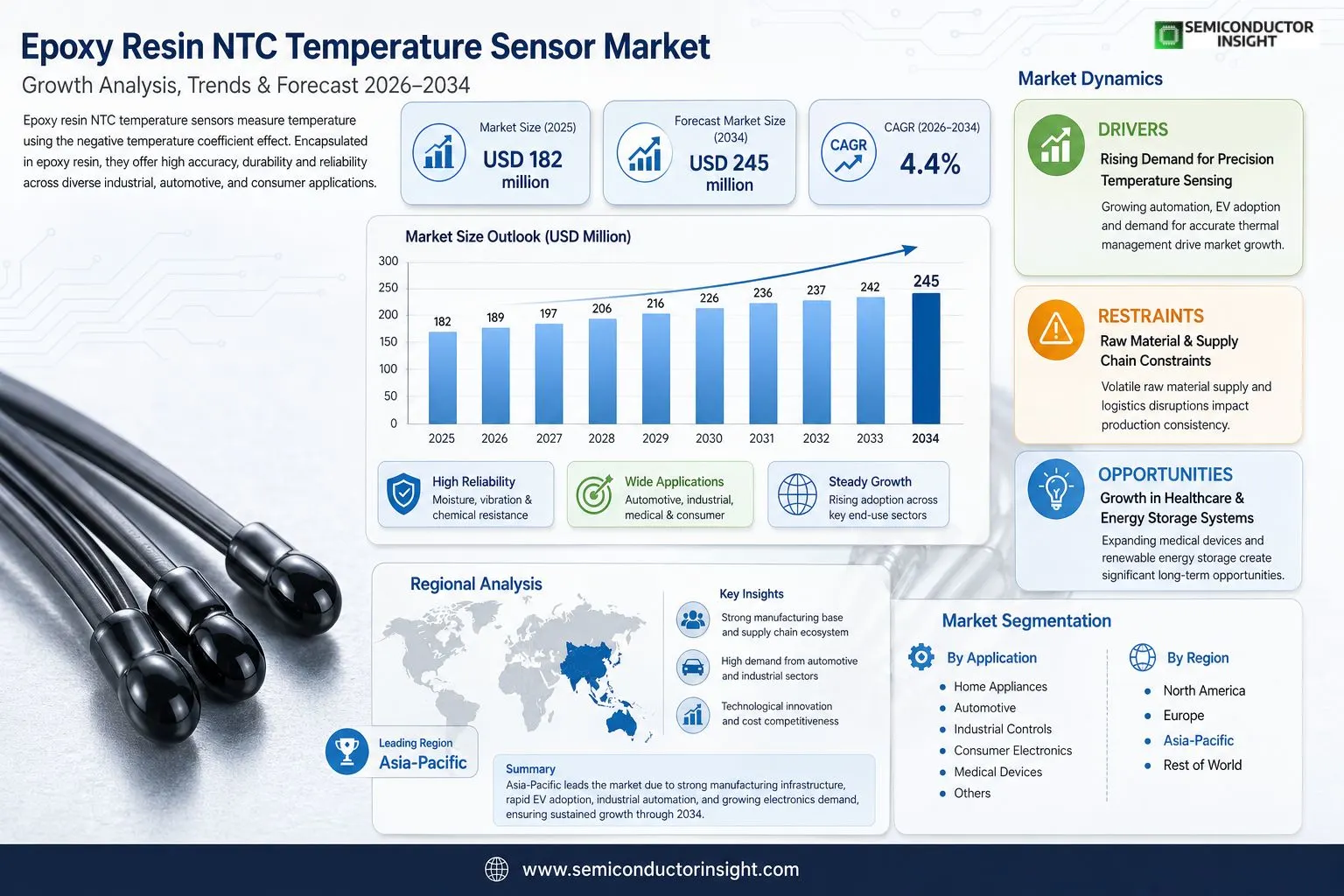
Global Epoxy Resin NTC Temperature Sensor market size was valued at USD 182 million in 2025. The market is projected to grow from USD 189 million in 2026 to USD 245 million by 2034, exhibiting a CAGR of 4.4% during the forecast period.
Epoxy resin NTC temperature sensors are precision sensing devices built on the negative temperature coefficient (NTC) effect, wherein the electrical resistance of the sensing element decreases as temperature rises. This characteristic makes them particularly well-suited for applications demanding accurate, real-time temperature measurement and control. Epoxy resin serves as the primary encapsulation material for the NTC thermistor element, providing robust protection against moisture, mechanical stress, and chemical exposure, thereby significantly enhancing the sensor’s long-term reliability and environmental resilience. The product range encompasses Cylindrical Encapsulated NTC Temperature Sensors, Chip Package NTC Temperature Sensors, and Glass Encapsulated NTC Temperature Sensors, catering to a broad spectrum of end-use requirements.
The market is witnessing steady growth driven by rising demand across home appliances, automotive systems, industrial controls, consumer electronics, and medical devices. The expanding adoption of electric vehicles and the growing emphasis on energy-efficient building automation systems are further reinforcing demand. Key global manufacturers operating in this space include Ametherm, Eaton, Amphenol-sensors, TE Connectivity, Littelfuse, Molex, EI Sensor Technologies, Guilcor Sensors, Jingpu Sensor, and Minchuang Electronics, among others.
MARKET DRIVERS
Rising Demand for Precision Temperature Sensing Across Industrial and Consumer Electronics Sectors
Global epoxy resin NTC temperature sensor market is experiencing robust growth, driven primarily by the accelerating adoption of precise thermal management solutions across industrial automation, consumer electronics, and automotive applications. NTC (Negative Temperature Coefficient) thermistors encapsulated in epoxy resin offer superior moisture resistance, mechanical durability, and electrical insulation, making them highly suitable for demanding operating environments. As manufacturing processes become increasingly automated and smart factory deployments expand worldwide, the need for reliable, compact, and cost-effective temperature sensing components continues to intensify. Industries such as HVAC, medical devices, and battery management systems are particularly active end-users driving consistent demand growth in this segment.
Expansion of Electric Vehicle Infrastructure Boosting NTC Sensor Integration
The rapid global transition toward electric vehicles (EVs) represents one of the most significant growth catalysts for Epoxy resin NTC Temperature Sensor Market. Battery thermal management systems (BMS) in EVs rely heavily on NTC thermistors to monitor cell temperatures, prevent thermal runaway, and optimize charging efficiency. Epoxy resin encapsulation enhances the sensor’s ability to withstand vibration, humidity, and chemical exposure commonly encountered within automotive environments. As EV production scales across North America, Europe, and Asia-Pacific, original equipment manufacturers are actively sourcing high-reliability epoxy-encapsulated NTC sensors in increasing volumes, providing a durable and expanding demand base for market participants.
➤ The proliferation of IoT-connected devices and smart home systems is further amplifying demand for miniaturized, high-accuracy epoxy resin NTC temperature sensors capable of real-time environmental monitoring and energy optimization.
Beyond automotive and industrial applications, the consumer electronics and smart home segments are contributing meaningfully to market expansion. Devices including smart thermostats, wearable health monitors, and energy management systems increasingly integrate epoxy resin NTC temperature sensors for continuous, accurate thermal feedback. The compact form factor and cost-efficiency of these sensors align well with the design constraints of modern IoT hardware, enabling manufacturers to embed thermal monitoring without significant bill-of-materials impact. This broad applicability across multiple verticals strengthens the long-term growth trajectory of the market.
MARKET CHALLENGES
Supply Chain Volatility and Raw Material Availability Constraining Consistent Production Output
One of the most pressing challenges facing Epoxy resin NTC Temperature Sensor Market is the intermittent volatility in the supply of key raw materials, including specialized epoxy resin compounds and metal oxide semiconductor materials used in thermistor manufacturing. Global supply chain disruptions, logistics bottlenecks, and geopolitical uncertainties have periodically affected the availability and pricing of these inputs, creating production planning difficulties for sensor manufacturers. Companies with limited supplier diversification are particularly exposed to procurement risks, which can result in delivery delays and margin compression, ultimately affecting their ability to meet growing customer demand in a timely manner.
Other Challenges
Intense Price Competition from Low-Cost Regional Manufacturers
The market for epoxy resin NTC temperature sensors faces considerable pricing pressure, particularly from manufacturers based in cost-competitive regions of Asia. While these producers have expanded global supply, they have also intensified competition on price, making it challenging for established players to maintain premium positioning without demonstrating clear differentiation in accuracy, reliability, or application-specific customization. This dynamic can compress average selling prices over time, particularly in commoditized application segments.
Technical Limitations in Extreme High-Temperature Environments
Despite their versatility, epoxy resin encapsulated NTC sensors face performance limitations in applications requiring sustained operation at temperatures beyond their rated thresholds. Certain industrial and aerospace applications demand sensing solutions capable of withstanding extreme thermal conditions where alternative encapsulation materials such as glass or ceramic may be preferred. This technical boundary restricts the addressable market for epoxy resin NTC sensors in select high-performance segments, necessitating ongoing materials research and product development investment from manufacturers seeking to broaden their application coverage.
MARKET RESTRAINTS
Regulatory Compliance Requirements and Certification Costs Limiting Market Entry for Smaller Manufacturers
A notable restraint on Epoxy resin NTC Temperature Sensor Market is the increasingly stringent regulatory and certification landscape governing temperature sensing components, particularly in safety-critical applications such as medical devices, automotive systems, and industrial control equipment. Compliance with international standards including ISO, IEC, and AEC-Q200 automotive qualification requirements demands significant investment in testing infrastructure, documentation, and quality management systems. For smaller manufacturers and new entrants, these compliance costs can be prohibitive, effectively limiting competitive participation and concentrating market share among established players with existing regulatory frameworks and certifications in place.
Competition from Alternative Temperature Sensing Technologies Moderating Adoption Rates
Epoxy resin NTC Temperature Sensor Market also contends with competition from alternative thermal sensing technologies, including resistance temperature detectors (RTDs), thermocouples, and digital temperature sensor integrated circuits. In applications where higher accuracy, broader temperature ranges, or digital communication interfaces are prioritized, these alternatives may be preferred over conventional NTC thermistors. The growing availability of low-cost digital temperature sensors with integrated signal conditioning is particularly relevant in consumer electronics and IoT applications, where ease of system integration can outweigh the cost advantages traditionally associated with epoxy resin NTC sensors. This technological competition moderates the rate of market expansion in certain application segments.
MARKET OPPORTUNITIES
Growing Medical Device and Healthcare Monitoring Sector Creating Substantial New Demand Avenues
The expanding global healthcare industry presents a compelling opportunity for Epoxy resin NTC Temperature Sensor Market. Wearable patient monitoring devices, infusion pumps, incubators, and diagnostic equipment all depend on accurate, reliable temperature sensing components. Epoxy resin encapsulation provides the biocompatibility, electrical safety, and mechanical robustness required in medical-grade applications. As healthcare systems worldwide invest in remote patient monitoring infrastructure and connected medical devices, the demand for miniaturized, high-precision NTC sensors with durable encapsulation is expected to grow meaningfully, opening new revenue streams for manufacturers positioned to meet stringent medical-grade quality requirements.
Renewable Energy and Energy Storage System Deployments Unlocking Long-Term Market Potential
Global acceleration of renewable energy adoption, particularly solar photovoltaic installations and grid-scale battery energy storage systems (BESS), represents a significant long-term growth opportunity for Epoxy resin NTC Temperature Sensor Market. Both solar inverters and large-format lithium-ion battery arrays require continuous thermal monitoring to ensure operational safety, efficiency, and longevity. Epoxy resin NTC sensors are well-suited to these applications due to their cost-effectiveness, moisture resistance, and reliable performance across the temperature ranges typical of energy storage environments. As governments and private sector entities escalate investment in clean energy infrastructure, demand for robust thermal sensing components embedded within energy systems is projected to increase substantially, benefiting manufacturers with proven product portfolios in this space.
Trends
Rising Demand for Reliable Temperature Sensing Solutions Across End-Use Industries
Epoxy resin NTC Temperature Sensor Market is experiencing steady growth driven by expanding applications across home appliances, automotive systems, industrial controls, consumer electronics, and medical devices. Epoxy resin NTC temperature sensors, which operate on the negative temperature coefficient principle , where resistance decreases as temperature rises , are increasingly preferred for their durability and environmental resilience. The use of epoxy resin as an encapsulation material significantly enhances thermistor reliability by protecting sensitive components from moisture, vibration, and chemical exposure, making these sensors well-suited for demanding operating environments.
Other Trends
Growing Adoption in Automotive and Industrial Applications
The automotive sector represents one of the most dynamic demand drivers for Epoxy resin NTC Temperature Sensor Market. Modern vehicles increasingly incorporate temperature monitoring systems for battery thermal management, HVAC regulation, and powertrain diagnostics. Electric vehicles, in particular, require precise and robust thermal sensing to ensure battery safety and performance, further accelerating the uptake of encapsulated NTC thermistors. Simultaneously, industrial control systems are adopting these sensors for process automation and equipment protection, where consistent temperature measurement under harsh conditions is critical.
Expansion in Medical Devices and Consumer Electronics
The medical devices segment is emerging as a high-growth application area within Epoxy resin NTC Temperature Sensor Market. Patient monitoring equipment, diagnostic instruments, and wearable health devices rely on accurate and stable temperature sensing components. Epoxy-encapsulated NTC sensors meet stringent reliability requirements in clinical environments. Concurrently, consumer electronics manufacturers are integrating compact NTC thermistors into smartphones, laptops, and smart home devices to enable thermal protection features, contributing to a broadening application base for this market.
Competitive Landscape and Regional Developments Shaping Market Direction
Epoxy resin NTC Temperature Sensor Market features a competitive landscape with established global players such as Ametherm, Eaton, Amphenol-sensors, TE Connectivity, Littelfuse, Molex, EI Sensor Technologies, Guilcor Sensors, Jingpu Sensor, and Minchuang Electronics actively driving product innovation and expanding their market presence. Asia, particularly China, plays a significant role in both production and consumption, supported by a robust electronics manufacturing base. North America and Europe continue to represent mature but steady demand regions, with growth supported by advancements in industrial automation, electric mobility, and healthcare technology. The cylindrical encapsulated NTC temperature sensors segment remains a key product category, reflecting ongoing preference for mechanically robust sensing configurations across diverse industries.
COMPETITIVE LANDSCAPE
Key Industry Players
Epoxy Resin NTC Temperature Sensor Market , Competitive Dynamics and Leading Manufacturer Profiles
Global Epoxy Resin NTC Temperature Sensor market, valued at approximately US$ 182 million in 2025 and projected to reach US$ 245 million by 2034 at a CAGR of 4.4%, is characterized by a moderately consolidated competitive landscape. A handful of established multinational corporations command a significant share of global revenues, leveraging their advanced manufacturing capabilities, broad distribution networks, and deep application expertise across sectors such as automotive, medical devices, industrial controls, home appliances, and consumer electronics. Leading players such as TE Connectivity, Eaton, Amphenol Sensors, Littelfuse, and Molex have solidified their market positions through continuous investment in R&D, strategic acquisitions, and vertically integrated supply chains. These companies benefit from economies of scale, enabling them to serve high-volume OEM customers across North America, Europe, and Asia with consistent product quality and reliability. The top five global players collectively held a notable share of total market revenue in 2025, underscoring the competitive weight carried by these incumbents in shaping pricing trends and technology standards for epoxy-encapsulated NTC thermistor solutions.
Beyond the dominant multinationals, Epoxy resin NTC Temperature Sensor Market also features a growing cohort of specialized and regional manufacturers that cater to niche application requirements and cost-sensitive end markets. Companies such as Ametherm, EI Sensor Technologies, and Guilcor Sensors have carved out strong positions by offering application-specific sensor configurations, including cylindrical encapsulated, chip package, and glass encapsulated NTC variants tailored to precise thermal management needs. Meanwhile, Asia-based manufacturers such as Jingpu Sensor and Minchuang Electronics are increasingly gaining global traction, supported by competitive pricing, expanding production capacities, and growing domestic demand from China’s robust electronics and automotive manufacturing sectors. As the market continues to evolve, competitive differentiation is being driven by factors including encapsulation material innovation, miniaturization, improved response times, enhanced environmental resistance, and the ability to meet stringent regulatory standards across medical and industrial verticals.
List of Key Epoxy Resin NTC Temperature Sensor Companies Profiled
- Ametherm
- Eaton
- Amphenol Sensors
- TE Connectivity
- Littelfuse
- Molex
- EI Sensor Technologies
- Guilcor Sensors
- Jingpu Sensor
- Minchuang Electronics
Segment Analysis:
| Segment Category | Sub-Segments | Key Insights |
| By Type |
|
Cylindrical Encapsulated NTC Temperature Sensors represent the leading segment within the product type classification, owing to their robust structural design and superior environmental resistance conferred by the epoxy resin encapsulation.
|
| By Application |
|
Automotive stands as a dominant and rapidly evolving application segment for epoxy resin NTC temperature sensors, driven by the accelerating global transition toward electric vehicles and hybrid powertrains that demand precise thermal management solutions.
|
| By End User |
|
OEMs (Original Equipment Manufacturers) constitute the primary end-user base for epoxy resin NTC temperature sensors, as large-scale manufacturers across automotive, home appliance, and electronics sectors integrate these sensors directly into their production lines at the design and engineering stage.
|
| By Encapsulation Material |
|
High-Temperature Epoxy Resin encapsulation is emerging as the leading material choice, particularly for sensors deployed in automotive under-hood environments and industrial process control systems where sustained exposure to elevated thermal conditions is a routine operational requirement.
|
| By Sales Channel |
|
Direct Sales channels dominate Epoxy resin NTC Temperature Sensor Market, particularly for large-volume transactions between established manufacturers such as Ametherm, TE Connectivity, Amphenol-sensors, and Littelfuse and their key OEM customers across automotive and industrial sectors.
|
Regional Analysis: Epoxy Resin NTC Temperature Sensor Market
Asia-Pacific
Asia-Pacific hosts an extensive and deeply integrated supply chain for epoxy resin materials and NTC thermistor components. China’s manufacturing corridors, Japan’s precision engineering legacy, and South Korea’s advanced materials sector collectively ensure a steady, high-volume output of Epoxy Resin NTC Temperature Sensors. This ecosystem allows regional producers to respond swiftly to evolving customer specifications while sustaining cost efficiencies unmatched in other parts of the world.
The accelerating shift toward electric mobility across China, Japan, and South Korea has created substantial demand for Epoxy Resin NTC Temperature Sensors in battery management systems, motor controllers, and thermal protection circuits. Automakers and Tier-1 suppliers operating in Asia-Pacific are prioritizing compact, highly accurate temperature sensing solutions, reinforcing the region’s dominant market position and stimulating continued product innovation from regional sensor manufacturers.
Government-led Industry 4.0 adoption programs across China, India, and Southeast Asia are fueling demand for precision temperature monitoring in automated manufacturing environments. Epoxy Resin NTC Temperature Sensors are increasingly integrated into programmable logic controllers, robotics, and energy management systems, reflecting the region’s commitment to intelligent, data-driven industrial operations. This trend is expected to sustain long-term market expansion across multiple verticals throughout the forecast period.
Leading sensor manufacturers and academic institutions across Asia-Pacific are channeling significant resources into advancing epoxy encapsulation technologies, miniaturization, and enhanced thermal response characteristics. This innovation momentum supports the development of next-generation NTC temperature sensors capable of withstanding increasingly demanding environmental and operational conditions, ensuring the region continues to set global benchmarks for product performance and reliability in Epoxy resin NTC Temperature Sensor Market.
North America
North America represents a mature yet steadily evolving market for Epoxy Resin NTC Temperature Sensors, underpinned by strong demand from the automotive, aerospace, medical device, and industrial automation sectors. The United States leads regional consumption, with a pronounced emphasis on high-precision, application-specific sensor solutions that meet stringent quality and compliance standards. The region’s well-developed EV infrastructure, particularly the growing network of battery electric vehicle platforms championed by domestic automakers, is driving consistent adoption of epoxy-encapsulated NTC thermistors for thermal management applications. Additionally, the expansion of smart building technologies and advanced HVAC systems across commercial and residential segments is creating new demand avenues. North America’s focus on reshoring critical electronics manufacturing, coupled with strong federal support for domestic semiconductor and sensor production, is expected to gradually reduce import dependency and bolster regional manufacturing capacity for Epoxy Resin NTC Temperature Sensor products through the 2026–2034 period.
Europe
Europe occupies a significant position in Global Epoxy Resin NTC Temperature Sensor Market, driven by the region’s stringent regulatory environment, strong automotive heritage, and advancing energy transition agenda. Germany, France, and the Nordic countries are among the key contributors to regional demand, with automotive OEMs and industrial equipment manufacturers representing core end-user segments. Europe’s ambitious carbon neutrality targets are accelerating the electrification of transportation and industrial processes, directly increasing the need for reliable, compact, and durable temperature sensing components such as epoxy resin NTC thermistors. The region also demonstrates elevated demand in medical electronics and precision instrumentation, where sensor accuracy and long-term stability are non-negotiable. European manufacturers are increasingly investing in sustainable epoxy formulations and eco-compliant production processes, aligning product development with evolving environmental regulations and positioning the region as a leader in green sensor technology innovation.
South America
South America presents a developing but increasingly promising landscape for Epoxy resin NTC Temperature Sensor Market, with Brazil and Argentina serving as the primary demand centers. The region’s gradual industrialization, expanding automotive assembly sector, and growing adoption of consumer electronics are collectively fostering demand for temperature sensing solutions. While South America currently lags behind more mature markets in terms of local manufacturing capability for epoxy resin NTC sensors, rising foreign direct investment in electronics and automotive production facilities is beginning to reshape the regional supply landscape. Infrastructure modernization programs and increasing penetration of smart appliances in urban markets are also contributing to steady demand growth. Over the 2026–2034 forecast horizon, South America is anticipated to emerge as a moderately growing market, supported by improving economic conditions and greater emphasis on industrial efficiency and energy management across key economies in the region.
Middle East & Africa
The Middle East & Africa region represents an emerging frontier for Epoxy resin NTC Temperature Sensor Market, characterized by nascent but gradually strengthening industrial and infrastructure development. Gulf Cooperation Council (GCC) nations, particularly the UAE and Saudi Arabia, are at the forefront of regional adoption, driven by large-scale smart city initiatives, oil and gas sector modernization, and expanding HVAC system deployments in extreme climatic conditions where precise temperature monitoring is operationally critical. Africa’s market, while still at an early stage, is witnessing incremental growth tied to rising demand for consumer electronics and telecommunications infrastructure. The region’s increasing participation in global manufacturing value chains and growing awareness of industrial automation benefits are expected to support long-term market development. Although the Middle East & Africa currently accounts for a modest share of global Epoxy Resin NTC Temperature Sensor Market revenues, its trajectory through the forecast period points toward gradual, sustained expansion as investment in technology infrastructure continues to intensify.
Report Scope
This market research report provides a comprehensive analysis of Epoxy resin NTC Temperature Sensor Market, covering the forecast period 2026–2034. It offers detailed insights into market dynamics, technological advancements, competitive landscape, and key trends shaping the industry.
Key focus areas of the report include:
-
Market Overview: The report begins with an overview outlining its current market scenario, key growth indicators, and industry transformation drivers. It discusses macroeconomic factors, demand–supply balance, regulatory landscape, and the strategic role of epoxy resin NTC temperature sensors in powering advancements across industries such as automotive, home appliances, consumer electronics, medical devices, and industrial automation.
- Market Size & Forecast: Historical data and future projections for revenue, unit shipments, and market value across major regions and segments.
- Segmentation Analysis: Detailed breakdown by product type, technology, application, and end-user industry to identify high-growth segments and investment opportunities.
- Regional Insights: Insights into market performance across North America, Europe, Asia-Pacific, Latin America, and the Middle East & Africa, including country-level analysis where relevant.
- Competitive Landscape: Profiles of leading market participants, including their product offerings, R&D focus, manufacturing capacity, pricing strategies, and recent developments such as mergers, acquisitions, and partnerships.
- Technology Trends & Innovation: Assessment of emerging technologies, integration of AI/IoT, sensor design trends, encapsulation techniques, and evolving industry standards.
- Market Drivers & Restraints: Evaluation of factors driving market growth along with challenges, supply chain constraints, regulatory issues, and market-entry barriers.
- Stakeholder Insights: Insights for component suppliers, OEMs, system integrators, investors, and policymakers regarding the evolving ecosystem and strategic opportunities.
Primary and secondary research methods are employed, including interviews with industry experts, data from verified sources, and real-time market intelligence to ensure the accuracy and reliability of the insights presented.
FREQUENTLY ASKED QUESTIONS:
What is the current market size of Epoxy Resin NTC Temperature Sensor Market?
-> Global Epoxy Resin NTC Temperature Sensor Market was valued at USD 182 million in 2025 and is expected to reach USD 245 million by 2034, growing at a CAGR of 4.4% during the forecast period.
Which key companies operate in Epoxy Resin NTC Temperature Sensor Market?
-> Key players include Ametherm, Eaton, Amphenol-sensors, TE Connectivity, Littelfuse, Molex, EI Sensor Technologies, Guilcor Sensors, Jingpu Sensor, and Minchuang Electronics, among others.
What are the key growth drivers?
-> Key growth drivers include rising demand for accurate temperature measurement and control, growing adoption in automotive and medical device applications, expanding use of NTC thermistors in consumer electronics and home appliances, and increasing need for reliable encapsulated sensors in industrial control systems.
Which region dominates the market?
-> Asia is a significant and fast-growing region in Epoxy resin NTC Temperature Sensor Market, with China being a major contributor, while North America, including the U.S., represents a substantial share of global market revenue.
What are the emerging trends?
-> Emerging trends include advanced epoxy resin encapsulation technologies for enhanced environmental resistance, miniaturization of NTC thermistor packages such as Chip Package NTC sensors, integration of temperature sensors in IoT-enabled devices, and growing adoption in medical devices and electric vehicles.

Get Sample Report PDF for Exclusive Insights
Report Sample Includes
- Table of Contents
- List of Tables & Figures
- Charts, Research Methodology, and more...
 Download Sample Report PDF