Environmental Monitor Sensor ASIC Market Insights
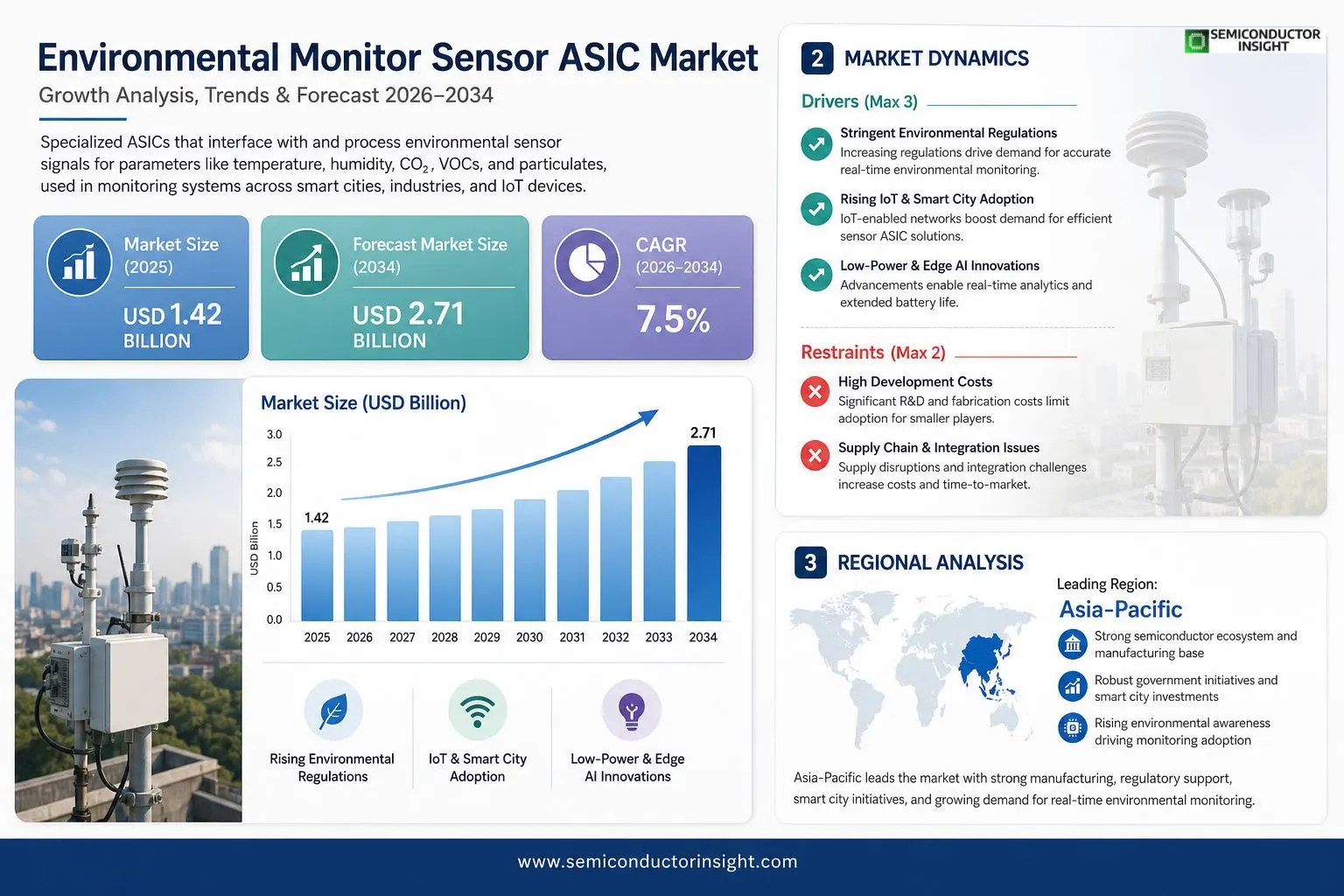
Global Environmental Monitor Sensor ASIC market size was valued at USD 1.42 billion in 2025. The market is projected to grow from USD 1.54 billion in 2026 to USD 2.71 billion by 2034, exhibiting a CAGR of 7.5% during the forecast period.
Environmental Monitor Sensor ASICs are highly specialized integrated circuits designed to interface with and process signals from sensors monitoring environmental parameters. These ASICs handle analog signal conditioning, A/D conversion, and digital processing tailored for metrics like temperature, humidity, CO2, VOCs, particulate matter, and noise levels. Essential types encompass gas sensor ASICs, particulate matter ASICs, multi-parameter environmental ASICs, and low-power IoT variants.
The market is experiencing robust growth driven by escalating climate concerns, stricter emission regulations worldwide, and booming IoT deployments in smart cities and industries. Additionally, innovations in low-power semiconductor fabrication and edge AI integration are accelerating adoption for real-time pollution tracking and sustainability efforts. Key industry players continue to propel expansion through strategic moves. For instance, in March 2024, Infineon Technologies AG unveiled its next-generation XENSIV™ PAS CO2 sensor platform, featuring advanced photoacoustic ASIC technology for precise, low-power environmental monitoring. Texas Instruments Inc., STMicroelectronics N.V., Analog Devices, Inc., and Renesas Electronics Corporation stand out as leading firms with extensive sensor ASIC portfolios.
MARKET DRIVERS
Stringent Environmental Regulations and Compliance Requirements
Environmental Monitor Sensor ASIC Market is experiencing robust growth driven by increasingly stringent government regulations aimed at monitoring air quality, water contamination, and soil health. Regulatory bodies worldwide are enforcing real-time data collection standards to combat pollution and ensure public safety, pushing manufacturers to integrate advanced application-specific integrated circuits (ASICs) that deliver high precision, low power consumption, and reliable performance in compact sensor designs.
Rising Adoption of IoT and Smart City Initiatives
Expansion of IoT-enabled environmental monitoring networks in urban infrastructure and industrial facilities has accelerated demand for customized sensor ASICs. These chips enable efficient sensor fusion, edge processing, and seamless connectivity with NB-IoT and wireless platforms, supporting dense deployment of monitoring solutions for air, water, and environmental parameters while optimizing energy efficiency in battery-powered devices.
➤ The integration of advanced semiconductor solutions allows for miniaturization and enhanced accuracy in environmental sensors, directly addressing the need for continuous, real-time monitoring amid growing urbanization and industrial activities.
Additionally, heightened public awareness of pollution-related health impacts and the push toward sustainable practices across industries continue to fuel investment in sophisticated ASIC-based sensor technologies tailored for environmental monitoring applications.
MARKET CHALLENGES
High Development Costs and Technical Complexity
Designing and fabricating specialized ASICs for environmental monitor sensors involves significant R&D investment and complex mixed-signal integration to achieve required sensitivity, stability, and environmental resilience. This creates barriers for smaller players in Environmental Monitor Sensor ASIC Market, particularly when balancing performance with ultra-low power demands for widespread IoT deployment.
Other Challenges
Integration with Legacy Systems and Data Management
Many existing environmental monitoring infrastructures rely on older technologies, making seamless incorporation of new ASIC-driven sensors difficult and increasing overall system complexity for data processing and analytics.
Sensor Stability in Harsh Conditions
Maintaining long-term accuracy and calibration of environmental sensors under varying temperature, humidity, and exposure conditions remains a persistent technical hurdle that ASIC designers must continuously address through advanced compensation algorithms.
MARKET RESTRAINTS
High Initial Costs and Skilled Talent Shortage
Environmental Monitor Sensor ASIC Market faces notable restraints from the elevated costs associated with ASIC development, prototyping, and production scaling, which can limit adoption especially among cost-sensitive end-users and smaller organizations. Furthermore, a shortage of professionals with specialized expertise in both semiconductor design and environmental sensing applications slows innovation cycles and market penetration.
Supply Chain and Integration Issues
Global semiconductor supply chain disruptions and challenges in integrating high-performance ASICs with diverse sensor elements and communication protocols continue to constrain rapid scaling. These factors raise operational expenses and extend time-to-market for new environmental monitoring solutions requiring precise, application-specific chip designs.
MARKET OPPORTUNITIES
Advancements in Miniaturization and Edge AI Integration
Significant opportunities exist in Environmental Monitor Sensor ASIC Market through ongoing progress in chip miniaturization, power optimization, and incorporation of edge AI capabilities. These innovations enable smarter, self-calibrating sensors suitable for large-scale smart city deployments, precision agriculture, and industrial emissions tracking, opening new revenue streams for ASIC providers.
Expansion into Emerging Applications and Regions
Growing demand for real-time environmental data in developing regions, combined with initiatives in sustainable agriculture, water resource management, and climate resilience programs, presents substantial growth potential. ASIC manufacturers can capitalize by developing cost-effective, multi-parameter solutions tailored to air quality, water quality, and soil monitoring needs in high-growth markets.
Environmental Monitor Sensor ASIC Market Trends
Advancements in Low-Power and Multi-Parameter Environmental Sensor ASICs
Environmental Monitor Sensor ASIC Market is witnessing significant evolution driven by the need for highly integrated circuits capable of precise signal conditioning, analog-to-digital conversion, and digital processing for key environmental parameters including temperature, humidity, CO2, VOCs, particulate matter, and noise levels. Manufacturers are prioritizing the development of low-power IoT variants and multi-parameter ASICs that enable seamless operation in battery-powered devices and continuous monitoring applications. These specialized integrated circuits support real-time data acquisition essential for modern environmental tracking systems deployed across urban and industrial settings.
Other Trends
Rising Adoption of Specialized Gas and Particulate Matter Sensor ASICs
Industry demand is accelerating for dedicated gas sensor ASICs and particulate matter ASICs as regulatory frameworks tighten around emissions and air quality standards globally. These solutions deliver optimized performance for specific sensing modalities while maintaining compact footprints suitable for integration into smart city infrastructure and industrial environmental monitoring platforms. The push toward sustainability initiatives further amplifies the requirement for reliable ASIC-based sensor interfaces that deliver accurate, low-latency environmental intelligence.
Integration of Edge AI and Innovative Semiconductor Technologies
Leading semiconductor companies are embedding edge AI capabilities into Environmental Monitor Sensor ASICs to facilitate on-device analytics and immediate response capabilities for pollution tracking and climate monitoring applications. Innovations in low-power semiconductor fabrication processes are enabling extended operational lifespans for sensor nodes in remote or energy-constrained environments. Strategic product launches, such as advanced photoacoustic ASIC platforms for precise CO2 detection, underscore the competitive focus on combining high accuracy with minimal power consumption. Major players including Infineon Technologies, Texas Instruments, STMicroelectronics, Analog Devices, and Renesas Electronics continue to expand their portfolios to address the growing complexity of environmental monitoring requirements across diverse end-use scenarios.
COMPETITIVE LANDSCAPE
Key Industry Players
Environmental Monitor Sensor ASIC Market Features Intense Competition Among Semiconductor Leaders
Environmental Monitor Sensor ASIC Market is led by established semiconductor giants with deep expertise in analog signal processing, low-power design, and sensor interface technologies. Infineon Technologies AG stands out as a prominent player, leveraging its advanced XENSIV™ platform including photoacoustic CO2 sensor ASICs for precise, energy-efficient environmental monitoring. Texas Instruments Incorporated, STMicroelectronics N.V., Analog Devices, Inc., and Renesas Electronics Corporation maintain strong positions through comprehensive portfolios covering gas, particulate matter, and multi-parameter environmental ASICs tailored for IoT and industrial applications.
Other significant players include specialized sensor firms and diversified electronics manufacturers that contribute niche innovations in low-power IoT variants and edge processing capabilities. Companies such as Bosch Sensortec GmbH, Sensirion AG, Honeywell International Inc., and ams-OSRAM AG enhance market dynamics with MEMS-integrated solutions and high-accuracy environmental parameter processing, supporting smart city deployments and regulatory compliance efforts worldwide.
List of Key Environmental Monitor Sensor ASIC Companies Profiled
- Infineon Technologies AG
- Texas Instruments Incorporated
- STMicroelectronics N.V.
- Analog Devices, Inc.
- Renesas Electronics Corporation
- Bosch Sensortec GmbH
- Sensirion AG
- Honeywell International Inc.
- ams-OSRAM AG
- OMRON Corporation
- TE Connectivity Ltd.
- NXP Semiconductors N.V.
- ABB Ltd.
- Siemens AG
- Schneider Electric SE
Segment Analysis:
| Segment Category | Sub-Segments | Key Insights |
| By Type |
|
Multi-Parameter Environmental ASICs represent the leading segment due to their ability to integrate signal conditioning, conversion, and processing for multiple environmental parameters within a single compact chip. These ASICs enable seamless handling of temperature, humidity, gas concentrations, and particulate data simultaneously, reducing system complexity and power requirements. Their design supports advanced edge processing capabilities that facilitate real-time decision-making without relying on external microcontrollers. Integration of low-power architectures further enhances suitability for battery-operated deployments in remote or distributed monitoring networks. Manufacturers prioritize these solutions for their versatility across diverse sensing needs while maintaining high signal fidelity and noise immunity. |
| By Application |
|
Air Quality Monitoring emerges as the dominant application segment owing to heightened global focus on pollution tracking and public health protection. Environmental monitor sensor ASICs in this area deliver precise analog front-end processing for detecting gases, VOCs, and particulates with exceptional accuracy and minimal latency. They support continuous data acquisition essential for urban infrastructure and regulatory compliance initiatives. Advanced features like on-chip filtering and calibration enhance reliability in variable environmental conditions. These ASICs also facilitate integration with communication protocols for seamless data transmission to centralized analytics platforms, enabling proactive responses to air pollution events and long-term trend analysis for sustainability planning. |
| By End User |
|
Government and Smart City Authorities constitute the leading end-user segment as they drive large-scale deployment of environmental monitoring networks to support urban sustainability and regulatory frameworks. Sensor ASICs tailored for these users emphasize ultra-low power consumption and robust integration with IoT ecosystems for city-wide coverage. They enable real-time environmental intelligence that informs policy decisions, emergency response, and infrastructure optimization. The specialized signal processing capabilities ensure high data integrity even in challenging outdoor conditions. Collaboration between ASIC providers and public entities fosters customized solutions that align with smart city architectures, promoting scalable and interoperable monitoring systems that enhance quality of life and environmental stewardship. |
| By Integration Level |
|
System-on-Chip with Edge AI leads this segment by combining analog signal conditioning, data conversion, processing, and artificial intelligence capabilities on a single die. This high level of integration minimizes external components, reduces latency in environmental data interpretation, and supports on-device anomaly detection for immediate alerts. Such ASICs excel in delivering intelligent insights directly at the sensor node, which is critical for applications requiring rapid response to changing conditions. Their design optimizes power efficiency while maintaining computational performance, making them ideal for distributed networks where connectivity or energy resources may be limited. Ongoing advancements in semiconductor processes continue to enhance the sophistication of these integrated solutions. |
| By Power Profile |
|
Ultra-Low Power ASICs dominate due to the proliferation of battery-powered and energy-harvesting environmental monitors deployed in remote or inaccessible locations. These ASICs incorporate advanced power management techniques, including sleep modes and efficient signal paths, to extend operational life significantly while preserving measurement accuracy. They are particularly valued in IoT-driven ecosystems where frequent battery replacement is impractical. The focus on minimizing energy consumption during both active sensing and data processing phases supports sustainable monitoring practices. Innovations in fabrication processes enable these chips to deliver reliable performance across wide temperature ranges and harsh environmental conditions without compromising on essential features like precision analog-to-digital conversion. |
Regional Analysis: Environmental Monitor Sensor ASIC Market
Asia-Pacific
Governments across Asia-Pacific have enacted sweeping environmental protection legislation, compelling industries to adopt certified monitoring solutions embedded with high-performance environmental monitor sensor ASICs. China’s revised ambient air quality standards and India’s National Clean Air Programme have created a sustained policy-driven demand environment, pushing manufacturers and system integrators to source advanced sensor ASIC solutions at scale.
The region’s deeply integrated semiconductor ecosystem, spanning chip design houses, foundries, packaging specialists, and test facilities, provides an unmatched competitive advantage. This vertical integration enables faster time-to-market for environmental monitor sensor ASIC products, reduced production costs, and localized supply chain resilience , factors that collectively reinforce Asia-Pacific’s leadership in this specialized segment.
The relentless deployment of smart city frameworks and industrial IoT networks across Asia-Pacific creates an ever-expanding base of applications for environmental monitor sensor ASICs. Real-time urban air monitoring, industrial emission tracking, and connected agricultural sensors all demand customized ASIC solutions capable of low-power, high-accuracy environmental data acquisition, making the region a natural growth engine for the market.
Substantial government and private investment in semiconductor R&D, particularly in China, Japan, and South Korea, is accelerating innovation in environmental monitor sensor ASIC design. Advances in ultra-low-power architectures, multi-parameter sensing integration, and miniaturization are being pioneered in the region, positioning Asia-Pacific not merely as a manufacturing hub but as a global innovation leader in this market.
North America
North America represents one of the most technologically advanced and commercially mature regional markets for environmental monitor sensor ASICs. The United States leads regional demand, supported by a strong regulatory framework encompassing the Environmental Protection Agency’s ambient monitoring requirements, industrial emissions standards, and federal clean water mandates. These regulations compel end-user industries , including petrochemicals, automotive, pharmaceuticals, and municipal utilities , to deploy sophisticated, ASIC-driven monitoring instruments. Canada contributes through its natural resource monitoring programs and climate change adaptation initiatives, while Mexico’s expanding manufacturing sector increasingly requires industrial environmental compliance monitoring. The region benefits from a mature base of fabless semiconductor design companies and a deep talent pool specializing in mixed-signal ASIC development. Partnerships between federal research institutions, universities, and private sensor manufacturers continue to yield next-generation environmental monitor sensor ASIC architectures, keeping North America at the forefront of product innovation despite Asia-Pacific’s volume dominance.
Europe
Europe occupies a strategically important position in Environmental Monitor Sensor ASIC Market, characterized by some of the world’s most rigorous environmental regulations and a well-established culture of precision instrumentation. The European Union’s Green Deal, Industrial Emissions Directive, and evolving air quality standards under the revised Ambient Air Quality Directive collectively generate consistent and growing demand for advanced environmental sensing solutions. Germany, France, the Netherlands, and the Nordic countries are particularly active markets, with strong industrial bases in chemical processing, automotive manufacturing, and energy production all requiring continuous emissions monitoring. European ASIC designers are noted for their emphasis on reliability, long operational lifetimes, and compliance with electromagnetic compatibility standards. The region’s commitment to reducing carbon emissions and transitioning to renewable energy also opens new application areas for environmental monitor sensor ASICs in atmospheric monitoring networks and climate research instrumentation.
South America
South America presents an emerging and increasingly consequential market for environmental monitor sensor ASICs, shaped by growing awareness of environmental degradation, expanding industrial activity, and strengthening regulatory frameworks. Brazil, as the region’s largest economy, leads demand through its growing mining, agriculture, and oil and gas sectors, all of which face mounting compliance requirements related to air and water quality monitoring. Argentina, Chile, and Colombia are also witnessing increased adoption of environmental monitoring infrastructure, partly driven by international trade requirements and sustainability commitments tied to foreign direct investment. Although the region’s domestic semiconductor manufacturing capacity remains limited, the growing import of environmental monitor sensor ASIC-based instruments and systems signals a maturing market. Long-term growth prospects are supported by international climate funding, urbanization trends, and multilateral environmental agreements that are prompting public sector investment in environmental monitoring networks throughout the continent.
Middle East & Africa
The Middle East and Africa region represents a nascent yet strategically significant segment of the global environmental monitor sensor ASIC market. In the Middle East, Gulf Cooperation Council nations , particularly Saudi Arabia, the UAE, and Qatar , are investing substantially in industrial diversification and environmental sustainability as part of broader national vision programs. The oil and gas sector remains the primary driver of demand for environmental monitoring solutions, with refineries, processing plants, and export terminals requiring continuous emissions and air quality monitoring. Africa’s market is more fragmented, driven by international development aid programs, mining sector compliance needs, and growing urban air quality concerns in rapidly expanding cities such as Nairobi, Lagos, and Johannesburg. Expanding mobile and cellular infrastructure across the continent also facilitates the deployment of connected environmental sensor networks. While market development remains at an early stage relative to other regions, the combination of regulatory progress, resource sector growth, and climate vulnerability is expected to steadily elevate the importance of environmental monitor sensor ASICs across the Middle East and Africa through 2034.
Report Scope
This market research report provides a comprehensive analysis of the Environmental Monitor Sensor ASIC Market , covering the forecast period 2026–2034. It offers detailed insights into market dynamics, technological advancements, competitive landscape, and key trends shaping the industry.
Key focus areas of the report include:
- Market Overview: The report begins with an overview outlining its current market scenario, key growth indicators, and industry transformation drivers. It discusses macroeconomic factors, demand–supply balance, regulatory landscape, and the strategic role of semiconductors in powering advancements across industries such as automotive, telecommunications, consumer electronics, and industrial automation.
- Market Size & Forecast: Historical data and future projections for revenue, unit shipments, and market value across major regions and segments.
- Segmentation Analysis: Detailed breakdown by product type, technology, application, and end-user industry to identify high-growth segments and investment opportunities.
- Regional Insights: Insights into market performance across North America, Europe, Asia-Pacific, Latin America, and the Middle East & Africa, including country-level analysis where relevant.
- Competitive Landscape: Profiles of leading market participants, including their product offerings, R&D focus, manufacturing capacity, pricing strategies, and recent developments such as mergers, acquisitions, and partnerships.
- Technology Trends & Innovation: Assessment of emerging technologies, integration of AI/IoT, semiconductor design trends, fabrication techniques, and evolving industry standards.
- Market Drivers & Restraints: Evaluation of factors driving market growth along with challenges, supply chain constraints, regulatory issues, and market-entry barriers.
- Stakeholder Insights: Insights for component suppliers, OEMs, system integrators, investors, and policymakers regarding the evolving ecosystem and strategic opportunities.
Primary and secondary research methods are employed, including interviews with industry experts, data from verified sources, and real-time market intelligence to ensure the accuracy and reliability of the insights presented.
FREQUENTLY ASKED QUESTIONS:
What is the current market size of Environmental Monitor Sensor ASIC Market?
-> Global Environmental Monitor Sensor ASIC Market was valued at USD 1.42 billion in 2025 and is expected to reach USD 2.71 billion by 2034, growing at a CAGR of 7.5% during the forecast period from 2026 to 2034.
Which key companies operate in Environmental Monitor Sensor ASIC Market?
-> Key players include Texas Instruments Inc., STMicroelectronics N.V., Analog Devices, Inc., Renesas Electronics Corporation, and Infineon Technologies AG, among others.
What are the key growth drivers?
-> Key growth drivers include escalating climate concerns, stricter emission regulations worldwide, booming IoT deployments in smart cities and industries, innovations in low-power semiconductor fabrication, and edge AI integration for real-time pollution tracking and sustainability efforts.
Which region dominates the market?
-> Asia-Pacific is the fastest-growing region, driven by rapid industrialization and smart city deployments, while North America and Europe remain dominant markets due to stringent environmental regulations and advanced semiconductor ecosystems.
What are the emerging trends?
-> Emerging trends include low-power IoT sensor ASICs, edge AI integration for real-time environmental monitoring, multi-parameter environmental ASICs, photoacoustic ASIC technology, and advanced gas sensor and particulate matter ASIC platforms tailored for smart city and industrial applications.

Get Sample Report PDF for Exclusive Insights
Report Sample Includes
- Table of Contents
- List of Tables & Figures
- Charts, Research Methodology, and more...
 Download Sample Report PDF