
Key Statistics
Key Takeaways
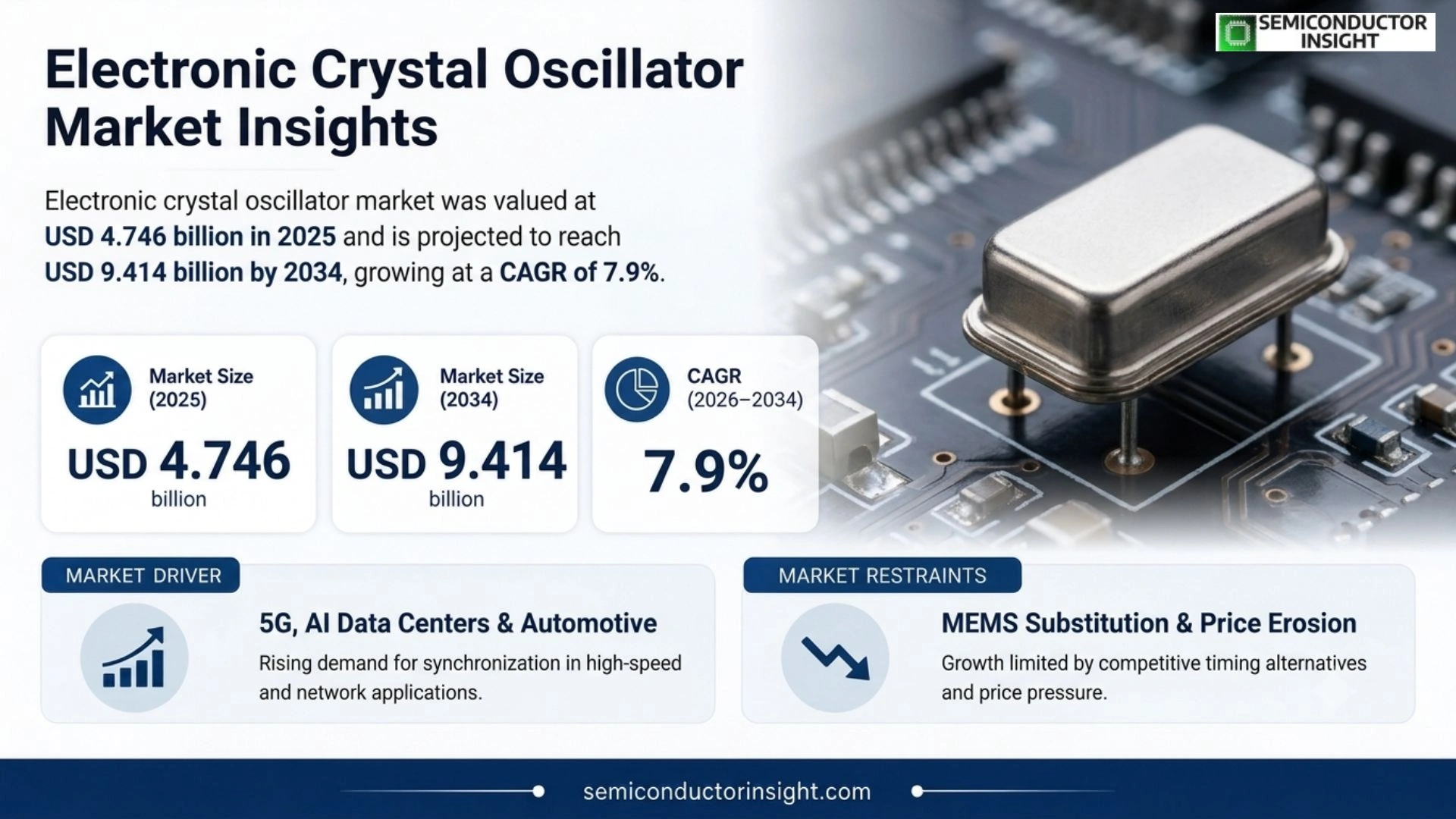
- The market was valued at USD 4.746 billion in 2025 after rebasing the published 2024 and 2032 endpoints.
- Revenue is forecast to reach USD 9.414 billion by 2034, representing a 7.9% CAGR during 2026–2034.
- Asia Pacific leads because Japan, China and Taiwan combine major crystal-device suppliers, electronics production and communications-equipment demand.
- SPXO provides the broad volume base, while TCXO, VCXO, OCXO and low-jitter differential products capture higher value in communications, data centers, automotive and industrial systems.
Electronic Crystal Oscillator Market Overview
Electronic Crystal Oscillator Market covers packaged timing components that combine a quartz resonator with an oscillator circuit to generate a stable periodic reference. Valued at USD 4.746 billion in 2025, the market is forecast to reach USD 9.414 billion by 2034 at a 7.9% CAGR during 2026–2034. Epson’s technical description distinguishes oscillators from standalone crystal units: the integrated circuit drives the quartz element and delivers a specified clock output, simplifying system design across consumer, automotive, network and industrial electronics.
Commercial differentiation is increasingly defined by frequency stability, phase noise, jitter, temperature range, aging, power consumption, package size and shock tolerance. A low-cost SPXO fits general microcontroller clocks, while 5G radios, AI servers, precision instruments and navigation may require TCXO, VCXO or OCXO performance. NDK’s OCXO guidance explains that oven control reduces sensitivity to environmental temperature, demonstrating why higher-stability architectures command significant price premiums.
Segment Analysis: By Type
Product segmentation follows the control method used to manage frequency error. Simple packaged oscillators serve broad digital timing, temperature compensation improves stability across operating conditions, voltage control enables frequency adjustment and synchronization, and oven control provides the strongest long-term stability. Differential and low-jitter variants are gaining value in high-speed networks, servers and test equipment.
| Type | Role in the market | Commercial outlook |
|---|---|---|
| SPXO and Programmable Oscillators | Standard packaged oscillators provide fixed or programmable reference clocks with low cost and compact size. | Largest unit-volume segment across consumer, industrial and embedded electronics; pricing is competitive. |
| TCXO | Temperature compensation corrects quartz frequency drift across the operating range. | Strong growth in communications, GNSS, automotive and portable equipment where stability and power must be balanced. |
| VCXO | Voltage control permits fine frequency adjustment for phase-locked loops and network synchronization. | Important in telecom, broadcast, data acquisition and high-speed interfaces; design-in cycles support supplier stickiness. |
| OCXO and High-performance Differential Oscillators | Thermal control or specialized output architecture delivers very low drift, phase noise and jitter. | Highest-value category for 5G, data centers, aerospace, instrumentation and precision timing. |
Segment Analysis: By Application
Crystal oscillators are used wherever processors, radios, converters or interfaces require an accurate timebase. Consumer and computing products drive unit scale; automotive electronics require high-temperature and reliability qualification; telecommunications and data centers demand low jitter and holdover; industrial, medical, aerospace and defense systems prioritize long life, traceability and environmental stability.
| Application | Purchase logic | Forecast implications |
|---|---|---|
| Consumer Electronics and Computing | Clocks support processors, wireless links, displays, storage and peripheral interfaces. | Largest volume base, with miniaturization and low voltage offset by intense price pressure. |
| Telecommunications and Data Centers | Oscillators stabilize radios, base stations, switches, optical links, servers and synchronization equipment. | Fast value growth from 5G, AI infrastructure and higher data rates requiring low jitter and high temperature stability. |
| Automotive Electronics | Timing supports ADAS, gateways, infotainment, vehicle networking and powertrain controllers. | AEC-qualified compact products benefit from rising electronics content and zonal architectures. |
| Industrial, Medical, Aerospace and Defense | Precision clocks serve automation, instruments, imaging, navigation, communications and mission systems. | Lower volume but higher average selling price, long qualification and strong reliability requirements. |
Regional Analysis
Asia Pacific is the largest production and consumption region because it houses leading Japanese and Taiwanese crystal-device companies and much of the global electronics manufacturing base. North America leads portions of data-center, aerospace and network-system demand, while Europe is important in automotive and industrial electronics. Other regions participate mainly through downstream equipment and telecom deployment.
North America
North America concentrates hyperscale data centers, network-equipment design, aerospace, defense and advanced instrumentation. Low-jitter differential oscillators and high-stability timing gain from AI server and optical-network expansion. The region imports many quartz devices but influences specifications through semiconductor and system companies. U.S. automotive and industrial customers also require qualified, traceable long-life components.
| Country / market | Commercial role | Evidence-led outlook |
|---|---|---|
| United States | Largest regional market | Cloud, telecom, aerospace and semiconductor design support premium timing. |
| Canada | Telecom and aerospace niche | Network infrastructure and specialized electronics create stable demand. |
| Mexico | Electronics manufacturing base | Automotive and contract manufacturing support volume consumption. |
Dated market instances
Europe
European demand is shaped by automotive electronics, industrial automation, communications and aerospace. Germany leads vehicle and machinery applications, while France and the United Kingdom contribute aerospace and telecom demand. Customers prioritize AEC-Q100 or AEC-Q200 qualification, functional-safety documentation, long product availability and robust electromagnetic performance. Energy efficiency and supply continuity increasingly influence component selection.
| Country / market | Commercial role | Evidence-led outlook |
|---|---|---|
| Germany | Largest regional buyer | Automotive, machinery and industrial networks drive qualified oscillators. |
| France | Aerospace and telecom demand | Precision timing supports communications and mission systems. |
| United Kingdom | Design and distribution market | Network, test and aerospace companies require specialized timing. |
Dated market instances
Asia Pacific
Asia Pacific combines the leading quartz oscillator suppliers with smartphone, computer, telecom, automotive and industrial manufacturing. Japan’s Epson, NDK, Daishinku, Murata and Kyocera provide strong technology depth; Taiwan’s TXC and other regional manufacturers add scale. China is both a major consumer and an expanding source of components. Supplier proximity shortens qualification and logistics for electronics OEMs.
| Country / market | Commercial role | Evidence-led outlook |
|---|---|---|
| Japan | Technology and supplier center | High-stability, automotive and miniaturized products support leadership. |
| China | Largest manufacturing demand base | Consumer, telecom and industrial electronics generate volume. |
| Taiwan | Frequency-control production hub | TXC and electronics supply chains support export-oriented scale. |
Dated market instances
South America
South American oscillator demand is tied to telecom infrastructure, automotive assembly, industrial electronics and imported consumer devices. Brazil is the principal market, with Mexico excluded from the region. Limited local quartz-device production makes distributor inventory, currency and lead time important. Higher-value opportunities occur in network upgrades and industrial equipment where timing failure creates significant operational cost.
| Country / market | Commercial role | Evidence-led outlook |
|---|---|---|
| Brazil | Largest regional opportunity | Telecom, vehicles and industrial production support demand. |
| Argentina | Selective electronics market | Industrial and communications projects create modest consumption. |
| Chile | Network and mining applications | Telecom and industrial systems require reliable timing. |
Dated market instances
Middle East & Africa
The Middle East and Africa consume crystal oscillators mainly through telecom equipment, data centers, defense electronics, industrial systems and imported vehicles. Gulf investment in cloud and communications supports low-jitter timing, while South Africa has the strongest diversified electronics base in Africa. Distribution availability, counterfeit control and long-term support are central concerns for mission-critical equipment.
| Country / market | Commercial role | Evidence-led outlook |
|---|---|---|
| Saudi Arabia | Digital infrastructure growth | Telecom, cloud and defense programs support premium timing. |
| United Arab Emirates | Data-center and communications hub | High-performance network systems create targeted demand. |
| South Africa | Regional industrial base | Telecom and automation sustain replacement and OEM purchases. |
Dated market instances
Key Electronic Crystal Oscillator Manufacturers and Competitive Landscape
The market is led by Japanese and Taiwanese frequency-control manufacturers with deep quartz processing, package design and high-volume qualification. The complete company list combines global leaders and specialist timing suppliers. Competitive position depends on phase-noise and stability performance, proprietary oscillator ICs, automotive qualification, customer design support, production continuity and the ability to miniaturize without sacrificing yield or reliability.
| Competitive tier | Companies | Basis of position |
|---|---|---|
| Global quartz leaders | Murata Manufacturing; Seiko Epson; Nihon Dempa Kogyo; Daishinku; Kyocera AVX | Technology breadth, scale and strong automotive or telecom qualification. |
| Asian scale competitors | TXC Corporation; Siward Crystal Technology; TKD Science and Technology | High-volume frequency-control production and regional OEM relationships. |
| Specialist and distribution-led suppliers | Abracon; IQD Frequency Products; Rakon; Microchip Technology | Programmable, high-stability, aerospace or broad-channel timing portfolios. |
Companies covered in the report
- Murata Manufacturing
- TXC Corporation
- Seiko Epson
- Daishinku Corporation
- Kyocera AVX
- Abracon
- IQD Frequency Products
- Nihon Dempa Kogyo
- Siward Crystal Technology
- Rakon
- Microchip Technology
- TKD Science and Technology
Epson, NDK and Kyocera continue to differentiate through low-power, compact and high-stability designs. Murata has scale and deep relationships in consumer and automotive electronics, while TXC and other Taiwanese suppliers compete strongly on volume and response time. Abracon, IQD and Rakon serve design engineers through broad distribution and specialist timing, while Microchip integrates oscillators into wider clock and synchronization solutions.
Customers rarely change an approved oscillator casually because board layout, load, startup behavior, electromagnetic compatibility and system timing are validated together. This creates design-in stickiness, but shortages or end-of-life notices can force second sourcing. Suppliers with transparent lifecycle policies, authorized distribution, cross-reference engineering and reliable delivery can win even when electrical specifications appear similar.
Frequency Stability, Phase Noise and Qualification Analysis
Factory capacity alone does not explain competitive success in electronic crystal oscillators. Customers qualify timing performance across temperature, aging, vibration, supply noise and system interfaces. This topic-relevant replacement examines the engineering metrics that determine design wins, average selling price and substitution risk, while preserving the required analytical depth and position in the report structure.
| Performance dimension | Buyer test | Commercial consequence |
|---|---|---|
| Frequency stability | Temperature, voltage, load and aging deviation | Determines whether SPXO, TCXO or OCXO is required. |
| Phase noise and jitter | Integrated timing noise across application-specific offsets | Controls data-link integrity and converter performance. |
| Environment | Shock, vibration, humidity and high-temperature operation | Sets automotive, industrial and aerospace qualification burden. |
| Power and package | Startup, current, voltage, footprint and thermal behavior | Drives portable, server and dense-board design wins. |
Jitter becomes more valuable as data rates rise
High-speed serial links, optical modules, radios and converters translate timing noise into bit errors or signal degradation. Headline frequency tolerance is therefore insufficient. Customers need phase-noise plots, integrated jitter over defined bandwidths and system-level reference designs. Low-noise oscillator ICs and resonator quality create defensible value in data-center and telecom applications.
Temperature and aging determine architecture
A standard oscillator may meet nominal room-temperature accuracy but drift beyond system limits across an automotive or outdoor telecom range. TCXO compensation, selected quartz cuts and OCXO thermal control address different stability levels. Buyers should specify lifetime aging and warm-up behavior, because short-term stability alone may not protect synchronization after years of operation.
Qualification creates long revenue tails
Automotive, aerospace, medical and network customers invest heavily in validation. Once approved, a part can remain in production for many years, favoring suppliers with stable processes and product-change discipline. The same stickiness increases customer risk when capacity is disrupted or a component is discontinued, making second-source compatibility and lifecycle communication important competitive factors.
Electronic Crystal Oscillator Market Dynamics: Drivers, Restraints and Opportunities
Growth is driven by 5G and network synchronization, AI data centers, rising automotive electronics, high-speed interfaces and continued device proliferation. Restraints include MEMS and silicon timing substitution, cyclical consumer demand, price erosion and concentrated quartz processing. Directional CAGR impacts below are planning scenarios, not separate published forecasts. The analysis therefore connects technical constraints to procurement, qualification, deployment and long-term service economics instead of treating unit shipments as the only indicator of market strength.
MARKET DRIVERS
Estimated impact of primary growth drivers
| Factor | Directional CAGR impact | Most exposed market | Time horizon |
|---|---|---|---|
| AI servers and high-speed networking | +1.5 to +2.3 points | North America and Asia | Immediate to medium |
| 5G and telecom synchronization | +1.1 to +1.8 points | Global networks | Medium term |
| Automotive electronics content | +0.8 to +1.4 points | Asia, Europe, North America | Medium term |
| Miniaturized low-power devices | +0.5 to +1.0 points | Consumer and IoT | Immediate |
AI infrastructure raises low-jitter requirements
Servers, accelerators, network interface cards and optical links use multiple precise clock domains. As bandwidth rises, timing noise consumes more of the signal margin. Kyocera’s 2026 differential oscillator launch specifically targeted AI servers and cut current consumption, showing that performance and energy are converging procurement criteria in dense computing systems.
5G networks need stable synchronization
Base stations and transport networks require frequency and phase stability to manage radio operation and handoffs. NDK’s 2025 TCXO and OCXO developments targeted high-temperature 5G and data-center environments. Network densification therefore supports premium timing products, especially where holdover, low phase noise and operation above traditional commercial temperature ranges are required.
Vehicles contain more networked electronics
ADAS, infotainment, gateways, Ethernet, radar and power-control systems each need timing references. Automotive qualification creates long design cycles but durable revenue after platform launch. Epson and NDK introduced compact high-temperature products in 2025, demonstrating supplier investment in frequency stability, miniaturization and AEC compliance for next-generation vehicle networks. For commercial planning, this evidence should be read together with qualification requirements, installed-base economics, regional service coverage and the operating consequences of a failed deployment. Decision makers can then distinguish a durable purchasing signal from a short-lived technology announcement while keeping specification, integration and lifecycle risk visible in investment case 48.
MARKET RESTRAINTS
Estimated impact of primary restraints
| Factor | Directional CAGR impact | Most exposed market | Time horizon |
|---|---|---|---|
| MEMS and silicon timing substitution | -1.0 to -1.6 points | General-purpose clocks | Medium term |
| Consumer electronics cyclicality | -0.8 to -1.3 points | Volume SPXO | Immediate |
| Price erosion and commoditization | -0.6 to -1.1 points | Standard packages | Immediate to medium |
| Supply concentration and qualification risk | -0.4 to -0.8 points | Automotive and telecom | Medium term |
Alternative timing technologies are improving
MEMS oscillators offer programmability, shock resistance and flexible lead times, while integrated silicon clocks can reduce component count. Quartz retains advantages in phase noise, stability and established qualification for many applications. Suppliers must keep improving power, package and delivery, because designers can adopt alternatives when quartz performance exceeds the actual system requirement.
Volume markets create persistent price pressure
Smartphone, computer and consumer OEMs negotiate aggressively and may consolidate oscillator functions. High unit volume does not guarantee margin when packages and frequencies are standardized. Manufacturers need high yields, automated assembly and differentiated temperature or jitter performance. Exposure to device replacement cycles can also create sharp inventory corrections after periods of component shortage.
Second sourcing is technically difficult
Oscillators with similar catalog specifications can differ in load, drive level, startup, phase noise and electromagnetic behavior. Customers want second sources for resilience but must repeat system qualification. This slows supplier switching and can constrain production if an approved source is disrupted. Pin-compatible families, transparent change notices and reference-design support reduce the barrier.
MARKET OPPORTUNITIES
Low-power differential clocks for AI systems
Data centers need lower jitter without increasing board power or cooling demand. Oscillators that reduce current while supporting common differential interfaces can capture premium design wins. Suppliers should provide complete jitter integration, power-supply sensitivity and thermal evidence because server architects evaluate the clock inside a larger signal-integrity and energy budget.
Automotive Ethernet and zonal architectures
Centralized and zonal vehicle networks increase the number and performance of timing references. Compact AEC-qualified oscillators operating to 125°C can support gateways, cameras, radar and controllers. Long platform lives create attractive revenue, but vendors must sustain traceability, change control and multi-region supply across the automotive program lifecycle. For commercial planning, this evidence should be read together with qualification requirements, installed-base economics, regional service coverage and the operating consequences of a failed deployment. Decision makers can then distinguish a durable purchasing signal from a short-lived technology announcement while keeping specification, integration and lifecycle risk visible in investment case 53.
High-stability timing for private networks and edge infrastructure
Private 5G, industrial Ethernet, edge data centers and precision instruments require synchronization outside traditional carrier sites. Compact TCXO and OCXO products can address temperature and holdover requirements. Distribution partners and evaluation boards can shorten design cycles for industrial customers that lack dedicated timing engineers. For commercial planning, this evidence should be read together with qualification requirements, installed-base economics, regional service coverage and the operating consequences of a failed deployment. Decision makers can then distinguish a durable purchasing signal from a short-lived technology announcement while keeping specification, integration and lifecycle risk visible in investment case 54.
Quartz Timing Design-in and Lifecycle Ecosystem Analysis
A basic supply-chain narrative would not fully explain this design-in market. Value flows from synthetic quartz and resonator processing through oscillator ICs, packaging, qualification, authorized distribution and system timing validation. The replacement ecosystem analysis focuses on how engineering evidence, availability and lifecycle management convert a frequency-control component into a durable customer program.
Leading companies control critical resonator processing and oscillator-circuit know-how, while other suppliers combine sourced resonators with proprietary ICs and packaging. Capacity expansion matters during shortages, but qualified yield and stable process control are more important than nominal unit output. Kyocera AVX’s U.S. facility investment illustrates the strategic value of resilient high-quality quartz manufacturing for specialized customers.
Distributors play a major role because frequency, voltage, output logic, tolerance and package create thousands of combinations. Stock breadth and engineering cross-reference support shorten prototyping. For production, customers need authorized traceability and product-change communication. Counterfeit or mishandled timing components can create intermittent failures that are difficult to diagnose, so procurement governance directly affects market value.
Recent Developments in the Electronic Crystal Oscillator Market
Developments tracked to September 2026. Entries are dated to their official announcement or publication period.
- March 2026
Source – Kyocera began mass production of X Series differential clock oscillators with approximately 42% lower current for AI servers. - December 2025
Source – NDK announced a 625 MHz low-jitter differential crystal oscillator with samples planned from March 2026. - November 2025
Source – Kyocera introduced 1.2 × 1.0 mm, 0.9 V clock oscillators for smartphones and wearables. - June 2025
Source – NDK developed a high-stability TCXO supporting operation to 105°C for 5G base stations and data centers. - October 2024
Source – Epson developed an oven-controlled crystal oscillator consuming 56% less power than its conventional OCXO.
REPORT SCOPE & SEGMENTATION
| Attribute | Details |
|---|---|
| Category | Electronic Components > Frequency Control and Timing > Quartz Crystal Oscillators |
| Base Year | 2025 |
| Forecast Period | 2026–2034 |
| Market Size | USD 4.746 billion in 2025; USD 9.414 billion by 2034; 7.9% CAGR during 2026–2034 |
| By Type | SPXO; Programmable Oscillator; TCXO; VCXO; OCXO; Differential and Low-jitter Oscillator |
| By Application | Consumer Electronics; Telecommunications; Data Centers and Computing; Automotive; Industrial; Medical; Aerospace and Defense |
| By Output | CMOS; LVDS; LV-PECL; HCSL; Sine Wave and Other |
| By Frequency | kHz; Up to 50 MHz; 50–200 MHz; Above 200 MHz |
| By Package | Through-hole; Standard SMD; Miniature SMD; Hermetic / High-reliability |
| Regions | North America; Europe; Asia Pacific; South America; Middle East & Africa |
| Companies | Murata Manufacturing; TXC Corporation; Seiko Epson; Daishinku Corporation; Kyocera AVX; Abracon; IQD Frequency Products; Nihon Dempa Kogyo; Siward Crystal Technology; Rakon; Microchip Technology; TKD Science and Technology |
Frequently Asked Questions
What is the current size of the electronic crystal oscillator market?
The global electronic crystal oscillator market was valued at USD 4.746 billion in 2025. The value is rebased from the source page’s 2024 and 2032 endpoints using their implied annual growth factor. Scope includes packaged quartz SPXO, programmable, TCXO, VCXO, OCXO and differential oscillators, excluding standalone crystals without oscillator circuitry.
What will the market be worth by 2034?
The market is forecast to reach USD 9.414 billion by 2034, representing a 7.9% CAGR during 2026–2034. Growth is supported by AI servers, high-speed networking, 5G synchronization, automotive electronics and low-power connected devices. Results remain sensitive to consumer cycles, price erosion, alternative MEMS timing and qualified supply availability. For commercial planning, this evidence should be read together with qualification requirements, installed-base economics, regional service coverage and the operating consequences of a failed deployment. Decision makers can then distinguish a durable purchasing signal from a short-lived technology announcement while keeping specification, integration and lifecycle risk visible in investment case 58.
Which region leads the market?
Asia Pacific is the largest market because Japan and Taiwan host major crystal-device suppliers and the region manufactures much of the world’s consumer, communications, computing and automotive electronics. China is a major demand and production base. North America contributes high-value cloud, aerospace and networking requirements, while Europe is important in automotive and industrial timing.
Which oscillator type is most important?
Standard packaged crystal oscillators provide the largest unit volume across embedded and consumer electronics. TCXO is important where temperature stability and low power must be balanced, VCXO enables controlled synchronization, and OCXO serves the highest-stability applications. Low-jitter differential oscillators are the strongest value-growth area for servers, optical networking and high-speed data conversion.
What are the primary applications?
Applications include smartphones, computers, wearables, Wi-Fi and Bluetooth devices, base stations, optical networks, data-center servers, automotive gateways and ADAS, industrial automation, medical instruments, navigation, test equipment, aerospace and defense communications. Each system establishes different requirements for frequency, temperature, phase noise, startup, voltage, package, aging and shock resistance. For commercial planning, this evidence should be read together with qualification requirements, installed-base economics, regional service coverage and the operating consequences of a failed deployment. Decision makers can then distinguish a durable purchasing signal from a short-lived technology announcement while keeping specification, integration and lifecycle risk visible in investment case 61.
What drives market growth?
Major drivers are higher network data rates, AI infrastructure, 5G synchronization, rising electronic content per vehicle, industrial connectivity and continued device miniaturization. As timing margins narrow, customers pay for lower jitter and better temperature stability. Low-power oscillator ICs also expand use in dense servers and battery-operated devices where thermal or energy budgets are constrained.
What restrains the market?
MEMS oscillators, silicon timing integration, consumer cyclicality, pricing pressure and difficult second-source qualification restrain growth. Standard oscillator packages can become commoditized, while specialized products face long approval cycles. Supply disruptions are particularly costly because electrically similar alternatives may behave differently in startup, phase noise, load sensitivity or electromagnetic compatibility. For commercial planning, this evidence should be read together with qualification requirements, installed-base economics, regional service coverage and the operating consequences of a failed deployment. Decision makers can then distinguish a durable purchasing signal from a short-lived technology announcement while keeping specification, integration and lifecycle risk visible in investment case 63.
Which companies are covered?
The report covers Murata Manufacturing, TXC Corporation, Seiko Epson, Daishinku Corporation, Kyocera AVX, Abracon, IQD Frequency Products, Nihon Dempa Kogyo, Siward Crystal Technology, Rakon, Microchip Technology and TKD Science and Technology. Profiles compare product types, frequency range, stability, phase noise, qualification, production footprint, channels and target applications. For commercial planning, this evidence should be read together with qualification requirements, installed-base economics, regional service coverage and the operating consequences of a failed deployment. Decision makers can then distinguish a durable purchasing signal from a short-lived technology announcement while keeping specification, integration and lifecycle risk visible in investment case 64.
Why was production-capacity analysis replaced?
Nominal factory output does not determine most design wins. Frequency stability, phase noise, qualification, package and lifecycle continuity are more important. The report therefore replaces production-capacity analysis with Frequency Stability, Phase Noise and Qualification Analysis, providing a more relevant framework for assessing technical differentiation, pricing power, design-in risk and substitution.
Where are the strongest opportunities?
The strongest opportunities are low-power differential oscillators for AI servers, high-temperature TCXO and OCXO products for 5G and edge infrastructure, AEC-qualified timing for automotive Ethernet, and compact clocks for wearables. Suppliers that combine verified jitter performance, low current, miniaturization, authorized distribution and long lifecycle support can command premium positions. For commercial planning, this evidence should be read together with qualification requirements, installed-base economics, regional service coverage and the operating consequences of a failed deployment. Decision makers can then distinguish a durable purchasing signal from a short-lived technology announcement while keeping specification, integration and lifecycle risk visible in investment case 66.
Get Sample Report PDF for Exclusive Insights
Report Sample Includes
- Table of Contents
- List of Tables & Figures
- Charts, Research Methodology, and more...
 Download Sample Report PDF