Electronic Article Surveillance Labels (EAS) Market Insights
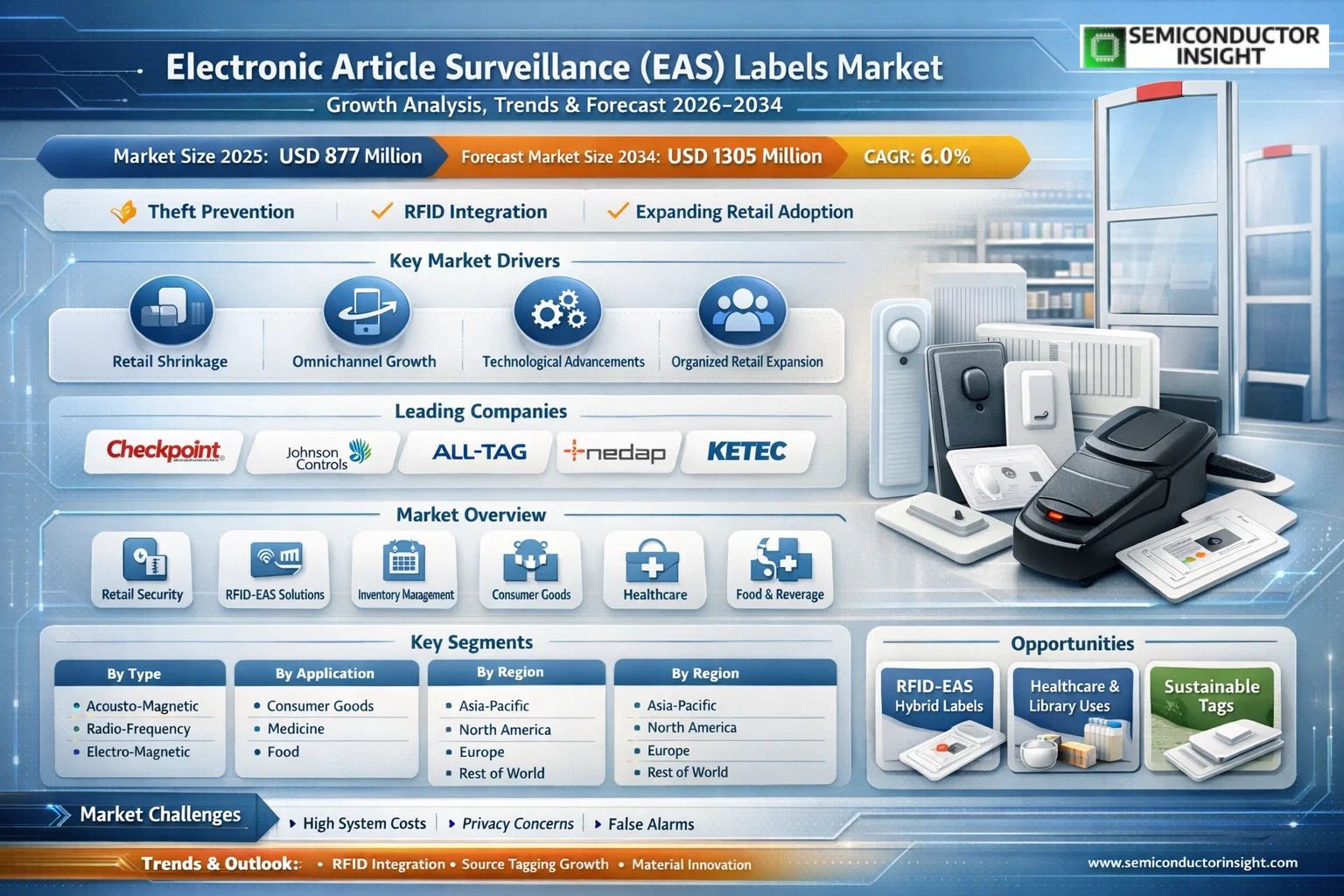
Global Electronic Article Surveillance Labels (EAS) market size was valued at USD 877 million in 2025. The market is projected to grow from USD 930 million in 2026 to USD 1,305 million by 2034, exhibiting a CAGR of 6.0% during the forecast period.
Electronic Article Surveillance (EAS) labels are security devices used primarily in retail environments to prevent theft and unauthorized removal of merchandise. These labels work in conjunction with an EAS system, which comprises sensors, antennas, and deactivation devices, to alert store personnel when someone attempts to leave the store with an item that has not been properly deactivated or removed. The primary types of EAS labels include Acousto-Magnetic (AM), Electro Magnetic (EM), Radio Frequency (RF), Microwave, and Video Wall technologies.
The market is experiencing steady growth due to several factors, including persistent retail shrinkage and the increasing adoption of loss prevention solutions across various sectors such as consumer goods, medicine, and food. Furthermore, technological advancements leading to more discreet and source-tagging compatible labels are contributing to market expansion. Initiatives by key players in the market are also expected to fuel growth. For instance, major manufacturers continuously innovate to integrate EAS labels with RFID technology for enhanced inventory management. Leading companies operating in this competitive landscape include Checkpoint Systems, Inc., Johnson Controls (through its Tyco Security Products division), ALL-TAG Corporation, Nedap N.V., and Hangzhou Century Co., Ltd., among others.
MARKET DRIVERS
Persistent Retail Shrinkage and Loss Prevention Investment
Global Electronic Article Surveillance Labels (EAS) Market is fundamentally propelled by the retail industry’s continuous battle against inventory shrinkage, which sources estimate at over $100 billion annually. This financial drain compels retailers across apparel, electronics, cosmetics, and supermarkets to invest heavily in proven loss prevention technologies. Electronic Article Surveillance Labels, as the frontline component of EAS systems, offer a direct and scalable deterrent against shoplifting, directly protecting profit margins and supporting the argument for market growth fueled by security spending.
Expansion of Organized Retail and Omnichannel Fulfillment
The rapid expansion of organized retail chains in emerging economies and the complexity of omnichannel operations, including buy-online-pickup-in-store (BOPIS), create a larger, more vulnerable inventory footprint. Securing high-value goods across extensive floor spaces and backrooms necessitates reliable, item-level security. Consequently, demand for Electronic Article Surveillance Labels is intrinsically linked to retail floor space growth and the need to secure inventory throughout the supply chain, from distribution to the sales floor, in a unified retail environment.
➤ The integration of RFID technology with traditional EAS labels is creating a powerful dual-function solution, driving adoption beyond basic theft prevention into inventory intelligence.
This technological fusion not only secures items but also enables real-time stock visibility, improving inventory accuracy to levels exceeding 98% in some implementations. This value-added functionality is a critical driver, encouraging retailers to upgrade their Electronic Article Surveillance Labels (EAS) Market infrastructure for both security and operational efficiency.
MARKET CHALLENGES
High System Costs and Integration Complexity
A primary challenge facing the Electronic Article Surveillance Labels (EAS) Market is the significant initial capital expenditure required for a comprehensive system, including labels, deactivators/detachers, and detection gates. For small to medium-sized retailers, this cost can be prohibitive. Furthermore, integrating new EAS hardware and software with existing point-of-sale (POS) and inventory management systems poses technical and logistical hurdles, often requiring specialized IT support and potentially disrupting store operations during installation.
Other Challenges
Consumer Privacy and Shopping Experience Concerns
The visible presence of EAS hard tags and detection gates can sometimes be perceived as intrusive, potentially creating a negative customer experience that implies distrust. Retailers must carefully balance security measures with a welcoming store atmosphere.
Tag Deactivation Failures and False Alarms
Operational inefficiencies arise from inconsistent deactivation at checkout, leading to embarrassing false alarms for paying customers. This erodes consumer trust and requires constant staff training and equipment maintenance to minimize, representing an ongoing operational challenge for the EAS labels market.
MARKET RESTRAINTS
Rise of E-commerce and Reduced In-Store Traffic
The structural shift toward online shopping presents a long-term restraint on the traditional Electronic Article Surveillance Labels (EAS) Market, which is predominantly focused on physical retail security. As a greater share of retail sales moves to digital channels where physical labels are irrelevant, the addressable market for new EAS label installations in certain retail segments may see moderated growth. This trend pressures suppliers to innovate and justify the ROI of EAS systems in brick-and-mortar stores more vigorously.
Availability and Sophistication of Counter-Defeat Methods
The market is restrained by the ongoing cat-and-mouse game between security providers and thieves. The proliferation of information on defeating EAS systems, including the use of booster bags and inexpensive jamming devices, can undermine the perceived effectiveness of Electronic Article Surveillance Labels. This constant threat requires continuous investment in R&D by label manufacturers to develop more secure, tamper-evident solutions, which increases costs and can slow market penetration for next-generation technologies.
MARKET OPPORTUNITIES
Hybrid RFID-EAS Labels and Smart Solutions
The convergence of RFID and EAS technologies represents the single largest opportunity for the Electronic Article Surveillance Labels (EAS) Market. These hybrid labels provide dual benefits: theft deterrence and granular inventory visibility. This allows for advanced applications like smart fitting rooms, automated self-checkout verification, and supply chain transparency. Retailers seeking a unified platform for loss prevention and inventory optimization are increasingly adopting these smart labels, opening a high-value growth segment.
Expansion into New Vertical Markets
Beyond traditional retail, significant opportunities exist in securing assets in libraries, healthcare (medical equipment and pharmaceuticals), and manufacturing (tool cribs). The core technology of the Electronic Article Surveillance Labels Market is adaptable to securing high-value, portable assets in these environments. Customized label designs for specialized items, such as surgical tools or library media, allow vendors to tap into new, less saturated markets with strong demand for asset protection.
Sustainability and Source Tagging Initiatives
The growing emphasis on sustainability creates an opportunity for innovation in label materials and processes. Developing recyclable or biodegradable EAS labels aligns with corporate ESG goals. Furthermore, the expansion of source tagging,where labels are applied by the manufacturer,presents a scalable opportunity. This shifts the application burden from retailers and ensures 100% of goods are protected, driving consistent volume demand for the Electronic Article Surveillance Labels (EAS) Market from the production source.
Electronic Article Surveillance Labels (EAS) Market Trends
Technology Integration and Market Evolution
The predominant trend in the Electronic Article Surveillance Labels (EAS) Market is the rapid integration of these security solutions with broader retail technology ecosystems. This is driven by the need for efficiency beyond theft prevention. EAS labels are increasingly being combined with RFID labels and inventory management software, creating dual-purpose tags that provide loss prevention and real-time stock visibility. This evolution addresses the significant retail challenge of shrink while optimizing supply chain operations, leading to greater adoption in high-value consumer goods sectors.
Other Trends
Material and Form Factor Innovation
Manufacturers are heavily investing in developing new materials and form factors for Electronic Article Surveillance Labels. The push is towards thinner, more discreet, and harder-to-remove labels that are equally effective. There is a growing demand for labels that integrate seamlessly with product packaging without damaging goods, particularly in luxury apparel, electronics, and cosmetics. This trend is a direct response to retailer demands for security solutions that do not compromise the customer’s in-store experience or the product’s aesthetic value.
Application Expansion Beyond Traditional Retail
A significant trend is the expanding application of Electronic Article Surveillance Labels into new verticals. While consumer goods remain the core market, adoption is growing steadily in the healthcare sector to secure high-cost pharmaceuticals and medical equipment, and in libraries or rental services for asset management. This diversification represents a strategic move by industry players to mitigate reliance on traditional retail cycles and tap into new revenue streams within the broader EAS Market.
Consolidation and Strategic Partnerships
The competitive landscape of the Electronic Article Surveillance Labels (EAS) Market is characterized by consolidation and strategic alliances. Leading manufacturers are acquiring smaller specialists and forming partnerships with software providers to offer comprehensive security and inventory solutions. This trend is driven by the need to provide integrated, one-stop-shop services to large, global retailers, strengthening market positions for companies like Checkpoint Systems and Johnson Controls while raising the technological and capital barriers to entry.
COMPETITIVE LANDSCAPE
Key Industry Players
A Market Defined by Established Security Giants and Specialized Manufacturers
Global Electronic Article Surveillance (EAS) labels market is consolidated yet competitive, with a handful of major technology providers holding significant revenue shares. Checkpoint Systems, Inc., a historical leader now part of CCL Industries, continues to exert substantial influence through its comprehensive portfolio of RF and Acousto-Magnetic labels and systems. Similarly, Johnson Controls, through its Tyco Security Products division, is a dominant force, offering integrated security solutions that leverage EAS labels across retail verticals. These established players compete on global scale, technological innovation, and the ability to provide end-to-end loss prevention ecosystems. The market structure is characterized by ongoing integration, where label manufacturers are often part of larger companies providing the complementary hardware (detectors, deactivators) and software analytics, creating high barriers to entry for new participants.
Beyond the top-tier integrators, the competitive landscape is populated by numerous specialized and regional manufacturers that cater to niche applications and price-sensitive segments. Companies such as ALL-Tag Corporation and Nedap N.V. are recognized for their robust product lines and reliability in specific label technologies. The Asia-Pacific region, a major manufacturing hub, hosts several significant players like Hangzhou Century Co., Ltd. and TAKACHIHO KOHEKI CO., LTD., which contribute substantially to Global supply chain. Other notable competitors, including Sentry Custom Security, Agon Systems Ltd., and Shopguard, often focus on customized label solutions, specific retail formats, or regional markets, ensuring a dynamic and varied competitive environment that drives continuous product development.
List of Key Electronic Article Surveillance Labels (EAS) Companies Profiled
- Checkpoint Systems, Inc. (CCL Industries)
- Johnson Controls (Tyco Security Products)
- ALL-Tag Corporation
- Nedap N.V.
- Agon Systems Ltd.
- Sentry Custom Security
- TAKACHIHO KOHEKI CO., LTD.
- Hangzhou Century Co., Ltd.
- KETEC PRECISION TOOLING
- Shopguard
- AMERSEC
- Softdel
- Feltron Security Systems LLC
- GATEWAY SECURITY SWEDEN AB
- Dongguan Lifangmei Electronic Technology Co., Ltd.
Segment Analysis:
| Segment Category | Sub-Segments | Key Insights |
| By Type |
|
Acousto-Magnetic labels are recognized as a leading and highly reliable technology. Their superior detection range and resistance to shielding offer robust security for high-value goods. The technology’s consistent performance across various retail environments and its ability to be embedded within products or packaging without compromising aesthetics are significant advantages. Ongoing innovation focuses on enhancing deactivation speed and recyclability to meet modern operational and sustainability needs. |
| By Application |
|
Consumer Goods remains the dominant application area, driven by pervasive retail shrinkage concerns. The demand is fueled by the need to protect a diverse range of products, from apparel and electronics to cosmetics and luxury items. Retailers increasingly require labels that are not only effective but also discreet and adaptable to different packaging formats. This segment sees continuous integration with broader loss prevention strategies, including source tagging and inventory management systems. |
| By End User |
|
Apparel & Fashion Retailers constitute a critical end-user segment due to the high pilferage rates of small, high-margin items. This sector’s demand is shaped by the necessity for labels that integrate seamlessly with garment tags, are easily removable at point-of-sale, and provide a strong visual deterrent. The trend towards omnichannel retailing further encourages the use of EAS labels that support inventory accuracy and can be used across both physical stores and e-commerce fulfillment centers for loss prevention. |
| By Activation Method |
|
Source-Tagged Labels are gaining prominence as a leading and growing segment. Applied by the manufacturer or distributor, these labels embed security directly into product packaging, streamlining retail operations and enhancing supply chain security. This method reduces labor costs for retailers, ensures consistent label application, and improves inventory visibility from warehouse to shelf. The shift towards source tagging represents a strategic collaboration between brand owners and retailers to combat organized retail crime more effectively. |
| By Form Factor |
|
Soft Labels/Stickers lead in adoption due to their versatility and cost-effectiveness. These adhesive-based labels are ideal for a wide array of products, including books, DVDs, cosmetics, and packaged goods. Their thin profile allows for easy concealment and minimal impact on product presentation, which is crucial for brand-sensitive items. Continuous developments in adhesive technology ensure reliable attachment without damaging surfaces, making them a fundamental choice for high-volume, low-cost item protection in diverse retail settings. |
Regional Analysis: Electronic Article Surveillance Labels (EAS) Market
North America
The North American landscape is characterized by seamless EAS label integration, both at point-of-sale deactivation and within self-checkout systems. This deep operational integration across major retail chains makes EAS a standard, non-negotiable component of store infrastructure, driving consistent, high-volume label procurement. The focus is on operational efficiency and enhancing customer experience.
Persistent pressure from organized retail crime syndicates targeting high-value goods like electronics, health & beauty, and designer apparel forces retailers to invest in sophisticated loss prevention. This directly fuels the Electronic Article Surveillance Labels Market, as security managers prioritize high-frequency label deployment on vulnerable merchandise to mitigate substantial financial losses.
North America leads in the adoption of source tagging, where EAS labels are applied by manufacturers during production. This model, preferred for its efficiency and lower labor costs at the retail level, creates a stable, high-volume demand channel for Electronic Article Surveillance Labels. It fosters strong partnerships between label producers and major brand owners.
The region serves as a primary testing ground for next-generation EAS labels, including those that combine RF or AM technology with RFID for dual security and inventory tracking. This focus on innovation, driven by tech-savvy enterprises, pushes the market beyond basic loss prevention towards intelligent asset management solutions.
Europe
Europe represents a sophisticated and highly regulated market for the Electronic Article Surveillance Labels Market. Stringent data privacy laws influence how surveillance technologies, including EAS systems, are deployed. Retail trends vary significantly, with Western Europe mirroring North America’s mature adoption, driven by high-end fashion, pharmacies, and DIY stores. In contrast, Eastern Europe shows stronger growth potential as modern retail formats expand. The European market is characterized by a demand for highly aesthetic, discreet labels for luxury goods and a strong push for sustainable, environmentally friendly label materials from retailers with strong ESG commitments. The regional market’s dynamics are also shaped by cross-border retail strategies, where large chains seek standardized EAS solutions, including label specifications, across multiple countries.
Asia-Pacific
The Asia-Pacific region is the fastest-growing frontier for the Electronic Article Surveillance Labels Market, propelled by the explosive expansion of organized retail, e-commerce fulfillment centers, and supermarket chains in China, India, and Southeast Asia. Growth is primarily cost-driven, with a high demand for affordable, reliable label solutions tailored for high-volume, fast-moving consumer goods retail. The market is highly diverse, ranging from the advanced adoption of RFID-integrated systems in countries like Japan and Australia to the nascent but rapidly expanding modern retail sectors in emerging economies. Local manufacturing of EAS components in the region also contributes to competitive pricing and accessibility, making Electronic Article Surveillance Labels more viable for a broader range of retailers, from large hypermarkets to smaller specialty stores.
South America
The South American market for Electronic Article Surveillance Labels is in a development phase, with growth concentrated in major urban centers and within expanding supermarket and apparel retail chains in Brazil, Mexico, and Chile. Market penetration is increasing as retailers combat high inventory shrinkage rates. The primary dynamic is a focus on cost-effective solutions; retailers often prioritize essential, no-frills EAS label deployments over advanced integrations. Economic volatility in the region can impact capital expenditure on security infrastructure, but the fundamental need for loss prevention continues to drive steady demand. The market shows potential for growth as regional retail consolidation increases and international chains bring standardized security protocols that include specific EAS label requirements.
Middle East & Africa
The Middle East & Africa region presents a bifurcated market dynamic for Electronic Article Surveillance Labels. The affluent Gulf Cooperation Council (GCC) nations, with their luxury shopping malls and high-end retail sectors, drive demand for premium, discreet security solutions, including sophisticated EAS labels. In contrast, much of Africa’s market is emerging, with growth tied to the slow but steady expansion of formal retail in key economies like South Africa and Nigeria. The region’s primary challenge is the diverse and fragmented retail landscape. Market development is often project-based, linked to the opening of new large-scale malls or the entry of international retail brands, which implement standardized EAS systems that require a consistent supply of compatible labels.
Report Scope
This market research report provides a comprehensive analysis of the Electronic Article Surveillance Labels (EAS) Market , covering the forecast period 2026–2034. It offers detailed insights into market dynamics, technological advancements, competitive landscape, and key trends shaping the industry.
Key focus areas of the report include:
- Market Overview: The report begins with an overview outlining its current market scenario, key growth indicators, and industry transformation drivers. It discusses macroeconomic factors, demand–supply balance, regulatory landscape, and the strategic role of semiconductors in powering advancements across industries such as automotive, telecommunications, consumer electronics, and industrial automation.
- Market Size & Forecast: Historical data and future projections for revenue, unit shipments, and market value across major regions and segments.
- Segmentation Analysis: Detailed breakdown by product type, technology, application, and end-user industry to identify high-growth segments and investment opportunities.
- Regional Insights: Insights into market performance across North America, Europe, Asia-Pacific, Latin America, and the Middle East & Africa, including country-level analysis where relevant.
- Competitive Landscape: Profiles of leading market participants, including their product offerings, R&D focus, manufacturing capacity, pricing strategies, and recent developments such as mergers, acquisitions, and partnerships.
- Technology Trends & Innovation: Assessment of emerging technologies, integration of AI/IoT, semiconductor design trends, fabrication techniques, and evolving industry standards.
- Market Drivers & Restraints: Evaluation of factors driving market growth along with challenges, supply chain constraints, regulatory issues, and market-entry barriers.
- Stakeholder Insights: Insights for component suppliers, OEMs, system integrators, investors, and policymakers regarding the evolving ecosystem and strategic opportunities.
Primary and secondary research methods are employed, including interviews with industry experts, data from verified sources, and real-time market intelligence to ensure the accuracy and reliability of the insights presented.
FREQUENTLY ASKED QUESTIONS:
What is the current market size of Electronic Article Surveillance Labels (EAS) Market?
-> Global Electronic Article Surveillance Labels (EAS) Market was valued at USD 877 million in 2025 and is projected to reach USD 1305 million by 2034, growing at a CAGR of 6.0% during the forecast period.
Which key companies operate in Electronic Article Surveillance Labels (EAS) Market?
-> Key players include Agon Systems Ltd., Johnson Controls, ALL-Tag Corporation, Checkpoint Systems, Inc., KETEC PRECISION TOOLING, AMERSEC, BTCB, Tag, Softdel, TAKACHIHO KOHEKI CO., LTD., among others.
What are the key growth drivers?
-> Key growth is driven by the need to prevent retail theft and unauthorized removal of merchandise across various sectors, supported by investments in integrated security systems and evolving industry standards.
Which region dominates the market?
-> Global market analysis covers performance across North America, Europe, Asia, South America, and the Middle East & Africa. The U.S. and China are key country markets noted in the analysis.
What are the emerging trends?
-> The market segments by key technologies including Acousto-Magnetic, Electro Magnetic, Radio Frequency, Microwave, and Video Wall, with applications spanning Consumer Goods, Medicine, Food, and Others.

Get Sample Report PDF for Exclusive Insights
Report Sample Includes
- Table of Contents
- List of Tables & Figures
- Charts, Research Methodology, and more...
 Download Sample Report PDF