Market Insights
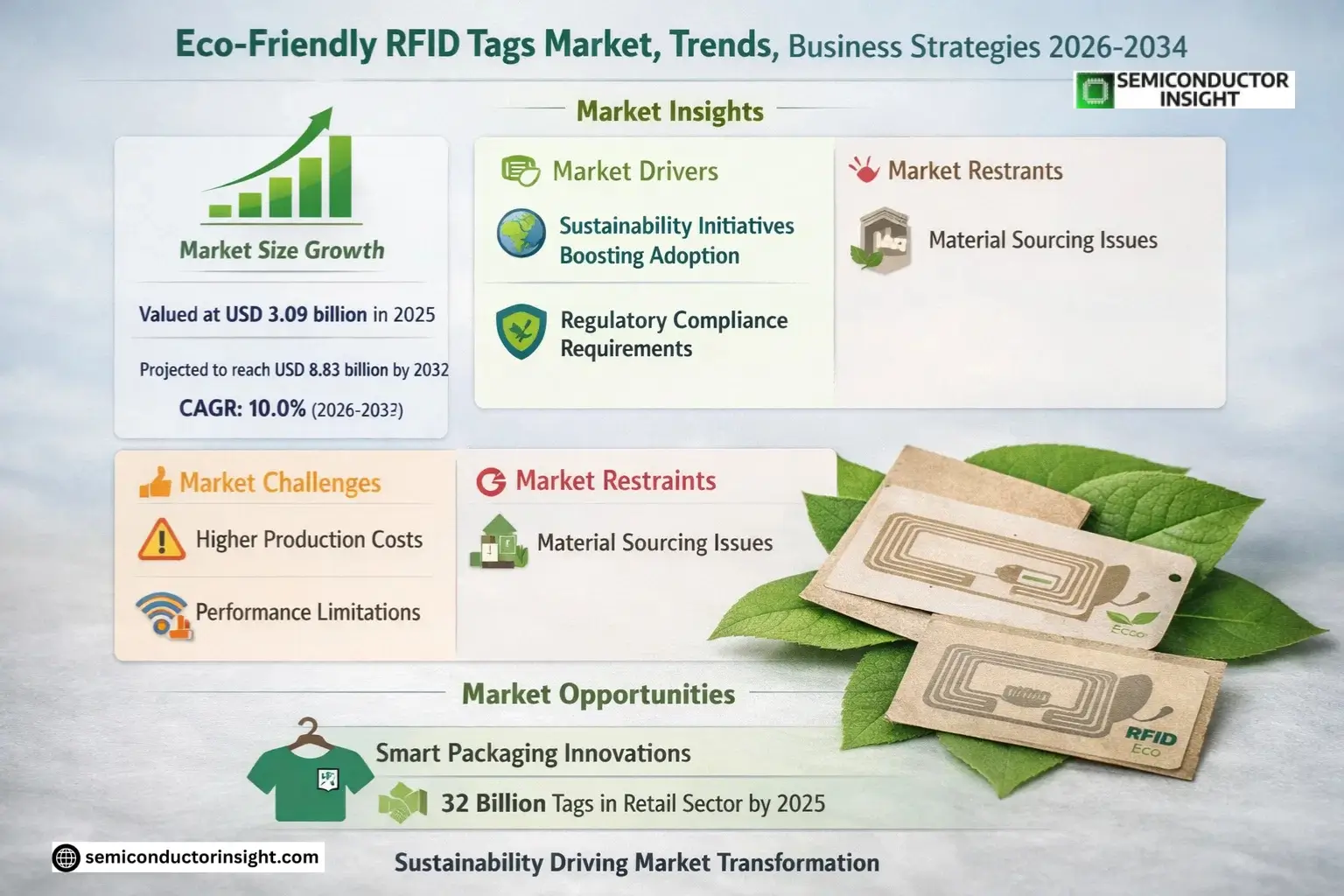
Global Eco-Friendly RFID Tags Market size was valued at USD 3.09 billion in 2025. The market is projected to grow from USD 3.40 billion in 2026 to USD 5.83 billion by 2032, exhibiting a CAGR of 10.0% during the forecast period.
Eco-Friendly RFID Tags are radio frequency identification products designed to minimize environmental impact while maintaining functional performance. These tags incorporate sustainable materials, recyclable components, and manufacturing processes that align with circular economy principles. Key features include reduced plastic content, biodegradable substrates, and compatibility with existing recycling systems.
The market growth is driven by increasing regulatory pressures for sustainable packaging solutions and corporate ESG commitments across retail and logistics sectors. Retail apparel currently dominates application demand, accounting for approximately two-thirds of global tag deployments in 2025. Technological advancements in paper-based antenna designs and water-based adhesives are enabling wider adoption without compromising read-range performance or durability requirements.
MARKET DRIVERS
Sustainability Initiatives Boosting Adoption
Global Eco-Friendly RFID Tags Market is experiencing significant growth due to increasing corporate sustainability commitments. Over 65% of Fortune 500 companies have implemented green procurement policies, driving demand for sustainable tracking solutions. These tags reduce electronic waste by using biodegradable materials without compromising functionality.
Regulatory Compliance Requirements
Stringent environmental regulations across North America and Europe are accelerating market growth. The EU’s Circular Economy Action Plan mandates sustainable packaging solutions, with RFID tags falling under these requirements. Manufacturers are investing heavily in plant-based and recyclable materials to meet compliance standards.
Retail giants now prioritize supply chain transparency, with eco-friendly RFID tags enabling both sustainability tracking and inventory management. This dual functionality creates strong market incentives for adoption across multiple industries.
MARKET CHALLENGES
Higher Production Costs Impacting Adoption
Eco-Friendly RFID Tags currently carry 25-30% premium pricing compared to conventional tags, creating barriers for price-sensitive markets. The specialized materials and manufacturing processes required for biodegradable components contribute to these cost differentials. Some supply chains resist adoption due to narrow profit margins in competitive sectors.
Other Challenges
Performance Limitations
While improving, some biodegradable RFID materials show 10-15% reduced read range in high-density environments. This technical limitation requires careful deployment planning in complex logistics operations.
MARKET RESTRAINTS
Material Sourcing Complexities
The limited availability of certified biodegradable substrates constrains production scalability. Only 12 specialized facilities globally currently produce RFID-compatible biopolymers at commercial scale. This supply chain bottleneck creates lead time challenges for large-scale deployments in the Eco-Friendly RFID Tags Market.
MARKET OPPORTUNITIES
Smart Packaging Innovations
Integration with intelligent packaging systems presents USD 2.1 billion growth opportunity for Eco-Friendly RFID Tags. Brands are combining sustainability with consumer engagement features, such as compostable tags with embedded product authentication capabilities. This convergence creates new value propositions for premium product segments.
Emerging Circular Economy Applications
Closed-loop recycling programs are adopting eco-friendly RFID tags to track material flows throughout product lifecycles. The apparel industry leads this trend, with 72 major brands implementing recyclable RFID systems for textile recovery programs across North America and Europe.
Eco-Friendly RFID Tags Market Trends
Sustainability Driving Market Transformation
Eco-Friendly RFID Tags Market is experiencing significant shifts due to evolving sustainability requirements across industries. Retail apparel remains the largest application sector, with approximately 32 billion tags deployed by 2025. This sector’s demand for environmentally conscious solutions is prompting manufacturers to develop RFID tags with reduced plastic content and improved recyclability.
Other Trends
Regulatory Compliance Accelerates Adoption
European Digital Product Passport regulations, effective from 2026, are creating mandatory requirements for item-level traceability and sustainability data. This is forcing brands to adopt Eco-Friendly RFID Tags that meet stringent recyclability standards while providing carbon footprint transparency throughout supply chains.
Material Innovation Trends
Leading manufacturers are developing paper-based and plastic-free RFID tag solutions that maintain performance while reducing environmental impact. These innovations include separable structures, recyclable adhesives, and low-carbon materials that align with circular economy principles. The market is seeing particularly strong growth in paper-based ECO RFID solutions that integrate with existing recycling systems.
Profit Margin Evolution
The industry is experiencing a shift from low-margin standardized inlay production to higher-value solutions incorporating environmental certifications and system integration. Value-added services like Digital Product Passport integration and recycling system compatibility are creating new revenue streams with significantly better profitability than traditional tag production.
Supply Chain Optimization
Beyond retail applications, logistics operations are driving demand for Eco-Friendly RFID Tags, accounting for 15% of UHF tag deployments. Companies are leveraging these sustainable tracking solutions to simultaneously improve operational visibility and meet corporate ESG targets. The combination of efficiency gains and environmental benefits makes these tags increasingly attractive for global supply chains.
COMPETITIVE LANDSCAPE
Key Industry Players
Strategic Positioning in the Eco-Friendly RFID Tags Market
Avery Dennison and SML Group dominate the eco-friendly RFID tags market with their comprehensive sustainable product portfolios. These companies lead in material innovation and recycling-compatible solutions, holding approximately 30% combined market share. The market exhibits an oligopolistic structure where top 5 players control nearly 50% of global revenue, while specialized manufacturers like Tageos and XINDECO IOT compete through technological differentiation in paper-based and plastic-free tag solutions.
Niche players such as Talkin’ Things and Beontag are gaining traction by offering customized sustainable RFID solutions aligned with circular economy principles. The competitive intensity increased significantly post-2020 as European Digital Product Passport regulations created demand for compliant eco-tags. Smaller Asian manufacturers like Arizon RFID are emerging as cost-effective suppliers by leveraging local material sourcing advantages.
List of Key Eco-Friendly RFID Tags Companies Profiled
- Avery Dennison
- SML Group
- Trimco Group
- Beontag
- Arizon RFID
- Tageos
- XINDECO IOT
- SATO
- INLAYLINK
- Talkin’ Things
- Hana Technologies
- Alien Technology
- Identiv
- HID Global
- Confidex
Segment Analysis:
| Segment Category | Sub-Segments | Key Insights |
| By Type |
|
Paper-based tags dominate due to their superior environmental profile:
|
| By Application |
|
Retail Apparel remains the primary adoption driver with compelling sustainability benefits:
|
| By End User |
|
Fashion Brands lead adoption with comprehensive sustainability strategies:
|
| By Material Innovation |
|
Biodegradable Substrates represent the most impactful innovation:
|
| By Compliance Requirement |
|
European DPP Standards are reshaping market requirements:
|
Regional Analysis: Global Eco-Friendly RFID Tags Market
U.S. EPA guidelines and state-level plastic reduction laws mandate sustainable tracking solutions. California’s packaging laws specifically incentivize compostable RFID tag adoption across supply chains.
Major retailers like Walmart and Target drive demand through vendor sustainability requirements. Over 60% of North American apparel brands now specify eco-friendly RFID tags in procurement contracts.
Research hubs develop bio-based substrate materials with comparable performance to traditional tags. Several universities collaborate with manufacturers on biodegradable antenna solutions.
Venture capital flows into sustainable RFID startups reached record levels in 2023. Corporate sustainability funds increasingly include eco-friendly tracking solutions in their investment portfolios.
Europe
Europe demonstrates strong growth in eco-friendly RFID tags, propelled by the EU Circular Economy Action Plan. Germany and France lead in sustainable packaging regulations that include tracking component requirements. The region’s emphasis on extended producer responsibility creates consistent demand. Scandinavian countries show particularly high adoption rates, with Norway mandating biodegradable tags in certain retail segments. European manufacturers focus on closed-loop recycling systems for RFID components. Cross-border logistics initiatives increasingly specify sustainable tracking solutions to meet carbon neutrality targets.
Asia-Pacific
The Asia-Pacific region shows rapid adoption growth led by Japan’s Eco Mark certification program and China’s dual carbon goals. Singapore serves as regional innovation hub for sustainable RFID solutions. Australian retailers implement eco-friendly tags to meet corporate sustainability commitments. However, price sensitivity remains a challenge in emerging markets. Government-led smart city projects across India and Southeast Asia incorporate green RFID technologies in urban infrastructure.
South America
Brazil leads South America’s eco-friendly RFID adoption, particularly in agribusiness supply chains requiring sustainable tracking. Chile implements progressive e-waste regulations affecting RFID component disposal. Argentina focuses on sustainable textile tagging in its apparel export sector. Regional growth remains constrained by limited recycling infrastructure, prompting innovative biodegradable tag solutions tailored for tropical climate durability.
Middle East & Africa
The UAE drives regional adoption through smart city initiatives specifying sustainable RFID solutions. South Africa implements eco-friendly tagging in mining equipment tracking. African agriculture exporters increasingly adopt biodegradable tags to meet EU import requirements. Market growth faces challenges from limited local manufacturing and reliance on imports, though several regional startups now offer customized sustainable solutions.
Report Scope
This market research report provides a comprehensive analysis of the Eco-Friendly RFID Tags Market , covering the forecast period 2025–2032. It offers detailed insights into market dynamics, technological advancements, competitive landscape, and key trends shaping the industry.
Key focus areas of the report include:
- Market Overview: The report begins with an overview outlining its current market scenario, key growth indicators, and industry transformation drivers. It discusses macroeconomic factors, demand–supply balance, regulatory landscape, and the strategic role of semiconductor applications across industries such as retail apparel, supply chain logistics, food packaging, and general retail.
- Market Size & Forecast: Historical data and future projections for revenue, unit shipments, and market value across major regions and segments.
- Segmentation Analysis: Detailed breakdown by product type, form, frequency band, and application to identify high-growth segments and investment opportunities.
- Regional Insights: Insights into market performance across North America, Europe, Asia, South America, and Middle East & Africa, including country-level analysis where relevant.
- Competitive Landscape: Profiles of leading market participants, including their product offerings, R&D focus, manufacturing capacity, pricing strategies, and recent developments such as mergers, acquisitions, and partnerships.
- Technology Trends & Innovation: Assessment of emerging technologies, material innovations, recyclability solutions, and evolving industry standards.
- Market Drivers & Restraints: Evaluation of factors driving market growth along with challenges, supply chain constraints, regulatory issues, and market-entry barriers.
- Stakeholder Insights: Insights for component suppliers, OEMs, system integrators, investors, and policymakers regarding the evolving ecosystem and strategic opportunities.
Primary and secondary research methods are employed, including interviews with industry experts, data from verified sources, and real-time market intelligence to ensure the accuracy and reliability of the insights presented.
FREQUENTLY ASKED QUESTIONS:
What is the current market size of Eco-Friendly RFID Tags Market?
-> Eco-Friendly RFID Tags Market size was valued at USD 3.09 billion in 2025. The market is projected to grow from USD 3.40 billion in 2026 to USD 5.83 billion by 2032, exhibiting a CAGR of 10.0% during the forecast period.
What is the production volume of Eco-Friendly RFID Tags?
-> Global production reached 48.3 billion units in 2025, with an average market price of USD 0.07 per unit.
Which key companies operate in Eco-Friendly RFID Tags Market?
-> Key players include Avery Dennison, SML Group, Trimco Group, Beontag, Arizon RFID, Tageos, XINDECO IOT, SATO, INLAYLINK, Talkin’ Things, Hana Technologies, Alien Technology, Identiv, HID Global, and Confidex, among others.
What are the key growth drivers?
-> Key growth drivers include retail apparel demand (32 billion tags deployed in 2025), logistics sector expansion (15% of total tags), regulatory compliance (Digital Product Passport requirements), and brand ESG initiatives promoting sustainable packaging solutions.
Which region dominates the market?
-> Europe leads in regulatory-driven adoption, while Asia shows strong growth potential due to expanding retail and manufacturing sectors.
What are the emerging trends?
-> Emerging trends include paper-based plastic-free tags, recyclable PET materials, integration with circular economy systems, and low-carbon footprint RFID solutions.

Get Sample Report PDF for Exclusive Insights
Report Sample Includes
- Table of Contents
- List of Tables & Figures
- Charts, Research Methodology, and more...
 Download Sample Report PDF