SEMICONDUCTOR INSIGHT
MARKET RESEARCH REPORT

E-Paper Technology Market

2026 to 2034
MARKET INTELLIGENCE
ACROSS KEY REGIONS
2026 EDITION
DISPLAY AND VISUALIZATION Semiconductor Market Research

E-Paper Technology Market

Size, Share & Industry Analysis, By Type (E-Reader, Electronic Shelf Label, Wearable Devices, Signage, Others), By Application (Retail & Smart Labels, Public Transport, Advertising & Signage, Consumer Reading, Others), By Color Capability (Monochrome, Three/Four-Color, Full-Color), By Backplane (Glass TFT, Flexible / Plastic TFT, System-on-Panel), and Regional Forecast, 2026-2034

◷
UPDATED 14 October 2026
▤
REPORT LENGTH Detailed Report
▣
REPORT CODE 4b36b9a603af
▯
FORMATS PDF

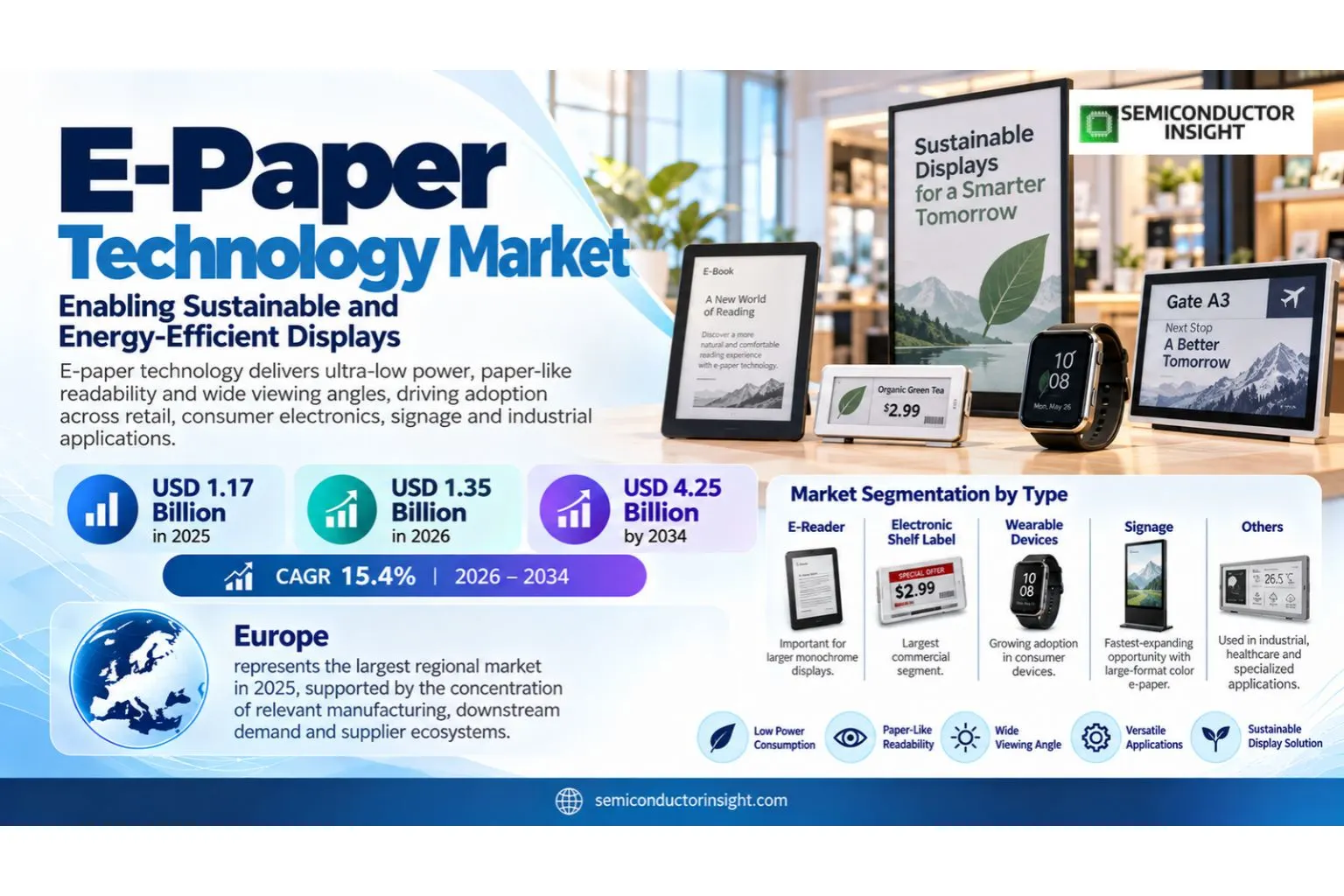
E-paper technology market was valued at USD 1.17 billion in 2025, is estimated at USD 1.35 billion in 2026, and is projected to reach USD 4.25 billion by 2034, advancing at a 15.4% CAGR during 2026–2034. Europe represents the largest regional market in 2025, supported by the concentration of relevant manufacturing, downstream demand and supplier ecosystems.

Get the sample PDF with study scope, segmentation and methodology details.

Key Statistics

2025 Market Size
USD 1.17 billion
2034 Projected Market Size
USD 4.25 billion
CAGR (2026–2034)
15.4%
Largest Market in 2025
Europe

Key Takeaways

  • E-paper technology market was valued at USD 1.17 billion in 2025 and is projected to reach USD 4.25 billion by 2034, representing a 15.4% CAGR over 2026–2034.
  • The market is valued at USD 1.17 billion in 2025 and is projected to reach USD 4.25 billion by 2034, representing a 15.4% CAGR over 2026–2034.
  • Electronic shelf labels are the largest commercial application because bistable e-paper uses power primarily during updates and can operate for years on small batteries.
  • Europe leads adoption through mature electronic shelf-label rollouts, while Asia Pacific remains the core display manufacturing and technology supply base.
  • Color e-paper is expanding the addressable market from price tags and e-readers toward advertising, transit information and large-format digital signage.

E-Paper Technology Market Overview

E-paper technology market was valued at USD 1.17 billion in 2025, is estimated at USD 1.35 billion in 2026, and is projected to reach USD 4.25 billion by 2034, advancing at a 15.4% CAGR during 2026–2034. Europe represents the largest regional market in 2025, supported by the concentration of relevant manufacturing, downstream demand and supplier ecosystems.

Base year: 2025 · Estimated year: 2026 · Forecast period: 2026–2034 · Values in USD million unless otherwise stated

E-paper is a reflective display technology designed to reproduce paper-like readability while consuming little or no power when a static image is displayed. Electrophoretic particles move under electric fields to form text and graphics, allowing screens to remain readable in bright ambient light without a conventional emissive backlight.

The market has evolved from e-readers into retail, signage, logistics and public-information applications. Electronic shelf labels provide the largest deployed base, while color platforms such as Spectra and Kaleido are enabling larger signage. Improvements in waveform control, system-on-panel integration and color saturation are expanding use cases without sacrificing the technology’s low-power advantage.

The commercial structure of the e-paper technology market is shaped by design qualification, production economics and the interaction between component performance and downstream system requirements. Suppliers that can combine consistent manufacturing, application engineering and supply assurance are better positioned to convert technical eligibility into repeat business. Customer decisions increasingly account for lifecycle continuity, geographic resilience and integration cost, which makes proven process control and ecosystem compatibility as important as nominal product capability.

Segment Analysis: By Type

By type, the E-Paper Technology market is segmented into E-Reader, Electronic Shelf Label, Wearable Devices, Signage, Others. Electronic shelf labels are the largest commercial segment, while e-readers remain important for larger monochrome displays. Signage is the fastest-expanding opportunity as full-color e-paper moves into 25-inch, 75-inch and other large formats. Purchasing decisions vary by performance requirement, qualification burden, integration complexity and lifecycle economics, so suppliers compete on application fit rather than on a single technical specification.

Type Role in the market Demand characteristics
E-Reader E-Reader addresses a distinct part of the product and process mix. Its commercial position depends on technical fit, manufacturing maturity, integration requirements and customer qualification rather than on headline specifications alone. Demand is strongest where the segment aligns with established customer designs, predictable supply, and measurable system-level performance. Suppliers that can document repeatability, compatibility and lifecycle support are better placed to defend design wins.
Electronic Shelf Label Electronic Shelf Label addresses a distinct part of the product and process mix. Its commercial position depends on technical fit, manufacturing maturity, integration requirements and customer qualification rather than on headline specifications alone. Demand is strongest where the segment aligns with established customer designs, predictable supply, and measurable system-level performance. Suppliers that can document repeatability, compatibility and lifecycle support are better placed to defend design wins.
Wearable Devices Wearable Devices addresses a distinct part of the product and process mix. Its commercial position depends on technical fit, manufacturing maturity, integration requirements and customer qualification rather than on headline specifications alone. Demand is strongest where the segment aligns with established customer designs, predictable supply, and measurable system-level performance. Suppliers that can document repeatability, compatibility and lifecycle support are better placed to defend design wins.
Signage Signage addresses a distinct part of the product and process mix. Its commercial position depends on technical fit, manufacturing maturity, integration requirements and customer qualification rather than on headline specifications alone. Demand is strongest where the segment aligns with established customer designs, predictable supply, and measurable system-level performance. Suppliers that can document repeatability, compatibility and lifecycle support are better placed to defend design wins.
Others Others addresses a distinct part of the product and process mix. Its commercial position depends on technical fit, manufacturing maturity, integration requirements and customer qualification rather than on headline specifications alone. Demand is strongest where the segment aligns with established customer designs, predictable supply, and measurable system-level performance. Suppliers that can document repeatability, compatibility and lifecycle support are better placed to defend design wins.

Segment Analysis: By Color Capability

By color capability, the E-Paper Technology market is segmented into Monochrome, Three/Four-Color, Full-Color. Monochrome offers the fastest refresh and highest maturity, three- and four-color products serve retail promotion, and full-color platforms such as Spectra 6 and Kaleido expand signage and premium reading applications. Purchasing decisions vary by performance requirement, qualification burden, integration complexity and lifecycle economics, so suppliers compete on application fit rather than on a single technical specification.

Color Capability Role in the market Demand characteristics
Monochrome Monochrome represents a relevant purchasing and deployment pathway within this market. Commercial attractiveness depends on how well it aligns with customer architecture, supply-chain constraints and required performance. Growth is linked to design-in activity, installed-base transitions and the ability of suppliers to meet qualification, cost and availability requirements over the full product lifecycle.
Three/Four-Color Three/Four-Color represents a relevant purchasing and deployment pathway within this market. Commercial attractiveness depends on how well it aligns with customer architecture, supply-chain constraints and required performance. Growth is linked to design-in activity, installed-base transitions and the ability of suppliers to meet qualification, cost and availability requirements over the full product lifecycle.
Full-Color Full-Color represents a relevant purchasing and deployment pathway within this market. Commercial attractiveness depends on how well it aligns with customer architecture, supply-chain constraints and required performance. Growth is linked to design-in activity, installed-base transitions and the ability of suppliers to meet qualification, cost and availability requirements over the full product lifecycle.

Segment Analysis: By Application

By application, the E-Paper Technology market is segmented into Retail & Smart Labels, Public Transport, Advertising & Signage, Consumer Reading, Others. Retail dominates because price and inventory labels can be updated wirelessly without continuous display power. Public transport and advertising benefit from outdoor readability and low operating power, while consumer reading remains a stable established market. Purchasing decisions vary by performance requirement, qualification burden, integration complexity and lifecycle economics, so suppliers compete on application fit rather than on a single technical specification.

Application Role in the market Demand characteristics
Retail & Smart Labels Retail & Smart Labels creates demand when the underlying system requires the market’s core function at production scale. Procurement is normally tied to platform launches, equipment upgrades, capacity expansion or replacement cycles. Buyers evaluate reliability, qualification time, integration cost and vendor support alongside unit economics. Adoption accelerates when the solution removes a system bottleneck or supports a new performance tier without creating disproportionate redesign risk.
Public Transport Public Transport creates demand when the underlying system requires the market’s core function at production scale. Procurement is normally tied to platform launches, equipment upgrades, capacity expansion or replacement cycles. Buyers evaluate reliability, qualification time, integration cost and vendor support alongside unit economics. Adoption accelerates when the solution removes a system bottleneck or supports a new performance tier without creating disproportionate redesign risk.
Advertising & Signage Advertising & Signage creates demand when the underlying system requires the market’s core function at production scale. Procurement is normally tied to platform launches, equipment upgrades, capacity expansion or replacement cycles. Buyers evaluate reliability, qualification time, integration cost and vendor support alongside unit economics. Adoption accelerates when the solution removes a system bottleneck or supports a new performance tier without creating disproportionate redesign risk.
Consumer Reading Consumer Reading creates demand when the underlying system requires the market’s core function at production scale. Procurement is normally tied to platform launches, equipment upgrades, capacity expansion or replacement cycles. Buyers evaluate reliability, qualification time, integration cost and vendor support alongside unit economics. Adoption accelerates when the solution removes a system bottleneck or supports a new performance tier without creating disproportionate redesign risk.
Others Others creates demand when the underlying system requires the market’s core function at production scale. Procurement is normally tied to platform launches, equipment upgrades, capacity expansion or replacement cycles. Buyers evaluate reliability, qualification time, integration cost and vendor support alongside unit economics. Adoption accelerates when the solution removes a system bottleneck or supports a new performance tier without creating disproportionate redesign risk.

Segment Analysis: By Backplane

By backplane, the E-Paper Technology market is segmented into Glass TFT, Flexible / Plastic TFT, System-on-Panel. Glass TFT remains common in rigid labels and signage, flexible backplanes enable lightweight or curved applications, and system-on-panel designs integrate radio and control electronics more directly with the display. Purchasing decisions vary by performance requirement, qualification burden, integration complexity and lifecycle economics, so suppliers compete on application fit rather than on a single technical specification.

Backplane Role in the market Demand characteristics
Glass TFT Glass TFT represents a relevant purchasing and deployment pathway within this market. Commercial attractiveness depends on how well it aligns with customer architecture, supply-chain constraints and required performance. Growth is linked to design-in activity, installed-base transitions and the ability of suppliers to meet qualification, cost and availability requirements over the full product lifecycle.
Flexible / Plastic TFT Flexible / Plastic TFT represents a relevant purchasing and deployment pathway within this market. Commercial attractiveness depends on how well it aligns with customer architecture, supply-chain constraints and required performance. Growth is linked to design-in activity, installed-base transitions and the ability of suppliers to meet qualification, cost and availability requirements over the full product lifecycle.
System-on-Panel System-on-Panel represents a relevant purchasing and deployment pathway within this market. Commercial attractiveness depends on how well it aligns with customer architecture, supply-chain constraints and required performance. Growth is linked to design-in activity, installed-base transitions and the ability of suppliers to meet qualification, cost and availability requirements over the full product lifecycle.

Regional Analysis

Europe leads the e-paper technology market in 2025, while regional growth patterns differ according to manufacturing concentration, customer investment cycles, regulation, product mix and supply-chain access. The most important regional distinction is not simply market size; it is the mechanism that converts local investment and end-market demand into qualified purchases.

How does regional demand differ across the e-paper technology market?

Regional demand for e-paper technology is structurally uneven because manufacturing assets, design centers, downstream customers and qualification ecosystems are not distributed evenly. Asia Pacific typically has the deepest electronics manufacturing base, North America combines technology development with capital investment, Europe emphasizes reliability and industrial requirements, and emerging regions are more dependent on imported systems. These differences influence vendor selection, inventory policy, service expectations and the pace at which new technologies are adopted.

Region Market position Growth outlook Demand profile Supplier-selection gate
Europe Largest Strong Electronic shelf-label adoption led Retail ROI and system interoperability
Asia Pacific Technology and manufacturing hub Very strong Display supply and retail digitalization led Panel cost and scale
North America Large growth market Strong Retail, signage and logistics led Deployment economics and retailer scale
South America Emerging Moderate-strong Retail modernization led Hardware cost and network integration
Middle East & Africa Developing Moderate Premium retail and signage led Cost and retailer concentration

Detailed Regional Blocks

Europe LARGEST MARKET

What defines the Europe e-paper technology market?

Europe leads because major retailers have deployed electronic shelf labels at scale and the region has strong incentives to reduce manual pricing labor and paper consumption. Color and larger signage are expanding the opportunity beyond shelf edges. Supplier strategies therefore need to reflect local qualification practices, channel structure, end-market priorities and the availability of technically comparable alternatives rather than treating the region as a uniform extension of global demand.

Market positionLargest
Growth outlookStrong
Demand profileElectronic shelf-label adoption led
Market access gateRetail ROI and system interoperability
Country / subregion Role Demand logic
France Mature ESL market Large grocery and retail chains have long used digital shelf labels.
Germany Retail and signage demand Automation and sustainability goals support adoption.
Nordic countries Digital retail leaders High labor costs strengthen ESL economics.

Market instances

E Ink states that ESL adoption continued expanding across major retail channels in Europe, the Americas and Asia Pacific during 2025. For suppliers in Europe, the commercial implication is a stronger need to align product qualification, account coverage and inventory planning with the local demand mechanism rather than relying on broad global growth assumptions.

E Ink’s ESL technology can support battery lifetimes of up to five years while enabling wireless price updates and promotional content. For suppliers in Europe, the commercial implication is a stronger need to align product qualification, account coverage and inventory planning with the local demand mechanism rather than relying on broad global growth assumptions.

Retailers increasingly use color e-paper to highlight promotions and synchronize store pricing with online channels. For suppliers in Europe, the commercial implication is a stronger need to align product qualification, account coverage and inventory planning with the local demand mechanism rather than relying on broad global growth assumptions.

Full-report coverage for Europe examines country-level demand, customer concentration, supplier positioning and the technical or commercial requirements that influence qualification. The regional view is designed to distinguish structural demand drivers from short-lived purchasing cycles and to show where market access depends on local manufacturing, distribution, standards, service capability or long-term customer relationships.

Asia Pacific TECHNOLOGY AND MANUFACTURING HUB

What defines the Asia Pacific e-paper technology market?

Asia Pacific is the main e-paper technology and manufacturing base, led by Taiwan, China and Japan. Regional retail digitization and transit applications add a growing domestic demand layer. Supplier strategies therefore need to reflect local qualification practices, channel structure, end-market priorities and the availability of technically comparable alternatives rather than treating the region as a uniform extension of global demand.

Market positionTechnology and manufacturing hub
Growth outlookVery strong
Demand profileDisplay supply and retail digitalization led
Market access gatePanel cost and scale
Country / subregion Role Demand logic
Taiwan E-paper technology hub E Ink anchors global electrophoretic-display technology.
China Manufacturing and retail growth Panel, module and retail deployments scale rapidly.
Japan Reader and signage demand Retail automation and consumer devices support adoption.

Market instances

E Ink and Realtek unveiled a second-generation system-on-panel ESL in March 2025 that reduced TFT area and FPC dimensions while integrating RF functionality directly on glass. For suppliers in Asia Pacific, the commercial implication is a stronger need to align product qualification, account coverage and inventory planning with the local demand mechanism rather than relying on broad global growth assumptions.

E Ink’s Spectra 6 platform supports full-color signage and retail applications, creating new opportunities beyond small labels. For suppliers in Asia Pacific, the commercial implication is a stronger need to align product qualification, account coverage and inventory planning with the local demand mechanism rather than relying on broad global growth assumptions.

Asian electronics manufacturing enables rapid commercialization of new panel sizes and integrated ESL designs. For suppliers in Asia Pacific, the commercial implication is a stronger need to align product qualification, account coverage and inventory planning with the local demand mechanism rather than relying on broad global growth assumptions.

Full-report coverage for Asia Pacific examines country-level demand, customer concentration, supplier positioning and the technical or commercial requirements that influence qualification. The regional view is designed to distinguish structural demand drivers from short-lived purchasing cycles and to show where market access depends on local manufacturing, distribution, standards, service capability or long-term customer relationships.

North America LARGE GROWTH MARKET

What defines the North America e-paper technology market?

North America is a large growth market as major retailers expand ESL and digital-signage pilots into larger deployments. Low-power signage also fits logistics, healthcare and smart-building applications. Supplier strategies therefore need to reflect local qualification practices, channel structure, end-market priorities and the availability of technically comparable alternatives rather than treating the region as a uniform extension of global demand.

Market positionLarge growth market
Growth outlookStrong
Demand profileRetail, signage and logistics led
Market access gateDeployment economics and retailer scale
Country / subregion Role Demand logic
United States Largest regional demand National retailers and signage networks drive adoption.
Canada Retail automation Large chains use ESL to reduce manual price changes.
Mexico Emerging retail digitization Modern trade creates growing label demand.

Market instances

E Ink introduced a 75-inch Spectra 6 full-color display in April 2025 for sustainable digital signage, extending the technology into much larger commercial formats. For suppliers in North America, the commercial implication is a stronger need to align product qualification, account coverage and inventory planning with the local demand mechanism rather than relying on broad global growth assumptions.

Large retailers value the ability to update prices centrally and reduce mismatch between shelf and checkout systems. For suppliers in North America, the commercial implication is a stronger need to align product qualification, account coverage and inventory planning with the local demand mechanism rather than relying on broad global growth assumptions.

Battery-operated displays can lower wiring and installation requirements for distributed signage. For suppliers in North America, the commercial implication is a stronger need to align product qualification, account coverage and inventory planning with the local demand mechanism rather than relying on broad global growth assumptions.

Full-report coverage for North America examines country-level demand, customer concentration, supplier positioning and the technical or commercial requirements that influence qualification. The regional view is designed to distinguish structural demand drivers from short-lived purchasing cycles and to show where market access depends on local manufacturing, distribution, standards, service capability or long-term customer relationships.

South America EMERGING

What defines the South America e-paper technology market?

South America is an emerging market where supermarkets and pharmacy chains are evaluating electronic shelf labels to improve pricing accuracy and labor productivity. Brazil is the main opportunity. Supplier strategies therefore need to reflect local qualification practices, channel structure, end-market priorities and the availability of technically comparable alternatives rather than treating the region as a uniform extension of global demand.

Market positionEmerging
Growth outlookModerate-strong
Demand profileRetail modernization led
Market access gateHardware cost and network integration
Country / subregion Role Demand logic
Brazil Largest regional market Modern retail and logistics create ESL demand.
Chile Digitally advanced retail High modern-trade penetration supports adoption.
Argentina Selective deployment Economics depend heavily on hardware cost and currency.

Market instances

ESL can be attractive in inflationary environments where prices change frequently. For suppliers in South America, the commercial implication is a stronger need to align product qualification, account coverage and inventory planning with the local demand mechanism rather than relying on broad global growth assumptions.

Initial hardware investment remains the main barrier for smaller retailers. For suppliers in South America, the commercial implication is a stronger need to align product qualification, account coverage and inventory planning with the local demand mechanism rather than relying on broad global growth assumptions.

Color e-paper can combine price communication with promotional content, improving the business case. For suppliers in South America, the commercial implication is a stronger need to align product qualification, account coverage and inventory planning with the local demand mechanism rather than relying on broad global growth assumptions.

Full-report coverage for South America examines country-level demand, customer concentration, supplier positioning and the technical or commercial requirements that influence qualification. The regional view is designed to distinguish structural demand drivers from short-lived purchasing cycles and to show where market access depends on local manufacturing, distribution, standards, service capability or long-term customer relationships.

Middle East & Africa DEVELOPING

What defines the Middle East & Africa e-paper technology market?

Middle East and Africa demand is led by Gulf premium retail, airports and public signage, while broader African adoption remains early. Large mall and supermarket operators offer the clearest scale opportunity. Supplier strategies therefore need to reflect local qualification practices, channel structure, end-market priorities and the availability of technically comparable alternatives rather than treating the region as a uniform extension of global demand.

Market positionDeveloping
Growth outlookModerate
Demand profilePremium retail and signage led
Market access gateCost and retailer concentration
Country / subregion Role Demand logic
United Arab Emirates Premium retail and signage Large modern retail formats support color e-paper.
Saudi Arabia Retail modernization Digital transformation creates growth opportunity.
South Africa Regional retail hub Large chains provide a base for ESL adoption.

Market instances

Large malls and transit environments can benefit from low-power signage that remains readable under bright ambient light. For suppliers in Middle East & Africa, the commercial implication is a stronger need to align product qualification, account coverage and inventory planning with the local demand mechanism rather than relying on broad global growth assumptions.

Retail chains with centralized pricing systems have the best economics for ESL deployment. For suppliers in Middle East & Africa, the commercial implication is a stronger need to align product qualification, account coverage and inventory planning with the local demand mechanism rather than relying on broad global growth assumptions.

Hardware affordability remains a constraint in lower-income markets. For suppliers in Middle East & Africa, the commercial implication is a stronger need to align product qualification, account coverage and inventory planning with the local demand mechanism rather than relying on broad global growth assumptions.

Full-report coverage for Middle East & Africa examines country-level demand, customer concentration, supplier positioning and the technical or commercial requirements that influence qualification. The regional view is designed to distinguish structural demand drivers from short-lived purchasing cycles and to show where market access depends on local manufacturing, distribution, standards, service capability or long-term customer relationships.

Competitive Landscape

Competition in the e-paper technology market is determined by technical qualification, manufacturing consistency, customer relationships and the ability to support product lifecycles. Price matters, but it rarely overrides reliability, integration effort or switching cost once a supplier has been designed into a production platform.

The competitive field includes E Ink Holdings, Pervasive Displays, Seekink, Tianma Microelectronics, BOE, Wuxi Vision Peak, alongside other specialized suppliers. Market share can shift when a vendor gains access to a new platform, expands qualified capacity or introduces a technology that materially improves system performance. Because customer validation can be lengthy, incumbent suppliers often benefit from continuity, while challengers need a clear technical or supply-chain advantage to displace an approved source.

Competitive strategy is increasingly multi-dimensional. Leading suppliers invest in process or product development, application engineering and regional support at the same time, while customers seek second-source options where technically feasible. This creates a market in which differentiation is sustained through documented performance, manufacturing yield, quality systems, responsiveness and the ability to support future roadmap transitions without forcing unnecessary redesigns.

Company Competitive position Primary basis of competition
E Ink Holdings Established global / strategic supplier Competes through product capability, qualification, account access and supply execution.
Pervasive Displays Established global / strategic supplier Competes through product capability, qualification, account access and supply execution.
Seekink Established global / strategic supplier Competes through product capability, qualification, account access and supply execution.
Tianma Microelectronics Specialist / regional competitor Competes through product capability, qualification, account access and supply execution.
BOE Specialist / regional competitor Competes through product capability, qualification, account access and supply execution.
Wuxi Vision Peak Specialist / regional competitor Competes through product capability, qualification, account access and supply execution.
Guangzhou OED Technologies Focused challenger / niche participant Competes through product capability, qualification, account access and supply execution.
Realtek Focused challenger / niche participant Competes through product capability, qualification, account access and supply execution.

Production Capacity Analysis

E-paper capacity depends on electrophoretic film production, TFT backplanes, module assembly and waveform electronics. Unlike LCD or OLED, the frontplane material and driving algorithms are specialized, concentrating technology among a limited supplier base.

Taiwan and China provide the strongest manufacturing ecosystem. E Ink continues to invest in color platforms and production capacity, while system partners integrate radios, batteries and management software into finished retail and signage products.

Capacity should therefore be evaluated on a qualified-output basis rather than as nominal installed capability. A supplier may possess equipment or production lines that appear suitable but still require customer-specific validation, process tuning, test correlation or upstream material qualification. This distinction becomes especially important during demand spikes, when headline capacity can overstate the volume that is immediately available for a particular application, technology generation or reliability class.

Market Dynamics

The e-paper technology market is being shaped by rising performance requirements and technology transitions on the demand side, while qualification complexity, supply concentration and cost discipline constrain the pace of adoption. The balance of these forces favors suppliers that can solve a measurable system problem without increasing integration risk.

Demand expansion is not uniform across all product variants or customer groups. New technology creates attractive design opportunities, but buyers typically require a clear economic or performance case before changing a qualified architecture. At the same time, supply-chain localization, capacity investment and tighter quality requirements are changing procurement behavior. As a result, growth is likely to concentrate around applications where performance upgrades, manufacturing scale and lifecycle value reinforce one another.

Market Drivers

Four forces provide the strongest support for demand in the e-paper technology market: performance-driven technology upgrades, expansion of relevant downstream applications, investment in manufacturing or infrastructure, and the need for more resilient supply. Their importance varies by segment, but each creates a direct reason for customers to qualify or purchase additional solutions.

Driver Impact Commercial mechanism
Retail automation reduces manual price-change labor High ESLs allow centralized updates across thousands of labels.
Bistable displays use very little energy High Power is mainly needed during image changes, enabling long battery life.
Color e-paper expands signage applications Medium-High Improved color saturation supports promotions, advertising and public information.
Outdoor readability is strong Medium-High Reflective displays remain visible under bright ambient light without high-power backlights.

Retail automation reduces manual price-change labor

ESLs allow centralized updates across thousands of labels. The commercial effect is strongest where customers can link the technology change to higher throughput, lower power, improved reliability, reduced lifecycle cost or access to a new end-market requirement.

Bistable displays use very little energy

Power is mainly needed during image changes, enabling long battery life. The commercial effect is strongest where customers can link the technology change to higher throughput, lower power, improved reliability, reduced lifecycle cost or access to a new end-market requirement.

Color e-paper expands signage applications

Improved color saturation supports promotions, advertising and public information. The commercial effect is strongest where customers can link the technology change to higher throughput, lower power, improved reliability, reduced lifecycle cost or access to a new end-market requirement.

Outdoor readability is strong

Reflective displays remain visible under bright ambient light without high-power backlights. The commercial effect is strongest where customers can link the technology change to higher throughput, lower power, improved reliability, reduced lifecycle cost or access to a new end-market requirement.

Market Restraints

Growth is moderated by qualification burden, cyclical purchasing, technology substitution and supply-chain risk. These restraints do not eliminate demand, but they can extend sales cycles, limit supplier switching and reduce the speed at which technically superior solutions convert into production revenue.

Restraint Impact Commercial consequence
Refresh speed is slower than LCD or OLED High E-paper is not suited to high-frame-rate video or animation.
Initial hardware cost can be significant High Large retail deployments require labels, gateways, software and installation.
Color performance remains below emissive displays Medium Full-color e-paper prioritizes low power over saturated video-class color.
Temperature can affect performance Medium Cold environments require specialized formulations and update strategies.

Refresh speed is slower than LCD or OLED

E-paper is not suited to high-frame-rate video or animation. Suppliers can mitigate part of this pressure through stronger qualification support, transparent lifecycle planning, dual-source strategies and better alignment between product roadmaps and customer production schedules.

Initial hardware cost can be significant

Large retail deployments require labels, gateways, software and installation. Suppliers can mitigate part of this pressure through stronger qualification support, transparent lifecycle planning, dual-source strategies and better alignment between product roadmaps and customer production schedules.

Color performance remains below emissive displays

Full-color e-paper prioritizes low power over saturated video-class color. Suppliers can mitigate part of this pressure through stronger qualification support, transparent lifecycle planning, dual-source strategies and better alignment between product roadmaps and customer production schedules.

Temperature can affect performance

Cold environments require specialized formulations and update strategies. Suppliers can mitigate part of this pressure through stronger qualification support, transparent lifecycle planning, dual-source strategies and better alignment between product roadmaps and customer production schedules.

Market Opportunities

The most attractive opportunities in the e-paper technology market occur where a technology transition creates measurable value and where suppliers can enter before the customer architecture is locked. Early engagement, application-specific engineering and credible supply planning can convert these windows into durable design positions.

Large-format digital signage

75-inch and other large color panels open advertising and transit applications. The opportunity is strongest for suppliers that can demonstrate performance with production-relevant data, provide engineering support during qualification and maintain a roadmap that gives customers confidence in long-term availability.

System-on-panel ESL

Integrated RF and control electronics can reduce border size, material use and assembly complexity. The opportunity is strongest for suppliers that can demonstrate performance with production-relevant data, provide engineering support during qualification and maintain a roadmap that gives customers confidence in long-term availability.

Smart logistics labels

Battery-powered tags can display routing, inventory and status information dynamically. The opportunity is strongest for suppliers that can demonstrate performance with production-relevant data, provide engineering support during qualification and maintain a roadmap that gives customers confidence in long-term availability.

Sustainable advertising

Low-energy signage can replace paper posters or continuously powered LCD displays. The opportunity is strongest for suppliers that can demonstrate performance with production-relevant data, provide engineering support during qualification and maintain a roadmap that gives customers confidence in long-term availability.

Supply Chain Analysis

Stage 1
Electrophoretic film and pigments
Stage 2
TFT backplane and module assembly
Stage 3
Driver electronics and wireless modules
Stage 4
Retail and signage systems

Electrophoretic film and pigments

Charged particles and frontplane films create the reflective image layer. Value capture at this stage depends on quality consistency, technical differentiation and the difficulty of substitution. Bottlenecks can propagate downstream when qualification or material compatibility prevents customers from shifting quickly to an alternative supplier.

TFT backplane and module assembly

Glass or flexible backplanes control pixels and are laminated with the e-paper film. Value capture at this stage depends on quality consistency, technical differentiation and the difficulty of substitution. Bottlenecks can propagate downstream when qualification or material compatibility prevents customers from shifting quickly to an alternative supplier.

Driver electronics and wireless modules

Controllers, radios and batteries enable updates and remote content management. Value capture at this stage depends on quality consistency, technical differentiation and the difficulty of substitution. Bottlenecks can propagate downstream when qualification or material compatibility prevents customers from shifting quickly to an alternative supplier.

Retail and signage systems

Software platforms connect thousands of labels or displays to pricing and content databases. Value capture at this stage depends on quality consistency, technical differentiation and the difficulty of substitution. Bottlenecks can propagate downstream when qualification or material compatibility prevents customers from shifting quickly to an alternative supplier.

Recent Developments

Recent developments show how technology roadmaps, manufacturing investment and standards are changing the competitive requirements of the e-paper technology market. The entries below are selected for their direct relevance to product capability, capacity, qualification or downstream adoption rather than for general corporate activity.

March 2025 · E Ink

E Ink and Realtek introduced a second-generation system-on-panel ESL that integrates RF circuitry onto the display glass and reduces TFT and flexible-circuit footprint, simplifying label design. Source

March 2025 · E Ink

E Ink introduced Ripple and a second-generation waveform architecture for Spectra displays, expanding color options and reducing visual flashing during updates. Source

April 2025 · E Ink

E Ink unveiled a 75-inch Spectra 6 full-color e-paper display for low-power digital signage, significantly expanding the available commercial display size. Source

Report Scope & Segmentation

Report attribute Coverage
Market E-Paper Technology
Base Year 2025
Estimated Year 2026
Forecast Period 2026–2034
2025 Market Size USD 1.17 billion
2026 Estimated Size USD 1.35 billion
2034 Forecast Size USD 4.25 billion
CAGR (2026–2034) 15.4%
Largest Market in 2025 Europe
By Type E-Reader, Electronic Shelf Label, Wearable Devices, Signage, Others
By Application Retail & Smart Labels, Public Transport, Advertising & Signage, Consumer Reading, Others
By Color Capability Monochrome, Three/Four-Color, Full-Color
By Backplane Glass TFT, Flexible / Plastic TFT, System-on-Panel
Companies Profiled E Ink Holdings, Pervasive Displays, Seekink, Tianma Microelectronics, BOE, Wuxi Vision Peak, Guangzhou OED Technologies, Realtek

Frequently Asked Questions

What was the e-paper technology market size in 2025?

The global e-paper technology market was valued at USD 1.17 billion in 2025. The 2025 value is the base-year reference used throughout this overview and provides the starting point for comparing the 2026 estimate and the 2034 forecast.

What is the projected e-paper technology market size in 2034?

The global market is projected to reach USD 4.25 billion by 2034. The forecast reflects the interaction of downstream adoption, technology transitions, production investment and the qualification requirements that shape commercial conversion across the market.

What is the CAGR of the e-paper technology market from 2026 to 2034?

The e-paper technology market is expected to expand at a 15.4% CAGR during 2026–2034. Growth will not be uniform across every product or region because customer qualification, capital cycles, supply constraints and application-specific performance requirements differ materially.

Which region is the largest e-paper technology market?

Europe is the largest regional market in 2025. Its position is supported by the concentration of relevant manufacturing, customers, technology ecosystems and downstream demand, although the precise commercial mechanism differs by country and application.

How is the e-paper technology market segmented by type?

By type, the market is segmented into E-Reader, Electronic Shelf Label, Wearable Devices, Signage, Others. These categories address different performance, cost and integration requirements, so supplier selection depends on application fit, qualification history and lifecycle economics rather than a single specification.

What are the main applications for e-paper technology?

By application, the market covers Retail & Smart Labels, Public Transport, Advertising & Signage, Consumer Reading, Others. Demand in each application is linked to platform launches, capacity expansion, equipment replacement and the degree to which the technology improves system performance or manufacturing economics.

What are the principal growth drivers for the e-paper technology market?

Key drivers include retail automation reduces manual price-change labor and bistable displays use very little energy. These forces increase demand when customers can translate technical improvements into higher performance, lower cost, greater reliability or access to new applications.

What are the main restraints in the e-paper technology market?

Important restraints include refresh speed is slower than lcd or oled and initial hardware cost can be significant. The resulting qualification burden, purchasing cyclicality and technology risk can extend sales cycles and limit rapid supplier substitution even when new solutions offer clear technical advantages.

Which companies participate in the e-paper technology market?

Companies profiled in this market include E Ink Holdings, Pervasive Displays, Seekink, Tianma Microelectronics, BOE, Wuxi Vision Peak, Guangzhou OED Technologies, Realtek. Competition centers on qualification, product or process performance, manufacturing consistency, customer support and the ability to maintain supply across the required product lifecycle.

What should buyers evaluate when selecting a e-paper technology supplier?

Buyers should evaluate demonstrated performance, qualification history, manufacturing consistency, lifecycle support, supply resilience and integration cost. A technically strong product can still face adoption barriers if it increases redesign risk, lacks regional support or cannot meet the customer’s production and quality requirements.

Research Sources & Evidence Base

View research sources used for this overview.
  1. E Ink. Electronic Shelf Label application — Battery life, readability and retail operating benefits.
  2. E Ink. 2025 shareholder / business update — ESL adoption and color e-paper commercialization across regions.
  3. E Ink. Spectra 6 75-inch display — Large-format full-color e-paper signage launch.
  4. E Ink. Second-generation System-on-Panel ESL — Integrated RF and display architecture for next-generation retail labels.
E-Paper Technology Market Size, Share & Industry Analysis, By Type (E-Reader, Electronic Shelf Label, Wearable Devices, Signage, Others), By Application (Retail & Smart Labels, Public Transport, Advertising & Signage, Consumer Reading, Others), By Color Capability (Monochrome, Three/Four-Color, Full-Color), By Backplane (Glass TFT, Flexible / Plastic TFT, System-on-Panel), and Regional Forecast, 2026-2034

Get Sample Report PDF for Exclusive Insights

Report Sample Includes

  • Table of Contents
  • List of Tables & Figures
  • Charts, Research Methodology, and more...

PDF Icon Download Sample Report PDF

Download Sample Report

Table of Content

Table of Contents
1 Research Methodology and Statistical Scope
1.1 Market Definition and Statistical Scope of E-Paper Technology
1.2 Key Market Segments
1.2.1 E-Paper Technology Segment by Type
1.2.2 E-Paper Technology Segment by Application
1.3 Methodology & Sources of Information
1.3.1 Research Methodology
1.3.2 Research Process
1.3.3 Market Breakdown and Data Triangulation
1.3.4 Base Year
1.3.5 Report Assumptions & Caveats
2 E-Paper Technology Market Overview
2.1 Global Market Overview
2.1.1 Global E-Paper Technology Market Size (M USD) Estimates and Forecasts (2026-2034)
2.1.2 Global E-Paper Technology Sales Estimates and Forecasts (2026-2034)
2.2 Market Segment Executive Summary
2.3 Global Market Size by Region
3 E-Paper Technology Market Competitive Landscape
3.1 Global E-Paper Technology Sales by Manufacturers (2019-2025)
3.2 Global E-Paper Technology Revenue Market Share by Manufacturers (2019-2025)
3.3 E-Paper Technology Market Share by Company Type (Tier 1, Tier 2, and Tier 3)
3.4 Global E-Paper Technology Average Price by Manufacturers (2019-2025)
3.5 Manufacturers E-Paper Technology Sales Sites, Area Served, Product Type
3.6 E-Paper Technology Market Competitive Situation and Trends
3.6.1 E-Paper Technology Market Concentration Rate
3.6.2 Global 5 and 10 Largest E-Paper Technology Players Market Share by Revenue
3.6.3 Mergers & Acquisitions, Expansion
4 E-Paper Technology Industry Chain Analysis
4.1 E-Paper Technology Industry Chain Analysis
4.2 Market Overview of Key Raw Materials
4.3 Midstream Market Analysis
4.4 Downstream Customer Analysis
5 The Development and Dynamics of E-Paper Technology Market
5.1 Key Development Trends
5.2 Driving Factors
5.3 Market Challenges
5.4 Market Restraints
5.5 Industry News
5.5.1 New Product Developments
5.5.2 Mergers & Acquisitions
5.5.3 Expansions
5.5.4 Collaboration/Supply Contracts
5.6 Industry Policies
6 E-Paper Technology Market Segmentation by Type
6.1 Evaluation Matrix of Segment Market Development Potential (Type)
6.2 Global E-Paper Technology Sales Market Share by Type (2019-2025)
6.3 Global E-Paper Technology Market Size Market Share by Type (2019-2025)
6.4 Global E-Paper Technology Price by Type (2019-2025)
7 E-Paper Technology Market Segmentation by Application
7.1 Evaluation Matrix of Segment Market Development Potential (Application)
7.2 Global E-Paper Technology Market Sales by Application (2019-2025)
7.3 Global E-Paper Technology Market Size (M USD) by Application (2019-2025)
7.4 Global E-Paper Technology Sales Growth Rate by Application (2019-2025)
8 E-Paper Technology Market Consumption by Region
8.1 Global E-Paper Technology Sales by Region
8.1.1 Global E-Paper Technology Sales by Region
8.1.2 Global E-Paper Technology Sales Market Share by Region
8.2 North America
8.2.1 North America E-Paper Technology Sales by Country
8.2.2 U.S.
8.2.3 Canada
8.2.4 Mexico
8.3 Europe
8.3.1 Europe E-Paper Technology Sales by Country
8.3.2 Germany
8.3.3 France
8.3.4 U.K.
8.3.5 Italy
8.3.6 Russia
8.4 Asia Pacific
8.4.1 Asia Pacific E-Paper Technology Sales by Region
8.4.2 China
8.4.3 Japan
8.4.4 South Korea
8.4.5 India
8.4.6 Southeast Asia
8.5 South America
8.5.1 South America E-Paper Technology Sales by Country
8.5.2 Brazil
8.5.3 Argentina
8.5.4 Columbia
8.6 Middle East and Africa
8.6.1 Middle East and Africa E-Paper Technology Sales by Region
8.6.2 Saudi Arabia
8.6.3 UAE
8.6.4 Egypt
8.6.5 Nigeria
8.6.6 South Africa
9 E-Paper Technology Market Production by Region
9.1 Global Production of E-Paper Technology by Region (2019-2025)
9.2 Global E-Paper Technology Revenue Market Share by Region (2019-2025)
9.3 Global E-Paper Technology Production, Revenue, Price and Gross Margin (2019-2025)
9.4 North America E-Paper Technology Production
9.4.1 North America E-Paper Technology Production Growth Rate (2019-2025)
9.4.2 North America E-Paper Technology Production, Revenue, Price and Gross Margin (2019-2025)
9.5 Europe E-Paper Technology Production
9.5.1 Europe E-Paper Technology Production Growth Rate (2019-2025)
9.5.2 Europe E-Paper Technology Production, Revenue, Price and Gross Margin (2019-2025)
9.6 Japan E-Paper Technology Production (2019-2025)
9.6.1 Japan E-Paper Technology Production Growth Rate (2019-2025)
9.6.2 Japan E-Paper Technology Production, Revenue, Price and Gross Margin (2019-2025)
9.7 China E-Paper Technology Production (2019-2025)
9.7.1 China E-Paper Technology Production Growth Rate (2019-2025)
9.7.2 China E-Paper Technology Production, Revenue, Price and Gross Margin (2019-2025)
10 Key Companies Profile
10.1 E Ink Holdings Incorporated
10.1.1 E Ink Holdings Incorporated E-Paper Technology Basic Information
10.1.2 E Ink Holdings Incorporated E-Paper Technology Product Overview
10.1.3 E Ink Holdings Incorporated E-Paper Technology Product Market Performance
10.1.4 E Ink Holdings Incorporated Business Overview
10.1.5 E Ink Holdings Incorporated E-Paper Technology SWOT Analysis
10.1.6 E Ink Holdings Incorporated Recent Developments
10.2 Pervisive Displays
10.2.1 Pervisive Displays E-Paper Technology Basic Information
10.2.2 Pervisive Displays E-Paper Technology Product Overview
10.2.3 Pervisive Displays E-Paper Technology Product Market Performance
10.2.4 Pervisive Displays Business Overview
10.2.5 Pervisive Displays E-Paper Technology SWOT Analysis
10.2.6 Pervisive Displays Recent Developments
10.3 Seekink
10.3.1 Seekink E-Paper Technology Basic Information
10.3.2 Seekink E-Paper Technology Product Overview
10.3.3 Seekink E-Paper Technology Product Market Performance
10.3.4 Seekink E-Paper Technology SWOT Analysis
10.3.5 Seekink Business Overview
10.3.6 Seekink Recent Developments
10.4 Tianma Microelectronics Co.,Ltd.
10.4.1 Tianma Microelectronics Co.,Ltd. E-Paper Technology Basic Information
10.4.2 Tianma Microelectronics Co.,Ltd. E-Paper Technology Product Overview
10.4.3 Tianma Microelectronics Co.,Ltd. E-Paper Technology Product Market Performance
10.4.4 Tianma Microelectronics Co.,Ltd. Business Overview
10.4.5 Tianma Microelectronics Co.,Ltd. Recent Developments
10.5 Samsung
10.5.1 Samsung E-Paper Technology Basic Information
10.5.2 Samsung E-Paper Technology Product Overview
10.5.3 Samsung E-Paper Technology Product Market Performance
10.5.4 Samsung Business Overview
10.5.5 Samsung Recent Developments
10.6 Shenzhen Laibao Hi-tech Co.,Ltd.
10.6.1 Shenzhen Laibao Hi-tech Co.,Ltd. E-Paper Technology Basic Information
10.6.2 Shenzhen Laibao Hi-tech Co.,Ltd. E-Paper Technology Product Overview
10.6.3 Shenzhen Laibao Hi-tech Co.,Ltd. E-Paper Technology Product Market Performance
10.6.4 Shenzhen Laibao Hi-tech Co.,Ltd. Business Overview
10.6.5 Shenzhen Laibao Hi-tech Co.,Ltd. Recent Developments
10.7 Admiral Overseas Corporation
10.7.1 Admiral Overseas Corporation E-Paper Technology Basic Information
10.7.2 Admiral Overseas Corporation E-Paper Technology Product Overview
10.7.3 Admiral Overseas Corporation E-Paper Technology Product Market Performance
10.7.4 Admiral Overseas Corporation Business Overview
10.7.5 Admiral Overseas Corporation Recent Developments
10.8 Refond
10.8.1 Refond E-Paper Technology Basic Information
10.8.2 Refond E-Paper Technology Product Overview
10.8.3 Refond E-Paper Technology Product Market Performance
10.8.4 Refond Business Overview
10.8.5 Refond Recent Developments
11 E-Paper Technology Market Forecast by Region
11.1 Global E-Paper Technology Market Size Forecast
11.2 Global E-Paper Technology Market Forecast by Region
11.2.1 North America Market Size Forecast by Country
11.2.2 Europe E-Paper Technology Market Size Forecast by Country
11.2.3 Asia Pacific E-Paper Technology Market Size Forecast by Region
11.2.4 South America E-Paper Technology Market Size Forecast by Country
11.2.5 Middle East and Africa Forecasted Consumption of E-Paper Technology by Country
12 Forecast Market by Type and by Application (2025-2032)
12.1 Global E-Paper Technology Market Forecast by Type (2025-2032)
12.1.1 Global Forecasted Sales of E-Paper Technology by Type (2025-2032)
12.1.2 Global E-Paper Technology Market Size Forecast by Type (2025-2032)
12.1.3 Global Forecasted Price of E-Paper Technology by Type (2025-2032)
12.2 Global E-Paper Technology Market Forecast by Application (2025-2032)
12.2.1 Global E-Paper Technology Sales (K Units) Forecast by Application
12.2.2 Global E-Paper Technology Market Size (M USD) Forecast by Application (2025-2032)
13 Conclusion and Key FindingsList of Tables
Table 1. Introduction of the Type
Table 2. Introduction of the Application
Table 3. Market Size (M USD) Segment Executive Summary
Table 4. E-Paper Technology Market Size Comparison by Region (M USD)
Table 5. Global E-Paper Technology Sales (K Units) by Manufacturers (2019-2025)
Table 6. Global E-Paper Technology Sales Market Share by Manufacturers (2019-2025)
Table 7. Global E-Paper Technology Revenue (M USD) by Manufacturers (2019-2025)
Table 8. Global E-Paper Technology Revenue Share by Manufacturers (2019-2025)
Table 9. Company Type (Tier 1, Tier 2, and Tier 3) & (based on the Revenue in E-Paper Technology as of 2022)
Table 10. Global Market E-Paper Technology Average Price (USD/Unit) of Key Manufacturers (2019-2025)
Table 11. Manufacturers E-Paper Technology Sales Sites and Area Served
Table 12. Manufacturers E-Paper Technology Product Type
Table 13. Global E-Paper Technology Manufacturers Market Concentration Ratio (CR5 and HHI)
Table 14. Mergers & Acquisitions, Expansion Plans
Table 15. Industry Chain Map of E-Paper Technology
Table 16. Market Overview of Key Raw Materials
Table 17. Midstream Market Analysis
Table 18. Downstream Customer Analysis
Table 19. Key Development Trends
Table 20. Driving Factors
Table 21. E-Paper Technology Market Challenges
Table 22. Global E-Paper Technology Sales by Type (K Units)
Table 23. Global E-Paper Technology Market Size by Type (M USD)
Table 24. Global E-Paper Technology Sales (K Units) by Type (2019-2025)
Table 25. Global E-Paper Technology Sales Market Share by Type (2019-2025)
Table 26. Global E-Paper Technology Market Size (M USD) by Type (2019-2025)
Table 27. Global E-Paper Technology Market Size Share by Type (2019-2025)
Table 28. Global E-Paper Technology Price (USD/Unit) by Type (2019-2025)
Table 29. Global E-Paper Technology Sales (K Units) by Application
Table 30. Global E-Paper Technology Market Size by Application
Table 31. Global E-Paper Technology Sales by Application (2019-2025) & (K Units)
Table 32. Global E-Paper Technology Sales Market Share by Application (2019-2025)
Table 33. Global E-Paper Technology Sales by Application (2019-2025) & (M USD)
Table 34. Global E-Paper Technology Market Share by Application (2019-2025)
Table 35. Global E-Paper Technology Sales Growth Rate by Application (2019-2025)
Table 36. Global E-Paper Technology Sales by Region (2019-2025) & (K Units)
Table 37. Global E-Paper Technology Sales Market Share by Region (2019-2025)
Table 38. North America E-Paper Technology Sales by Country (2019-2025) & (K Units)
Table 39. Europe E-Paper Technology Sales by Country (2019-2025) & (K Units)
Table 40. Asia Pacific E-Paper Technology Sales by Region (2019-2025) & (K Units)
Table 41. South America E-Paper Technology Sales by Country (2019-2025) & (K Units)
Table 42. Middle East and Africa E-Paper Technology Sales by Region (2019-2025) & (K Units)
Table 43. Global E-Paper Technology Production (K Units) by Region (2019-2025)
Table 44. Global E-Paper Technology Revenue (US$ Million) by Region (2019-2025)
Table 45. Global E-Paper Technology Revenue Market Share by Region (2019-2025)
Table 46. Global E-Paper Technology Production (K Units), Revenue (US$ Million), Price (USD/Unit) and Gross Margin (2019-2025)
Table 47. North America E-Paper Technology Production (K Units), Revenue (US$ Million), Price (USD/Unit) and Gross Margin (2019-2025)
Table 48. Europe E-Paper Technology Production (K Units), Revenue (US$ Million), Price (USD/Unit) and Gross Margin (2019-2025)
Table 49. Japan E-Paper Technology Production (K Units), Revenue (US$ Million), Price (USD/Unit) and Gross Margin (2019-2025)
Table 50. China E-Paper Technology Production (K Units), Revenue (US$ Million), Price (USD/Unit) and Gross Margin (2019-2025)
Table 51. E Ink Holdings Incorporated E-Paper Technology Basic Information
Table 52. E Ink Holdings Incorporated E-Paper Technology Product Overview
Table 53. E Ink Holdings Incorporated E-Paper Technology Sales (K Units), Revenue (M USD), Price (USD/Unit) and Gross Margin (2019-2025)
Table 54. E Ink Holdings Incorporated Business Overview
Table 55. E Ink Holdings Incorporated E-Paper Technology SWOT Analysis
Table 56. E Ink Holdings Incorporated Recent Developments
Table 57. Pervisive Displays E-Paper Technology Basic Information
Table 58. Pervisive Displays E-Paper Technology Product Overview
Table 59. Pervisive Displays E-Paper Technology Sales (K Units), Revenue (M USD), Price (USD/Unit) and Gross Margin (2019-2025)
Table 60. Pervisive Displays Business Overview
Table 61. Pervisive Displays E-Paper Technology SWOT Analysis
Table 62. Pervisive Displays Recent Developments
Table 63. Seekink E-Paper Technology Basic Information
Table 64. Seekink E-Paper Technology Product Overview
Table 65. Seekink E-Paper Technology Sales (K Units), Revenue (M USD), Price (USD/Unit) and Gross Margin (2019-2025)
Table 66. Seekink E-Paper Technology SWOT Analysis
Table 67. Seekink Business Overview
Table 68. Seekink Recent Developments
Table 69. Tianma Microelectronics Co.,Ltd. E-Paper Technology Basic Information
Table 70. Tianma Microelectronics Co.,Ltd. E-Paper Technology Product Overview
Table 71. Tianma Microelectronics Co.,Ltd. E-Paper Technology Sales (K Units), Revenue (M USD), Price (USD/Unit) and Gross Margin (2019-2025)
Table 72. Tianma Microelectronics Co.,Ltd. Business Overview
Table 73. Tianma Microelectronics Co.,Ltd. Recent Developments
Table 74. Samsung E-Paper Technology Basic Information
Table 75. Samsung E-Paper Technology Product Overview
Table 76. Samsung E-Paper Technology Sales (K Units), Revenue (M USD), Price (USD/Unit) and Gross Margin (2019-2025)
Table 77. Samsung Business Overview
Table 78. Samsung Recent Developments
Table 79. Shenzhen Laibao Hi-tech Co.,Ltd. E-Paper Technology Basic Information
Table 80. Shenzhen Laibao Hi-tech Co.,Ltd. E-Paper Technology Product Overview
Table 81. Shenzhen Laibao Hi-tech Co.,Ltd. E-Paper Technology Sales (K Units), Revenue (M USD), Price (USD/Unit) and Gross Margin (2019-2025)
Table 82. Shenzhen Laibao Hi-tech Co.,Ltd. Business Overview
Table 83. Shenzhen Laibao Hi-tech Co.,Ltd. Recent Developments
Table 84. Admiral Overseas Corporation E-Paper Technology Basic Information
Table 85. Admiral Overseas Corporation E-Paper Technology Product Overview
Table 86. Admiral Overseas Corporation E-Paper Technology Sales (K Units), Revenue (M USD), Price (USD/Unit) and Gross Margin (2019-2025)
Table 87. Admiral Overseas Corporation Business Overview
Table 88. Admiral Overseas Corporation Recent Developments
Table 89. Refond E-Paper Technology Basic Information
Table 90. Refond E-Paper Technology Product Overview
Table 91. Refond E-Paper Technology Sales (K Units), Revenue (M USD), Price (USD/Unit) and Gross Margin (2019-2025)
Table 92. Refond Business Overview
Table 93. Refond Recent Developments
Table 94. Global E-Paper Technology Sales Forecast by Region (2025-2032) & (K Units)
Table 95. Global E-Paper Technology Market Size Forecast by Region (2025-2032) & (M USD)
Table 96. North America E-Paper Technology Sales Forecast by Country (2025-2032) & (K Units)
Table 97. North America E-Paper Technology Market Size Forecast by Country (2025-2032) & (M USD)
Table 98. Europe E-Paper Technology Sales Forecast by Country (2025-2032) & (K Units)
Table 99. Europe E-Paper Technology Market Size Forecast by Country (2025-2032) & (M USD)
Table 100. Asia Pacific E-Paper Technology Sales Forecast by Region (2025-2032) & (K Units)
Table 101. Asia Pacific E-Paper Technology Market Size Forecast by Region (2025-2032) & (M USD)
Table 102. South America E-Paper Technology Sales Forecast by Country (2025-2032) & (K Units)
Table 103. South America E-Paper Technology Market Size Forecast by Country (2025-2032) & (M USD)
Table 104. Middle East and Africa E-Paper Technology Consumption Forecast by Country (2025-2032) & (Units)
Table 105. Middle East and Africa E-Paper Technology Market Size Forecast by Country (2025-2032) & (M USD)
Table 106. Global E-Paper Technology Sales Forecast by Type (2025-2032) & (K Units)
Table 107. Global E-Paper Technology Market Size Forecast by Type (2025-2032) & (M USD)
Table 108. Global E-Paper Technology Price Forecast by Type (2025-2032) & (USD/Unit)
Table 109. Global E-Paper Technology Sales (K Units) Forecast by Application (2025-2032)
Table 110. Global E-Paper Technology Market Size Forecast by Application (2025-2032) & (M USD)
List of Figures
Figure 1. Product Picture of E-Paper Technology
Figure 2. Data Triangulation
Figure 3. Key Caveats
Figure 4. Global E-Paper Technology Market Size (M USD), 2026-2034
Figure 5. Global E-Paper Technology Market Size (M USD) (2026-2034)
Figure 6. Global E-Paper Technology Sales (K Units) & (2026-2034)
Figure 7. Evaluation Matrix of Segment Market Development Potential (Type)
Figure 8. Evaluation Matrix of Segment Market Development Potential (Application)
Figure 9. Evaluation Matrix of Regional Market Development Potential
Figure 10. E-Paper Technology Market Size by Country (M USD)
Figure 11. E-Paper Technology Sales Share by Manufacturers in 2023
Figure 12. Global E-Paper Technology Revenue Share by Manufacturers in 2023
Figure 13. E-Paper Technology Market Share by Company Type (Tier 1, Tier 2 and Tier 3): 2023
Figure 14. Global Market E-Paper Technology Average Price (USD/Unit) of Key Manufacturers in 2023
Figure 15. The Global 5 and 10 Largest Players: Market Share by E-Paper Technology Revenue in 2023
Figure 16. Evaluation Matrix of Segment Market Development Potential (Type)
Figure 17. Global E-Paper Technology Market Share by Type
Figure 18. Sales Market Share of E-Paper Technology by Type (2019-2025)
Figure 19. Sales Market Share of E-Paper Technology by Type in 2023
Figure 20. Market Size Share of E-Paper Technology by Type (2019-2025)
Figure 21. Market Size Market Share of E-Paper Technology by Type in 2023
Figure 22. Evaluation Matrix of Segment Market Development Potential (Application)
Figure 23. Global E-Paper Technology Market Share by Application
Figure 24. Global E-Paper Technology Sales Market Share by Application (2019-2025)
Figure 25. Global E-Paper Technology Sales Market Share by Application in 2023
Figure 26. Global E-Paper Technology Market Share by Application (2019-2025)
Figure 27. Global E-Paper Technology Market Share by Application in 2023
Figure 28. Global E-Paper Technology Sales Growth Rate by Application (2019-2025)
Figure 29. Global E-Paper Technology Sales Market Share by Region (2019-2025)
Figure 30. North America E-Paper Technology Sales and Growth Rate (2019-2025) & (K Units)
Figure 31. North America E-Paper Technology Sales Market Share by Country in 2023
Figure 32. U.S. E-Paper Technology Sales and Growth Rate (2019-2025) & (K Units)
Figure 33. Canada E-Paper Technology Sales (K Units) and Growth Rate (2019-2025)
Figure 34. Mexico E-Paper Technology Sales (Units) and Growth Rate (2019-2025)
Figure 35. Europe E-Paper Technology Sales and Growth Rate (2019-2025) & (K Units)
Figure 36. Europe E-Paper Technology Sales Market Share by Country in 2023
Figure 37. Germany E-Paper Technology Sales and Growth Rate (2019-2025) & (K Units)
Figure 38. France E-Paper Technology Sales and Growth Rate (2019-2025) & (K Units)
Figure 39. U.K. E-Paper Technology Sales and Growth Rate (2019-2025) & (K Units)
Figure 40. Italy E-Paper Technology Sales and Growth Rate (2019-2025) & (K Units)
Figure 41. Russia E-Paper Technology Sales and Growth Rate (2019-2025) & (K Units)
Figure 42. Asia Pacific E-Paper Technology Sales and Growth Rate (K Units)
Figure 43. Asia Pacific E-Paper Technology Sales Market Share by Region in 2023
Figure 44. China E-Paper Technology Sales and Growth Rate (2019-2025) & (K Units)
Figure 45. Japan E-Paper Technology Sales and Growth Rate (2019-2025) & (K Units)
Figure 46. South Korea E-Paper Technology Sales and Growth Rate (2019-2025) & (K Units)
Figure 47. India E-Paper Technology Sales and Growth Rate (2019-2025) & (K Units)
Figure 48. Southeast Asia E-Paper Technology Sales and Growth Rate (2019-2025) & (K Units)
Figure 49. South America E-Paper Technology Sales and Growth Rate (K Units)
Figure 50. South America E-Paper Technology Sales Market Share by Country in 2023
Figure 51. Brazil E-Paper Technology Sales and Growth Rate (2019-2025) & (K Units)
Figure 52. Argentina E-Paper Technology Sales and Growth Rate (2019-2025) & (K Units)
Figure 53. Columbia E-Paper Technology Sales and Growth Rate (2019-2025) & (K Units)
Figure 54. Middle East and Africa E-Paper Technology Sales and Growth Rate (K Units)
Figure 55. Middle East and Africa E-Paper Technology Sales Market Share by Region in 2023
Figure 56. Saudi Arabia E-Paper Technology Sales and Growth Rate (2019-2025) & (K Units)
Figure 57. UAE E-Paper Technology Sales and Growth Rate (2019-2025) & (K Units)
Figure 58. Egypt E-Paper Technology Sales and Growth Rate (2019-2025) & (K Units)
Figure 59. Nigeria E-Paper Technology Sales and Growth Rate (2019-2025) & (K Units)
Figure 60. South Africa E-Paper Technology Sales and Growth Rate (2019-2025) & (K Units)
Figure 61. Global E-Paper Technology Production Market Share by Region (2019-2025)
Figure 62. North America E-Paper Technology Production (K Units) Growth Rate (2019-2025)
Figure 63. Europe E-Paper Technology Production (K Units) Growth Rate (2019-2025)
Figure 64. Japan E-Paper Technology Production (K Units) Growth Rate (2019-2025)
Figure 65. China E-Paper Technology Production (K Units) Growth Rate (2019-2025)
Figure 66. Global E-Paper Technology Sales Forecast by Volume (2026-2034) & (K Units)
Figure 67. Global E-Paper Technology Market Size Forecast by Value (2026-2034) & (M USD)
Figure 68. Global E-Paper Technology Sales Market Share Forecast by Type (2025-2032)
Figure 69. Global E-Paper Technology Market Share Forecast by Type (2025-2032)
Figure 70. Global E-Paper Technology Sales Forecast by Application (2025-2032)
Figure 71. Global E-Paper Technology Market Share Forecast by Application (2025-2032)