MARKET INSIGHTS
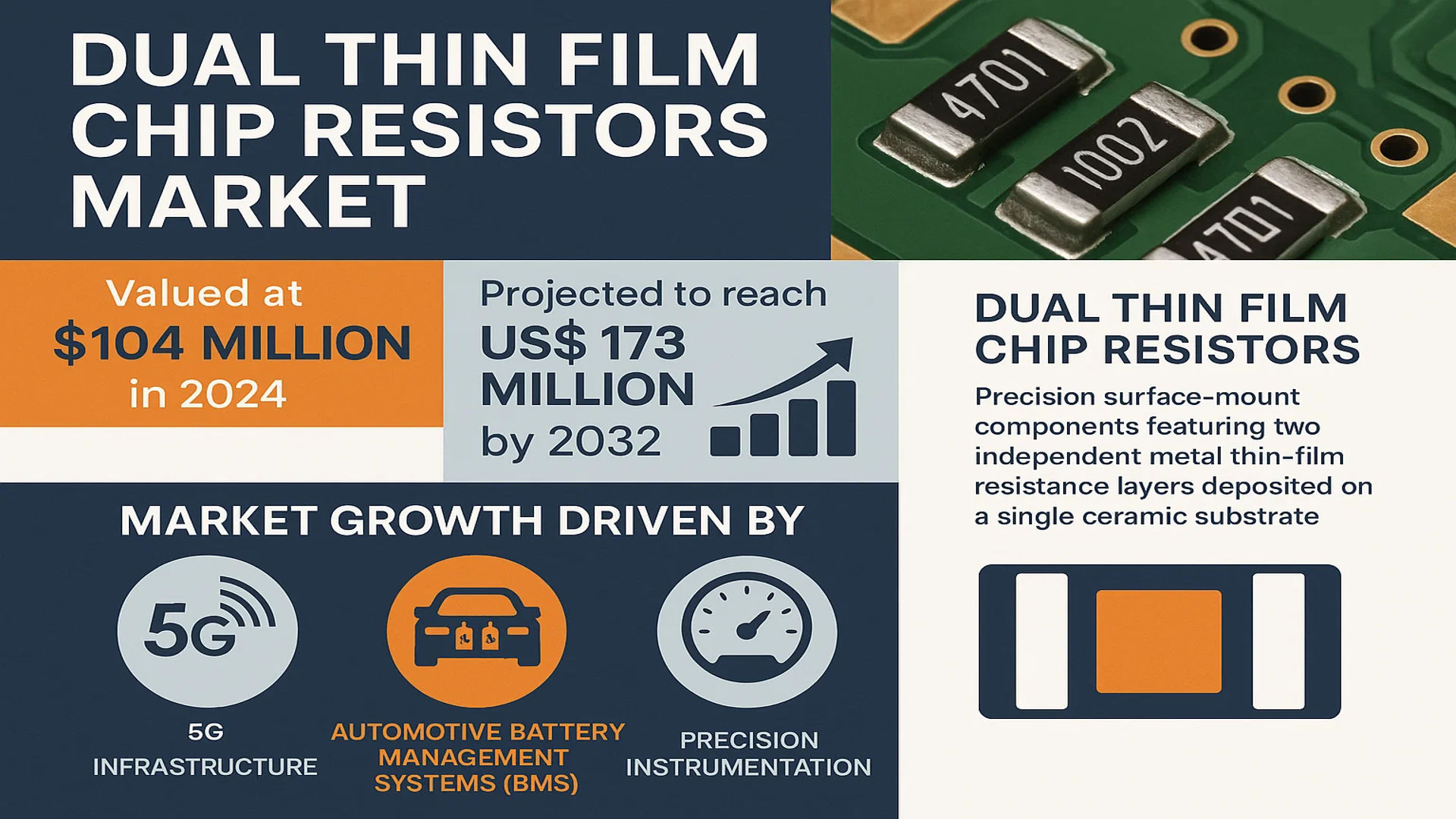
The global Dual Thin Film Chip Resistors Market was valued at 104 million in 2024 and is projected to reach US$ 173 million by 2032, at a CAGR of 7.7% during the forecast period.
Dual thin film chip resistors are precision surface-mount components featuring two independent metal thin-film resistance layers deposited on a single ceramic substrate using vacuum evaporation or sputtering techniques. These components achieve high-precision resistance values through advanced lithography or laser trimming, making them ideal for applications requiring tight tolerance, stability, and miniaturization. Their compact laminated or side-by-side configurations support dual-channel designs with low parasitic inductance and high vibration resistance.
Market growth is driven by increasing demand for miniaturized electronic components in 5G infrastructure, automotive battery management systems (BMS), and precision instrumentation. The U.S. currently holds a dominant market position, while China’s rapid adoption of advanced electronics manufacturing is accelerating regional growth. The laminated double pieces segment is expected to show significant expansion, supported by its superior thermal performance in high-density circuits. Key industry players like Vishay, Passive Plus, and Mini-Systems are investing in material innovations to meet the evolving requirements of IoT and automotive applications.
MARKET DYNAMICS
MARKET DRIVERS
Rising Demand for Miniaturized Electronic Components to Fuel Market Expansion
The global electronics industry is witnessing an unprecedented push toward miniaturization, driven by the need for compact, high-performance devices across consumer electronics, automotive, and industrial applications. Dual thin film chip resistors, with their compact design and dual-channel capabilities, are becoming essential components in modern circuitry. The consumer electronics sector alone is expected to account for over 35% of the market demand by 2026, fueled by the proliferation of smartphones, wearables, and IoT devices requiring precise impedance matching and current detection.
5G Network Expansion Accelerating Adoption in Telecommunication Infrastructure
The global rollout of 5G networks represents a significant growth driver for dual thin film chip resistors, as these components are critical for impedance matching in high-frequency communication modules. With 5G infrastructure investments projected to exceed $400 billion worldwide by 2025, the demand for precision resistors that can operate reliably in high-frequency environments has surged. These resistors play a vital role in ensuring signal integrity and reducing power loss in 5G base stations and RF modules, making them indispensable components in next-generation telecommunication equipment.
MARKET RESTRAINTS
High Production Costs and Complex Manufacturing Process Limiting Market Penetration
While dual thin film chip resistors offer superior performance characteristics, their manufacturing involves sophisticated processes like vacuum deposition, photolithography, and laser trimming that require specialized equipment and controlled environments. The capital-intensive nature of production facilities, coupled with the need for high-purity materials, results in substantially higher costs compared to conventional thick film resistors. This price premium makes them less accessible for cost-sensitive applications, particularly in emerging markets where price competitiveness is crucial.
Additional Constraints
Supply Chain Vulnerability
The industry faces growing challenges from semiconductor material shortages and geopolitical tensions affecting the supply of rare earth metals used in thin film deposition. Recent disruptions have led to lead times extending beyond 20 weeks for certain resistor specifications, forcing manufacturers to maintain higher inventory levels.
MARKET CHALLENGES
Technical Limitations in Extreme Environment Applications
Dual thin film chip resistors face performance challenges in harsh operating conditions, particularly in automotive and aerospace applications where components must withstand extreme temperatures, vibration, and humidity. While these resistors demonstrate superior stability compared to thick film alternatives, their performance can degrade in environments exceeding 175°C, limiting adoption in certain industrial and defense applications where higher temperature tolerance is required.
Other Technical Hurdles
Precision Limitations
Achieving sub-0.1% tolerance levels consistently remains challenging due to variations in thin film deposition uniformity and trimming accuracy. This limitation affects applications requiring ultra-high precision, such as medical diagnostic equipment and scientific instrumentation.
MARKET OPPORTUNITIES
Electric Vehicle Revolution Creating New Application Frontiers
The rapid growth of electric vehicles presents substantial growth opportunities, particularly in battery management systems (BMS) where dual thin film resistors enable precise current sensing and cell balancing. With global EV production expected to grow at a compound annual rate of over 25% through 2030, the demand for reliable, high-performance resistors in automotive applications is set to increase dramatically. These components are particularly valuable for their ability to maintain stability across wide temperature ranges and their resistance to mechanical vibration.
Emerging IoT and AI Applications Driving Innovation
The proliferation of edge computing devices and AI-powered sensors is creating demand for advanced resistor solutions that can support miniaturized, high-density circuit designs. Dual thin film chip resistors are particularly well-suited for these applications due to their small footprint and ability to maintain performance in compact, thermally constrained environments. The global IoT market is projected to exceed $1 trillion by 2030, representing a significant addressable market for advanced passive components.
DUAL THIN FILM CHIP RESISTORS MARKET TRENDS
5G Network Expansion Drives Adoption of Dual Thin Film Chip Resistors
The rapid global deployment of 5G infrastructure is accelerating demand for high-frequency, precision passive components like dual thin film chip resistors. These resistors play a critical role in 5G base stations and communication modules due to their low parasitic inductance and stable performance in high-frequency applications. The global rollout of 5G is projected to require over 7 million base stations by 2025, creating significant opportunities for precision resistor manufacturers. Moreover, the compact design of dual resistors allows for space optimization in densely packed 5G equipment, making them particularly valuable as telecom providers work to maximize capacity while minimizing physical footprint. The automotive sector is also benefiting from this trend, with 5G-enabled vehicle connectivity solutions incorporating these components for reliable signal processing.
Other Trends
Electric Vehicle Boom Stimulates Market Growth
The electric vehicle revolution is creating substantial demand for dual thin film chip resistors, particularly in battery management systems (BMS) where precise current monitoring is essential. As EV production is forecast to reach 45 million units annually by 2030, BMS applications requiring redundant current paths will drive adoption of dual resistor solutions. These components offer the temperature stability and long-term reliability needed for automotive-grade applications, withstanding the harsh operating conditions typical in electric vehicles. Automotive manufacturers are increasingly specifying these resistors for critical safety systems, where their dual-channel architecture provides valuable redundancy in voltage monitoring and current sensing applications.
Miniaturization Trend Shapes Product Innovation
The relentless push for smaller electronic devices is compelling manufacturers to develop increasingly compact dual thin film chip resistor solutions. Recent advancements in laser trimming and deposition techniques now allow for resistor pairs in packages as small as 01005 size (0.4mm x 0.2mm), meeting the needs of ultra-compact consumer electronics. This trend is particularly evident in wearable technology and medical devices, where board space is at a premium. While enabling miniaturization, manufacturers must maintain the high precision and thermal performance that make these components valuable in sensitive applications. The market has responded with innovative packaging approaches, including stacked configurations that preserve electrical isolation while optimizing footprint. As IoT devices proliferate, this miniaturization capability will become even more crucial for dual resistor adoption across multiple industries.
COMPETITIVE LANDSCAPE
Key Industry Players
Technological Advancement and Precision Manufacturing Drive Competitive Strategies
The global dual thin film chip resistors market features a competitive environment where established players dominate through technological innovation and strategic partnerships. With the market projected to grow at a CAGR of 7.7% from 2024 to 2032, companies are aggressively expanding their product portfolios to meet the rising demand from sectors like 5G communication, automotive electronics, and industrial applications. The competitive landscape is characterized by established multinational corporations as well as specialized manufacturers focusing on high-precision components.
Vishay Intertechnology, Inc. leads the market with its extensive range of high-performance thin film resistors, catering to diverse applications across the automotive and defense sectors. The company’s strong presence in North America and Europe provides it with a competitive edge in servicing key OEMs and tier-1 suppliers.
Meanwhile, Passive Plus Inc. has made significant strides by focusing on customized resistor solutions, particularly for aerospace and military applications. Their vertical integration strategy ensures tighter quality control and faster production lead times, enhancing their market positioning.
Additionally, emerging players like RFTYT Technology and Semiconwell are rapidly gaining traction due to their cost-efficient manufacturing capabilities in Asia. These companies are leveraging automated production techniques and localized supply chains to compete with global giants.
To maintain competitiveness, market leaders are investing heavily in R&D for ultra-high-precision resistors, which are critical for next-generation electronics. Mini-Systems Inc., for example, recently introduced a new series of side-by-side dual film resistors with enhanced thermal stability, targeting high-frequency RF applications.
List of Key Dual Thin Film Chip Resistor Manufacturers
- Vishay Intertechnology, Inc. (U.S.)
- Passive Plus, Inc. (U.S.)
- Mini-Systems, Inc. (U.S.)
- Electro Photonics (U.S.)
- RFTYT Technology (China)
- Semiconwell (China)
- US Microwaves (U.S.)
Segment Analysis:
By Type
Laminated Double Pieces Segment Dominates Due to High Precision and Stability in Circuit Designs
The market is segmented based on type into:
- Laminated Double Pieces
- Subtypes: Standard precision, High precision, and others
- Side-by-side Double Pieces
- Subtypes: Low resistance range, Medium resistance range, and others
By Application
Consumer Electronics Segment Leads Due to Increasing Demand for Miniaturized Components
The market is segmented based on application into:
- Consumer Electronics
- Subtypes: Smartphones, Wearables, and others
- Automobile Industry
- Subtypes: EV battery management, Infotainment systems, and others
- Industrial Application
- Subtypes: Automation systems, Power control, and others
- National Defense and Military
- Subtypes: Communication systems, Radar equipment, and others
- Others
By End User
OEMs Lead the Market Through Direct Integration in Electronic Components
The market is segmented based on end user into:
- Original Equipment Manufacturers (OEMs)
- Electronic Component Distributors
- Research Institutions
- Others
Regional Analysis: Dual Thin Film Chip Resistors Market
Asia-Pacific
The Asia-Pacific region dominates the global Dual Thin Film Chip Resistors market, accounting for the highest revenue share due to rapid industrialization and the presence of major electronics manufacturers. Countries like China, Japan, and South Korea lead in demand, driven by thriving consumer electronics, automotive, and 5G infrastructure sectors. China alone contributes over 40% of regional consumption, supported by government initiatives like “Made in China 2025” that bolster advanced electronics manufacturing. While cost-competitive solutions remain preferred, there’s growing adoption of high-precision resistors for 5G base stations and new energy vehicles. The region also houses key manufacturing facilities for global players as well as local suppliers.
North America
North America maintains strong demand for high-performance Dual Thin Film Chip Resistors, particularly in defense, aerospace, and automotive applications. The U.S. leads regional consumption with its advanced electronics ecosystem and substantial investments in 5G deployment. Major OEMs prioritize suppliers offering MIL-spec compliant components for defense applications, while the growing EV market drives BMS-related resistor demand. Research institutions and tech giants in Silicon Valley foster innovation in miniaturized, high-frequency resistor technologies. However, shrinking semiconductor manufacturing capacity poses supply chain challenges that domestic suppliers are working to address.
Europe
Europe’s market is characterized by stringent quality requirements and strong demand from automotive and industrial sectors. Germany remains the largest consumer, with its robust automotive electronics industry driving requirements for reliable components in harsh environments. The EU’s focus on industrial digitization and renewable energy systems creates opportunities for precision resistors in power electronics. Environmental regulations like RoHS continue to influence material choices and production processes. While European resistor manufacturers emphasize precision engineering, they face pricing pressures from Asian competitors in consumer electronics segments.
South America
The South American market shows gradual growth potential, primarily served by imports from North America and Asia. Brazil represents the largest market, with increasing electronics production for domestic consumption. The automotive sector shows promising demand as regional vehicle production recovers, though economic instability and import dependencies constrain market expansion. Local assembly of electronic components is emerging but remains limited to basic passives, with dual thin film resistors still largely imported for high-end applications. Government incentives for electronics manufacturing could stimulate future market development.
Middle East & Africa
This region presents a developing market with growth concentrated in a few industrializing nations. Israel and UAE show the most advanced demand, particularly for defense and telecommunications applications. Infrastructure development and smart city projects drive basic electronics demand, though the high-end resistor market remains niche. The lack of local manufacturing means nearly all components are imported, with distribution channels still maturing. Long-term growth potential exists as regional electronics production capabilities expand, particularly in North African industrial zones.
Report Scope
This market research report provides a comprehensive analysis of the global Dual Thin Film Chip Resistors market, covering the forecast period 2024–2032. It offers detailed insights into market dynamics, technological advancements, competitive landscape, and key trends shaping the industry.
Key focus areas of the report include:
- Market Size & Forecast: Historical data and future projections for revenue, unit shipments, and market value across major regions and segments. The global market was valued at USD 104 million in 2024 and is projected to reach USD 173 million by 2032, growing at a CAGR of 7.7%.
- Segmentation Analysis: Detailed breakdown by product type (Laminated Double Pieces, Side-by-side Double Pieces), application (Consumer Electronics, Automobile Industry, Industrial, National Defense & Military), and end-user industry to identify high-growth segments.
- Regional Outlook: Insights into market performance across North America, Europe, Asia-Pacific, Latin America, and Middle East & Africa. Asia-Pacific dominates the market with China being a key growth region.
- Competitive Landscape: Profiles of leading market participants including Passive Plus, Vishay, Mini-Systems, Electro Photonics, RFTYT Technology, with their product portfolios, R&D focus, and strategic developments.
- Technology Trends: Assessment of precision manufacturing techniques like vacuum evaporation, sputtering processes, and laser trimming technologies in resistor production.
- Market Drivers: Evaluation of factors including 5G infrastructure development, electric vehicle adoption, and demand for high-frequency electronic components.
- Stakeholder Analysis: Strategic insights for component manufacturers, OEMs, and investors regarding emerging opportunities in precision electronics.
The report employs primary and secondary research methodologies, including expert interviews and analysis of verified market data, to ensure accuracy and reliability.
FREQUENTLY ASKED QUESTIONS:
What is the current market size of Global Dual Thin Film Chip Resistors Market?
-> Dual Thin Film Chip Resistors Market was valued at 104 million in 2024 and is projected to reach US$ 173 million by 2032, at a CAGR of 7.7% during the forecast period..
Which key companies operate in this market?
-> Major players include Passive Plus, Vishay, Mini-Systems, Electro Photonics, and RFTYT Technology, which collectively held significant market share in 2024.
What are the key growth drivers?
-> Primary growth drivers are 5G technology adoption, electric vehicle production, and demand for high-precision electronic components in industrial applications.
Which region dominates the market?
-> Asia-Pacific leads the market, driven by electronics manufacturing in China and increasing 5G infrastructure investments across the region.
What are the emerging technology trends?
-> Emerging trends include advanced laser trimming techniques, integration with IoT devices, and development of ultra-high frequency resistors for next-gen applications.

Get Sample Report PDF for Exclusive Insights
Report Sample Includes
- Table of Contents
- List of Tables & Figures
- Charts, Research Methodology, and more...
 Download Sample Report PDF