
Dual Mode SAW Filter Market Insights
Global Dual Mode SAW Filter market size was valued at USD 598 million in 2025. The market is projected to grow from USD 626 million in 2026 to USD 817 million by 2034, exhibiting a CAGR of 4.7% during the forecast period.
A dual-mode surface acoustic wave (SAW) filter is a precision filter technology widely deployed in wireless communication systems and electronic devices. It operates by leveraging the physical properties of surface acoustic waves propagating on piezoelectric crystal substrates , such as quartz or lithium niobate , through the use of interdigital electrodes formed by evaporating metal films onto these substrates. The piezoelectric effect converts electrical signals into surface acoustic wave signals, while the electrode structure and acoustic wave propagation path are carefully engineered to achieve selective filtering of signals at specific frequencies. When a signal voltage is applied to the transmitting transducer, an electric field forms between the electrodes, inducing mechanical vibration in the piezoelectric material; these vibrations travel along the crystal surface as acoustic waves and are subsequently reconverted into an electrical output signal at the receiving transducer.
The market is experiencing steady growth driven by the rapid global deployment of 5G networks and the accelerating proliferation of Internet of Things (IoT) devices, both of which have substantially elevated demand for high-performance RF front-end components. Dual-mode SAW filters are indispensable in smartphones, tablets, and connected IoT devices, where they perform critical signal screening and noise filtering functions. Furthermore, ongoing advancements in communication technology are expanding the application scope of these filters into emerging segments such as small cell base stations, satellite communications, and automotive electronics. Key players operating in Global Dual Mode SAW Filter market include Murata Manufacturing, Skyworks Solutions, TAIYO YUDEN, Qorvo, and Kyocera Corporation, among others.
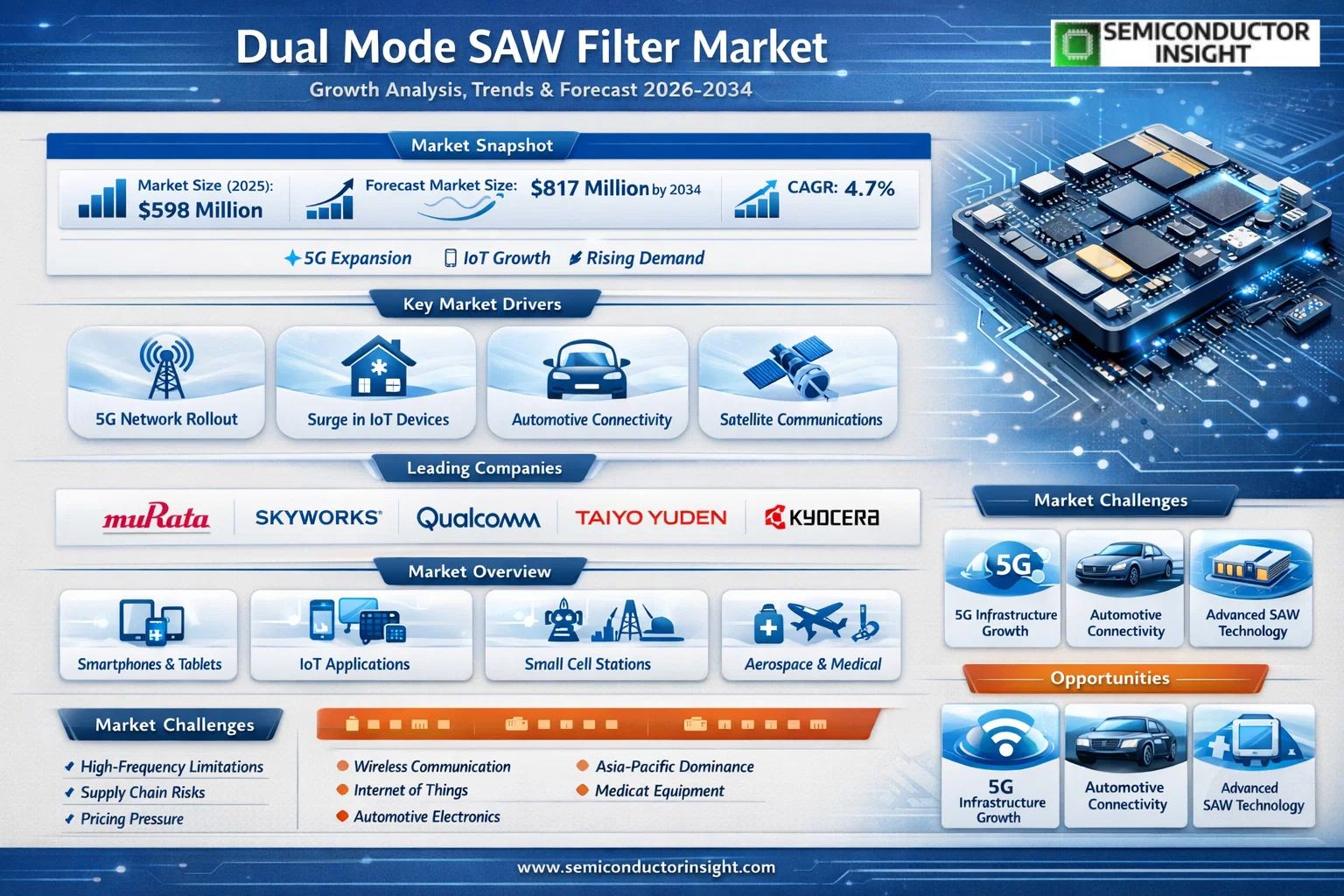
MARKET DRIVERS
Surging Demand for Advanced Wireless Communication Technologies
Global dual mode SAW filter market is experiencing robust growth, primarily driven by the rapid proliferation of wireless communication devices and the accelerating deployment of next-generation network infrastructure. Dual mode surface acoustic wave filters, which combine two resonant modes within a single compact component, have become indispensable in modern RF front-end modules due to their superior selectivity, low insertion loss, and compact form factor. As mobile network operators worldwide continue transitioning from 4G LTE to 5G architectures, the demand for high-performance filtering solutions capable of managing increasingly congested frequency spectrums has intensified significantly. Dual Mode SAW Filter Market benefits directly from this technological shift, as these components enable devices to operate across multiple frequency bands without signal interference.
Expansion of IoT Ecosystems and Connected Device Infrastructure
Another critical driver propelling Dual Mode SAW Filter Market forward is the exponential growth of the Internet of Things ecosystem. From smart home devices and industrial automation systems to wearable healthcare monitors and connected automotive platforms, the proliferation of IoT endpoints has created a sustained and diversified demand for compact, energy-efficient RF filtering components. Dual mode SAW filters are particularly well-suited for IoT applications due to their miniaturized architecture and ability to deliver reliable frequency selectivity within space-constrained device designs. As manufacturers scale production of IoT hardware across consumer, industrial, and enterprise segments, procurement of dual mode SAW filter components has grown correspondingly, reinforcing market expansion across multiple verticals.
➤ The integration of dual mode SAW filters into 5G-enabled smartphones, smartwatches, and industrial IoT modules reflects a broader industry trend toward multi-band RF front-end optimization, positioning these components as foundational elements of modern wireless architecture.
Furthermore, the rising adoption of carrier aggregation techniques in LTE-Advanced and 5G NR standards has amplified the technical requirements placed on RF filtering components. Dual mode SAW filters, capable of handling complex multi-band signal processing within a single device package, are increasingly preferred by OEMs seeking to reduce bill-of-materials complexity while maintaining stringent performance benchmarks. This convergence of technical necessity and design efficiency continues to underpin strong demand momentum within Dual Mode SAW Filter Market globally.
MARKET CHALLENGES
Technical Limitations at Higher Frequency Bands Constraining Broad Adoption
Despite its growth trajectory, Dual Mode SAW Filter Market faces notable technical challenges that may temper adoption in certain high-frequency application segments. Traditional SAW filter technology, including dual mode configurations, encounters inherent performance limitations at frequencies exceeding approximately 3 GHz, where competing technologies such as bulk acoustic wave filters and film bulk acoustic resonators tend to offer superior performance characteristics. As 5G mmWave deployments expand and devices increasingly require operation at sub-6 GHz and mmWave frequency bands simultaneously, Dual Mode SAW Filter Market must contend with a growing competitive landscape from alternative filtering technologies. Engineers designing RF front-ends for high-band 5G applications may find that dual mode SAW filters do not fully satisfy the performance requirements at these elevated frequency ranges, potentially limiting market penetration in premium 5G device categories.
Other Challenges
Supply Chain Vulnerabilities and Raw Material Constraint
Dual Mode SAW Filter Market is also exposed to supply chain risks associated with the specialized materials and manufacturing processes required for SAW device fabrication. Key piezoelectric substrates, including lithium tantalate and lithium niobate wafers, are sourced from a limited number of global suppliers, creating concentration risks that can disrupt production timelines during periods of elevated demand or geopolitical tension. Semiconductor fab capacity constraints, which became acutely visible during recent global chip shortages, have further highlighted the vulnerability of the dual mode SAW filter supply chain to external disruptions, creating challenges for manufacturers seeking to fulfill growing customer orders reliably.
Intense Price Competition and Margin Pressure
Dual Mode SAW Filter Market also faces persistent pricing pressure driven by intense competition among established Asian manufacturers, particularly those headquartered in Japan, South Korea, and China. As production volumes have scaled and manufacturing processes have matured, average selling prices for standard dual mode SAW filter configurations have trended downward, compressing profit margins for vendors operating in commodity-oriented market segments. For smaller or emerging market participants, sustaining research and development investment while competing on price remains a significant operational challenge within Dual Mode SAW Filter Market ecosystem.
MARKET RESTRAINTS
Growing Competition from BAW and FBAR Filter Technologies
One of the most significant structural restraints facing Dual Mode SAW Filter Market is the accelerating development and commercialization of bulk acoustic wave and film bulk acoustic resonator filter technologies. These competing RF filtering solutions offer performance advantages at higher frequency bands, particularly above 2.5 GHz, where dual mode SAW filters begin to exhibit performance trade-offs related to temperature stability and power handling capacity. As 5G network deployments increasingly target sub-6 GHz and mmWave spectrum allocations requiring high-band filtering solutions, device OEMs and RF module designers are evaluating BAW-based alternatives more actively. This competitive dynamic poses a meaningful restraint on the long-term market share trajectory of dual mode SAW filters in high-performance 5G application segments.
Complexity of Design Integration in Advanced Multi-Band RF Front-End Modules
The increasing architectural complexity of modern RF front-end modules represents an additional restraint for Dual Mode SAW Filter Market. As smartphone manufacturers and wireless device OEMs pursue higher levels of RF integration through the adoption of RF front-end module chipsets that consolidate filtering, switching, and amplification functions into single packages, the design-in process for discrete dual mode SAW filter components becomes more technically demanding. Ensuring compatibility between dual mode SAW filters and highly integrated RF module architectures requires extensive co-design effort and validation testing, which can extend product development cycles and increase engineering resource requirements. This complexity may discourage some OEMs from specifying discrete dual mode SAW filter solutions in favor of fully integrated module alternatives, acting as a restraint on market volume growth in certain device categories.
MARKET OPPORTUNITIES
Accelerating 5G Infrastructure Rollout Across Emerging Economies
The ongoing global rollout of 5G network infrastructure, particularly across emerging economies in Asia-Pacific, Latin America, the Middle East, and Africa, represents a substantial and largely untapped growth opportunity for Dual Mode SAW Filter Market. As mobile operators in these regions invest in 5G base station deployment and consumers upgrade to 5G-capable handsets, demand for dual mode SAW filters integrated within RF front-end modules is expected to grow significantly. Importantly, the sub-6 GHz frequency bands that dominate 5G deployments in many emerging markets align closely with the optimal performance range of advanced dual mode SAW filter configurations, positioning these components favorably within the expanding 5G device ecosystem. Market participants capable of scaling production capacity and establishing competitive pricing structures for high-volume 5G device manufacturers stand to capture meaningful incremental revenue from this opportunity.
Rising Demand in Automotive Connectivity and V2X Communication Systems
The rapidly evolving automotive connectivity landscape presents a compelling opportunity for dual mode SAW filter market participants. Modern connected vehicles increasingly incorporate advanced RF communication systems supporting cellular vehicle-to-everything communication, dedicated short-range communication protocols, GPS navigation, and emerging Wi-Fi 6 and Bluetooth capabilities. Each of these communication interfaces requires reliable RF filtering to ensure signal integrity and prevent cross-band interference within the electromagnetically complex interior environment of modern vehicles. Dual mode SAW filters, with their established track record of performance reliability, compact footprint, and cost-effective manufacturability, are well-positioned to address growing automotive RF filtering requirements. As global vehicle production gradually shifts toward connected and autonomous vehicle platforms, the automotive segment is expected to become an increasingly important revenue contributor within Dual Mode SAW Filter Market over the coming years.
Technological Innovation Enabling Performance Enhancements at Higher Frequency Ranges
Ongoing research and development activity within the SAW filter technology domain is generating promising innovations that may progressively address the current frequency range limitations of dual mode SAW filter configurations. Advances in piezoelectric substrate engineering, electrode design optimization, and temperature compensation techniques are enabling next-generation dual mode SAW filter products to operate reliably at higher frequency bands than previously achievable with conventional designs. Several leading manufacturers within Dual Mode SAW Filter Market are actively investing in the development of I.H.P. SAW and TC-SAW variants that extend usable frequency ranges while maintaining competitive insertion loss and selectivity characteristics. Successful commercialization of these enhanced dual mode SAW filter technologies could substantially broaden the addressable application landscape, opening new design-in opportunities across premium 5G smartphones, advanced IoT gateways, and satellite-enabled communication devices.
Trends
Rising Demand from 5G Deployment and IoT Expansion Driving Dual Mode SAW Filter Market
Dual Mode SAW Filter Market is experiencing significant momentum driven by the accelerating global rollout of 5G networks and the rapid proliferation of Internet of Things (IoT) devices. As wireless communication systems demand increasingly precise signal filtering capabilities, dual-mode surface acoustic wave filters have emerged as a critical component in RF front-end modules. Smartphones, tablets, and connected devices require high-performance bandpass and bandstop filters to manage complex multi-band signal environments, and dual mode SAW filters meet these needs through their efficient piezoelectric signal conversion mechanism. The expanding ecosystem of connected devices across consumer electronics and industrial sectors continues to reinforce the strategic importance of this technology in modern communication infrastructure.
Other Trends
Adoption in Emerging Application Segments
Beyond traditional consumer electronics, Dual Mode SAW Filter Market is witnessing growing traction in emerging application areas including small cell base stations, satellite communications, automotive electronics, aerospace systems, and medical equipment. Automotive electronics, in particular, represent a fast-growing segment as vehicles integrate advanced driver-assistance systems (ADAS) and vehicle-to-everything (V2X) communication capabilities that require reliable RF filtering solutions. Medical devices leveraging wireless connectivity for remote monitoring and diagnostics are also increasingly incorporating dual mode SAW filters to ensure signal integrity and electromagnetic compatibility.
Asia-Pacific as a Dominant Manufacturing and Consumption Hub
Asia-Pacific continues to hold a commanding position in Global Dual Mode SAW Filter Market, driven by the strong manufacturing base of key producing countries such as China, Japan, and South Korea. Japan-based companies including Murata Manufacturing, TAIYO YUDEN, and Kyocera Corporation are recognized global leaders in SAW filter production, leveraging advanced piezoelectric substrate expertise. China’s robust electronics manufacturing sector and South Korea’s semiconductor ecosystem further reinforce the region’s dominance in both production capacity and consumption volume. North America and Europe also represent significant markets, supported by leading fabless design firms and defense-grade communication applications.
Technological Advancements Enhancing Filter Performance and Miniaturization
A notable trend shaping Dual Mode SAW Filter Market is the continuous advancement in interdigital electrode design and piezoelectric substrate materials, including refined lithium niobate and quartz crystal processing techniques. These innovations are enabling manufacturers to produce filters with improved frequency selectivity, lower insertion loss, and reduced form factors , critical attributes for next-generation compact communication devices. Companies such as Qorvo, Skyworks Solutions, and QUALCOMM Incorporated are actively investing in research and development to enhance filter integration with RF modules. As communication standards evolve and spectrum congestion intensifies, the demand for high-precision, miniaturized dual mode SAW filters is expected to sustain its upward trajectory across global markets.
COMPETITIVE LANDSCAPE
Key Industry Players
Dual Mode SAW Filter Market – Competitive Dynamics, Strategic Positioning, and Leading Manufacturer Profiles
Global Dual Mode SAW Filter market is characterized by a moderately consolidated competitive landscape, with a handful of technologically advanced players commanding significant revenue shares. Murata Manufacturing consistently maintains its position as the dominant force in this market, leveraging its extensive R&D capabilities, vertically integrated manufacturing processes, and broad product portfolio spanning bandpass and bandstop filter configurations. The company’s stronghold across Asia-Pacific , particularly Japan and China , combined with strategic partnerships with leading smartphone OEMs, provides it with a sustained competitive advantage. Alongside Murata, Taiyo Yuden and Kyocera Corporation represent formidable Japanese incumbents with deep expertise in piezoelectric substrate engineering and surface acoustic wave propagation technologies. These established players benefit from decades of accumulated intellectual property and close proximity to high-volume consumer electronics manufacturing hubs. The competitive intensity has further been amplified by the accelerating global rollout of 5G networks and the proliferation of IoT-connected devices, compelling market participants to invest aggressively in next-generation filter miniaturization and enhanced frequency selectivity.
Beyond the dominant Japanese manufacturers, the competitive arena features several highly specialized and regionally influential players. U.S.-based Skyworks Solutions and Qorvo have carved out significant niches within the RF front-end module segment, integrating dual-mode SAW filter technologies into comprehensive multi-chip solutions targeting North American and European wireless communication OEMs. QUALCOMM Incorporated, while primarily a semiconductor and wireless technology giant, exerts indirect competitive influence through its RF front-end ecosystem partnerships and system-level integration strategies. TAI-SAW Technology, headquartered in Taiwan, has emerged as a cost-competitive alternative for mid-tier device manufacturers across Southeast Asia, while Microgate Technology continues to expand its presence in the automotive electronics and medical equipment application segments. The competitive differentiation among these players is increasingly driven by innovation in electrode interdigital design, advances in piezoelectric substrate materials such as lithium niobate and quartz composites, and the ability to deliver high-Q, low-insertion-loss filters suited for emerging mmWave and sub-6GHz 5G frequency bands. As the market is projected to grow from US$ 598 million in 2025 to US$ 817 million by 2034 at a CAGR of 4.7%, competitive pressures around pricing, supply chain resilience, and application-specific customization are expected to intensify considerably across all key regions.
List of Key Dual Mode SAW Filter Companies Profiled
- Murata Manufacturing
- Skyworks Solutions
- QUALCOMM Incorporated
- Qorvo
- TAIYO YUDEN
- Kyocera Corporation
- TAI-SAW Technology
- Microgate Technology
- Vision
- TDK Corporation
- API Technologies
- Resonant Inc.
- Wisol Co., Ltd.
- EPCOS AG (TDK Group)
- NDK (Nihon Dempa Kogyo Co., Ltd.)
Segment Analysis:
| Segment Category | Sub-Segments | Key Insights |
| By Type |
|
Bandpass Filter holds the dominant position within Dual Mode SAW Filter Market by type, driven by its critical role in RF front-end architectures across modern wireless communication platforms.
|
| By Application |
|
Wireless Communication Industry commands the leading position among application segments, as dual-mode SAW filters are foundational components within the RF front-end modules of virtually all modern wireless communication devices.
|
| By End User |
|
Consumer Electronics Manufacturers represent the dominant end-user segment, as the relentless innovation cycle in smartphones, tablets, wearables, and other personal devices continues to generate consistent and high-volume demand for dual-mode SAW filters.
|
| By Substrate Material |
|
Lithium Niobate (LiNbO₃)-Based filters lead this segment owing to their superior electromechanical coupling coefficients, which enable broader bandwidth and enhanced signal transmission efficiency critical for modern wireless communication standards.
|
| By Frequency Range |
|
1 GHz – 2 GHz frequency range dominates the dual-mode SAW filter market, as this band encompasses a significant portion of the sub-6 GHz spectrum widely deployed for 4G LTE and early 5G NR rollouts globally.
|
Regional Analysis: Dual Mode SAW Filter Market
Asia-Pacific
Asia-Pacific hosts the world’s most vertically integrated electronics manufacturing ecosystems, allowing dual mode SAW filter producers to operate with significant cost and logistical advantages. The proximity of component suppliers, fabrication facilities, and OEM assemblers reduces lead times and enables rapid product iteration, making the region exceptionally responsive to shifting end-market demand patterns in mobile and wireless communication segments.
The region leads globally in advanced wireless network deployments, with numerous markets accelerating infrastructure buildout to support next-generation connectivity standards. This sustained investment directly fuels demand for high-performance dual mode SAW filters capable of handling complex multi-band and multi-mode filtering requirements, reinforcing Asia-Pacific’s position as both the primary production center and the largest consumption market simultaneously.
Home to several of the world’s largest consumer electronics markets, Asia-Pacific generates sustained, high-volume demand for dual mode SAW filter components. The continued mass-market adoption of feature-rich smartphones, connected devices, and smart home systems across both mature and emerging economies within the region translates into a consistent and expanding procurement pipeline for filter manufacturers and their downstream customers.
Leading dual mode SAW filter innovators headquartered in Japan, South Korea, and increasingly China continue to direct substantial resources toward advancing filter miniaturization, frequency range extension, and insertion loss reduction. This concentration of research and development activity within Asia-Pacific ensures the region maintains a technology edge, enabling manufacturers to address the increasingly stringent performance specifications demanded by next-generation wireless device platforms.
North America
North America represents a strategically significant region within Dual Mode SAW Filter Market, characterized by its strong emphasis on advanced wireless system design, defense electronics integration, and high-performance telecommunications infrastructure. The United States, in particular, hosts a robust ecosystem of technology companies, system integrators, and network operators whose demand for precision RF filtering solutions underpins sustained market activity. The region’s proactive approach to wireless spectrum management and ongoing network modernization initiatives creates consistent pull-through demand for dual mode SAW filter components. While North America relies substantially on Asia-Pacific for component manufacturing, it exercises considerable influence over product specification and performance standards through its dominant original equipment manufacturers and chipset designers. Growing interest in domestic semiconductor supply chain resilience, supported by policy initiatives, may gradually shift a portion of advanced filter production activity toward the region over the coming years, further shaping its role in Global dual mode SAW filter market landscape through 2034.
Europe
Europe occupies a measured but meaningful position in Global dual mode SAW filter market, with its market dynamics shaped by a sophisticated automotive electronics sector, mature telecommunications infrastructure, and a stringent regulatory environment governing radio frequency emissions and device performance. Germany, France, and the Nordic countries represent key centers of demand, particularly as automotive connectivity systems and industrial wireless applications increasingly incorporate dual mode SAW filter technology. European manufacturers and system designers place considerable emphasis on quality certification, environmental compliance, and long product lifecycle support , characteristics that influence procurement decisions and supplier qualification processes. The region’s ongoing transition toward connected and autonomous vehicle platforms, combined with expanding smart infrastructure initiatives, positions Europe as a steady and technically demanding consumer of dual mode SAW filter solutions, even as large-scale consumer electronics manufacturing remains limited compared to Asia-Pacific counterparts.
South America
South America represents an emerging and gradually expanding market for dual mode SAW filter solutions, with growth prospects closely tied to the region’s evolving telecommunications landscape and increasing penetration of modern mobile devices. Brazil anchors regional demand as the largest economy and most advanced wireless market in South America, with ongoing network infrastructure investments creating incremental pull for RF filtering components. While the region does not host significant indigenous manufacturing capacity for dual mode SAW filters, its role as an end-use consumption market is progressively growing as smartphone adoption deepens across middle-income population segments. Economic volatility and infrastructure investment cycles continue to moderate the pace of market expansion, but the long-term trajectory remains constructive as connectivity priorities gain traction across both urban and peri-urban markets throughout the region.
Middle East & Africa
The Middle East and Africa region currently represents the nascent stage of dual mode SAW filter market development, yet holds noteworthy long-term potential driven by demographic trends, urbanization momentum, and accelerating digital infrastructure investment. Gulf Cooperation Council nations are actively modernizing their telecommunications networks and expanding smart city initiatives, generating demand for advanced RF components including dual mode SAW filters within base station and connected device applications. Across sub-Saharan Africa, mobile connectivity continues to expand as the primary medium for internet access, gradually building a foundation for increased filter component consumption. The region’s market growth is primarily import-dependent, with components sourced from Asia-Pacific and to a lesser extent European suppliers. As digital transformation agendas advance and wireless subscriber bases continue to grow, the Middle East and Africa are expected to emerge as progressively more relevant participants in the broader global dual mode SAW filter market ecosystem.
Report Scope
This market research report provides a comprehensive analysis of Dual Mode SAW Filter Market, covering the forecast period 2026–2034. It offers detailed insights into market dynamics, technological advancements, competitive landscape, and key trends shaping the industry.
Key focus areas of the report include:
- Market Overview: The report begins with an overview outlining its current market scenario, key growth indicators, and industry transformation drivers. It discusses macroeconomic factors, demand–supply balance, regulatory landscape, and the strategic role of dual-mode SAW filters in powering advancements across industries such as wireless communications, consumer electronics, automotive electronics, and industrial automation.
- Market Size & Forecast: Historical data and future projections for revenue, unit shipments, and market value across major regions and segments.
- Segmentation Analysis: Detailed breakdown by product type, technology, application, and end-user industry to identify high-growth segments and investment opportunities.
- Regional Insights: Insights into market performance across North America, Europe, Asia-Pacific, Latin America, and the Middle East & Africa, including country-level analysis where relevant.
- Competitive Landscape: Profiles of leading market participants, including their product offerings, R&D focus, manufacturing capacity, pricing strategies, and recent developments such as mergers, acquisitions, and partnerships.
- Technology Trends & Innovation: Assessment of emerging technologies, integration of AI/IoT, semiconductor design trends, fabrication techniques, and evolving industry standards.
- Market Drivers & Restraints: Evaluation of factors driving market growth along with challenges, supply chain constraints, regulatory issues, and market-entry barriers.
- Stakeholder Insights: Insights for component suppliers, OEMs, system integrators, investors, and policymakers regarding the evolving ecosystem and strategic opportunities.
Primary and secondary research methods are employed, including interviews with industry experts, data from verified sources, and real-time market intelligence to ensure the accuracy and reliability of the insights presented.
FREQUENTLY ASKED QUESTIONS:
What is the current market size of Dual Mode SAW Filter Market?
-> Global Dual Mode SAW Filter Market was valued at USD 598 Million in 2025 and is expected to reach USD 817 Million by 2034, growing at a CAGR of 4.7% during the forecast period.
Which key companies operate in Dual Mode SAW Filter Market?
-> Key players include Murata Manufacturing, Skyworks, Vision, QUALCOMM Incorporated, TAIYO YUDEN, Qorvo, Skyworks Solutions, TAI-SAW, Kyocera Corporation, and Microgate Technology, among others.
What are the key growth drivers?
-> Key growth drivers include rapid deployment of 5G networks, growing adoption of Internet of Things (IoT) devices, increasing demand for RF front-end components in smartphones and tablets, and expanding applications in automotive electronics, satellite communications, and small base stations.
Which region dominates the market?
-> Asia-Pacific is the fastest-growing region driven by strong electronics manufacturing bases in China, Japan, and South Korea, while North America remains a significant market due to advanced wireless communication infrastructure and leading semiconductor companies.
What are the emerging trends?
-> Emerging trends include integration of dual-mode SAW filters in 5G-enabled devices, expansion into aerospace and medical equipment applications, miniaturization of filter components, and growing use in satellite communications and automotive electronics.

Get Sample Report PDF for Exclusive Insights
Report Sample Includes
- Table of Contents
- List of Tables & Figures
- Charts, Research Methodology, and more...
 Download Sample Report PDF





