
Market Insights
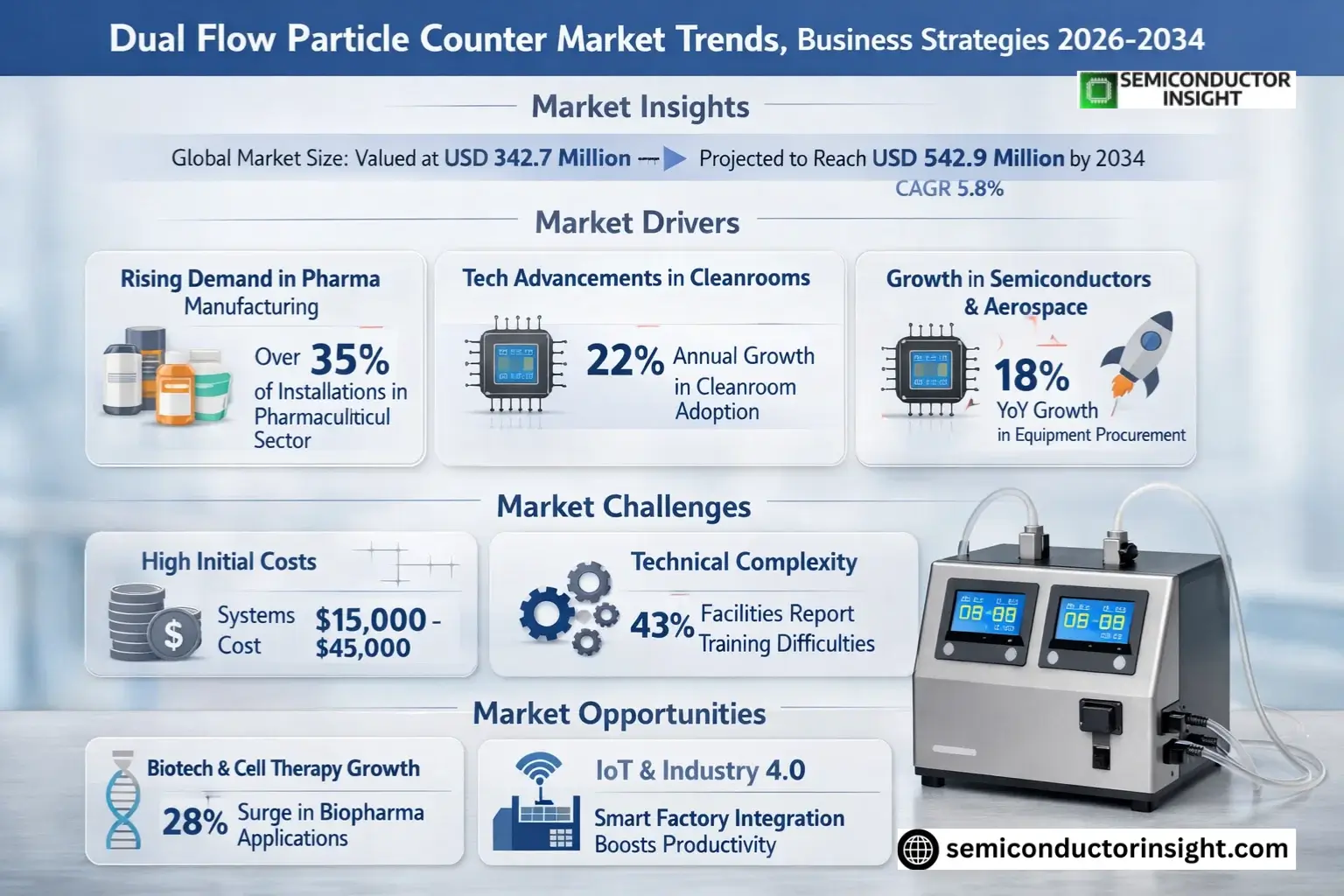
Global Dual Flow Particle Counter Market size was valued at USD 342.7 million in 2025. The market is projected to grow from USD 368.4 million in 2026 to USD 542.9 million by 2034, exhibiting a CAGR of 5.8% during the forecast period.
A dual flow particle counter is a specialized instrument used to detect and measure the number and size of particles in gas or liquid samples. This device operates with two different flow rates simultaneously, enabling versatile and precise monitoring of particulate contamination across industries such as semiconductor manufacturing, pharmaceuticals, and environmental monitoring.
The market growth is driven by increasing demand for contamination control in cleanroom environments, stringent regulatory standards for air quality, and advancements in particle detection technologies. Key players like Beckman Coulter and Labodam are expanding their product portfolios to cater to diverse industrial applications.
MARKET DRIVERS
Rising Demand in Pharmaceutical Manufacturing
Dual Flow Particle Counter Market is experiencing significant growth due to stringent regulatory requirements in pharmaceutical manufacturing. These devices provide simultaneous monitoring of both liquid and air particles, ensuring compliance with cGMP and other industry standards. Recent studies show the pharmaceutical sector accounts for over 35% of all dual flow particle counter installations globally.
Technological Advancements in Cleanroom Monitoring
Innovations in sensor technology and data analytics have enhanced the capabilities of dual flow particle counters, making them indispensable for modern cleanroom environments. The integration of real-time monitoring and automated reporting features has increased adoption rates by approximately 22% annually since 2020.
Growing focus on contamination control in semiconductor manufacturing and aerospace applications further propels market expansion, with these verticals showing 18% year-over-year growth in equipment procurement.
MARKET CHALLENGES
High Initial Investment Costs
The sophisticated technology behind dual flow particle counters results in premium pricing, creating adoption barriers for smaller facilities. Typical systems range from USD 15,000 to USD 45,000 depending on configuration, requiring significant capital expenditure.
Other Challenges
Technical Complexity
The operation and maintenance of these systems demands specialized training, with 43% of surveyed facilities reporting difficulties in staff competency development for advanced particle counting applications.
Calibration Requirements
Frequent calibration needs (typically quarterly) and associated downtime present operational challenges, particularly for 24/7 manufacturing environments in the Dual Flow Particle Counter Market.
MARKET RESTRAINTS
Limited Awareness in Developing Regions
Despite growing adoption in developed markets, emerging economies show slower uptake of dual flow technology due to limited understanding of its benefits compared to traditional single-flow systems. Market penetration in Asia-Pacific (excluding Japan and South Korea) remains below 15% of total global sales.
MARKET OPPORTUNITIES
Expansion in Biotechnology Applications
The rapidly growing biopharmaceutical sector presents substantial opportunities for the Dual Flow Particle Counter Market, with projected 28% growth in demand for contamination monitoring solutions in cell therapy and gene therapy production facilities through 2025.
IoT Integration and Industry 4.0
Smart factory initiatives are creating demand for networked particle counting systems with predictive maintenance capabilities. Manufacturers report 35% higher productivity when integrating dual flow counters with centralized monitoring platforms in pharmaceutical quality control systems.
Dual Flow Particle Counter Market Trends
Increasing Demand in Semiconductor Manufacturing
The semiconductor industry continues to drive significant demand for Dual Flow Particle Counters due to stringent cleanliness requirements in fabrication facilities. These instruments provide critical real-time monitoring capabilities for detecting sub-micron particles that could impact semiconductor yield. Manufacturers increasingly adopt dual-flow configurations to simultaneously monitor different process zones while maintaining ISO Class 1-5 cleanroom standards.
Other Trends
Expansion in Pharmaceutical Applications
Pharmaceutical companies are implementing Dual Flow Particle Counters for monitoring cleanrooms and controlled environments in drug manufacturing. The ability to track two separate airflow paths simultaneously enables more comprehensive contamination control during aseptic processing of injectables and sensitive biologics. Regulatory requirements from FDA and EMA are pushing wider adoption in this sector.
Technological Advancements in Detection Accuracy
Leading manufacturers are developing Dual Flow Particle Counters with improved detection capabilities down to 0.1 micron particles. New models incorporate advanced optical sensors and AI-powered data analysis to reduce false counts while maintaining high sampling flow rates. These innovations are particularly valuable for nanotechnology applications and semiconductor lithography processes where even nanoscale particles can cause defects.
Regional Market Developments
Asia Pacific has emerged as the fastest-growing regional market, driven by semiconductor expansion in Taiwan, South Korea, and China. North America maintains strong demand from both semiconductor and pharmaceutical sectors, with several key manufacturers headquartered in the region. Europe shows steady adoption across multiple industrial applications, particularly in Germany and France.
Competitive Landscape Evolution
Dual Flow Particle Counter Market is consolidating, with Labodam, Beckman Coulter, and LABTRON emerging as leading suppliers. These companies are focusing on product differentiation through specialized configurations for different industry applications. Recent strategic partnerships between equipment manufacturers and cleanroom technology providers aim to deliver integrated monitoring solutions.
COMPETITIVE LANDSCAPE
Key Industry Players
Innovation and Precision Drive Market Competition
Beckman Coulter and Labodam lead Global Dual Flow Particle Counter Market with combined revenue share exceeding 30% in 2025. These established manufacturers dominate through continuous R&D investments and strategic partnerships in semiconductor and pharmaceutical sectors. The market structure remains moderately consolidated, with the top five players accounting for approximately 45% of total revenue while maintaining strong regional presences across North America, Europe, and Asia-Pacific manufacturing hubs.
Emerging players such as LABTRON and HR Airclean Technology are gaining traction through specialized solutions for environmental monitoring applications. Niche manufacturers focus on developing portable, IoT-enabled devices with enhanced connectivity features for real-time air quality monitoring in commercial and industrial settings. Technological advancements in laser detection and multi-channel analysis continue to shape competitive differentiation strategies.
List of Key Dual Flow Particle Counter Companies Profiled
- Beckman Coulter
- Labodam
- LABTRON
- Labmate Scientific
- HR Airclean Technology
- Particle Measuring Systems
- TSI Incorporated
- Climet Instruments
- Lighthouse Worldwide Solutions
- Met One Instruments
- Kanomax USA
- Chemtrac Systems
- Setra Systems
- PAMAS Partikelmess- und Analysesysteme
- Suzhou Sujing Group
Segment Analysis:
| Segment Category | Sub-Segments | Key Insights |
| By Type |
|
Benchtop Dual Flow Counters dominate due to their superior accuracy and integration capabilities in laboratory settings. Key factors driving preference include:
|
| By Application |
|
Semiconductor Manufacturing leads application demand as particle control is critical for chip yield. Notable application-specific insights:
|
| By End User |
|
Electronics Manufacturers represent the most sophisticated users with evolving needs:
|
| By Flow Rate Configuration |
|
Standard Flow configurations see widest adoption due to their balance of performance and practicality:
|
| By Detection Technology |
|
Light Scattering remains the preferred technology due to its proven reliability:
|
Regional Analysis: Global Dual Flow Particle Counter Market
North America
The FDA’s stringent cleanroom standards for pharmaceutical production create sustained demand for high-precision Dual Flow Particle Counters, with validation requirements ensuring market stability.
U.S. manufacturers lead in integrating IoT capabilities with particle counters, enabling real-time monitoring and predictive maintenance in semiconductor fabrication facilities.
Pharmaceutical QC labs account for 40% of regional demand, followed by aerospace component manufacturers requiring contamination control in sensitive assembly processes.
Major suppliers are shifting toward subscription-based calibration and maintenance services, particularly for research institutions with budget constraints on capital equipment.
Europe
Europe maintains strong position in the Dual Flow Particle Counter Market through harmonized EU regulations on clean manufacturing. Germany and France lead in medical device production requiring particle monitoring, while Nordic countries show growing adoption in environmental monitoring applications. The region’s emphasis on energy-efficient manufacturing drives demand for low-power consumption particle counters. Eastern European markets are experiencing gradual growth as pharmaceutical outsourcing increases to Poland and Hungary.
Asia-Pacific
The Asia-Pacific Dual Flow Particle Counter Market is the fastest growing globally, fueled by semiconductor industry expansion in Taiwan and South Korea. China’s domestic manufacturers are gaining share with cost-competitive models, though premium applications still prefer imported systems. India’s pharmaceutical industry modernization and Japan’s nanotechnology research present specialized opportunities. Regional differences in calibration standards create challenges for multi-country operations.
South America
Brazil anchors the South American market for Dual Flow Particle Counters, primarily serving pharmaceutical and food processing industries. Infrastructure limitations affect adoption rates outside major industrial centers. Local manufacturers focus on ruggedized systems for challenging environmental conditions while importers cater to multinational corporations requiring certified equipment.
Middle East & Africa
The Middle East shows concentrated demand for Dual Flow Particle Counters in oil/gas applications and hospital construction projects. Africa’s market remains nascent but exhibits potential in South African pharmaceutical manufacturing and North African automotive component production, constrained by limited technical service networks.
Report Scope
This market research report provides a comprehensive analysis of the Dual Flow Particle Counter Market , covering the forecast period 2025–2034. It offers detailed insights into market dynamics, technological advancements, competitive landscape, and key trends shaping the industry.
Key focus areas of the report include:
- Market Overview: The report begins with an overview outlining its current market scenario, key growth indicators, and industry transformation drivers. It discusses macroeconomic factors, demand–supply balance, regulatory landscape, and the strategic role of particle counters in maintaining quality across industries such as semiconductor manufacturing, environmental monitoring, and building cleaning.
- Market Size & Forecast: Historical data and future projections for revenue, unit shipments, and market value across major regions and segments.
- Segmentation Analysis: Detailed breakdown by product type, application, and end-user industry to identify high-growth segments and investment opportunities.
- Regional Insights: Insights into market performance across North America, Europe, Asia, South America, and Middle East & Africa, including country-level analysis.
- Competitive Landscape: Profiles of leading market participants, including their product offerings, manufacturing capacity, pricing strategies, and recent developments.
- Technology Trends & Innovation: Assessment of emerging monitoring technologies and evolving industry standards.
- Market Drivers & Restraints: Evaluation of factors driving market growth along with challenges and regulatory constraints.
- Stakeholder Insights: Strategic guidance for manufacturers, suppliers, and investors regarding market opportunities.
Primary and secondary research methods are employed, including interviews with industry experts and data from verified sources to ensure the accuracy and reliability of the insights presented.
FREQUENTLY ASKED QUESTIONS:
What is the current market size of Dual Flow Particle Counter Market?
-> Dual Flow Particle Counter Market size was valued at USD 342.7 million in 2025. The market is projected to grow from USD 368.4 million in 2026 to USD 542.9 million by 2034, exhibiting a CAGR of 5.8% during the forecast period.
Which key companies operate in Dual Flow Particle Counter Market?
-> Key players include Labodam, LABTRON, Labmate, Beckman Coulter, and HR Airclean Technology. These companies held approximately % of Global market share in 2025.
What are the key applications of dual flow particle counters?
-> Key applications include semiconductor manufacturing, environmental monitoring, residential/commercial building cleaning, and other industrial uses.
Which segment shows the highest growth potential?
-> The semiconductor manufacturing segment is projected to reach USD million by 2034, demonstrating significant growth potential.
What are the regional market trends?
-> The U.S. market was valued at USD million in 2025, while China’s market is expected to reach USD million, indicating strong growth in the Asia region.
Get Sample Report PDF for Exclusive Insights
Report Sample Includes
- Table of Contents
- List of Tables & Figures
- Charts, Research Methodology, and more...
 Download Sample Report PDF





