Double-diffused Metal Oxide Semiconductor Market, Trends, Business Strategies 2026-2034

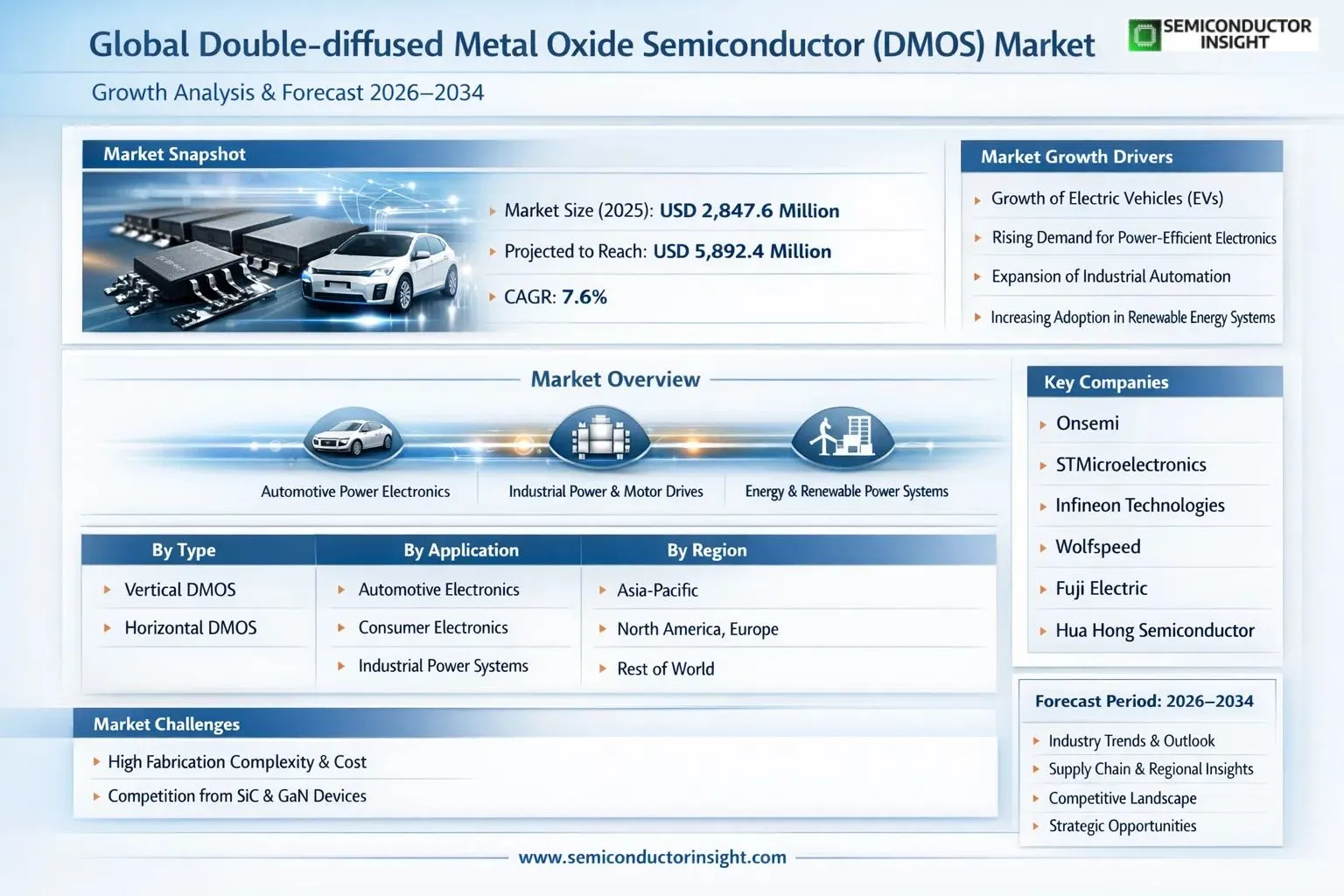
Global Double-diffused Metal Oxide Semiconductor Market was valued at USD 2,847.6 million in 2025. and is projected to reach USD 5,892.4 million by 2034, growing at a CAGR of 7.6%  during the forecast period 2026–2034.

PDF Icon Download Sample Report PDF
  • Quick Dispatch

    All Orders

  • Secure Payment

    100% Secure Payment

Price range: $1,500.00 through $4,250.00

Clear

Double-diffused Metal Oxide Semiconductor Market Insights

Global Double-diffused Metal Oxide Semiconductor (DMOS) market size was valued at USD 2,847.6 million in 2025. The market is projected to grow from USD 3,041.3 million in 2026 to USD 5,892.4 million by 2034, exhibiting a CAGR of 7.6% during the forecast period.

Double-diffused metal oxide semiconductor (DMOS) is a specialized semiconductor device that utilizes a changing voltage to control current flow, distinguished by its unique double-diffusion fabrication process. This technology encompasses both Vertical DMOS (VDMOS) and Horizontal DMOS (LDMOS) configurations, each serving distinct application requirements. DMOS transistors are widely deployed across automotive electronics, consumer electronics, industrial power systems, and telecommunications infrastructure, owing to their superior high-voltage handling capability, fast switching speed, and low on-resistance characteristics.

The market is witnessing robust expansion driven by surging demand for energy-efficient power management solutions and the accelerating global transition toward electric vehicles (EVs). Furthermore, the proliferation of advanced driver-assistance systems (ADAS) and increasing adoption of DMOS technology in motor drive applications continue to broaden the addressable market. Key manufacturers operating in this space include Onsemi, STMicroelectronics, Infineon Technologies, Wolfspeed, Fuji Electric, and Hua Hong Semiconductor, collectively accounting for a significant share of global revenues and continuing to invest in next-generation DMOS device development to maintain competitive positioning.
Double-diffused Metal Oxide Semiconductor Market Insights

MARKET DRIVERS

Rising Demand for Power-Efficient Semiconductor Devices in Power Electronics Applications

Double-diffused Metal Oxide Semiconductor (DMOS) market is experiencing significant momentum driven by the accelerating global transition toward energy-efficient power management systems. DMOS transistors, characterized by their unique double-diffusion fabrication process, deliver superior breakdown voltage and low on-resistance characteristics that make them indispensable in modern power conversion circuits. The widespread adoption of electric vehicles (EVs), renewable energy inverters, and industrial motor drives has created sustained demand for high-performance power semiconductors, with DMOS devices positioned at the forefront of this transition. As power density requirements in electronic systems continue to rise, the inherent thermal stability and switching efficiency of Double-diffused Metal Oxide Semiconductor technology offer compelling advantages over conventional bipolar junction transistors.

Expansion of Electric Vehicle Infrastructure and Automotive Power Systems

Automotive electrification represents one of the most powerful structural drivers shaping the Double-diffused Metal Oxide Semiconductor market. Modern EV powertrains and battery management systems demand robust power switching devices capable of operating across wide voltage and temperature ranges. DMOS-based power MOSFETs are increasingly integrated into on-board chargers, DC-DC converters, and traction inverters due to their low gate charge, fast switching speed, and rugged avalanche capability. Major automotive semiconductor suppliers are expanding their DMOS product portfolios to address stringent AEC-Q101 automotive qualification standards, further validating the technology’s role in next-generation mobility solutions. The growing penetration of 48V mild-hybrid architectures across passenger and commercial vehicle segments is expected to further amplify demand for DMOS components through the forecast period.

The integration of DMOS technology in automotive-grade power modules is expected to remain a pivotal growth catalyst, as global EV production volumes continue to scale and automakers prioritize compact, thermally efficient power electronic architectures.

Beyond automotive applications, the rapid proliferation of data centers and cloud computing infrastructure is reinforcing demand for Double-diffused Metal Oxide Semiconductor devices in server power supplies and voltage regulation modules. High-frequency switching capabilities inherent to DMOS architecture enable significant reductions in passive component size and overall system losses, aligning with data center operators’ aggressive power usage effectiveness (PUE) targets. This convergence of automotive, industrial, and digital infrastructure demand is establishing a broad and resilient growth foundation for Global DMOS semiconductor market.

MARKET CHALLENGES

Technological Complexity and High Fabrication Costs Associated with Advanced DMOS Process Nodes

Despite its performance advantages, the Double-diffused Metal Oxide Semiconductor market faces notable challenges stemming from the inherent complexity of DMOS fabrication processes. The double-diffusion implantation technique requires precise control of doping profiles, diffusion depths, and gate oxide integrity to achieve consistent device parametrics across wafer lots. This process sensitivity translates into elevated manufacturing costs, particularly when transitioning to advanced process nodes targeting sub-100V and ultra-low on-resistance specifications. Smaller or emerging fabless semiconductor companies often encounter significant barriers when attempting to qualify DMOS processes at leading-edge foundries, constraining the competitive landscape and limiting the pace of innovation in certain product segments.

Other Challenges

Supply Chain Vulnerabilities and Raw Material Constraints

Global semiconductor supply chain disruptions experienced in recent years have underscored the vulnerability of Double-diffused Metal Oxide Semiconductor manufacturers to upstream raw material shortages, including high-purity silicon wafers, specialty chemicals, and critical packaging substrates. Geopolitical tensions affecting key semiconductor manufacturing regions, combined with tight capacity at specialized power semiconductor fabs, have introduced lead time volatility that challenges downstream OEM supply planning. These supply-side pressures have particularly affected mid-range voltage DMOS devices used in consumer electronics and industrial automation, where demand elasticity is lower and inventory buffer strategies are more limited.

Competitive Pressure from Wide Bandgap Semiconductor Alternatives

The accelerating commercialization of silicon carbide (SiC) and gallium nitride (GaN) power transistors presents a growing competitive challenge for the Double-diffused Metal Oxide Semiconductor market in high-voltage and high-frequency application segments. Wide bandgap devices offer superior switching performance and thermal conductivity at voltage ratings above 600V, gradually displacing conventional silicon-based DMOS solutions in premium EV traction inverters and industrial power conversion equipment. While cost differentials currently sustain DMOS competitiveness across a broad range of applications, the trajectory of wide bandgap cost reduction necessitates continuous innovation in DMOS device architecture and process efficiency to defend market positioning over the long term.

MARKET RESTRAINTS

Saturation in Mature Consumer Electronics Segments Limiting Incremental Volume Growth

The Double-diffused Metal Oxide Semiconductor market faces a structural restraint in the form of demand saturation within mature consumer electronics categories, including smartphones, flat-panel displays, and desktop computing platforms. These segments, which historically represented significant volume consumption of low-voltage DMOS devices, are experiencing slowing unit shipment growth as hardware replacement cycles lengthen and market penetration in developed economies approaches ceiling levels. This dynamic compresses average selling price trajectories for commodity DMOS products and reduces the revenue upside available from incremental unit volume expansion in legacy application areas.

Regulatory and Environmental Compliance Pressures on Semiconductor Manufacturing Operations

Increasingly stringent environmental regulations governing semiconductor manufacturing processes represent a meaningful restraint on capacity expansion and operational flexibility within the Double-diffused Metal Oxide Semiconductor industry. DMOS fabrication involves the use of hazardous chemicals and high-purity water resources subject to evolving regulatory frameworks across major manufacturing jurisdictions in Asia, Europe, and North America. Compliance with regulations such as the EU’s REACH framework, restrictions on perfluorocarbon emissions, and wastewater discharge standards requires ongoing capital investment in abatement systems and process substitution programs. These compliance costs disproportionately affect smaller integrated device manufacturers and contract foundries with limited resources to absorb incremental environmental expenditures, potentially accelerating industry consolidation over the medium term.

Furthermore, the capital-intensive nature of power semiconductor fabrication facilities creates long investment payback periods that can deter capacity additions during periods of demand uncertainty. The extended gestation time between fab investment decisions and qualified production output , typically spanning three to five years for greenfield facilities , introduces timing mismatches between supply response and evolving demand patterns in the Double-diffused Metal Oxide Semiconductor market, constraining the industry’s ability to rapidly address emerging application requirements.

MARKET OPPORTUNITIES

Accelerating Adoption of Renewable Energy Systems Creating Sustained Demand for DMOS Power Devices

Global energy transition toward solar photovoltaic and wind power generation presents a compelling long-term opportunity for the Double-diffused Metal Oxide Semiconductor market. Grid-tied inverters, maximum power point tracking (MPPT) controllers, and energy storage system converters rely extensively on high-efficiency power switching devices, where DMOS-based MOSFETs deliver favorable combinations of conduction loss, switching loss, and ruggedness. As installed renewable energy capacity continues to expand globally, driven by government decarbonization mandates and declining system costs, the addressable market for DMOS components in clean energy power electronics is projected to grow at an above-average rate relative to the broader semiconductor industry.

Emerging Opportunities in Industrial Automation and Smart Manufacturing Ecosystems

The ongoing digitization of industrial operations through Industry 4.0 initiatives is generating substantial incremental demand for Double-diffused Metal Oxide Semiconductor devices across servo drive controllers, programmable logic controllers, robotics power stages, and smart grid equipment. DMOS transistors integrated within intelligent power modules (IPMs) and gate driver ICs enable the precise, high-efficiency motor control demanded by next-generation factory automation platforms. As manufacturing enterprises in Asia-Pacific, Europe, and North America accelerate investments in flexible automation and predictive maintenance systems, the embedded power semiconductor content per installed automation unit is expected to increase meaningfully, expanding the total addressable market available to DMOS device suppliers with differentiated product offerings.

Additionally, the proliferation of Double-diffused Metal Oxide Semiconductor technology in telecommunications infrastructure , particularly in 5G base station power amplifiers and DC power systems , represents an emerging high-value opportunity segment. The densification of 5G radio access networks globally requires energy-efficient, compact power conversion solutions capable of operating reliably in diverse environmental conditions, creating a differentiated demand profile well-suited to advanced DMOS product architectures. Strategic investments in application-specific DMOS device development targeting these high-growth verticals are expected to yield above-market revenue growth opportunities for technologically agile semiconductor suppliers through the coming forecast horizon.

MAIN TITLE HERE () Trends

Rising Demand Across Automotive and Consumer Electronics Driving the Double-diffused Metal Oxide Semiconductor Market

The Double-diffused Metal Oxide Semiconductor Market is witnessing significant momentum, primarily driven by the expanding adoption of DMOS devices in automotive electronics and consumer electronics applications. As a voltage-controlled semiconductor device capable of managing high current levels efficiently, the double-diffused metal oxide semiconductor has become an indispensable component in modern power management systems. The automotive sector, in particular, continues to integrate these devices into advanced driver-assistance systems (ADAS), electric powertrains, and onboard charging units, reflecting a broader industry shift toward electrification and energy efficiency.

Other Trends

Growing Role of Vertical DMOS Architecture

Within the Double-diffused Metal Oxide Semiconductor Market, the vertical product segment is gaining considerable traction over its horizontal counterpart. Vertical DMOS transistors offer superior current-carrying capability and lower on-resistance, making them highly suitable for high-voltage and high-frequency applications. This structural advantage has encouraged manufacturers such as Onsemi, Infineon, and STMicroelectronics to prioritize vertical architecture in their product development roadmaps. The growing preference for vertical devices across industrial and automotive platforms is expected to sustain this segment’s dominance through the forecast period.

Asia-Pacific Emerging as a Key Manufacturing and Consumption Hub

Geographically, Asia , particularly China, Japan, South Korea, and Southeast Asia , represents one of the most active regions in the Double-diffused Metal Oxide Semiconductor Market. China’s robust electronics manufacturing base and its strong push toward domestic semiconductor self-sufficiency have encouraged local players such as Hua Hong Semiconductor to scale production capacity. Meanwhile, Japan and South Korea continue to innovate in power semiconductor design, catering to both regional and global demand.

Competitive Landscape and Innovation Among Leading Players

The competitive environment within the Double-diffused Metal Oxide Semiconductor Market remains concentrated among a handful of established global manufacturers. Companies including Onsemi, STMicroelectronics, Infineon, Wolfspeed, Fuji Electric, and Hua Hong Semiconductor collectively account for a substantial share of global revenues. These players are actively investing in next-generation DMOS technologies, with a focus on improving switching speed, thermal performance, and miniaturization. Strategic mergers, acquisitions, and capacity expansion initiatives are further reshaping the competitive landscape. As end-use industries demand higher efficiency and reliability from power semiconductors, innovation in double-diffused metal oxide semiconductor design is expected to remain a central theme defining market evolution through 2034.

COMPETITIVE LANDSCAPE

Key Industry Players

Double-diffused Metal Oxide Semiconductor (DMOS) Market ,Competitive Intelligence & Strategic Benchmarking of Leading Global Manufacturers

Global Double-diffused Metal Oxide Semiconductor (DMOS) market is characterized by the strong dominance of a handful of established semiconductor giants that leverage advanced fabrication technologies, extensive R&D investments, and broad application portfolios. Onsemi and STMicroelectronics lead the competitive landscape by offering a comprehensive range of DMOS transistors optimized for automotive electronics, industrial power management, and consumer applications. Infineon Technologies further consolidates its market position through its high-performance vertical DMOS product lines, targeting electric vehicle (EV) powertrains and energy-efficient industrial drives. Wolfspeed, recognized for its wide-bandgap semiconductor expertise, has been actively expanding its DMOS-compatible power device portfolio to address next-generation power conversion demands. These top-tier players collectively commanded approximately the majority of Global market revenue in 2025, driven by their ability to deliver scalable, cost-effective, and high-reliability DMOS solutions across diverse end-use verticals.

Beyond the market leaders, a number of regionally significant and niche-focused manufacturers contribute meaningfully to the competitive dynamics of the Double-diffused Metal Oxide Semiconductor market. Fuji Electric maintains a strong presence particularly within the Asia-Pacific industrial and automotive segments, while Hua Hong Semiconductor has emerged as a notable Chinese domestic player benefiting from localization trends and government-backed semiconductor self-sufficiency initiatives. Companies such as Vishay Intertechnology, ROHM Semiconductor, and Toshiba Electronics Device & Storage Corporation differentiate themselves through specialized DMOS architectures targeting consumer electronics and low-to-medium voltage applications. Meanwhile, players including Renesas Electronics, Texas Instruments, and Nexperia are actively investing in process node improvements and packaging innovations to capture incremental share in the rapidly evolving automotive electronics and IoT-driven consumer segments. The competitive environment is further intensified by increasing merger and acquisition activity, strategic partnerships, and capacity expansion plans aimed at addressing growing global demand for efficient power semiconductor solutions.

List of Key Double-diffused Metal Oxide Semiconductor Companies Profiled

Segment Analysis:

Segment Category Sub-Segments Key Insights
By Type
  • Vertical DMOS
  • Horizontal DMOS
Vertical DMOS holds the leading position in the Double-diffused Metal Oxide Semiconductor market by type, owing to its superior structural advantages that enable efficient current flow perpendicular to the chip surface.

  • Vertical DMOS devices are highly favored for high-power and high-frequency applications due to their ability to handle greater current densities while maintaining lower on-resistance, making them indispensable in demanding power management systems.
  • The architecture of Vertical DMOS supports better thermal dissipation characteristics, which enhances device reliability and longevity under continuous operation , a critical requirement in industrial and automotive environments.
  • Horizontal DMOS, while serving a niche role, is predominantly adopted in integrated circuit (IC) designs where lateral device integration is necessary, particularly in mixed-signal and analog circuit platforms.
By Application
  • Consumer Electronics
  • Automotive Electronics
  • Industrial Power Systems
  • Others
Automotive Electronics emerges as the leading application segment, driven by the accelerating global transition toward electric vehicles (EVs) and advanced driver-assistance systems (ADAS).

  • DMOS transistors are integral to automotive power control units, battery management systems, and motor drive circuits in EVs and hybrid electric vehicles, where precise voltage control and high switching efficiency are paramount.
  • The increasing complexity of in-vehicle electronic architectures , including infotainment systems, electronic stability control, and onboard charging units , continuously elevates the demand for robust, thermally stable DMOS components.
  • Consumer Electronics represents a significant application area as well, with DMOS devices being widely integrated into smartphones, laptops, gaming consoles, and wearable devices for efficient power conversion and battery protection functions.
By End User
  • Automotive OEMs & Tier-1 Suppliers
  • Consumer Electronics Manufacturers
  • Industrial Equipment Manufacturers
  • Telecommunications & Networking Companies
Automotive OEMs & Tier-1 Suppliers represent the dominant end-user category in the DMOS market, reflecting the deep integration of power semiconductor solutions into modern vehicle platforms.

  • Leading automotive manufacturers and their Tier-1 supply chain partners increasingly source high-performance DMOS transistors to meet stringent automotive-grade reliability standards such as AEC-Q101, ensuring long-term component durability in harsh operating environments.
  • The ongoing electrification of powertrains and the growing prevalence of 48V mild-hybrid systems are compelling automotive end users to adopt advanced DMOS solutions that offer superior switching speeds and reduced energy losses.
  • Consumer Electronics Manufacturers also constitute a major end-user group, continuously driving demand for compact, cost-efficient DMOS devices optimized for miniaturized power management in portable and smart devices.
By Voltage Rating
  • Low Voltage (Below 100V)
  • Medium Voltage (100V – 500V)
  • High Voltage (Above 500V)
Medium Voltage DMOS devices lead this segment, finding widespread adoption across a broad spectrum of applications that require a balanced combination of switching performance and power handling capability.

  • Medium voltage DMOS transistors are extensively utilized in motor drives, power supplies, and DC-DC converters, where they serve as the backbone of efficient energy transfer and regulation in both industrial and commercial settings.
  • High voltage DMOS devices are gaining accelerated traction in renewable energy systems , including solar inverters and wind turbine converters , where the ability to withstand elevated voltage stress without compromising switching efficiency is critically important.
  • Low voltage variants remain highly relevant in portable consumer electronics and telecommunications infrastructure, offering optimized performance for battery-operated systems that demand minimal power losses and rapid response characteristics.
By Packaging Type
  • Through-Hole Packages (TO Series)
  • Surface Mount Packages (SMD/SMT)
  • Chip-Scale & Bare Die Packages
Surface Mount Packages (SMD/SMT) dominate the packaging segment of the DMOS market, aligning with the broader industry shift toward miniaturization and high-density PCB assembly in modern electronic systems.

  • SMD-packaged DMOS devices are preferred by consumer electronics and automotive electronics manufacturers for their compatibility with automated assembly processes, enabling reduced board real estate, improved parasitic performance, and enhanced production throughput.
  • Chip-Scale and Bare Die packages are witnessing growing adoption in cutting-edge applications such as advanced driver assistance modules, wearable health devices, and high-frequency power converters, where ultra-compact form factors and minimal packaging parasitics are essential design requirements.
  • Through-Hole packages, while considered a more traditional format, continue to hold relevance in industrial power electronics and legacy system retrofits, where mechanical robustness and ease of manual assembly remain important procurement considerations.

Regional Analysis: Double-diffused Metal Oxide Semiconductor Market

Asia-Pacific

Asia-Pacific stands as the dominant force in the Double-diffused Metal Oxide Semiconductor market, driven by an unparalleled concentration of semiconductor manufacturing infrastructure, electronics production ecosystems, and rapidly expanding end-use industries. Countries such as China, Japan, South Korea, and Taiwan have collectively established themselves as global hubs for power semiconductor development and fabrication. The region benefits from deep-rooted supply chain networks, government-backed industrial policies, and aggressive investments in electric vehicle adoption, renewable energy integration, and advanced consumer electronics. The Double-diffused Metal Oxide Semiconductor market in Asia-Pacific is further strengthened by a robust demand from industrial motor drives, inverter systems, and telecommunications infrastructure, all of which rely heavily on efficient power management solutions. Local semiconductor foundries continue to scale capacity while regional players compete with global leaders on both performance and cost efficiency. The growing focus on energy efficiency regulations and the proliferation of smart grid technologies are expected to sustain long-term growth momentum across the Asia-Pacific Double-diffused Metal Oxide Semiconductor market well into the forecast period.
Manufacturing Ecosystem
Asia-Pacific hosts the world’s most comprehensive semiconductor manufacturing ecosystem. Leading foundries and integrated device manufacturers in China, South Korea, and Taiwan support end-to-end Double-diffused Metal Oxide Semiconductor production, from wafer fabrication to advanced packaging, enabling rapid scaling and cost-effective delivery to global markets.
EV & Renewable Energy Demand
The accelerating shift toward electric vehicles and renewable energy infrastructure across China, Japan, and South Korea is a primary demand catalyst for the Double-diffused Metal Oxide Semiconductor market. High-efficiency power conversion systems in these sectors require reliable, high-voltage switching components, positioning the region at the forefront of adoption.
Government Policy & Investment
Strategic government initiatives across Asia-Pacific, including semiconductor self-sufficiency programs and green energy mandates, have directed substantial capital toward power electronics research and manufacturing. These policies create a favorable environment for Double-diffused Metal Oxide Semiconductor market participants, reducing import dependency and fostering indigenous innovation.
Industrial & Telecom Applications
Industrial automation, motor control systems, and expanding 5G telecommunications networks across Asia-Pacific generate consistent demand for power-efficient switching devices. The Double-diffused Metal Oxide Semiconductor market benefits from these diverse application segments, which provide stability and multi-sector growth drivers throughout the forecast period.

North America
North America represents a technologically advanced and innovation-driven segment of the Double-diffused Metal Oxide Semiconductor market. The United States leads regional demand, underpinned by a mature automotive sector transitioning toward electrification, a robust defense and aerospace industry requiring high-reliability power components, and significant investments in data center infrastructure. The presence of leading semiconductor design firms and research universities fosters continuous advancement in power device architectures. Additionally, federal initiatives supporting domestic semiconductor production have renewed focus on strengthening the regional supply chain. The Double-diffused Metal Oxide Semiconductor market in North America also benefits from growing adoption of distributed energy resources and grid modernization projects, which demand efficient power conversion solutions. Canada contributes through its clean energy commitments, while Mexico’s expanding automotive manufacturing base adds incremental demand for power electronic components throughout the region.

Europe
Europe occupies a significant position in Global Double-diffused Metal Oxide Semiconductor market, characterized by stringent energy efficiency regulations and a strong industrial tradition in automotive and power electronics engineering. Germany, France, and the Nordic countries are at the forefront of regional adoption, driven by ambitious carbon neutrality targets and the rapid electrification of transportation. European automotive OEMs and tier-one suppliers are key consumers of advanced power semiconductor devices, integrating them into electric drivetrains and onboard charging systems. The region’s focus on industrial digitalization and smart factory deployment further elevates demand for reliable switching components. European regulatory frameworks, including the European Green Deal, provide a structural tailwind for the Double-diffused Metal Oxide Semiconductor market, encouraging the development and deployment of energy-efficient power management technologies across multiple industries.

South America
South America presents an emerging opportunity landscape for the Double-diffused Metal Oxide Semiconductor market, with growth being shaped by gradual industrial modernization and increasing investments in renewable energy generation. Brazil leads regional demand, supported by its extensive hydroelectric and solar energy programs that require efficient power conversion equipment. The automotive sector, while still developing its electrification roadmap, is beginning to incorporate advanced power electronics into newer vehicle platforms. Challenges related to economic volatility, limited local semiconductor manufacturing, and dependency on imported components continue to temper growth pace. However, expanding grid infrastructure projects and rising awareness of energy efficiency present meaningful medium-term opportunities for the Double-diffused Metal Oxide Semiconductor market as regional industrial capacity continues to develop.

Middle East & Africa
The Middle East and Africa region represents a nascent but gradually evolving market for Double-diffused Metal Oxide Semiconductor applications. Large-scale renewable energy projects, particularly solar installations across the Gulf Cooperation Council countries and North Africa, are driving initial demand for power conversion and management systems that rely on efficient semiconductor devices. Nations such as Saudi Arabia and the United Arab Emirates are pursuing economic diversification strategies that include investments in smart infrastructure, data centers, and advanced manufacturing, all of which create downstream demand for power electronics. While local production capabilities remain limited, growing import activity and technology transfer agreements are beginning to establish a foundation for sustained market participation in the Double-diffused Metal Oxide Semiconductor market across the forecast period.

Report Scope

This market research report provides a comprehensive analysis of the Double-diffused Metal Oxide Semiconductor Market, covering the forecast period 2026–2034. It offers detailed insights into market dynamics, technological advancements, competitive landscape, and key trends shaping the industry.

Key focus areas of the report include:

  • Market Overview: The report begins with an overview outlining its current market scenario, key growth indicators, and industry transformation drivers. It discusses macroeconomic factors, demand–supply balance, regulatory landscape, and the strategic role of semiconductors in powering advancements across industries such as automotive, telecommunications, consumer electronics, and industrial automation.
  • Market Size & Forecast: Historical data and future projections for revenue, unit shipments, and market value across major regions and segments.
  • Segmentation Analysis: Detailed breakdown by product type, technology, application, and end-user industry to identify high-growth segments and investment opportunities.
  • Regional Insights: Insights into market performance across North America, Europe, Asia-Pacific, Latin America, and the Middle East & Africa, including country-level analysis where relevant.
  • Competitive Landscape: Profiles of leading market participants, including their product offerings, R&D focus, manufacturing capacity, pricing strategies, and recent developments such as mergers, acquisitions, and partnerships.
  • Technology Trends & Innovation: Assessment of emerging technologies, integration of AI/IoT, semiconductor design trends, fabrication techniques, and evolving industry standards.
  • Market Drivers & Restraints: Evaluation of factors driving market growth along with challenges, supply chain constraints, regulatory issues, and market-entry barriers.
  • Stakeholder Insights: Insights for component suppliers, OEMs, system integrators, investors, and policymakers regarding the evolving ecosystem and strategic opportunities.

Primary and secondary research methods are employed, including interviews with industry experts, data from verified sources, and real-time market intelligence to ensure the accuracy and reliability of the insights presented.

FREQUENTLY ASKED QUESTIONS:

What is the current market size of the Double-diffused Metal Oxide Semiconductor Market?

-> Global Double-diffused Metal Oxide Semiconductor Market was valued at USD 2,847.6 million in 2025. and is projected to reach USD 5,892.4 million by 2034, growing at a CAGR of 7.6%  during the forecast period 2026–2034.

Which key companies operate in the Double-diffused Metal Oxide Semiconductor Market?

-> Key players include Onsemi, STMicroelectronics, Infineon, Wolfspeed, Fuji Electric, and Hua Hong Semiconductor, among others. In 2025, Global top five players held approximately % of the market in terms of revenue.

What are the key growth drivers?

-> Key growth drivers include rising demand in automotive electronics and consumer electronics, increased adoption of power-efficient semiconductor devices, rapid urbanization, and the expanding role of Double-diffused Metal Oxide Semiconductors in industrial automation and telecommunications. The device’s ability to control current through changing voltage makes it critical across a wide range of applications.

Which region dominates the Double-diffused Metal Oxide Semiconductor Market?

-> Asia is a key region in the market, with China representing a significant share, projected to reach USD million by the forecast period. North America, particularly the U.S. market estimated at USD million in 2025, also plays a major role in global market dynamics.

What are the emerging trends in the Double-diffused Metal Oxide Semiconductor Market?

-> Emerging trends include advancements in vertical DMOS structures, with the Vertical segment projected to reach USD million by 2034 at a notable CAGR over the next six years, as well as growing integration of AI and IoT in semiconductor applications, development of more efficient power devices, and increasing use of DMOS in automotive electronics and consumer electronics segments.

Double-diffused Metal Oxide Semiconductor Market, Trends, Business Strategies 2026-2034

Get Sample Report PDF for Exclusive Insights

Report Sample Includes

  • Table of Contents
  • List of Tables & Figures
  • Charts, Research Methodology, and more...

PDF Icon Download Sample Report PDF
SKU: ab9b2582a1c2
Category:
License Type

Corporate License, Excel License, PDF and Excel Databook License

Download Sample Report

Table of Content

1 Introduction to Research & Analysis Reports
1.1 Double-diffused Metal Oxide Semiconductor Market Definition
1.2 Market Segments
1.2.1 Segment by Type
1.2.2 Segment by Application
1.3 Global Double-diffused Metal Oxide Semiconductor Market Overview
1.4 Features & Benefits of This Report
1.5 Methodology & Sources of Information
1.5.1 Research Methodology
1.5.2 Research Process
1.5.3 Base Year
1.5.4 Report Assumptions & Caveats
2 Global Double-diffused Metal Oxide Semiconductor Overall Market Size
2.1 Global Double-diffused Metal Oxide Semiconductor Market Size: 2025 VS 2034
2.2 Global Double-diffused Metal Oxide Semiconductor Market Size, Prospects & Forecasts: 2021-2034
2.3 Global Double-diffused Metal Oxide Semiconductor Sales: 2021-2034
3 Company Landscape
3.1 Top Double-diffused Metal Oxide Semiconductor Players in Global Market
3.2 Top Global Double-diffused Metal Oxide Semiconductor Companies Ranked by Revenue
3.3 Global Double-diffused Metal Oxide Semiconductor Revenue by Companies
3.4 Global Double-diffused Metal Oxide Semiconductor Sales by Companies
3.5 Global Double-diffused Metal Oxide Semiconductor Price by Manufacturer (2021-2026)
3.6 Top 3 and Top 5 Double-diffused Metal Oxide Semiconductor Companies in Global Market, by Revenue in 2025
3.7 Global Manufacturers Double-diffused Metal Oxide Semiconductor Product Type
3.8 Tier 1, Tier 2, and Tier 3 Double-diffused Metal Oxide Semiconductor Players in Global Market
3.8.1 List of Global Tier 1 Double-diffused Metal Oxide Semiconductor Companies
3.8.2 List of Global Tier 2 and Tier 3 Double-diffused Metal Oxide Semiconductor Companies
4 Sights by Type
4.1 Overview
4.1.1 Segment by Type – Global Double-diffused Metal Oxide Semiconductor Market Size Markets, 2025 & 2034
4.1.2 Vertical
4.1.3 Horizontal
4.2 Segment by Type – Global Double-diffused Metal Oxide Semiconductor Revenue & Forecasts
4.2.1 Segment by Type – Global Double-diffused Metal Oxide Semiconductor Revenue, 2021-2026
4.2.2 Segment by Type – Global Double-diffused Metal Oxide Semiconductor Revenue, 2027-2034
4.2.3 Segment by Type – Global Double-diffused Metal Oxide Semiconductor Revenue Market Share, 2021-2034
4.3 Segment by Type – Global Double-diffused Metal Oxide Semiconductor Sales & Forecasts
4.3.1 Segment by Type – Global Double-diffused Metal Oxide Semiconductor Sales, 2021-2026
4.3.2 Segment by Type – Global Double-diffused Metal Oxide Semiconductor Sales, 2027-2034
4.3.3 Segment by Type – Global Double-diffused Metal Oxide Semiconductor Sales Market Share, 2021-2034
4.4 Segment by Type – Global Double-diffused Metal Oxide Semiconductor Price (Manufacturers Selling Prices), 2021-2034
5 Sights by Application
5.1 Overview
5.1.1 Segment by Application – Global Double-diffused Metal Oxide Semiconductor Market Size, 2025 & 2034
5.1.2 Consumer Electronics
5.1.3 Automotive Electronics
5.1.4 Other
5.2 Segment by Application – Global Double-diffused Metal Oxide Semiconductor Revenue & Forecasts
5.2.1 Segment by Application – Global Double-diffused Metal Oxide Semiconductor Revenue, 2021-2026
5.2.2 Segment by Application – Global Double-diffused Metal Oxide Semiconductor Revenue, 2027-2034
5.2.3 Segment by Application – Global Double-diffused Metal Oxide Semiconductor Revenue Market Share, 2021-2034
5.3 Segment by Application – Global Double-diffused Metal Oxide Semiconductor Sales & Forecasts
5.3.1 Segment by Application – Global Double-diffused Metal Oxide Semiconductor Sales, 2021-2026
5.3.2 Segment by Application – Global Double-diffused Metal Oxide Semiconductor Sales, 2027-2034
5.3.3 Segment by Application – Global Double-diffused Metal Oxide Semiconductor Sales Market Share, 2021-2034
5.4 Segment by Application – Global Double-diffused Metal Oxide Semiconductor Price (Manufacturers Selling Prices), 2021-2034
6 Sights Region
6.1 By Region – Global Double-diffused Metal Oxide Semiconductor Market Size, 2025 & 2034
6.2 By Region – Global Double-diffused Metal Oxide Semiconductor Revenue & Forecasts
6.2.1 By Region – Global Double-diffused Metal Oxide Semiconductor Revenue, 2021-2026
6.2.2 By Region – Global Double-diffused Metal Oxide Semiconductor Revenue, 2027-2034
6.2.3 By Region – Global Double-diffused Metal Oxide Semiconductor Revenue Market Share, 2021-2034
6.3 By Region – Global Double-diffused Metal Oxide Semiconductor Sales & Forecasts
6.3.1 By Region – Global Double-diffused Metal Oxide Semiconductor Sales, 2021-2026
6.3.2 By Region – Global Double-diffused Metal Oxide Semiconductor Sales, 2027-2034
6.3.3 By Region – Global Double-diffused Metal Oxide Semiconductor Sales Market Share, 2021-2034
6.4 North America
6.4.1 By Country – North America Double-diffused Metal Oxide Semiconductor Revenue, 2021-2034
6.4.2 By Country – North America Double-diffused Metal Oxide Semiconductor Sales, 2021-2034
6.4.3 United States Double-diffused Metal Oxide Semiconductor Market Size, 2021-2034
6.4.4 Canada Double-diffused Metal Oxide Semiconductor Market Size, 2021-2034
6.4.5 Mexico Double-diffused Metal Oxide Semiconductor Market Size, 2021-2034
6.5 Europe
6.5.1 By Country – Europe Double-diffused Metal Oxide Semiconductor Revenue, 2021-2034
6.5.2 By Country – Europe Double-diffused Metal Oxide Semiconductor Sales, 2021-2034
6.5.3 Germany Double-diffused Metal Oxide Semiconductor Market Size, 2021-2034
6.5.4 France Double-diffused Metal Oxide Semiconductor Market Size, 2021-2034
6.5.5 U.K. Double-diffused Metal Oxide Semiconductor Market Size, 2021-2034
6.5.6 Italy Double-diffused Metal Oxide Semiconductor Market Size, 2021-2034
6.5.7 Russia Double-diffused Metal Oxide Semiconductor Market Size, 2021-2034
6.5.8 Nordic Countries Double-diffused Metal Oxide Semiconductor Market Size, 2021-2034
6.5.9 Benelux Double-diffused Metal Oxide Semiconductor Market Size, 2021-2034
6.6 Asia
6.6.1 By Region – Asia Double-diffused Metal Oxide Semiconductor Revenue, 2021-2034
6.6.2 By Region – Asia Double-diffused Metal Oxide Semiconductor Sales, 2021-2034
6.6.3 China Double-diffused Metal Oxide Semiconductor Market Size, 2021-2034
6.6.4 Japan Double-diffused Metal Oxide Semiconductor Market Size, 2021-2034
6.6.5 South Korea Double-diffused Metal Oxide Semiconductor Market Size, 2021-2034
6.6.6 Southeast Asia Double-diffused Metal Oxide Semiconductor Market Size, 2021-2034
6.6.7 India Double-diffused Metal Oxide Semiconductor Market Size, 2021-2034
6.7 South America
6.7.1 By Country – South America Double-diffused Metal Oxide Semiconductor Revenue, 2021-2034
6.7.2 By Country – South America Double-diffused Metal Oxide Semiconductor Sales, 2021-2034
6.7.3 Brazil Double-diffused Metal Oxide Semiconductor Market Size, 2021-2034
6.7.4 Argentina Double-diffused Metal Oxide Semiconductor Market Size, 2021-2034
6.8 Middle East & Africa
6.8.1 By Country – Middle East & Africa Double-diffused Metal Oxide Semiconductor Revenue, 2021-2034
6.8.2 By Country – Middle East & Africa Double-diffused Metal Oxide Semiconductor Sales, 2021-2034
6.8.3 Turkey Double-diffused Metal Oxide Semiconductor Market Size, 2021-2034
6.8.4 Israel Double-diffused Metal Oxide Semiconductor Market Size, 2021-2034
6.8.5 Saudi Arabia Double-diffused Metal Oxide Semiconductor Market Size, 2021-2034
6.8.6 UAE Double-diffused Metal Oxide Semiconductor Market Size, 2021-2034
7 Manufacturers & Brands Profiles
7.1 Onsemi
7.1.1 Onsemi Company Summary
7.1.2 Onsemi Business Overview
7.1.3 Onsemi Double-diffused Metal Oxide Semiconductor Major Product Offerings
7.1.4 Onsemi Double-diffused Metal Oxide Semiconductor Sales and Revenue in Global (2021-2026)
7.1.5 Onsemi Key News & Latest Developments
7.2 STMicroelectronics
7.2.1 STMicroelectronics Company Summary
7.2.2 STMicroelectronics Business Overview
7.2.3 STMicroelectronics Double-diffused Metal Oxide Semiconductor Major Product Offerings
7.2.4 STMicroelectronics Double-diffused Metal Oxide Semiconductor Sales and Revenue in Global (2021-2026)
7.2.5 STMicroelectronics Key News & Latest Developments
7.3 Infineon
7.3.1 Infineon Company Summary
7.3.2 Infineon Business Overview
7.3.3 Infineon Double-diffused Metal Oxide Semiconductor Major Product Offerings
7.3.4 Infineon Double-diffused Metal Oxide Semiconductor Sales and Revenue in Global (2021-2026)
7.3.5 Infineon Key News & Latest Developments
7.4 Wolfspeed
7.4.1 Wolfspeed Company Summary
7.4.2 Wolfspeed Business Overview
7.4.3 Wolfspeed Double-diffused Metal Oxide Semiconductor Major Product Offerings
7.4.4 Wolfspeed Double-diffused Metal Oxide Semiconductor Sales and Revenue in Global (2021-2026)
7.4.5 Wolfspeed Key News & Latest Developments
7.5 Fuji Electric
7.5.1 Fuji Electric Company Summary
7.5.2 Fuji Electric Business Overview
7.5.3 Fuji Electric Double-diffused Metal Oxide Semiconductor Major Product Offerings
7.5.4 Fuji Electric Double-diffused Metal Oxide Semiconductor Sales and Revenue in Global (2021-2026)
7.5.5 Fuji Electric Key News & Latest Developments
7.6 Hua Hong Semiconductor
7.6.1 Hua Hong Semiconductor Company Summary
7.6.2 Hua Hong Semiconductor Business Overview
7.6.3 Hua Hong Semiconductor Double-diffused Metal Oxide Semiconductor Major Product Offerings
7.6.4 Hua Hong Semiconductor Double-diffused Metal Oxide Semiconductor Sales and Revenue in Global (2021-2026)
7.6.5 Hua Hong Semiconductor Key News & Latest Developments
8 Global Double-diffused Metal Oxide Semiconductor Production Capacity, Analysis
8.1 Global Double-diffused Metal Oxide Semiconductor Production Capacity, 2021-2034
8.2 Double-diffused Metal Oxide Semiconductor Production Capacity of Key Manufacturers in Global Market
8.3 Global Double-diffused Metal Oxide Semiconductor Production by Region
9 Key Market Trends, Opportunity, Drivers and Restraints
9.1 Market Opportunities & Trends
9.2 Market Drivers
9.3 Market Restraints
10 Double-diffused Metal Oxide Semiconductor Supply Chain Analysis
10.1 Double-diffused Metal Oxide Semiconductor Industry Value Chain
10.2 Double-diffused Metal Oxide Semiconductor Upstream Market
10.3 Double-diffused Metal Oxide Semiconductor Downstream and Clients
10.4 Marketing Channels Analysis
10.4.1 Marketing Channels
10.4.2 Double-diffused Metal Oxide Semiconductor Distributors and Sales Agents in Global
11 Conclusion
12 Appendix
12.1 Note
12.2 Examples of Clients
12.3 DisclaimerList of Tables
Table 1. Key Players of Double-diffused Metal Oxide Semiconductor in Global Market
Table 2. Top Double-diffused Metal Oxide Semiconductor Players in Global Market, Ranking by Revenue (2025)
Table 3. Global Double-diffused Metal Oxide Semiconductor Revenue by Companies, (US$, Mn), 2021-2026
Table 4. Global Double-diffused Metal Oxide Semiconductor Revenue Share by Companies, 2021-2026
Table 5. Global Double-diffused Metal Oxide Semiconductor Sales by Companies, (K Units), 2021-2026
Table 6. Global Double-diffused Metal Oxide Semiconductor Sales Share by Companies, 2021-2026
Table 7. Key Manufacturers Double-diffused Metal Oxide Semiconductor Price (2021-2026) & (US$/Unit)
Table 8. Global Manufacturers Double-diffused Metal Oxide Semiconductor Product Type
Table 9. List of Global Tier 1 Double-diffused Metal Oxide Semiconductor Companies, Revenue (US$, Mn) in 2025 and Market Share
Table 10. List of Global Tier 2 and Tier 3 Double-diffused Metal Oxide Semiconductor Companies, Revenue (US$, Mn) in 2025 and Market Share
Table 11. Segment by Type – Global Double-diffused Metal Oxide Semiconductor Revenue, (US$, Mn), 2025 & 2034
Table 12. Segment by Type – Global Double-diffused Metal Oxide Semiconductor Revenue (US$, Mn), 2021-2026
Table 13. Segment by Type – Global Double-diffused Metal Oxide Semiconductor Revenue (US$, Mn), 2027-2034
Table 14. Segment by Type – Global Double-diffused Metal Oxide Semiconductor Sales (K Units), 2021-2026
Table 15. Segment by Type – Global Double-diffused Metal Oxide Semiconductor Sales (K Units), 2027-2034
Table 16. Segment by Application – Global Double-diffused Metal Oxide Semiconductor Revenue, (US$, Mn), 2025 & 2034
Table 17. Segment by Application – Global Double-diffused Metal Oxide Semiconductor Revenue, (US$, Mn), 2021-2026
Table 18. Segment by Application – Global Double-diffused Metal Oxide Semiconductor Revenue, (US$, Mn), 2027-2034
Table 19. Segment by Application – Global Double-diffused Metal Oxide Semiconductor Sales, (K Units), 2021-2026
Table 20. Segment by Application – Global Double-diffused Metal Oxide Semiconductor Sales, (K Units), 2027-2034
Table 21. By Region – Global Double-diffused Metal Oxide Semiconductor Revenue, (US$, Mn), 2025 & 2034
Table 22. By Region – Global Double-diffused Metal Oxide Semiconductor Revenue, (US$, Mn), 2021-2026
Table 23. By Region – Global Double-diffused Metal Oxide Semiconductor Revenue, (US$, Mn), 2027-2034
Table 24. By Region – Global Double-diffused Metal Oxide Semiconductor Sales, (K Units), 2021-2026
Table 25. By Region – Global Double-diffused Metal Oxide Semiconductor Sales, (K Units), 2027-2034
Table 26. By Country – North America Double-diffused Metal Oxide Semiconductor Revenue, (US$, Mn), 2021-2026
Table 27. By Country – North America Double-diffused Metal Oxide Semiconductor Revenue, (US$, Mn), 2027-2034
Table 28. By Country – North America Double-diffused Metal Oxide Semiconductor Sales, (K Units), 2021-2026
Table 29. By Country – North America Double-diffused Metal Oxide Semiconductor Sales, (K Units), 2027-2034
Table 30. By Country – Europe Double-diffused Metal Oxide Semiconductor Revenue, (US$, Mn), 2021-2026
Table 31. By Country – Europe Double-diffused Metal Oxide Semiconductor Revenue, (US$, Mn), 2027-2034
Table 32. By Country – Europe Double-diffused Metal Oxide Semiconductor Sales, (K Units), 2021-2026
Table 33. By Country – Europe Double-diffused Metal Oxide Semiconductor Sales, (K Units), 2027-2034
Table 34. By Region – Asia Double-diffused Metal Oxide Semiconductor Revenue, (US$, Mn), 2021-2026
Table 35. By Region – Asia Double-diffused Metal Oxide Semiconductor Revenue, (US$, Mn), 2027-2034
Table 36. By Region – Asia Double-diffused Metal Oxide Semiconductor Sales, (K Units), 2021-2026
Table 37. By Region – Asia Double-diffused Metal Oxide Semiconductor Sales, (K Units), 2027-2034
Table 38. By Country – South America Double-diffused Metal Oxide Semiconductor Revenue, (US$, Mn), 2021-2026
Table 39. By Country – South America Double-diffused Metal Oxide Semiconductor Revenue, (US$, Mn), 2027-2034
Table 40. By Country – South America Double-diffused Metal Oxide Semiconductor Sales, (K Units), 2021-2026
Table 41. By Country – South America Double-diffused Metal Oxide Semiconductor Sales, (K Units), 2027-2034
Table 42. By Country – Middle East & Africa Double-diffused Metal Oxide Semiconductor Revenue, (US$, Mn), 2021-2026
Table 43. By Country – Middle East & Africa Double-diffused Metal Oxide Semiconductor Revenue, (US$, Mn), 2027-2034
Table 44. By Country – Middle East & Africa Double-diffused Metal Oxide Semiconductor Sales, (K Units), 2021-2026
Table 45. By Country – Middle East & Africa Double-diffused Metal Oxide Semiconductor Sales, (K Units), 2027-2034
Table 46. Onsemi Company Summary
Table 47. Onsemi Double-diffused Metal Oxide Semiconductor Product Offerings
Table 48. Onsemi Double-diffused Metal Oxide Semiconductor Sales (K Units), Revenue (US$, Mn) and Average Price (US$/Unit) & (2021-2026)
Table 49. Onsemi Key News & Latest Developments
Table 50. STMicroelectronics Company Summary
Table 51. STMicroelectronics Double-diffused Metal Oxide Semiconductor Product Offerings
Table 52. STMicroelectronics Double-diffused Metal Oxide Semiconductor Sales (K Units), Revenue (US$, Mn) and Average Price (US$/Unit) & (2021-2026)
Table 53. STMicroelectronics Key News & Latest Developments
Table 54. Infineon Company Summary
Table 55. Infineon Double-diffused Metal Oxide Semiconductor Product Offerings
Table 56. Infineon Double-diffused Metal Oxide Semiconductor Sales (K Units), Revenue (US$, Mn) and Average Price (US$/Unit) & (2021-2026)
Table 57. Infineon Key News & Latest Developments
Table 58. Wolfspeed Company Summary
Table 59. Wolfspeed Double-diffused Metal Oxide Semiconductor Product Offerings
Table 60. Wolfspeed Double-diffused Metal Oxide Semiconductor Sales (K Units), Revenue (US$, Mn) and Average Price (US$/Unit) & (2021-2026)
Table 61. Wolfspeed Key News & Latest Developments
Table 62. Fuji Electric Company Summary
Table 63. Fuji Electric Double-diffused Metal Oxide Semiconductor Product Offerings
Table 64. Fuji Electric Double-diffused Metal Oxide Semiconductor Sales (K Units), Revenue (US$, Mn) and Average Price (US$/Unit) & (2021-2026)
Table 65. Fuji Electric Key News & Latest Developments
Table 66. Hua Hong Semiconductor Company Summary
Table 67. Hua Hong Semiconductor Double-diffused Metal Oxide Semiconductor Product Offerings
Table 68. Hua Hong Semiconductor Double-diffused Metal Oxide Semiconductor Sales (K Units), Revenue (US$, Mn) and Average Price (US$/Unit) & (2021-2026)
Table 69. Hua Hong Semiconductor Key News & Latest Developments
Table 70. Double-diffused Metal Oxide Semiconductor Capacity of Key Manufacturers in Global Market, 2024-2026 (K Units)
Table 71. Global Double-diffused Metal Oxide Semiconductor Capacity Market Share of Key Manufacturers, 2024-2026
Table 72. Global Double-diffused Metal Oxide Semiconductor Production by Region, 2021-2026 (K Units)
Table 73. Global Double-diffused Metal Oxide Semiconductor Production by Region, 2027-2034 (K Units)
Table 74. Double-diffused Metal Oxide Semiconductor Market Opportunities & Trends in Global Market
Table 75. Double-diffused Metal Oxide Semiconductor Market Drivers in Global Market
Table 76. Double-diffused Metal Oxide Semiconductor Market Restraints in Global Market
Table 77. Double-diffused Metal Oxide Semiconductor Raw Materials
Table 78. Double-diffused Metal Oxide Semiconductor Raw Materials Suppliers in Global Market
Table 79. Typical Double-diffused Metal Oxide Semiconductor Downstream
Table 80. Double-diffused Metal Oxide Semiconductor Downstream Clients in Global Market
Table 81. Double-diffused Metal Oxide Semiconductor Distributors and Sales Agents in Global Market

List of Figures
Figure 1. Double-diffused Metal Oxide Semiconductor Product Picture
Figure 2. Double-diffused Metal Oxide Semiconductor Segment by Type in 2025
Figure 3. Double-diffused Metal Oxide Semiconductor Segment by Application in 2025
Figure 4. Global Double-diffused Metal Oxide Semiconductor Market Overview: 2025
Figure 5. Key Caveats
Figure 6. Global Double-diffused Metal Oxide Semiconductor Market Size: 2025 VS 2034 (US$, Mn)
Figure 7. Global Double-diffused Metal Oxide Semiconductor Revenue: 2021-2034 (US$, Mn)
Figure 8. Double-diffused Metal Oxide Semiconductor Sales in Global Market: 2021-2034 (K Units)
Figure 9. The Top 3 and 5 Players Market Share by Double-diffused Metal Oxide Semiconductor Revenue in 2025
Figure 10. Segment by Type – Global Double-diffused Metal Oxide Semiconductor Revenue, (US$, Mn), 2025 & 2034
Figure 11. Segment by Type – Global Double-diffused Metal Oxide Semiconductor Revenue Market Share, 2021-2034
Figure 12. Segment by Type – Global Double-diffused Metal Oxide Semiconductor Sales Market Share, 2021-2034
Figure 13. Segment by Type – Global Double-diffused Metal Oxide Semiconductor Price (US$/Unit), 2021-2034
Figure 14. Segment by Application – Global Double-diffused Metal Oxide Semiconductor Revenue, (US$, Mn), 2025 & 2034
Figure 15. Segment by Application – Global Double-diffused Metal Oxide Semiconductor Revenue Market Share, 2021-2034
Figure 16. Segment by Application – Global Double-diffused Metal Oxide Semiconductor Sales Market Share, 2021-2034
Figure 17. Segment by Application -Global Double-diffused Metal Oxide Semiconductor Price (US$/Unit), 2021-2034
Figure 18. By Region – Global Double-diffused Metal Oxide Semiconductor Revenue, (US$, Mn), 2025 & 2034
Figure 19. By Region – Global Double-diffused Metal Oxide Semiconductor Revenue Market Share, 2021 VS 2025 VS 2034
Figure 20. By Region – Global Double-diffused Metal Oxide Semiconductor Revenue Market Share, 2021-2034
Figure 21. By Region – Global Double-diffused Metal Oxide Semiconductor Sales Market Share, 2021-2034
Figure 22. By Country – North America Double-diffused Metal Oxide Semiconductor Revenue Market Share, 2021-2034
Figure 23. By Country – North America Double-diffused Metal Oxide Semiconductor Sales Market Share, 2021-2034
Figure 24. United States Double-diffused Metal Oxide Semiconductor Revenue, (US$, Mn), 2021-2034
Figure 25. Canada Double-diffused Metal Oxide Semiconductor Revenue, (US$, Mn), 2021-2034
Figure 26. Mexico Double-diffused Metal Oxide Semiconductor Revenue, (US$, Mn), 2021-2034
Figure 27. By Country – Europe Double-diffused Metal Oxide Semiconductor Revenue Market Share, 2021-2034
Figure 28. By Country – Europe Double-diffused Metal Oxide Semiconductor Sales Market Share, 2021-2034
Figure 29. Germany Double-diffused Metal Oxide Semiconductor Revenue, (US$, Mn), 2021-2034
Figure 30. France Double-diffused Metal Oxide Semiconductor Revenue, (US$, Mn), 2021-2034
Figure 31. U.K. Double-diffused Metal Oxide Semiconductor Revenue, (US$, Mn), 2021-2034
Figure 32. Italy Double-diffused Metal Oxide Semiconductor Revenue, (US$, Mn), 2021-2034
Figure 33. Russia Double-diffused Metal Oxide Semiconductor Revenue, (US$, Mn), 2021-2034
Figure 34. Nordic Countries Double-diffused Metal Oxide Semiconductor Revenue, (US$, Mn), 2021-2034
Figure 35. Benelux Double-diffused Metal Oxide Semiconductor Revenue, (US$, Mn), 2021-2034
Figure 36. By Region – Asia Double-diffused Metal Oxide Semiconductor Revenue Market Share, 2021-2034
Figure 37. By Region – Asia Double-diffused Metal Oxide Semiconductor Sales Market Share, 2021-2034
Figure 38. China Double-diffused Metal Oxide Semiconductor Revenue, (US$, Mn), 2021-2034
Figure 39. Japan Double-diffused Metal Oxide Semiconductor Revenue, (US$, Mn), 2021-2034
Figure 40. South Korea Double-diffused Metal Oxide Semiconductor Revenue, (US$, Mn), 2021-2034
Figure 41. Southeast Asia Double-diffused Metal Oxide Semiconductor Revenue, (US$, Mn), 2021-2034
Figure 42. India Double-diffused Metal Oxide Semiconductor Revenue, (US$, Mn), 2021-2034
Figure 43. By Country – South America Double-diffused Metal Oxide Semiconductor Revenue Market Share, 2021-2034
Figure 44. By Country – South America Double-diffused Metal Oxide Semiconductor Sales, Market Share, 2021-2034
Figure 45. Brazil Double-diffused Metal Oxide Semiconductor Revenue, (US$, Mn), 2021-2034
Figure 46. Argentina Double-diffused Metal Oxide Semiconductor Revenue, (US$, Mn), 2021-2034
Figure 47. By Country – Middle East & Africa Double-diffused Metal Oxide Semiconductor Revenue, Market Share, 2021-2034
Figure 48. By Country – Middle East & Africa Double-diffused Metal Oxide Semiconductor Sales, Market Share, 2021-2034
Figure 49. Turkey Double-diffused Metal Oxide Semiconductor Revenue, (US$, Mn), 2021-2034
Figure 50. Israel Double-diffused Metal Oxide Semiconductor Revenue, (US$, Mn), 2021-2034
Figure 51. Saudi Arabia Double-diffused Metal Oxide Semiconductor Revenue, (US$, Mn), 2021-2034
Figure 52. UAE Double-diffused Metal Oxide Semiconductor Revenue, (US$, Mn), 2021-2034
Figure 53. Global Double-diffused Metal Oxide Semiconductor Production Capacity (K Units), 2021-2034
Figure 54. The Percentage of Production Double-diffused Metal Oxide Semiconductor by Region, 2025 VS 2034
Figure 55. Double-diffused Metal Oxide Semiconductor Industry Value Chain
Figure 56. Marketing Channels