Key Statistics
Key Takeaways
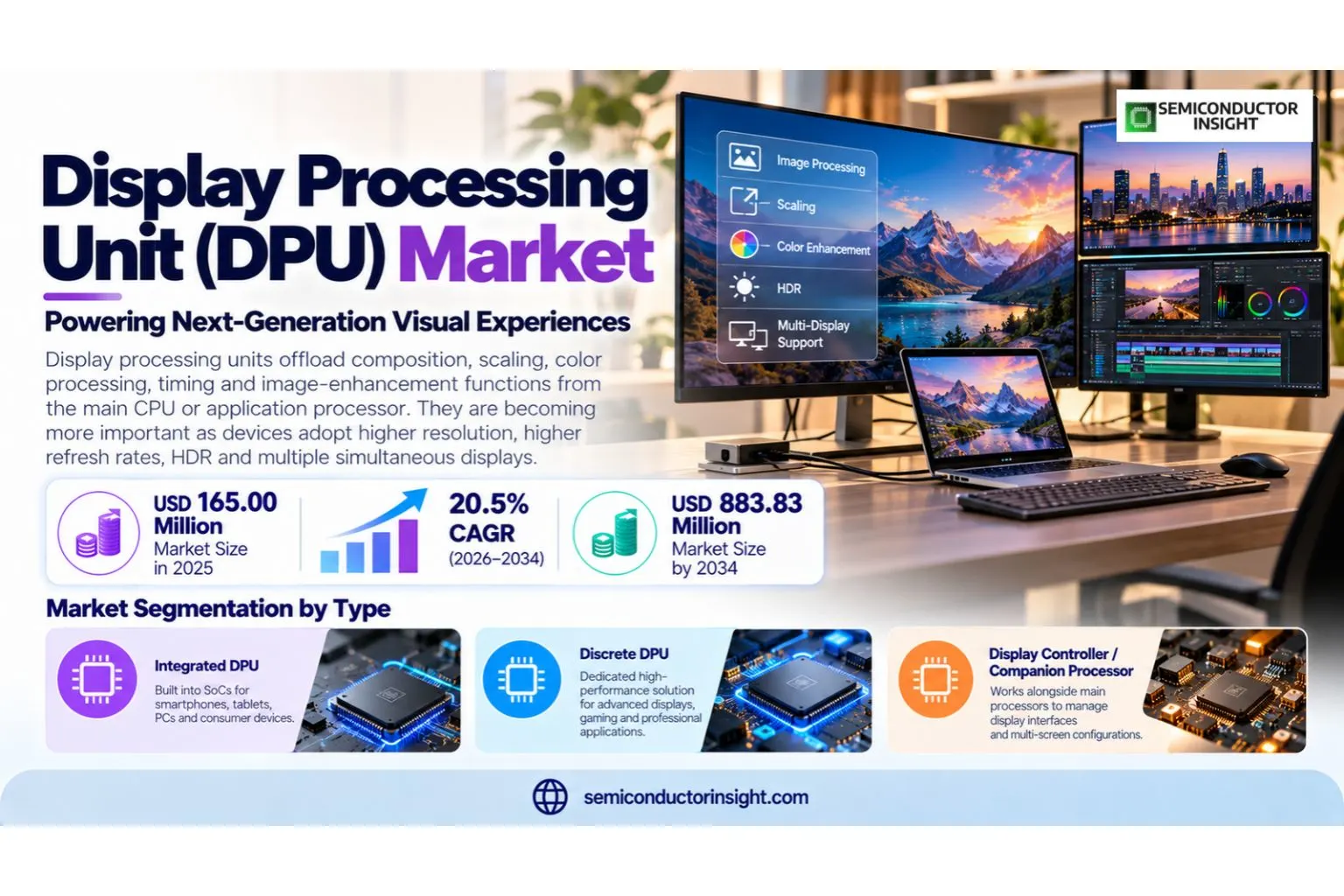
- Market size: The market is valued at USD 165.00 million in 2025 and is projected to reach USD 883.83 million by 2034, representing a 20.5% CAGR during 2026–2034.
- Integrated DPU remains commercially important because of its established use in core applications.
- North America leads current market value, while Asia Pacific offers a strong growth profile.
- Smartphones is a major demand segment, with purchasing shaped by reliability, performance and system integration.
- AI-enhanced image processing, multi-display management and higher-resolution low-power pipelines is a central competitive theme through 2034.
Display Processing Unit (DPU) Market Overview
Display processing unit DPU market is valued at USD 165.00 million in 2025 and is projected to reach USD 883.83 million by 2034, expanding at a 20.5% CAGR during 2026–2034. The 2026 market level is USD 198.83 million. Display processing units offload composition, scaling, color processing, timing and image-enhancement functions from the main CPU or application processor. They are becoming more important as devices adopt higher resolution, higher refresh rates, HDR and multiple simultaneous displays.
The client evidence values the market at USD 165 million in 2025 and projects USD 591 million by 2032 at a 20.5% CAGR. Automotive displays are an attractive segment because modern vehicles combine instrument clusters, center information displays, passenger screens and head-up displays. Commercial decisions in the Display Processing Unit (DPU) market also depend on qualification history, integration effort, operating reliability, lifecycle support and measurable system-level value.
Architecture varies widely: some display processing is integrated into application SoCs, while other systems use discrete companion processors for enhancement, interface conversion or safety isolation. Software compatibility and power efficiency increasingly influence vendor selection alongside raw pixel throughput. Commercial decisions in the Display Processing Unit (DPU) market also depend on qualification history, integration effort, operating reliability, lifecycle support and measurable system-level value.
Segment Analysis: By Type
By type, the market is segmented into Integrated DPU, Discrete DPU, Display Controller / Companion Processor. Each category serves a distinct performance, cost or integration requirement, so competitive positioning depends on more than shipment volume. Higher-value variants usually command premium pricing when they reduce system complexity, improve efficiency or satisfy stricter qualification requirements.
| Type | Commercial role |
|---|---|
| Integrated DPU | Display processing integrated within a broader SoC, reducing board area and power. |
| Discrete DPU | Dedicated display-processing silicon for specialized scaling, composition or enhancement. |
| Display Controller / Companion Processor | Auxiliary display logic managing interfaces, timing, power or image enhancement around the main SoC. |
Additional Segmentation: By Display Resolution
Resolution directly affects memory bandwidth, composition workload and power. As products migrate from Full HD toward 4K, 8K and high-refresh displays, processor architectures require more efficient pipelines and stronger compression or memory management. Commercial decisions in the Display Processing Unit (DPU) market also depend on qualification history, integration effort, operating reliability, lifecycle support and measurable system-level value.
| Display Resolution | Demand characteristics |
|---|---|
| FHD & Below | Volume systems with moderate bandwidth and power requirements. |
| 2K / 4K | Mainstream premium mobile, automotive and computing displays. |
| 8K & Higher | High-end TVs, professional displays and future multi-panel applications. |
Segment Analysis: By Application
By application, demand spans Smartphones, Automotive, PCs & Tablets, TVs / Monitors, Wearables. The mix changes according to performance needs, system value, reliability requirements, regulatory exposure and product lifecycle. This makes application-level analysis more useful than mechanically repeating one market statistic across every segment. Commercial decisions in the Display Processing Unit (DPU) market also depend on qualification history, integration effort, operating reliability, lifecycle support and measurable system-level value.
| Application | Demand characteristics |
|---|---|
| Smartphones | High-volume demand for composition, HDR, refresh-rate control and power-efficient display pipelines. |
| Automotive | Multiple high-resolution cockpit screens create demand for deterministic, safety-aware display processing. |
| PCs & Tablets | Higher resolution, variable refresh and multi-display use increase controller complexity. |
| TVs / Monitors | Image enhancement, upscaling and HDR drive specialized processing. |
| Wearables | Ultra-low-power display control is critical for battery life and compact form factor. |
Additional Segmentation: By Processing Function
Functional segmentation reveals where silicon value is migrating. Basic timing control is increasingly commoditized, while HDR, AI upscaling, multi-layer composition and multi-display management create stronger differentiation in premium systems. Commercial decisions in the Display Processing Unit (DPU) market also depend on qualification history, integration effort, operating reliability, lifecycle support and measurable system-level value.
| Processing Function | Commercial role |
|---|---|
| Composition & Scaling | Combines visual layers, resizes content and manages frame buffers. |
| HDR / Tone Mapping | Optimizes brightness, contrast and color for advanced panels. |
| AI Upscaling | Uses machine learning to improve perceived image quality at lower input resolution. |
| Multi-Display Management | Coordinates several screens in vehicles, PCs and professional systems. |
Regional Analysis
North America holds a significant market share through platform silicon, automotive electronics and advanced display-system design, while Asia Pacific is the fastest-growing region because it combines display-panel production, smartphone manufacturing and rapid automotive electronics adoption. Commercial decisions in the Display Processing Unit (DPU) market also depend on qualification history, integration effort, operating reliability, lifecycle support and measurable system-level value.
Asia Pacific has the deepest hardware supply chain for display panels and consumer devices, while North America contributes major SoC, GPU and software ecosystems. Europe is important in automotive displays, industrial HMIs and premium visualization systems. Commercial decisions in the Display Processing Unit (DPU) market also depend on qualification history, integration effort, operating reliability, lifecycle support and measurable system-level value.
Asia Pacific
Asia Pacific demand is supported by high-volume electronics manufacturing, semiconductor fabrication, automotive production and digital-infrastructure investment. China, Japan, South Korea, Taiwan, India and Southeast Asia contribute different mixes of production, consumption and technical capability, making the region central to both scale and supply-chain development. Commercial decisions in the Display Processing Unit (DPU) market also depend on qualification history, integration effort, operating reliability, lifecycle support and measurable system-level value.
North America
North America remains a high-value market because of strong semiconductor design, aerospace, cloud, enterprise and advanced-manufacturing activity. The United States is the principal contributor, supported by leading technology companies, research institutions and early adoption of premium systems with demanding performance requirements. Commercial decisions in the Display Processing Unit (DPU) market also depend on qualification history, integration effort, operating reliability, lifecycle support and measurable system-level value.
Europe
Europe combines advanced automotive, aerospace, industrial, energy and research demand. Germany, France, the United Kingdom, Italy and the Nordic markets emphasize reliability, energy efficiency, safety and regulatory compliance, supporting demand for technically differentiated products with strong lifecycle support. Commercial decisions in the Display Processing Unit (DPU) market also depend on qualification history, integration effort, operating reliability, lifecycle support and measurable system-level value.
South America
South America is a smaller but developing market led by Brazil and selected industrial economies. Demand is concentrated in telecom, infrastructure, industrial modernization, healthcare and consumer electronics, while import dependence makes distributor support, local certification and pricing important commercial factors. Commercial decisions in the Display Processing Unit (DPU) market also depend on qualification history, integration effort, operating reliability, lifecycle support and measurable system-level value.
Middle East & Africa
Middle East & Africa remains an emerging market where demand is concentrated in infrastructure, telecom, aviation, defense, energy and data-center projects. Gulf countries account for much of the premium investment, while wider adoption depends on local technical capability, procurement cycles and access to qualified suppliers. Commercial decisions in the Display Processing Unit (DPU) market also depend on qualification history, integration effort, operating reliability, lifecycle support and measurable system-level value.
Competitive Landscape
The competitive landscape includes Qualcomm, Arm ecosystem vendors, Pixelworks, MediaTek, Synaptics, NVIDIA, AMD, Intel and specialized display-controller suppliers. Supplier position is shaped by technical performance, qualification depth, customer relationships, manufacturing scale, software or application support and the ability to sustain product roadmaps across long customer lifecycles. Commercial decisions in the Display Processing Unit (DPU) market also depend on qualification history, integration effort, operating reliability, lifecycle support and measurable system-level value.
The boundary between display processors, GPUs, ISPs and dedicated display controllers is increasingly fluid. Suppliers win when they offer a complete software stack and power-efficient pipeline that integrates smoothly with panels, interfaces and operating systems rather than relying on standalone silicon specifications. Commercial decisions in the Display Processing Unit (DPU) market also depend on qualification history, integration effort, operating reliability, lifecycle support and measurable system-level value.
| Competitive dimension | What matters |
|---|---|
| Technology | Performance, integration, roadmap credibility and IP differentiation. |
| Qualification | Customer validation, compliance and field history. |
| Supply | Capacity, lead time, quality consistency and resilience. |
| Support | Application engineering, service and lifecycle management. |
Production Capacity Analysis
Most DPU silicon is manufactured through fabless supply chains using external foundries. Capacity requirements are modest relative to mainstream CPUs or GPUs, but advanced nodes become more important when very high pixel throughput must be delivered under tight power budgets. Commercial decisions in the Display Processing Unit (DPU) market also depend on qualification history, integration effort, operating reliability, lifecycle support and measurable system-level value.
Design capacity and software resources are often more limiting than wafer supply. Customers need drivers, firmware, operating-system integration and panel tuning, which means vendor engineering support can influence design wins more strongly than nominal manufacturing scale. Commercial decisions in the Display Processing Unit (DPU) market also depend on qualification history, integration effort, operating reliability, lifecycle support and measurable system-level value.
Market Dynamics
Display complexity is increasing faster than simple screen count. High refresh, HDR, foldable displays, multiple automotive screens and AI-enhanced rendering all increase display-pipeline workload, creating room for more specialized processing. Commercial decisions in the Display Processing Unit (DPU) market also depend on qualification history, integration effort, operating reliability, lifecycle support and measurable system-level value.
At the same time, integration creates pressure on discrete DPU suppliers because functions can migrate into larger SoCs. The most defensible opportunities are therefore in advanced enhancement, bridge functions, automotive isolation and ultra-low-power display management. Commercial decisions in the Display Processing Unit (DPU) market also depend on qualification history, integration effort, operating reliability, lifecycle support and measurable system-level value.
Market Drivers
Growth is driven by 4K/8K adoption, multi-display vehicles, premium smartphones, high-refresh panels and AI-enhanced image processing. Dedicated display logic can offload the main processor and improve power efficiency, responsiveness and visual quality. Commercial decisions in the Display Processing Unit (DPU) market also depend on qualification history, integration effort, operating reliability, lifecycle support and measurable system-level value.
| Driver | Directional impact on CAGR |
|---|---|
| Technology upgrade cycle | +1.8 percentage points |
| End-market expansion | +1.3 percentage points |
| Higher content per system | +0.9 percentage points |
Market Restraints
Integration of display functions into application processors can reduce the need for standalone devices. Software complexity, interface compatibility and tight thermal budgets also raise development cost, especially in mobile and automotive systems. Commercial decisions in the Display Processing Unit (DPU) market also depend on qualification history, integration effort, operating reliability, lifecycle support and measurable system-level value.
| Restraint | Directional impact on CAGR |
|---|---|
| Qualification / integration burden | -0.8 percentage points |
| Price pressure | -0.6 percentage points |
| Supply complexity | -0.5 percentage points |
Market Opportunities
Opportunities include AI upscaling, variable-refresh optimization, foldable and microdisplay control, multi-screen automotive cockpits and low-power wearable displays. Specialized DPUs can also support safety partitioning and deterministic rendering in vehicles. Commercial decisions in the Display Processing Unit (DPU) market also depend on qualification history, integration effort, operating reliability, lifecycle support and measurable system-level value.
| Opportunity | Commercial significance |
|---|---|
| AI-enhanced image processing, multi-display management and higher-resolution low-power pipelines | Supports premium product mix and new design wins. |
| Regional capacity | Improves lead time and supply resilience. |
| Application engineering | Deepens customer integration and raises switching costs. |
Supply Chain Analysis
The supply chain links display-IP design, semiconductor foundries, packaging, software, panel makers and device OEMs. Display processors must be tuned against specific panel timing, color and interface behavior, so close collaboration between silicon and display suppliers is essential. Commercial decisions in the Display Processing Unit (DPU) market also depend on qualification history, integration effort, operating reliability, lifecycle support and measurable system-level value.
| Stage | Role |
|---|---|
| IP & chip design | Display pipelines, scaling, HDR, compression and interface logic. |
| Foundry & packaging | Manufactures the mixed-signal or digital processor. |
| Software & tuning | Drivers, firmware, panel calibration and operating-system integration. |
| Device integration | Smartphones, vehicles, PCs, TVs and wearable products. |
The highest value increasingly lies in hardware-software co-design. A processor that delivers nominal throughput without stable drivers or panel tuning may offer little practical advantage to OEMs facing short product-development windows. Commercial decisions in the Display Processing Unit (DPU) market also depend on qualification history, integration effort, operating reliability, lifecycle support and measurable system-level value.
Recent Developments in the Display Processing Unit (DPU) Market
Report Scope & Segmentation
This analysis covers the Display Processing Unit (DPU) market from a 2025 base year through the 2026–2034 forecast period. It evaluates demand by product type, application and two additional segmentation axes, with regional coverage spanning Asia Pacific, North America, Europe, South America, and the Middle East & Africa. Commercial decisions in the Display Processing Unit (DPU) market also depend on qualification history, integration effort, operating reliability, lifecycle support and measurable system-level value.
| Scope item | Coverage |
|---|---|
| Base year | 2025 |
| Estimated year | 2026 |
| Forecast period | 2026–2034 |
| By Type | Integrated DPU, Discrete DPU, Display Controller / Companion Processor |
| By Application | Smartphones, Automotive, PCs & Tablets, TVs / Monitors, Wearables |
| By Display Resolution | FHD & Below, 2K / 4K, 8K & Higher |
| By Processing Function | Composition & Scaling, HDR / Tone Mapping, AI Upscaling, Multi-Display Management |
| Key participants | Qualcomm, Arm ecosystem vendors, Pixelworks, MediaTek, Synaptics, NVIDIA, AMD, Intel and specialized display-controller suppliers |
Frequently Asked Questions
What is the Display Processing Unit (DPU) market size in 2025?
The market is valued at USD 165.00 million in 2025.
What is the market forecast for 2034?
The market is projected to reach USD 883.83 million by 2034, with a 20.5% CAGR during 2026–2034.
Which region leads the market?
North America leads current market value, while Asia Pacific has a strong growth profile.
Which type is most important?
Integrated DPU is a leading category, although mix varies by application.
Which applications matter most?
Smartphones is a major demand segment, alongside Automotive, PCs & Tablets.
What technology trend matters most?
AI-enhanced image processing, multi-display management and higher-resolution low-power pipelines is a central technology and commercialization trend.
Who are the major suppliers?
Major participants include Qualcomm, Arm ecosystem vendors, Pixelworks, MediaTek, Synaptics, NVIDIA, AMD, Intel and specialized display-controller suppliers.
What drives market growth?
Growth is driven by 4K/8K adoption, multi-display vehicles, premium smartphones, high-refresh panels and AI-enhanced image processing. Dedicated display logic can offload the main processor and improve power efficiency,
What limits growth?
Integration of display functions into application processors can reduce the need for standalone devices. Software complexity, interface compatibility and tight thermal budgets also raise development cost, especially in m
What will shape the market through 2034?
Technology roadmaps, qualification, supply continuity and AI-enhanced image processing, multi-display management and higher-resolution low-power pipelines will shape competitive outcomes.
Research Sources & Evidence Base
View selected external research sources
- Qualcomm — Snapdragon Mobile Platforms: Current mobile display and multimedia platform context. Open source
- Arm — Multimedia IP: Current display processing and multimedia IP context. Open source
- Pixelworks — Visual Processing: Current dedicated visual-processing and display-enhancement context. Open source
Get Sample Report PDF for Exclusive Insights
Report Sample Includes
- Table of Contents
- List of Tables & Figures
- Charts, Research Methodology, and more...
 Download Sample Report PDF