Key Statistics
Key Takeaways
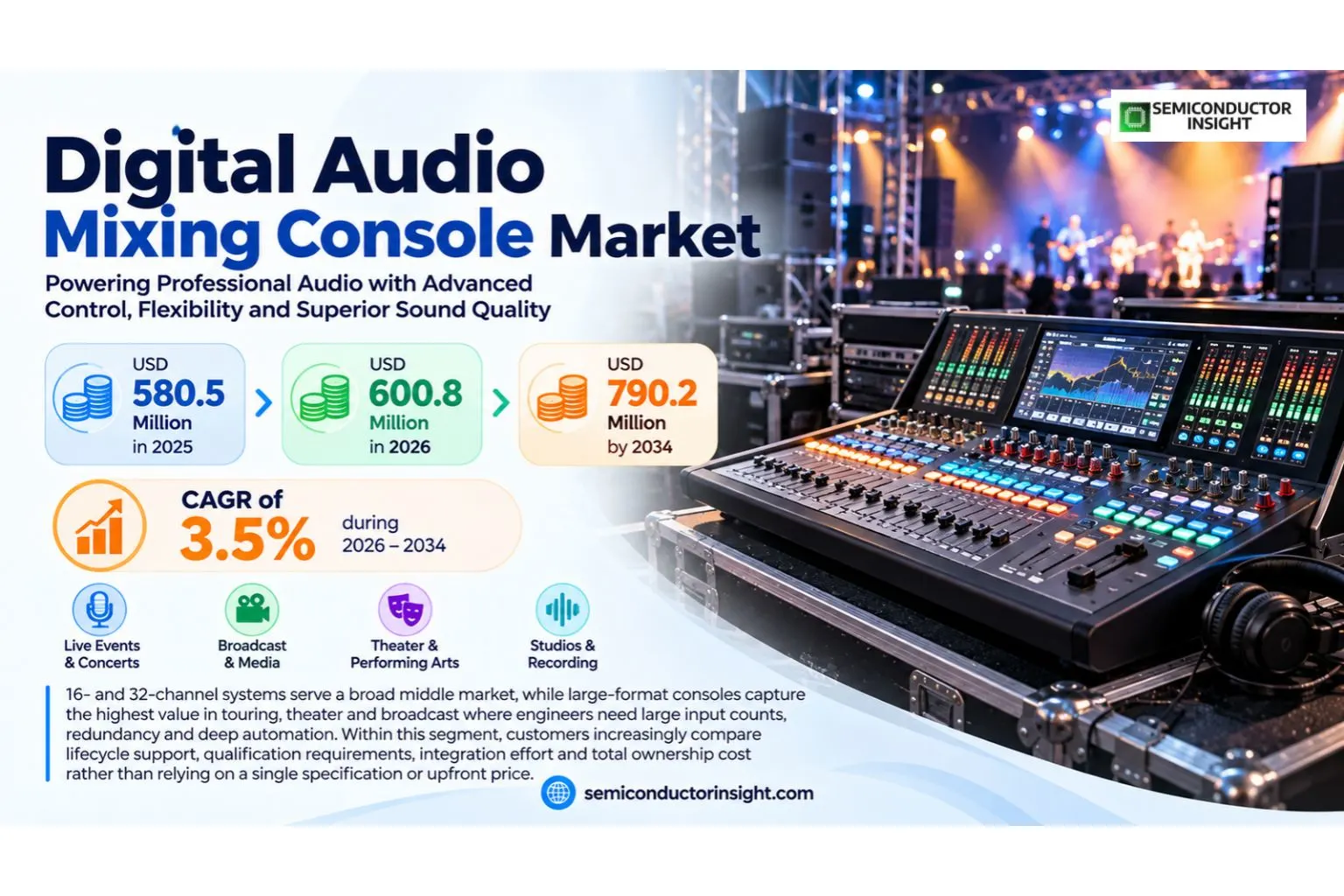
- The market is valued at USD 580.5 million in 2025 and is projected to reach USD 790.2 million by 2034, representing a 3.5% CAGR over 2026–2034.
- 8-Channel is a major product segment, while adjacent variants are expanding as performance, integration and cost requirements evolve.
- Public Address is a leading application area, supported by demand across Television Studio, Film Post-Production.
- North America is the largest market in 2025 based on the current concentration of demand, manufacturing capacity and ecosystem maturity.
Digital Audio Mixing Console Market Overview
Digital Audio Mixing Console systems combine multichannel audio conversion, DSP, routing, automation, effects and control surfaces in a programmable platform. Engineers can recall scenes, automate level changes, route hundreds of channels and control processing remotely, making digital consoles the standard for modern live sound, broadcast, recording and installed AV. Commercial adoption of Digital Audio Mixing Console products is therefore shaped by system-level productivity, integration requirements, reliability expectations and the cost of replacing established workflows or technologies.
The market is mature but continues to evolve through higher channel counts, networked audio, compact control surfaces and software-defined workflows. New platforms increasingly separate physical I/O from the console surface, allowing stage boxes and processing engines to connect over Dante, MADI or proprietary networks while engineers operate locally or remotely.
Segment Analysis: By Type
16- and 32-channel systems serve a broad middle market, while large-format consoles capture the highest value in touring, theater and broadcast where engineers need large input counts, redundancy and deep automation. Within this segment, customers increasingly compare lifecycle support, qualification requirements, integration effort and total ownership cost rather than relying on a single specification or upfront price.
| Type | Market relevance |
|---|---|
| 8-Channel | Compact portable systems. |
| 16-Channel | Small venue and project studio use. |
| 24-Channel | Mid-scale live and installation systems. |
| 32-Channel | High-demand venue and production workflows. |
| Large-Format / Others | Touring, broadcast and large installations. |
Segment Analysis: By Application
Sound reinforcement and public-address workflows create the largest installed demand, while broadcast, recording and post-production buy higher-specification systems with extensive routing, automation and network integration. Within this segment, customers increasingly compare lifecycle support, qualification requirements, integration effort and total ownership cost rather than relying on a single specification or upfront price.
| Application | Market relevance |
|---|---|
| Public Address | Corporate, venue and institutional sound. |
| Television Studio | Live broadcast and production. |
| Film Post-Production | Cinema and streaming post workflows. |
| Recording Studio | Music recording and production. |
| Sound Reinforcement | Concert, theater and event audio. |
| Others | Education, worship and specialty use. |
Segment Analysis: By Deployment
Touring consoles prioritize ruggedness, fast recall and redundant systems, fixed installations value integration and remote control, and broadcast environments emphasize deterministic networking and operational redundancy. Within this segment, customers increasingly compare lifecycle support, qualification requirements, integration effort and total ownership cost rather than relying on a single specification or upfront price.
| Deployment | Market relevance |
|---|---|
| Fixed Installation | Installed AV and venues. |
| Touring / Live | Rugged road and event systems. |
| Broadcast / Production | Redundant broadcast workflows. |
Segment Analysis: By Networking
Dante and AES67 have become central to modern audio infrastructure because they move large channel counts over standard Ethernet. MADI remains deeply installed in broadcast and touring, while proprietary networks persist in tightly integrated ecosystems. Within this segment, customers increasingly compare lifecycle support, qualification requirements, integration effort and total ownership cost rather than relying on a single specification or upfront price.
| Networking | Market relevance |
|---|---|
| Dante / AES67 | Open Ethernet audio networking. |
| MADI | Established broadcast/touring transport. |
| Proprietary Audio Networks | Vendor-optimized integrated systems. |
Regional Analysis
North America leads through touring, broadcast, worship, sports and installed AV, while Europe remains a major console-design center and Asia Pacific adds growing live-event and venue demand. Regional share also depends on supplier depth, local engineering support, channel structure and the speed at which new Digital Audio Mixing Console designs can move from evaluation into repeat deployment.
| Region | 2025 Position | Growth Outlook | Demand Profile |
|---|---|---|---|
| North America | Largest | Moderate | Live events, worship and broadcast led |
| Europe | Technology hub | Moderate | Console manufacturing and touring led |
| Asia Pacific | Fast-growing | Strong | Venues, broadcast and manufacturing led |
| South America | Emerging | Moderate | Live events and broadcast led |
| Middle East & Africa | Developing | Moderate-strong | Events, hospitality and worship led |
Detailed Regional Blocks
Why is North America important to this market?
North America is the largest revenue market because it combines major touring production, television, sports venues, houses of worship and corporate AV. Buyers frequently upgrade consoles for network integration and workflow improvements rather than basic audio quality alone. In North America, buyers also weigh service coverage, logistics, qualification resources and long-term availability, so ecosystem maturity can materially influence adoption even when core product performance is similar.
| Country / Subregion | Role | Market Context |
|---|---|---|
| United States | Largest global demand center | Touring, venues and broadcast create high-value demand. |
| Canada | Live and institutional market | Venues and broadcast support premium consoles. |
| Mexico | Events and broadcast | Touring and entertainment create growth. |
- Yamaha’s DM7 provides 120 mono input channels, 48 mix buses and 144×144 Dante I/O for professional live and installation workflows.
- Remote control and scene recall reduce staffing and setup time in multi-use venues.
- Large touring systems increasingly carry redundant networks and distributed stage I/O.
Why is Europe important to this market?
Europe has a strong supplier ecosystem through Allen & Heath, DiGiCo, Soundcraft, Lawo and others, together with dense theater, broadcast and festival markets. High-end customers value workflow design and network interoperability. In Europe, buyers also weigh service coverage, logistics, qualification resources and long-term availability, so ecosystem maturity can materially influence adoption even when core product performance is similar.
| Country / Subregion | Role | Market Context |
|---|---|---|
| United Kingdom | Console design hub | Allen & Heath, DiGiCo and Soundcraft ecosystems support innovation. |
| Germany | Broadcast and installed AV | Lawo and major venue markets support demand. |
| France | Live and cultural venues | Touring and theater create stable demand. |
- European manufacturers compete strongly in premium live sound and broadcast control surfaces.
- Audio-over-IP has reduced the need for large analog multicore systems in venues.
- Software updates extend console lifecycles by adding processing and workflow features.
Why is Asia Pacific important to this market?
Asia Pacific is expanding through new arenas, broadcast facilities, entertainment venues and corporate AV in China, India, Japan and Southeast Asia. Japan also contributes major technology through Yamaha. In Asia Pacific, buyers also weigh service coverage, logistics, qualification resources and long-term availability, so ecosystem maturity can materially influence adoption even when core product performance is similar.
| Country / Subregion | Role | Market Context |
|---|---|---|
| Japan | Technology hub | Yamaha provides broad professional mixing platforms. |
| China | Venue and event growth | New entertainment infrastructure supports digital consoles. |
| India | Live events and worship growth | Professional AV adoption expands addressable demand. |
- Compact networked consoles lower entry barriers for smaller venues.
- Large entertainment projects increasingly specify digital stage boxes and centralized audio networks.
- Regional production houses value recallable workflows for repeated events.
Why is South America important to this market?
South America is a smaller but active market led by Brazil, where concerts, churches and broadcast production support recurring console purchases and rentals. In South America, buyers also weigh service coverage, logistics, qualification resources and long-term availability, so ecosystem maturity can materially influence adoption even when core product performance is similar.
| Country / Subregion | Role | Market Context |
|---|---|---|
| Brazil | Largest regional market | Concerts and broadcast create professional demand. |
| Argentina | Live and studio niche | Music production supports digital consoles. |
| Chile | Events and venues | Professional AV creates selective demand. |
- Rental companies often drive premium touring-console purchases.
- Mid-range 16- and 32-channel systems dominate smaller venues.
- Currency conditions can extend replacement cycles.
Why is Middle East & Africa important to this market?
Middle East and Africa demand is concentrated in Gulf entertainment and hospitality projects, South African events and large worship installations. High-profile venues often specify premium networked systems. In Middle East & Africa, buyers also weigh service coverage, logistics, qualification resources and long-term availability, so ecosystem maturity can materially influence adoption even when core product performance is similar.
| Country / Subregion | Role | Market Context |
|---|---|---|
| United Arab Emirates | Premium events market | Hotels, venues and touring support high-end consoles. |
| Saudi Arabia | Entertainment expansion | New venues and events increase demand. |
| South Africa | Regional live-sound hub | Concert and worship markets support systems. |
- New entertainment infrastructure can adopt fully networked audio from the start.
- Touring productions require compatibility with international stage and transport standards.
- Training and local technical support influence brand selection.
Competitive Landscape
Yamaha, Allen & Heath, DiGiCo, Soundcraft, Avid, PreSonus, Behringer/Midas, Lawo and QSC compete across price tiers. Workflow, DSP architecture, networking, control-surface ergonomics and ecosystem compatibility matter more than raw channel count alone.
| Company | Position | Relevant capability |
|---|---|---|
| Yamaha | Key participant | DM7 and RIVAGE platforms span installed, live and broadcast applications with deep Dante integration. |
| Allen & Heath | Key participant | CQ, SQ, Avantis and dLive families cover compact through high-end live sound. |
| DiGiCo | Key participant | Premium touring and theater consoles with large channel counts and flexible processing. |
| Soundcraft | Key participant | Competes through product breadth, integration capability, qualification and customer support. |
| Avid Technology | Key participant | Competes through product breadth, integration capability, qualification and customer support. |
| PreSonus | Key participant | Competes through product breadth, integration capability, qualification and customer support. |
| Behringer / Midas | Key participant | Competes through product breadth, integration capability, qualification and customer support. |
| Lawo | Key participant | Competes through product breadth, integration capability, qualification and customer support. |
| QSC | Key participant | Competes through product breadth, integration capability, qualification and customer support. |
Production Capacity Analysis
Console manufacturing depends on DSP/FPGA devices, audio converters, displays, faders, network interfaces and final assembly. Production volumes are moderate, so component lifecycle and software support can be more important than factory scale. Scaling output without degrading quality requires stable upstream materials, disciplined process control and final test coverage that catches performance drift before products reach customers.
Manufacturers maintain long-lived product families through software updates, expansion cards and stage boxes. This increases installed-base loyalty and makes ecosystem compatibility a major factor in future console purchases. Second-source planning and regional technical support therefore become increasingly important as deployments grow and customers seek continuity without repeating lengthy qualification cycles.
Market Dynamics
The market is migrating from self-contained mixers toward distributed audio systems. Processing, I/O and control can reside in different locations connected through low-latency networks, allowing one console to access many stage boxes and facilities. This is changing competitive behavior because vendors increasingly sell system-level value, workflow integration and lifecycle economics rather than an isolated component specification.
At the same time, smaller digital consoles are bringing professional features such as multitrack USB, scene recall, automatic mixing and remote tablet control to lower price points. Premium vendors differentiate through reliability, workflow speed and redundancy. Buyers consequently evaluate total ownership cost, qualification effort and roadmap stability across the life of a program instead of focusing only on initial purchase price.
Market Drivers
| Factor | Analyst Interpretation |
|---|---|
| Live-event recovery and venue investment | Concerts, sports and entertainment venues require modern networked mixing. |
| Audio-over-IP | Ethernet audio simplifies routing across large facilities. |
| Workflow automation | Scene recall and remote control improve setup efficiency. |
| Broadcast modernization | Studios require redundant digital routing and flexible control surfaces. |
Market Restraints
| Factor | Analyst Interpretation |
|---|---|
| Long product lifecycles | Professional consoles can remain serviceable for many years. |
| Software learning curve | Complex systems require training and experienced operators. |
| Capital cost | Large-format systems and stage I/O can be expensive. |
| Component lifecycle risk | Displays, processors and network chips may change faster than console replacement cycles. |
Market Opportunities
| Factor | Analyst Interpretation |
|---|---|
| Remote production | Networked consoles can support centralized broadcast and event mixing. |
| AI-assisted mixing | Automatic gain, feedback management and source classification can simplify operation. |
| Immersive audio | Spatial sound formats increase routing and processing complexity. |
| Compact touring systems | More processing in smaller surfaces reduces transport and setup cost. |
Supply Chain Analysis
The supply chain combines general-purpose compute and DSP components with specialist low-noise audio electronics, motorized control surfaces, networking and application software. System value is heavily influenced by firmware and ecosystem integration. Traceability and coordination between component suppliers, integrators and end users are important because failures found late in the chain can be far more expensive than the underlying part itself.
| Supply Chain Stage | Role in the Market |
|---|---|
| Audio converters and DSP | ADC/DAC and processing devices handle signal conversion and mixing. |
| Control surface components | Faders, touchscreens and encoders provide operator control. |
| Networking and stage I/O | Dante, MADI and proprietary interfaces connect distributed audio. |
| System integration and service | Dealers, rental companies and integrators deploy and support installations. |
Recent Developments
| Date | Development | Source |
|---|---|---|
| 2026 | Yamaha continues active production of the DM7 digital mixing console with 120 mono inputs, 48 mix buses and 144×144 Dante connectivity. | Yamaha |
| 2026 | Allen & Heath maintains a broad digital console lineup spanning CQ, SQ, Avantis and dLive platforms for live and installed sound. | Allen & Heath |
| 2026 | Networked audio and remote-control workflows remain central design themes across new professional mixing-console platforms. | Yamaha |
Report Scope & Segmentation
| Scope Item | Coverage |
|---|---|
| Base Year | 2025 |
| Estimated Year | 2026 |
| Forecast Period | 2026–2034 |
| 2025 Market Size | USD 580.5 million |
| 2026 Estimated Size | USD 600.8 million |
| 2034 Forecast Size | USD 790.2 million |
| CAGR (2026–2034) | 3.5% |
| Largest Market in 2025 | North America |
| Category | Audio / Signal Processing / Digital Mixing Consoles |
| By Type | 8-Channel, 16-Channel, 24-Channel, 32-Channel, Large-Format / Others |
| By Application | Public Address, Television Studio, Film Post-Production, Recording Studio, Sound Reinforcement, Others |
| By Deployment | Fixed Installation, Touring / Live, Broadcast / Production |
| By Networking | Dante / AES67, MADI, Proprietary Audio Networks |
Frequently Asked Questions
What is the 2025 market size of the Digital Audio Mixing Console market?
The market is valued at USD 580.5 million in 2025.
What is the projected 2034 market size of the Digital Audio Mixing Console market?
The market is projected to reach USD 790.2 million by 2034.
What is the CAGR of the Digital Audio Mixing Console market from 2026 to 2034?
The market is expected to expand at a CAGR of 3.5% during 2026–2034.
Which region leads the Digital Audio Mixing Console market?
North America is the largest market in 2025 based on the current demand, manufacturing and deployment structure.
Which type segment is important in the Digital Audio Mixing Console market?
8-Channel is a major segment, while adjacent product variants are gaining share as performance and integration requirements evolve.
What is the main application for Digital Audio Mixing Console products?
Public Address is a leading application, with additional growth coming from Television Studio, Film Post-Production.
What drives growth in the Digital Audio Mixing Console market?
Concerts, sports and entertainment venues require modern networked mixing.
What is a key restraint for the Digital Audio Mixing Console market?
Professional consoles can remain serviceable for many years.
Which companies participate in the Digital Audio Mixing Console market?
Key participants include Yamaha, Allen & Heath, DiGiCo, Soundcraft, Avid Technology, alongside other specialized suppliers and system companies.
What technology trend is shaping the Digital Audio Mixing Console market?
Networked consoles can support centralized broadcast and event mixing.
Research Sources & Evidence Base
Get Sample Report PDF for Exclusive Insights
Report Sample Includes
- Table of Contents
- List of Tables & Figures
- Charts, Research Methodology, and more...
 Download Sample Report PDF