
MARKET INSIGHTS
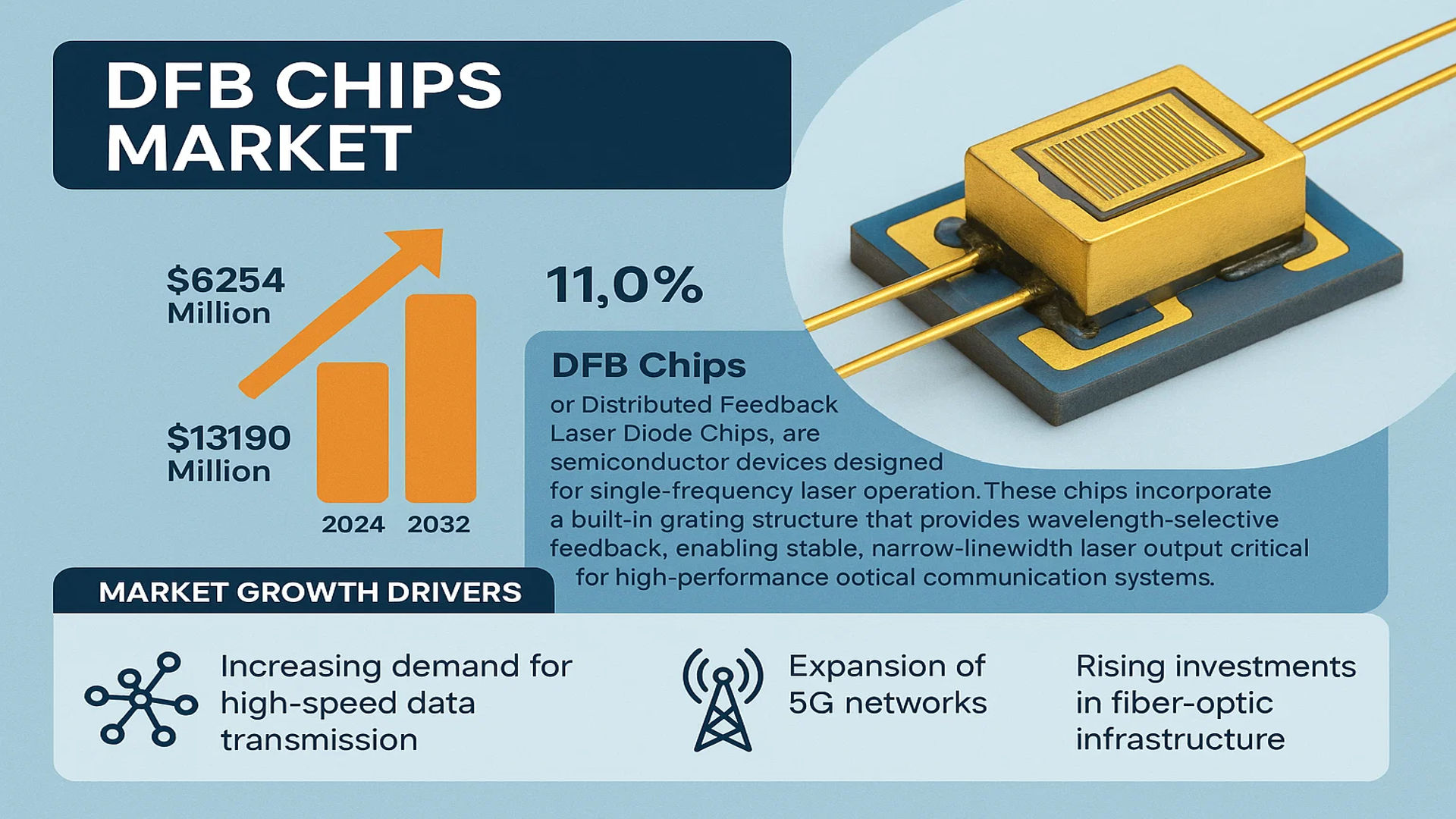
The global DFB Chips Market was valued at 6255 million in 2024 and is projected to reach US$ 13190 million by 2032, at a CAGR of 11.0% during the forecast period.
DFB Chips, or Distributed Feedback Laser Diode Chips, are semiconductor devices designed for single-frequency laser operation. These chips incorporate a built-in grating structure that provides wavelength-selective feedback, enabling stable, narrow-linewidth laser output critical for high-performance optical communication systems. DFB Chips are extensively used in telecommunications, data center interconnects, and sensing applications where precise wavelength control is essential.
The market growth is primarily driven by increasing demand for high-speed data transmission, expansion of 5G networks, and rising investments in fiber-optic infrastructure. While telecommunications remains the dominant application segment, data centers are emerging as a key growth area due to escalating cloud computing demands. The industry is witnessing technological advancements in chip design and manufacturing, with key players like Lumentum, II-VI (now Coherent), and Mitsubishi Electric leading innovation efforts to improve power efficiency and reduce costs.
MARKET DYNAMICS
MARKET DRIVERS
Rising Demand for High-Speed Optical Communication to Accelerate DFB Chip Adoption
The global telecommunications industry is undergoing a massive transformation with the increasing adoption of 5G networks and fiber-optic communications, creating substantial demand for DFB chips. These chips play a critical role in enabling high-speed data transmission with low signal distortion, making them essential for next-generation communication infrastructure. With data traffic projected to grow at an annual rate exceeding 26%, the need for efficient optical communication solutions is pushing telecom providers to integrate DFB-based laser diodes into their systems. Additionally, the rapid expansion of cloud computing and IoT applications further intensifies this demand, as these technologies rely heavily on robust and reliable optical components.
Expansion of Data Center Networks to Fuel Market Growth
The exponential rise in data consumption and the increasing complexity of data center architectures are driving the deployment of DFB chips in Data Center Interconnection (DCI) applications. These chips are instrumental in ensuring seamless, high-bandwidth communication between data centers, which is crucial for cloud service providers and enterprises managing large-scale distributed systems. The global data center market is estimated to grow at a CAGR of over 10%, with hyperscale data centers accounting for a significant portion of this expansion. DFB lasers, with their superior wavelength stability and narrow spectral linewidth, are becoming the preferred choice for high-performance optical interconnects, reinforcing their market adoption.
MARKET RESTRAINTS
High Manufacturing Costs and Supply Chain Constraints to Hinder Market Expansion
While the DFB chips market shows strong growth potential, it faces significant obstacles related to production costs and material scarcity. The fabrication of DFB laser diodes involves complex semiconductor processes, including epitaxial growth and grating formation, which require expensive equipment and highly controlled environments. This raises the overall manufacturing expenditure, making DFB chips less competitive in cost-sensitive applications. Additionally, supply chain disruptions in semiconductor raw materials, such as indium phosphide and gallium arsenide, have led to increased lead times and pricing volatility, further complicating production scalability.
Other Restraints
Performance Limitations at Higher Temperatures
DFB chips are sensitive to thermal variations, which can impact their wavelength stability and output power. This necessitates the use of additional thermal management solutions, increasing system complexity and cost.
Regulatory Compliance Challenges
Stringent regulations on laser product safety and emissions impose additional testing and certification requirements, delaying time-to-market for new DFB-based solutions.
MARKET OPPORTUNITIES
Emerging Applications in LiDAR and Sensing Technologies to Open New Revenue Streams
Beyond telecommunications and data centers, DFB chips are finding growing applications in LiDAR systems for autonomous vehicles and industrial sensing solutions. The automotive LiDAR market alone is projected to surpass $6 billion by 2030, with DFB lasers being increasingly adopted for their precise wavelength control and reliability. Similarly, environmental monitoring and industrial process control systems are leveraging DFB-based spectroscopy for real-time gas detection and chemical analysis, creating diverse growth avenues for manufacturers.
MARKET CHALLENGES
Intense Competition from Alternative Technologies to Pressure Market Share
The DFB chips market faces growing competition from emerging laser technologies, such as external cavity lasers (ECLs) and vertical-cavity surface-emitting lasers (VCSELs), which offer different performance trade-offs. While DFB lasers excel in single-mode operation and narrow linewidth, VCSELs provide cost advantages for short-reach applications, capturing segments of the data center market. This competitive landscape requires continuous innovation from DFB manufacturers to maintain technological leadership while addressing cost-effectiveness.
Other Challenges
Design Complexity for Advanced Applications
Developing DFB chips for emerging applications like quantum communications requires overcoming significant technical hurdles in yield improvement and performance optimization.
Geopolitical Factors Impacting Semiconductor Trade
Export restrictions and trade tensions between major economies create uncertainties in the global supply chain, affecting material sourcing and market accessibility for DFB chip manufacturers.
DFB CHIPS MARKET TRENDS
5G Network Expansion Driving Demand for High-Speed Optical Components
The rapid deployment of 5G infrastructure worldwide is significantly boosting the market for Distributed Feedback (DFB) laser chips, as they play a critical role in high-speed optical communication systems. Telecom operators are investing heavily in fiber-optic backhaul networks to support the increased data bandwidth requirements of 5G, creating sustained demand for DFB chips with narrow linewidth and high spectral purity. With over 500 million 5G subscribers added globally in 2023, network equipment manufacturers are scaling up production of optical transceivers incorporating these components. Furthermore, next-generation coherent optical systems operating at 400G and beyond require the precision wavelength stability that only DFB lasers can provide.
Other Trends
Data Center Interconnect Solutions
The exponential growth of cloud computing and hyperscale data centers is accelerating adoption of DFB laser chips in data center interconnect (DCI) applications. As data traffic between facilities continues to surge, with global IP traffic projected to exceed 5,000 exabytes annually by 2025, the market for high-performance optical modules containing DFB lasers is expanding rapidly. Leading cloud providers are transitioning to 100G and 400G optical links, where DFB-based transceivers offer the reliability and cost-effectiveness needed for short-reach interconnects.
Silicon Photonics Integration Creating New Opportunities
The integration of DFB lasers with silicon photonics platforms is emerging as a key technology trend, enabling compact, power-efficient optical engines for communications equipment. Major manufacturers are developing hybrid integration solutions that combine the performance advantages of III-V semiconductor DFB chips with the scalability of silicon photonic circuits. This convergence is particularly impactful in metro network applications, where the combination of low noise and small form factor gives hybrid devices a competitive edge. While the technology is still in relatively early stages, industry analysts project that silicon photonics could capture over 20% of the optical transceiver market by 2027, with DFB lasers playing a critical role in this transition.
COMPETITIVE LANDSCAPE
Key Industry Players
Technological Innovation and Strategic Expansions Drive Market Competitiveness
The global DFB Chips Market features a competitive landscape dominated by established semiconductor and photonics companies, with a mix of large-scale manufacturers and specialized players. The market is characterized by intensive R&D investments, strategic mergers, and product portfolio expansions to meet the growing demand for high-performance optical communication solutions.
Lumentum and Coherent (II-VI) lead the market, leveraging their extensive experience in laser diode technology and strong foothold in telecommunications. Their dominance is further solidified by continuous advancements in wavelength stability and high-power DFB chips, critical for 5G and data center applications.
Mitsubishi Electric and Sumitomo Electric hold significant market shares, particularly in Asia-Pacific, due to their vertically integrated supply chains and focus on cost-efficient manufacturing. Meanwhile, Broadcom and Source Photonics are gaining traction through partnerships with network infrastructure providers, catering to hyperscale data centers and metro networks.
The competitive intensity is expected to rise as companies like NTT Electronics and Furukawa Electric expand their production capacities and enhance short-wavelength DFB chips for emerging applications in LiDAR and biomedical sensing.
List of Key DFB Chips Manufacturers Profiled
- Lumentum Holdings Inc. (U.S.)
- Coherent (II-VI Incorporated) (U.S.)
- Mitsubishi Electric Corporation (Japan)
- Source Photonics (U.S.)
- Broadcom Inc. (U.S.)
- Sumitomo Electric Industries (Japan)
- Applied Optoelectronics (U.S.)
- NTT Electronics Corporation (Japan)
- Furukawa Electric Co., Ltd. (Japan)
Segment Analysis:
By Type
Long-Wavelength DFB Chips Segment Leads Due to High Demand in Long-Haul Telecommunications
The market is segmented based on type into:
- Short-Wavelength DFB Chips
- Subtypes: 1310 nm, 1550 nm, and others
- Long-Wavelength DFB Chips
By Application
Telecommunications Segment Dominates Owing to Rising Fiber Optic Network Deployments
The market is segmented based on application into:
- Telecommunications
- Data Center Interconnection (DCI Network)
- Fiber-optic Sensors
- Military and Defense
- Others
By Wavelength
1550 nm Segment Holds Major Share for Optical Communication Applications
The market is segmented by wavelength into:
- 1310 nm DFB Chips
- 1550 nm DFB Chips
- Other Wavelengths
By End-Use Industry
IT & Telecom Sector Accounts for Largest Market Share
The market is segmented by end-use industry into:
- IT & Telecommunications
- Data Centers
- Industrial
- Aerospace & Defense
- Healthcare
- Others
Regional Analysis: DFB Chips Market
Asia-Pacific
The Asia-Pacific region dominates the global DFB Chips market, driven by rapid expansion in telecommunications and data center infrastructure. China and Japan lead the charge, with China accounting for over 35% of global demand due to its massive 5G network rollout and government investments in optical communication technologies. Leading manufacturers such as Mitsubishi Electric and Sumitomo are capitalizing on cost-efficient production and high domestic demand. Meanwhile, India’s growing data center industry is fueling demand for high-speed optical components like DFB Chips, though adoption is still hindered by reliance on imports. The region’s competitive pricing and technological advancements position it as the key growth engine for the DFB Chips market.
North America
North America remains a high-growth market, primarily due to accelerated deployments of 5G networks and hyperscale data centers. The U.S. is the largest contributor, with companies like Lumentum and Broadcom leading innovation in high-performance DFB Chips for telecommunications and DCI applications. Regulatory support for fiber-optic infrastructure, such as the FCC’s Rural Digital Opportunity Fund, is further propelling demand. While the region prioritizes premium, high-purity chips, cost sensitivity in enterprise applications is pushing suppliers to balance performance with affordability. Investments in quantum computing and LiDAR technologies also present emerging opportunities.
Europe
Europe’s market is characterized by strict quality standards and sustainability initiatives, driving demand for energy-efficient DFB Chips. Countries like Germany and the U.K. are at the forefront, leveraging investments in EU-backed photonics projects and next-gen optical networks. However, the region faces challenges from supply chain dependencies on Asian manufacturers. Companies like NTT Electronics and Coherent (II-VI) focus on R&D to enhance spectral efficiency, catering to niche applications in healthcare sensing and autonomous vehicles. While growth is steady, high production costs and competition from global players limit rapid expansion.
South America
The South American market is nascent but shows potential, particularly in Brazil and Argentina, where telecom modernization efforts are underway. Limited local manufacturing forces reliance on imports, primarily from North America and Asia. Economic instability, however, constrains large-scale investments in optical infrastructure. Despite this, growing demand for high-speed internet in urban centers and gradual 5G adoption are creating pockets of opportunity. Suppliers must navigate complex import regulations and pricing pressures to establish a foothold in this emerging region.
Middle East & Africa
The MEA region is experiencing slow but steady growth, with UAE and Saudi Arabia leading due to smart city projects and data center expansions. Fiber-optic deployment in Gulf Cooperation Council (GCC) countries is boosting demand for DFB Chips, though the market remains small compared to global leaders. Challenges include limited technical expertise and high import costs, but partnerships with international players like Furukawa Electric are bridging gaps. Sub-Saharan Africa, while lagging, holds long-term potential as digital transformation initiatives gain traction.
Report Scope
This market research report provides a comprehensive analysis of the Global DFB Chips Market, covering the forecast period 2024–2032. It offers detailed insights into market dynamics, technological advancements, competitive landscape, and key trends shaping the industry.
Key focus areas of the report include:
- Market Size & Forecast: Historical data and future projections for revenue, unit shipments, and market value across major regions and segments. The global DFB Chips market was valued at USD 6,255 million in 2024 and is projected to reach USD 13,190 million by 2032, growing at a CAGR of 11.0%.
- Segmentation Analysis: Detailed breakdown by product type (Short-Wavelength and Long-Wavelength DFB Chips), application (Telecommunications and Data Center Interconnection), and end-user industry to identify high-growth segments.
- Regional Outlook: Insights into market performance across North America, Europe, Asia-Pacific, Latin America, and the Middle East & Africa. The U.S. market size is estimated at USD million in 2024, while China is expected to reach USD million.
- Competitive Landscape: Profiles of leading market participants, including Lumentum, Coherent (II-VI), Mitsubishi Electric, Source Photonics, Broadcom, Sumitomo, Applied Optoelectronics, NTT Electronics, Furukawa Electric, and Macom, among others.
- Technology Trends & Innovation: Assessment of emerging technologies in optical communication, integration of AI/IoT in DFB chip applications, and advancements in fabrication techniques.
- Market Drivers & Restraints: Evaluation of factors driving market growth, such as increasing demand for high-speed data transmission, along with challenges like supply chain constraints and regulatory issues.
- Stakeholder Analysis: Insights for component suppliers, OEMs, system integrators, investors, and policymakers regarding the evolving ecosystem and strategic opportunities in the DFB Chips market.
Primary and secondary research methods are employed, including interviews with industry experts, data from verified sources, and real-time market intelligence to ensure the accuracy and reliability of the insights presented.
FREQUENTLY ASKED QUESTIONS:
What is the current market size of Global DFB Chips Market?
-> DFB Chips Market was valued at 6255 million in 2024 and is projected to reach US$ 13190 million by 2032, at a CAGR of 11.0% during the forecast period.
Which key companies operate in Global DFB Chips Market?
-> Key players include Lumentum, Coherent (II-VI), Mitsubishi Electric, Source Photonics, Broadcom, Sumitomo, Applied Optoelectronics, NTT Electronics, Furukawa Electric, and Macom.
What are the key growth drivers?
-> Key growth drivers include rising demand for high-speed optical communication, expansion of data centers, and increasing adoption of fiber-optic networks.
Which region dominates the market?
-> Asia-Pacific is the fastest-growing region, driven by China’s rapid telecommunications infrastructure development, while North America remains a significant market.
What are the emerging trends?
-> Emerging trends include development of ultra-narrow linewidth DFB chips, integration with quantum communication systems, and advancements in semiconductor laser technology.

Get Sample Report PDF for Exclusive Insights
Report Sample Includes
- Table of Contents
- List of Tables & Figures
- Charts, Research Methodology, and more...
 Download Sample Report PDF




