
DDR5 RDIMM Memory Module Market Insights
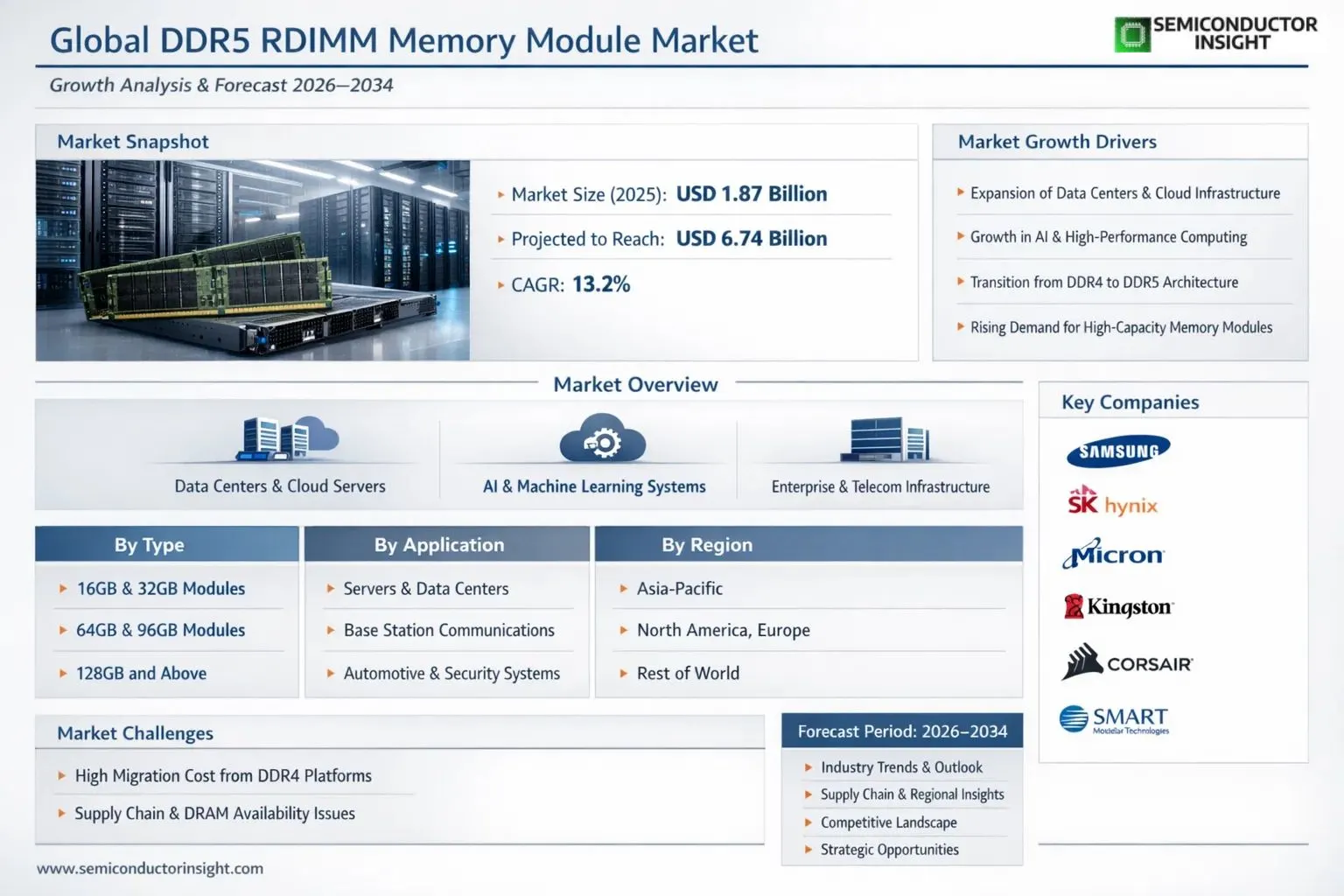
Global DDR5 RDIMM Memory Module market size was valued at USD 1.87 billion in 2025. The market is projected to grow from USD 2.21 billion in 2026 to USD 6.74 billion by 2034, exhibiting a CAGR of 13.2% during the forecast period.
DDR5 RDIMM (Registered Dual Inline Memory Module) is a high-performance memory module that meets the DDR5 technical standard. It delivers significantly superior data transmission speeds and bandwidth compared to its predecessor, DDR4, while enhancing system stability and scalability through an onboard RCD (Registering Clock Driver) component. This architecture makes DDR5 RDIMM particularly well-suited for demanding application environments such as enterprise servers, cloud data centers, high-performance workstations, and AI inference platforms that require large memory capacities and consistently high throughput.
The market is witnessing robust growth driven by the accelerating global transition from DDR4 to DDR5 architecture across server infrastructure, the rapid expansion of hyperscale data centers, and the surging demand for AI and machine learning workloads that require high-bandwidth memory solutions. Furthermore, the widespread adoption of Intel Sapphire Rapids and AMD EPYC Genoa processor platforms , both of which natively support DDR5 , has meaningfully accelerated enterprise deployment cycles. Key manufacturers operating in DDR5 RDIMM Memory Module Market include Kingston Technology, SK Hynix, Samsung, Micron, CORSAIR, Netlist, ATP, SMART Modular, Innodisk, and Apacer, among others, each offering broad and competitive product portfolios across multiple capacity tiers.
MARKET DRIVERS
Surging Demand from Data Centers and Cloud Infrastructure
DDR5 RDIMM Memory Module Market is experiencing substantial momentum driven by the rapid expansion of hyperscale data centers and cloud computing infrastructure worldwide. As enterprises increasingly migrate workloads to cloud-based platforms, the need for high-capacity, high-bandwidth registered memory has intensified significantly. DDR5 RDIMM modules, with their improved bandwidth of up to 6400 MT/s compared to DDR4’s 3200 MT/s ceiling, offer data center operators a compelling upgrade path that directly addresses throughput bottlenecks in modern server deployments. Major cloud service providers across North America, Europe, and Asia-Pacific are actively deploying next-generation server platforms based on Intel Sapphire Rapids and AMD EPYC Genoa architectures, both of which natively support DDR5 RDIMM memory, accelerating adoption across enterprise and hyperscale segments.
AI and High-Performance Computing Workloads Fueling Adoption
The proliferation of artificial intelligence, machine learning, and high-performance computing workloads represents one of the most significant tailwinds for DDR5 RDIMM Memory Module Market. Training large language models and running inference at scale demand exceptional memory bandwidth and capacity per server node. DDR5 RDIMM modules support configurations of up to 256GB per DIMM slot on select platforms, enabling system architects to achieve unprecedented memory density without expanding physical server footprints. This capability is particularly critical for AI infrastructure operators seeking to maximize computational efficiency per rack unit. The ongoing buildout of AI-dedicated data centers globally has created a sustained pipeline of demand that continues to support market expansion beyond near-term projections.
➤ The transition from DDR4 to DDR5 RDIMM in enterprise server deployments is being accelerated by the dual benefit of higher per-channel bandwidth and improved power efficiency, with DDR5 offering on-die ECC and improved voltage regulation that translates to measurable total cost of ownership advantages for large-scale operators.
Furthermore, the growing adoption of 5G network infrastructure and edge computing deployments is broadening the addressable market for DDR5 RDIMM modules beyond traditional data center environments. Telecom operators deploying virtualized radio access networks and multi-access edge compute nodes require reliable, high-performance registered memory capable of sustaining demanding real-time processing tasks. This diversification of end-use applications reinforces the long-term growth trajectory of DDR5 RDIMM Memory Module Market, reducing dependence on any single vertical and supporting more resilient demand dynamics across the forecast period.
MARKET CHALLENGES
High Transition Costs and Platform Compatibility Barriers
Despite robust long-term growth prospects, DDR5 RDIMM Memory Module Market faces meaningful near-term challenges related to the cost and complexity of platform migration. Enterprises operating legacy server infrastructure built on DDR4-compatible motherboards and chipsets cannot directly adopt DDR5 RDIMM modules without comprehensive hardware upgrades, including new server platforms, updated BIOS firmware, and compatible processors. This creates a significant capital expenditure barrier, particularly for mid-sized enterprises and public sector organizations operating under constrained IT budgets. The total cost of a DDR5-compatible server refresh cycle remains substantially higher than incremental DDR4 capacity additions, slowing the pace of adoption among cost-sensitive buyer segments and extending the coexistence period between DDR4 and DDR5 RDIMM ecosystems.
Other Challenges
Supply Chain Volatility and Component Availability
DDR5 RDIMM Memory Module Market remains exposed to supply chain disruptions affecting upstream DRAM wafer production and advanced packaging capacity. The concentration of DRAM manufacturing among a limited number of global foundry operators introduces systemic supply risk, as production disruptions or yield challenges at key facilities can rapidly translate into module shortages and price volatility. Memory market cycles historically exhibit pronounced boom-bust pricing dynamics, and while DDR5 RDIMM products command a premium over DDR4 equivalents, sudden oversupply scenarios can compress margins for module vendors and create uncertainty for buyers attempting to plan multi-year infrastructure investments.
Technical Complexity and Validation Requirements
The increased architectural complexity of DDR5 RDIMM modules, including the integration of on-DIMM power management ICs and advanced signal integrity requirements, introduces additional validation and qualification timelines for server OEMs and system integrators. Longer qualification cycles can delay product introductions and limit the speed at which new DDR5 RDIMM capacities and speeds reach volume production. For enterprise buyers operating standardized hardware qualification programs, this complexity adds procurement lead time and may slow the pace at which DDR5 RDIMM technology achieves broad deployment across heterogeneous server fleets.
MARKET RESTRAINTS
Persistent DDR4 RDIMM Installed Base and Refresh Cycle Lag
One of the primary restraints on DDR5 RDIMM Memory Module Market is the substantial installed base of DDR4 RDIMM-equipped servers that continues to operate productively across enterprise data centers globally. Server hardware refresh cycles in enterprise environments typically span five to seven years, meaning a large proportion of currently deployed server infrastructure will remain DDR4-based for the foreseeable future. Organizations that have recently completed DDR4 platform investments are unlikely to accelerate hardware refresh programs solely to adopt DDR5 RDIMM technology, particularly in the absence of application-level performance requirements that cannot be met by existing DDR4 configurations. This installed base inertia represents a structural constraint on DDR5 RDIMM volume growth in the near to medium term.
Price Premium Over DDR4 RDIMM Equivalents
DDR5 RDIMM Memory Module Market continues to be restrained by a persistent price premium relative to comparable DDR4 RDIMM configurations. While DDR5 RDIMM pricing has declined from peak levels observed at initial product introduction, the per-gigabyte cost of DDR5 RDIMM modules remains elevated compared to mature DDR4 equivalents, where manufacturing scale and yield optimization have driven costs to historically competitive levels. For procurement teams evaluating total server bill-of-materials costs, the memory subsystem price differential between DDR4 and DDR5 platforms continues to influence platform selection decisions, particularly in budget-constrained deployment scenarios where raw performance differentiation may not justify incremental expenditure. Price normalization over the forecast period is anticipated but the timeline remains subject to DRAM market conditions.
MARKET OPPORTUNITIES
Expansion of AI Infrastructure and Generative AI Server Deployments
The accelerating buildout of generative AI and large-scale machine learning infrastructure presents a compelling growth opportunity for DDR5 RDIMM Memory Module Market. As hyperscale operators and enterprise AI adopters deploy purpose-built AI server platforms, DDR5 RDIMM modules are positioned as the standard memory solution for next-generation compute nodes, offering the bandwidth and capacity density required to support GPU-accelerated and CPU-based AI workloads efficiently. The ongoing investment cycle in AI infrastructure, which spans model training clusters, inference servers, and AI-optimized edge deployments, is expected to sustain elevated demand for DDR5 RDIMM modules across multiple years, creating a durable and expanding revenue opportunity for module vendors and DRAM suppliers with strong enterprise channel relationships.
Emerging Markets and Government-Backed Data Center Initiatives
Emerging economies across Southeast Asia, the Middle East, Latin America, and Africa represent an underserved growth frontier for DDR5 RDIMM Memory Module Market. Government-backed digital infrastructure programs, national data sovereignty initiatives, and the establishment of regional cloud computing hubs are driving the construction of new data center capacity in markets that have historically relied on legacy or imported IT infrastructure. As these facilities adopt contemporary server platforms from the outset, DDR5 RDIMM modules are well positioned to capture a significant share of initial memory procurement. The alignment of new data center construction timelines with the DDR5 platform maturation cycle creates a favorable window for market participants to establish distribution and supply relationships in high-growth geographic markets before DDR4-to-DDR5 transition dynamics have fully played out in more mature regions.
Next-Generation CXL Memory Pooling and Advanced Memory Architectures
The emergence of Compute Express Link (CXL) memory pooling architectures built on DDR5 RDIMM substrates offers a significant incremental opportunity for DDR5 RDIMM Memory Module Market over the medium to long term. CXL-enabled memory expansion and pooling solutions allow data center operators to decouple memory capacity from individual server nodes, enabling more flexible and efficient memory resource allocation across compute clusters. Leading server platform vendors and memory module manufacturers are actively developing CXL-attached DDR5 RDIMM solutions that extend the addressable use cases for registered DDR5 memory beyond conventional slot-based server configurations. As CXL ecosystem maturity improves and platform support broadens, this architectural evolution is expected to meaningfully expand the total addressable market for DDR5 RDIMM technology and create differentiated value propositions for vendors capable of delivering validated CXL-compatible module solutions.
DDR5 RDIMM Memory Module Market () Trends
Accelerating Adoption in Server and Data Center Infrastructure
DDR5 RDIMM Memory Module Market is experiencing a significant shift as enterprise data centers and hyperscale cloud operators accelerate their transition from DDR4 to DDR5-based server architectures. DDR5 RDIMM modules offer substantially higher bandwidth and improved data transfer speeds compared to their predecessors, making them increasingly essential for workloads involving artificial intelligence inference, real-time analytics, and high-performance computing. Server OEMs and system integrators are progressively qualifying DDR5 RDIMM configurations across new platform launches, reinforcing the technology’s growing foothold in mission-critical environments.
Other Trends
Rising Demand Across High-Capacity Segments
Within DDR5 RDIMM Memory Module Market, demand for higher-capacity modules , particularly 64G, 96G, and 128G variants , is gaining traction as virtualization density and in-memory database applications expand. Enterprises running containerized workloads and large-scale machine learning pipelines require increased per-slot memory capacity, driving procurement toward higher-density DDR5 RDIMM configurations. The 32G segment continues to hold a substantial share, while the 16G segment remains relevant for cost-sensitive deployments seeking an entry point into DDR5 RDIMM infrastructure.
Competitive Landscape and Manufacturer Activity
Leading manufacturers in DDR5 RDIMM Memory Module Market , including Samsung, SK Hynix, Micron, Kingston Technology, and CORSAIR , are investing in production capacity expansion and advancing module reliability certifications. Smaller specialized players such as Innodisk, ATP, SMART Modular, and Apacer are focusing on industrial-grade and ruggedized DDR5 RDIMM solutions tailored for edge computing and telecommunications base station applications. This competitive dynamic is fostering product differentiation across performance tiers, thermal profiles, and extended lifecycle support offerings.
Regional Momentum and Sectoral Expansion
From a regional perspective, North America and Asia-Pacific , particularly China, South Korea, and Japan , represent the most active markets for DDR5 RDIMM Memory Module adoption, driven by aggressive data center build-out programs and government-backed semiconductor infrastructure initiatives. Europe is also witnessing steady uptake, especially within automotive computing and security monitoring applications that demand high-reliability memory solutions. The automotive segment represents an emerging vertical for DDR5 RDIMM modules, as advanced driver assistance systems and in-vehicle computing platforms increasingly require server-class memory performance. Across all regions, supply chain localization efforts and strategic inventory management are becoming critical priorities for distributors and module manufacturers navigating the evolving DDR5 RDIMM Memory Module Market landscape.
COMPETITIVE LANDSCAPE
Key Industry Players
DDR5 RDIMM Memory Module Market , Competitive Dynamics and Leading Manufacturer Profiles
Global DDR5 RDIMM Memory Module market is characterized by intense competition among a select group of vertically integrated semiconductor giants and specialized memory module manufacturers. Samsung, SK Hynix, and Micron collectively dominate the market, leveraging their proprietary DRAM fabrication capabilities to maintain significant cost advantages and supply chain control. These three IDMs (Integrated Device Manufacturers) are the primary suppliers of DDR5 DRAM dies, which underpin virtually all DDR5 RDIMM production globally. Their technological leadership is evident in the rapid commercialization of high-density DDR5 RDIMMs , particularly in the 64GB, 96GB, and 128GB capacity segments , catering to the surging demand from hyperscale data centers, cloud service providers, and AI/ML workload infrastructure. The adoption of DDR5 RDIMM across servers and data centers remains the dominant application segment, driven by the platform transition to Intel Sapphire Rapids and AMD EPYC Genoa processor ecosystems, both of which mandate DDR5 memory architectures for next-generation server deployments.
Beyond the top-tier DRAM manufacturers, a robust ecosystem of specialized module makers and value-added resellers competes vigorously in enterprise, embedded, industrial, and ruggedized application segments. Companies such as Kingston Technology, CORSAIR, and Adata serve high-performance computing and workstation markets, while ATP Electronics, Innodisk, and SMART Modular Technologies focus on industrial-grade, extended-temperature, and mission-critical deployments requiring stringent qualification standards. Netlist has carved a differentiated position through its patented memory technologies and licensing portfolio, while Apacer, Silicon Power, and Longsys compete primarily across Asia-Pacific markets with cost-competitive offerings. Emerging players such as Wuxi HippStor Technology are gaining traction in China’s rapidly expanding domestic server memory supply chain, reflecting broader industry trends toward regional supply diversification. Overall, the competitive landscape continues to evolve as manufacturers invest in RCD (Registering Clock Driver) design advancements, on-module error correction, and power efficiency improvements to meet the escalating performance demands of modern server and data center infrastructure.
List of Key DDR5 RDIMM Memory Module Companies Profiled
- Kingston Technology
- SK Hynix
- Samsung
- Micron
- CORSAIR
- Netlist
- ATP Electronics
- SMART Modular Technologies
- Innodisk
- Apacer
- Adata
- Silicon Power
- Longsys
- Wuxi HippStor Technology
Segment Analysis:
| Segment Category | Sub-Segments | Key Insights |
| By Type |
|
Higher-Capacity Modules (64G and Above) are rapidly emerging as the dominant force in DDR5 RDIMM Memory Module Market, driven by the intensifying demands of modern enterprise computing environments.
|
| By Application |
|
Servers and Data Centers represent the most prominent and strategically critical application segment for DDR5 RDIMM Memory Modules, underpinned by a confluence of transformative technological and infrastructure trends.
|
| By End User |
|
Cloud Service Providers and Hyperscalers constitute the most influential end-user segment, consistently driving large-volume procurement of DDR5 RDIMM modules to support their ever-expanding global infrastructure.
|
| By Speed Grade |
|
DDR5-4800 and DDR5-5600 currently serve as the foundational speed grades commanding the broadest installed base, while higher-performance grades are gaining decisive momentum as platform and workload requirements evolve.
|
| By Channel |
|
OEM and Direct Enterprise Sales Channels dominate the DDR5 RDIMM distribution landscape, reflecting the highly specialized and volume-intensive nature of memory module procurement in enterprise markets.
|
Regional Analysis: DDR5 RDIMM Memory Module Market
Asia-Pacific
South Korea, home to global memory giants, plays a pivotal role in advancing DDR5 RDIMM technology innovation, while Taiwan’s robust motherboard and server OEM ecosystem ensures consistent downstream adoption. China’s expanding domestic data center buildout, fueled by government-backed digitalization initiatives and the growth of indigenous cloud service providers, further amplifies regional consumption. India is emerging as a noteworthy contributor as its IT infrastructure modernization accelerates. Collectively, Asia-Pacific’s integrated supply chain advantages, cost competitiveness, and technology leadership position it as the most critical and fastest-evolving geography in Global DDR5 RDIMM memory module market landscape through the 2026–2034 forecast period.
Asia-Pacific’s vertically integrated semiconductor supply chain gives the region an unmatched competitive edge in DDR5 RDIMM Memory Module Market. From wafer fabrication to module assembly and testing, key regional players maintain tight control over production quality and cost efficiency. This integration minimizes lead times and supports rapid scalability in response to fluctuating global server demand cycles.
The explosive growth of hyperscale and colocation data centers across China, India, and Southeast Asia is a primary demand driver for DDR5 RDIMM modules in the region. Major cloud service providers are aggressively upgrading server infrastructure to accommodate AI inference, big data analytics, and enterprise workloads, each requiring the enhanced bandwidth and reliability that DDR5 RDIMM technology delivers.
Leading memory manufacturers headquartered in South Korea and Taiwan are channeling significant resources into next-generation DDR5 RDIMM research and development. Innovations in die-stacking, error correction, and power efficiency are being pioneered in the region, ensuring Asia-Pacific maintains its technological leadership and shapes global product roadmaps in DDR5 RDIMM Memory Module Market well into the next decade.
Supportive government frameworks across Asia-Pacific are accelerating DDR5 RDIMM adoption. China’s national semiconductor self-sufficiency drive, India’s Digital India initiative, and South Korea’s strategic investment in advanced memory technology collectively create a favorable policy environment. These initiatives stimulate domestic procurement of high-performance memory solutions and reduce reliance on external supply chains, reinforcing regional market momentum.
North America
North America represents a critically important geography in DDR5 RDIMM Memory Module Market, distinguished by its concentration of world-leading hyperscale cloud operators, enterprise IT powerhouses, and cutting-edge research institutions. The United States, in particular, is a major consumption hub, with hyperscalers and large enterprises rapidly transitioning server fleets to DDR5-compatible platforms to support AI model training, high-performance computing, and mission-critical workloads. The region’s strong culture of early technology adoption ensures that DDR5 RDIMM modules achieve faster penetration into commercial data centers compared to many other markets. Canada also contributes through its growing data center corridor and expanding AI research ecosystem. While North America depends heavily on Asia-Pacific for memory module manufacturing, its role as a technology standard-setter and primary demand generator keeps it at the strategic forefront of Global DDR5 RDIMM memory module market through the forecast period.
Europe
Europe occupies a significant position in DDR5 RDIMM Memory Module Market, propelled by the region’s ambitious digital transformation agenda, expanding cloud infrastructure investments, and stringent data sovereignty regulations that incentivize domestic data center buildouts. Germany, the United Kingdom, France, and the Netherlands serve as the primary hubs of enterprise server deployment and data center growth, each driving consistent demand for advanced DDR5 RDIMM solutions. The European Union’s focus on technological resilience and reducing dependency on non-European supply chains has begun encouraging regional semiconductor ecosystem development, which may gradually influence the memory module supply landscape. Additionally, Europe’s robust automotive and industrial sectors are increasingly exploring high-performance computing platforms that leverage DDR5 RDIMM technology for embedded and edge applications. Regulatory compliance requirements further reinforce demand for reliable, enterprise-grade memory solutions across the continent’s diverse vertical markets.
South America
South America represents an emerging but steadily developing segment of Global DDR5 RDIMM memory module market. Brazil leads the regional landscape as the largest economy and most active technology adopter, supported by a growing data center sector and increasing cloud service penetration among enterprises and government institutions. While the pace of DDR5 RDIMM adoption in South America remains more measured compared to North America or Asia-Pacific, rising digital infrastructure investments and the modernization of financial, telecommunications, and public sector IT environments are gradually creating organic demand. Argentina, Chile, and Colombia also contribute incrementally as their digital economies mature. Cost sensitivity among regional buyers and currency volatility present adoption challenges, but improving broadband connectivity, increasing hyperscaler presence, and ongoing enterprise server refresh cycles position South America as a market with meaningful long-term growth potential in DDR5 RDIMM Memory Module Market.
Middle East & Africa
The Middle East and Africa region is at an early but increasingly active stage of engagement with DDR5 RDIMM Memory Module Market. The Gulf Cooperation Council nations, particularly the United Arab Emirates and Saudi Arabia, are spearheading ambitious smart city, artificial intelligence, and national cloud infrastructure projects that necessitate high-performance server memory solutions. Saudi Arabia’s Vision 2030 and the UAE’s AI national strategy are catalyzing substantial data center investments, creating nascent but growing demand for DDR5 RDIMM modules in the sub-region. South Africa serves as the primary technology adoption hub on the African continent, with increasing interest from regional enterprises and telecoms operators in upgrading aging server infrastructure. While the broader Middle East and Africa market faces challenges including limited local distribution networks and procurement budget constraints, the strategic nature of ongoing digital infrastructure programs ensures the region will play a progressively larger role in Global DDR5 RDIMM memory module market through 2034.
Report Scope
This market research report provides a comprehensive analysis of DDR5 RDIMM Memory Module Market, covering the forecast period 2026–2034. It offers detailed insights into market dynamics, technological advancements, competitive landscape, and key trends shaping the industry.
Key focus areas of the report include:
- Market Overview: The report begins with an overview outlining its current market scenario, key growth indicators, and industry transformation drivers. It discusses macroeconomic factors, demand–supply balance, regulatory landscape, and the strategic role of semiconductors in powering advancements across industries such as automotive, telecommunications, consumer electronics, and industrial automation.
- Market Size & Forecast: Historical data and future projections for revenue, unit shipments, and market value across major regions and segments.
- Segmentation Analysis: Detailed breakdown by product type, technology, application, and end-user industry to identify high-growth segments and investment opportunities.
- Regional Insights: Insights into market performance across North America, Europe, Asia-Pacific, Latin America, and the Middle East & Africa, including country-level analysis where relevant.
- Competitive Landscape: Profiles of leading market participants, including their product offerings, R&D focus, manufacturing capacity, pricing strategies, and recent developments such as mergers, acquisitions, and partnerships.
- Technology Trends & Innovation: Assessment of emerging technologies, integration of AI/IoT, semiconductor design trends, fabrication techniques, and evolving industry standards.
- Market Drivers & Restraints: Evaluation of factors driving market growth along with challenges, supply chain constraints, regulatory issues, and market-entry barriers.
- Stakeholder Insights: Insights for component suppliers, OEMs, system integrators, investors, and policymakers regarding the evolving ecosystem and strategic opportunities.
Primary and secondary research methods are employed, including interviews with industry experts, data from verified sources, and real-time market intelligence to ensure the accuracy and reliability of the insights presented.
FREQUENTLY ASKED QUESTIONS:
What is the current market size of DDR5 RDIMM Memory Module Market?
-> Global DDR5 RDIMM Memory Module Market was valued at USD 1.87 billion in 2025 and is expected to reach USD 6.74 billion by 2034, growing at a CAGR of 13.2% during the forecast period 2026–2034.
Which key companies operate in DDR5 RDIMM Memory Module Market?
-> Key players include Kingston Technology, SK Hynix, Samsung, Micron, CORSAIR, Netlist, ATP, SMART Modular, Innodisk, Apacer, Adata, Silicon Power, Longsys, and Wuxi HippStor Technology, among others. In 2025, Global top five players held a share of approximately % in terms of revenue.
What are the key growth drivers of DDR5 RDIMM Memory Module Market?
-> Key growth drivers include rising demand for high-performance memory in servers and data centers, rapid expansion of cloud computing and AI infrastructure, growing adoption of DDR5 technology over DDR4 due to superior data transmission speed and bandwidth, and increasing deployment in automotive, base station communications, and security monitoring applications.
Which region dominates DDR5 RDIMM Memory Module Market?
-> Asia is a dominant and fast-growing region in DDR5 RDIMM Memory Module Market. China is projected to reach USD million by 2025, while the U.S. market is estimated at USD million in 2025, reflecting strong demand across both regions driven by large-scale data center investments and semiconductor manufacturing capabilities.
What are the emerging trends in DDR5 RDIMM Memory Module Market?
-> Emerging trends include rapid adoption of DDR5 RDIMM modules in AI-driven server infrastructure, increased focus on higher-capacity memory modules (64G, 96G, and 128G), growing integration of RCD (Register Clock Driver) technology to enhance system stability and scalability, and expansion into automotive and base station communication applications requiring robust, high-performance memory solutions.
What is the projected growth of the 16G capacity segment?
-> The Capacity: 16G segment of DDR5 RDIMM Memory Module Market is projected to reach USD million by 2034, registering a CAGR of % over the next six years, driven by widespread adoption across entry-level server configurations and cost-sensitive deployments.

Get Sample Report PDF for Exclusive Insights
Report Sample Includes
- Table of Contents
- List of Tables & Figures
- Charts, Research Methodology, and more...
 Download Sample Report PDF




