MARKET INSIGHTS
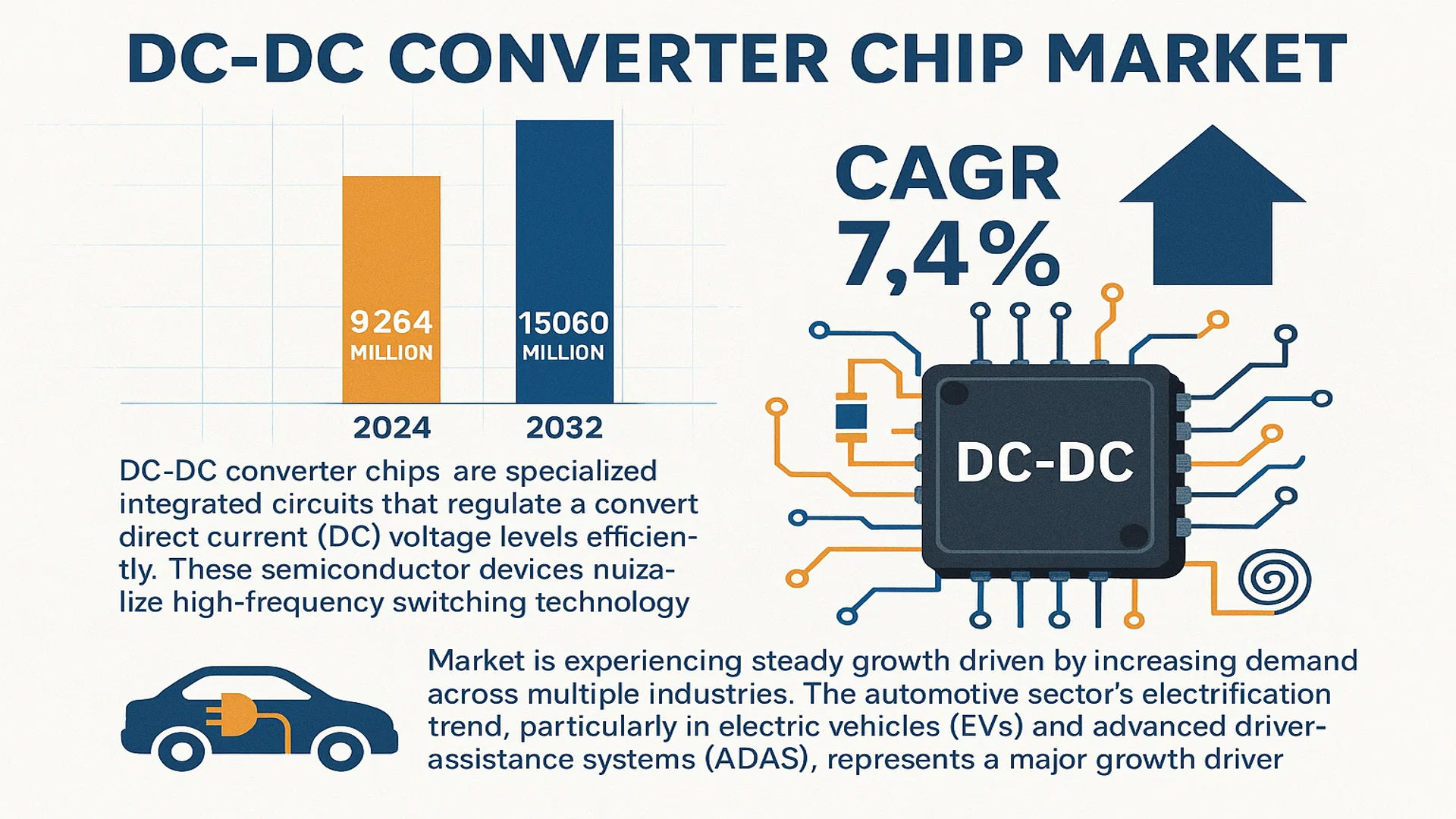
The global DC-DC Converter Chip Market was valued at 9264 million in 2024 and is projected to reach US$ 15060 million by 2032, at a CAGR of 7.4% during the forecast period.
DC-DC converter chips are specialized integrated circuits that regulate and convert direct current (DC) voltage levels efficiently. These semiconductor devices utilize high-frequency switching technology to transfer energy between capacitors and inductors, enabling step-up (boost), step-down (buck), or voltage inversion functionality. Their ability to maintain stable power output despite input voltage fluctuations makes them essential components in modern electronic systems.
The market is experiencing steady growth driven by increasing demand across multiple industries. The automotive sector’s electrification trend, particularly in electric vehicles (EVs) and advanced driver-assistance systems (ADAS), represents a major growth driver. Additionally, the proliferation of IoT devices and 5G infrastructure demands compact, efficient power solutions. Technological advancements in gallium nitride (GaN) and silicon carbide (SiC) based converters are further enhancing power density and efficiency, addressing the evolving needs of data centers and renewable energy systems.
MARKET DYNAMICS
MARKET DRIVERS
Rapid Electrification of Automotive Industry to Accelerate DC-DC Converter Chip Demand
The global shift toward electric vehicles (EVs) is creating unprecedented demand for DC-DC converter chips, which are essential components in power management systems. With EV sales projected to exceed 17 million units annually by 2028, the need for efficient voltage conversion solutions is growing exponentially. These chips play a critical role in managing power distribution between high-voltage traction batteries and low-voltage vehicle systems, ensuring optimal energy utilization and extending driving range. Major automotive manufacturers are increasingly partnering with semiconductor firms to develop customized power solutions, further driving innovation in this space.
Proliferation of 5G Infrastructure Deployment to Fuel Market Expansion
The ongoing global rollout of 5G networks represents another significant growth driver for DC-DC converter chips. These components are vital for power management in 5G base stations, which require highly efficient voltage regulation to handle increased data throughput. With telecom operators worldwide investing billions in network upgrades, the demand for robust power management solutions has intensified. The small form factor and high efficiency of modern DC-DC converter chips make them particularly suitable for space-constrained 5G equipment installations, driving their adoption across telecommunications infrastructure projects.
MARKET CHALLENGES
Thermal Management Issues Continue to Challenge Power Density Improvements
While DC-DC converter chips continue to shrink in size while increasing power handling capabilities, thermal dissipation remains a persistent challenge. As component densities approach physical limits, maintaining acceptable operating temperatures becomes increasingly difficult. This thermal challenge is particularly acute in consumer electronics and automotive applications where space constraints limit cooling options. Manufacturers must balance the competing demands of higher efficiency, smaller footprints, and thermal performance, often requiring costly material innovations and complex packaging solutions.
Other Challenges
Supply Chain Disruptions
The semiconductor industry continues to face supply chain volatility, with DC-DC converter chip production affected by raw material shortages and geopolitical factors. These disruptions can lead to extended lead times and price fluctuations, complicating procurement strategies for OEMs.
Design Complexity
The increasing integration of additional functionalities into DC-DC converter chips, while beneficial for end-users, raises development costs and extends time-to-market for new products. This complexity can strain R&D budgets and delay product launches.
MARKET RESTRAINTS
Price Sensitivity in Consumer Markets Limits Adoption of Advanced Solutions
While technological advancements have improved DC-DC converter performance, price sensitivity in key application segments like consumer electronics constrains market growth. Many manufacturers in these sectors prioritize cost reduction over feature enhancements, opting for simpler, less expensive power management solutions. This creates a challenging environment for chip suppliers that have invested in developing higher-performance but more costly converter technologies, potentially slowing the pace of innovation diffusion in price-sensitive markets.
MARKET OPPORTUNITIES
Artificial Intelligence Hardware Revolution to Create New Growth Frontiers
The explosive growth of AI computing presents significant opportunities for DC-DC converter chip manufacturers. AI servers and edge computing devices require exceptionally precise and responsive power management solutions to handle fluctuating computational loads. This need is driving demand for intelligent, software-configurable DC-DC converters that can dynamically adjust voltage levels based on processing requirements. The AI hardware market’s projected compound annual growth rate of over 25% suggests substantial long-term potential for power management IC suppliers who can meet these specialized requirements.
Renewable Energy Integration to Drive Market Expansion
The global transition toward renewable energy systems offers another promising growth avenue for DC-DC converter technology. Solar microinverters, energy storage systems, and smart grid applications all require sophisticated power conversion solutions. The increasing adoption of distributed energy resources, supported by government incentives worldwide, is creating demand for robust, efficient DC-DC converters that can operate in harsh environmental conditions while maintaining high reliability over extended lifetimes.
DC-DC CONVERTER CHIP MARKET TRENDS
Growing Demand for Energy-Efficient Power Solutions to Drive Market Expansion
The DC-DC converter chip market is witnessing robust growth, driven by the increasing need for high-efficiency power management solutions across multiple industries. The global market valuation reached $9.26 billion in 2024, with projections estimating a rise to $15.06 billion by 2032, reflecting a CAGR of 7.4%. These chips are critical in applications such as consumer electronics, automotive electrification, and industrial automation, where energy efficiency and compact design are paramount. Recent advancements in wide-bandgap semiconductors (SiC and GaN) have further enhanced efficiency and reduced power loss, making DC-DC converters even more valuable for modern electronics.
Other Trends
Accelerated Adoption in Electric Vehicles (EVs)
The rapid growth of the electric vehicle industry is a major driver for DC-DC converter chips. These chips are essential for voltage regulation and energy conversion in EVs, ensuring optimal battery performance and power distribution. With global EV sales surpassing 10 million units in 2022 and expected to grow exponentially, demand for high-performance power management ICs is surging. Additionally, 48V mild-hybrid systems are becoming more prevalent, further increasing the need for advanced DC-DC converters in the automotive sector.
Expansion of IoT and Portable Electronics
The proliferation of wearables, smartphones, and IoT devices is boosting demand for compact, low-power DC-DC converter chips. These applications require miniaturized power solutions that maximize battery life while maintaining high efficiency. Semiconductor firms are introducing ultra-low-power converter ICs with integrated passives, enabling smaller form factors and greater energy savings. The increasing integration of AI-driven power management in smart devices is further contributing to market growth, optimizing voltage regulation dynamically based on usage patterns.
COMPETITIVE LANDSCAPE
Key Industry Players
Innovation and Strategic Expansion Define Market Leadership in DC-DC Converter Chips
The global DC-DC converter chip market exhibits a fiercely competitive environment characterized by technological innovation and strategic collaborations. While the sector remains semi-consolidated with dominant players controlling significant market share, emerging companies continue to disrupt traditional power management solutions through specialized offerings. Texas Instruments leads the pack with an estimated 18% revenue share in 2024, leveraging its comprehensive product portfolio spanning automotive, industrial, and consumer electronics applications. Their recent introduction of the TPS62913 buck converter series demonstrates their commitment to addressing high-efficiency requirements in next-gen IoT devices.
Infineon Technologies and Analog Devices collectively hold approximately 22% of the market, capitalizing on their expertise in automotive power solutions and precision analog technologies. Both companies have significantly expanded production capacity to meet surging demand from electric vehicle manufacturers, with Infineon’s OptiMOS™ power MOSFET technology gaining particular traction in 48V mild-hybrid systems. Meanwhile, Analog Devices’ Silent Switcher® architecture continues to set benchmarks for low-noise power conversion in sensitive medical equipment and aerospace applications.
The competitive intensity is further amplified by regional players like ROHM Semiconductor in Japan and Shenzhen Lianyi Electronics in China, who are aggressively capturing market share through cost-optimized solutions for mass-market consumer electronics. Their ability to deliver competitively priced chips without compromising basic efficiency parameters has enabled penetration into price-sensitive Asian markets, particularly in smartphone and home appliance segments. Industry analysts note these companies increased their combined market presence by 3.2% year-over-year in 2023.
Strategic movements among key players underscore the market’s dynamic nature. ON Semiconductor recently expanded its Michigan wafer fabrication facility to double production of automotive-qualified power ICs, while STMicroelectronics entered a joint development agreement with a leading Chinese EV manufacturer to co-design application-specific converter chips. Such initiatives, coupled with ongoing R&D investments averaging 12-15% of annual revenues among top competitors, signal sustained competition across power density, thermal performance, and integration capabilities.
List of Key DC-DC Converter Chip Companies Profiled
- Texas Instruments Incorporated (U.S.)
- Analog Devices, Inc. (U.S.)
- Infineon Technologies AG (Germany)
- STMicroelectronics (Switzerland)
- ON Semiconductor (U.S.)
- ROHM Semiconductor (Japan)
- Microchip Technology Inc. (U.S.)
- NXP Semiconductors (Netherlands)
- Diodes Incorporated (U.S.)
- Shenzhen Lianyi Electronics (China)
Segment Analysis:
By Type
DC-DC Converters Chip Segment Leads Due to High Demand for Efficient Power Management Solutions
The market is segmented based on type into:
- DC-DC Converters Chip
- Subtypes: Buck, Boost, Buck-Boost, and others
- SMPS Chip
- Subtypes: Isolated and Non-Isolated
- Others
By Application
Automotive Segment Leads Due to Rapid Electrification of Vehicles
The market is segmented based on application into:
- Automotive
- Subtypes: Electric Vehicles, Hybrid Vehicles, and Conventional Vehicles
- LED Lighting
- Consumer Electronics
- Subtypes: Smartphones, Tablets, Wearables, and Laptops
- Others
By End User
Industrial Sector Emerges as Key End User Due to Automation Trends
The market is segmented based on end user into:
- Industrial
- Telecommunications
- Healthcare
- Others
By Power Rating
Low Power Segment Holds Significant Share in Portable Electronics
The market is segmented based on power rating into:
- Low Power (Below 100W)
- Medium Power (100W-1KW)
- High Power (Above 1KW)
Regional Analysis: DC-DC Converter Chip Market
Asia-Pacific
The Asia-Pacific region dominates the global DC-DC converter chip market, accounting for over 40% of total revenue in 2024. China leads regional growth through aggressive electronics manufacturing expansion and government-backed EV adoption initiatives. With 65% of global smartphone production concentrated in the region, consumer electronics drive substantial demand for power management ICs. India emerges as a high-growth market with increasing local semiconductor manufacturing under the “Make in India” initiative. While Japan and South Korea maintain technological leadership in high-efficiency chips, Southeast Asian nations benefit from supply chain diversification trends. The region’s auto industry electrification pace – China alone targets 40% EV sales penetration by 2030 – creates parallel demand for automotive-grade DC-DC solutions.
North America
North America’s DC-DC converter chip market thrives on innovative applications and stringent energy regulations. The U.S. accounts for 78% of regional demand, driven by data center expansions (projected to require 35GW capacity by 2025) and 5G infrastructure deployments. Silicon Valley’s tech giants increasingly adopt advanced power management solutions for AI servers and edge computing. Automotive applications grow through Detroit’s EV investments and Tier 1 supplier innovations, though adoption faces challenges from prolonged semiconductor certification processes. Canada’s growing industrial IoT sector presents opportunities, while Mexico benefits from nearshoring of electronics manufacturing.
Europe
Europe’s market emphasizes energy efficiency and sustainability, with the EU’s Ecodesign Directive pushing for higher power conversion efficiencies. Germany remains the technology hub, housing major R&D centers for semiconductor firms. The automotive sector’s rapid electrification – targeting 30 million EVs on roads by 2030 – drives demand for reliable DC-DC solutions. Industrial automation growth in Italy and France supports steady demand, while Nordic countries lead in renewable energy applications. Brexit continues to impact UK supply chains, but the nation maintains strength in aerospace and defense applications requiring ruggedized power solutions.
South America
South America’s DC-DC converter chip market grows steadily but faces infrastructure challenges. Brazil dominates with 45% regional share, driven by automotive manufacturing and telecommunications investments Argentina shows potential in industrial applications despite economic volatility. The region benefits from increasing renewable energy projects requiring power conversion solutions. However, limited local semiconductor production capacity and import dependencies constrain faster market expansion, with customers prioritizing cost-competitive solutions over advanced features.
Middle East & Africa
This emerging market shows uneven growth patterns, with Gulf nations leading adoption through smart city initiatives and telecom infrastructure projects. Saudi Arabia’s Vision 2030 drives demand in industrial and energy sectors, while UAE focuses on data center expansions. South Africa remains the most mature market in Sub-Saharan Africa, though power infrastructure limitations hinder wider adoption. The region shows increasing interest in solar energy applications but faces challenges in technical expertise and supply chain development for advanced power management solutions.
Report Scope
This market research report provides a comprehensive analysis of the Global DC-DC Converter Chip Market, covering the forecast period 2025–2032. It offers detailed insights into market dynamics, technological advancements, competitive landscape, and key trends shaping the industry.
Key focus areas of the report include:
- Market Size & Forecast: Historical data and future projections for revenue, unit shipments, and market value across major regions and segments. The global DC-DC Converter Chip market was valued at USD 9,264 million in 2024 and is projected to reach USD 15,060 million by 2032, growing at a CAGR of 7.4% during the forecast period.
- Segmentation Analysis: Detailed breakdown by product type (DC-DC Converters Chip, SMPS Chip, Others), technology, application (Automotive, LED Lighting, Consumer Electronics, Others), and end-user industry to identify high-growth segments and investment opportunities.
- Regional Outlook: Insights into market performance across North America, Europe, Asia-Pacific, Latin America, and the Middle East & Africa, with Asia-Pacific expected to dominate due to strong electronics manufacturing presence.
- Competitive Landscape: Profiles of leading market participants including Texas Instruments, Analog Devices, Infineon Technologies, STMicroelectronics, and ON Semiconductor, including their product offerings, R&D focus, and recent developments.
- Technology Trends & Innovation: Assessment of emerging technologies in power management, including higher power densities, improved efficiency, and advanced control features in DC-DC converter designs.
- Market Drivers & Restraints: Evaluation of factors driving market growth including increasing demand for energy-efficient solutions and portable electronic devices, along with challenges in supply chain and regulatory compliance.
- Stakeholder Analysis: Insights for component suppliers, OEMs, system integrators, investors, and policymakers regarding the evolving power management ecosystem and strategic opportunities.
Primary and secondary research methods are employed, including interviews with industry experts, data from verified sources, and real-time market intelligence to ensure the accuracy and reliability of the insights presented.
FREQUENTLY ASKED QUESTIONS:
What is the current market size of Global DC-DC Converter Chip Market?
-> DC-DC Converter Chip Market was valued at 9264 million in 2024 and is projected to reach US$ 15060 million by 2032, at a CAGR of 7.4% during the forecast period.
Which key companies operate in Global DC-DC Converter Chip Market?
-> Key players include Texas Instruments, Analog Devices, Infineon Technologies, STMicroelectronics, ON Semiconductor, Renesas Electronics, and NXP, among others.
What are the key growth drivers?
-> Key growth drivers include rising demand for energy-efficient power solutions, proliferation of portable electronic devices, automotive electrification trends, and industrial automation advancements.
Which region dominates the market?
-> Asia-Pacific dominates the market due to strong electronics manufacturing presence, particularly in China, Japan, and South Korea.
What are the emerging trends?
-> Emerging trends include development of high-efficiency converters, integration of advanced control features, and increasing adoption in electric vehicle power systems.

Get Sample Report PDF for Exclusive Insights
Report Sample Includes
- Table of Contents
- List of Tables & Figures
- Charts, Research Methodology, and more...
 Download Sample Report PDF