
Data Center Networking ASIC Market Insights
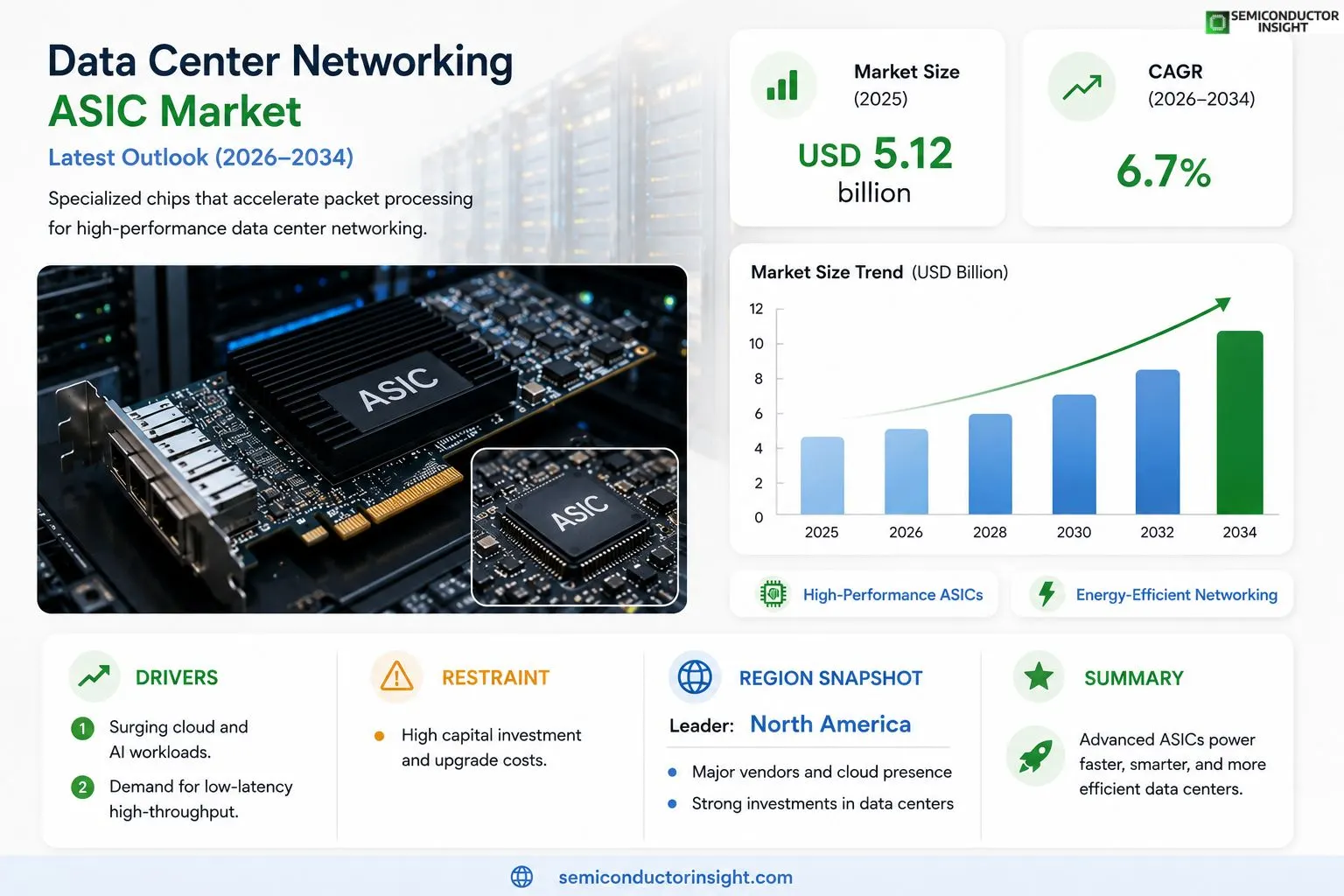
Global Data Center Networking ASIC market size was valued at USD 5.12 billion in 2025. The market is projected to grow from USD 5.12 billion in 2025 to USD 9.84 billion by 2034, exhibiting a CAGR of 6.7% during the forecast period.
Data Center Networking ASICs are specialized application‑specific integrated circuits designed to accelerate packet processing, switching, and routing functions within large‑scale data centers. They enable high‑throughput, low‑latency connectivity for workloads such as cloud services, AI inference, and edge computing.The market is experiencing rapid growth due to surging demand for cloud infrastructure, the rise of AI‑driven workloads, and the need for energy‑efficient networking solutions. Furthermore, major vendorsincluding Broadcom Inc., Intel Corporation, Marvell Technology Group Ltd., and Nvidia Corp.are expanding their portfolios through acquisitions and advanced silicon designs, further fueling expansion.
MARKET DRIVERS
Growing Data Traffic and AI Workloads
The rapid expansion of cloud services and AI‑driven applications is pushing data traffic volumes beyond 10 zettabytes annually. This surge fuels demand for high‑performance ASICs that can handle massive parallelism while maintaining energy efficiency. Companies that invest in advanced packet processing silicon are positioned to capture a significant share of Data Center Networking ASIC Market.
Demand for Low‑Latency, High‑Throughput Switching
Enterprises are prioritizing sub‑microsecond latency to support real‑time analytics and financial trading platforms. ASIC designs that deliver multi‑terabit throughput enable seamless scaling of hyperscale data centers, driving robust revenue growth across the sector.
➤ “Next‑gen ASICs will set the benchmark for power‑per‑bit efficiency, a key factor for operators seeking to reduce total cost of ownership.”
Collectively, these forces generate a compound annual growth rate (CAGR) of around 12 % through 2030, reinforcing the strategic importance of Data Center Networking ASIC Market.
MARKET CHALLENGES
Design Complexity and Power Constraints
Integrating sophisticated networking features onto a single ASIC increases design cycles and verification overhead. Balancing high throughput with strict power budgets remains a technical hurdle, especially as customers demand higher port densities.
Other Challenges
Supply Chain Volatility
Geopolitical tensions and semiconductor shortages have extended lead times for key components, causing project delays and elevating inventory costs for data‑center operators.
MARKET RESTRAINTS
High Capital Expenditure
Deploying state‑of‑the‑art ASICs requires substantial upfront investment in both silicon and supporting cooling infrastructure. Smaller cloud providers often lack the financial capacity to undertake such upgrades, limiting market penetration.Additionally, legacy networking equipment in older facilities creates a migration barrier, as operators must justify the ROI of replacing proven hardware with newer ASIC solutions.Regulatory compliance for energy consumption in large data centers imposes further cost constraints, prompting some operators to delay adoption until more cost‑effective designs emerge.
MARKET OPPORTUNITIES
Edge Computing Integration
The proliferation of edge data centers creates a demand for compact, low‑power ASICs that can deliver high performance in space‑constrained environments. Vendors that tailor their designs for edge workloads can tap into a fast‑growing niche within Data Center Networking ASIC Market.Emerging standards for disaggregated architectures also open avenues for modular ASIC solutions that can be dynamically reconfigured, offering operators flexibility to scale resources in line with workload fluctuations.Investment in AI‑accelerated networking functions presents another growth vector, as manufacturers develop ASICs with built‑in inference capabilities, positioning themselves at the forefront of next‑generation data‑center technology.
Data Center Networking ASIC Market Trends
Accelerating Demand for AI‑Driven Workloads
Data Center Networking ASIC Market is being reshaped by the rapid rise of artificial‑intelligence inference and training tasks that require ultra‑low latency and massive parallelism. Cloud providers are deploying next‑generation ASICs to offload tensor operations and to sustain petabyte‑scale data flows without saturating traditional networking silicon. This shift drives a migration toward chips that embed programmable pipelines, hardware‑accelerated packet classification, and native support for high‑speed Ethernet standards. As AI workloads become the primary engine of data‑center traffic, vendors are prioritizing silicon that can scale bandwidth per port while keeping power draw within tight limits, ensuring that capacity growth does not translate into proportional energy costs.
Other Trends
Energy‑Efficient Silicon Design
Energy consumption remains a critical cost factor for large‑scale facilities, prompting Data Center Networking ASIC Market to focus on power‑aware architectures. Advanced process nodes, such as 7 nm and 5 nm, enable designers to reduce switching capacitance and to integrate more functionality per die. Techniques like dynamic voltage scaling and fine‑grained clock gating are now standard features in flagship products. By delivering higher throughput per watt, these ASICs allow operators to meet sustainability targets while expanding compute density. The result is a tighter coupling between performance metrics and environmental impact, a trend that is reinforced by regulatory pressures and corporate ESG commitments.
Vendor Consolidation and Portfolio Expansion
Strategic acquisitions and collaborative R&D programs are accelerating consolidation in Data Center Networking ASIC Market. Leading playersincluding Broadcom, Intel, Marvell, and Nvidiaare broadening their product suites to cover end‑to‑end networking stacks, from top‑of‑rack switches to hyperscale spine fabrics. This vertical integration reduces time‑to‑market for new silicon generations and creates more cohesive ecosystems for customers. At the same time, partnerships with software‑defined networking vendors enable tighter hardware‑software co‑optimization, delivering deterministic latency and adaptive traffic engineering. The combined effect is a more streamlined supply chain and heightened innovation velocity, positioning the market for sustained growth as data‑center demands evolve.
COMPETITIVE LANDSCAPEKey Industry Players
Data Center Networking ASIC Competitive Landscape
Data Center Networking ASIC Market is presently led by a handful of entrenched suppliers whose silicon platforms power the majority of hyperscale and enterprise cloud infrastructures. Broadcom Inc. commands a sizable share with its Trident and Tomahawk families, delivering high‑throughput, low‑latency switching fabrics that underpin large‑scale fabric architectures. Intel Corporation, after acquiring Barefoot Networks, offers programmable Tofino chips that enable flexible pipeline customization for AI‑driven workloads. Marvell Technology Group Ltd. expands its reach through the OCTEON and Prestera product lines, targeting both Ethernet and RDMA use cases. Nvidia Corp., leveraging its Mellanox acquisition, supplies ConnectX adapters that integrate advanced offload capabilities with GPU‑centric data‑center designs. Collectively, these leaders shape a market structure where scalable, power‑efficient ASICs are the core enablers of cloud, edge, and AI services, driving a compound annual growth rate of roughly 6.7% through 2034.Beyond the dominant tier, a diverse set of niche players intensifies competition by focusing on specialized functions or emerging standards. Qualcomm Inc. brings its networking‑focused Snapdragon processors to edge‑centric data‑centers, emphasizing AI inference acceleration. Xilinx, now part of AMD, supplies programmable FPGA‑based ASICs that cater to low‑latency trading and security appliances. Lattice Semiconductor offers cost‑effective low‑power solutions for hyperscale rack‑level interconnects. Innovium and Pensando Systems differentiate through purpose‑built ASICs for programmable, software‑defined networking. Samsung Electronics and Huawei Technologies Co., Ltd. contribute advanced silicon leveraging their broader semiconductor portfolios. Netronome and Arista Networks provide niche acceleration and programmable pipeline technologies that address specific market segments such as NFV and high‑frequency trading. This ecosystem of specialized suppliers ensures a continual flow of innovation and price pressure across the data‑center networking stack.
List of Key Data Center Networking ASIC Companies Profiled
- Broadcom Inc.
- Intel Corporation
- Marvell Technology Group Ltd.
- Nvidia Corp.
- Qualcomm Inc.
- Xilinx (AMD)
- Lattice Semiconductor Corp.
- Innovium
- Pensando Systems
- Samsung Electronics
- Huawei Technologies Co., Ltd.
- Netronome
- Arista Networks
- Barefoot Networks (Intel)
- Google (TPU Networking ASIC)
Segment Analysis:
| Segment Category | Sub-Segments | Key Insights |
| By Type |
|
Switch ASICs
|
| By Application |
|
AI/ML Workloads
|
| By End User |
|
Hyperscale Data Centers
|
| By Architecture |
|
Programmable ASICs
|
| By Deployment Model |
|
On‑Premise Data Centers
|
Regional Analysis: North America
North America
The rapid expansion of cloud infrastructure is a primary driver of demand for advanced Data Center Networking ASICs, particularly those optimized for high-speed data transfer and low latency. Cloud providers require efficient networking solutions to support their growing customer base and service offerings.
Large enterprises are increasingly adopting advanced networking ASICs to enhance the performance and scalability of their internal networks, supporting demanding applications such as AI, analytics, and high-performance computing. The need for robust and secure network infrastructure within enterprises is a key factor driving ASIC adoption.
Telecommunication companies are utilizing Data Center Networking ASICs to build high-capacity and low-latency networks to support the growing demand for bandwidth driven by 5G and other advanced services. The performance requirements of modern telecommunications networks are pushing the boundaries of ASIC technology.
Universities and research institutions are investing in advanced networking infrastructure to support their research activities, requiring high-performance ASICs for data-intensive applications and high-speed communication. The demand for specialized ASIC solutions in this sector is growing.
Europe
Europe’s Data Center Networking ASIC Market is characterized by a strong focus on energy efficiency and sustainability, aligning with the region’s stringent environmental regulations. The growth is propelled by increasing cloud adoption, particularly in countries like the UK, Germany, and France. The market is witnessing a shift towards disaggregated networking architectures, further boosting the demand for advanced ASIC solutions. Key trends include the adoption of open networking standards and the growing emphasis on security and data privacy. European data centers are investing in technologies that enable greater flexibility and scalability, creating opportunities for ASIC providers. The competitive landscape consists of both global leaders and regional players adapting to the specific needs of the European market. The focus on industrial IoT is also contributing to the demand for networking ASICs in certain sectors.
Asia-Pacific
The Asia-Pacific region represents the largest and fastest-growing market for Data Center Networking ASICs globally. Driven by rapid economic growth, increasing digitalization, and large-scale investments in infrastructure, the region is experiencing exponential demand. China is the dominant market, followed by Japan, South Korea, and India. The growth is fueled by the expanding cloud computing sector, the proliferation of 5G networks, and the increasing adoption of AI and machine learning. The Asia-Pacific market is characterized by a strong emphasis on cost-effectiveness and scalability, leading to a demand for ASICs that offer high performance at competitive prices. The region also presents a significant opportunity for innovation, with emerging players developing specialized ASIC solutions to address the unique needs of the local market.
South America
Data Center Networking ASIC Market in South America is emerging, with growth primarily driven by the expanding cloud infrastructure and increasing data consumption. Brazil is the largest market in the region, followed by Chile and Argentina. The adoption of cloud services is gaining momentum, with local and international providers establishing data centers to cater to the growing demand. The region’s infrastructure development is crucial for supporting this expansion. The market is still relatively nascent compared to North America and Asia-Pacific, but it offers significant long-term growth potential. Challenges include limited investment and infrastructure constraints in certain areas.
Middle East & Africa
Data Center Networking ASIC Market in the Middle East and Africa is experiencing steady growth, driven by increasing investments in digital transformation and infrastructure development. The region is witnessing a surge in demand for cloud services, particularly in countries like Saudi Arabia, the UAE, and South Africa. Government initiatives aimed at promoting digital economies are further fueling market growth. The market is characterized by a focus on energy efficiency and cost-effectiveness, requiring ASICs that can operate in challenging environmental conditions. The expansion of data centers to support 5G and IoT applications is a key growth driver.
Report Scope
This market research report provides a comprehensive analysis of the Data Center Networking ASIC Market , covering the forecast period 2026–2034. It offers detailed insights into market dynamics, technological advancements, competitive landscape, and key trends shaping the industry.
Key focus areas of the report include:
- Market Overview: The report begins with an overview outlining its current market scenario, key growth indicators, and industry transformation drivers. It discusses macroeconomic factors, demand–supply balance, regulatory landscape, and the strategic role of semiconductors in powering advancements across industries such as automotive, telecommunications, consumer electronics, and industrial automation.
- Market Size & Forecast: Historical data and future projections for revenue, unit shipments, and market value across major regions and segments.
- Segmentation Analysis: Detailed breakdown by product type, technology, application, and end-user industry to identify high-growth segments and investment opportunities.
- Regional Insights: Insights into market performance across North America, Europe, Asia-Pacific, Latin America, and the Middle East & Africa, including country-level analysis where relevant.
- Competitive Landscape: Profiles of leading market participants, including their product offerings, R&D focus, manufacturing capacity, pricing strategies, and recent developments such as mergers, acquisitions, and partnerships.
- Technology Trends & Innovation: Assessment of emerging technologies, integration of AI/IoT, semiconductor design trends, fabrication techniques, and evolving industry standards.
- Market Drivers & Restraints: Evaluation of factors driving market growth along with challenges, supply chain constraints, regulatory issues, and market-entry barriers.
- Stakeholder Insights: Insights for component suppliers, OEMs, system integrators, investors, and policymakers regarding the evolving ecosystem and strategic opportunities.
Primary and secondary research methods are employed, including interviews with industry experts, data from verified sources, and real-time market intelligence to ensure the accuracy and reliability of the insights presented.
FREQUENTLY ASKED QUESTIONS:
What is the current market size of Data Center Networking ASIC Market?
-> Data Center Networking ASIC Market was valued at USD 5.12 billion in 2025 and is expected to reach USD 9.84 billion by 2034, exhibiting a CAGR of 6.7%.
Which key companies operate in Data Center Networking ASIC Market?
-> Key players include Broadcom Inc., Intel Corporation, Marvell Technology Group Ltd., and Nvidia Corp., among others.
What are the key growth drivers?
-> Key growth drivers include surging demand for cloud infrastructure, the rise of AI‑driven workloads, and the need for energy‑efficient networking solutions.
Which region dominates the market?
-> North America is a leading region due to the presence of major semiconductor vendors and extensive cloud service deployments, while Asia‑Pacific shows rapid growth.
What are the emerging trends?
-> Emerging trends include advanced silicon design, increased acquisitions among vendors, and integration of AI/IoT into networking ASICs.
Get Sample Report PDF for Exclusive Insights
Report Sample Includes
- Table of Contents
- List of Tables & Figures
- Charts, Research Methodology, and more...
 Download Sample Report PDF



