MARKET INSIGHTS
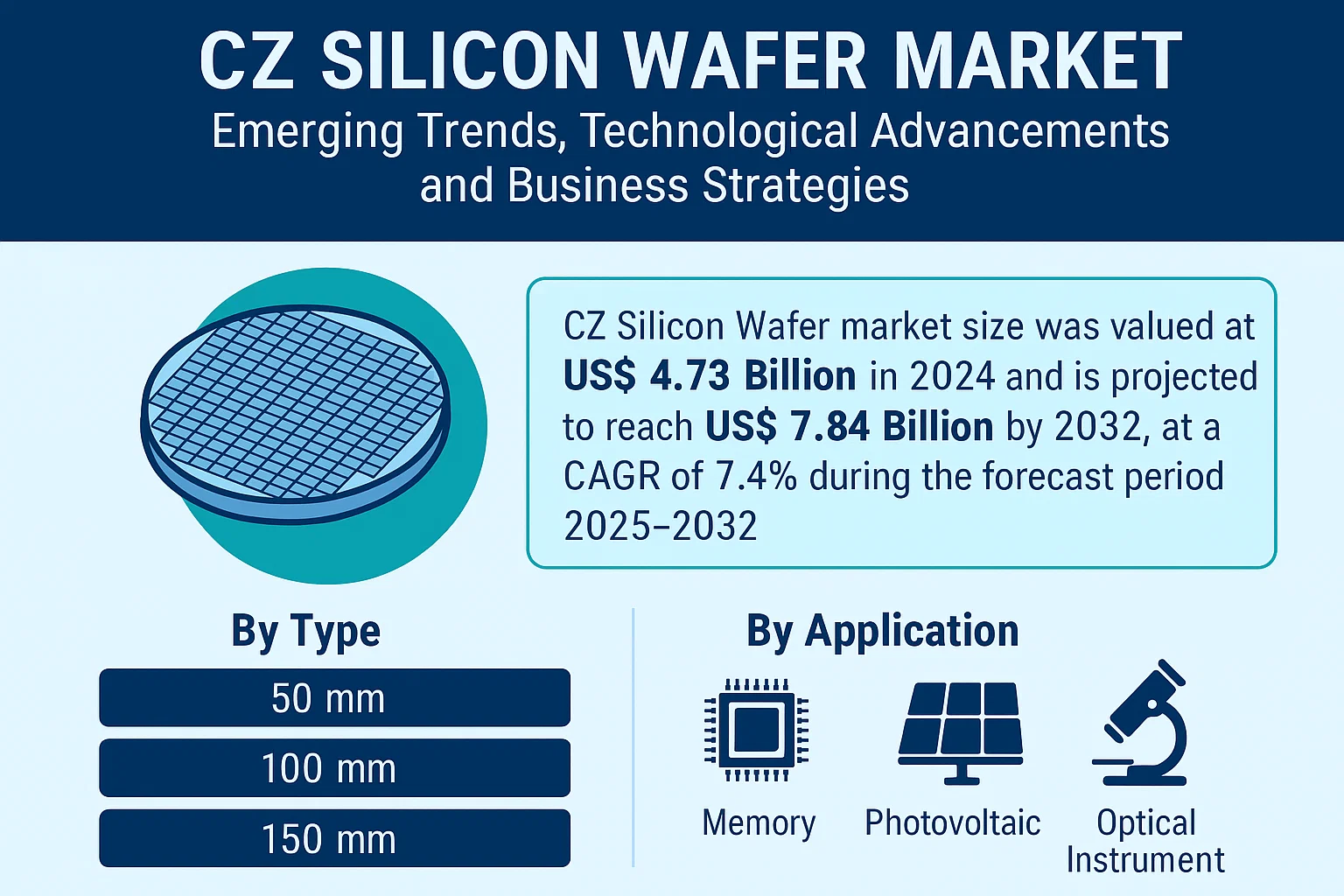
The global CZ Silicon Wafer market size was valued at US$ 4.73 billion in 2024 and is projected to reach US$ 7.84 billion by 2032, at a CAGR of 7.4% during the forecast period 2025-2032. This growth is closely tied to the broader semiconductor industry, which was valued at USD 579 billion in 2022 and is expected to reach USD 790 billion by 2029.
CZ (Czochralski) Silicon Wafers are single-crystal silicon substrates produced through the Czochralski process, which involves pulling a seed crystal from molten silicon. These wafers serve as fundamental building blocks for semiconductor devices, offering superior purity and uniformity compared to alternative production methods. The most common wafer diameters include 200mm and 300mm, with growing demand for larger sizes to improve manufacturing efficiency.
The market expansion is driven by several key factors: rising demand for advanced electronics, increased adoption of IoT devices, and growing investments in semiconductor fabrication facilities worldwide. While the memory segment faces fluctuations, sectors like photovoltaics and optical instruments are showing robust growth. Major players including Shin-Etsu, SUMCO, and Siltronic dominate the market, accounting for over 60% of global production capacity. Recent capacity expansions in Asia, particularly China, are reshaping the competitive landscape as regional players like Zhonghuan Semiconductor gain market share.
MARKET DYNAMICS
MARKET DRIVERS
Expanding Semiconductor Industry to Fuel CZ Silicon Wafer Demand
The CZ (Czochralski) silicon wafer market is experiencing robust growth, primarily driven by the booming semiconductor industry. With semiconductor revenues projected to reach $790 billion by 2029, manufacturers require increasingly sophisticated silicon wafers as the foundation for chip production. The 300mm wafer segment currently dominates with over 70% market share, as this size enables higher production yields and cost efficiencies for advanced logic and memory chips. Leading foundries are expanding production capacities, with multiple new fabs planned worldwide that will significantly increase silicon wafer consumption. This creates sustained demand growth for high-quality CZ silicon wafers through 2032.
Rise of IoT and 5G Technologies Accelerating Market Expansion
Emerging technologies are creating new growth avenues for CZ silicon wafers. The Internet of Things (IoT) market requires billions of connected devices, each containing multiple semiconductor components built on silicon wafers. Similarly, 5G infrastructure deployment demands specialized RF chips that use high-resistivity CZ silicon wafers. Automotive semiconductor content is doubling with autonomous driving capabilities, with each modern vehicle now using approximately 1,400 chips. These trends combined are expected to increase silicon wafer demand by over 40% in the next five years, particularly for 200mm and 300mm diameters.
Photovoltaic Industry Transition to Monocrystalline Driving Growth
The solar energy sector represents another significant driver, as photovoltaic manufacturers shift from multicrystalline to monocrystalline silicon wafers for higher efficiency. CZ monocrystalline wafers now account for over 95% of new solar panel production, with global PV installations exceeding 260 GW annually. This transition, combined with government renewable energy targets worldwide, is creating substantial demand for high-purity CZ silicon wafers with optimized crystal structures for solar applications.
MARKET RESTRAINTS
High Capital Costs and Long Lead Times for Production Expansion
The CZ silicon wafer market faces significant barriers to capacity expansion. Establishing new crystal growth facilities requires investments exceeding $1 billion, with lead times of 2-3 years before production begins. The specialized equipment needs, including crystal pullers and ultra-clean room environments, create high barriers to entry. Additionally, wafer purification and crystal growth processes are energy-intensive, making operations vulnerable to energy price fluctuations. These factors collectively limit how quickly supply can respond to growing demand, potentially creating shortages during market upcycles.
Material Purity Requirements Create Production Challenges
Manufacturing semiconductor-grade CZ silicon wafers demands exceptional purity levels, typically requiring 11N (99.999999999%) purity silicon. Achieving and maintaining these specifications presents technical hurdles, particularly as node sizes shrink below 10nm. Even minute impurities or crystal defects can ruin entire wafer batches, leading to yield challenges. The industry must balance these quality requirements against cost pressures, as chipmakers demand both higher purity and lower prices amid competitive market conditions.
MARKET OPPORTUNITIES
Advanced Packaging Technologies Opening New Applications
Emerging 3D packaging and chiplet architectures create opportunities for specialized wafer products. Technologies like silicon interposers and through-silicon vias (TSVs) require wafers with unique properties, enabling suppliers to develop higher-margin specialty products. The demand for these advanced packaging solutions is growing at 15% annually, driven by applications in high-performance computing and artificial intelligence processors. Wafer manufacturers investing in these segments can achieve premium pricing and long-term customer engagements.
Expansion in Emerging Markets Presenting Growth Potential
While traditional semiconductor markets show steady growth, emerging regions present significant expansion opportunities. Countries in Southeast Asia are rapidly developing domestic semiconductor ecosystems, with governments offering incentives for local wafer production. India’s semiconductor market is projected to reach $64 billion by 2026, creating demand for localized wafer supply chains. Similarly, Middle Eastern nations are investing heavily in technology infrastructure, including wafer fabrication facilities to diversify their economies beyond oil.
MARKET CHALLENGES
Supply Chain Volatility Impacting Raw Material Availability
The CZ silicon wafer industry faces ongoing supply chain challenges, particularly for high-purity polysilicon and crucible materials. Geopolitical tensions have disrupted traditional supply routes, while trade restrictions have created sourcing complexities. The production of quartz crucibles, essential for the CZ process, remains concentrated in few locations globally, creating single-point failure risks. These factors contribute to price volatility and potential production bottlenecks during periods of high demand.
Technology Transition to Larger Wafer Sizes Creating Disruptions
The industry’s gradual shift toward 450mm wafers presents both opportunities and challenges. While larger wafers offer potential cost benefits, the transition requires massive capital investments and process re-engineering. Equipment manufacturers must develop new crystal pullers capable of handling larger ingots, while chipmakers need to upgrade their fabrication lines. This technological discontinuity creates uncertainty in the market, as companies must carefully time their investments to avoid stranded assets or capability gaps.
CZ SILICON WAFER MARKET TRENDS
Demand for Larger Wafer Sizes Driving Market Growth
The CZ Silicon Wafer market is experiencing significant shifts as semiconductor manufacturers prioritize larger wafer sizes to achieve greater production efficiency and cost savings. 300mm wafers now account for over 70% of global silicon wafer production due to their higher yield potential, while the transition to 450mm wafers remains challenging due to prohibitive capital requirements exceeding $20 billion. Memory chip producers in particular are accelerating adoption of advanced 300mm CZ wafers to meet the demand for DRAM and 3D NAND flash storage solutions. Furthermore, photovoltaic manufacturers are progressively moving from 156mm to 200mm wafer formats to enhance solar cell efficiency while reducing material wastage. This transition across applications is expected to drive the CZ silicon wafer market growth at a steady CAGR of approximately 6% through 2032.
Other Trends
Semiconductor Industry Expansion in Asia-Pacific
Asia-Pacific dominates CZ silicon wafer consumption, representing nearly 80% of global demand, driven by semiconductor fabrication clusters in Taiwan, South Korea, and China. The region’s semiconductor market is projected to grow at 7% annually through 2029, fueled by government initiatives like China’s $150 billion semiconductor self-sufficiency plan. While Japan maintains technological leadership in wafer production through companies like Shin-Etsu and SUMCO, Chinese manufacturers are rapidly expanding 300mm wafer capacity to reduce import dependence. This geographic shift is reshaping supply chain dynamics as global wafer suppliers establish production facilities closer to Asian chipmakers to ensure just-in-time deliveries.
Technological Innovations in Crystal Growth Methods
Continuous improvements in Czochralski (CZ) crystal growth techniques are enhancing wafer quality while reducing manufacturing costs. Advanced magnetic CZ (MCZ) methods now enable precise control over oxygen concentration below 5ppma, critical for high-performance logic chips. Some manufacturers are implementing AI-driven process optimization that reduces crystal defects by 30-40% compared to conventional methods. Furthermore, novel doping techniques using gaseous dopants during crystal growth are enabling tighter resistivity control within ±5% specifications for power semiconductor applications. These technological advancements are particularly crucial as the industry moves toward smaller process nodes below 7nm, where wafer substrate quality directly impacts device yields.
COMPETITIVE LANDSCAPE
Key Industry Players
Market Leaders Drive Innovation Through Strategic Expansion and R&D Investments
The global CZ silicon wafer market features a semi-consolidated competitive structure, with dominant players maintaining their positions through technological leadership and extensive production capabilities. Shin-Etsu Chemical and SUMCO Corporation collectively control approximately 60% of the market share, primarily due to their vertically integrated operations and ability to manufacture 300mm wafers at scale.
Japanese manufacturers continue to lead the industry, with Siltronic AG (Germany) and GlobalWafers (Taiwan) emerging as strong competitors through targeted acquisitions and capacity expansions. The recent acquisition of Siltronic by GlobalWafers, valued at $4.5 billion, has significantly reshaped the competitive dynamics in the European market.
Chinese players such as Zhonghuan Semiconductor and Luoyang Hongtai Semiconductor are rapidly gaining traction, supported by government initiatives under the “Made in China 2025” policy. These companies are focusing on 200mm wafer production to cater to the growing demand from domestic semiconductor fabs.
Meanwhile, specialized manufacturers like Okmetic (Finland) are carving out niche positions in the RF-SOI wafer segment, capitalizing on the 5G infrastructure boom. The company’s recent €400 million investment in new production lines demonstrates the industry’s commitment to meeting future demand.
List of Key CZ Silicon Wafer Manufacturers
- Shin-Etsu Chemical Co., Ltd. (Japan)
- Siltronic AG (Germany)
- SUMCO Corporation (Japan)
- Silicon Technology Corp (U.S.)
- Western Minmetals (SC) Corporation (China)
- Okmetic Oy (Finland)
- Mi-Net Technology (Taiwan)
- SVM (South Korea)
- Nippon Chemi-Con Corporation (Japan)
- NorSun (Norway)
- FST Corporation (Taiwan)
- Luoyang Hongtai Semiconductor (China)
- PlutoSemi (China)
- Zhonghuan Semiconductor (China)
- GlobalWafers Co., Ltd. (Taiwan)
- CCMC (China)
Segment Analysis:
By Type
300 mm Segment Dominates the Market Due to High Adoption in Advanced Semiconductor Manufacturing
The market is segmented based on type into:
- 50 mm
- 100 mm
- 150 mm
- 200 mm
- 300 mm
- Others
By Application
Memory Segment Leads Due to Growing Demand for High-performance Computing and Data Storage
The market is segmented based on application into:
- Memory
- Photovoltaic
- Optical Instrument
- Other
Regional Analysis: CZ Silicon Wafer Market
North America
North America maintains a strong position in the CZ silicon wafer market, driven by the region’s advanced semiconductor fabrication capabilities and significant investments in research and development. The U.S. dominates the region, supported by major semiconductor manufacturers and tech industry leaders investing in wafer production for applications like memory chips and IoT devices. While demand for 300mm wafers remains high for cutting-edge semiconductor nodes, increasing government incentives under the CHIPS Act are accelerating domestic production capabilities. However, the region faces growing competition from Asia-Pacific manufacturers, which benefit from cost efficiencies. Environmental regulations also influence production processes, pushing for more sustainable crystal growth techniques.
Europe
The European CZ silicon wafer market is characterized by a strong focus on high-quality wafer production for automotive and industrial applications. Countries like Germany and France lead in demand, particularly for wafers used in power devices and optoelectronics. The EU’s emphasis on semiconductor sovereignty has spurred investments in domestic supply chains, particularly for 200mm and 300mm wafers needed for legacy and advanced chips. However, high energy costs and labor expenses remain challenges, limiting large-scale production expansion. The region’s niche expertise in specialty wafers—such as high-resistivity and epitaxial wafers—provides opportunities for differentiation in global markets.
Asia-Pacific
Asia-Pacific dominates global CZ silicon wafer production and consumption, accounting for over 70% of the market share due to the concentration of semiconductor fabs in Taiwan, South Korea, Japan, and China. China’s aggressive expansion in domestic wafer manufacturing—particularly in 300mm wafers—poses both opportunities and competitive threats to established suppliers. Meanwhile, Japan and South Korea remain key players in high-purity wafers for memory and logic applications. While Taiwan leads in foundry-driven demand, Southeast Asia is emerging as a hub for back-end semiconductor production, increasing wafer consumption. The region’s cost advantages and strong government support make it a critical growth driver for the global market.
South America
The CZ silicon wafer market in South America is limited but shows gradual growth due to increasing electronics manufacturing in Brazil and Argentina. The region primarily relies on imports from Asia and North America, with very limited local wafer production. While photovoltaic applications are a minor demand driver, the lack of advanced semiconductor fabrication facilities restricts market expansion. Economic instability and inconsistent policy support further hinder the adoption of high-purity wafer technologies. However, increasing investments in renewable energy and regional trade agreements could spur demand for wafers in energy and sensor applications over the long term.
Middle East & Africa
This region exhibits nascent but growing interest in semiconductor manufacturing, with countries like Saudi Arabia and the UAE investing in technology diversification. While wafer production facilities remain scarce, planned semiconductor initiatives—such as Saudi Arabia’s Vision 2030—are expected to boost demand for 150mm and 200mm wafers in power electronics and MEMS applications. Africa, however, has minimal wafer consumption due to underdeveloped semiconductor ecosystems. Challenges like limited infrastructure and skilled labor persist, though partnerships with global foundries and government-funded tech hubs could open future opportunities in specialty wafer applications.
Report Scope
This market research report provides a comprehensive analysis of the global and regional CZ Silicon Wafer markets, covering the forecast period 2025–2032. It offers detailed insights into market dynamics, technological advancements, competitive landscape, and key trends shaping the industry.
Key focus areas of the report include:
- Market Size & Forecast: Historical data and future projections for revenue, unit shipments, and market value across major regions and segments. The Global CZ Silicon Wafer market was valued at USD 2.8 billion in 2024 and is projected to reach USD 4.1 billion by 2032, growing at a CAGR of 4.9%.
- Segmentation Analysis: Detailed breakdown by wafer size (50mm to 300mm), application (Memory, Photovoltaic, Optical Instruments), and end-user industry to identify high-growth segments and investment opportunities. 300mm wafers dominate with 58% market share in 2024.
- Regional Outlook: Insights into market performance across North America, Europe, Asia-Pacific, Latin America, and Middle East & Africa. Asia-Pacific holds 72% market share, led by China, Japan and South Korea.
- Competitive Landscape: Profiles of 15 leading market participants including Shin-Etsu (28% share), SUMCO (19% share), and Siltronic (14% share), with analysis of their product portfolios and recent expansions.
- Technology Trends & Innovation: Assessment of emerging fabrication techniques, increasing adoption of 450mm wafers in R&D, and integration with advanced semiconductor packaging technologies.
- Market Drivers & Restraints: Evaluation of factors including semiconductor industry growth (projected USD 790 billion by 2029), IoT expansion, and challenges like silicon price volatility and geopolitical trade restrictions.
- Stakeholder Analysis: Strategic insights for wafer manufacturers, semiconductor foundries, equipment suppliers, and investors regarding capacity expansions and technology roadmaps.
The research employs primary interviews with industry leaders and analysis of financial reports, trade data, and production statistics from semiconductor associations to ensure data accuracy.
FREQUENTLY ASKED QUESTIONS:
What is the current market size of Global CZ Silicon Wafer Market?
-> CZ Silicon Wafer market size was valued at US$ 4.73 billion in 2024 and is projected to reach US$ 7.84 billion by 2032, at a CAGR of 7.4% during the forecast period 2025-2032.
Which key companies operate in Global CZ Silicon Wafer Market?
-> Key players include Shin-Etsu, SUMCO, Siltronic, GlobalWafers, and SK Siltron, with top 5 companies holding 68% market share.
What are the key growth drivers?
-> Growth is driven by semiconductor industry expansion (6% CAGR), IoT device proliferation, and renewable energy demand boosting photovoltaic applications.
Which region dominates the market?
-> Asia-Pacific dominates with 72% share, while North America is the fastest growing region at 5.8% CAGR.
What are the emerging trends?
-> Emerging trends include transition to 450mm wafers, advanced doping techniques, and increasing adoption in power electronics for electric vehicles.

Get Sample Report PDF for Exclusive Insights
Report Sample Includes
- Table of Contents
- List of Tables & Figures
- Charts, Research Methodology, and more...
 Download Sample Report PDF