SEMICONDUCTOR INSIGHT
MARKET RESEARCH REPORT

CVD SiC Focus Ring Market

2026 to 2034
MARKET INTELLIGENCE
ACROSS KEY REGIONS
2026 EDITION
DIELECTRIC MATERIALS Semiconductor Market Research

CVD SiC Focus Ring Market

Trends and Business Strategies 2026–2034

◷
UPDATED 30 October 2026
▤
REPORT LENGTH Detailed Report
▣
REPORT CODE a82a3960b7c8
▯
FORMATS PDF

CVD SiC focus ring market generated USD 111.70 million in 2025 and is projected to reach USD 253.05 million by 2034, a 9.5% CAGR over the nine-year interval. A focus ring surrounds the wafer during plasma processing, where its geometry and resistance to reactive species influence the uniformity of etching near the wafer perimeter and the timing of chamber-maintenance cycles.

Get the sample PDF with study scope, segmentation and methodology details.

Key Statistics

2025 Market Size
USD 111.70 million
2034 Projected Size
USD 253.05 million
CAGR (2025–2034)
9.5%
Largest Market in 2025
Asia-Pacific (~48%)

Key Takeaways

  • Market trajectory: Worldwide CVD SiC focus-ring sales reached USD 111.70 million in 2025, with a modelled 2034 value of USD 253.05 million and 9.5% compound annual expansion across nine years; replacement demand from installed etch chambers contributes alongside new factory capacity.
  • Dominant wafer format: The 300mm category represented ~68% of 2025 revenue because advanced logic and memory fabs employ large numbers of wafer-edge consumables, while the 200mm installed base provides a smaller but durable replacement business.
  • Materials mix: Pure CVD silicon carbide led at ~64%, reflecting demand for erosion resistance and particle control; silicon-carbide-coated graphite and other qualifying constructions remain relevant where thermal and cost requirements differ.
  • Process application: Wafer etching accounted for ~64% of sales, ahead of thin-film deposition, broader semiconductor manufacturing and residual process uses that purchase rings to meet different chamber qualification requirements.
  • End-use concentration: Semiconductor production represented ~78% of revenue, whereas LED processing and power-electronics manufacturing contribute smaller procurement streams and require distinct chamber geometries.
  • Regional leadership: Asia-Pacific captured ~48% of global sales in 2025, supported by large foundry and memory clusters in Taiwan, South Korea, China and Japan, as well as established local precision-component suppliers.
  • Commercial catalysts: Plasma-process complexity, wafer-edge uniformity requirements, high-purity component qualification, 300mm capacity additions and scheduled ring replacement drive demand, while fabrication yield and long qualification cycles constrain supplier entry.
  • Competitive structure: Tokai Carbon Korea, CoorsTek, VeTek Semiconductor and Semixlab illustrate the range of established and specialist material-component suppliers; equipment OEMs influence specifications but are not automatically independent ring vendors.

CVD SiC Focus Ring Market Overview

CVD SiC focus ring market generated USD 111.70 million in 2025 and is projected to reach USD 253.05 million by 2034, a 9.5% CAGR over the nine-year interval. A focus ring surrounds the wafer during plasma processing, where its geometry and resistance to reactive species influence the uniformity of etching near the wafer perimeter and the timing of chamber-maintenance cycles.

Base year: 2025 · Estimated year: 2026 · Forecast year: 2034 · Historical anchor: 2024 · Values in USD million

Unlike an etch system or a finished semiconductor, a CVD SiC focus ring is a consumable precision component whose sales recur as plasma exposure alters its surface and dimensional tolerances. Chemical-vapour-deposited silicon carbide offers high purity, thermal stability and resistance to aggressive etch chemistry. A fabricator qualifies each part for a particular chamber, process recipe and wafer size; replacement therefore follows the installed equipment population and the frequency of maintenance, rather than semiconductor unit shipments alone.

The market boundary covers rings made from deposited silicon carbide and qualifying silicon-carbide-coated graphite products included in the material segmentation. It excludes ordinary quartz or silicon rings, unprocessed silicon-carbide feedstock, unrelated chamber showerheads, entire plasma tools and the wafers processed by those tools. The selling price of the qualified ring is counted once, even when the ring is delivered through a toolmaker, a maintenance contractor or a specialist component distributor.

Two commercial mechanisms operate at different speeds. Expansion of 300mm logic and memory capacity raises the number of active chambers that need a spare-parts programme, while more demanding high-aspect-ratio plasma steps can increase the technical value of a ring and the scrutiny applied to particle generation. A new fab may create initial stocking orders before wafer production begins; thereafter chamber uptime, consumable lifetime and process qualification determine the recurring order cadence.

The supplier economics depend on much more than bulk ceramic price. CVD deposition time, machining yield, surface finishing, contamination control, dimensional inspection and customer-specific validation all contribute to the delivered cost. The ability to maintain consistent composition across batches matters because even a small change in the plasma-facing surface can trigger requalification or a process excursion. This creates switching costs that protect proven suppliers but slow the introduction of new ring designs.

Adjacent semiconductor investment provides a demand signal without being equivalent to ring revenue. SEMI projected in October 2026 that worldwide 300mm front-end equipment spending would reach USD 149 billion in 2026 and USD 227 billion in 2029, reflecting new fabrication lines and capacity upgrades. Only a fraction of that expenditure eventually translates into purchases of CVD SiC rings, and the timing depends on which etch chambers enter service, their consumable bills of materials and the replacement intervals specified by fabs.

Segment Analysis: By Type

By wafer format, 300mm and 200mm rings form the two reported categories. The larger 300mm class represented ~68% of 2025 sales and grows at about ~10.2% annually in the model, whereas 200mm rings held ~32% and expand more slowly as mature-node factories favour extending existing chamber life. The difference is tied to process intensity, replacement economics and the number of qualified part designs in active production.

Type Technical use and purchasing pattern Market position
300mm These rings are engineered for twelve-inch plasma etch chambers processing advanced logic, DRAM, 3D NAND and selected mature-node wafers. Flatness, edge profile, purity and resistance to ion bombardment are critical because an excursion near the wafer perimeter can impair die yield. Purchase orders are commonly tied to a chamber-specific part number and repeat qualification across multiple production sites. Largest category (~68% in 2025; ~10.2% CAGR). Demand benefits from new 300mm fabrication lines and from additional etch steps required by complex device structures. Higher unit value and rigorous surface specifications can support a price premium, but long approval cycles mean suppliers must prove lot-to-lot consistency before receiving sustained replacement orders.
200mm Eight-inch ring designs serve mature analog, discrete power, sensor and specialty semiconductor processes. Installed tools can remain in production for long periods, so customers place importance on replacement compatibility, stable lead times and preservation of legacy geometry. Some facilities prefer refurbishment or alternative ceramics when plasma chemistry and contamination limits allow them. Smaller category (~32% in 2025; ~8.0% CAGR). The revenue pool is sustained by the large installed population of mature-node equipment rather than a rapid shift toward new chamber architectures. A vendor capable of maintaining older drawing revisions can secure recurring orders, while price pressure is stronger when multiple machining suppliers can meet the same tolerance requirements.

Secondary segmentation: material composition and end-use industry

Material choice changes the exposure surface, service interval and inspection burden. Pure CVD SiC captured ~64% of 2025 material revenue; SiC-coated graphite represented ~29%; and other qualifying constructions accounted for ~7%. These categories refer to the composition of the sold ring, not to the total value of a chamber assembly. Coated graphite can offer thermal and cost advantages in selected recipes, whereas deposited SiC is preferred where plasma erosion and trace contamination are the decisive procurement criteria.

End-use demand is more concentrated than the material mix. Semiconductor fabrication accounted for ~78% of purchases, LED-related processing ~10%, power-electronics manufacturing ~8%, and remaining specialist uses ~4%. This classification follows the buyer process served by the ring, so a component used in a power-device etcher is assigned to that end-use rather than counted again under mainstream semiconductor production. Distinct process chemistries, chamber diameters and maintenance cycles produce different qualification hurdles across the four groups.

Market growth schedule and model allocations

Year Modeled global revenue, USD million 2025 index
2025 111.70 100.0
2026 122.33 109.5
2027 133.96 119.9
2028 146.70 131.3
2029 160.66 143.8
2030 175.94 157.5
2031 192.67 172.5
2032 211.00 188.9
2033 231.07 206.9
2034 253.05 226.5
Region 2025 share Modeled annual growth 2034 share 2034 demand index, 2025=100
Asia-Pacific 48% 9.88% 49.50% 233.4
North America 24% 9.00% 23.0% 217.2
Europe 17% 8.60% 15.8% 210.1
South America 6% 10.20% 6.3% 239.7
Middle East & Africa 5% 10.50% 5.4% 245.6
Axis Member 2025 share Annual growth model
Type 300mm 68% 10.17%
Type 200mm 32% 8.00%
Material Composition Pure CVD SiC 64% 10.00%
Material Composition SiC-coated Graphite 29% 8.50%
Material Composition Others 7% 9.00%
Application Wafer etching 64% 10.21%
Application Thin film deposition 17% 8.00%
Application Semiconductor manufacturing 13% 8.70%
Application Others 6% 7.50%
End-Use Industry Semiconductor 78% 9.84%
End-Use Industry LED 10% 7.80%
End-Use Industry Power electronics 8% 8.90%
End-Use Industry Others 4% 8.20%

Segment Analysis: By Application

The application taxonomy separates Wafer etching, Thin film deposition, Semiconductor manufacturing and Others. Wafer etching leads at ~64% of 2025 sales and a modeled ~10.2% CAGR because plasma-exposed edge rings directly shape local conditions around a wafer. The remaining categories capture qualified ring-like consumables used in deposition and broader chamber operations without treating entire equipment purchases as product revenue.

Application Demand characteristics
Wafer etching Leading application (~64%; ~10.2% CAGR). Conductive and dielectric plasma etch processes expose edge rings to reactive gases, energetic ions and repeated temperature changes. Manufacturers therefore compare erosion rate, particle generation, profile stability and replacement interval. Qualification is demanding, yet a proven design can be reordered across a chamber fleet for years, making this the core recurring-revenue segment.
Thin film deposition Secondary application (~17%; ~8.0% CAGR). Deposition tools may employ protective edge components with different thermal loading and gas-flow requirements from etchers. SiC materials are selected where chemical resistance and temperature stability justify their cost. Purchase volumes are smaller, and a component that works in an etch chamber cannot be assumed to satisfy deposition tool specifications without separate testing.
Semiconductor manufacturing Broader process category (~13%; ~8.7% CAGR). This residual application includes qualifying chamber-edge consumables used in production environments not assigned to the preceding two specific operations. Customers often request dimensional traceability, contamination documentation and spare-part continuity. The classification is exclusive: an etch ring remains in the etch category even though etching is part of semiconductor manufacturing.
Others Specialised applications (~6%; ~7.5% CAGR). Smaller process niches include development lines and non-standard wafer handling configurations that use SiC ring geometries. Orders tend to be irregular and design-specific, with higher engineering effort relative to volume. This category does not include unrelated silicon-carbide ceramics merely because they are installed somewhere inside semiconductor production equipment.

Application mix determines replacement frequency and vendor selection. Etch engineers assess plasma-facing material loss and wafer-edge electrical behaviour; deposition teams emphasise temperature response and compatibility with their process gases; development fabs may value small-batch flexibility over unit price. Across these settings, a qualified focus ring is not interchangeable with a generic ceramic annulus, and supplier claims about hardness or purity must be supported by chamber-specific production results before a purchasing decision.
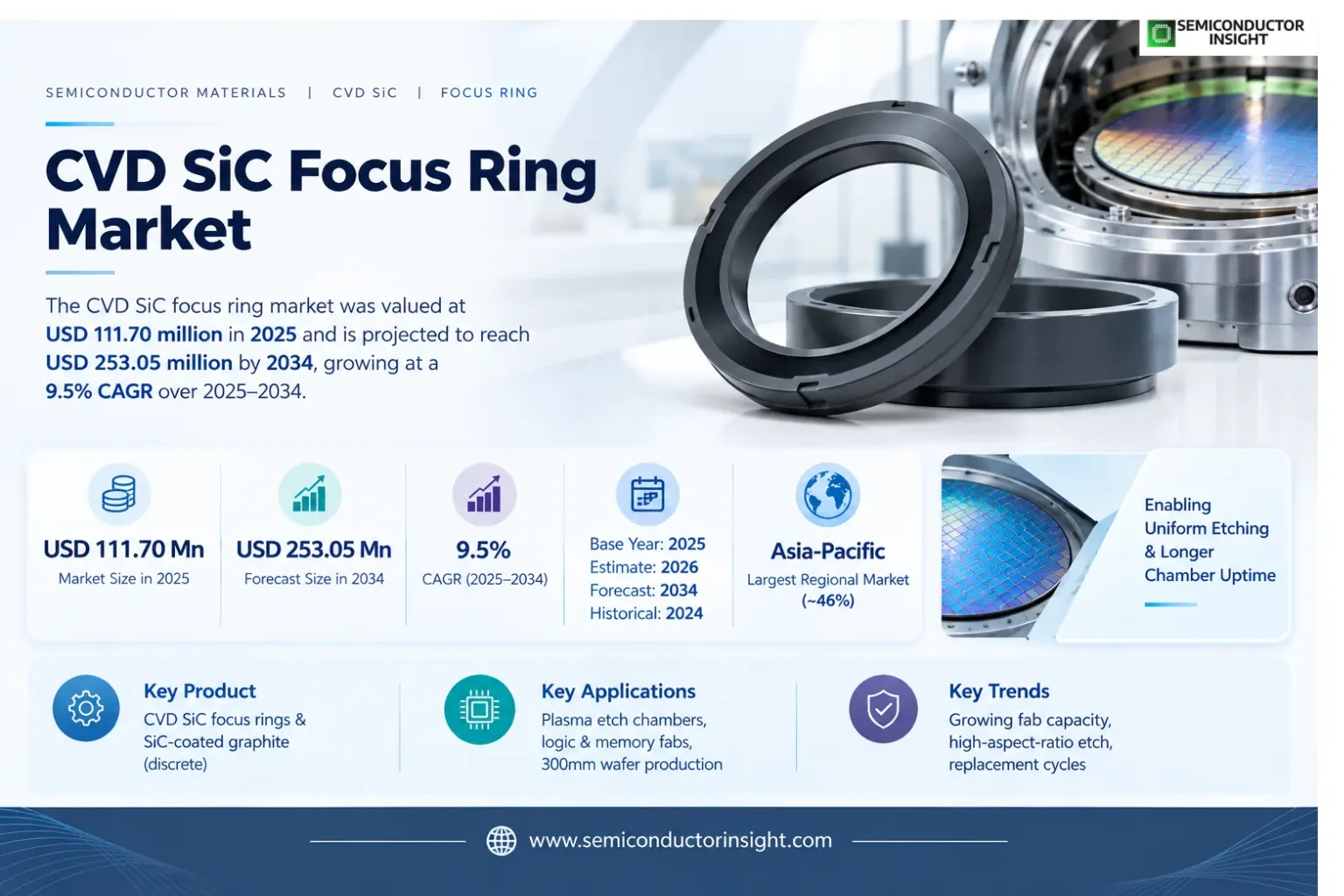
CVD SiC Focus Ring Market, Trends and Business Strategies 2026–2034

Regional Analysis

Regional purchasing follows the concentration of wafer-fabrication equipment, the installed base of plasma chambers and the availability of qualified precision-ceramic suppliers. Asia-Pacific dominates manufacturing demand; North America combines process-tool design with growing fab investment; Europe contributes high-value materials expertise; South America and the Middle East and Africa remain smaller markets where local sourcing and equipment service channels shape procurement.

Where are CVD SiC focus rings purchased and qualified?

The five-region allocation is built around 2025 ring consumption rather than semiconductor output or equipment capital expenditure. Asia-Pacific holds ~48% of revenue, North America ~24%, Europe ~17%, South America ~6%, and the Middle East and Africa ~5%. Growth differs because new fabs, existing chamber replacement and local service ecosystems develop at unequal speeds; the model uses region-specific rates while retaining one reconciled worldwide revenue total.

Region Position Growth outlook Demand profile What decides supplier selection
Asia-Pacific Largest (~48%) ~9.9% CAGR High-volume foundry and memory fabs Purity documentation, process qualification and short replacement lead times
North America Second (~24%) ~9.0% CAGR Tool design and new fab capacity Engineering access, qualified part traceability and supply assurance
Europe Third (~17%) ~8.6% CAGR Precision ceramics and industrial fabs Dimensional repeatability, quality systems and materials testing
South America Fourth (~6%) ~10.2% CAGR Small installed tool population Distributor inventory, imported spares and maintenance support
Middle East & Africa Fifth (~5%) ~10.5% CAGR Early fabrication investment Project timing, technology transfer and toolmaker-approved components

Asia-Pacific LARGEST · ~48% SHARE

Why does Asia-Pacific account for the largest focus-ring demand?

Asia-Pacific accounts for ~48% of 2025 CVD SiC focus-ring revenue and expands at a modeled ~9.9% CAGR because Taiwan, South Korea, China and Japan operate dense concentrations of 300mm foundry and memory equipment. Replacement orders follow the number of plasma chambers in service, while established precision-material supply chains shorten logistics and facilitate joint troubleshooting between part makers, tool engineers and fabrication customers.

Market positionLargest (~48%)
Growth outlook~9.9% CAGR
Demand profileFoundry and memory etch
Market access gateQualification and replenishment
Country Position in region What drives demand
Taiwan Advanced foundry hub Taiwanese foundries operate intensive multi-step plasma processes in leading-edge logic manufacturing, where the wafer-edge condition must remain consistent across thousands of chamber cycles. Component suppliers serving this customer base need rapid dimensional feedback, detailed process-control records and the capacity to deliver identical replacements for many tool configurations without interrupting qualified production recipes.
South Korea Memory manufacturing Korean memory production uses demanding conductor and dielectric etch sequences for advanced DRAM and vertically stacked NAND. Local component makers and global equipment suppliers work closely with fab engineers to evaluate erosion, surface particles and spare-part intervals. A supplier winning a memory-platform qualification may gain recurring volume but must respond quickly to process-generation changes.
China Expanding installed base China continues to expand domestic wafer-fabrication capacity across logic, memory and mature processes, increasing the range of chamber consumables purchased locally. Import substitution creates opportunities for regional SiC manufacturers, yet customers still require qualification against specific etch recipes. Faster plant additions do not guarantee proportional ring revenue until tools are installed and operating.
Japan Materials and tool ecosystem Japanese companies contribute advanced ceramics, carbon materials and process equipment to the regional supply chain. Their customers often evaluate contamination control, dimensional accuracy and material lifetime over several replacement cycles. Japan also serves as an engineering base for parts that are ultimately installed in factories elsewhere in Asia, making production location different from final consumption.
Market instances

  • Korean CVD SiC suppliers demonstrate specialised ring capability. Tokai Carbon Korea identifies SiC rings among its chemical-vapour-deposited components for dry etch and diffusion chambers, and describes purity above 99.9999% for the material family. Such specifications are relevant to plasma-facing consumables, but qualification remains chamber-specific. The example illustrates regional supplier depth rather than proving a particular percentage of global ring sales.
  • New 300mm lines enlarge the future consumables population. SEMI projected in October 2026 that 20 new 300mm fabs or lines would begin construction during the year, followed by 18 in 2027. A newly built plant generates demand for spare rings only after equipment installation and qualification, so the commercial impact is staggered over commissioning and subsequent replacement cycles rather than immediate sales matching capital spending.
In the full report: country-level focus-ring demand, 200mm versus 300mm consumption, manufacturer shipments and replacement pricing for Taiwan, South Korea, China, Japan and Southeast Asia.

North America SECOND · ~24% SHARE

How do North American toolmakers influence purchasing?

North America represents ~24% of 2025 revenue and an estimated ~9.0% CAGR, with demand divided between domestic wafer fabrication and the specification-setting role of major plasma equipment developers. The United States is central to process development, component qualification and tool-service distribution. Customers frequently require traceability, controlled materials changes and long-term spares support because a ring alteration can affect process yield.

Market positionSecond (~24%)
Growth outlook~9.0% CAGR
Demand profileEtch engineering and fabs
Market access gateTraceability and approved vendors
Country Position in region What drives demand
United States Primary market US fabs and plasma equipment suppliers create demand for rings used in high-performance logic, memory development and specialty wafer processing. Supplier engagement often begins with a tool qualification and extends through field support, contamination investigations and replacement-part inventory. Domestic capacity additions can broaden the addressable installed base, although orders remain dependent on which chamber platforms are deployed.
Canada Specialty demand Canadian semiconductor activity is concentrated in research, photonics, specialty fabrication and supporting industrial services rather than a broad fleet of advanced memory fabs. This leads to smaller, less standardised ring orders, often sourced through international distributors. Engineering responsiveness and the ability to manufacture a documented geometry may matter more than high-volume price concessions.
Mexico Supply-chain role Mexico participates in North American electronics manufacturing and industrial supply chains, but its direct installed base of advanced plasma etch tools is limited relative to the United States. Local demand therefore concentrates on specialised facilities and equipment-service channels. Import lead time, customs documentation and spare-part availability are practical purchasing considerations for qualifying SiC consumables.
Market instances

  • A new conductor-etch platform raises the performance benchmark. Lam Research introduced its Akara conductor etch technology in February 2025, highlighting process control and advanced semiconductor scaling. A new etch platform does not imply that every chamber uses the same CVD SiC ring, but it demonstrates why materials suppliers must support changing plasma conditions, chamber geometries and contamination thresholds when competing for future approved parts.
  • US fab construction changes the medium-term installed base. SEMI projected that three 300mm fabs or lines would start construction in the United States in 2026 and four more in 2027. The eventual effect on ring procurement depends on the number of etch chambers and their duty cycles, while component makers must plan qualification capacity well before replacement orders become predictable.
In the full report: United States, Canada and Mexico supplier channels, qualified ring specifications, toolmaker relationships, spare-part inventories and fabrication-site procurement trends.

Europe THIRD · ~17% SHARE

What sustains the European focus-ring supply chain?

Europe holds ~17% of 2025 sales and a modeled ~8.6% CAGR, supported by precision ceramic manufacturing, semiconductor equipment research and a varied base of industrial fabrication sites. Germany, France and neighbouring countries supply high-performance materials and machining expertise. Ring procurement is specification-led, with stringent attention to thermal behaviour, chemical compatibility and documentation of each production lot.

Market positionThird (~17%)
Growth outlook~8.6% CAGR
Demand profileSpecialty fabrication
Market access gateQuality-system compliance
Country Position in region What drives demand
Germany Engineering centre Germany hosts semiconductor materials specialists and fabrication operations that use plasma processing in power devices, sensors and automotive electronics. Buyers frequently favour suppliers able to document ceramic provenance and machining tolerances, particularly where the component must remain compatible with older installed equipment. High labour costs increase the value of reliable service life and predictable maintenance intervals.
France Materials development French advanced-materials companies contribute expertise in sintered silicon carbide, coatings and technical ceramics used in demanding industrial environments. These capabilities are adjacent to focus-ring manufacture but do not by themselves establish merchant ring revenue. Research partnerships and specialised machining can nevertheless support process development for future chamber consumables, especially when engineering teams need custom surface finishes and rigorous contamination checks.
Italy and Benelux Specialist processing Italian and Benelux semiconductor ecosystems combine specialty device production, equipment engineering and research facilities. Their purchases of chamber-edge consumables are generally smaller than those of major Asian memory clusters. Suppliers compete on bespoke geometry, contamination control and responsiveness to process changes rather than on supplying a single high-volume ring design.
Market instances

  • Coated ceramic alternatives broaden engineering choices. Mersen describes sintered silicon carbide products that can receive high-purity CVD SiC coatings for demanding semiconductor applications. This evidence establishes material capability rather than direct market share in focus rings. European purchasers compare coated and solid constructions against actual plasma conditions, service life and part-cost economics before approving a change to chamber hardware.
  • Process research supports more demanding material specifications. European semiconductor research facilities evaluate advanced patterning and deposition methods that can increase sensitivity to chamber particles and edge uniformity. Their pilot lines create small initial orders and validation data, not the same revenue as volume production. Commercial opportunity develops when a proven component design is adopted across a larger fabrication fleet.
In the full report: country-level consumption for Germany, France, Italy, Benelux and the rest of Europe, with ceramic supplier qualification, equipment installed base and price segmentation.

South America FOURTH · ~6% SHARE

Why is South American demand smaller but persistent?

South America accounts for ~6% of global sales in 2025 and is modeled to grow at ~10.2% annually from a relatively narrow installed base. Semiconductor fabrication activity is concentrated in specialist and legacy processes rather than extensive 300mm memory production. Purchasers depend on imported consumables, distributors and tool-service providers, so stock availability can be more important than access to the newest ring material.

Market positionFourth (~6%)
Growth outlook~10.2% CAGR
Demand profileLegacy and specialist tools
Market access gateImport lead time
Country Position in region What drives demand
Brazil Regional centre Brazil combines semiconductor research, packaging and selected fabrication activities with a broad electronics industry. Only wafer-processing facilities operating compatible plasma tools directly purchase CVD SiC rings. Maintenance contractors and overseas part suppliers therefore play a significant role, and a delayed replacement can impose an outsized production interruption on a small facility.
Argentina Limited direct market Argentina has a modest semiconductor fabrication footprint and a stronger emphasis on research and electronics integration. Focus-ring orders are consequently intermittent, tied to specialised process equipment rather than mass-market consumer-device assembly. Customers may source replacements through the original tool vendor when independent local qualification resources are insufficient, particularly for older plasma chambers that require legacy drawings and traceable spare-part substitutions.
Rest of South America Emerging users Other South American markets contain research institutions, industrial process users and electronics facilities with selective semiconductor capabilities. A large electronics assembly sector does not necessarily create plasma-chamber consumables demand, because packaged chips can be imported. Opportunities for SiC ring vendors arise only when local wafer processing or equipment refurbishment requires a qualified part.
Market instances

  • Replacement logistics determine practical equipment uptime. A specialist South American fab may operate only a handful of compatible plasma chambers, making a single unplanned ring failure more disruptive than in a large cluster with pooled inventory. Vendors able to provide documented drawings and regional distributor stock can reduce maintenance risk, even when annual component volumes remain modest compared with Asia-Pacific.
  • Imported precision ceramics face extended procurement chains. Where local CVD deposition and ultra-precision finishing capacity are limited, buyers rely on international manufacturing and customs clearance. The commercial effect is a preference for advance spare-part planning and stable approved suppliers. This distribution pattern supports steady service revenue without implying that the region manufactures a comparable share of global focus-ring output.
In the full report: Brazil, Argentina and remaining South American markets by wafer-process activity, replacement purchasing, imported consumable supply and service-channel economics.

Middle East & Africa FIFTH · ~5% SHARE

What could increase adoption across the Middle East and Africa?

The Middle East and Africa represent ~5% of 2025 revenue with a modeled ~10.5% CAGR, reflecting a small starting base and the possibility of selected new semiconductor facilities. Demand is currently more project-specific than in established Asian wafer-fabrication clusters. For a new customer, access to toolmaker-approved ring designs and experienced maintenance support can be more important than local ceramic manufacturing.

Market positionFifth (~5%)
Growth outlook~10.5% CAGR
Demand profileProject-based capacity
Market access gateToolmaker qualification
Country Position in region What drives demand
Israel Technology-intensive niche Israel has semiconductor design, process research and advanced fabrication activities that create selective demand for precision chamber components. Purchasing decisions can involve close collaboration between equipment engineers and specialist materials suppliers. High-specification projects favour contamination control and repeatable dimensions, but the overall volume of consumable rings is smaller than in the major East Asian foundry hubs.
United Arab Emirates Investment exploration The United Arab Emirates has pursued technology diversification and industrial investment, although electronics assembly and design activities are not substitutes for a large plasma etch installed base. Focus-ring demand would rise materially only if wafer-fabrication capacity entered operation. Potential suppliers therefore track concrete tool installations and qualification programmes rather than broad announcements about semiconductor ambitions.
South Africa Research and specialty South African universities and industrial laboratories contribute semiconductor-related research and specialised materials work. Direct purchases of CVD SiC focus rings depend on the presence of suitable plasma-processing equipment, not on the size of the national electronics market. Small orders may prioritise engineering support, refurbishment compatibility and assured imported spare-part availability.
Market instances

  • New fabrication projects have a delayed consumables effect. A proposed wafer fab does not purchase routine replacement rings while it is in the design stage. Orders begin with tool installation, chamber qualification and initial spare stocking, followed by maintenance-linked replenishment. This sequence makes the region sensitive to construction milestones and creates a lag between capital announcements and observable CVD SiC component sales.
  • Research tools generate specialised rather than mass-volume orders. University and pilot-line plasma systems can require uncommon wafer sizes or chamber-edge geometries, creating opportunities for flexible machining specialists. These projects are technically valuable references but cannot be counted as large production contracts without evidence of repeated purchases. Vendors must separate prototype work from installed-fleet consumables when evaluating regional revenue potential.
In the full report: Israel, the Gulf states, South Africa and other regional users by fab project status, installed plasma tool count, qualification needs and service arrangements.

Key CVD SiC Focus Ring Manufacturers and Competitive Landscape

Competition is shaped by deposition capability, precision machining, material purity and access to semiconductor chamber qualifications. A small set of specialist ceramic and carbon-material groups supplies established tool platforms, while emerging companies target specific ring geometries or coating routes. Public product catalogues demonstrate technical participation but rarely disclose ring-only revenue, so company rankings should not be inferred from unrelated consolidated sales.

Tokai Carbon Korea is an important example of an integrated materials and component supplier. Its catalogue identifies CVD SiC rings, showerheads and dummy wafers for semiconductor chambers; Tokai Carbon group disclosures also place the Korean subsidiary within a broader fine-carbon business. The group relationship matters because Tokai Carbon and TCK should not be counted as two independent competitors merely because both names appear in supplier lists.

CoorsTek has a broad technical-ceramics portfolio and established relationships with semiconductor equipment customers. The relevant competitive advantage is the ability to control material processing, machining and quality documentation for demanding components. However, total ceramic revenue cannot be used as a proxy for the value of CVD SiC focus-ring shipments, and any supplier-share estimate would require product-level commercial evidence not provided by general corporate disclosures.

VeTek Semiconductor and Semixlab publish dedicated CVD SiC focus-ring product information, including the geometry and plasma-facing attributes sought by chamber operators. Their visibility demonstrates that niche manufacturers can compete with diversified materials groups where customer drawings and process qualification are accessible. The principal barrier remains repeated approval across actual etch recipes, because catalogue specifications alone do not establish field lifetime or particle performance.

Top Seiko, Mersen and other precision-material companies illustrate adjacent capabilities in silicon-carbide machining, sintered substrates and protective coatings. They can be relevant development partners or potential sources of components, but a generic SiC ceramics page is not proof of current merchant focus-ring sales. Likewise, Lam Research and Applied Materials define important tool requirements without automatically being independent producers of the rings installed in their systems.

Tier structure

Tier Companies Basis of competition
Qualified materials groups Tokai Carbon Korea / Tokai Carbon; CoorsTek Established materials expertise, disciplined manufacturing control and relationships with semiconductor equipment customers are valuable in recurring chamber consumables. Their competitive position rests on technical approval and supply continuity rather than publicly disclosed focus-ring revenue share, which remains difficult to isolate from larger fine-ceramics businesses.
Specialist ring manufacturers VeTek Semiconductor; Semixlab; Coma Technology Focused suppliers target defined CVD SiC geometries, coating requirements and plasma-chamber spare-part programmes. They may offer flexible engineering support for customer drawings, but each proposed replacement must pass contamination and service-life tests before large-volume purchase commitments become credible.
Adjacent materials and machining Top Seiko; Mersen; Morgan Advanced Materials These companies provide relevant ceramic or engineering capabilities but should not be ranked as independent focus-ring vendors without product-specific evidence. Their participation may occur through machining, coating, materials development or upstream supply rather than direct sale of a qualified plasma-facing ring.

Key companies profiled

  • Tokai Carbon Korea (TCK)
  • Tokai Carbon Co., Ltd.
  • CoorsTek
  • VeTek Semiconductor
  • Semixlab
  • Coma Technology
  • Top Seiko
  • Mersen
  • Morgan Advanced Materials
  • Worldex
  • Kallex
  • Max Luck Technology

CVD SiC Focus Ring Production Capacity and Manufacturing Economics

Manufacturing capacity is constrained by chemical-vapour-deposition throughput, precision finishing and final inspection rather than by raw silicon-carbide availability alone. A qualified 300mm focus ring requires a tightly controlled plasma-facing surface, dimensional repeatability and documented trace contamination. Capacity is therefore best assessed as the number of approved finished components a plant can ship, not as the tonnage of ceramic feedstock processed.

CVD SiC manufacturing uses controlled deposition chemistry to form a dense silicon-carbide structure or coating. Deposition cycle time, fixture design, temperature uniformity and precursor purity influence how many acceptable blanks emerge from a reactor. Subsequent machining must meet demanding flatness and profile tolerances while avoiding cracks and contamination. Each stage can reduce effective yield, which makes a nominal increase in deposition volume less useful if finishing and inspection cannot keep pace.

Production is geographically concentrated near semiconductor materials and precision-machining ecosystems in East Asia, with additional capabilities in North America and Europe. A supplier serving several customers may need separate production controls for 200mm and 300mm geometries, plus multiple chamber-specific variants within each size. As a result, inventory is fragmented across part numbers, and a manufacturer with high overall output may still face shortages of a particular qualified ring.

The economics favour stable contracts with repeatable specifications. An approved ring can generate a multi-year replacement stream, but customer engineering changes may require new tooling, test coupons and process trials before shipment. Vendors also hold safety stock to protect fab uptime. A new competitor must fund qualification and reliability testing before significant revenue arrives, creating a working-capital burden that is not visible in generic SiC material price comparisons.

CVD SiC Focus Ring Market Dynamics: Drivers, Restraints and Opportunities

The growth outlook balances the larger installed population of 300mm plasma chambers and higher process intensity against qualification expense, fabrication yield losses and price pressure. Modeled contribution values describe the relative strength of demand mechanisms over 2025–2034; they are not independently measured causal coefficients. The combined driver and restraint contributions reconcile to the displayed market CAGR.

MARKET DRIVERS

Drivers Impact Analysis*

Market Drivers Impact Rank CAGR Contribution (%) 2026–2028 2029–2031 2032–2034
300mm foundry and memory etch capacity additions High +4.00% High High Medium
Greater process complexity and edge-control requirements Medium-High +3.10% Medium High High
Recurring replacement across installed chamber fleets Medium +2.60% High High High
High-purity SiC substitution for shorter-life materials Low-Medium +1.50% Medium Medium High
Regional supply assurance and qualified second sourcing Low +1.00% Low Medium Medium
Others (pilot fabs, specialist devices and chamber retrofits) Low +0.70% Low Medium Medium

More active chambers create a recurring parts population

The connection between fabrication investment and ring sales is indirect but persistent. Once a 300mm etch chamber enters service, its consumable components require inspection and periodic replacement under a qualified maintenance plan. Each additional production line can therefore enlarge the future installed population of rings, even if the first significant replenishment order arrives after process ramp rather than at the construction stage.

Complex etch recipes raise the cost of edge instability

Advanced device structures increase sensitivity to etch uniformity and chamber-generated particles. Ring erosion changes the geometry surrounding the wafer, potentially affecting local plasma conditions and the process margin near the perimeter. Customers may accept a higher part price if validated material stability reduces wafer scrap or unplanned chamber interventions, strengthening the position of suppliers with detailed lifetime data.

Replacement cycles cushion fluctuations in new equipment orders

A mature fabrication plant continues buying approved consumables when capital expenditure slows because its existing plasma tools must remain operational. The purchasing cadence reflects wafer starts, chamber utilisation, etch chemistry and maintenance practice. This installed-base effect supports recurring business for component makers, although fabs can defer nonessential replacement or negotiate price reductions during weak semiconductor demand.

Material upgrades offer process-specific performance gains

Pure deposited silicon carbide can outperform certain alternative ring constructions under aggressive plasma conditions because of its chemical resistance and low contamination potential. The benefit is not universal: some coated graphite designs may meet requirements at a lower cost. Suppliers gain when they demonstrate a measured reduction in erosion or particles for a named process rather than relying on broad material-property claims.

MARKET RESTRAINTS

Restraints Impact Analysis*

Market Restraints Impact Rank CAGR Contribution (%) 2026–2028 2029–2031 2032–2034
Deposition and finishing yield losses High -1.40% High Medium Medium
Long chamber qualification and change-control cycles Medium-High -1.00% High High Medium
Price pressure and alternative ceramic constructions Medium -0.60% Medium Medium High
Others (tool downtime, customer concentration and inventory) Low -0.40% Medium Low Medium
*CAGR contribution shows the percentage points each factor adds to or removes from the forecast CAGR for 2026–2034; driver contributions less restraint contributions equal the market CAGR. The three time-window assessments distinguish near-term fab commissioning effects from later replacement-cycle and process-qualification influences.

High-purity manufacturing imposes a cost floor

A ring that passes dimensional inspection may still fail contamination or surface-quality criteria, and rejects consume expensive deposition and machining time. Manufacturers must invest in process monitoring, clean handling and measurement equipment to reduce variability. Smaller suppliers can struggle to amortise this investment across a narrow set of approved part numbers, particularly when customers request low-volume custom geometry.

Qualification slows conversion of technical interest into sales

An etch chamber is a tightly controlled process environment. Changing the edge ring can alter local conditions, so fabs often require controlled trials, comparison wafers and approval by process engineering before a substitute part is installed in production. Even where a vendor has a credible SiC product, the elapsed time to recurring orders can extend well beyond an ordinary industrial spare-part purchase.

Alternative materials limit pricing power

Customers choose between pure CVD SiC, coated graphite and other compatible materials according to lifetime, thermal behaviour and contamination risk. If two designs deliver comparable performance in a mature process, procurement teams can pressure suppliers on price or seek second sources. The resulting competitive tension limits the ability to pass through every increase in energy, precursor or precision-machining cost.

MARKET OPPORTUNITIES

Service-life analytics for chamber-specific designs

Vendors that connect ring wear measurements with wafer-edge yield data can move from catalogue selling toward engineered maintenance solutions. Tracking erosion by process step and chamber family helps customers predict replacement timing, reduce emergency shutdowns and rationalise spare inventory. The opportunity is strongest where the supplier can support on-site trials and preserve traceable manufacturing records over successive production lots.

Second-source qualification in expanding fab regions

Fabricators seek resilience when one component design depends on a limited set of producers. A specialist supplier can enter by reproducing approved geometry, documenting composition and offering stable replenishment. However, winning a second-source position still requires process evidence; national localisation incentives alone do not replace chamber-level technical approval or establish the amount of ring revenue that will follow.

Optimised 200mm products for legacy tools

Older fabrication facilities need reliable parts for equipment that may no longer receive extensive redesign support from the original tool vendor. Small-batch precision machining and long-term drawing retention can create defensible service niches. The opportunity lies in reducing the maintenance risk of legacy plasma systems, not in assuming that every mature-node line will adopt the newest 300mm ceramic design.

Lower-particle coatings for advanced memory etch

High-aspect-ratio memory processing places exceptional demands on plasma-facing chamber surfaces. Improved CVD coatings, finish quality and geometry control may help customers maintain process stability as structures become more complex. Suppliers can capture higher-value contracts by demonstrating repeatable field performance in those specific recipes, while preserving the ability to produce established parts for existing chamber generations.

CVD SiC Focus Ring Value Chain and Purchasing Channels

The value chain begins with high-purity precursors and deposition engineering, moves through machining and metrology, and ends with toolmaker or fab qualification followed by replacement supply. Product ownership may change hands several times, but the market counts the finished qualifying ring once. Manufacturing process capability and field reliability evidence carry more commercial weight than commodity ceramic input prices.

Precursor and depositionHigh-purity feedstock, reactor control and CVD processing determine density, composition and the quality of the initial SiC structure before precision shaping begins.
Machining and inspectionGrinding, finishing, dimensional metrology and contamination tests convert a blank into a chamber-specific ring with traceable acceptance criteria.
Qualification and channelsEquipment OEMs, direct fab procurement and specialist service distributors validate the part number, manage approved changes and replenish installed chambers.

Upstream process control. The purity of silicon- and carbon-bearing precursors, reactor cleanliness and deposition conditions influences defects and trace contamination in the finished material. Suppliers must connect raw-material batches to individual components so that a process excursion can be investigated. The upstream stage is capital-intensive, but its output has limited commercial value until the ring passes downstream dimensional and chamber-specific acceptance tests.

Customer qualification. Fabrication customers normally qualify a component for a named tool and process, not for every etch chamber in their fleet. Purchasing may be handled by a toolmaker, a central fab materials team or an authorised distributor. A design change can require reapproval even when the material grade remains nominally unchanged, which favours manufacturers with disciplined documentation and a stable engineering workforce.

Replacement and service. After installation, ring consumption depends on plasma exposure, wafer throughput and preventive maintenance schedules. Service organisations value spare stock, predictable delivery and consistent geometry because a missing ring can idle a much more expensive tool. The commercial relationship may therefore be anchored in uptime guarantees and replenishment logistics rather than a one-time component price comparison.

Recent Developments Affecting the CVD SiC Focus Ring Market

  • 13 Oct 2026 Fab investment
    SEMI projected USD 149 billion in worldwide 300mm front-end equipment spending for 2026 and USD 227 billion by 2029, alongside 20 planned new fab or line construction starts in 2026. These figures indicate the scale of future chamber installations; they are equipment-market indicators and should not be read as focus-ring sales or supplier bookings. Source
  • 16 Jun 2026 Process technology
    Applied Materials announced selective etch and deposition technologies for increasingly three-dimensional semiconductor structures. More demanding process integration can increase attention to chamber-surface stability and wafer-edge behaviour, but the announcement does not identify a CVD SiC ring contract. Component manufacturers must still validate compatibility with the relevant tool architecture and plasma chemistry. Source
  • 01 Apr 2026 Industry outlook
    SEMI outlined an earlier 300mm equipment investment forecast driven by advanced logic and memory requirements, including investment in sub-2nm processes and next-generation DRAM. Subsequent October revisions raised the spending outlook, showing how fast capex expectations can change. Ring demand follows actual chamber deployment and utilisation rather than the level of a single spending forecast. Source
  • 19 Feb 2025 Etch platform
    Lam Research unveiled its Akara conductor-etch technology, highlighting plasma control for advanced chip fabrication. A new etch platform can alter the specification and service environment of wafer-edge consumables. The development is a technical demand indicator, not evidence that any named ring manufacturer won a supply agreement or captured a specific market share. Source
  • 31 Jul 2024 Memory etch
    Lam Research introduced Cryo 3.0 cryogenic etch technology for scaling three-dimensional NAND memory. Cryogenic and high-aspect-ratio processes underscore the importance of chamber materials and repeatable surface behaviour. Qualification conditions differ by tool and recipe, so the announcement supports the technology outlook without directly quantifying purchases of deposited silicon-carbide rings. Source

REPORT SCOPE & SEGMENTATION

Attribute Details
Report Title CVD SiC Focus Ring Market, Trends and Business Strategies 2025–2034
Base Year 2025
Estimated Year 2026
Forecast Year 2034
Historical Reference 2024
2025 Market Size USD 111.70 million
2034 Forecast USD 253.05 million
CAGR (2025–2034) 9.5%
Units USD million; merchant sales of qualifying focus rings
By Type 300mm · 200mm
By Material Composition Pure CVD SiC · SiC-coated Graphite · Others
By Application Wafer etching · Thin film deposition · Semiconductor manufacturing · Others
By End-Use Industry Semiconductor · LED · Power electronics · Others
By Region Five global regions, with country examples and exclusive regional allocations
North AmericaUnited States, Canada, Mexico
EuropeGermany, France, Italy, Benelux, Rest of Europe
Asia-PacificTaiwan, South Korea, China, Japan, Southeast Asia, Rest of Asia-Pacific
South AmericaBrazil, Argentina, Rest of South America
Middle East & AfricaIsrael, UAE, South Africa, Rest of Middle East & Africa
Key Companies Profiled Tokai Carbon Korea, Tokai Carbon, CoorsTek, VeTek Semiconductor, Semixlab, Coma Technology, Top Seiko, Mersen, Morgan Advanced Materials, Worldex, Kallex, Max Luck Technology
Customization Scope Optional country, supplier and chamber-family breakdowns, material-specific price benchmarks, replacement-cycle comparisons and procurement-channel analysis can be defined for a tailored study.

Frequently Asked Questions

How large is the CVD SiC focus ring market?

The market was valued at USD 111.70 million in 2025 and is projected to reach USD 253.05 million by 2034, corresponding to 9.5% compound annual growth. These values track qualifying focus rings used as plasma-facing chamber consumables rather than whole etch machines or semiconductor wafers. The forecast reflects both replacement of worn rings and additions to the installed base of compatible processing equipment.

What does a CVD SiC focus ring do?

A focus ring sits around the edge of a semiconductor wafer during a plasma process. Its dimensions and material properties help maintain consistent local processing conditions near the wafer perimeter, while its surface absorbs chemical and ion exposure that would otherwise damage less durable components. Customers replace it when erosion, contamination or geometry drift approaches their validated maintenance limits.

Which wafer size represents the largest ring category?

The 300mm format leads with a modeled ~68% of 2025 revenue because twelve-inch fabs operate many advanced logic and memory etch chambers with demanding consumable specifications. The 200mm segment remains commercially relevant through mature-node production and long-lived equipment. The two formats require different physical dimensions and may also differ in plasma chemistry, inspection requirements and replacement intervals.

Why is pure CVD silicon carbide preferred in demanding processes?

Deposited silicon carbide offers high chemical resistance, thermal stability and purity for components exposed to aggressive plasma environments. These attributes can reduce erosion and particle risk when the material is matched correctly to a process. The benefit must be demonstrated in chamber trials; coated graphite or another approved construction may remain economically preferable for a less demanding recipe.

Which applications consume the most CVD SiC rings?

Wafer etching accounts for an estimated ~64% of application revenue, reflecting direct plasma exposure and the need to control edge conditions during repeated production cycles. Thin-film deposition and broader semiconductor processing represent smaller groups. Classification follows the ring’s primary process use so that the same component is not counted under several application headings at once.

Which region is the largest buyer?

Asia-Pacific is the largest regional market at a modeled ~48% share in 2025, supported by extensive wafer-fabrication operations in Taiwan, South Korea, China and Japan. North America follows because of domestic fabs and its role in plasma equipment design, while Europe contributes precision-materials capability. Smaller regions depend more heavily on imported qualified components and maintenance channels.

Who supplies CVD SiC focus rings?

The supplier landscape includes Tokai Carbon Korea, CoorsTek and specialist companies such as VeTek Semiconductor and Semixlab. Product evidence is stronger for firms explicitly listing focus rings than for companies offering only general SiC ceramics or machining services. Tokai Carbon Korea belongs to the Tokai Carbon group, so the parent and subsidiary should not be treated as unrelated competitors.

What are the main obstacles to supplier qualification?

The central challenges are high-purity deposition consistency, machining yield, particle control and the time required to approve a component for a specific chamber. Customers may require comparative wafer trials and detailed traceability before allowing a new part into production. A generic material data sheet cannot substitute for measured lifetime and process stability under the intended plasma conditions.

Does semiconductor equipment spending equal focus-ring demand?

No. Spending on wafer-fabrication equipment includes entire etch, deposition, metrology and other tool systems, while this market counts only qualifying focus rings sold as components. Equipment investment can enlarge the future population of chambers that consume rings, but the timing and value of replacement orders depend on installed tools, their bills of materials, utilisation and maintenance schedules.

What does the forecast include and exclude?

The scope covers 2025–2034 sales of CVD SiC focus rings and qualifying SiC-coated graphite rings across five regions and four segmentation axes. It excludes general silicon or quartz rings, raw SiC powders, finished wafers and complete processing tools. Purchases through original equipment manufacturers and service distributors are included only once at the finished ring level to avoid channel double counting.

Research Sources & Evidence Base
View research sources used for this overview
  1. Tokai Carbon Korea. CVD SiC Components, Dry-etch chamber applications, ring geometry and stated material characteristics.
  2. Tokai Carbon. Fine Carbon Products, Group materials portfolio and semiconductor component context.
  3. Tokai Carbon annual report. Annual Report 2018, Historical identification of TCK and solid-SiC ring business.
  4. Mersen. Boostec Sintered SiC, Coating and materials capability adjacent to chamber consumables.
  5. VeTek Semiconductor. CVD SiC Focus Ring, Dedicated ring product and material application descriptions.
  6. Semixlab. CVD SiC Focus Ring, Component geometry and plasma erosion properties.
  7. Top Seiko. Silicon Carbide Machining, Precision ceramics machining capabilities and material properties.
  8. SEMI. 300mm Fab Outlook, October 2026, 300mm equipment spending and construction pipeline, not ring revenue.
  9. SEMI. Global Equipment Sales Forecast, Industry tool investment context.
  10. Lam Research. Cryo 3.0 Etch Technology, Advanced memory plasma processing developments.
  11. Lam Research. Akara Conductor Etch, Process technology and chamber control.
  12. TSMC. 2025 Form 20-F, Foundry manufacturing footprint and capacity context.
  13. Applied Materials. Selective Etch and Deposition Products, June 2026 equipment process announcement.
  14. SEMI. 200mm Fab Outlook, Legacy fab capacity and equipment context.
  15. SEMI. April 2026 300mm Spending Outlook, Earlier equipment forecasts and fab investment distribution.
  16. SEMI. Fab and Capacity Research, Semiconductor manufacturing regional activity and capacity developments.
CVD SiC Focus Ring Market, Trends and Business Strategies 2026–2034

Get Sample Report PDF for Exclusive Insights

Report Sample Includes

  • Table of Contents
  • List of Tables & Figures
  • Charts, Research Methodology, and more...

PDF Icon Download Sample Report PDF

Download Sample Report

Table of Content

1 Introduction to Research & Analysis Reports
1.1 CVD SiC Focus Ring Market Definition
1.2 Market Segments
1.2.1 Segment by Type
1.2.2 Segment by Application
1.3 Global CVD SiC Focus Ring Market Overview
1.4 Features & Benefits of This Report
1.5 Methodology & Sources of Information
1.5.1 Research Methodology
1.5.2 Research Process
1.5.3 Base Year
1.5.4 Report Assumptions & Caveats
2 Global CVD SiC Focus Ring Overall Market Size
2.1 Global CVD SiC Focus Ring Market Size: 2024 VS 2032
2.2 Global CVD SiC Focus Ring Market Size, Prospects & Forecasts: 2026-2034
2.3 Global CVD SiC Focus Ring Sales: 2026-2034
3 Company Landscape
3.1 Top CVD SiC Focus Ring Players in Global Market
3.2 Top Global CVD SiC Focus Ring Companies Ranked by Revenue
3.3 Global CVD SiC Focus Ring Revenue by Companies
3.4 Global CVD SiC Focus Ring Sales by Companies
3.5 Global CVD SiC Focus Ring Price by Manufacturer (2020-2025)
3.6 Top 3 and Top 5 CVD SiC Focus Ring Companies in Global Market, by Revenue in 2024
3.7 Global Manufacturers CVD SiC Focus Ring Product Type
3.8 Tier 1, Tier 2, and Tier 3 CVD SiC Focus Ring Players in Global Market
3.8.1 List of Global Tier 1 CVD SiC Focus Ring Companies
3.8.2 List of Global Tier 2 and Tier 3 CVD SiC Focus Ring Companies
4 Sights by Product
4.1 Overview
4.1.1 Segment by Type – Global CVD SiC Focus Ring Market Size Markets, 2024 & 2032
4.1.2 ?300mm
4.1.3 ?200mm
4.2 Segment by Type – Global CVD SiC Focus Ring Revenue & Forecasts
4.2.1 Segment by Type – Global CVD SiC Focus Ring Revenue, 2020-2025
4.2.2 Segment by Type – Global CVD SiC Focus Ring Revenue, 2026-2032
4.2.3 Segment by Type – Global CVD SiC Focus Ring Revenue Market Share, 2026-2034
4.3 Segment by Type – Global CVD SiC Focus Ring Sales & Forecasts
4.3.1 Segment by Type – Global CVD SiC Focus Ring Sales, 2020-2025
4.3.2 Segment by Type – Global CVD SiC Focus Ring Sales, 2026-2032
4.3.3 Segment by Type – Global CVD SiC Focus Ring Sales Market Share, 2026-2034
4.4 Segment by Type – Global CVD SiC Focus Ring Price (Manufacturers Selling Prices), 2026-2034
5 Sights by Application
5.1 Overview
5.1.1 Segment by Application – Global CVD SiC Focus Ring Market Size, 2024 & 2032
5.1.2 Wafer Etching
5.1.3 Others
5.2 Segment by Application – Global CVD SiC Focus Ring Revenue & Forecasts
5.2.1 Segment by Application – Global CVD SiC Focus Ring Revenue, 2020-2025
5.2.2 Segment by Application – Global CVD SiC Focus Ring Revenue, 2026-2032
5.2.3 Segment by Application – Global CVD SiC Focus Ring Revenue Market Share, 2026-2034
5.3 Segment by Application – Global CVD SiC Focus Ring Sales & Forecasts
5.3.1 Segment by Application – Global CVD SiC Focus Ring Sales, 2020-2025
5.3.2 Segment by Application – Global CVD SiC Focus Ring Sales, 2026-2032
5.3.3 Segment by Application – Global CVD SiC Focus Ring Sales Market Share, 2026-2034
5.4 Segment by Application – Global CVD SiC Focus Ring Price (Manufacturers Selling Prices), 2026-2034
6 Sights by Region
6.1 By Region – Global CVD SiC Focus Ring Market Size, 2024 & 2032
6.2 By Region – Global CVD SiC Focus Ring Revenue & Forecasts
6.2.1 By Region – Global CVD SiC Focus Ring Revenue, 2020-2025
6.2.2 By Region – Global CVD SiC Focus Ring Revenue, 2026-2032
6.2.3 By Region – Global CVD SiC Focus Ring Revenue Market Share, 2026-2034
6.3 By Region – Global CVD SiC Focus Ring Sales & Forecasts
6.3.1 By Region – Global CVD SiC Focus Ring Sales, 2020-2025
6.3.2 By Region – Global CVD SiC Focus Ring Sales, 2026-2032
6.3.3 By Region – Global CVD SiC Focus Ring Sales Market Share, 2026-2034
6.4 North America
6.4.1 By Country – North America CVD SiC Focus Ring Revenue, 2026-2034
6.4.2 By Country – North America CVD SiC Focus Ring Sales, 2026-2034
6.4.3 United States CVD SiC Focus Ring Market Size, 2026-2034
6.4.4 Canada CVD SiC Focus Ring Market Size, 2026-2034
6.4.5 Mexico CVD SiC Focus Ring Market Size, 2026-2034
6.5 Europe
6.5.1 By Country – Europe CVD SiC Focus Ring Revenue, 2026-2034
6.5.2 By Country – Europe CVD SiC Focus Ring Sales, 2026-2034
6.5.3 Germany CVD SiC Focus Ring Market Size, 2026-2034
6.5.4 France CVD SiC Focus Ring Market Size, 2026-2034
6.5.5 U.K. CVD SiC Focus Ring Market Size, 2026-2034
6.5.6 Italy CVD SiC Focus Ring Market Size, 2026-2034
6.5.7 Russia CVD SiC Focus Ring Market Size, 2026-2034
6.5.8 Nordic Countries CVD SiC Focus Ring Market Size, 2026-2034
6.5.9 Benelux CVD SiC Focus Ring Market Size, 2026-2034
6.6 Asia
6.6.1 By Region – Asia CVD SiC Focus Ring Revenue, 2026-2034
6.6.2 By Region – Asia CVD SiC Focus Ring Sales, 2026-2034
6.6.3 China CVD SiC Focus Ring Market Size, 2026-2034
6.6.4 Japan CVD SiC Focus Ring Market Size, 2026-2034
6.6.5 South Korea CVD SiC Focus Ring Market Size, 2026-2034
6.6.6 Southeast Asia CVD SiC Focus Ring Market Size, 2026-2034
6.6.7 India CVD SiC Focus Ring Market Size, 2026-2034
6.7 South America
6.7.1 By Country – South America CVD SiC Focus Ring Revenue, 2026-2034
6.7.2 By Country – South America CVD SiC Focus Ring Sales, 2026-2034
6.7.3 Brazil CVD SiC Focus Ring Market Size, 2026-2034
6.7.4 Argentina CVD SiC Focus Ring Market Size, 2026-2034
6.8 Middle East & Africa
6.8.1 By Country – Middle East & Africa CVD SiC Focus Ring Revenue, 2026-2034
6.8.2 By Country – Middle East & Africa CVD SiC Focus Ring Sales, 2026-2034
6.8.3 Turkey CVD SiC Focus Ring Market Size, 2026-2034
6.8.4 Israel CVD SiC Focus Ring Market Size, 2026-2034
6.8.5 Saudi Arabia CVD SiC Focus Ring Market Size, 2026-2034
6.8.6 UAE CVD SiC Focus Ring Market Size, 2026-2034
7 Manufacturers & Brands Profiles
7.1 Kallex
7.1.1 Kallex Company Summary
7.1.2 Kallex Business Overview
7.1.3 Kallex CVD SiC Focus Ring Major Product Offerings
7.1.4 Kallex CVD SiC Focus Ring Sales and Revenue in Global (2020-2025)
7.1.5 Kallex Key News & Latest Developments
7.2 CoorsTek
7.2.1 CoorsTek Company Summary
7.2.2 CoorsTek Business Overview
7.2.3 CoorsTek CVD SiC Focus Ring Major Product Offerings
7.2.4 CoorsTek CVD SiC Focus Ring Sales and Revenue in Global (2020-2025)
7.2.5 CoorsTek Key News & Latest Developments
7.3 Tokai Carbon
7.3.1 Tokai Carbon Company Summary
7.3.2 Tokai Carbon Business Overview
7.3.3 Tokai Carbon CVD SiC Focus Ring Major Product Offerings
7.3.4 Tokai Carbon CVD SiC Focus Ring Sales and Revenue in Global (2020-2025)
7.3.5 Tokai Carbon Key News & Latest Developments
7.4 Worldex
7.4.1 Worldex Company Summary
7.4.2 Worldex Business Overview
7.4.3 Worldex CVD SiC Focus Ring Major Product Offerings
7.4.4 Worldex CVD SiC Focus Ring Sales and Revenue in Global (2020-2025)
7.4.5 Worldex Key News & Latest Developments
7.5 Max Luck Technology
7.5.1 Max Luck Technology Company Summary
7.5.2 Max Luck Technology Business Overview
7.5.3 Max Luck Technology CVD SiC Focus Ring Major Product Offerings
7.5.4 Max Luck Technology CVD SiC Focus Ring Sales and Revenue in Global (2020-2025)
7.5.5 Max Luck Technology Key News & Latest Developments
7.6 Top Seiko
7.6.1 Top Seiko Company Summary
7.6.2 Top Seiko Business Overview
7.6.3 Top Seiko CVD SiC Focus Ring Major Product Offerings
7.6.4 Top Seiko CVD SiC Focus Ring Sales and Revenue in Global (2020-2025)
7.6.5 Top Seiko Key News & Latest Developments
7.7 Morgan Advanced Materials
7.7.1 Morgan Advanced Materials Company Summary
7.7.2 Morgan Advanced Materials Business Overview
7.7.3 Morgan Advanced Materials CVD SiC Focus Ring Major Product Offerings
7.7.4 Morgan Advanced Materials CVD SiC Focus Ring Sales and Revenue in Global (2020-2025)
7.7.5 Morgan Advanced Materials Key News & Latest Developments
7.8 Coma Technology
7.8.1 Coma Technology Company Summary
7.8.2 Coma Technology Business Overview
7.8.3 Coma Technology CVD SiC Focus Ring Major Product Offerings
7.8.4 Coma Technology CVD SiC Focus Ring Sales and Revenue in Global (2020-2025)
7.8.5 Coma Technology Key News & Latest Developments
8 Global CVD SiC Focus Ring Production Capacity, Analysis
8.1 Global CVD SiC Focus Ring Production Capacity, 2026-2034
8.2 CVD SiC Focus Ring Production Capacity of Key Manufacturers in Global Market
8.3 Global CVD SiC Focus Ring Production by Region
9 Key Market Trends, Opportunity, Drivers and Restraints
9.1 Market Opportunities & Trends
9.2 Market Drivers
9.3 Market Restraints
10 CVD SiC Focus Ring Supply Chain Analysis
10.1 CVD SiC Focus Ring Industry Value Chain
10.2 CVD SiC Focus Ring Upstream Market
10.3 CVD SiC Focus Ring Downstream and Clients
10.4 Marketing Channels Analysis
10.4.1 Marketing Channels
10.4.2 CVD SiC Focus Ring Distributors and Sales Agents in Global
11 Conclusion
12 Appendix
12.1 Note
12.2 Examples of Clients
12.3 DisclaimerList of Tables
Table 1. Key Players of CVD SiC Focus Ring in Global Market
Table 2. Top CVD SiC Focus Ring Players in Global Market, Ranking by Revenue (2024)
Table 3. Global CVD SiC Focus Ring Revenue by Companies, (US$, Mn), 2020-2025
Table 4. Global CVD SiC Focus Ring Revenue Share by Companies, 2020-2025
Table 5. Global CVD SiC Focus Ring Sales by Companies, (Units), 2020-2025
Table 6. Global CVD SiC Focus Ring Sales Share by Companies, 2020-2025
Table 7. Key Manufacturers CVD SiC Focus Ring Price (2020-2025) & (US$/Unit)
Table 8. Global Manufacturers CVD SiC Focus Ring Product Type
Table 9. List of Global Tier 1 CVD SiC Focus Ring Companies, Revenue (US$, Mn) in 2024 and Market Share
Table 10. List of Global Tier 2 and Tier 3 CVD SiC Focus Ring Companies, Revenue (US$, Mn) in 2024 and Market Share
Table 11. Segment by Type – Global CVD SiC Focus Ring Revenue, (US$, Mn), 2024 & 2032
Table 12. Segment by Type – Global CVD SiC Focus Ring Revenue (US$, Mn), 2020-2025
Table 13. Segment by Type – Global CVD SiC Focus Ring Revenue (US$, Mn), 2026-2032
Table 14. Segment by Type – Global CVD SiC Focus Ring Sales (Units), 2020-2025
Table 15. Segment by Type – Global CVD SiC Focus Ring Sales (Units), 2026-2032
Table 16. Segment by Application – Global CVD SiC Focus Ring Revenue, (US$, Mn), 2024 & 2032
Table 17. Segment by Application – Global CVD SiC Focus Ring Revenue, (US$, Mn), 2020-2025
Table 18. Segment by Application – Global CVD SiC Focus Ring Revenue, (US$, Mn), 2026-2032
Table 19. Segment by Application – Global CVD SiC Focus Ring Sales, (Units), 2020-2025
Table 20. Segment by Application – Global CVD SiC Focus Ring Sales, (Units), 2026-2032
Table 21. By Region – Global CVD SiC Focus Ring Revenue, (US$, Mn), 2025-2032
Table 22. By Region – Global CVD SiC Focus Ring Revenue, (US$, Mn), 2020-2025
Table 23. By Region – Global CVD SiC Focus Ring Revenue, (US$, Mn), 2026-2032
Table 24. By Region – Global CVD SiC Focus Ring Sales, (Units), 2020-2025
Table 25. By Region – Global CVD SiC Focus Ring Sales, (Units), 2026-2032
Table 26. By Country – North America CVD SiC Focus Ring Revenue, (US$, Mn), 2020-2025
Table 27. By Country – North America CVD SiC Focus Ring Revenue, (US$, Mn), 2026-2032
Table 28. By Country – North America CVD SiC Focus Ring Sales, (Units), 2020-2025
Table 29. By Country – North America CVD SiC Focus Ring Sales, (Units), 2026-2032
Table 30. By Country – Europe CVD SiC Focus Ring Revenue, (US$, Mn), 2020-2025
Table 31. By Country – Europe CVD SiC Focus Ring Revenue, (US$, Mn), 2026-2032
Table 32. By Country – Europe CVD SiC Focus Ring Sales, (Units), 2020-2025
Table 33. By Country – Europe CVD SiC Focus Ring Sales, (Units), 2026-2032
Table 34. By Region – Asia CVD SiC Focus Ring Revenue, (US$, Mn), 2020-2025
Table 35. By Region – Asia CVD SiC Focus Ring Revenue, (US$, Mn), 2026-2032
Table 36. By Region – Asia CVD SiC Focus Ring Sales, (Units), 2020-2025
Table 37. By Region – Asia CVD SiC Focus Ring Sales, (Units), 2026-2032
Table 38. By Country – South America CVD SiC Focus Ring Revenue, (US$, Mn), 2020-2025
Table 39. By Country – South America CVD SiC Focus Ring Revenue, (US$, Mn), 2026-2032
Table 40. By Country – South America CVD SiC Focus Ring Sales, (Units), 2020-2025
Table 41. By Country – South America CVD SiC Focus Ring Sales, (Units), 2026-2032
Table 42. By Country – Middle East & Africa CVD SiC Focus Ring Revenue, (US$, Mn), 2020-2025
Table 43. By Country – Middle East & Africa CVD SiC Focus Ring Revenue, (US$, Mn), 2026-2032
Table 44. By Country – Middle East & Africa CVD SiC Focus Ring Sales, (Units), 2020-2025
Table 45. By Country – Middle East & Africa CVD SiC Focus Ring Sales, (Units), 2026-2032
Table 46. Kallex Company Summary
Table 47. Kallex CVD SiC Focus Ring Product Offerings
Table 48. Kallex CVD SiC Focus Ring Sales (Units), Revenue (US$, Mn) and Average Price (US$/Unit) & (2020-2025)
Table 49. Kallex Key News & Latest Developments
Table 50. CoorsTek Company Summary
Table 51. CoorsTek CVD SiC Focus Ring Product Offerings
Table 52. CoorsTek CVD SiC Focus Ring Sales (Units), Revenue (US$, Mn) and Average Price (US$/Unit) & (2020-2025)
Table 53. CoorsTek Key News & Latest Developments
Table 54. Tokai Carbon Company Summary
Table 55. Tokai Carbon CVD SiC Focus Ring Product Offerings
Table 56. Tokai Carbon CVD SiC Focus Ring Sales (Units), Revenue (US$, Mn) and Average Price (US$/Unit) & (2020-2025)
Table 57. Tokai Carbon Key News & Latest Developments
Table 58. Worldex Company Summary
Table 59. Worldex CVD SiC Focus Ring Product Offerings
Table 60. Worldex CVD SiC Focus Ring Sales (Units), Revenue (US$, Mn) and Average Price (US$/Unit) & (2020-2025)
Table 61. Worldex Key News & Latest Developments
Table 62. Max Luck Technology Company Summary
Table 63. Max Luck Technology CVD SiC Focus Ring Product Offerings
Table 64. Max Luck Technology CVD SiC Focus Ring Sales (Units), Revenue (US$, Mn) and Average Price (US$/Unit) & (2020-2025)
Table 65. Max Luck Technology Key News & Latest Developments
Table 66. Top Seiko Company Summary
Table 67. Top Seiko CVD SiC Focus Ring Product Offerings
Table 68. Top Seiko CVD SiC Focus Ring Sales (Units), Revenue (US$, Mn) and Average Price (US$/Unit) & (2020-2025)
Table 69. Top Seiko Key News & Latest Developments
Table 70. Morgan Advanced Materials Company Summary
Table 71. Morgan Advanced Materials CVD SiC Focus Ring Product Offerings
Table 72. Morgan Advanced Materials CVD SiC Focus Ring Sales (Units), Revenue (US$, Mn) and Average Price (US$/Unit) & (2020-2025)
Table 73. Morgan Advanced Materials Key News & Latest Developments
Table 74. Coma Technology Company Summary
Table 75. Coma Technology CVD SiC Focus Ring Product Offerings
Table 76. Coma Technology CVD SiC Focus Ring Sales (Units), Revenue (US$, Mn) and Average Price (US$/Unit) & (2020-2025)
Table 77. Coma Technology Key News & Latest Developments
Table 78. CVD SiC Focus Ring Capacity of Key Manufacturers in Global Market, 2023-2025 (Units)
Table 79. Global CVD SiC Focus Ring Capacity Market Share of Key Manufacturers, 2023-2025
Table 80. Global CVD SiC Focus Ring Production by Region, 2020-2025 (Units)
Table 81. Global CVD SiC Focus Ring Production by Region, 2026-2032 (Units)
Table 82. CVD SiC Focus Ring Market Opportunities & Trends in Global Market
Table 83. CVD SiC Focus Ring Market Drivers in Global Market
Table 84. CVD SiC Focus Ring Market Restraints in Global Market
Table 85. CVD SiC Focus Ring Raw Materials
Table 86. CVD SiC Focus Ring Raw Materials Suppliers in Global Market
Table 87. Typical CVD SiC Focus Ring Downstream
Table 88. CVD SiC Focus Ring Downstream Clients in Global Market
Table 89. CVD SiC Focus Ring Distributors and Sales Agents in Global Market

List of Figures
Figure 1. CVD SiC Focus Ring Product Picture
Figure 2. CVD SiC Focus Ring Segment by Type in 2024
Figure 3. CVD SiC Focus Ring Segment by Application in 2024
Figure 4. Global CVD SiC Focus Ring Market Overview: 2024
Figure 5. Key Caveats
Figure 6. Global CVD SiC Focus Ring Market Size: 2024 VS 2032 (US$, Mn)
Figure 7. Global CVD SiC Focus Ring Revenue: 2026-2034 (US$, Mn)
Figure 8. CVD SiC Focus Ring Sales in Global Market: 2026-2034 (Units)
Figure 9. The Top 3 and 5 Players Market Share by CVD SiC Focus Ring Revenue in 2024
Figure 10. Segment by Type – Global CVD SiC Focus Ring Revenue, (US$, Mn), 2024 & 2032
Figure 11. Segment by Type – Global CVD SiC Focus Ring Revenue Market Share, 2026-2034
Figure 12. Segment by Type – Global CVD SiC Focus Ring Sales Market Share, 2026-2034
Figure 13. Segment by Type – Global CVD SiC Focus Ring Price (US$/Unit), 2026-2034
Figure 14. Segment by Application – Global CVD SiC Focus Ring Revenue, (US$, Mn), 2024 & 2032
Figure 15. Segment by Application – Global CVD SiC Focus Ring Revenue Market Share, 2026-2034
Figure 16. Segment by Application – Global CVD SiC Focus Ring Sales Market Share, 2026-2034
Figure 17. Segment by Application -Global CVD SiC Focus Ring Price (US$/Unit), 2026-2034
Figure 18. By Region – Global CVD SiC Focus Ring Revenue, (US$, Mn), 2025 & 2032
Figure 19. By Region – Global CVD SiC Focus Ring Revenue Market Share, 2020 VS 2024 VS 2032
Figure 20. By Region – Global CVD SiC Focus Ring Revenue Market Share, 2026-2034
Figure 21. By Region – Global CVD SiC Focus Ring Sales Market Share, 2026-2034
Figure 22. By Country – North America CVD SiC Focus Ring Revenue Market Share, 2026-2034
Figure 23. By Country – North America CVD SiC Focus Ring Sales Market Share, 2026-2034
Figure 24. United States CVD SiC Focus Ring Revenue, (US$, Mn), 2026-2034
Figure 25. Canada CVD SiC Focus Ring Revenue, (US$, Mn), 2026-2034
Figure 26. Mexico CVD SiC Focus Ring Revenue, (US$, Mn), 2026-2034
Figure 27. By Country – Europe CVD SiC Focus Ring Revenue Market Share, 2026-2034
Figure 28. By Country – Europe CVD SiC Focus Ring Sales Market Share, 2026-2034
Figure 29. Germany CVD SiC Focus Ring Revenue, (US$, Mn), 2026-2034
Figure 30. France CVD SiC Focus Ring Revenue, (US$, Mn), 2026-2034
Figure 31. U.K. CVD SiC Focus Ring Revenue, (US$, Mn), 2026-2034
Figure 32. Italy CVD SiC Focus Ring Revenue, (US$, Mn), 2026-2034
Figure 33. Russia CVD SiC Focus Ring Revenue, (US$, Mn), 2026-2034
Figure 34. Nordic Countries CVD SiC Focus Ring Revenue, (US$, Mn), 2026-2034
Figure 35. Benelux CVD SiC Focus Ring Revenue, (US$, Mn), 2026-2034
Figure 36. By Region – Asia CVD SiC Focus Ring Revenue Market Share, 2026-2034
Figure 37. By Region – Asia CVD SiC Focus Ring Sales Market Share, 2026-2034
Figure 38. China CVD SiC Focus Ring Revenue, (US$, Mn), 2026-2034
Figure 39. Japan CVD SiC Focus Ring Revenue, (US$, Mn), 2026-2034
Figure 40. South Korea CVD SiC Focus Ring Revenue, (US$, Mn), 2026-2034
Figure 41. Southeast Asia CVD SiC Focus Ring Revenue, (US$, Mn), 2026-2034
Figure 42. India CVD SiC Focus Ring Revenue, (US$, Mn), 2026-2034
Figure 43. By Country – South America CVD SiC Focus Ring Revenue Market Share, 2026-2034
Figure 44. By Country – South America CVD SiC Focus Ring Sales, Market Share, 2026-2034
Figure 45. Brazil CVD SiC Focus Ring Revenue, (US$, Mn), 2026-2034
Figure 46. Argentina CVD SiC Focus Ring Revenue, (US$, Mn), 2026-2034
Figure 47. By Country – Middle East & Africa CVD SiC Focus Ring Revenue, Market Share, 2026-2034
Figure 48. By Country – Middle East & Africa CVD SiC Focus Ring Sales, Market Share, 2026-2034
Figure 49. Turkey CVD SiC Focus Ring Revenue, (US$, Mn), 2026-2034
Figure 50. Israel CVD SiC Focus Ring Revenue, (US$, Mn), 2026-2034
Figure 51. Saudi Arabia CVD SiC Focus Ring Revenue, (US$, Mn), 2026-2034
Figure 52. UAE CVD SiC Focus Ring Revenue, (US$, Mn), 2026-2034
Figure 53. Global CVD SiC Focus Ring Production Capacity (Units), 2026-2034
Figure 54. The Percentage of Production CVD SiC Focus Ring by Region, 2024 VS 2032
Figure 55. CVD SiC Focus Ring Industry Value Chain
Figure 56. Marketing Channels