
CVD Chemical Precursor Gas Concentration Sensors Market Insights
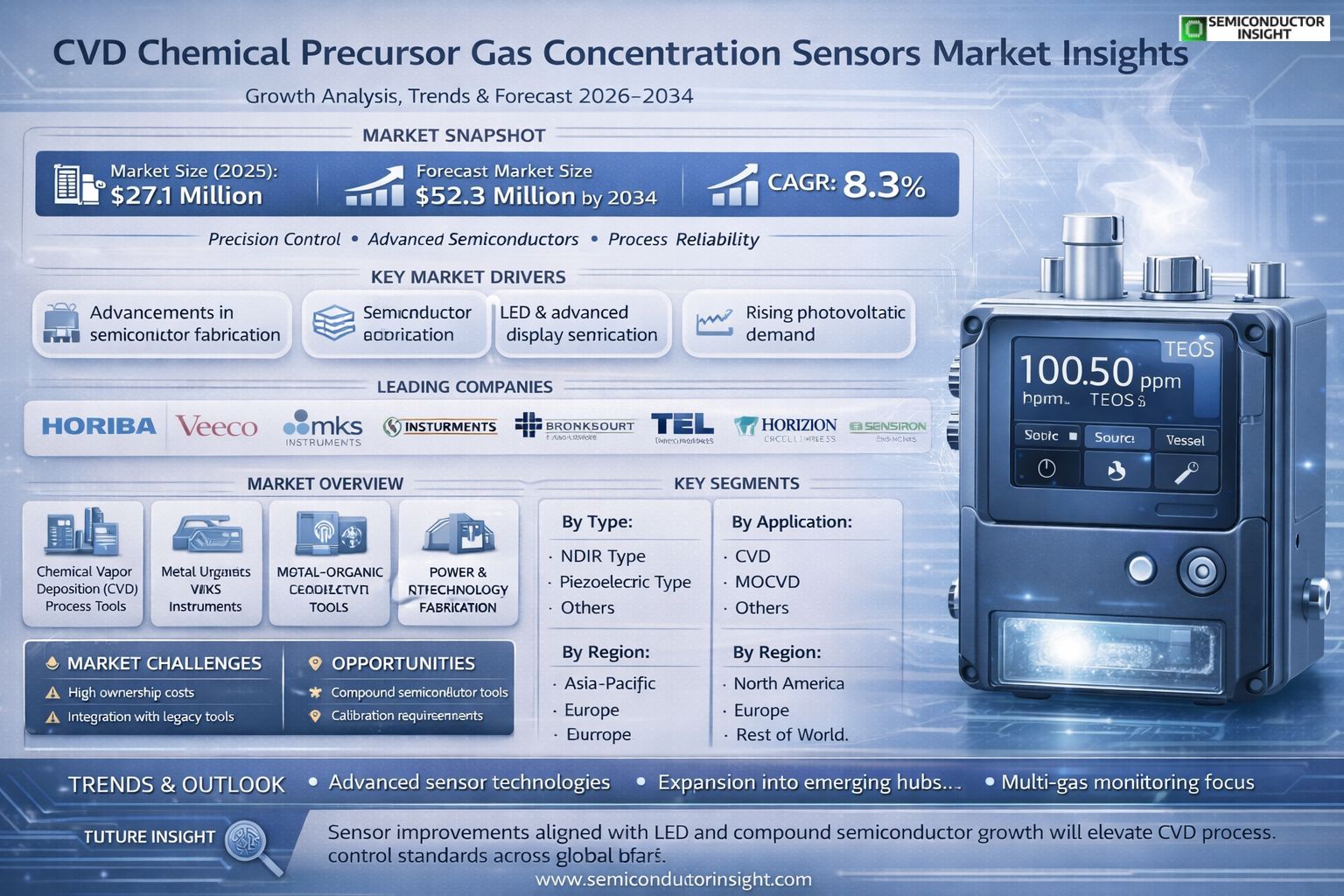
Global CVD Chemical Precursor Gas Concentration Sensors market size was valued at USD 27.1 million in 2025. The market is projected to grow from USD 29.3 million in 2026 to USD 52.3 million by 2034, exhibiting a CAGR of 8.3% during the forecast period.
CVD Chemical Precursor Gas Concentration Sensors are critical components used for the accurate monitoring and reproducible delivery control of chemical precursor vapors and dopant gases in Chemical Vapor Deposition (CVD) and Metal-Organic Chemical Vapor Deposition (MOCVD) process tools. These sensors ensure precise thin-film deposition, which is fundamental for manufacturing semiconductors, advanced optics, and specialized coatings.
The market growth is primarily driven by the relentless expansion of the global semiconductor industry and the increasing complexity of device fabrication nodes, which demand unparalleled process control. Furthermore, the rise of applications in power electronics, photovoltaics, and LED manufacturing using MOCVD technology creates sustained demand. Key technological advancements focus on improving sensor sensitivity, stability, and integration with advanced process control systems. Leading players such as HORIBA, Veeco Instruments, MKS Instruments, and Bronkhorst dominate this niche but essential market segment through continuous innovation and deep integration with semiconductor fabrication equipment.
MARKET DRIVERS
Advancements in Semiconductor Fabrication Processes
The relentless push for smaller, more powerful semiconductor nodes is a primary driver for CVD Chemical Precursor Gas Concentration Sensors Market. As chipmakers transition to advanced 3nm and 2nm processes, the precision and purity of chemical vapor deposition (CVD) processes become non-negotiable. Sensors that monitor precursor gas concentration with high accuracy are critical for achieving uniform, defect-free thin-film depositions. This demand from leading foundries directly fuels investment in next-generation sensor technology to ensure yield and performance.
Expansion of the LED and Advanced Display Sector
The mass production of Micro-LEDs and next-generation OLED displays relies heavily on metal-organic chemical vapor deposition (MOCVD). The growth of these high-value layers requires exceptionally precise control over organic precursor gases. This sector’s growth creates a sustained demand for highly stable and sensitive gas concentration sensors to manage complex deposition recipes, directly impacting the market for CVD Chemical Precursor Gas Concentration Sensors.
➤ The global drive for renewable energy is intensifying demand for high-efficiency photovoltaic cells, which depend on precise CVD processes for passivation and conductive layers, further propelling sensor adoption.
Finally, stringent industry regulations and quality standards mandate real-time, in-situ monitoring of process gases. This regulatory environment compels equipment manufacturers to integrate superior sensing solutions, making advanced CVD Chemical Precursor Gas Concentration Sensors a foundational component rather than an optional feature in modern fabrication tools.
MARKET CHALLENGES
High Cost and Integration Complexity
A significant challenge facing CVD Chemical Precursor Gas Concentration Sensors Market is the high total cost of ownership. These sensors are often sophisticated, require precise calibration, and must be integrated seamlessly with existing legacy CVD tools. The engineering and validation process for new sensor integration can be lengthy and expensive, acting as a barrier for smaller semiconductor fabrication facilities or research institutions.
Other Challenges
Sensor Durability in Harsh Process Environments
CVD chambers present extremely harsh environments with corrosive precursors, high temperatures, and plasma. Developing sensor materials and designs that offer long-term stability, minimal drift, and resistance to coating or etching in these conditions remains a persistent technical hurdle for manufacturers.
Calibration and Maintenance Demands
Maintaining measurement accuracy over time requires frequent calibration against traceable standards. This necessity can lead to tool downtime and requires specialized technical expertise, adding operational complexity and cost for end-users in CVD Chemical Precursor Gas Concentration Sensors Market.
MARKET RESTRAINTS
Cyclical Nature of the Semiconductor Capital Equipment Industry
CVD Chemical Precursor Gas Concentration Sensors Market is intrinsically linked to the capital expenditure cycles of the semiconductor industry. During periods of downturn or reduced fab investment, orders for new CVD tools and their critical sensor components can decline sharply. This cyclicality creates volatility and can restrain consistent year-over-year market growth, as sensor demand is ultimately derived from equipment purchasing trends.
MARKET OPPORTUNITIES
Adoption of AI and Machine Learning for Predictive Control
The integration of artificial intelligence with gas concentration sensors presents a major opportunity. By analyzing real-time sensor data streams, AI algorithms can predict process drift, optimize precursor delivery, and enable predictive maintenance for the CVD system. This evolution from monitoring to intelligent control adds substantial value, creating a premium segment within CVD Chemical Precursor Gas Concentration Sensors Market.
Growth in Compound Semiconductor and Power Device Manufacturing
The rapid expansion of markets for gallium nitride (GaN) and silicon carbide (SiC) based power devices and RF components requires specialized CVD processes. These processes often use highly reactive or pyrophoric precursor gases, necessitating sensors with enhanced safety and detection capabilities. This specialized application area offers a high-growth niche for sensor developers.
Development of Multi-Parameter and Miniaturized Sensors
There is growing demand for sensors that can measure not just concentration, but also parameters like pressure and temperature simultaneously within the gas line. Furthermore, the trend towards miniaturization of sensor packages allows for closer integration to the reaction zone in spatial ALD or cluster tools, opening new design possibilities for next-generation CVD equipment in the evolving CVD Chemical Precursor Gas Concentration Sensors Market.
MAIN TITLE HERE (CVD Chemical Precursor Gas Concentration Sensors Market) Trends
Integration of Advanced Sensor Technologies for Enhanced Precision
A dominant trend in CVD Chemical Precursor Gas Concentration Sensors Market is the development and integration of more advanced sensing technologies to meet the stringent demands of modern semiconductor fabrication. Manufacturers are focusing on improving the accuracy, response time, and long-term stability of sensors, particularly for NDIR and piezoelectric type sensors. This drive for enhanced precision is a direct response to the escalating complexities in chip design, where atomic-level control over thin-film deposition is critical. The reliable monitoring of precursor vapors like TEOS and dopant gases ensures process reproducibility and higher device yields, making sensor performance a key competitive factor for tool manufacturers and sensor suppliers alike.
Other Trends
Expansion into Emerging Semiconductor Manufacturing Hubs
The geographic demand for CVD Chemical Precursor Gas Concentration Sensors is evolving, with significant growth observed in Asia-Pacific regions outside of traditional markets like Japan and South Korea. Southeast Asia and other emerging manufacturing hubs are increasing their investment in advanced packaging and compound semiconductor production, which utilize both MOCVD and CVD processes. This regional shift is prompting leading global sensor companies to strengthen their local supply chains and technical support networks to capture growth in these new markets.
Increasing Focus on Multi-Gas Monitoring Capabilities
There is a growing demand for sensor solutions capable of monitoring multiple precursor gases simultaneously or interchangeably. As CVD and MOCVD processes become more sophisticated, using a wider variety of chemical precursors, the industry seeks to reduce the footprint and complexity of gas delivery systems. This trend encourages innovation in sensor design and calibration techniques, aiming for versatile platforms that can maintain high accuracy across different gas species. This capability is seen as vital for improving operational efficiency and flexibility in research and high-mix production environments within CVD Chemical Precursor Gas Concentration Sensors Market.
COMPETITIVE LANDSCAPE
Key Industry Players
A Specialized Arena Dominated by Process Control Experts
CVD Chemical Precursor Gas Concentration Sensors Market exhibits a consolidated structure with a few major players commanding a significant share of global revenue. In 2025, the top five manufacturers collectively accounted for a substantial portion of the market, driven by their deep integration with semiconductor and advanced materials fabrication ecosystems. HORIBA and MKS Instruments are particularly noteworthy for their comprehensive solutions spanning both NDIR and Piezoelectric sensor technologies, enabling precise monitoring of vapors and dopant gases critical for CVD and MOCVD processes. Veeco Instruments leverages its strong position in deposition equipment to offer integrated sensor solutions, reinforcing the trend of technology bundling to ensure process reproducibility and yield.
Beyond these leaders, the market includes several significant niche and specialized players that contribute to technological diversity and regional coverage. Companies like Bronkhorst are pivotal for their expertise in high-precision fluid delivery systems, which often incorporate concentration sensing. Other important competitors focus on specific geographic markets, emerging applications beyond traditional semiconductors, or the development of alternative sensing technologies categorized under “Others.” The competitive intensity is high, with continuous investment in R&D to improve accuracy, response times, and compatibility with a wider range of precursor chemistries, fostering an environment of strategic partnerships and targeted acquisitions to gain technological edges.
List of Key CVD Chemical Precursor Gas Concentration Sensors Companies Profiled
- HORIBA
- Veeco Instruments Inc.
- MKS Instruments, Inc.
- Bronkhorst High-Tech B.V.
- Tokyo Electron Limited
- Horizon Technology, Inc.
- Sensirion AG
- Axetris AG (Leister)
- Advanced Energy Industries, Inc.
- ATMI, Inc. (Entegris)
- ProSys Inc.
- Figaro Engineering Inc.
- WONIK IPS
- Pivotal Systems
- Mettler-Toledo GmbH
Segment Analysis:
| Segment Category | Sub-Segments | Key Insights |
| By Type |
|
NDIR Type sensors dominate the market due to their precision and reliability in measuring gas concentrations. The non-dispersive infrared technology offers high accuracy and stability for critical chemical vapor deposition process control, making it the preferred choice for leading manufacturers. Furthermore, ongoing advancements in NDIR sensor technology enhance sensitivity and reduce interference, solidifying its leading position in demanding semiconductor fabrication environments. |
| By Application |
|
CVD (Chemical Vapor Deposition) is the primary application, driven by the extensive use of these sensors for monitoring precursor gases in semiconductor and advanced materials manufacturing. The critical need for reproducible film quality and thickness control in CVD tools creates a substantial, sustained demand for high-precision concentration sensors. This segment benefits from continuous technological evolution in deposition processes, which require increasingly sophisticated sensing solutions to maintain process integrity and yield. |
| By End User |
|
Semiconductor Fabrication Facilities represent the most significant end-user segment, as these sensors are integral to maintaining precise process conditions in chip manufacturing. The relentless drive for smaller transistor nodes and complex 3D structures in the semiconductor industry necessitates unparalleled control over gas delivery, directly fueling demand. Additionally, the high cost of wafer production makes sensor reliability critical to minimizing scrap rates, thereby cementing this segment’s dominance in the market. |
| By Technology Maturity |
|
Established Technologies like NDIR hold the leading market position, benefiting from a proven track record, strong industry acceptance, and robust integration with existing CVD tool architectures. These technologies are considered low-risk investments for manufacturers who prioritize process stability and long-term operational reliability. The deep expertise of key suppliers in refining these established sensor types creates a significant barrier to entry for newer technologies, further reinforcing the segment’s leadership. |
| By Integration Level |
|
Integrated Sub-systems are increasingly favored as they offer pre-calibrated, plug-and-play functionality that reduces integration time and complexity for tool builders. This segment’s growth is propelled by the industry’s shift towards modular and scalable process tool designs, where reliability and ease of maintenance are paramount. The integration of sensors with control valves and advanced diagnostics provides a more comprehensive solution, enhancing overall system performance and appealing to a broad base of equipment manufacturers seeking to streamline their supply chain and assembly processes. |
Regional Analysis: CVD Chemical Precursor Gas Concentration Sensors Market
Asia-Pacific
The industry’s reliance on Asia-Pacific for leading-edge chip production establishes a captive, high-volume market for CVD Chemical Precursor Gas Concentration Sensors, driving both adoption and rapid iteration of sensor technologies to meet evolving process-control specifications in real-time fabrication environments.
National strategies and substantial fiscal policies aimed at securing technological sovereignty in semiconductors create a favorable investment climate, directly accelerating the deployment of advanced process control equipment, including next-generation CVD Chemical Precursor Gas Concentration Sensors, across new and upgraded fabrication facilities.
Proximity to a complete ecosystem of material suppliers, component manufacturers, and end-user fabs fosters tight integration. This allows for collaborative development of CVD Chemical Precursor Gas Concentration Sensors, leading to optimized designs with shorter feedback loops for reliability and performance validation.
The push towards sub-5nm process technologies and complex 3D architectures demands extreme precision in deposition processes, making the role of highly accurate and stable CVD Chemical Precursor Gas Concentration Sensors a critical, non-negotiable component for yield management and process repeatability.
North America
North America maintains a strong position in CVD Chemical Precursor Gas Concentration Sensors Market, anchored by advanced R&D activities and the presence of leading semiconductor equipment design firms. The region’s focus is on high-value, innovative sensor technologies for research institutions, pilot production lines, and specialized applications in compound semiconductors and MEMS. Demand is driven by the need for sensors that can handle novel precursor chemistries for next-generation materials like 2D semiconductors and high-k dielectrics. Stringent safety and environmental regulations also push the development of more sensitive and reliable CVD Chemical Precursor Gas Concentration Sensors with enhanced diagnostic capabilities.
Europe
Europe’s role in CVD Chemical Precursor Gas Concentration Sensors Market is defined by its technological sophistication and leadership in specific industrial niches. The region excels in supplying sensors for demanding applications such as power electronics (SiC, GaN) and advanced photovoltaics, where process control is critical. European sensor manufacturers are renowned for precision engineering, long-term stability, and compliance with rigorous industrial standards. Collaborative projects within the EU framework often drive innovation in metrology and process control, fostering advancements in sensor accuracy and integration with Industry 4.0 platforms for smart manufacturing.
South America
CVD Chemical Precursor Gas Concentration Sensors Market in South America is emerging, primarily linked to industrial expansion and technological modernization in key economies. Growth is supported by investments in sectors like renewable energy and basic electronics assembly, which are beginning to adopt more controlled manufacturing processes. While not a primary hub for leading-edge semiconductor fab, the region presents opportunities for sensor suppliers catering to industrial CVD applications in coatings and basic materials science, with a focus on cost-effective and robust solutions suitable for diverse operating environments.
Middle East & Africa
The market for CVD Chemical Precursor Gas Concentration Sensors in the Middle East & Africa is nascent but shows potential driven by strategic economic diversification initiatives. Investments in high-tech research centers and special economic zones aim to build knowledge-based industries. The initial demand is largely tied to academic and research institutions, as well as specific industrial projects in optics and protective coatings. Market development depends on establishing local technical expertise and building the necessary industrial infrastructure to support more advanced manufacturing that utilizes precise chemical vapor deposition processes.
Report Scope
This market research report provides a comprehensive analysis of the CVD Chemical Precursor Gas Concentration Sensors Market , covering the forecast period 2026–2034. It offers detailed insights into market dynamics, technological advancements, competitive landscape, and key trends shaping the industry.
Key focus areas of the report include:
- Market Overview: The report begins with an overview outlining its current market scenario, key growth indicators, and industry transformation drivers. It discusses macroeconomic factors, demand–supply balance, regulatory landscape, and the strategic role of semiconductors in powering advancements across industries such as automotive, telecommunications, consumer electronics, and industrial automation.
- Market Size & Forecast: Historical data and future projections for revenue, unit shipments, and market value across major regions and segments.
- Segmentation Analysis: Detailed breakdown by product type, technology, application, and end-user industry to identify high-growth segments and investment opportunities.
- Regional Insights: Insights into market performance across North America, Europe, Asia-Pacific, Latin America, and the Middle East & Africa, including country-level analysis where relevant.
- Competitive Landscape: Profiles of leading market participants, including their product offerings, R&D focus, manufacturing capacity, pricing strategies, and recent developments such as mergers, acquisitions, and partnerships.
- Technology Trends & Innovation: Assessment of emerging technologies, integration of AI/IoT, semiconductor design trends, fabrication techniques, and evolving industry standards.
- Market Drivers & Restraints: Evaluation of factors driving market growth along with challenges, supply chain constraints, regulatory issues, and market-entry barriers.
- Stakeholder Insights: Insights for component suppliers, OEMs, system integrators, investors, and policymakers regarding the evolving ecosystem and strategic opportunities.
Primary and secondary research methods are employed, including interviews with industry experts, data from verified sources, and real-time market intelligence to ensure the accuracy and reliability of the insights presented.
FREQUENTLY ASKED QUESTIONS:
What is the current market size of CVD Chemical Precursor Gas Concentration Sensors Market?
-> Global CVD Chemical Precursor Gas Concentration Sensors Market was valued at USD 27.1 million in 2025 and is projected to reach USD 52.3 million by 2034.
What is the projected CAGR for this market?
-> The market is projected to grow at a CAGR of 8.3% during the forecast period from 2025 to 2034.
What are the key applications of these sensors?
-> These sensors are critical for accurate monitoring and delivery control of chemical precursor vapors and dopant gases in CVD and MOCVD process tools.
Which key companies operate in this market?
-> Key players include HORIBA, Veeco Instruments, MKS Instruments, and Bronkhorst, among others.
What are the major market segments by type?
-> The market is segmented by type, including NDIR Type, Piezoelectric Type, and Others.

Get Sample Report PDF for Exclusive Insights
Report Sample Includes
- Table of Contents
- List of Tables & Figures
- Charts, Research Methodology, and more...
 Download Sample Report PDF


