Cryogenic Coax Cables Market Insights
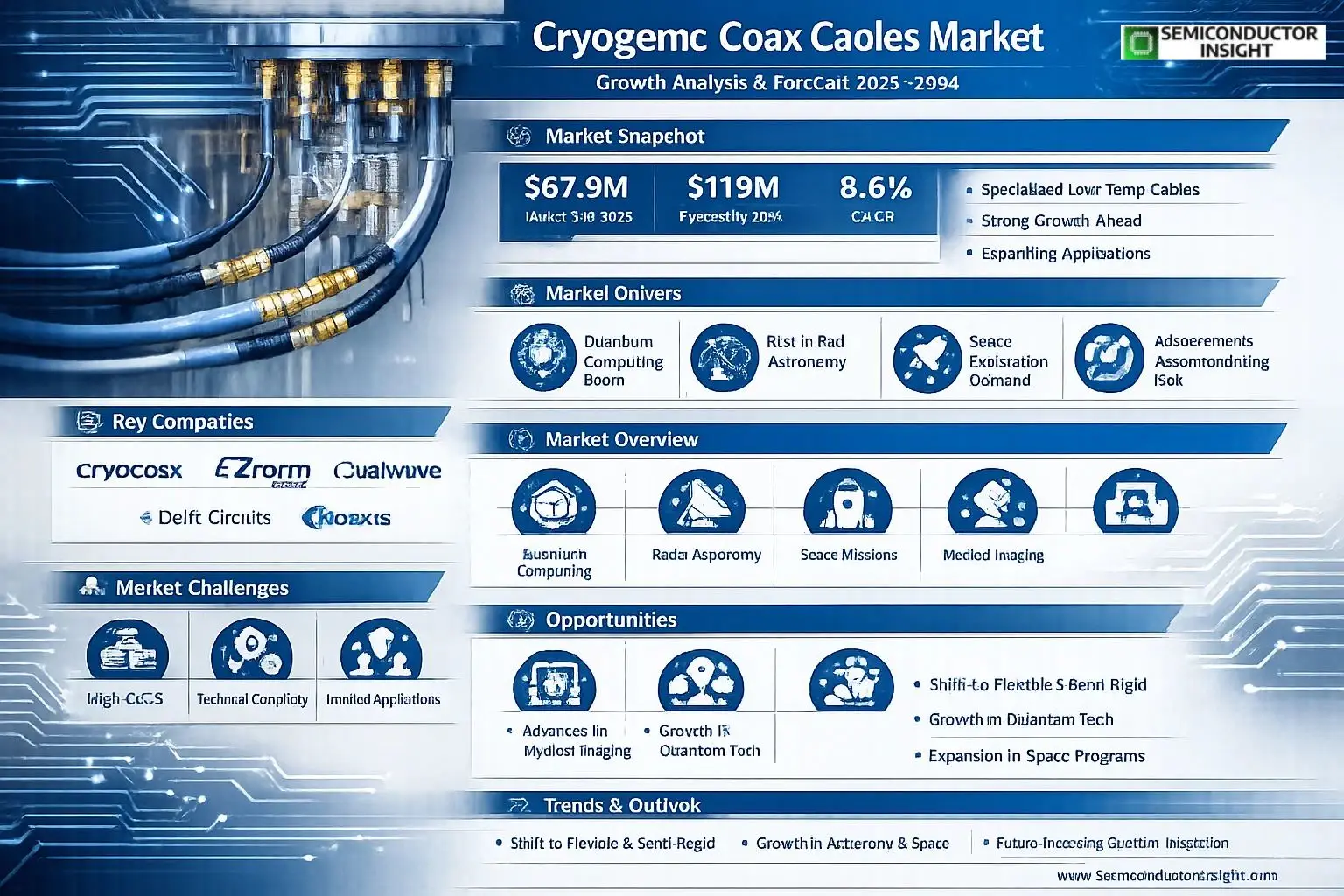
Global Cryogenic Coax Cables market size was valued at USD 67.88 million in 2025. The market is projected to grow from USD 73.72 million in 2026 to USD 119 million by 2034, exhibiting a CAGR of 8.6% during the forecast period.
Cryogenic coax cables are highly specialized transmission lines engineered to maintain reliable signal integrity and minimal thermal conductivity at extremely low temperatures, typically operating in environments ranging from 4 Kelvin down to millikelvin levels. These cables are available in three primary configurations , Rigid, Semi-Rigid, and Flexible , each designed to meet the precise mechanical and electrical demands of advanced cryogenic systems. The construction typically involves carefully selected materials such as stainless steel, beryllium copper, and superconducting alloys that retain their performance characteristics under thermal stress, making them fundamentally different from conventional coaxial cables used in standard RF applications.
The market is witnessing robust expansion driven by the accelerating global investments in quantum computing infrastructure, growing deployment in radio astronomy observatories, and increasing adoption across space exploration programs. Furthermore, leading manufacturers such as CryoCoax, Delft Circuits, Lake Shore Cryotronics, Radiall, and Bluefors continue to advance product innovation to address the evolving performance requirements of next-generation dilution refrigerator systems. The convergence of government-funded quantum research initiatives and private sector participation is further reinforcing market momentum, positioning cryogenic coax cables as an indispensable component within the broader quantum and deep-science technology ecosystem.
MARKET DRIVERS
Expanding Quantum Computing Infrastructure
Global push towards developing practical quantum computing systems is a primary driver for Cryogenic Coax Cables Market. These systems operate at near-absolute zero temperatures, creating immense demand for reliable, high-performance coaxial cables that can transmit signals with minimal loss and thermal noise in these extreme environments.
Advancements in Superconducting Electronics
Growth in applications utilizing superconducting electronics, such as SQUID magnetometers and ultra-sensitive radio astronomy receivers, necessitates specialized cryogenic interconnects. The performance of these sensitive instruments is directly contingent on the signal integrity provided by cryogenic coax cables.
➤ Rising R&D investments in cryogenic technologies are projected to increase the demand for specialized components by over 25% annually.
Furthermore, the modernization of existing particle accelerator facilities and the construction of new ones globally provide a steady stream of demand for high-quality Cryogenic Coax Cables Market components capable of withstanding rigorous operational conditions.
MARKET CHALLENGES
High Material and Manufacturing Costs
specialized materials required for constructing cryogenic coax cables, such as specific superconductors and advanced dielectric insulators, contribute significantly to their overall cost. The complex manufacturing processes needed to ensure performance at cryogenic temperatures further elevate production expenses.
Other Challenges
Technical Performance Standards
Maintaining signal integrity with extremely low attenuation and phase stability across a wide frequency range at cryogenic temperatures presents a persistent engineering challenge for manufacturers in Cryogenic Coax Cables Market.
MARKET RESTRAINTS
Limited Application Scope and Niche End-Users
highly specialized nature of cryogenic coax cables inherently restricts their application to a few advanced scientific and research fields. This niche market characteristic limits overall volume sales and can restrain broader market expansion beyond core research institutions and specialized industrial sectors.
MARKET OPPORTUNITIES
Emerging Medical Imaging Applications
The development of new ultra-high-field MRI systems and other cryogenically cooled medical imaging technologies presents a significant growth avenue for Cryogenic Coax Cables Market. These advanced systems require superior cabling to handle the increased signal throughput and sensitivity at low temperatures.
Cryogenic Coax Cables Market Trends
Growing Demand in Quantum Computing
Cryogenic Coax Cables Market is experiencing significant momentum from the quantum computing sector, where these specialized cables are essential for maintaining signal integrity at ultra-low temperatures. Quantum systems require coaxial cables with minimal thermal conductivity and low signal loss to connect components without introducing heat or noise, driving adoption among research institutions and tech firms. Leading manufacturers like CryoCoax and Delft Circuits are innovating to meet these precise specifications, enhancing performance in qubit control and readout applications. This trend underscores the market’s alignment with emerging technologies pushing boundaries in computation power.
Other Trends
Shift Toward Flexible and Semi-Rigid Types
Within Cryogenic Coax Cables Market, there is a noticeable shift toward flexible and semi-rigid cable variants over traditional rigid ones. Flexible options offer greater ease of installation and routing in complex cryogenic setups, appealing to applications demanding adaptability. Semi-rigid cables balance durability with formability, finding favor in high-frequency signal transmission needs. This evolution reflects manufacturers’ responses to user preferences for versatile solutions, as seen in products from EZ Form Cable Corporation and Qualwave, fostering broader integration across diverse setups.
Expansion in Space and Radio Astronomy Sectors
Another key trend in Cryogenic Coax Cables Market involves heightened utilization in space exploration and radio astronomy. These fields rely on cryogenic coax cables for their superior low-noise characteristics in extreme environments, supporting sensitive receivers and instrumentation. Companies such as Lake Shore Cryotronics and Radiall are supplying tailored solutions for satellite systems and telescope arrays, capitalizing on regional growth in North America and Europe. Meanwhile, Asia-Pacific markets, particularly China and Japan, are emerging as hotspots due to investments in astronomical observatories and space programs, indicating sustained demand diversification.
Competitive dynamics further shape these trends, with top players like COAX CO., LTD. and Koaxis focusing on R&D for enhanced materials and designs. Industry surveys highlight ongoing challenges like supply chain constraints for specialized conductors, yet opportunities abound in downstream applications such as others including medical imaging. Overall, Cryogenic Coax Cables Market demonstrates resilience through targeted innovations aligning with high-tech drivers across global regions.
COMPETITIVE LANDSCAPE
Key Industry Players
Leading Manufacturers Shaping Cryogenic Coax Cables Market
Cryogenic Coax Cables Market, valued at US$67.88 million in 2025 and projected to reach US$119 million by 2034 at a CAGR of 8.6%, is dominated by specialized manufacturers focused on low-loss, high-performance cables for extreme low-temperature environments. CryoCoax emerges as a leading player, offering innovative rigid, semi-rigid, and flexible coax cables tailored for quantum computing and cryogenic systems, capturing significant revenue share through advanced materials and precision engineering. The market structure remains oligopolistic, with Global top five players,such as CryoCoax, EZ Form Cable Corporation, and Qualwave,collectively holding a substantial portion of the revenue in 2025, driven by demand in quantum computing, radio astronomy, and space applications. Intense R&D investments and strategic partnerships underscore the competitive dynamics, where differentiation via signal integrity at cryogenic temperatures is paramount.
Beyond the frontrunners, niche significant players like Delft Circuits, Koaxis, and Lake Shore Cryotronics contribute through specialized offerings in semi-rigid and flexible variants, addressing applications in radio astronomy and others. Companies such as COAX CO., LTD., KEYCOM, and Radiall bolster the landscape with customizable solutions for space and quantum sectors, while emerging innovators like Heatsense, Bluefors, Hochfrequenzkabel el-spec GmbH, and ICEoxford expand via recent developments in low-thermal-conductivity cables. This fragmented yet innovative ecosystem fosters collaboration and mergers, enabling market penetration in high-growth regions like North America and Europe, where regulatory standards and technological barriers reinforce barriers to entry for new entrants.
List of Key Cryogenic Coax Cables Companies Profiled
- CryoCoax
- EZ Form Cable Corporation
- Qualwave
- Delft Circuits
- Koaxis
- COAX CO., LTD.
- Lake Shore Cryotronics
- KEYCOM
- Phoenix
- Radiall
- Heatsense
- Bluefors
- Hochfrequenzkabel el-spec GmbH
- ICEoxford
Segment Analysis:
| Segment Category | Sub-Segments | Key Insights |
| By Type |
|
Semi-Rigid
|
| By Application |
|
Quantum Computing
|
| By End User |
|
Research Laboratories
|
| By Material |
|
Stainless Steel
|
| By Insulation Type |
|
PTFE (Teflon)
|
Regional Analysis: Cryogenic Coax Cables Market
North America
North America’s Cryogenic Coax Cables Market thrives on innovation hubs like Silicon Valley and national labs, where engineers develop cables with minimal thermal noise for quantum sensors. These centers drive R&D, integrating advanced materials for superior performance in sub-zero applications.
Dominant applications in aerospace and healthcare propel the market, with cryogenic coax cables essential for satellite communications and superconducting magnets in medical devices, ensuring reliable signal transmission amid extreme cooling.
Venture funding and government grants bolster expansion, targeting fusion reactors and particle accelerators, where cryogenic coax cables provide critical low-attenuation pathways, enhancing overall system efficiency.
Localized production minimizes lead times, with established networks for specialty alloys and insulation materials vital for cryogenic coax cables, supporting just-in-time delivery for research institutions.
Europe
Europe’s Cryogenic Coax Cables Market exhibits steady growth, anchored by CERN’s particle physics demands and robust superconducting research. Specialized manufacturers cater to high-energy physics and fusion projects like ITER, emphasizing durable cables for prolonged cryogenic exposure. Collaborative EU funding promotes standardization, enhancing interoperability across borders. The focus on green energy transitions integrates these cables into wind turbine cryogenics and advanced labs. Challenges include supply chain dependencies, yet proximity to material innovators strengthens resilience. Market dynamics favor precision-engineered solutions for quantum technologies, positioning Europe as a quality leader in Cryogenic Coax Cables Market.
Asia-Pacific
Asia-Pacific emerges as a dynamic contender in Cryogenic Coax Cables Market, fueled by rapid industrialization in electronics and semiconductors. Japan and South Korea lead with investments in quantum computing and MRI advancements, demanding high-purity coax cables. China’s expansive R&D in fusion energy amplifies demand for scalable production. Local fabrication hubs reduce costs, while skilled workforce drives customization. Infrastructure projects in high-speed rail incorporate cryogenic elements for testing. Despite import reliance on advanced materials, regional alliances accelerate localization, fostering competitive pricing and innovation in Cryogenic Coax Cables Market.
South America
South America’s Cryogenic Coax Cables Market is nascent but promising, driven by growing research in astrophysics and medical facilities. Brazil’s space agency and universities adopt these cables for telescope arrays and cryogenic storage. Limited domestic production spurs imports from North America, yet partnerships build local expertise. Energy sector explorations in biofuels integrate superconducting tech, heightening need for reliable signal cables. Market expansion hinges on skill development and infrastructure, gradually elevating South America’s role in Global Cryogenic Coax Cables Market dynamics.
Middle East & Africa
The Middle East & Africa region in Cryogenic Coax Cables Market shows potential through oil & gas cryogenics and emerging quantum initiatives. UAE’s innovation parks invest in advanced materials research, incorporating coax cables for LNG facilities. South Africa’s particle accelerator projects demand specialized low-temperature cabling. Challenges like harsh climates spur resilient designs, while collaborations with Europe enhance technology transfer. Gradual infrastructure growth positions the region for increased participation in Cryogenic Coax Cables Market.
Report Scope
This market research report provides a comprehensive analysis of Cryogenic Coax Cables Market, covering the forecast period 2026–2034. It offers detailed insights into market dynamics, technological advancements, competitive landscape, and key trends shaping the industry.
Key focus areas of the report include:
- Market Overview: The report begins with an overview outlining its current market scenario, key growth indicators, and industry transformation drivers. It discusses macroeconomic factors, demand–supply balance, regulatory landscape, and the strategic role of cryogenic coax cables in powering advancements across industries such as quantum computing, radio astronomy, space, and scientific research.
- Market Size & Forecast: Historical data and future projections for revenue, unit shipments, and market value across major regions and segments.
- Segmentation Analysis: Detailed breakdown by product type, technology, application, and end-user industry to identify high-growth segments and investment opportunities.
- Regional Insights: Insights into market performance across North America, Europe, Asia-Pacific, Latin America, and the Middle East & Africa, including country-level analysis where relevant.
- Competitive Landscape: Profiles of leading market participants, including their product offerings, R&D focus, manufacturing capacity, pricing strategies, and recent developments such as mergers, acquisitions, and partnerships.
- Technology Trends & Innovation: Assessment of emerging technologies, integration of AI/IoT, semiconductor design trends, fabrication techniques, and evolving industry standards.
- Market Drivers & Restraints: Evaluation of factors driving market growth along with challenges, supply chain constraints, regulatory issues, and market-entry barriers.
- Stakeholder Insights: Insights for component suppliers, OEMs, system integrators, investors, and policymakers regarding the evolving ecosystem and strategic opportunities.
Primary and secondary research methods are employed, including interviews with industry experts, data from verified sources, and real-time market intelligence to ensure the accuracy and reliability of the insights presented.
FREQUENTLY ASKED QUESTIONS:
What is the current market size of Cryogenic Coax Cables Market?
-> Cryogenic Coax Cables Market was valued at USD 67.88 million in 2025 and is expected to reach USD 119 million by 2034, at a CAGR of 8.6% during the forecast period.
Which key companies operate in Cryogenic Coax Cables Market?
-> Key players include CryoCoax, EZ Form Cable Corporation, Qualwave, Delft Circuits, Koaxis, COAX CO., LTD., Lake Shore Cryotronics, KEYCOM, Phoenix, Radiall, among others.
What are the key growth drivers?
-> Key growth drivers include advancements in quantum computing, demand from space applications, and growth in radio astronomy technologies.
Which region dominates the market?
-> North America dominates the market, while Asia is expected to be the fastest-growing region.
What are the emerging trends?
-> Emerging trends include developments in flexible and semi-rigid cables, integration in quantum systems, and expansions in cryogenic applications.

Get Sample Report PDF for Exclusive Insights
Report Sample Includes
- Table of Contents
- List of Tables & Figures
- Charts, Research Methodology, and more...
 Download Sample Report PDF