Cryogenic Circulator Market Insights
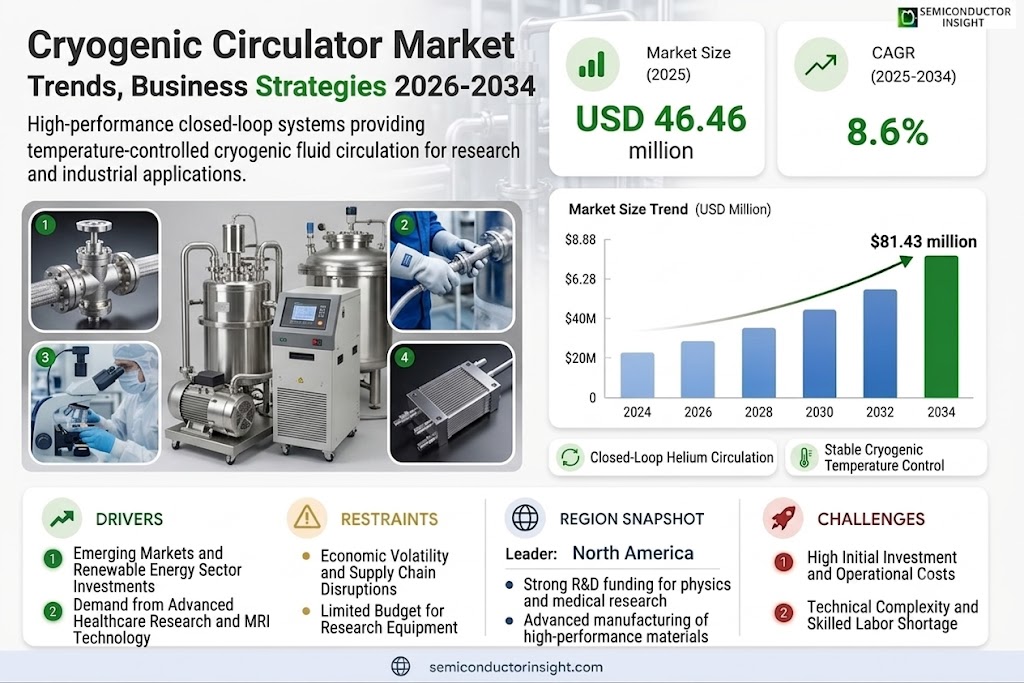
Global cryogenic circulator market size was valued at USD 46.46 million in 2025. The market is projected to grow from USD 50.46 million in 2026 to USD 81.43 million by 2034, exhibiting a CAGR of 8.6% during the forecast period.
A cryogenic circulator is a precision temperature control device designed to maintain a stable, ultra-low temperature environment, typically ranging from -100°C to -150°C and below. These systems are critical for applications requiring extreme cooling and are engineered to circulate a specialized heat transfer fluid with low viscosity and a low freezing point. They are essential for maintaining the thermal stability necessary for sensitive processes and experiments.
The market is experiencing robust growth driven by the rapid expansion of the quantum computing sector, which relies on these systems to cool superconducting qubits to near-absolute zero temperatures. Furthermore, increased investment in radio astronomy and space exploration, where cryogenic cooling is vital for sensitive detector instrumentation, is contributing significantly to market expansion. The competitive landscape is characterized by technological innovation from key players. For instance, in recent developments, companies have focused on enhancing energy efficiency and reliability. Quantum Microwave, DiTom Microwave, Raditek, L-TEQ Microwave Technology, and FERRITE-QUASAR are some of the key players that operate in the market with a wide range of portfolios.
MARKET DRIVERS
Expanding Applications in Medical and Scientific Research
Global Cryogenic Circulator Market is primarily propelled by its critical role in advanced medical and scientific applications. These systems are indispensable for maintaining ultra-low temperatures in MRI machines, superconducting magnets, and particle accelerators. The growing demand for precise temperature control in research laboratories and healthcare facilities directly fuels market growth. Increasing investments in life sciences and quantum computing research further accelerate the adoption of high-performance cryogenic equipment.
Technological Advancements and Energy Efficiency
Recent technological innovations have significantly enhanced the efficiency and reliability of cryogenic circulators. Modern systems feature improved heat exchange mechanisms, reduced energy consumption, and advanced digital control interfaces. These developments lower operational costs and improve system longevity, making them more attractive to a broader range of industrial and research users. The push towards sustainable and energy-efficient laboratory equipment continues to drive product development and market expansion.
➤ Market analysis indicates a robust annual growth rate of approximately 7.5% over the next five years, driven by escalating demand from the healthcare and semiconductor sectors.
The integration of IoT and smart monitoring capabilities in newer cryogenic circulator models allows for real-time performance tracking and predictive maintenance. This technological evolution not only enhances user convenience but also minimizes downtime, providing a substantial competitive advantage for manufacturers in cryogenic circulator market.
MARKET CHALLENGES
High Initial Investment and Operational Costs
One of the significant challenges facing cryogenic circulator market is the substantial capital required for acquisition and installation. These systems involve complex engineering and high-grade materials, resulting in elevated upfront costs. Additionally, operational expenses, including energy consumption and maintenance, can be considerable. This financial barrier often limits adoption to well-funded research institutions and large industrial entities, potentially restraining market penetration among smaller organizations.
Other Challenges
Technical Complexity and Skilled Labor Shortage
The operation and maintenance of cryogenic circulators require specialized knowledge and technical expertise. A global shortage of skilled technicians proficient in cryogenic systems poses a significant challenge for end-users, potentially leading to increased service costs and longer equipment downtime.
MARKET RESTRAINTS
Economic Volatility and Supply Chain Disruptions
Global economic fluctuations and recent supply chain disruptions have adversely impacted cryogenic circulator market. Instabilities in the availability of critical raw materials, such as high-purity metals and specialized cooling gases, have led to production delays and increased manufacturing costs. Furthermore, budget constraints in academic and government research sectors during economic downturns can delay new purchases and upgrades, temporarily slowing market growth.
MARKET OPPORTUNITIES
Emerging Markets and Renewable Energy Sector
cryogenic circulator market presents significant growth opportunities in emerging economies, where investments in healthcare infrastructure and scientific research are rapidly increasing. Additionally, the expanding renewable energy sector, particularly in hydrogen liquefaction and energy storage applications, requires reliable cryogenic temperature management. This creates a new and substantial customer base for cryogenic circulator manufacturers, promising long-term market expansion.
Cryogenic Circulator Market Trends
Quantum Computing Drives Market Expansion
Global cryogenic circulator market is experiencing significant growth, largely propelled by the expanding quantum computing sector. These circulators are essential components in quantum computing systems, providing the necessary thermal management for superconducting qubits to operate reliably at millikelvin temperatures. As quantum computing technology progresses from research laboratories to commercial applications, demand for high-performance cryogenic circulators continues to increase. This trend is particularly evident in North America and Asia-Pacific regions, where substantial investments in quantum technology infrastructure are underway.
Other Trends
Advancements in Cryogenic Technology
Manufacturers are continuously innovating to improve the performance and efficiency of cryogenic circulators. Recent developments focus on enhancing thermal stability, reducing power consumption, and improving reliability at extremely low temperatures. These advancements are critical for applications requiring precise temperature control, such as quantum computing systems and advanced radio astronomy equipment. Leading companies are investing in research and development to create circulators that can operate effectively at temperatures approaching absolute zero while maintaining minimal heat load on the refrigeration system.
Diversification of Application Segments
cryogenic circulator market is witnessing diversification beyond traditional applications. While quantum computing remains a primary driver, these components are finding increased usage in space exploration missions, where reliable thermal management is crucial for scientific instruments operating in extreme environments. Additionally, the growing field of quantum sensing and metrology is creating new opportunities for cryogenic circulator manufacturers. This diversification helps stabilize market growth and reduces dependence on any single application segment, providing a more balanced growth trajectory for the industry.
COMPETITIVE LANDSCAPE
Key Industry Players
A consolidated market driven by precision technology and high R&D investment
Global cryogenic circulator market is characterized by a moderately consolidated competitive environment, with the top five players accounting for a significant share of global revenue. Leadership is maintained by specialized technology firms that possess deep expertise in cryogenic engineering, microwave technology, and ultra-low temperature fluid dynamics. Quantum Microwave and DiTom Microwave are recognized as prominent players, leveraging strong R&D capabilities and established product portfolios to serve high-value applications like quantum computing and radio astronomy. The market structure is defined by high barriers to entry, including stringent performance requirements, complex manufacturing processes, and the need for close collaboration with end-users in scientific research and space industries.
Beyond the leading entities, several other companies compete effectively in specific niches or regional markets. Manufacturers like Raditek and L-TEQ Microwave Technology focus on advanced ferrite components and custom design solutions, while firms such as FERRITE-QUASAR and QuinStar Technology cater to specialized needs in defense and aerospace sectors. Additionally, companies like Low Noise Factory emphasize ultra-low noise performance for sensitive measurement applications, and Julabo brings expertise in precision temperature control systems. The competitive landscape is further enriched by ongoing technological innovations, strategic mergers, and a focus on expanding global sales networks to capture growth in emerging research and development hubs.
List of Key Cryogenic Circulator Companies Profiled
- Quantum Microwave
- DiTom Microwave
- Raditek
- L-TEQ Microwave Technology
- FERRITE-QUASAR
- QuinStar Technology
- Low Noise Factory
- Julabo
- Advanced Cryogenic Systems
- Cryomagnetics
- Lake Shore Cryotronics
- Oxford Instruments
- Bluefors
- Janis Research
- TTI, Inc.
Segment Analysis:
| Segment Category | Sub-Segments | Key Insights |
| By Type |
|
Single Junction
|
| By Application |
|
Quantum Computing
|
| By End User |
|
Research Institutions
|
| By Frequency Range |
|
Below 10 GHz
|
| By Cooling Technology |
|
Dilution Refrigerators
|
Regional Analysis: Cryogenic Circulator Market
North America
North America’s research ecosystem excels in cryogenic circulator innovations, with institutions pioneering compact, high-performance models for quantum processors. Collaborative projects focus on reducing heat loads and improving flow stability, directly addressing Cryogenic Circulator Market challenges in scaling quantum systems.
Advanced healthcare facilities drive adoption of cryogenic circulators in imaging and therapeutic devices. Enhanced precision in temperature control supports longer operational durations for MRI systems, reinforcing the region’s Cryogenic Circulator Market through healthcare technology integration.
Defense and space sectors utilize circulators for sensor cooling and cryogenic fuel management. Innovations in lightweight designs meet stringent mission requirements, sustaining robust demand within North America’s high-tech Cryogenic Circulator Market segment.
Venture funding and grants fuel startups developing energy-efficient circulators. Public-private partnerships accelerate commercialization, ensuring North America maintains its edge in the evolving Cryogenic Circulator Market landscape.
Europe
Europe exhibits strong growth in cryogenic circulator market, anchored by world-class particle physics research and industrial precision engineering. Facilities like CERN demand reliable circulators for massive superconducting magnets, spurring technological refinements. The automotive and energy sectors adopt these systems for hydrogen storage and fusion experiments, leveraging EU-funded initiatives. Regional manufacturers emphasize sustainability, developing low-maintenance circulators with eco-friendly refrigerants. Collaborative frameworks across borders enhance supply chain resilience, while stringent safety standards ensure high-quality deployments. This positions Europe as a key innovator, balancing research-driven demand with expanding commercial applications in renewables and advanced manufacturing.
Asia-Pacific
Asia-Pacific emerges as a dynamic force in cryogenic circulator market, fueled by rapid industrialization and tech investments. Japan and South Korea lead in semiconductor and quantum research, requiring advanced circulators for fabrication processes and computing labs. China’s expansive infrastructure projects integrate cryogenics in high-speed rail and energy storage, boosting local production. Government incentives promote domestic innovation, fostering cost-competitive solutions. The region’s manufacturing prowess enables scale-up, meeting surging needs in electronics and medical devices. Strategic alliances with global firms transfer knowledge, accelerating market penetration and positioning Asia-Pacific for substantial future expansion.
South America
South America shows nascent potential in cryogenic circulator market, driven by growing scientific ambitions and resource sectors. Brazil’s research institutes explore superconductivity for energy grids, increasing circulator imports. Emerging biotech hubs adopt these for medical research, while oil and gas operations utilize cryogenics for LNG handling. Infrastructure investments facilitate technology adoption, though challenges like supply logistics persist. Local partnerships aim to build capabilities, focusing on customized solutions for harsh environments. This gradual maturation promises steady progress amid regional economic diversification.
Middle East & Africa
The Middle East & Africa region holds emerging opportunities in cryogenic circulator market, centered on energy and research diversification. Gulf nations invest in LNG facilities and fusion projects, demanding robust circulators for gas processing. African universities expand quantum and materials science, gradually incorporating cryogenic systems. Oil-rich economies drive demand for cooling in exploration tech, supported by international collaborations. Developing infrastructure and skilled training initiatives pave the way for adoption. Strategic focus on sustainable energy transitions enhances prospects, positioning the region for measured growth in high-tech cryogenics.
Report Scope
This market research report provides a comprehensive analysis of the Cryogenic Circulator Market , covering the forecast period 2026–2034. It offers detailed insights into market dynamics, technological advancements, competitive landscape, and key trends shaping the industry.
Key focus areas of the report include:
- Market Overview: The report begins with an overview outlining its current market scenario, key growth indicators, and industry transformation drivers. It discusses macroeconomic factors, demand–supply balance, regulatory landscape, and the strategic role of cryogenic circulators in enabling low-noise applications across industries such as quantum computing, radio astronomy, space, and scientific research.
- Market Size & Forecast: Historical data and future projections for revenue, unit shipments, and market value across major regions and segments.
- Segmentation Analysis: Detailed breakdown by product type, technology, application, and end-user industry to identify high-growth segments and investment opportunities.
- Regional Insights: Insights into market performance across North America, Europe, Asia-Pacific, Latin America, and the Middle East & Africa, including country-level analysis where relevant.
- Competitive Landscape: Profiles of leading market participants, including their product offerings, R&D focus, manufacturing capacity, pricing strategies, and recent developments such as mergers, acquisitions, and partnerships.
- Technology Trends & Innovation: Assessment of emerging technologies, integration of AI/IoT, semiconductor design trends, fabrication techniques, and evolving industry standards.
- Market Drivers & Restraints: Evaluation of factors driving market growth along with challenges, supply chain constraints, regulatory issues, and market-entry barriers.
- Stakeholder Insights: Insights for component suppliers, OEMs, system integrators, investors, and policymakers regarding the evolving ecosystem and strategic opportunities.
Primary and secondary research methods are employed, including interviews with industry experts, data from verified sources, and real-time market intelligence to ensure the accuracy and reliability of the insights presented.
FREQUENTLY ASKED QUESTIONS:
What is the current market size of Cryogenic Circulator Market?
-> Cryogenic Circulator Market was valued at USD 46.46 million in 2025 and is expected to reach USD 81.43 million by 2034, at a CAGR of 8.6% during the forecast period.
Which key companies operate in Cryogenic Circulator Market?
-> Key players include Quantum Microwave, DiTom Microwave, Raditek, L-TEQ Microwave Technology, FERRITE-QUASAR, QuinStar Technology, Low Noise Factory, Julabo, among others.
What are the key growth drivers?
-> Key growth drivers include advancements in quantum computing, demand from radio astronomy, and applications in space technology.
Which region dominates the market?
-> North America holds a significant market share, with strong growth expected in Asia, particularly China.
What are the emerging trends?
-> Emerging trends include Single Junction and Dual Junction types, expansion in quantum computing and space sectors.

Get Sample Report PDF for Exclusive Insights
Report Sample Includes
- Table of Contents
- List of Tables & Figures
- Charts, Research Methodology, and more...
 Download Sample Report PDF