Computer Workstation Market Insights
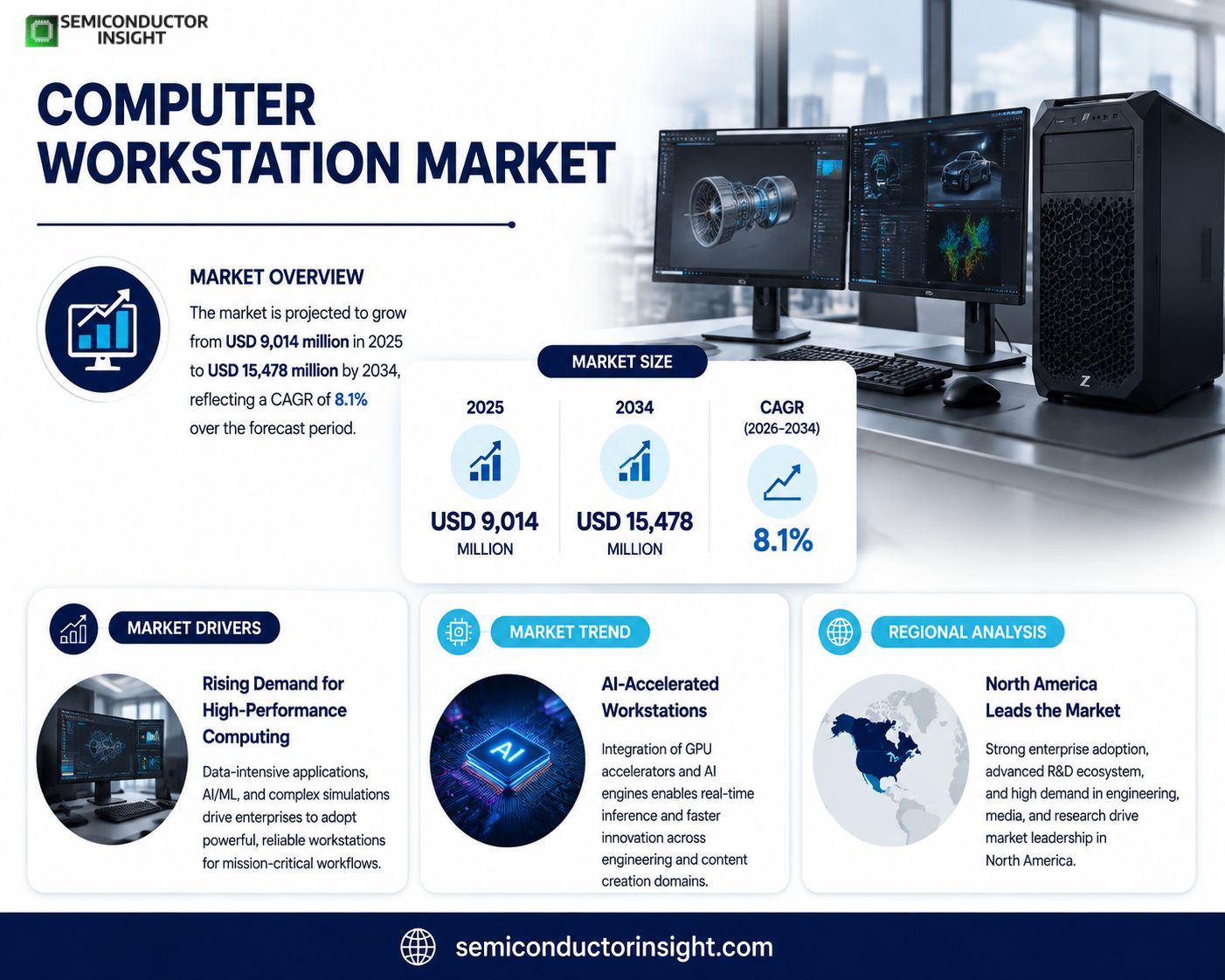
Computer Workstation market size was valued at USD 9,014 million in 2025. The market will increase from USD 9,014 million in 2025 to USD 15,478 million by 2034, reflecting a CAGR of 8.1% over the forecast period.
A computer workstation is a high‑performance computing system engineered for professional users who demand exceptional processing power, reliability and data integrity for complex tasks. Unlike standard PCs, workstations incorporate advanced CPUs, professional‑grade GPUs, large memory capacities and scalable storage solutions. They support specialized workflows in engineering design, scientific research, three‑dimensional modeling, digital content creation and data analysis across form factors such as tower desktops, mobile units, rack‑mounts or blade configurations.The expansion of the sector stems from several forces: digital transformation pushes enterprises toward data‑intensive applications; artificial‑intelligence and machine‑learning workloads require GPU‑accelerated performance; and regulatory initiatives encourage domestic high‑tech manufacturing. Companies such as Dell Technologies, Hewlett Packard Enterprise and Lenovo have broadened their portfolios with certified ISV‑validated models that guarantee stability for mission‑critical software. Additionally, collaborations between graphics chipmakers and OEMsexemplified by Nvidia’s partnership with HP on AI‑optimized workstationsstrengthen ecosystem confidence and stimulate adoption across engineering, media production and scientific research domains.
MARKET DRIVERS
Enterprise Performance Demands
Large‑scale data analytics, high‑resolution rendering, and complex simulation workloads force organizations to replace legacy desktops with purpose‑built workstations. Reliability and predictable latency become non‑negotiable, prompting procurement teams to allocate a higher share of IT budgets toward machines that can sustain continuous heavy loads.
Advances in GPU and CPU Technologies
Recent processor generations deliver up to a 40% performance uplift while maintaining power envelopes suitable for office environments. Simultaneously, graphics accelerators now support real‑time ray tracing and AI inference in a single chassis, granting engineers the ability to prototype and iterate without resorting to cloud‑based alternatives.
➤ High‑end workstations now deliver workstation‑grade performance at mid‑range pricing, reshaping purchasing calculus for midsize enterprises.
When decision‑makers evaluate total cost of ownership, the reduction in downtime and the acceleration of product development cycles often outweigh the upfront premium, creating a favorable environment for sustained market expansion.
MARKET CHALLENGES
Cost Sensitivity in Mid‑Market
Small and medium businesses operate under tight financial constraints, making the higher price point of premium workstations a potential barrier. Even modest price variations can shift preference toward high‑spec laptops or commodity desktops, especially when budget cycles are short.
Other Challenges
Supply Chain Volatility
Component shortages, particularly for high‑performance GPUs, have introduced lead‑time uncertainty. OEMs that cannot guarantee reliable delivery risk losing contracts to competitors with more resilient sourcing strategies.
MARKET RESTRAINTS
Regulatory Compliance Overheads
Industries such as aerospace and medical devices impose stringent validation processes on hardware. Workstation configurations must often be certified, adding engineering effort and extending time‑to‑market for new models.
Energy‑Efficiency Standards
Corporate sustainability agendas now demand that even high‑performance machines meet aggressive power‑consumption benchmarks. Designers are forced to balance raw compute capability with thermal and energy limits, sometimes curbing the inclusion of the most power‑hungry components.
Legacy Software Compatibility
Enterprises that rely on specialized, older engineering applications face risk when newer workstation architectures diverge from supported operating environments. The need for backward‑compatible drivers can delay adoption of the latest hardware innovations.
MARKET OPPORTUNITIES
AI‑Enabled Design Workflows
Embedding AI inference engines within workstations empowers designers to generate concept variations instantly. Vendors that integrate dedicated AI accelerators into their platforms stand to capture a growing segment of firms transitioning from manual to assisted design processes.
Remote Engineering Collaboration
The rise of distributed product development teams fuels demand for workstations that can stream high‑fidelity visualisations over corporate networks without degradation. Solutions offering secure, low‑latency remote desktop experiences are positioned to attract contracts from engineering firms.
Modular Upgrade Ecosystems
Manufacturers that provide easily replaceable GPU, storage, and memory modules enable customers to extend the lifecycle of a single chassis. This approach aligns with cost‑containment strategies while keeping performance on pace with evolving software requirements.
Computer Workstation Market Trends
Adoption of AI‑Accelerated Workstations
The rise of artificial‑intelligence workloads has reshaped purchasing logic for professional computing platforms. Enterprises that train deep‑learning models or run real‑time inference now prioritize workstations equipped with tensor‑optimized GPUs and high‑bandwidth memory. This shift reflects the growing complexity of data pipelines, where latency and precision directly affect product cycles. Vendors respond by bundling certified AI software stacks, reducing integration risk for end users. For buyers, the benefit lies in securing on‑premise compute that matches cloud‑grade performance while preserving data sovereignty. Consequently, budget allocations that previously favored generic PCs are being redirected toward purpose‑built AI workstations, accelerating market turnover.
Other Trends
Supply‑Chain Resilience
Recent disruptions in semiconductor production have prompted workstation manufacturers to diversify sourcing strategies and to hold safety stock for critical components such as CPUs and professional GPUs. Companies that establish multiple fab partnerships reduce lead‑time volatility and can honor delivery commitments even when a single node experiences a slowdown. This operational discipline translates into higher inventory costs, yet it protects revenue streams by avoiding order cancellations. Moreover, the trend encourages closer collaboration between OEMs and component vendors, fostering co‑development projects that embed reliability features directly into the silicon. Buyers therefore view supply‑chain robustness as a decisive factor alongside raw performance.
Regional Shifts Toward Distributed Design Hubs
North America and Western Europe continue to dominate high‑value workstation sales, but a noticeable migration toward emerging design clusters in Asia‑Pacific is underway. Governments in China, India and Vietnam are investing heavily in advanced manufacturing and digital‑twin initiatives, creating a cascade of demand for locally sourced, high‑performance workstations. These regions benefit from lower labor costs for assembly and from a growing pool of engineers trained in CAD and simulation tools. As a result, vendors are establishing regional R&D centers to tailor hardware configurations to local standards and to provide rapid after‑sales support. The redistribution of design activity not only expands the addressable user base but also introduces new competitive dynamics that pressure incumbents to innovate pricing and service models.
COMPETITIVE LANDSCAPE
Key Industry Players
Computer Workstation Market Competitive Overview
The workstation arena is anchored by a handful of OEMs that leverage scale, deep R&D pipelines, and extensive certification programs to dominate enterprise contracts. Dell, with its Precision line, couples a breadth of CPU optionsfrom Intel Xeon to AMD EPYCwith professional GPU options and a robust after‑sales service network that appeals to large engineering firms and research labs. HP’s Z series mirrors this approach, emphasizing modularity and security features that meet stringent data‑integrity requirements in regulated sectors such as finance and healthcare. Lenovo, through its ThinkStation portfolio, has built a reputation for reliability in European markets by integrating ISV‑certified drivers and offering flexible financing models that lower upfront capital outlay for midsize manufacturers. These three vendors collectively capture a sizable share of tier‑1 sales, control the majority of distribution channels, and set performance baselines that smaller players must match or exceed.Beyond the tier‑1 cohort, a diverse set of specialists occupies niche segments, often tailoring hardware to vertical‑specific workloads. BOXX focuses on high‑end graphics workstations for media and entertainment, embedding Nvidia RTX and Quadro GPUs in compact chassis that meet space‑constrained studio requirements. ClearCube and Corvalent pursue the secure‑office niche, supplying fan‑less, thin‑client‑style workstations that satisfy government and defense security mandates. Supermicro and Tyan dominate rack‑mount and blade configurations, enabling data‑center‑grade scalability for AI research clusters. Meanwhile, ASUS, Acer, Apple, Fujitsu, Gigabyte, MSI, and Inspur target a mix of mobile workstations, customized solutions for Asian markets, and hybrid work environments, each leveraging regional brand equity and cost‑effective component sourcing to stay competitive.
List of Key Computer Workstation Companies Profiled
Segment Analysis:
| Segment Category | Sub-Segments | Key Insights |
| By Type |
|
Tower Workstation
|
| By Application |
|
Engineering Design
|
| By End User |
|
Large Enterprises
|
| By Processor Architecture |
|
GPU‑Accelerated Workstations
|
| By Form Factor |
|
Desktop Form Factor
|
Regional Analysis: Computer Workstation Market
North America
Fortune‑500 firms are standardizing on workstation clusters to handle complex analytics, driving vendors to emphasize scalability and centralized monitoring tools that reduce administrative overhead across dispersed sites.
Automotive and aerospace designers rely on graphic‑intensive workstations to accelerate product iteration, prompting manufacturers to integrate next‑gen GPUs and high‑resolution displays that cut render times dramatically.
Research hospitals are deploying workstations for medical imaging and genomics, favoring solutions that combine compute density with strict compliance certifications to protect patient data.
Hybrid cloud strategies are encouraging firms to adopt workstations that can offload bursts of processing to the cloud, creating a market niche for devices with seamless virtualization support.
Europe
European firms exhibit a balanced approach, blending legacy workstation deployments with incremental upgrades that focus on sustainability and energy standards. Manufacturers that can certify low‑power consumption and recyclable components find a receptive audience, especially within the EU’s stringent regulatory environment. The region’s strong presence in automotive and media production also sustains demand for graphics‑heavy machines, while cross‑border data‑flow rules shape procurement toward hardware with built‑in encryption capabilities.
Asia‑Pacific
In Asia‑Pacific, rapid digital transformation in China, Japan, and South Korea fuels a surge in workstation purchases for AI research and advanced manufacturing. Nevertheless, price sensitivity remains high, prompting vendors to offer modular configurations that let customers scale performance without replacing entire units. Emerging markets such as India are beginning to prioritize workstation adoption in the education sector, laying the groundwork for a longer‑term expansion of professional‑grade hardware.
South America
South American enterprises are navigating a dual challenge of constrained budgets and the need for high‑performance tools in sectors like oil & gas and mining. The prevailing strategy centers on extending the lifecycle of existing assets through refurbishment programs, while selectively introducing newer workstations for mission‑critical tasks. Partnerships with local system integrators are becoming a decisive factor for vendors seeking market penetration.
Middle East & Africa
The Middle East & Africa region shows a cautious but increasingly optimistic outlook, driven by sovereign wealth funds investing in digital infrastructure and by oil‑centric companies modernizing their design capabilities. Vendors that combine robust after‑sales support with training initiatives are gaining trust, especially in markets where skilled technicians are scarce. This environment rewards providers that can couple technical excellence with localized service networks.
Report Scope
This market research report provides a comprehensive analysis of the Computer Workstation Market , covering the forecast period 2026–2034. It offers detailed insights into market dynamics, technological advancements, competitive landscape, and key trends shaping the industry.
Key focus areas of the report include:
- Market Overview: The report begins with an overview outlining its current market scenario, key growth indicators, and industry transformation drivers. It discusses macroeconomic factors, demand–supply balance, regulatory landscape, and the strategic role of semiconductors in powering advancements across industries such as automotive, telecommunications, consumer electronics, and industrial automation.
- Market Size & Forecast: Historical data and future projections for revenue, unit shipments, and market value across major regions and segments.
- Segmentation Analysis: Detailed breakdown by product type, technology, application, and end-user industry to identify high-growth segments and investment opportunities.
- Regional Insights: Insights into market performance across North America, Europe, Asia-Pacific, Latin America, and the Middle East & Africa, including country-level analysis where relevant.
- Competitive Landscape: Profiles of leading market participants, including their product offerings, R&D focus, manufacturing capacity, pricing strategies, and recent developments such as mergers, acquisitions, and partnerships.
- Technology Trends & Innovation: Assessment of emerging technologies, integration of AI/IoT, semiconductor design trends, fabrication techniques, and evolving industry standards.
- Market Drivers & Restraints: Evaluation of factors driving market growth along with challenges, supply chain constraints, regulatory issues, and market-entry barriers.
- Stakeholder Insights: Insights for component suppliers, OEMs, system integrators, investors, and policymakers regarding the evolving ecosystem and strategic opportunities.
Primary and secondary research methods are employed, including interviews with industry experts, data from verified sources, and real-time market intelligence to ensure the accuracy and reliability of the insights presented.
FREQUENTLY ASKED QUESTIONS:
What is the current market size of Computer Workstation Market?
-> Computer Workstation Market was valued at USD 9,014 million in 2025 and is expected to reach USD 15,478 million by 2034, growing at a CAGR of 8.1% during the forecast period.
Which key companies operate in Computer Workstation Market?
-> Key players include ASUS, Acer, Apple, BOXX, ClearCube, Corvalent, Dell, Fujitsu, Gigabyte, HP, Inspur, Lenovo, MSI, Supermicro, and Tyan, among others.
What are the key growth drivers?
-> Key growth drivers include digital transformation, surge in data‑intensive applications, expanding AI and machine‑learning workloads, continuous advancements in multi‑core CPUs and professional GPUs, and supportive regulatory initiatives promoting high‑tech manufacturing.
Which region dominates the market?
-> Asia‑Pacific is the fastest‑growing region, while North America remains the largest market in terms of revenue, driven by strong engineering, scientific research, and media production sectors.
What are the emerging trends?
-> Emerging trends include GPU‑accelerated workstations for AI/ML, integration of specialized accelerators, increased focus on error‑correcting memory for reliability, and a gradual shift toward hybrid cloud‑HPC models complementing on‑premise workstations.
Get Sample Report PDF for Exclusive Insights
Report Sample Includes
- Table of Contents
- List of Tables & Figures
- Charts, Research Methodology, and more...
 Download Sample Report PDF