Blade Server Market Insights
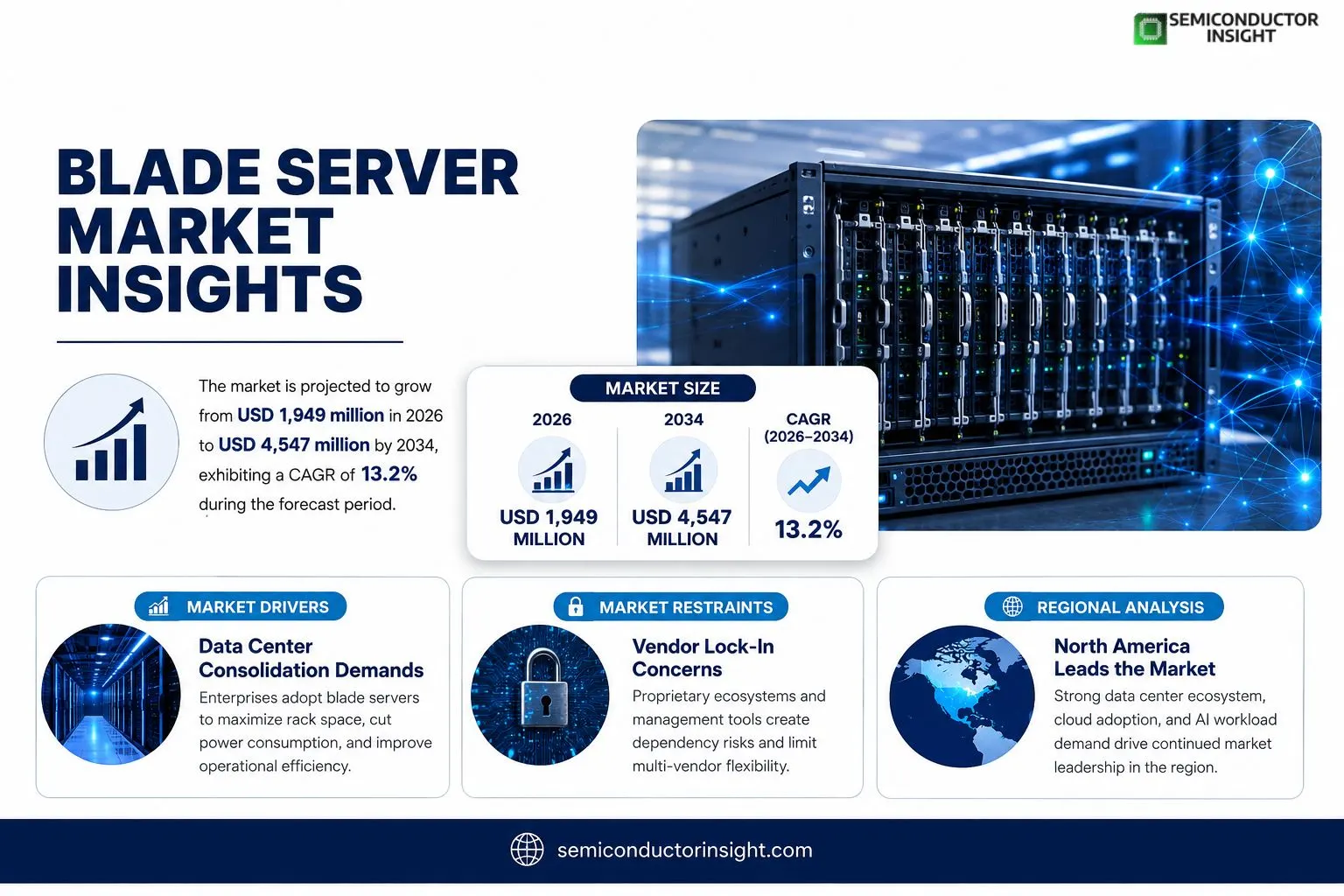
Blade Server market size was valued at USD 1,949 million in 2025. The market is projected to grow from USD 1,949 million in 2025 to USD 4,547 million by 2034, exhibiting a CAGR of 13.2% during the forecast period.
A Blade Server is a high‑density modular server system designed to optimise space, power and administrative efficiency in enterprise IT environments. The core concept integrates essential computing components – processors (CPUs), memory (RAM), network controllers and sometimes storage interfaces – onto a slender “blade”, a compact circuit board that functions as a complete server.The market is experiencing rapid growth due to several factors, including expanding data‑center footprints driven by cloud and edge computing adoption, heightened demand for energy‑efficient high‑performance computing, and ongoing digital transformation initiatives across industries. Leading vendors such as Dell Technologies, Cisco Systems, Hewlett Packard Enterprise and Lenovo are extending modular scalability and management capabilities to meet these pressures.
MARKET DRIVERS
Data Center Consolidation Demands
Enterprises are tightening rack footprints to lower power consumption and real‑estate costs. Blade Server Market offerings enable a single chassis to host multiple compute modules, turning a sprawling aisle of traditional racks into a compact, high‑density enclosure. This shift reduces cooling load by up to 30 % and improves operational efficiency, prompting CIOs to prioritize blade deployments over standalone servers.
Cloud‑Native Workloads Drive Architecture Choices
As hyperscale providers and private clouds migrate to micro‑service architectures, the need for modular, easily replaceable compute blocks intensifies. Blade platforms permit rapid scaling of CPU, memory, and storage resources without disruptive chassis removal, aligning with continuous‑delivery pipelines that demand near‑zero downtime. Organizations that adopt this flexibility can shave weeks from capacity‑upgrade cycles.
➤ “The ability to add or remove compute blades in minutes has become a competitive differentiator for data‑center operators.”
Moreover, advances in interconnect standards such as PCIe 5.0 and 100 GbE Ethernet have narrowed the performance gap between blade and traditional rack servers. By embedding these high‑speed links directly into the backplane, blade solutions deliver latency profiles suited for AI inference and real‑time analytics, reinforcing their appeal across vertically integrated industries.
MARKET CHALLENGES
Initial Capital Outlay
Despite long‑term cost savings, the upfront expense of a fully populated blade chassis remains substantial. Smaller firms often face budgetary constraints that make a monolithic blade investment less attractive than a phased acquisition of rack units. This cash‑flow pressure can delay adoption, especially in markets where CapEx approval cycles are lengthy.
Other Challenges
Thermal Management Complexity
High density translates into concentrated heat zones; without sophisticated cooling strategies, temperature spikes can erode component lifespan. Integrators must pair blade enclosures with liquid‑cooling or enhanced airflow designs, adding engineering overhead and elevating maintenance requirements.Furthermore, legacy applications that are not container‑aware may encounter compatibility hurdles when migrated onto blade‑based virtualization layers, prompting organizations to invest in refactoring efforts that extend project timelines.
MARKET RESTRAINTS
Vendor Lock‑In Concerns
Blade ecosystems are often tied to proprietary management software and firmware updates supplied by a single OEM. Companies wary of dependence on a sole supplier may defer purchases, fearing future licensing fees or limited upgrade paths. This perception can suppress market momentum in regions where procurement policies emphasize multi‑vendor flexibility.In addition, the rapid evolution of disaggregated infrastructurewhere compute, storage, and networking are sourced from independent vendorscreates a parallel avenue that some organizations view as a less restrictive alternative to traditional blade solutions.
MARKET OPPORTUNITIES
Edge Computing Expansion
The proliferation of 5G and IoT workloads is pushing compute resources toward the network edge. Compact blade enclosures, with their small footprint and integrated management, are well‑suited to remote sites that demand high performance in limited space. Deployments in telecom base stations and autonomous‑vehicle testbeds represent a growing revenue stream for suppliers that can certify blade platforms for rugged environments.Simultaneously, the emergence of AI‑optimized acceleratorssuch as GPUs and custom ASICscreates a niche for blade chassis designed to accommodate heterogeneous modules. Vendors that engineer flexible backplanes capable of supporting diverse accelerator form factors will capture early‑adopter contracts from research institutions and enterprise AI labs.
Blade Server Market Trends
Modular Density Drives Data Center Consolidation
The shift toward higher compute density is reshaping how enterprises allocate floor space. By housing multiple compute nodes within a single chassis, blade architectures free up rack units that would otherwise be consumed by traditional servers. This reduction in footprint translates into lower real estate costs and fewer power distribution units, a direct response to the pressure on operators to squeeze more workloads into existing facilities. Providers of cloud platforms and large‑scale enterprises are leveraging this efficiency to accelerate the rollout of new services without expanding their physical footprint, thereby preserving capital for higher‑value initiatives such as AI model training or real‑time analytics. Blade Server Market therefore benefits from a clear link between physical efficiency and the ability to scale services quickly.
Other Trends
Edge Adoption and Energy Efficiency
Edge locations demand compute that can be deployed in constrained environments while maintaining strict power budgets. Blade solutions, with their shared power and cooling subsystems, present a compelling option for telco micro‑data centers and industrial sites where space and energy are premium. Operators are increasingly specifying blades that incorporate low‑power processors and advanced thermal designs, because any reduction in kilowatt‑hour consumption directly improves operating margins. Moreover, the modular nature of blades simplifies incremental capacity upgrades, allowing edge sites to add nodes as demand matures without a full infrastructure overhaul. This flexibility is encouraging firms to embed blade deployments into edge strategies, positioning Blade Server Market as a cornerstone of distributed computing growth.
Competitive Landscape Shifts Toward Integrated Management
Vendors are differentiating their offerings through software‑defined management layers that consolidate provisioning, monitoring, and lifecycle operations across the entire chassis. Such unified interfaces reduce the skill set required for day‑to‑day administration, a factor that resonates with organizations aiming to curb staffing costs. Companies that combine hardware reliability with robust orchestration tools are capturing the attention of hyperscalers that need to spin up and retire capacity on demand. Consequently, the competitive arena is moving away from pure hardware specifications toward holistic solutions that promise lower total cost of ownership and faster time‑to‑market. For buyers, this evolution means evaluating purchase decisions not just on blade density but also on the breadth of integrated management capabilities that accompany the product.
COMPETITIVE LANDSCAPE
Key Industry Players
Blade Server Market: Competitive Overview 2025‑2034
The blade server segment remains anchored by Dell Technologies, whose PowerEdge MX family leverages a flexible chassis architecture that appeals to hyperscale operators and large enterprises alike. Dell’s extensive channel network, combined with a strong services arm, allows it to bundle hardware with lifecycle management contracts, reinforcing its position as a market leader. Recent product refreshes have emphasized higher compute density, accelerated networking options, and integrated management tools that reduce operational overhead for data center operators. This integrated approach not only secures recurring revenue streams but also creates entry barriers for smaller vendors seeking comparable breadth of support.Beyond Dell, the field is populated by a mix of integrators and regionally focused manufacturers. Cisco Systems differentiates through its UCS ecosystem, pairing blade modules with unified fabric that streamlines provisioning for hybrid cloud workloads. Hewlett Packard Enterprise and Lenovo capitalize on long‑standing relationships in enterprise IT, delivering chassis that emphasize modularity and power‑efficiency for varied workload tiers. Huawei and ZTE, backed by strong domestic demand in China, target edge‑centric deployments where rapid scaling is paramount. Companies such as Inspur, Fujitsu, Quanta, Gigabyte, NEC, and Oracle occupy niche positionsInspur’s strength lies in government contracts, Fujitsu in highly regulated financial services, while Quanta and Gigabyte focus on cost‑effective solutions for mid‑market servers. Collectively, this constellation of players sustains a competitive environment where differentiation hinges on design innovation, regional supply chain resilience, and value‑added service layers.
List of Key Blade Server Companies Profiled
- Dell Technologies
- Cisco Systems
- Hewlett Packard Enterprise
- Lenovo
- Huawei Technologies
- Inspur
- Fujitsu
- Quanta Computer
- ZTE Corporation
- Gigabyte Technology
- NEC Corporation
- Oracle
Segment Analysis:
| Segment Category | Sub-Segments | Key Insights |
| By Type |
|
Universal Server is favored for its flexibility and broad applicability across workloads.
|
| By Application |
|
Cloud Services drive demand for blade servers because of their need for dense, scalable compute platforms.
|
| By End User |
|
Large Enterprises prioritize blade servers for their ability to consolidate workloads and streamline operations.
|
| By Chassis Height |
|
Full‑height Blade is preferred where higher expansion capacity and additional I/O density are required.
|
| By Node Count per Blade |
|
Multi‑node Blade addresses the need for ultra‑dense compute clusters in modern data‑centers.
|
Regional Analysis: Blade Server Market
North America
Large corporations in the United States and Canada are reshaping their IT footprints, moving from monolithic servers to blade ensembles that enable rapid provisioning. The shift reduces floorspace consumption and aligns with sustainability mandates, compelling vendors to bundle management software that simplifies lifecycle oversight.
Cloud providers operating edge sites are integrating blade racks to deliver consistent performance across distributed locations. This architecture supports a seamless hand‑off between public and private clouds, allowing customers to scale workloads without re‑architecting applications.
Data‑sovereignty regulations in Canada and several U.S. states encourage localized processing, prompting data‑center operators to install blade solutions that meet strict security and audit requirements while preserving compute density.
Recent component shortages have led North American buyers to prioritize vendors with diversified manufacturing footprints. Contracts now often incorporate service‑level clauses that address lead‑time variability for blade chassis and accompanying networking modules.
Europe
European markets exhibit a cautious but steady appetite for blade technology, driven by a blend of legacy system modernization and green‑IT initiatives. Companies in Germany and the United Kingdom leverage blade servers to reduce energy consumption while meeting stringent EU efficiency standards. Vendor alliances with local system integrators enable customized solutions that respect regional data‑privacy frameworks, a factor that differentiates successful players. Additionally, the rise of edge‑compute projects in the Nordics fuels demand for compact, high‑performance enclosures that can be deployed in limited‑space environments.
Asia‑Pacific
The Asia‑Pacific region is experiencing a noticeable uptick in blade deployments as rapid digital transformation sweeps across Japan, South Korea, and Singapore. Telecommunications firms are modernizing core networks, opting for blade platforms that support high‑throughput and low‑latency requirements. Meanwhile, emerging economies such as India are witnessing a shift in large‑scale IT outsourcing firms towards blade infrastructures to meet client expectations for scalability. The collective push for data‑center consolidation and the desire to achieve operational efficiency are reshaping procurement strategies across the continent.
South America
In South America, Brazil and Chile are leading the conversation around blade adoption, primarily as enterprises seek to optimize limited data‑center footprints. Financial institutions are embracing blade solutions to enhance processing power without incurring extensive capital expenditure. Local vendors are forming partnerships with manufacturers to deliver region‑specific support, which mitigates concerns around parts availability and technical expertise. The market’s evolution reflects a broader trend of aligning IT investments with cost‑control imperatives while preparing for future workload intensification.
Middle East & Africa
The Middle East & Africa segment shows a growing confidence in blade architectures, especially within sovereign wealth fund‑backed data‑center projects in the United Arab Emirates and Saudi Arabia. Organizations prioritize modularity to accelerate deployment timelines for smart‑city initiatives. In Africa, limited power infrastructure drives interest in blade systems that offer higher compute per watt ratios, enabling providers to deliver reliable services in emerging markets. Collaborative efforts between regional carriers and OEMs aim to build localized service ecosystems, fostering a more predictable procurement environment.
Report Scope
This market research report provides a comprehensive analysis of the Blade Server Market , covering the forecast period 2026–2034. It offers detailed insights into market dynamics, technological advancements, competitive landscape, and key trends shaping the industry.
Key focus areas of the report include:
- Market Overview: The report begins with an overview outlining its current market scenario, key growth indicators, and industry transformation drivers. It discusses macroeconomic factors, demand–supply balance, regulatory landscape, and the strategic role of semiconductors in powering advancements across industries such as automotive, telecommunications, consumer electronics, and industrial automation.
- Market Size & Forecast: Historical data and future projections for revenue, unit shipments, and market value across major regions and segments.
- Segmentation Analysis: Detailed breakdown by product type, technology, application, and end-user industry to identify high-growth segments and investment opportunities.
- Regional Insights: Insights into market performance across North America, Europe, Asia-Pacific, Latin America, and the Middle East & Africa, including country-level analysis where relevant.
- Competitive Landscape: Profiles of leading market participants, including their product offerings, R&D focus, manufacturing capacity, pricing strategies, and recent developments such as mergers, acquisitions, and partnerships.
- Technology Trends & Innovation: Assessment of emerging technologies, integration of AI/IoT, semiconductor design trends, fabrication techniques, and evolving industry standards.
- Market Drivers & Restraints: Evaluation of factors driving market growth along with challenges, supply chain constraints, regulatory issues, and market-entry barriers.
- Stakeholder Insights: Insights for component suppliers, OEMs, system integrators, investors, and policymakers regarding the evolving ecosystem and strategic opportunities.
Primary and secondary research methods are employed, including interviews with industry experts, data from verified sources, and real-time market intelligence to ensure the accuracy and reliability of the insights presented.
FREQUENTLY ASKED QUESTIONS:
What is the current market size of Blade Server Market?
-> Blade Server Market was valued at USD 1,949 million in 2025 and is expected to reach USD 4,547 million by 2034.
Which key companies operate in Blade Server Market?
-> Key players include Dell, Cisco, Hewlett Packard Enterprise (HPE), Lenovo, among others.
What are the key growth drivers?
-> Key growth drivers include cloud adoption, edge computing, AI/ML workloads, high‑density data center consolidation, and ESG‑driven energy efficiency.
Which region dominates the market?
-> North America remains the largest market, while Asia‑Pacific is the fastest‑growing region.
What are the emerging trends?
-> Emerging trends include integration of AI‑optimized blades, hyperscale modular designs, and sustainable cooling solutions.
Get Sample Report PDF for Exclusive Insights
Report Sample Includes
- Table of Contents
- List of Tables & Figures
- Charts, Research Methodology, and more...
 Download Sample Report PDF