All-in-one PCs Market Insights
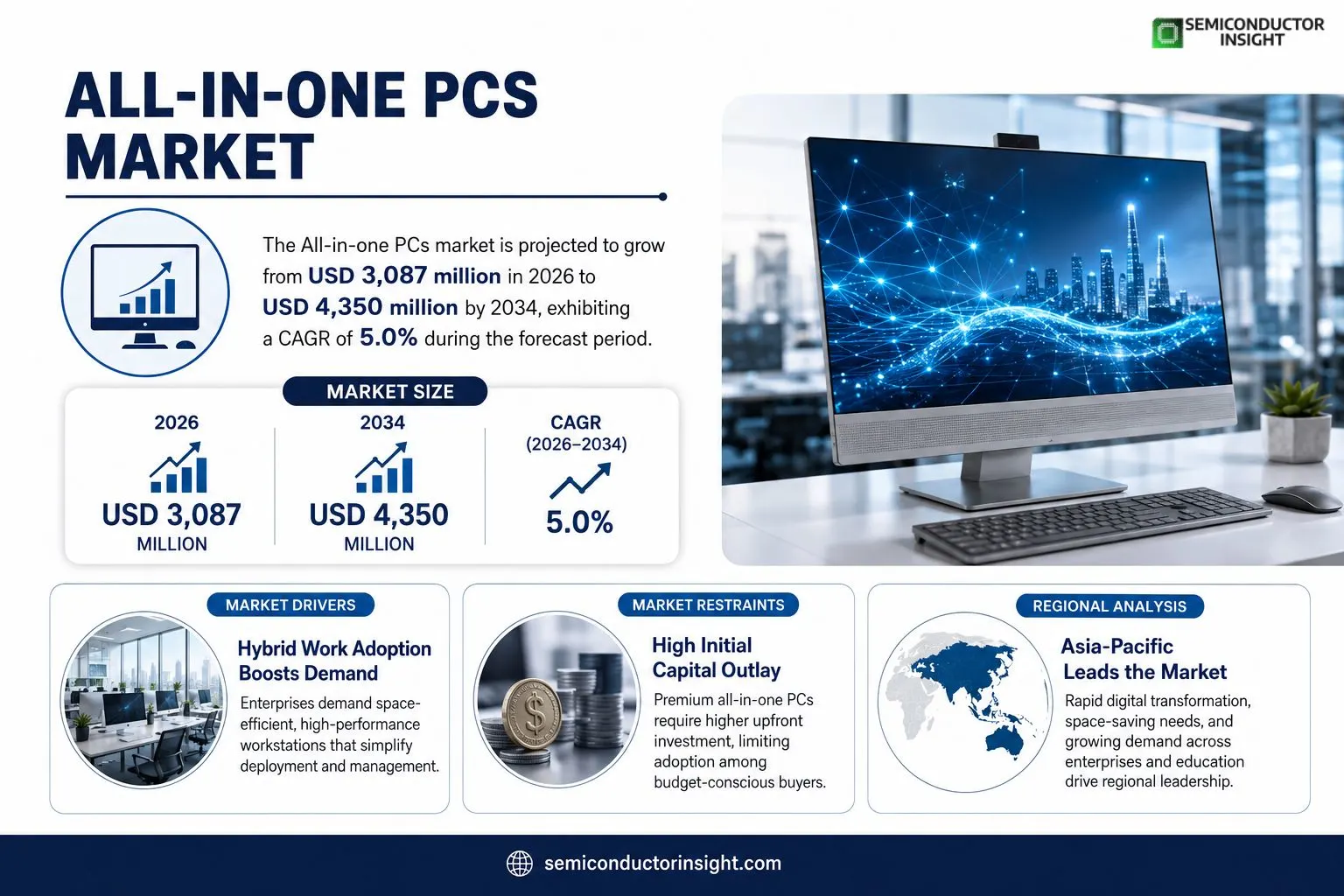
All-in-one PCs market size was valued at USD 3,087 million in 2025 and is forecasted to reach USD 4,350 million by 2034, delivering a CAGR of 5.0% over the period.
An All‑in‑one PC integrates the display, motherboard, processor, graphics unit, memory, solid‑state storage, camera, speakers, microphones, network modules and primary I/O interfaces within a single chassis. Typically presented as a large flat‑panel screen on a stand, it combines a front display module, rear system compartment, thermal management system and power section, thereby reducing footprint and cable clutter compared with traditional tower desktops.Market expansion reflects heightened demand for space‑efficient workstations in offices, classrooms and retail environments; enterprises favour unified endpoints that simplify deployment and maintenance; and advancements in high‑definition cameras and AI‑ready processors enhance collaboration capabilities. Nevertheless limited upgradeability and reliance on OEM‑ODM supply chains pose challenges for long‑term cost efficiency.
MARKET DRIVERS
Hybrid Work Adoption Boosts Demand
Enterprises that shifted to hybrid models are looking for hardware that reduces desk clutter while delivering desktop‑class performance. All‑in‑one PCs satisfy that need by merging processing power, high‑resolution screens, and integrated peripherals into a single chassis, allowing workplaces to maintain a professional aesthetic without sacrificing capability.
Advances in Display Technology
Edge‑to‑edge glass panels, 4K panels, and touch‑enabled displays have narrowed the experience gap between traditional towers and all‑in‑one solutions. When buyers evaluate visual fidelity for tasks ranging from graphic design to video conferencing, the superior screen quality becomes a decisive factor, prompting firms to allocate budget toward these converged devices.
➤ “The combination of sleek design and powerful internals makes all‑in‑one systems the preferred choice for modern office spaces,” said a senior IT procurement manager.
Beyond aesthetics, the reduced footprint translates into lower facility costsfewer cables, minimized power consumption, and simplified maintenance schedules. Companies that factor these operational savings into their total cost of ownership calculations often find All-in-one PCs Market financially compelling.
MARKET CHALLENGES
Cost Sensitivity Among SMBs
Small and medium‑size businesses frequently operate under tight capital constraints. Even though an all‑in‑one unit offers long‑term efficiencies, its upfront price can exceed that of a comparable desktop‑monitor combo, leading price‑driven buyers to postpone upgrades.
Other Challenges
Supply Chain Bottlenecks
Component shortagesparticularly for high‑performance GPUs and DDR5 memoryhave introduced lead‑time volatility. Vendors that cannot guarantee timely delivery risk losing contracts to rivals offering more predictable fulfillment.Additionally, the rapid pace of software updates demands that hardware remain compatible for several years. Organizations wary of premature obsolescence may adopt a conservative stance, limiting the speed at which they transition to newer all‑in‑one platforms.
MARKET RESTRAINTS
High Initial Capital Outlay
Purchasing a premium all‑in‑one system typically requires a larger initial outlay compared with assembling a desktop workstation. For budget‑constrained departments, this cash‑flow impact can act as a deterrent, especially in regions where leasing options remain underdeveloped.
Limited Upgrade Paths
While the integrated design streamlines deployment, it also restricts component‑by‑component upgrades. Companies that anticipate frequent scaling of processing power or memory may favor modular desktops to preserve flexibility, thereby tempering adoption rates.Enterprise IT policies that prioritize standardization across device fleets sometimes place all‑in‑one solutions behind a compliance hurdle, as they must align with existing security baselines and management tools.
MARKET OPPORTUNITIES
Emerging AI Integration
Manufacturers are embedding AI‑accelerated chips that enable on‑device facial recognition, voice assistants, and real‑time analytics. Organizations seeking to enhance security or streamline workflow can leverage these capabilities without procuring separate edge devices, opening a new growth avenue for All-in-one PCs Market.
Education Sector Expansion
Schools and universities are modernizing classrooms with interactive displays and collaborative software. All‑in‑one units, with their built‑in cameras and touch functionality, align closely with these pedagogical shifts, presenting a sizable addressable segment for vendors.
Emerging Market Penetration
Developing economies are investing in digital infrastructure, and the appeal of a single‑package solution resonates in regions where IT support resources are limited. Companies that tailor pricing models and warranty services to these markets can capture incremental volume.
All-in-one PCs Market Trends
Convergence of Workspace Efficiency and Integrated Computing
All-in-one PCs Market is being reshaped by organizations that demand a single endpoint capable of handling display, computation, video collaboration, and security management. Enterprises that have retired Windows 10 see the refresh cycle as an opportunity to replace disparate towers, cameras, and speakers with a unified device. This shift reduces installation time and cable clutter, which directly translates into lower facilities cost for reception desks, open‑plan offices, and retail counters. Because the hardware now bundles high‑definition cameras, eye‑comfort displays and AI‑ready processors, firms can roll out collaboration‑centric workstations without adding separate peripherals. The net effect is a faster rollout of digital‑workplace initiatives and a clearer line of sight for IT teams managing endpoint health.
Other Trends
Vertical Customisation and Service‑Layer Expansion
Education, healthcare and retail buyers are insisting on features that go beyond raw performance. In classrooms, touch‑enabled screens and rugged chassis extend device life, while in nursing stations fanless cooling and antimicrobial surfaces address hygiene regulations. Retail operators prioritize integrated point‑of‑sale software and centralized device‑management platforms. Suppliers that combine hardware with subscription‑based deployment services capture additional revenue streams, moving All-in-one PCs Market from pure unit sales toward long‑term service contracts. This evolution encourages manufacturers to embed remote‑management agents and industry‑specific firmware, turning the device into a platform rather than a standalone computer.
Supply‑Chain Sensitivities and Upgradeability Trade‑offs
While the integrated form factor delivers space savings, it also introduces a vulnerability: limited post‑sale upgrade paths. Organizations focused on total cost of ownership question the economics of replacing an entire chassis versus swapping a graphics card or storage module in a traditional tower. At the same time, fluctuations in processor roadmaps, display‑panel pricing and wireless‑module availability create inventory risk for OEMs. Companies that can secure multi‑year panel agreements or design modular thermal subsystems gain a competitive edge, because they can promise predictable pricing and faster refresh cycles. All-in-one PCs Market therefore rewards players that balance design elegance with pragmatic serviceability, ensuring that the perceived cost advantage does not erode over a five‑year horizon.
COMPETITIVE LANDSCAPE
Key Industry Players
All‑in‑One PCs: Converging Form Factor and Enterprise Demands
Among the manufacturers, Dell, HP, and Lenovo dominate the All‑in‑One PC market by virtue of their extensive channel reach, diversified product portfolios, and integrated management solutions. Dell’s OptiPlex line leverages a unified firmware layer that simplifies remote administration, a feature that resonates with large‑scale corporate renewals. HP’s EliteOne series couples high‑resolution touch panels with optional fan‑less designs, addressing the hygiene concerns of healthcare and retail sectors. Lenovo’s ThinkCentre AIOs benefit from a modular thermal architecture that eases field service, giving the brand a competitive edge in education environments where rapid deployment is critical. Collectively, these three firms capture the bulk of revenue, while their pricing strategiesranging from cost‑effective entry models to premium collaborative workstationsshape the overall market structure.Beyond the tier‑one triad, a cluster of niche players adds depth to the ecosystem. Apple’s iMac continues to attract creative professionals with its color‑accurate display and tight integration with macOS, yet its premium pricing limits broader adoption. ASUS and Acer target the mid‑range segment, focusing on compact form factors and bundled accessories for small‑office/home‑office users. AAEON, Advantech, and IEI Integration specialize in industrial‑grade AIOs that meet IEC‑60529 ingress ratings and fan‑less cooling, making them attractive to manufacturing and logistics customers. Meanwhile, regional OEMs such as Cybernet (Taiwan) and DT Research (US) differentiate through customizable chassis and localized support, enabling vertical penetration in markets that value compliance and service continuity.
List of Key All‑in‑One PCs Companies Profiled
- Dell Technologies
- HP Inc.
- Lenovo Group
- Apple Inc.
- ASUS
- Acer
- AAEON
- Advantech
- IEI Integration
- Cybernet
- DT Research
- Micro‑Star International (MSI)
- Winmate
- NEC Personal Computers
Segment Analysis:
| Segment Category | Sub-Segments | Key Insights |
| By Type |
|
Leading Segment
|
| By Application |
|
Leading Segment
|
| By End User |
|
Leading Segment
|
| By Workspace |
|
Leading Segment
|
| By Vertical |
|
Leading Segment
|
Regional Analysis: All-in-one PCs Market
North America
Large firms integrate all‑in‑one workstations to streamline desk layouts and reduce IT overhead. The consolidated hardware footprint minimizes cable clutter, which translates into faster deployment cycles and lower facility‑maintenance budgets, reinforcing the appeal of integrated solutions for mission‑critical environments.
Affluent homeowners are gravitating toward sleek designs that double as entertainment hubs. The aesthetic edge of an all‑in‑one device dovetails with a desire for uncluttered living spaces, prompting retailers to showcase premium finishes alongside high‑resolution panels.
Vendors are pivoting to a more modular parts strategy, sourcing displays, CPUs and GPUs from diversified pools. This approach mitigates the risk of single‑source bottlenecks and enables quicker response to demand spikes without compromising build quality.
Energy‑efficiency standards in the United States push manufacturers to optimise power draw. Compliance not only avoids penalties but also serves as a selling point for eco‑conscious buyers, encouraging the inclusion of low‑power components in newer models.
Europe
European markets illustrate a nuanced balance between public‑sector procurement and boutique‑brand loyalty. Government agencies favour all‑in‑one platforms for their ease of maintenance, while creative studios in cities such as Berlin and Milan prize the high‑resolution displays for colour‑critical work. Local regulations on e‑waste encourage manufacturers to design recyclable chassis, prompting a modest rise in offerings that combine modularity with compliance. Cross‑border supply routes have become tighter due to Brexit‑related customs changes, nudging distributors to hold safety stock in regional hubs. As a result, OEMs are tailoring firmware updates to meet differing voltage standards and language settings, reinforcing market relevance across the continent.
Asia‑Pacific
In the Asia‑Pacific arena, rapid urbanisation fuels demand for space‑saving computing. Small‑to‑medium enterprises in Singapore and Melbourne adopt all‑in‑one units to maximise office density, while the burgeoning remote‑work culture in India amplifies household purchases. Local OEMs leverage cost‑effective component sourcing to deliver competitively priced models, yet they also experiment with innovative touch‑screen integrations aimed at education markets. Trade agreements within ASEAN streamline tariff flows, allowing multinational vendors to expand footprint with limited pricing pressure. Concurrently, consumer awareness of after‑sales support drives brand differentiation, encouraging firms to invest in region‑specific service centres.
South America
South American economies exhibit a cautious but optimistic outlook for All-in-one PCs Market. Educational reforms in Brazil and Chile prioritize technology‑rich classrooms, and the compact nature of integrated machines aligns with budget constraints tied to limited classroom space. Nevertheless, import duties and fluctuating exchange rates temper price sensitivity, prompting distributors to negotiate volume‑based discounts. Growing interest in digital signage within retail corridors also opens a niche for durable, all‑in‑one displays that can operate continuously. Companies that localise software interfaces and provide multilingual support find a competitive edge, as language diversity remains a pivotal factor for user adoption.
Middle East & Africa
The Middle East & Africa region reflects a blend of high‑value projects and emerging demand. In the Gulf, luxury hotels and corporate towers integrate all‑in‑one workstations as part of premium office designs, valuing the sleek aesthetics and reduced maintenance footprint. Meanwhile, sub‑Saharan markets experience gradual uptake driven by expanding telecom infrastructure that enables reliable remote work. Energy‑efficiency certifications are gaining traction, as power‑cost considerations become more prominent. Vendors that can navigate diverse regulatory landscapesranging from strict import standards in the UAE to more flexible customs regimes in Kenyaare better positioned to capture incremental growth across this heterogeneous region.
Report Scope
This market research report provides a comprehensive analysis of the All-in-one PCs Market , covering the forecast period 2026–2034. It offers detailed insights into market dynamics, technological advancements, competitive landscape, and key trends shaping the industry.
Key focus areas of the report include:
- Market Overview: The report begins with an overview outlining its current market scenario, key growth indicators, and industry transformation drivers. It discusses macroeconomic factors, demand–supply balance, regulatory landscape, and the strategic role of semiconductors in powering advancements across industries such as automotive, telecommunications, consumer electronics, and industrial automation.
- Market Size & Forecast: Historical data and future projections for revenue, unit shipments, and market value across major regions and segments.
- Segmentation Analysis: Detailed breakdown by product type, technology, application, and end-user industry to identify high-growth segments and investment opportunities.
- Regional Insights: Insights into market performance across North America, Europe, Asia-Pacific, Latin America, and the Middle East & Africa, including country-level analysis where relevant.
- Competitive Landscape: Profiles of leading market participants, including their product offerings, R&D focus, manufacturing capacity, pricing strategies, and recent developments such as mergers, acquisitions, and partnerships.
- Technology Trends & Innovation: Assessment of emerging technologies, integration of AI/IoT, semiconductor design trends, fabrication techniques, and evolving industry standards.
- Market Drivers & Restraints: Evaluation of factors driving market growth along with challenges, supply chain constraints, regulatory issues, and market-entry barriers.
- Stakeholder Insights: Insights for component suppliers, OEMs, system integrators, investors, and policymakers regarding the evolving ecosystem and strategic opportunities.
Primary and secondary research methods are employed, including interviews with industry experts, data from verified sources, and real-time market intelligence to ensure the accuracy and reliability of the insights presented.
FREQUENTLY ASKED QUESTIONS:
What is the current market size of All-in-one PCs Market?
-> All-in-one PCs Market was valued at USD 3,087 million in 2025 and is expected to reach USD 4,350 million by 2034, growing at a CAGR of 5.0%.
Which key companies operate in All-in-one PCs Market?
-> Key players include Huawei, IEI Integration, Lenovo, Micro-Star International, Winmate, Apple, Cybernet, Dell, DT Research, HP, Microsoft, NEC Personal Computers, AAEON, Acer, Advantech, Avalue, ASUS, Axiomtek.
What are the key growth drivers?
-> Key growth drivers include workspace efficiency, digital collaboration, endpoint security management, vertical application integration, and the shift after Windows 10 support ended in 2025 prompting endpoint redesigns.
Which region dominates the market?
-> Asia-Pacific is the fastest‑growing region, while Europe remains a dominant market.
What are the emerging trends?
-> Emerging trends include AI‑ready capabilities, fanless hygiene‑focused designs for healthcare, touch‑enabled retail solutions, and integrated management software platforms.
Get Sample Report PDF for Exclusive Insights
Report Sample Includes
- Table of Contents
- List of Tables & Figures
- Charts, Research Methodology, and more...
 Download Sample Report PDF