
Key Statistics
Key Takeaways
- LCD remains the largest display technology because IPS, VA and TN panels cover the broadest price and performance range, while OLED and Mini-LED are gaining share in premium gaming and creator monitors.
- Commercial applications lead demand through offices, education and public-sector deployments, while gaming is the fastest-moving performance segment as refresh rates, HDR and OLED adoption rise.
- 22–27-inch screens remain the largest size band because they balance desktop footprint, resolution and price for mainstream office and home users, while 32-inch and ultrawide displays are expanding in premium setups.
- Asia Pacific is the largest regional market and manufacturing center. China, South Korea and India together account for more than half of global screen production, while the U.S. represented 32% of global revenue in 2024.
- 2026 products are pushing both resolution and refresh rate. Samsung commercialized a 6K gaming monitor, LG launched 5K2K OLED and Mini-LED products, and ASUS expanded RGB OLED, QD-OLED and high-refresh esports displays.
Computer Screen Market Overview
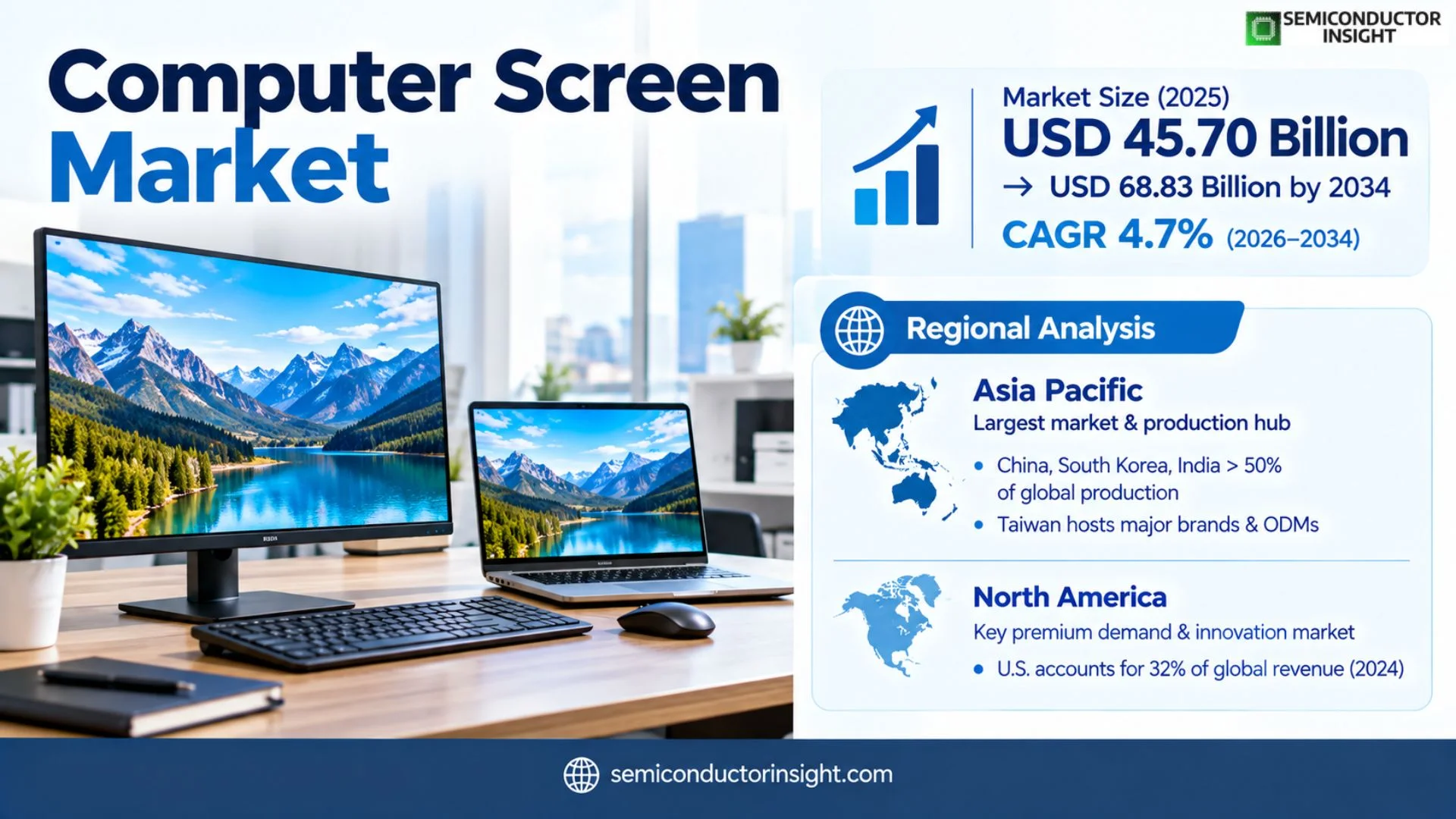
Computer Screen market is valued at USD 45.70 billion in 2025 and is projected to reach USD 68.83 billion by 2034, representing a 4.7% CAGR during 2026–2034. The 2026 estimated market size is USD 47.83 billion. Asia Pacific is the largest regional market, supported by display-panel manufacturing, electronics assembly and expanding gaming, office and commercial demand.
Computer screens span desktop monitors, professional displays and gaming displays using LCD, LED-backlit LCD, OLED, Mini-LED, quantum-dot and emerging MicroLED architectures. Product value is determined by resolution, panel technology, refresh rate, response time, color accuracy, HDR capability, connectivity, ergonomics and integrated features such as USB-C docking or webcams.
The market is becoming more segmented rather than moving toward one universal display. Office users prioritize power efficiency, ergonomics, text clarity and USB-C connectivity; creators need wide color gamut and calibration; gamers value low latency, high refresh and adaptive sync; professional visualization requires resolution, uniformity and color accuracy. Manufacturers increasingly build dedicated families around these use cases.
Technology competition is intensifying at the premium end. OLED delivers emissive contrast and very fast response but requires burn-in management and cost reduction. Mini-LED increases brightness and local-dimming performance while retaining LCD’s established manufacturing base. New RGB-stripe OLED, tandem OLED and high-refresh architectures are improving text clarity, brightness and panel longevity.
Segment Analysis: By Type
By type, the market includes LCD, LED, OLED, Quantum Dot and Other Display Technologies. LCD remains the largest segment because IPS, VA and TN variants can serve mainstream office, education, gaming and commercial users at competitive cost.
| Display technology | Technical characteristics | Market position |
|---|---|---|
| LCD | Liquid-crystal panels use a backlight and include IPS, VA and TN technologies. IPS emphasizes viewing angle and color, VA emphasizes contrast and TN emphasizes speed and cost. Modern LCD monitors increasingly use fast IPS and Mini-LED backlighting. | Largest technology segment. Broad price coverage and mature manufacturing keep LCD dominant in office, education and mainstream consumer monitors. |
| LED / Mini-LED LCD | LED-backlit screens improve power efficiency, while Mini-LED uses many smaller backlight zones to improve local dimming and peak brightness. High-end Mini-LED monitors can deliver strong HDR without OLED’s organic-emitter aging concerns. | A growing premium LCD category, particularly in gaming, creator and professional HDR displays. |
| OLED | Self-emissive pixels provide near-instant response, deep black levels and high contrast. QD-OLED, WOLED and tandem RGB OLED offer different trade-offs in brightness, text rendering and color volume. | Fast-growing premium segment. Gaming and creator monitors are moving toward higher refresh rates, improved burn-in mitigation and more screen sizes. |
| Quantum Dot | Quantum-dot layers or QD-OLED structures improve color gamut and brightness efficiency. The technology is used across premium LCD and emissive monitor products. | A value-enhancing technology rather than a single form factor, supporting wide-gamut professional and gaming monitors. |
| Other / Emerging | MicroLED, e-paper secondary screens, glasses-free 3D and unusual form factors expand the market beyond conventional flat desktop monitors. | A smaller innovation segment targeting premium or specialized workflows. |
Screen-size and resolution segmentation
The market is also segmented by screen size and resolution. The 22–27-inch band leads mainstream desktop use, while 28–32-inch and ultrawide formats gain share among gamers and professionals. Full HD remains the volume standard, but QHD and 4K are increasingly common as GPU capability and content resolution improve.
| Axis | Segments | Commercial implication |
|---|---|---|
| By Screen Size | Below 22 in · 22–27 in · 28–32 in · Above 32 in | 22–27 inches leads mainstream desktop demand; 28–32 inches supports 4K and premium gaming; above 32 inches serves ultrawide, simulation and professional multi-window workflows. |
| By Resolution | HD · Full HD · QHD · 4K UHD · 8K / 6K and Above | Full HD remains the largest installed base, QHD is strong in gaming, and 4K/6K adoption grows in creator, professional and premium productivity markets. |
Segment Analysis: By Application
By application, Commercial is the leading segment, followed by home, gaming, professional and other specialized use cases. Offices and education favor reliable mainstream monitors, while gaming and professional applications generate higher average selling prices through advanced panels and performance features.
| Application | Key market insight |
|---|---|
| Commercial | Offices, education, retail and public-sector deployments require dependable displays with ergonomic stands, eye-comfort features, USB-C docking and fleet-management simplicity. Multi-monitor setups increase units per desk in knowledge-work environments. |
| Home | Home-office, study and general computing demand spans value Full HD screens through large 4K productivity displays. Hybrid work supports larger screens and integrated docking features. |
| Gaming | High-refresh, low-response-time and adaptive-sync monitors are a major premium category. OLED and advanced Mini-LED are gaining share as refresh rates move above 240Hz and HDR expectations increase. |
| Professional / Creator | Graphic design, video, CAD, medical imaging and content creation require accurate color, high resolution, uniformity and factory calibration. USB-C/Thunderbolt and KVM functions support workstation workflows. |
| Other | Digital signage, control rooms, simulation, secondary displays and specialized industrial systems use computer-monitor technology in tailored form factors. |
Regional Analysis
Asia Pacific is the largest Computer Screen market and the leading production center. China, South Korea and India together contribute more than half of global screen production, while Taiwan hosts major monitor brands and ODM supply chains. North America remains a key premium demand and innovation market, with the U.S. accounting for 32% of global revenue in 2024.
How do regional computer-screen demand patterns differ?
Asia Pacific combines manufacturing scale with fast gaming and enterprise growth. North America has high spending on premium gaming, creator and enterprise displays. Europe emphasizes energy efficiency, sustainability and premium productivity. South America and the Middle East & Africa remain more price sensitive, but digitization and gaming support steady growth.
| Region | Market position | Growth outlook | Core demand | Commercial priority |
|---|---|---|---|---|
| Asia Pacific | Largest market / production hub | High | Gaming, commercial & manufacturing | Scale, price and panel technology |
| North America | Premium demand market | Moderate to high | Gaming, enterprise & creator | High-end features and replacement cycles |
| Europe | Large mature market | Moderate | Enterprise, gaming & professional | Efficiency, compliance and sustainability |
| South America | Emerging | Moderate | Home, commercial & gaming | Affordability and import economics |
| Middle East & Africa | Emerging | Moderate | Commercial, education & gaming | Digital infrastructure and price |
Competitive Landscape
Key manufacturers include Samsung, TPV Technology, Apple, Intel, HP, LG, Lenovo, Dell Technologies, ASUS, Acer, ViewSonic, BenQ, AOC International, Philips and GIGABYTE. The top five participants accounted for more than 45% of 2024 market revenue, creating a semi-consolidated market with strong competition across technology, channel and price.
Samsung competes through broad LCD, OLED and high-performance gaming portfolios and continues to push resolution and refresh-rate boundaries. Its 2026 Odyssey range includes 6K and OLED products and uses DisplayPort 2.1 in premium models, extending the performance ceiling for gaming and professional use.
LG is a major OLED and premium-monitor supplier. Its 2026 UltraGear portfolio spans 540Hz/720Hz dual-mode OLED, 5K2K curved OLED and 5K Mini-LED products, showing how suppliers are segmenting around esports, immersive gaming and premium HDR.
ASUS, Dell, HP, Lenovo, Acer, BenQ, AOC and ViewSonic compete through gaming, enterprise and creator specialization. TPV Technology provides large-scale manufacturing and brand operations, while PC OEMs can bundle monitors with notebooks, desktops and enterprise device-management programs.
Competitive tier structure
| Competitive tier | Representative companies | Competitive strengths |
|---|---|---|
| Global premium leaders | Samsung; LG; Dell; HP; Apple | OLED / Mini-LED technology, enterprise channels, premium design and global distribution |
| Gaming / creator specialists | ASUS; Acer; BenQ; GIGABYTE; ViewSonic | High refresh, OLED, color accuracy, esports positioning and enthusiast channels |
| High-volume / value leaders | TPV / AOC; Lenovo; Philips and regional brands | Cost-efficient manufacturing, broad screen sizes and commercial / value-market coverage |
Key companies profiled
Computer Screen Production Capacity & Panel Supply Analysis
Monitor capacity depends on panel availability, backlight or OLED module supply, driver ICs, timing controllers, power electronics, mechanical assembly and regional final configuration. Panel manufacturing is the highest-capital layer, while monitor brands and ODMs can adjust final assembly more quickly across screen sizes and feature sets.
Panel utilization drives price cycles. When LCD panel capacity exceeds PC and TV demand, monitor prices can decline rapidly; when high-end OLED or Mini-LED supply is constrained, premium products can remain expensive. Brands manage this by spreading product portfolios across mature LCD and newer emissive or advanced-backlight technologies.
High-refresh and high-resolution monitors add tighter interface and thermal requirements. DisplayPort 2.1, HDMI 2.1, high-bandwidth timing controllers and larger power supplies increase BOM cost. OLED models also require panel-protection algorithms and thermal-management features to maintain image quality over long use.
Market Dynamics
Growth is driven by higher resolution, gaming, hybrid work, creator workflows and premium display technologies. Restraints include panel-price cycles, market saturation, OLED cost and technical yield. Opportunities center on OLED democratization, ultra-high refresh, USB-C docking, large ultrawide displays and smart/AI-assisted monitor functionality.
MARKET DRIVERS
Resolution is moving upward across price tiers
QHD and 4K improve text, workspace and content detail. As GPUs and operating systems handle scaling better, higher resolution becomes easier to justify in mainstream productivity.
Gaming refresh cycles support premium replacement
Competitive users value higher refresh and lower response time, while immersive users adopt OLED, HDR and ultrawide formats. New panel generations create visible upgrade reasons.
Hybrid work sustains multi-monitor demand
Home and corporate workers use larger screens, multiple displays and USB-C docking to improve productivity. This supports commercial refresh cycles beyond PC replacement alone.
Panel innovation expands use cases
OLED improves contrast and speed, Mini-LED improves HDR brightness, and new 6K/5K2K formats target creators and simulation users.
Drivers Impact Analysis
| Driver | Impact | Primary markets | Time horizon |
|---|---|---|---|
| High-resolution adoption | High | Global premium and professional | Persistent |
| Gaming / esports | High | Asia, North America, Europe | Persistent |
| Hybrid work / productivity | Medium to high | Global enterprise | Persistent |
| OLED / Mini-LED innovation | High | Premium segments | Medium to long term |
MARKET RESTRAINTS
Monitors have long replacement cycles
A good display can remain useful across several PC upgrades, limiting annual replacement demand in mature markets.
Panel pricing can change rapidly
LCD and OLED utilization, memory or driver-IC supply and logistics can create sudden changes in BOM and retail price.
OLED still carries premium cost
While prices are falling, OLED remains more expensive than mainstream LCD and requires burn-in mitigation for static desktop content.
Advanced displays are harder to manufacture
Higher resolution, Mini-LED local dimming and new OLED structures increase yield and calibration requirements.
Restraints Impact Analysis
| Restraint | Impact | Exposure | Time horizon |
|---|---|---|---|
| Mature-market saturation | High | North America, Europe | Persistent |
| Panel / component price cycles | Medium to high | Global supply chain | Recurring |
| OLED cost and burn-in concerns | Medium | Premium segment | Medium term |
| Yield / complexity at new technologies | Medium to high | OLED, Mini-LED, MicroLED | Persistent |
MARKET OPPORTUNITIES
Make OLED accessible to wider price tiers
More panel suppliers, improved yield and 27-inch / 32-inch standard sizes can move OLED beyond flagship gaming.
Expand high-refresh esports displays
500Hz, 720Hz and higher-refresh products create a new performance tier for competitive gaming and esports venues.
Integrate USB-C docking and conferencing
Business monitors can replace standalone docks, webcams and KVM devices, increasing value per screen.
Grow creator and AI-assisted workflows
Large high-resolution displays with color accuracy, local dimming and smart controls can serve video, 3D and AI content creation.
Computer Screen Value Chain Analysis
Panel materials & semiconductors
Panel / module manufacturing
Monitor assembly & firmware
Retail / enterprise deployment
Panel technology determines the cost ceiling
LCD, OLED and Mini-LED have different capex, material and yield economics. Panel availability strongly influences monitor pricing.
Electronics determine connectivity and performance
Timing controllers, scalers and interfaces enable high refresh, HDR, USB-C, KVM and adaptive sync.
Mechanical design affects usability
Stands, bezels, cooling and enclosure thickness influence ergonomics and reliability. Premium gaming displays need additional thermal engineering.
Channel strategy matters because monitors are visible products
Retail display quality, reviews, warranty and bundled promotions influence consumer purchases more strongly than in many hidden PC components.
Recent Developments in the Computer Screen Market
Samsung previews 2027 Odyssey gaming lineup at Gamescom
Samsung introduced upcoming Odyssey models spanning large OLED, curved OLED and an ultra-high-refresh G6, showing continued competition on speed, format and HDR gaming features.
ASUS expands OLED esports portfolio to 720Hz
ASUS announced new 24.5-inch esports OLED monitors with 720Hz, 560Hz and 360Hz options, extending high-refresh competition into a dedicated professional-gaming range.
ASUS starts availability of Tandem RGB OLED monitors
ROG PG27UCWM and PG32UCWM combine true RGB stripe OLED with 4K 240Hz / FHD 480Hz dual mode and DisplayPort 2.1a connectivity.
Samsung launches 2026 Odyssey and ViewFinity monitors
Samsung began global availability of a lineup led by 6K gaming, OLED and high-resolution professional displays.
LG launches 5K2K OLED and 5K Mini-LED UltraGear evo monitors
The 2026 GX9 and GM9 target immersive and competitive gaming with up to 330Hz refresh and premium HDR performance.
REPORT SCOPE & SEGMENTATION
| Attribute | Details |
|---|---|
| Study Period | 2020–2034 |
| Base Year | 2025 |
| Estimated Year | 2026 |
| Forecast Period | 2026–2034 |
| Historical Period | 2020–2025 |
| Market Size 2025 | USD 45.70 billion |
| Market Size 2034 | USD 68.83 billion |
| Growth Rate | 4.7% during 2026–2034 |
| Unit | Value (USD Million/Billion) and monitor unit shipments |
| By Type | LCD · LED / Mini-LED · OLED · Quantum Dot · Others |
| By Application | Home · Commercial · Gaming · Professional · Others |
| By Screen Size | Below 22 Inches · 22–27 Inches · 28–32 Inches · Above 32 Inches |
| By Resolution | HD · Full HD · QHD · 4K UHD · 8K / 6K and Above |
| By Region | Each region analysed by display technology, application, screen size, resolution and country market North AmericaUnited States, Canada, Mexico EuropeGermany, United Kingdom, France, Italy and other European markets Asia PacificChina, South Korea, Taiwan, Japan, India and other Asian markets South AmericaBrazil, Argentina, Chile and other South American markets Middle East & AfricaSaudi Arabia, UAE, South Africa and other MEA markets |
| Key Companies Profiled | Samsung Electronics · TPV Technology · Apple Inc. · Intel Corporation · HP Inc. · LG Electronics / LG Display · Lenovo Group · Dell Technologies · ASUSTeK Computer · Acer Inc. · ViewSonic Corporation · BenQ Corporation · AOC International · Philips · GIGABYTE Technology |
| Customization Scope | Free report customization equivalent to up to four analyst working days with purchase. Addition or alteration to country, regional and segment scope. |
Frequently Asked Questions
What is the 2025 size of the Computer Screen market?
The market is valued at USD 45.70 billion in 2025 and is projected to reach USD 68.83 billion by 2034. The 2026 estimate is USD 47.83 billion and the 2026–2034 CAGR is 4.7%.
Which display technology leads the market?
LCD remains the largest technology because IPS, VA and TN panels cover mainstream office, home and gaming price points. OLED and Mini-LED are gaining share in premium products.
Which application is the largest?
Commercial applications lead through offices, education and public-sector deployment. Gaming is a faster-moving premium segment driven by OLED, HDR and high refresh rates.
Which region leads the market?
Asia Pacific is the largest market and production center, supported by China, South Korea, Taiwan, Japan and India. The U.S. remains a major premium-demand market.
What is the estimated market size in 2026?
The 2026 estimated market size is USD 47.83 billion, based on the mathematically consistent growth path from the 2024 and 2032 market-size endpoints.
Which screen size is most important?
The 22–27-inch band remains the largest mainstream size because it balances desk space, price and resolution. Larger 28–32-inch and ultrawide models grow in gaming and professional use.
What are the main market restraints?
Mature-market saturation, panel-price cycles, OLED cost, burn-in concerns and yield complexity for advanced display technologies are the main constraints.
How is gaming changing monitor technology?
Gaming is pushing refresh rates above 500Hz, wider OLED adoption, low response times, adaptive sync, HDR and new 5K/6K formats.
Which companies are active in the market?
Major participants include Samsung, LG, TPV/AOC, Dell, HP, Lenovo, ASUS, Acer, ViewSonic, BenQ, GIGABYTE and Apple.
What does the report cover?
The report covers LCD, LED/Mini-LED, OLED and quantum-dot technologies; home, commercial, gaming and professional applications; screen sizes, resolutions, five global regions, competitive landscape, capacity, dynamics and recent developments.
Research Sources & Evidence Base
View primary and authoritative evidence used in this overview
- Samsung Electronics. 2026 Odyssey and ViewFinity Monitor Launch – May 2026 official evidence on 6K gaming, OLED and professional monitor commercialization.
- LG Electronics. UltraGear evo GX9 and GM9 – April 2026 official launch of 5K2K OLED and 5K Mini-LED gaming monitors.
- LG Electronics. UltraGear GX7 540Hz / 720Hz OLED – January 2026 evidence on ultra-high-refresh OLED gaming displays.
- ASUS. Computex 2026 Display Portfolio – June 2026 official evidence on RGB OLED, QD-OLED, creator and productivity monitors.
- VESA. DisplayHDR Version 1.2 – Industry-standard evidence on HDR monitor performance requirements.
- ASUS. Tandem RGB OLED Availability – July 2026 official evidence on 4K 240Hz / FHD 480Hz tandem RGB OLED and DisplayPort 2.1a.
Get Sample Report PDF for Exclusive Insights
Report Sample Includes
- Table of Contents
- List of Tables & Figures
- Charts, Research Methodology, and more...
 Download Sample Report PDF


