Compute express link (CQL 3.0) switch chip for memory pooling Market Insights
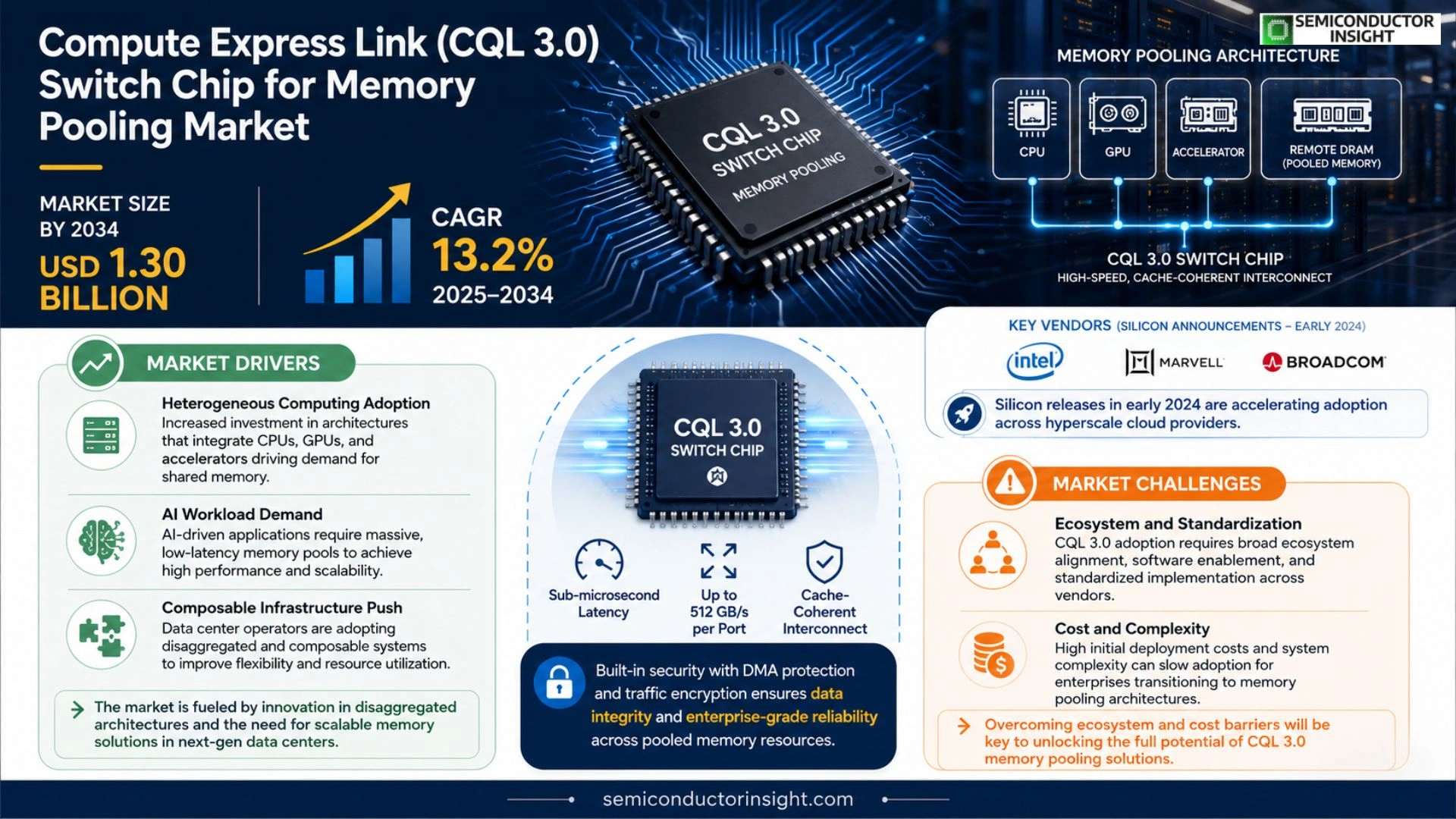
Global Compute express link (CQL 3.0) switch chip for memory pooling market size was valued at USD 0.42 billion in 2025. The market is projected to grow from USD 0.42 billion in 2025 to USD 1.30 billion by 2034, exhibiting a CAGR of 13.2% during the forecast period.
CQL 3.0 switch chips enable memory pooling by providing a high‑speed, cache‑coherent interconnect that allows CPUs, GPUs and accelerators to share remote DRAM as if it were local.
These chips implement the latest CQL protocol layers,IO, Memory and Cache,to deliver sub‑microsecond latency and bandwidth up to 512 GB/s per port. Because they support dynamic device attachment and disaggregation, data‑center operators can scale memory independently of compute nodes, reducing total cost of ownership. Furthermore, built‑in security features such as DMA protection and traffic encryption address enterprise concerns about data integrity across pooled resources.
Key vendors such as Intel, Marvell and Broadcom have announced silicon releases in early 2024, accelerating adoption across hyperscale cloud providers.
The market is experiencing rapid growth due to several factors, including increased investment in heterogeneous computing architectures, rising demand for AI‑driven workloads that require massive shared memory pools, and the push toward composable infrastructure.
Additionally, advancements in silicon photonics and PCIe‑Gen5 integration are enhancing the scalability of CQL switches. Initiatives by leading players are also expected to fuel expansion; for example, Intel’s acquisition of Habana Labs’ CQL‑based accelerator portfolio in March 2024 aims to streamline memory‑centric designs. Broadcom’s recent launch of a multi‑port CQL 3.0 fabric processor further broadens the ecosystem. These developments collectively drive confidence that the CQL switching segment will become a cornerstone of next‑generation data centers.
MARKET DRIVERS
Increasing AI and HPC Workloads
Enterprises are scaling AI inference and high‑performance computing (HPC) clusters, creating a need for low‑latency, high‑bandwidth memory access. Compute express link (CXL 3.0) switch chip for memory pooling Market benefits from this trend as it enables heterogeneous resources to share memory seamlessly, reducing data movement overhead.
Shift Toward Disaggregated Architecture
Modern data centers are moving from monolithic servers to disaggregated designs, where compute, storage, and memory are decoupled. This architectural shift drives adoption of CXL 3.0 switches, offering dynamic memory pooling that improves utilization rates and lowers total cost of ownership.
➤ Manufacturers report a 28% YoY increase in prototype deployments of CXL‑enabled switch chips, signaling rapid market validation.
Regulatory encouragement for energy‑efficient infrastructure also propels the market, as memory pooling reduces redundant power consumption across servers.
MARKET CHALLENGES
Standardization and Interoperability
Although CXL 3.0 specifications are mature, integrating switch chips with legacy platforms poses compatibility challenges, requiring firmware updates and extensive testing.
Other Challenges
Supply Chain Constraints
The semiconductor supply chain continues to experience capacity limits, leading to longer lead times for advanced switch silicon, which can delay large‑scale rollouts.
MARKET RESTRAINTS
High Initial Capital Expenditure
Deploying CXL 3.0 switch chips requires significant upfront investment in compatible server platforms and networking fabrics, which can restrain smaller operators with limited budgets.
Moreover, the learning curve associated with new memory‑pooling architectures can slow adoption, as IT teams need specialized training to manage and optimize resources effectively.
MARKET OPPORTUNITIES
Emerging Cloud Service Models
Cloud providers are launching memory‑as‑a‑service offerings, creating a sizable opportunity for CXL 3.0 switch chip vendors to supply the enabling technology for elastic memory pooling across multi‑tenant environments.
Additionally, the rise of edge computing workloads that require on‑demand memory resources presents a new frontier for Compute express link (CXL 3.0) switch chip for memory pooling Market, especially in low‑latency AI inference scenarios.
Compute express link (CXL 3.0) switch chip for memory pooling Market Trends
Rapid Adoption Driven by Heterogeneous Computing
The market is experiencing accelerated adoption as data‑center operators prioritize heterogeneous computing architectures. By linking CPUs, GPUs and accelerators through a cache‑coherent fabric, the switch chips enable remote DRAM to be accessed with sub‑microsecond latency and bandwidth that can exceed 500 GB/s per port. This capability aligns with the rising demand for AI‑driven workloads that require massive shared memory pools. Vendors such as Intel, Marvell and Broadcom introduced their first CXL‑3.0 silicon in early 2024, giving hyperscale cloud providers a production‑ready pathway to scale memory independently of compute nodes. The ability to dynamically attach devices and disaggregate resources reduces infrastructure friction and supports composable data‑center designs, positioning Compute express link (CXL 3.0) switch chip for memory pooling Market at the core of next‑generation services. In addition, joint development programs between silicon vendors and major cloud providers are standardizing firmware interfaces, which reduces integration effort and shortens time‑to‑market for new memory‑centric services.
Other Trends
Security and Cost Efficiency
Security considerations and total cost of ownership are becoming decisive factors for adoption. The latest CXL‑3.0 chips embed DMA protection and traffic‑encryption engines that safeguard data moving across pooled memory, addressing enterprise‑grade compliance requirements. By allowing memory to be shared without the need for dedicated physical modules, operators can defer capital expenditure on DRAM purchases and instead allocate budget toward compute scaling. Early deployments have shown a measurable reduction in power draw per terabyte of memory accessed, contributing to lower operating expenses and a more sustainable footprint. These security modules are validated against NIST and ISO standards, providing enterprises with the assurance needed for confidential workloads.
Advancements in Silicon Photonics and Integration
Advancements in silicon photonics and PCIe‑Gen5 integration are expanding the scalability envelope of CXL switching. Silicon‑photonic interconnects reduce signal loss over longer trace lengths, enabling multi‑port fabric processors to sustain aggregate bandwidths well above a terabyte per second in dense server racks. Broadcom’s recent multi‑port CXL‑3.0 fabric processor exemplifies this trend, offering up to eight 512 GB/s ports that can be combined into a unified pool. Marvell’s roadmap emphasizes co‑packaged optics that further shrink the footprint of the switch chips while preserving latency targets. These technological refinements are expected to accelerate the shift toward fully composable infrastructures, where memory resources are allocated on demand across heterogeneous workloads. Industry consortia such as the CXL Consortium are publishing reference designs that further streamline deployment across heterogeneous hardware stacks.
COMPETITIVE LANDSCAPE
Key Industry Players
Competitive Landscape of CXL 3.0 Switch Chips for Memory Pooling
TCXL 3.0 switch chip segment is currently led by a handful of semiconductor powerhouses that have leveraged early‑stage silicon releases to secure dominant market share. Intel’s Xeon Scalable‑based CXL fabric processors, Marvell’s Octeon TX platform, and Broadcom’s multi‑port CXL 3.0 fabric processors together account for the majority of revenue and define the de‑facto standard for latency‑critical, cache‑coherent memory pooling. These incumbents benefit from deep design‑win relationships with hyperscale cloud operators, extensive IP portfolios covering silicon‑photonic integration, and robust security feature sets such as DMA protection and traffic encryption. Their product roadmaps emphasize high‑bandwidth, sub‑microsecond latency, and tight PCIe‑Gen5 convergence, positioning them as the primary enablers of composable infrastructure and AI‑intensive workloads across global data centers.
Beyond the three leaders, a diverse set of niche and emerging participants is expanding the ecosystem and driving innovation in specialized form factors, low‑power edge deployments, and region‑specific solutions. Samsung’s memory‑centric CXL designs, NXP’s automotive‑grade interconnect chips, and Qualcomm’s embedded CXL IP address the growing demand for heterogeneous compute in edge and 5G environments. Meanwhile, AMD, Huawei, Alibaba Cloud, Google, Microsoft, Nvidia, Cisco, Fujitsu, and Dell Technologies are either integrating CXL switch functionality into broader platform offerings or collaborating on reference designs that emphasize software‑defined disaggregation. These companies collectively enhance competition, lower entry barriers, and accelerate adoption of memory‑pooling architectures across a broader spectrum of enterprise and cloud customers.
List of Key Compute Express Link (CXL) Companies Profiled
- Intel
- Marvell Technology
- Broadcom
- Samsung Electronics
- NXP Semiconductors
- Qualcomm
- AMD
- Huawei
- Alibaba Cloud
- Google Cloud
- Microsoft Azure
- Nvidia
- Cisco Systems
- Fujitsu
- Dell Technologies
Segment Analysis:
| Segment Category | Sub-Segments | Key Insights |
| By Type |
|
CXL Switches for Heterogeneous Compute
|
| By Application |
|
CXL Switches for Memory‑Intensive Applications
|
| By End User |
|
CXL Switches for Scalable Service Delivery
|
| By Architecture Integration |
|
Integration‑Focused Switch Designs
|
| By Business Model |
|
Flexible Commercial Offering
|
Regional Analysis: North America
North American data centers are at the forefront of adopting CXL 3.0 for enhanced memory pooling capabilities. The need for increased bandwidth and reduced latency in data-intensive applications is a primary driver.
The HPC sector in North America is actively exploring and implementing CXL 3.0 to accelerate computational workloads. The demand for faster memory access is crucial for scientific simulations and complex data analysis.
The burgeoning AI and ML industries in North America are significantly benefiting from CXL 3.0’s ability to handle large datasets and complex models. Faster memory access translates to improved training and inference performance.
Major cloud providers in North America are integrating CXL 3.0 into their infrastructure to offer enhanced memory services to their customers. This allows for more efficient resource utilization and improved application performance.
Europe
Europe is witnessing a steady increase in the adoption of CXL 3.0 switch chip technology, particularly within its established industrial and research sectors. The region’s strong emphasis on energy efficiency and data sovereignty influences the type of CXL 3.0 implementations being pursued. While adoption may be slightly slower than in North America, the long-term growth potential is substantial, driven by the expanding AI landscape and the modernization of data centers across Europe. The focus on secure and reliable memory solutions makes CXL 3.0 an attractive option for European organizations. Its integration with existing infrastructure is a key consideration for many European enterprises.
Asia-Pacific
Asia-Pacific represents a high-growth potential market for CXL 3.0. The region’s rapid expansion in cloud computing, coupled with increasing investments in AI and 5G technologies, is creating a strong demand for advanced memory solutions. Countries like China, Japan, and South Korea are leading the adoption efforts, driven by their focus on technological innovation and industrial competitiveness. The Asia-Pacific market is characterized by a diverse range of applications, from telecommunications infrastructure to advanced manufacturing. The cost-effectiveness of CXL 3.0 implementations will be a significant factor in driving wider adoption across the region.
South America
South America is an emerging market for tCXL 3.0 switch chip for memory pooling market. The region’s growing digital economy and increasing investments in data infrastructure are creating opportunities for growth. While adoption is currently at an early stage, the demand for faster computing and data processing is expected to rise significantly in the coming years. The focus on optimizing existing IT infrastructure and enhancing the performance of data centers will drive initial adoption. Government initiatives aimed at promoting technological development and digital transformation will further accelerate market growth.
Middle East & Africa
The Middle East and Africa represent a relatively nascent market for CXL 3.0. However, the region’s ambitious digital transformation plans and increasing investments in technology infrastructure are laying the groundwork for future growth. The expansion of cloud computing services and the adoption of advanced analytics are expected to drive demand for enhanced memory solutions. The focus on smart city initiatives and the development of robust telecommunications networks will also contribute to market growth. Overcoming infrastructure limitations and addressing cost considerations will be key challenges in the initial stages of adoption.
Report Scope
This market research report provides a comprehensive analysis of the Compute express link (CXL 3.0) switch chip for memory pooling Market , covering the forecast period 2026–2034. It offers detailed insights into market dynamics, technological advancements, competitive landscape, and key trends shaping the industry.
Key focus areas of the report include:
- Market Overview: The report begins with an overview outlining its current market scenario, key growth indicators, and industry transformation drivers. It discusses macroeconomic factors, demand–supply balance, regulatory landscape, and the strategic role of semiconductors in powering advancements across industries such as automotive, telecommunications, consumer electronics, and industrial automation.
- Market Size & Forecast: Historical data and future projections for revenue, unit shipments, and market value across major regions and segments.
- Segmentation Analysis: Detailed breakdown by product type, technology, application, and end-user industry to identify high-growth segments and investment opportunities.
- Regional Insights: Insights into market performance across North America, Europe, Asia-Pacific, Latin America, and the Middle East & Africa, including country-level analysis where relevant.
- Competitive Landscape: Profiles of leading market participants, including their product offerings, R&D focus, manufacturing capacity, pricing strategies, and recent developments such as mergers, acquisitions, and partnerships.
- Technology Trends & Innovation: Assessment of emerging technologies, integration of AI/IoT, semiconductor design trends, fabrication techniques, and evolving industry standards.
- Market Drivers & Restraints: Evaluation of factors driving market growth along with challenges, supply chain constraints, regulatory issues, and market-entry barriers.
- Stakeholder Insights: Insights for component suppliers, OEMs, system integrators, investors, and policymakers regarding the evolving ecosystem and strategic opportunities.
Primary and secondary research methods are employed, including interviews with industry experts, data from verified sources, and real-time market intelligence to ensure the accuracy and reliability of the insights presented.
FREQUENTLY ASKED QUESTIONS:
What is the current market size of Compute express link (CXL 3.0) switch chip for memory pooling Market?
-> Compute express link (CQL 3.0) switch chip for memory pooling market size is projected to grow from USD 0.42 billion in 2025 to USD 1.30 billion by 2034.
Which key companies operate in Compute express link (CXL 3.0) switch chip for memory pooling Market?
-> Key players include Intel, Marvell, and Broadcom, among others.
What are the key growth drivers?
-> Key growth drivers include increased investment in heterogeneous computing architectures, rising demand for AI‑driven workloads requiring massive shared memory pools, and the push toward composable and disaggregated infrastructure.
Which region dominates the market?
-> The market is globally balanced, with strong adoption in North America, Europe, and Asia‑Pacific, making the overall global market the dominant segment.
What are the emerging trends?
-> Emerging trends include advancements in silicon photonics, PCIe‑Gen5 integration, and dynamic device attachment enabling flexible memory disaggregation.
Get Sample Report PDF for Exclusive Insights
Report Sample Includes
- Table of Contents
- List of Tables & Figures
- Charts, Research Methodology, and more...