MARKET INSIGHTS
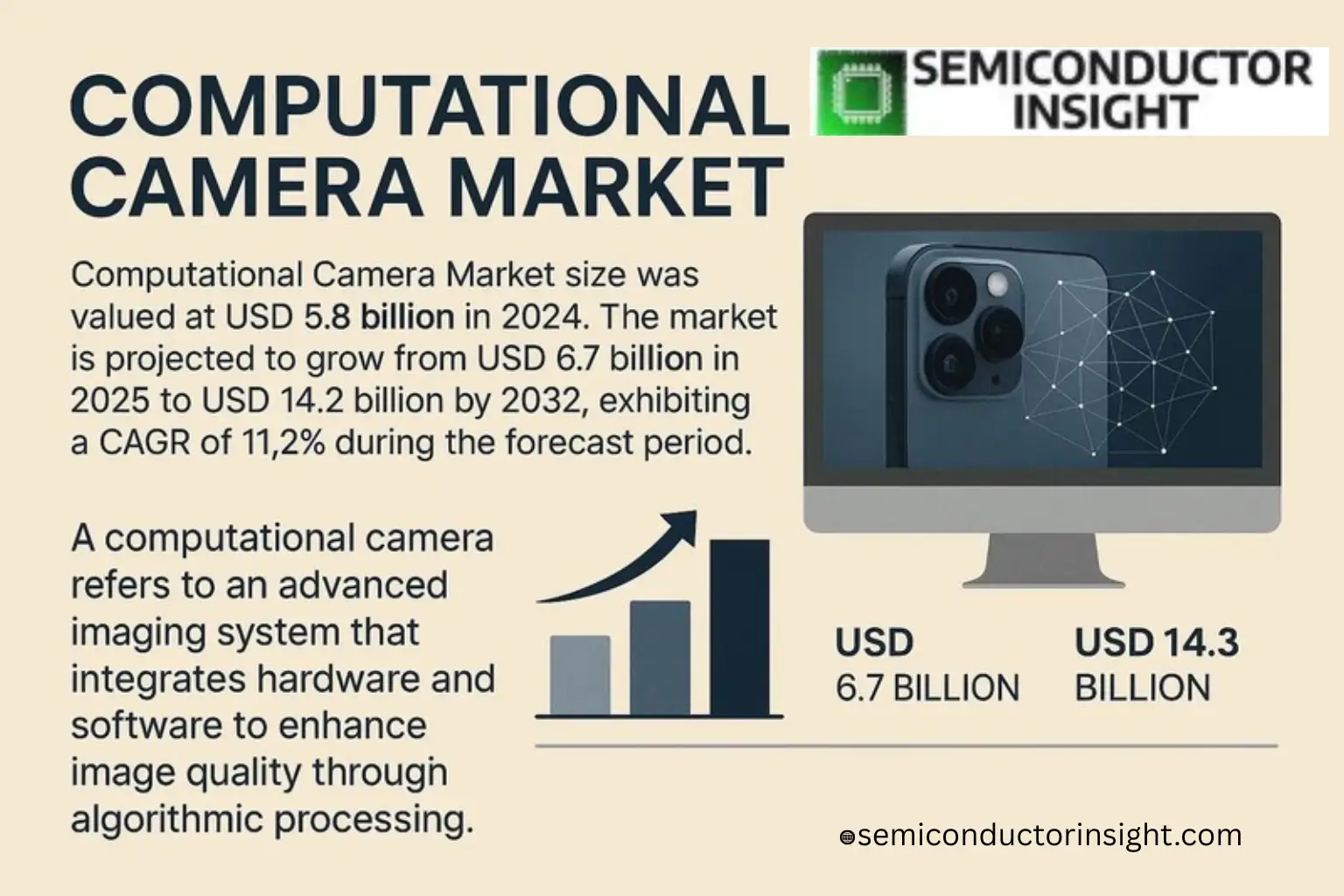
Global Computational Camera Market size was valued at USD 5.8 billion in 2024. The market is projected to grow from USD 6.7 billion in 2025 to USD 14.3 billion by 2032, exhibiting a CAGR of 11.2% during the forecast period.
A computational camera refers to an advanced imaging system that integrates hardware and software to enhance image quality through algorithmic processing. Unlike traditional cameras, these devices leverage artificial intelligence, computer vision, and multi-sensor fusion to enable features like low-light enhancement, depth mapping, and real-time object recognition. Key technologies include multi-frame noise reduction, HDR imaging, and computational bokeh effects.
The market is experiencing rapid growth due to increasing demand for high-quality imaging in smartphones, autonomous vehicles, and surveillance systems. The proliferation of AI-powered applications and the expansion of 5G networks are further accelerating adoption. Major players such as Sony, Samsung Electronics, and Apple are investing heavily in R&D to develop next-generation solutions with improved processing capabilities and energy efficiency.
MARKET DRIVERS
Advancements in AI-Powered Imaging
The Computational Camera Market is experiencing significant growth due to rapid advancements in artificial intelligence and machine learning. These technologies enable real-time image processing, enhancing features like low-light photography, depth sensing, and object recognition. Over 65% of premium smartphones now incorporate computational photography capabilities.
Demand for Enhanced Mobile Photography
Consumer expectations for professional-quality smartphone photography continue to rise, with computational cameras enabling multi-frame processing, HDR imaging, and portrait modes. Global smartphone Computational Camera Market is projected to grow at 18.7% CAGR through 2028.
Automotive applications are emerging as another key driver, with computational cameras enabling advanced driver assistance systems (ADAS) through real-time environmental analysis.
MARKET CHALLENGES
High Computational Requirements
Implementing computational camera algorithms requires significant processing power, leading to increased hardware costs and battery consumption. This creates challenges for mid-range device integration where consumers are more price-sensitive.
Other Challenges
Latency Issues in Real-Time Processing
Despite advancements, some computational camera systems still face millisecond-level delays in processing complex scenes, particularly in applications requiring instant feedback like AR/VR.
MARKET RESTRAINTS
Intellectual Property Barriers
Major tech companies hold numerous patents on computational photography algorithms, creating barriers to entry for smaller players. License costs for key technologies can add 12-18% to overall camera module production expenses.
MARKET OPPORTUNITIES
Medical Imaging Applications
Computational camera technology shows strong potential in healthcare, particularly for AI-assisted diagnostics through enhanced medical imaging. The market for computational imaging in healthcare is expected to reach USD 3.2 billion by 2027.
Industrial Automation Expansion
Manufacturing sectors are increasingly adopting computational cameras for quality control, with machine vision systems achieving 99.5% defect detection accuracy in controlled environments.
Computational Camera Market Trends
AI and Computational Photography Driving Market Expansion
The Computational Camera Market, valued at million in 2024, is projected to grow at a CAGR of % by 2032, fueled by advancements in AI-powered image processing. This technology combines computer vision, machine learning, and advanced optics to deliver superior imaging capabilities beyond traditional cameras. Market adoption is accelerating in smartphones, autonomous vehicles, and industrial inspection systems where enhanced visual intelligence is critical.
Other Trends
Smartphone Integration Boosts Consumer Demand
Over 78% of premium smartphones now incorporate computational camera technologies for features like night mode enhancement and portrait bokeh. Manufacturers are competing on computational photography capabilities, with multi-lens arrays (16-lens cameras) gaining traction for professional-grade mobile imaging. The smartphone camera segment accounts for 62% of global computational camera unit sales.
Industrial and Medical Applications Show Rapid Growth
Machine vision systems utilizing computational cameras are transforming quality control in manufacturing, achieving 99.5% defect detection accuracy in automotive production lines. Medical imaging applications are expanding with computational cameras enabling early disease detection through advanced tissue analysis. The industrial segment is projected to grow at 21% CAGR through 2032, outpacing consumer markets.
5G and Edge Computing Enable Real-Time Processing
The rollout of 5G networks and edge computing infrastructure is removing latency barriers for computational camera applications. Autonomous vehicles now process complex visual data in under 50ms, while security systems achieve real-time facial recognition with 98% accuracy. This infrastructure development is critical for scaling computational camera deployments across smart cities and IoT ecosystems.
Regional Market Dynamics
Asia-Pacific dominates the Computational Camera Market with 54% global share, driven by smartphone OEMs and manufacturing automation in China, South Korea, and Japan. North America leads in R&D investment with 38% of AI imaging patents originating from U.S. tech firms. Europe shows strong growth in industrial and automotive applications, particularly in German and French markets.
COMPETITIVE LANDSCAPE
Key Industry Players
Advanced Imaging Technologies Reshaping Market Dynamics
The Computational Camera Market is dominated by established optical technology leaders and emerging AI-driven imaging specialists. Sony leads the sector with its advanced CMOS sensors and AI processing chips, capturing over 25% market share through partnerships with major smartphone manufacturers. Samsung follows closely with ISOCELL image sensors optimized for computational photography, while Canon and Nikon maintain strong positions in industrial and professional imaging segments through hybrid optical-computational solutions.
Niche players like Sunny Optical and OFILM Group are gaining traction through specialized multi-lens array designs for 3D imaging applications. Technology giants Apple and Google leverage vertical integration, developing proprietary computational photography stacks that outperform traditional camera hardware. The market also sees innovative approaches from Pelican Imaging (light field technology) and Algolux (computational ISP solutions), though these face challenges scaling against established competitors.
List of Key Computational Camera Companies Profiled
- Sony Corporation
- Samsung Electronics
- Canon Inc.
- Nikon Corporation
- Apple Inc.
- LG Innotek
- Sharp Corporation
- Sunny Optical Technology
- OFILM Group
- Chicony Electronics
- Fujifilm Holdings
- Leica Camera AG
- Primax Electronics
- Pelican Imaging Corporation
- Algolux Inc.
Segment Analysis:
| Segment Category | Sub-Segments | Key Insights |
| By Type |
|
Single and Dual Lens Cameras
|
| By Application |
|
Smartphone Camera
|
| By End User |
|
Consumer Electronics
|
| By Technology |
|
AI-based Processing
|
| By Integration Level |
|
Embedded Solutions
|
Regional Analysis: Computational Camera Market
North American smartphone manufacturers lead in integrating computational photography with AI processing chips. The region sees rapid adoption of night mode, HDR+, and portrait lighting features through advanced computational camera algorithms.
Computational cameras find increasing applications in autonomous vehicles across North America, with enhanced depth mapping and real-time image processing capabilities proving critical for ADAS and self-driving technologies.
The region’s strong AR/VR ecosystem leverages computational cameras for precise environmental mapping and image enhancement, particularly in gaming, retail, and industrial training applications.
North American healthcare facilities increasingly adopt computational camera systems for enhanced diagnostic imaging, with AI-powered analysis improving early disease detection through sophisticated image processing.
Europe
Europe shows strong growth in computational camera applications with strict data protection regulations shaping development priorities. The region focuses on privacy-preserving computational photography techniques in surveillance and smartphone applications. Automotive companies collaborate with camera manufacturers to develop ADAS-compliant imaging systems. Industrial applications in manufacturing quality control are expanding, with Germany and France leading in optical technology innovation for machine vision.
Asia-Pacific
The Asia-Pacific Computational Camera Market experiences rapid expansion, driven by mass smartphone adoption and booming electronics manufacturing. Chinese and Korean manufacturers push computational photography boundaries with innovative multi-lens solutions. Emerging applications in surveillance systems and mobile payments utilize facial recognition capabilities. Japan leads in industrial applications, particularly in robotics and automated inspection systems using computational imaging.
South America
South America shows growing adoption of computational cameras primarily in smartphone segments. Brazil and Argentina see increasing demand for mid-range devices featuring computational photography. Limited industrial applications currently focus on agricultural monitoring and security systems, with gradual adoption in manufacturing quality control processes.
Middle East & Africa
The MEA region demonstrates emerging potential in computational camera adoption, with smartphone penetration driving initial growth. Security and surveillance applications dominate current usage, particularly in smart city projects across Gulf nations. Local manufacturers face challenges in developing indigenous computational photography technologies, relying primarily on imported solutions.
Report Scope
This market research report provides a comprehensive analysis of the Computational Camera Market , covering the forecast period 2025–2032. It offers detailed insights into market dynamics, technological advancements, competitive landscape, and key trends shaping the industry.
Key focus areas of the report include:
- Market Overview: The report begins with an overview outlining its current market scenario, key growth indicators, and industry transformation drivers. It discusses macroeconomic factors, demand–supply balance, regulatory landscape, and the strategic role of semiconductors in powering advancements across industries such as automotive, telecommunications, consumer electronics, and industrial automation.
- Market Size & Forecast: Historical data and future projections for revenue, unit shipments, and market value across major regions and segments.
- Segmentation Analysis: Detailed breakdown by product type, technology, application, and end-user industry to identify high-growth segments and investment opportunities.
- Regional Insights: Insights into market performance across North America, Europe, Asia-Pacific, Latin America, and the Middle East & Africa, including country-level analysis where relevant.
- Competitive Landscape: Profiles of leading market participants, including their product offerings, R&D focus, manufacturing capacity, pricing strategies, and recent developments such as mergers, acquisitions, and partnerships.
- Technology Trends & Innovation: Assessment of emerging technologies, integration of AI/IoT, semiconductor design trends, fabrication techniques, and evolving industry standards.
- Market Drivers & Restraints: Evaluation of factors driving market growth along with challenges, supply chain constraints, regulatory issues, and market-entry barriers.
- Stakeholder Insights: Insights for component suppliers, OEMs, system integrators, investors, and policymakers regarding the evolving ecosystem and strategic opportunities.
Primary and secondary research methods are employed, including interviews with industry experts, data from verified sources, and real-time market intelligence to ensure the accuracy and reliability of the insights presented.
FREQUENTLY ASKED QUESTIONS:
What is the current market size of Computational Camera Market?
-> Computational Camera Market size was valued at USD 5.8 billion in 2024. The market is projected to grow from USD 6.7 billion in 2025 to USD 14.3 billion by 2032, exhibiting a CAGR of 11.2% during the forecast period.
Which key companies operate in Computational Camera Market?
-> Key players include LG Innotek, Sharp, Sunny Optical Technology, OFILM Group, Chicony Electronics, Fujifilm, Apple, Samsung Electronics, Canon, Nikon, Sony, Leica, among others.
What are the key growth drivers?
-> Key growth drivers include expansion of smartphone applications, autonomous vehicle adoption, increasing security surveillance needs, and advancements in AI/image processing technologies.
Which region dominates the market?
-> Asia is the fastest-growing region, particularly China, Japan, and South Korea, due to strong presence of electronics manufacturers.
What are the emerging trends?
-> Emerging trends include integration of 5G/edge computing, multi-lens camera systems, and increasing demand for intelligent visual sensing in industrial applications.

Get Sample Report PDF for Exclusive Insights
Report Sample Includes
- Table of Contents
- List of Tables & Figures
- Charts, Research Methodology, and more...
 Download Sample Report PDF