MARKET INSIGHTS
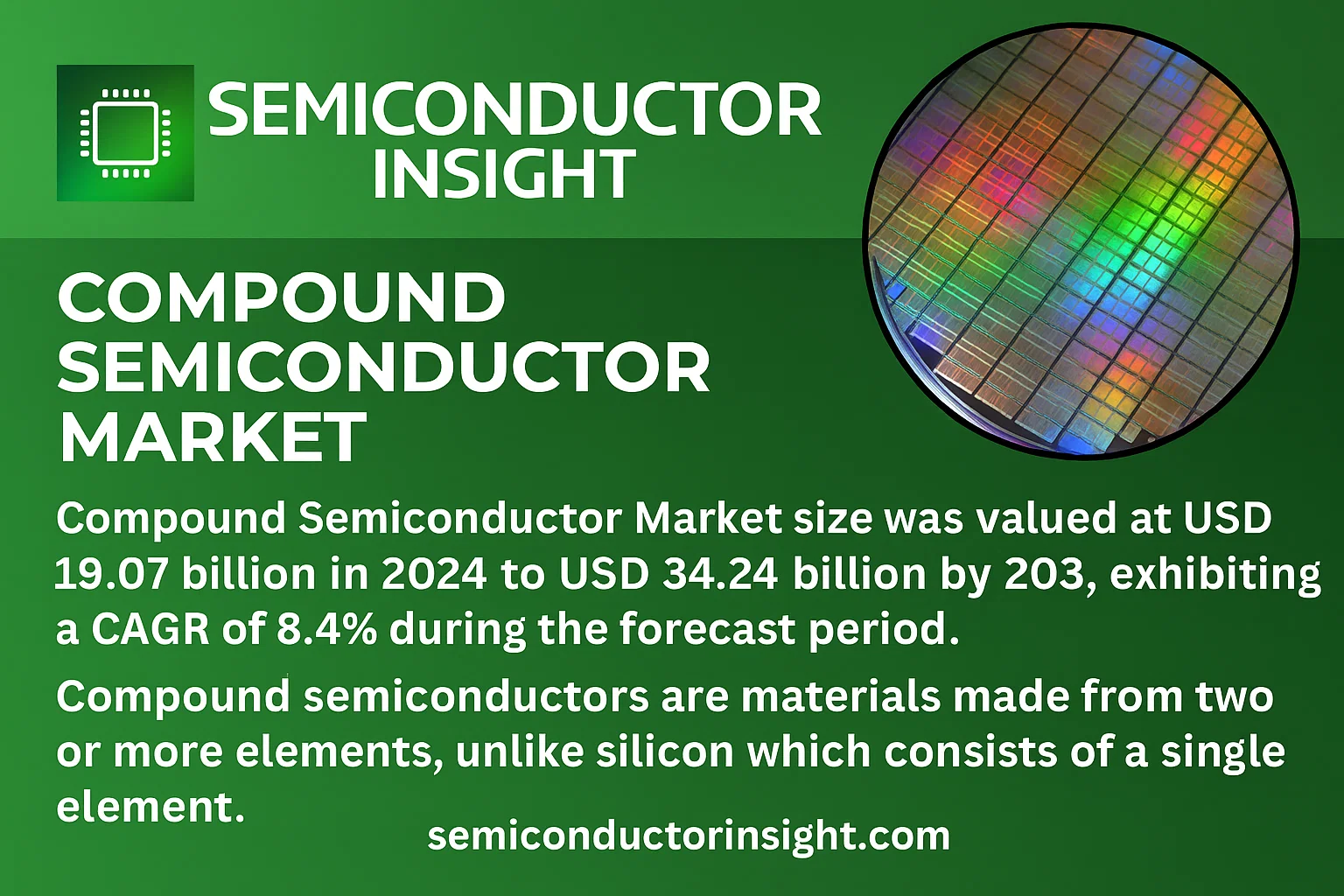
Global Compound Semiconductor Market size was valued at USD 19.07 billion in 2024 to USD 34.24 billion by 2032, exhibiting a CAGR of 8.4% during the forecast period.
Compound semiconductors are materials made from two or more elements, unlike silicon which consists of a single element. These advanced materials typically combine elements from Groups III and V of the Periodic Table (such as GaAs, GaP, InP) or Groups II and VI (including CdTe, ZnSe). It’s also possible to create compound semiconductors using different elements within the same group IV, such as silicon carbide (SiC).
The market is experiencing significant growth due to several factors, including increasing demand for high-performance electronic devices, expanding adoption of 5G technology, and growing requirements for energy-efficient power electronics. Additionally, the rising implementation of compound semiconductors in electric vehicles, renewable energy systems, and advanced communication technologies is contributing to market expansion. Initiatives by key industry players are also expected to fuel market growth; for instance, Wolfspeed continues to expand its SiC manufacturing capacity with new facilities in North Carolina and Germany. Infineon Technologies AG, STMicroelectronics N.V., Skyworks Solutions Inc., and Qorvo Inc. are some of the key players operating in the market with diverse product portfolios.
MARKET DRIVERS
Proliferation of 5G Infrastructure and Mobile Devices
Global deployment of 5G networks is a primary driver for the Compound Semiconductor Market, particularly for gallium nitride (GaN) and gallium arsenide (GaAs) components. These materials are essential for producing the high-frequency, high-power radio frequency (RF) amplifiers and power electronics required in 5G base stations and smartphones. The superior electron mobility of compound semiconductors compared to silicon enables higher efficiency and thermal performance, which is critical for the energy demands of next-generation connectivity.
Rising Demand for Energy-Efficient Power Electronics
Stringent global energy efficiency regulations and the transition to renewable energy sources are accelerating the adoption of compound semiconductors in power conversion systems. Silicon Carbide (SiC) and GaN power devices are increasingly used in electric vehicle (EV) inverters, industrial motor drives, and photovoltaic inverters. These materials significantly reduce energy loss, allowing for smaller, lighter, and more efficient systems, which is a key factor driving market growth.
Furthermore, the increasing integration of advanced sensing and imaging technologies in consumer electronics and automotive applications, such as LiDAR for autonomous driving and micro-LED displays, relies heavily on compound semiconductors like indium gallium arsenide (InGaAs) and indium phosphide (InP). This expanding application scope underpins sustained market expansion.
MARKET CHALLENGES
High Manufacturing Costs and Complex Fabrication
A significant challenge facing the Compound Semiconductor Market is the high cost of raw materials and the complex, expensive fabrication processes, such as metal-organic chemical vapor deposition (MOCVD). These processes require specialized equipment and controlled environments, leading to higher wafer costs compared to silicon. This cost disparity can hinder adoption in highly price-sensitive consumer markets.
Other Challenges
Supply Chain Constraints and Geopolitical Factors
The market is susceptible to supply chain disruptions for critical raw materials like gallium and indium, which are often by-products of other metal processing. Geopolitical tensions can impact the stable supply of these materials, creating volatility and potential bottlenecks for manufacturers.
Technological Competition from Advanced Silicon
While compound semiconductors hold performance advantages, continuous innovation in silicon-based technologies, such as silicon-on-insulator (SOI) and super-junction MOSFETs, presents strong competition. These silicon solutions are improving in high-frequency and power applications, challenging the value proposition of more expensive compound semiconductor alternatives.
MARKET RESTRAINTS
Economic Volatility and Capital-Intensive Nature
Global economic downturns and fluctuations in end-market demand can severely restrain the Compound Semiconductor Market. The capital expenditure required for establishing and scaling up fabrication facilities is exceptionally high. During periods of economic uncertainty, investment in new semiconductor manufacturing capacity often slows, delaying market growth and technological deployment.
Technical and Standardization Hurdles
The integration of compound semiconductors with existing silicon-based CMOS technology in complex systems poses significant technical challenges. Issues related to thermal management, reliability under high-stress conditions, and a lack of standardized manufacturing processes can act as barriers to widespread adoption, particularly in mission-critical automotive and aerospace applications.
MARKET OPPORTUNITIES
Expansion into Renewable Energy and Industrial Automation
Global push for decarbonization creates substantial opportunities for SiC and GaN in renewable energy systems. Their use in high-voltage direct current (HVDC) transmission, wind turbine converters, and smart grid infrastructure can dramatically improve overall system efficiency. Similarly, the growth of industrial automation and robotics drives demand for robust, high-performance power and RF components where compound semiconductors excel.
Emerging Applications in Quantum Computing and Photonics
Compound semiconductors are fundamental enablers for next-generation technologies. Materials like InP and GaAs are critical for photonic integrated circuits (PICs) used in data centers and optical communications. Furthermore, they are essential for developing qubits and other components in quantum computing systems, representing a frontier for long-term market growth beyond traditional electronics.
Compound Semiconductor Market Trends
Robust Market Growth Fueled by High-Performance Applications
Global Compound Semiconductor market is on a strong growth trajectory, with its value projected to surge from USD 19,070 million in 2024 to USD 34,240 million by 2032, representing a compound annual growth rate (CAGR) of 8.4%. This significant expansion is primarily driven by the escalating demand for advanced electronic devices, high-speed communication infrastructure, and energy-efficient power electronics. Unlike silicon, compound semiconductors are fabricated from two or more elements, such as Gallium Arsenide (GaAs) and Silicon Carbide (SiC), offering superior performance characteristics including higher efficiency, greater bandwidth, and better thermal conductivity.
Other Trends
Dominance of Gallium-Based Materials and Japanese Manufacturing
The market is segmented by material type, with Gallium Arsenide (GaAs), Gallium Nitride (GaN), Silicon Carbide (SiC), and Indium Phosphide (InP) being the primary categories. Geographically, Japan is the dominant production hub, accounting for nearly 25% of the global market, followed by North America with a 20% share. Key manufacturers such as Sumitomo Electric Industries, SCIOCS, and Mitsubishi Chemical collectively hold approximately 40% of the market, indicating a concentrated competitive landscape with significant influence from established Japanese players.
Application-Driven Expansion Across Key Segments
The application of compound semiconductors spans critical and growing sectors, including electronic components, photonic and optoelectronic devices, and integrated circuits. The demand in these areas is fueled by the continuous innovation in consumer electronics, the global rollout of 5G networks, the adoption of electric vehicles, and the need for renewable energy solutions. This broad applicability across high-growth industries ensures a sustained and diversified demand base, positioning the Compound Semiconductor Market for long-term, robust expansion as it continues to enable next-generation technological advancements.
COMPETITIVE LANDSCAPE
Key Industry Players
A Market Characterized by Material and Application Specialization
Global Compound Semiconductor Market is highly competitive and fragmented, with a diverse set of players specializing in different material types such as Gallium Arsenide (GaAs), Gallium Nitride (GaN), and Silicon Carbide (SiC). Japan is the largest production hub, with key manufacturers including Sumitomo Electric Industries and Mitsubishi Electric, which collectively hold a significant portion of the market share. The competitive environment is shaped by technological innovation, strategic partnerships, and continuous R&D investments to enhance material performance for applications ranging from high-frequency RF devices to power electronics and optoelectronics. Leading players like Infineon, STMicroelectronics, and Wolfspeed (Cree) dominate the power semiconductor segment, particularly in SiC and GaN technologies, which are critical for electric vehicles and renewable energy systems.
Beyond the dominant global leaders, numerous other companies have carved out strong positions in niche segments. Companies like IQE and Soitec are pivotal in the supply of high-quality semiconductor epitaxial wafers, which are the foundation for many compound semiconductor devices. In the RF components space, Qorvo and Skyworks Solutions are major forces. The market also features a growing number of specialized Chinese manufacturers, such as San’an Optoelectronics and China Resources Microelectronics, who are rapidly expanding their capabilities and market presence, particularly in the optoelectronic and consumer electronics segments, intensifying competition on a global scale.
List of Key Compound Semiconductor Companies Profiled
- STMicroelectronics
- Infineon Technologies AG
- Wolfspeed, Inc.
- ROHM Co., Ltd.
- onsemi
- BYD Semiconductor Co., Ltd.
- Microchip Technology Inc. (Microsemi)
- Mitsubishi Electric Corporation (Vincotech)
- Fuji Electric Co., Ltd.
- Navitas Semiconductor (GeneSiC)
- IQE plc
- Soitec (EpiGaN)
- Sumitomo Electric Device Innovations (SEDI)
- Qorvo, Inc. (UnitedSiC)
- San’an Optoelectronics Co., Ltd.
Segment Analysis:
| Segment Category | Sub-Segments | Key Insights |
| By Type |
|
Gallium Nitride (GaN) is demonstrating significant traction as a leading segment, driven by its superior performance in high-frequency and high-power applications. Its inherent material properties enable more energy-efficient and compact power electronics, which are critical for modern consumer devices and electric vehicle power systems. The ongoing transition towards 5G infrastructure and the demand for fast-charging solutions further solidify GaN’s prominent position. Concurrently, Silicon Carbide (SiC) is experiencing robust growth due to its critical role in high-temperature and high-voltage industrial applications, particularly within the renewable energy and automotive sectors, where its thermal conductivity and efficiency advantages are paramount. |
| By Application |
|
Integrated Circuit applications represent the most dynamic and expansive segment, fueled by the pervasive need for high-speed data processing and advanced computing capabilities. Compound semiconductors are indispensable for manufacturing high-electron-mobility transistors and monolithic microwave integrated circuits that are the backbone of telecommunications, radar systems, and data centers. The Optoelectronic Devices segment is also a major growth area, underpinned by the expanding deployment of light-emitting diodes for general lighting and displays, as well as the crucial role of laser diodes in fiber-optic communication networks and consumer electronics like smartphone facial recognition systems. |
| By End User |
|
Telecommunications & IT stands as the dominant end-user segment, with compound semiconductors being fundamental to the rollout and operation of 5G networks, satellite communications, and high-speed data centers. The Automotive & Transportation sector is rapidly emerging as a critical growth driver, where the adoption of electric vehicles and advanced driver-assistance systems creates intense demand for efficient power management and robust sensing solutions. The relentless innovation in Consumer Electronics, including smartphones, laptops, and wearable devices, continually pushes the boundaries for smaller, faster, and more power-efficient components, securing its position as a consistently high-volume end-user. |
| By Material Property |
|
Wide Bandgap Semiconductors are the unequivocal leaders in this categorization, as materials like GaN and SiC offer exceptional advantages for high-power, high-temperature, and high-frequency operations that are beyond the capabilities of traditional silicon. Their superior thermal stability and efficiency are revolutionizing power conversion systems. The significance of Direct Bandgap Semiconductors is also paramount, particularly for optoelectronic applications such as LEDs and laser diodes, where efficient light emission is a critical functional requirement, making them indispensable for lighting, displays, and optical communication technologies. |
| By Fabrication Technology |
|
Metal-Organic Chemical Vapor Deposition (MOCVD) is the predominant fabrication technology, extensively used for mass production of high-quality epi-wafers for devices like LEDs and power semiconductors due to its excellent throughput and scalability. Meanwhile, Molecular Beam Epitaxy (MBE) maintains a crucial role in research, development, and the manufacture of highly specialized devices requiring ultra-pure and precise atomic-layer control, such as those used in advanced photonic and quantum computing applications. The choice of technology is heavily influenced by the required material quality, layer complexity, and the specific performance demands of the end application. |
Regional Analysis: Compound Semiconductor Market
The region’s dominance is underpinned by its unparalleled semiconductor fabrication capabilities. It hosts the world’s foremost foundries and epitaxial wafer producers specializing in compound materials like GaN and silicon carbide (SiC). This concentrated expertise allows for rapid scaling of production to meet the high-volume demands of consumer electronics and automotive industries, creating a significant competitive advantage in terms of both cost and supply chain reliability for global markets.
The aggressive deployment of 5G infrastructure across the region is a primary growth driver. Compound semiconductors are critical for the power amplifiers and base station components required for high-frequency 5G networks. Countries like China, South Korea, and Japan are at the forefront, creating immense, sustained demand for RF semiconductors, which in turn stimulates further research, development, and investment in advanced compound semiconductor technologies within the region.
Being the global center for consumer electronics manufacturing, the region generates massive demand for compound semiconductors used in fast chargers, displays, and sensors. Simultaneously, the burgeoning electric vehicle markets in China and Japan are accelerating the adoption of SiC power devices for efficient power conversion and motor drives. This dual demand from two major industries creates a resilient and diversified market base.
Proactive government policies and substantial state-backed investments are crucial to the region’s leadership. Initiatives aimed at achieving technological sovereignty and reducing dependency on foreign semiconductor technology have led to the creation of specialized industrial parks, research grants, and partnerships between academia and industry, fostering a highly conducive environment for innovation and commercial-scale production of compound semiconductors.
North America
North America represents a highly innovative and technologically advanced market for compound semiconductors, characterized by strong research institutions and a focus on cutting-edge applications. The United States is a key player, with significant activity in defense and aerospace sectors where the high-frequency and high-power capabilities of GaN and SiC are critical for radar systems, electronic warfare, and satellite communications. The region also boasts a vibrant ecosystem of fabless semiconductor companies and integrated device manufacturers that pioneer new designs. Furthermore, the push for data center efficiency and the development of autonomous vehicle technologies are creating substantial demand for advanced power management and sensing solutions based on compound semiconductors, ensuring the region remains a critical center for high-value innovation.
Europe
The European Compound Semiconductor Market is distinguished by its strong automotive industry and strategic focus on research and sustainability. Germany, in particular, drives demand for SiC power electronics through its leading automotive manufacturers who are rapidly electrifying their vehicle fleets, requiring highly efficient power modules. The region benefits from collaborative research initiatives like the European Union’s Joint Undertaking, which funds projects to advance GaN and SiC technologies. There is also a growing emphasis on renewable energy applications, where compound semiconductors are used in high-efficiency solar inverters and wind turbine systems. This combination of established industrial strength and a forward-looking regulatory environment supports a stable and specialized market.
South America
The Compound Semiconductor Market in South America is still in a nascent stage of development but shows potential for growth, primarily driven by gradual telecommunications upgrades and specific industrial applications. Brazil is the most significant market, where investments in modernizing communication infrastructure are slowly creating demand for RF components. The mining industry also presents a niche application for robust sensing and power electronics in harsh environments. However, market growth is tempered by economic volatility and comparatively lower levels of local manufacturing and R&D investment, making the region largely dependent on imports and limiting its current scale within the global landscape.
Middle East & Africa
The Middle East and Africa region exhibits a diverse but fragmented market for compound semiconductors. In the Middle East, wealthier Gulf nations are investing in smart city projects, telecommunications infrastructure, and diversification away from oil, which creates opportunities for optoelectronics in displays and sensors, as well as power devices for new industrial applications. In Africa, the market is largely untapped, with growth potential linked to the expansion of mobile networks and basic electrification projects. The region overall faces challenges related to a lack of local manufacturing base and technical expertise, but strategic investments in specific countries point to a slowly emerging, long-term opportunity.
Report Scope
This market research report provides a comprehensive analysis of the Compound Semiconductor Market , covering the forecast period 2025–2032. It offers detailed insights into market dynamics, technological advancements, competitive landscape, and key trends shaping the industry.
Key focus areas of the report include:
- Market Overview: The report begins with an overview outlining its current market scenario, key growth indicators, and industry transformation drivers. It discusses macroeconomic factors, demand–supply balance, regulatory landscape, and the strategic role of semiconductors in powering advancements across industries such as automotive, telecommunications, consumer electronics, and industrial automation.
- Market Size & Forecast: Historical data and future projections for revenue, unit shipments, and market value across major regions and segments.
- Segmentation Analysis: Detailed breakdown by product type, technology, application, and end-user industry to identify high-growth segments and investment opportunities.
- Regional Insights: Insights into market performance across North America, Europe, Asia-Pacific, Latin America, and the Middle East & Africa, including country-level analysis where relevant.
- Competitive Landscape: Profiles of leading market participants, including their product offerings, R&D focus, manufacturing capacity, pricing strategies, and recent developments such as mergers, acquisitions, and partnerships.
- Technology Trends & Innovation: Assessment of emerging technologies, integration of AI/IoT, semiconductor design trends, fabrication techniques, and evolving industry standards.
- Market Drivers & Restraints: Evaluation of factors driving market growth along with challenges, supply chain constraints, regulatory issues, and market-entry barriers.
- Stakeholder Insights: Insights for component suppliers, OEMs, system integrators, investors, and policymakers regarding the evolving ecosystem and strategic opportunities.
Primary and secondary research methods are employed, including interviews with industry experts, data from verified sources, and real-time market intelligence to ensure the accuracy and reliability of the insights presented.
FREQUENTLY ASKED QUESTIONS:
What is the current market size of Compound Semiconductor Market?
-> Compound Semiconductor Market size was valued at USD 19.07 billion in 2024 to USD 34.24 billion by 2032, exhibiting a CAGR of 8.4% during the forecast period.
Which key companies operate in Compound Semiconductor Market?
-> Key players include Sumitomo Electric Industries, SCIOCS, Mitsubishi Chemical, Dow Corning, Shin-Etsu Chemical, among others.
What are the key growth drivers?
-> Key growth drivers include increasing demand for advanced electronic devices, high-speed communication technologies, and energy-efficient power electronics.
Which region dominates the market?
-> Japan is the largest producer with a market share of nearly 25%, followed by North America with 20%.
What are the emerging trends?
-> Emerging trends include technological advancements and increasing applications across various industries, particularly in high-performance, energy-efficient, and compact electronic devices.

Get Sample Report PDF for Exclusive Insights
Report Sample Includes
- Table of Contents
- List of Tables & Figures
- Charts, Research Methodology, and more...
 Download Sample Report PDF